NASA to Preview US Spacewalks at Space Station in January

NASA to Preview US Spacewalks at Space Station in January
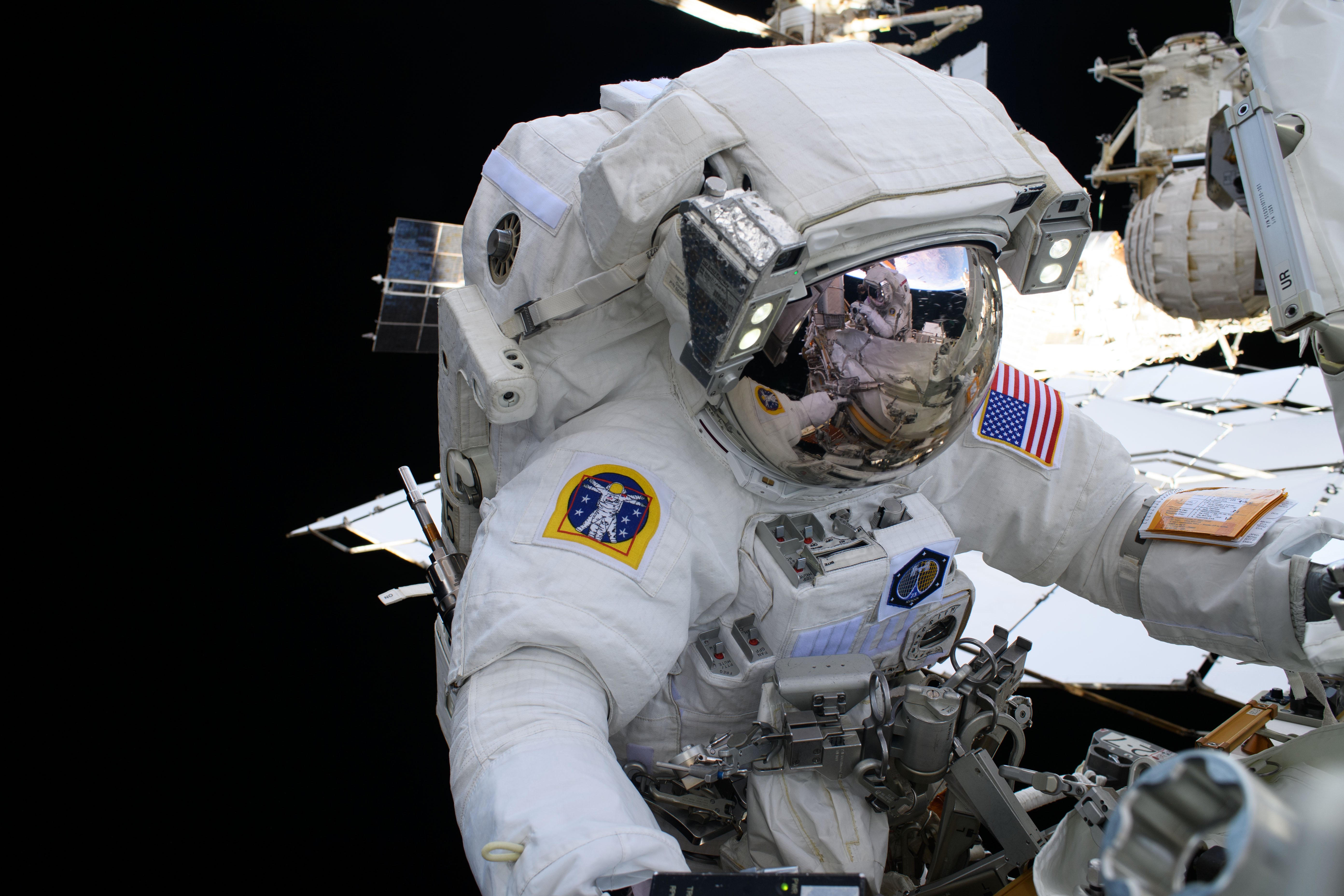
NASA astronaut and Expedition 72 Flight Engineer Nichole Ayers is pictured during a spacewalk to upgrade the orbital outpost’s power generation system and relocate a communications antenna.
Credit: NASA

NASA astronauts will conduct a pair of spacewalks in January outside of the International Space Station to prepare for the installation of a roll-out solar array and complete other tasks. Experts from NASA will preview the spacewalks in a briefing at 2 p.m. EST Tuesday, Jan. 6, at NASA’s Johnson Space Center in Houston.

Watch NASA’s live coverage of the news conference on the agency’s YouTube channel. Learn how to stream NASA content through a variety of online platforms, including social media.

Participants include:

  • Bill Spetch, operations integration manager, International Space Station Program
  • Diana Trujillo, spacewalk flight director, Flight Operations Directorate
  • Heidi Brewer, spacewalk flight director, Flight Operations Directorate

Media interested in participating in person or by phone must contact the NASA Johnson newsroom no later than 10 a.m., Monday, Jan. 5, by calling 281-483-5111 or emailing jsccommu@mail.nasa.gov. To ask questions by phone, reporters must dial into the news conference no later than 15 minutes prior to the start of the call. Questions may also be submitted on social media using #AskNASA. NASA’s media accreditation policy is available online.

On Thursday, Jan. 8, NASA astronauts Mike Fincke and Zena Cardman will exit the station’s Quest airlock to prepare the 2A power channel for future installation of International Space Station Roll-Out Solar Arrays. Once installed, the array will provide additional power for the orbital laboratory, including critical support of its safe and controlled deorbit. This spacewalk will be Cardman’s first and Fincke’s 10th, tying him for the most spacewalks by a NASA astronaut.

On Thursday, Jan. 15, two NASA astronauts will replace a high-definition camera on camera port 3, install a new navigational aid for visiting spacecraft, called a planar reflector, on the Harmony module’s forward port, and relocate an early ammonia servicer jumper — a flexible hose assembly that connects parts of a fluid system — along with other jumpers on the station’s S6 and S4 truss.

NASA will announce the astronauts planned for the second spacewalk and start times for both events closer to the operations.

The spacewalks will be the 278th and 279th in support of space station assembly, maintenance and upgrades. They also are the first two International Space Station spacewalks of 2026, and the first by Expedition 74.

Learn more about International Space Station research and operations at:

https://www.nasa.gov/station

-end-

Josh Finch / Jimi Russell
Headquarters, Washington
202-358-1100
joshua.a.finch@nasa.gov / james.j.russell@nasa.gov

Sandra Jones / Joseph Zakrzewski
Johnson Space Center, Houston
281-483-5111
sandra.p.jones@nasa.gov / joseph.a.zakrzewski@nasa.gov

Share

Details

Last Updated

Dec 29, 2025

Powered by WPeMatico

Get The Details…
Lauren E. Low
A Galactic Embrace

A Galactic Embrace

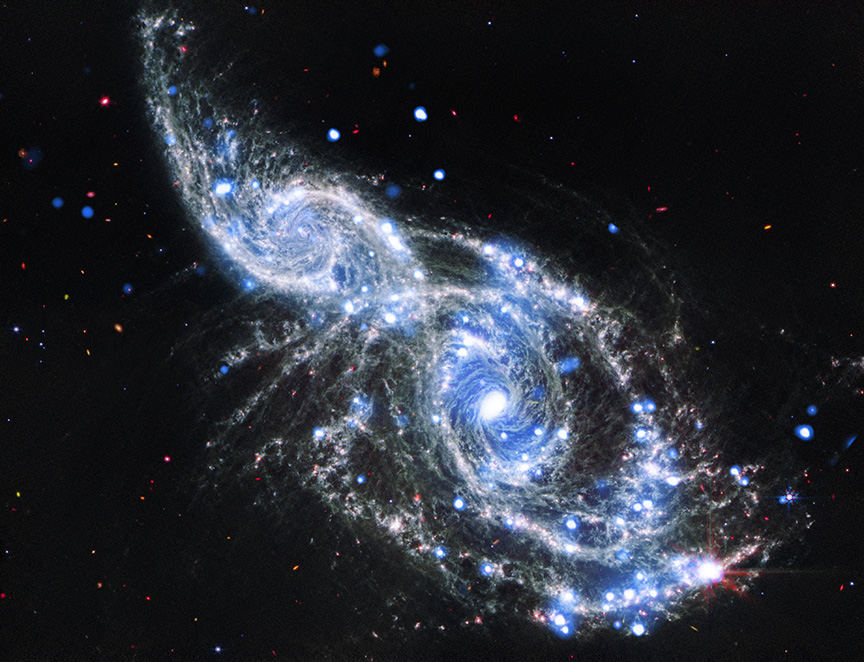
A pair of colliding spiral galaxies. Here, both spirals are shown face on, with the smaller of the two galaxies, IC 2163, at the upper left of the larger galaxy, NGC 2207, which dominates the center and lower right of the image. Both galaxies have long, spiraling, silver blue arms, dotted with specs of blue and red. Toward our upper left, the curving arms overlap, and bend toward their neighbors' core. James Webb mid-infrared image (white, gray, and red) and adds the X-ray view from Chandra (blue).
X-ray: NASA/CXC/SAO; Infrared: NASA/ESA/CSA/STScI/Webb; Image Processing: NASA/CXC/SAO/L. Frattare

Mid-infrared data from NASA’s James Webb Space Telescope (in white, gray, and red) and X-ray data from NASA’s Chandra X-ray Observatory (in blue) come together in this photo of colliding spiral galaxies released on Dec. 1, 2025. The pair grazed one another millions of years ago; billions of years in the future, they will merge into a single galaxy.

Image credit: X-ray: NASA/CXC/SAO; Infrared: NASA/ESA/CSA/STScI/Webb; Image Processing: NASA/CXC/SAO/L. Frattare

Powered by WPeMatico

Get The Details…
Monika Luabeya

I Am Artemis: Jen Madsen and Trey Perryman

I Am Artemis: Jen Madsen and Trey Perryman

3 Min Read

I Am Artemis: Jen Madsen and Trey Perryman

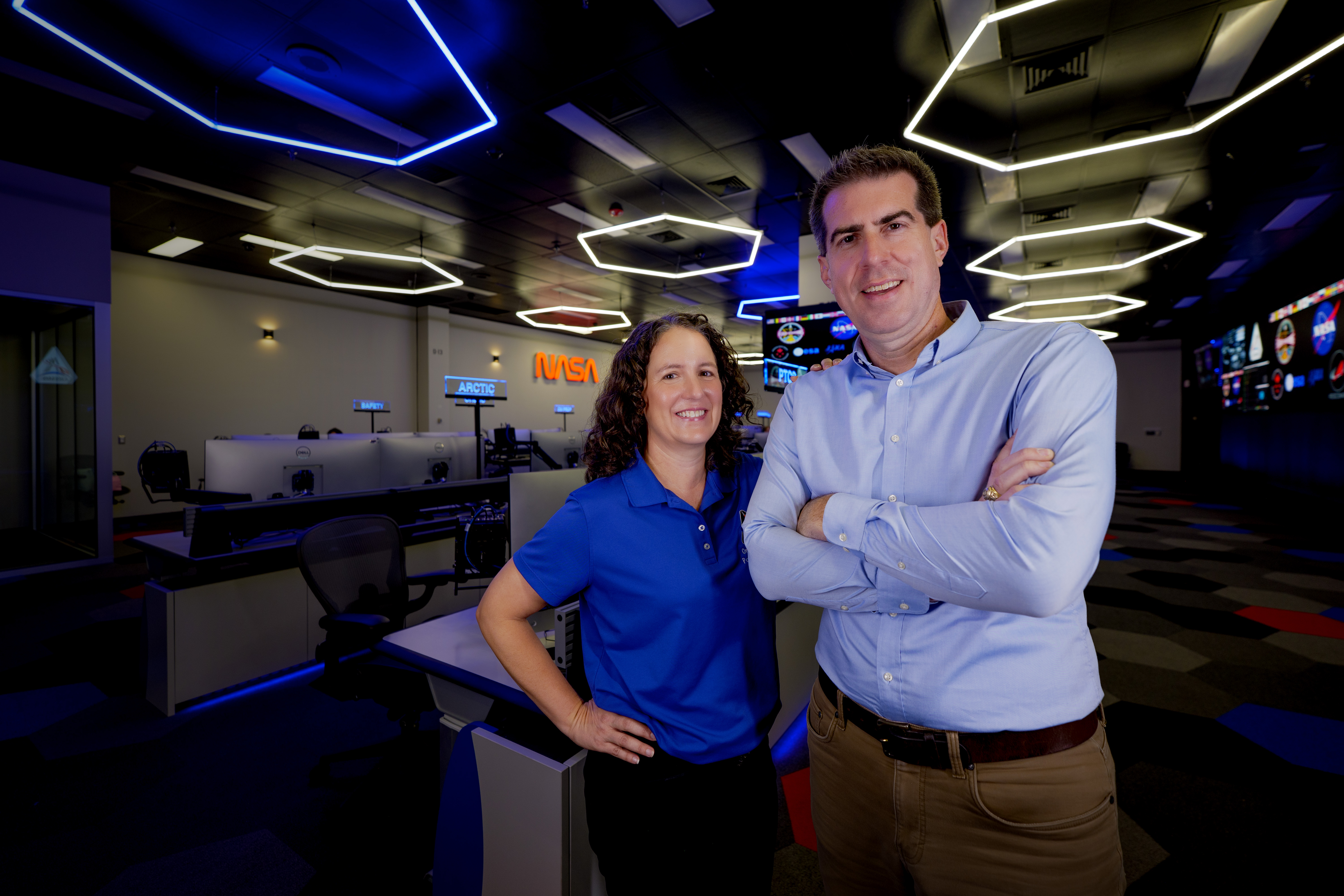
Artemis II Orion Mission Evaluation Room Leads Jen Madsen and Trey Perryman stand in the Orion Mission Evaluation Room in the Mission Control Center at NASA’s Johnson Space Center in Houston.

Credits:
NASA/Rad Sinyak

Listen to this audio excerpt from Jen Madsen and Trey Perryman, leads of the Orion Mission Evaluation Room for the Artemis II mission:

0:00 / 0:00

During NASA’s Artemis II mission, Jen Madsen and Trey Perryman will be leading a team monitoring the Orion spacecraft as it carries four astronauts around the Moon. The team works in the Orion Mission Evaluation Room where they will monitor and analyze Orion’s systems and performance in real time to help ensure crew safety and mission success.

As the leaders of the Orion Mission Evaluation Room located inside the Mission Control Center at NASA’s Johnson Space Center in Houston, Madsen and Perryman are responsible for ensuring that the dozens of NASA, Lockheed Martin, ESA (European Space Agency), and Airbus expert engineers that staff the room’s consoles are ready for Artemis II.

Jen and I are responsible for the organization, training, and execution of the entire team. We’ll also play a key role in communicating the findings of the Mission Evaluation Room to our program and agency leadership.

Trey Perryman

Trey Perryman

Lead for Orion Mission and Systems Integration

The flight control team operating Orion from mission control’s White Flight Control Room will rely on the Mission Evaluation Room’s crucial findings to help with unexpected spacecraft behaviors that may arise and help analyze Orion’s performance data during the mission.

With crew aboard Orion, Artemis II brings new challenges, new opportunities, and a new space in mission control for the Orion Mission Evaluation Room. More spacecraft systems will be put to the test, requiring more evaluation room expertise and new consoles to monitor systems not previously flown, like life support.

“There’s loads of excitement — for the new capabilities, the mission, and having a new, wonderful space to operate in,” said Perryman.

Besides leading the Mission Evaluation Room, Perryman is also the lead for Orion Mission and Systems Integration, and Madsen is deputy manager for Orion’s Avionics, Power, and Software. Their co-leadership styles complement each other — Perryman leads with energy and team spirit, while Madsen brings a steadiness and structure.

Artemis II Orion Mission Evaluation Room Leads Jen Madsen and Trey Perryman stand in the Orion Mission Evaluation Room in the Mission Control Center at NASA’s Johnson Space Center in Houston.
NASA/Rad Sinyak

“We balance each other out,” Madsen said. “And that balance is reflected in our team.”

For Perryman, a former flight controller with a background in space shuttle and space station operations, the MER represents the culmination of a career in human spaceflight that’s personal.

“I couldn’t imagine being anywhere else right now,” Perryman said. “My wife and I have four boys, and my boys are very excited about Artemis…that’s meaningful to me. And they like seeing a father who’s really connected to this mission.”

Madsen began her NASA career in engineering, designing and simulating Orion’s guidance, navigation, and control systems early on in the program.

I spent many years doing computer simulations, writing code, doing analysis… we designed, built, and tested Orion. So now it’s amazing to me to get to be a part of the legacy of operating the vehicle.

Jen Madsen

Jen Madsen

Deputy Manager for Orion’s Avionics, Power, and Software

For both leaders, the Artemis II mission is more than technical. With crew flying aboard the spacecraft, it’s deeply human.

“I do feel an extra sense of importance and mindfulness about what we’re doing in this building,” Perryman said,  “making sure — specifically in the Orion MER — that we understand how the vehicle supports the crew, because it is so important to return them home safely.”

“We all feel like Reid, Victor, Christina, and Jeremy are part of the Orion family,” Madsen said. “When we have discussions about risk, from design all the way through operations, we’re thinking about our friends aboard the spacecraft.”

About the Author

Erika Peters

Erika Peters

Share

Details

Last Updated

Dec 22, 2025

Powered by WPeMatico

Get The Details…
Erika Peters

Studying Physics in Microgravity

Studying Physics in Microgravity

Tiny silver ball bearings crowd around a larger bearing in a clear, viscous fluid. Some of the smaller ball bearings are suspended in the fluid.
NASA/Zena Cardman

In this Oct. 20, 2025, photo, tiny ball bearings surround a larger central bearing during the Fluid Particles experiment, conducted inside the Microgravity Science Glovebox (MSG) aboard the International Space Station’s Destiny laboratory module. A bulk container installed in the MSG, filled with viscous fluid and embedded particles, is subjected to oscillating frequencies to observe how the particles cluster and form larger structures in microgravity. Insights from this research may advance fire suppression, lunar dust mitigation, and plant growth in space. On Earth, the findings could inform our understanding of pollen dispersion, algae blooms, plastic pollution, and sea salt transport during storms.

In addition to uncovering potential benefits on Earth, research done aboard the space station helps inform long-duration missions like Artemis and future human expeditions to Mars.

Image credit: NASA/Zena Cardman

Powered by WPeMatico

Get The Details…
Monika Luabeya

Santa Visits Artemis II Rocket

Santa Visits Artemis II Rocket

A man with a big white beard wearing a blue Santa costume with Artemis and NASA patches points to his hat. The Artemis II SLS and Orion spacecraft are In the background.
NASA/Adeline Morgan

Santa Claus (NASA engineer Guy Naylor) poses with NASA’s Artemis II Orion spacecraft and SLS (Space Launch System) rocket in the Vehicle Assembly Building at NASA’s Kennedy Space Center in Florida on Dec. 11, 2025. The Orion spacecraft was stacked atop the SLS in October 2025.

Set to launch in early 2026, the Artemis II test flight will be NASA’s first mission with crew under Artemis. Astronauts on their first flight aboard Orion will confirm all the spacecraft’s systems operate as designed with crew aboard in the actual environment of deep space. Through the Artemis campaign, NASA will send astronauts to explore the Moon for scientific discovery, economic benefits, and to build the foundation for the first crewed missions to Mars – for the benefit of all.

Image credit: NASA/Adeline Morgan

Powered by WPeMatico

Get The Details…
Monika Luabeya