NASA to Host a Pair of Briefings for Starliner Crew Flight

NASA to Host a Pair of Briefings for Starliner Crew Flight
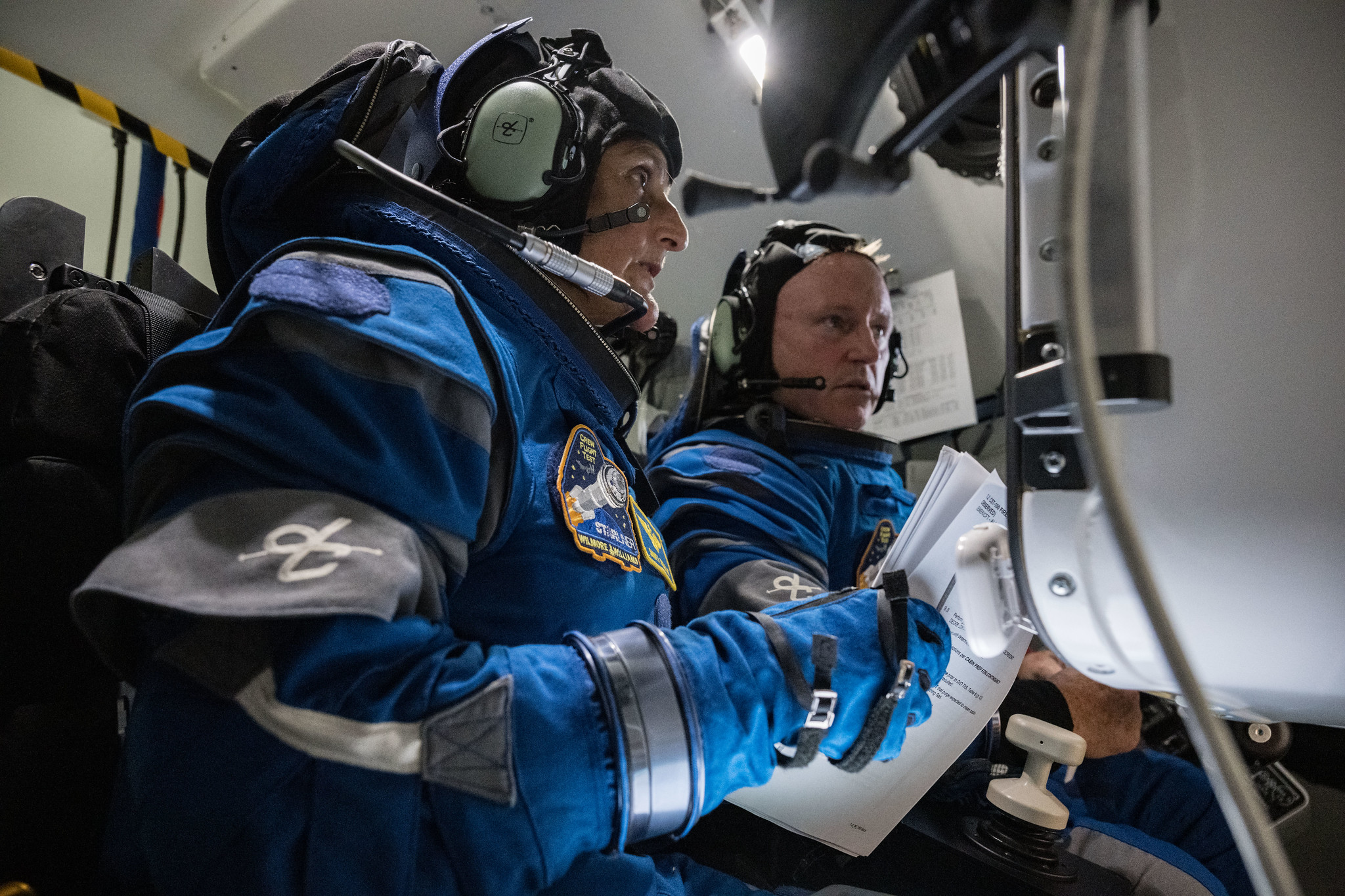
NASA’s Boeing Crew Flight Test Astronauts Butch Wilmore and Suni Williams prepare for their mission in the company’s Starliner spacecraft simulator at the agency’s Johnson Space Center in Houston.
Credits: NASA/Robert Markowitz

NASA will host two media opportunities on Thursday, April 25, in preparation for the agency’s Boeing Crew Flight Test to the International Space Station. The mission is targeting launch at 10:34 p.m. EDT on Monday, May 6, from Space Launch Complex-41 at Cape Canaveral Space Force Station in Florida.

NASA astronauts Butch Wilmore and Suni Williams will lift off aboard Boeing’s Starliner spacecraft on a United Launch Alliance Atlas V rocket and dock at the orbiting laboratory, where they will stay for about a week.

As part of the agency’s Commercial Crew Program, the mission is the first crewed flight for the Starliner spacecraft. The mission will test the end-to-end capabilities of the Starliner system, including launch, docking, and return to Earth in the western United States. Following a successful crewed flight test, NASA will begin the final process of certifying Starliner and systems for crewed missions to the space station.

The deadline for media accreditation for in-person coverage of this launch has passed. The agency’s media credentialing policy is available online. For questions about media accreditation, please email: ksc-media-accreditat@mail.nasa.gov.

NASA’s coverage is as follows (all times Eastern and subject to change based on real-time operations):

Thursday, April 25

1 p.m.: Crew arrival media event at NASA’s Kennedy Space Center in Florida, with the following participants:

  • Janet Petro, director, NASA Kennedy
  • Dana Hutcherson, deputy program manager, NASA’s Commercial Crew Program
  • NASA astronaut Butch Wilmore
  • NASA astronaut Suni Williams

Crew arrival will air live on NASA+, NASA Television, the NASA app, YouTube, and the agency’s website. Learn how to stream NASA TV through a variety of platforms including social media. Questions are limited to in-person media only. Follow Commercial Crew and Kennedy Space Center for the latest arrival updates.

6 p.m.: Flight Test Readiness Review media teleconference (no less than one hour following completion of the readiness review), with the following participants:

  • Jim Free, NASA associate administrator
  • Ken Bowersox, associate administrator, NASA’s Space Operations Mission Directorate
  • Steve Stich, manager, NASA’s Commercial Crew Program
  • Dana Weigel, manager, NASA’s International Space Station Program
  • Mark Nappi, vice president and program manager, Boeing Commercial Crew Program

Media may participate via phone only. For the dial-in number and passcode, please contact the Kennedy newsroom no later than 4 p.m. on April 25, at: ksc-newsroom@mail.nasa.gov.

NASA’s Commercial Crew Program has delivered on its goal of safe, reliable, and cost-effective transportation to and from the International Space Station from the United States through a partnership with American private industry. This partnership is changing the arc of human spaceflight history by opening access to low-Earth orbit and the International Space Station to more people, more science, and more commercial opportunities. The space station remains the springboard to NASA’s next great leap in space exploration, including future missions to the Moon and, eventually, to Mars.

For NASA’s launch blog and more information about the mission, visit:

https://www.nasa.gov/commercialcrew

-end-

Joshua Finch / Claire O’Shea
Headquarters, Washington
202-358-1100
joshua.a.finch@nasa.gov / claire.a.oshea@nasa.gov

Steven Siceloff / Danielle Sempsrott / Stephanie Plucinsky 
Kennedy Space Center, Florida
321-867-2468
steven.p.siceloff@nasa.gov / danielle.c.sempsrott@nasa.gov / stephanie.n.plucinsky@nasa.gov

Leah Cheshier / Anna Schneider
Johnson Space Center, Houston
281-483-5111
leah.d.cheshier@nasa.gov / anna.c.schneider@nasa.gov

Powered by WPeMatico

Get The Details…
Tiernan P. Doyle
NASA Observations Find What Helps Heat Roots of ‘Moss’ on Sun

NASA Observations Find What Helps Heat Roots of ‘Moss’ on Sun

3 min read

NASA Observations Find What Helps Heat Roots of ‘Moss’ on Sun

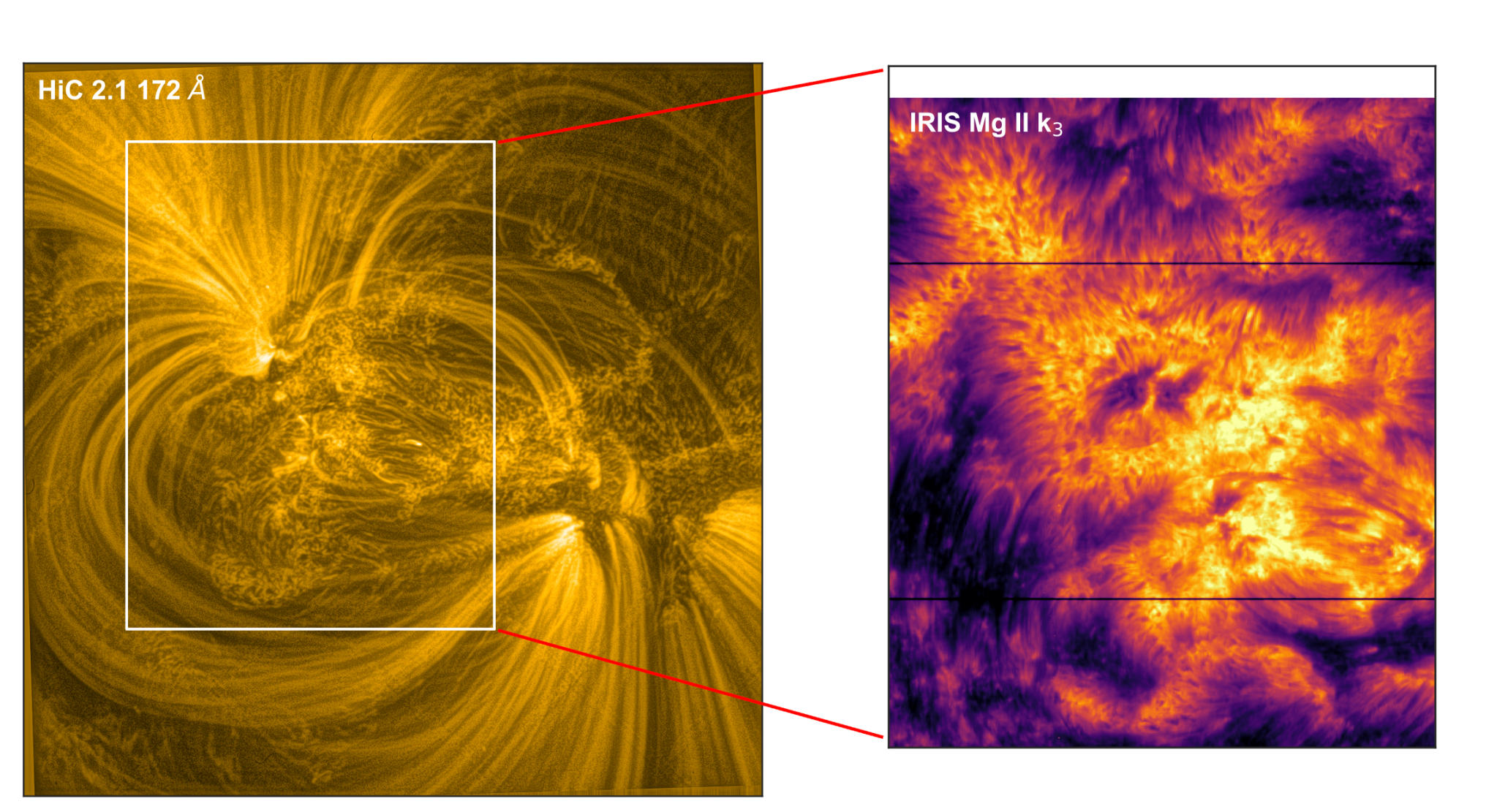
The left image shows thin swirls of bright golden material flowing off the Sun's surface. The outline of a white box is over a speckled area of the surface, in gray and bright gold. On the right, is that area in different wavelengths. The image is purple, black, red, orange, and right yellow. In the highlighted area, the speckles are a very bright yellow with some cooler purple areas.
At the center of this image (left) from NASA’s High Resolution Coronal Imager sounding rocket is a small-scale, patchy structure on the Sun that solar physicists call “moss.”  It forms low in the solar atmosphere around the center of sunspot groups on the Sun where magnetic activity is strong. An image from NASA’s Interface Region Imaging Spectrograph, or IRIS, mission shows a detailed scenery of the cooler roots of moss (right).
NASA/Bose et al 2024

Did you know the Sun has moss? Due to its resemblance to the earthly plants, scientists have named a small-scale, bright, patchy structure made of plasma in the solar atmosphere “moss.” This moss, which was first identified in 1999 by NASA’s TRACE mission, blossoms around the center of a sunspot group, where magnetic conditions are strong. It straddles two atmospheric layers known as the chromosphere and corona and hides below the long feathery ropes of plasma known as coronal loops.

For decades, scientists have struggled to understand how this mossy region is connected to the Sun’s lower atmospheric layers and how material there is heated from 10,000 degrees Fahrenheit up to nearly 1 million degrees Fahrenheit — 100 times hotter than the bright surface just below. Now, research enabled by NASA’s High Resolution Coronal Imager (Hi-C) sounding rocket and NASA’s Interface Region Imaging Spectrograph (IRIS) mission have given scientists insights into the superheating mechanism at play in the moss.

Observations from these instruments combined with complex 3D simulations have now revealed that electrical currents may contribute to heating the moss. Throughout this region there is a mess of magnetic field lines, like invisible spaghetti. This tangle of magnetic spaghetti creates electrical currents that can help heat material to a wide range of temperatures from 10,000 to 1 million degrees Fahrenheit. This local heating in the moss appears to occur in addition to heat flowing from the hot, multi-million-degree overlying corona. This insight, published in the journal Nature Astronomy on April 15, can help scientists understand the larger question of why the Sun’s entire corona is so much hotter than the surface.

“Thanks to the high-resolution observations and our advanced numerical simulations, we’re able to figure out part of this mystery that’s stumped us for the past quarter of a century,” said author Souvik Bose, a research scientist at Lockheed Martin Solar and Astrophysics Laboratory and Bay Area Environmental Institute, NASA’s Ames Research Center in California’s Silicon Valley. “However, this is just a piece of the puzzle; it doesn’t solve the whole problem.”

For that, many more observations are needed. Some are coming soon: Hi-C is scheduled to launch again this month to capture a solar flare, and it may also capture another moss region together with IRIS. However, to obtain observations that can fully address how the corona and moss are heated, scientists and engineers are working to develop new instruments onboard the future MUlti-slit Solar Explorer (MUSE) mission.

IRIS and TRACE are part of NASA’s Explorers Program.

By Mara Johnson-Groh
NASA’s Goddard Space Flight Center, Greenbelt, Md.

Media contact: Sarah Frazier
NASA’s Goddard Space Flight Center, Greenbelt, Md.

Keep Exploring

Discover More Topics From NASA

Powered by WPeMatico

Get The Details…

Space Biosciences Tri-Valley Innovation Fair 2024

Space Biosciences Tri-Valley Innovation Fair 2024

Space Biosciences Division at the 6th Tri-Valley Innovation Fair

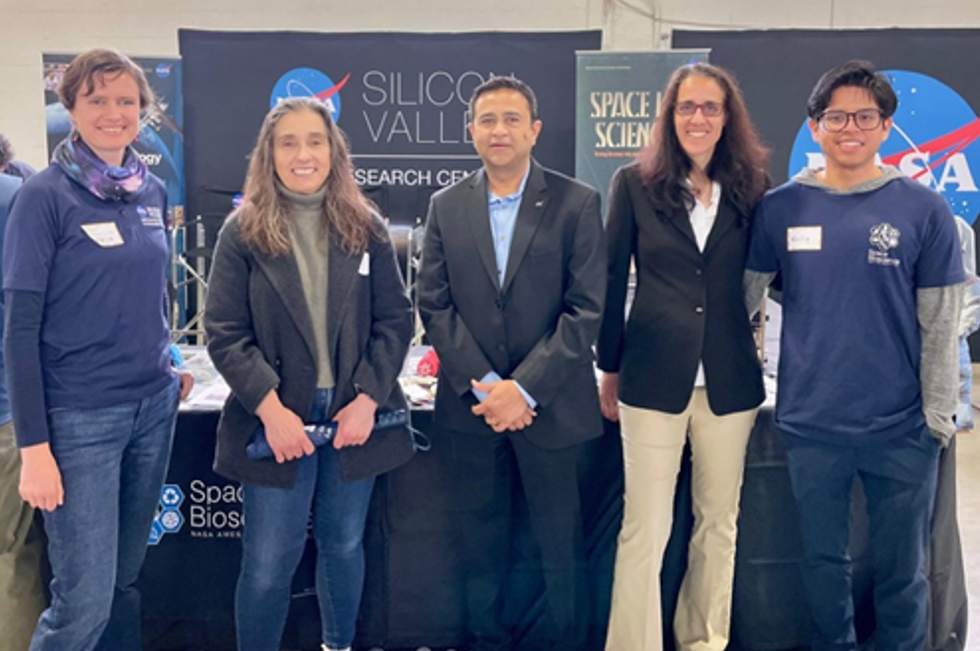
For the third consecutive year, six Ames Space Biosciences Division and one member from Space Sciences proudly participated in the 6th Tri-Valley Innovation Fair on Saturday, April 13, 2024, in Pleasanton, CA.  The fair was a resounding success, providing an excellent platform for showcasing NASA’s contributions to innovation and scientific exploration.

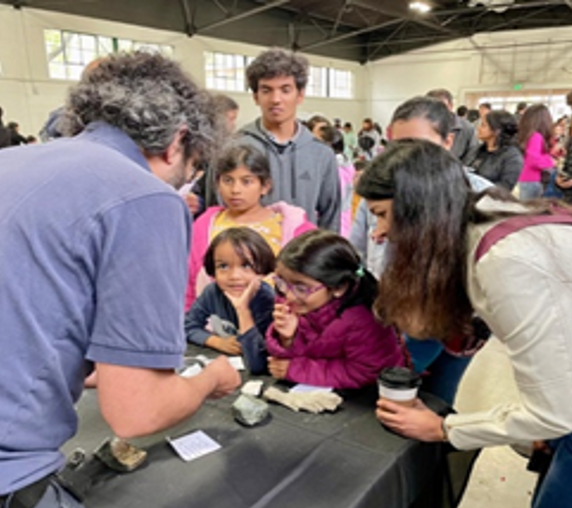
The NASA Booth featured captivating displays by the Astrobiology and Space Biosciences Groups, engaging visitors with cutting-edge research and discoveries.  Sigrid Reinsch (SCR) coordinated the SC Division’s booth to include activities and displays about Space Biology model organisms. The Space Biology Group presented a comprehensive overview of model organisms (DrosophilaC. elegansArabidopsis, yeast, tardigrades, microbes, mice), research on the International Space Station (ISS), the effects of spaceflight on bone and muscle, BioSentinel, GeneLab, education programs, and more. 

The Astrobiology group showcased a diverse collection of rocks with significant implications for life, demonstrating the profound impact of geological interactions on the development and sustenance of living organisms. Interactive elements like astronaut cutouts and an IR camera demo added excitement and engagement to the booth. Attendees were informed about NASA STEM programs, VIPER, and other ongoing missions, highlighting opportunities for education and involvement in space exploration.

The event attracted significant attention, with notable attendees including city officials such as the mayors of Livermore and Pleasanton, the director of Lawrence Livermore National Lab, and approximately 4000 residents from the Tri-Valley area.

Our participation in the 6th Tri-Valley Innovation Fair was instrumental in promoting NASA’s mission, fostering community engagement, and inspiring the next generation of innovators and scientists. We look forward to continuing our involvement in future events and furthering our impact in the realm of space exploration and biosciences.

ARC participants (from left): Egle Cekanaviciute, Parag Vaishampayan, Tara Samuels. Not pictured; April Ronca, Christina Lim, Walter Alvarado, Sanjoy Som and Jonas Dino. 

Powered by WPeMatico

Get The Details…
Elizabeth E. Keller

Dirigentes de la NASA visitarán México, se fortalecerá cooperación espacial

Dirigentes de la NASA visitarán México, se fortalecerá cooperación espacial

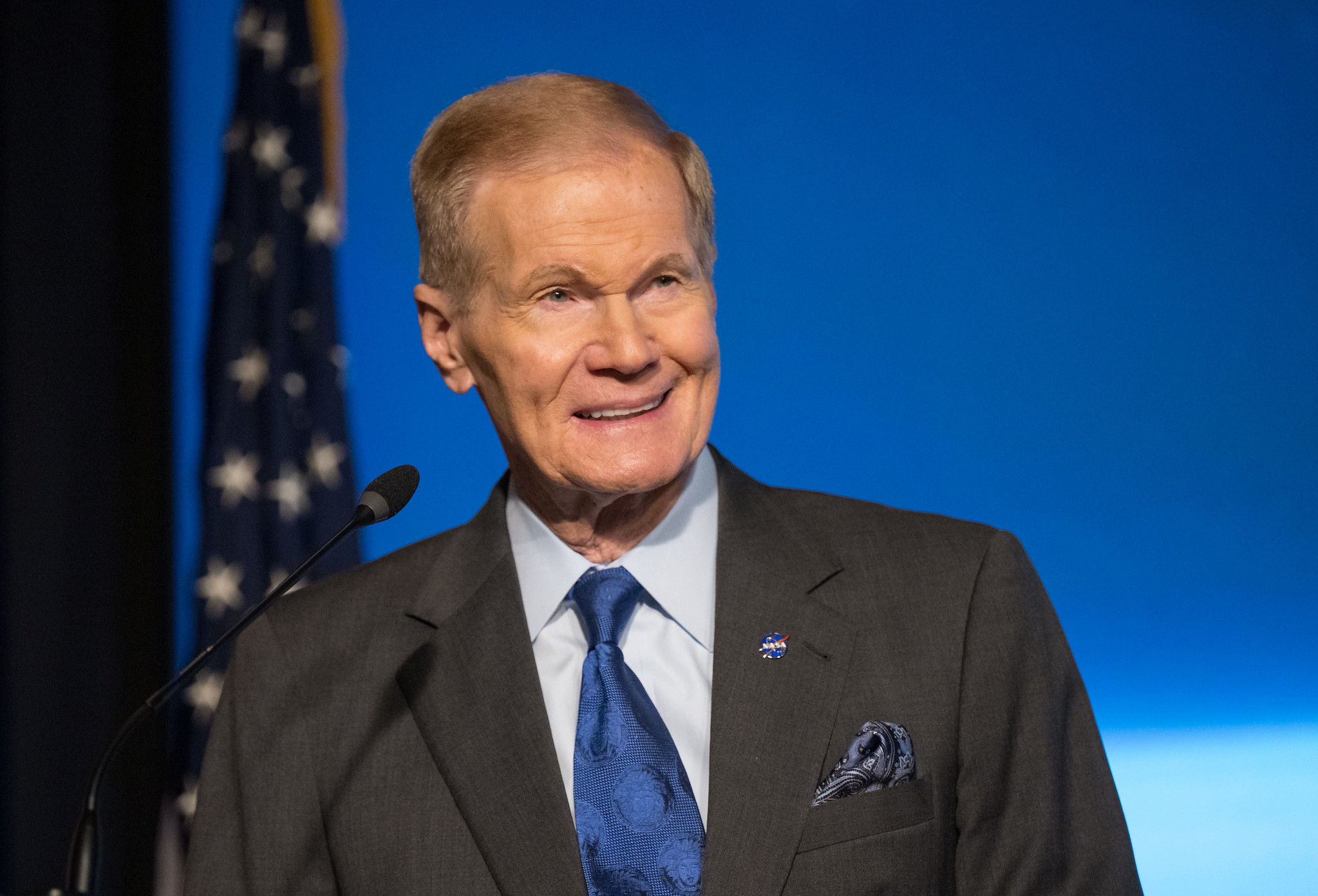
El Administrador de la NASA Bill Nelson habla acerca de las metas de la agencia durante el discurso anual del estado de la NASA, lunes, 11 de Marzo 2024, en la sede de la NASA en Washington, D.C.
Créditos: NASA/Bill Ingalls

Read this release in English here.

Como parte de una serie de reuniones con funcionarios gubernamentales clave alrededor del mundo, el titular de la agencia espacial estadounidense (NASA, por sus siglas en inglés), Bill Nelson, y su segunda al mando, Pam Melroy, visitarán la Ciudad de México, los días 22 y 23 de abril.

Nelson se reunirá con lideres de la Agencia Espacial Mexicana (AEM) y funcionarios de alto nivel del gobierno, incluyendo al presidente Andrés Manuel López Obrador, a fin de fortalecer la cooperación bilateral en una amplia gama de ámbitos relacionados con la innovación y la investigación, como ciencias de la Tierra, y Nanosatélites, entre otras. 

Juntas, ambas naciones están trabajando para alcanzar los objetivos mutuos de hacer frente al cambio climático.

NASA está involucrada en una amplia variedad de actividades con sus homólogos mexicanos en el ámbito de ciencias de la Tierra. Durante su visita a México en el “Día de la Tierra”, Nelson y Melroy explorarán nuevas oportunidades de colaboración con México, incluyendo el uso de misiones de la NASA para estudiar la calidad del aire y la gestión de recursos hídricos.

México es signatario de los Acuerdos Artemisa, un conjunto práctico de principios-guía para la cooperación en la exploración espacial entre naciones, hacia un seguro, pacífico, y próspero uso futuro del espacio; por lo que estudiantes de México también se reunirán con Nelson y Melroy para hablar sobre educación en ciencia, tecnología, ingeniería y matemáticas (STEM), y acerca de su importante rol como miembros de la Generación Artemisa.

Para más información sobre las colaboraciones internacionales de la NASA, visita la siguiente página web en inglés:

https://www.nasa.gov/oiir/

-end-

Faith McKie
Sede, Washington
202-358-1600
faith.d.mckie@nasa.gov

Powered by WPeMatico

Get The Details…
Tiernan P. Doyle
Kate A. McGinnis: Ready to “Go” with PACE Testing

Kate A. McGinnis: Ready to “Go” with PACE Testing

PACE Systems Engineer Kate A. McGinnis spent years planning the vibration, acoustic, and shock tests for the PACE spacecraft before saying “Systems is ‘go’” to start each test.

Name: Kate A. McGinnis
Title: Plankton, Aerosol, Cloud, and Ocean Ecosystem Mission (PACE) Systems Engineer
Formal Job Classification: Systems engineer
Organization: Mission Systems Engineering Branch, Engineering and Technology Directorate (Code 599)

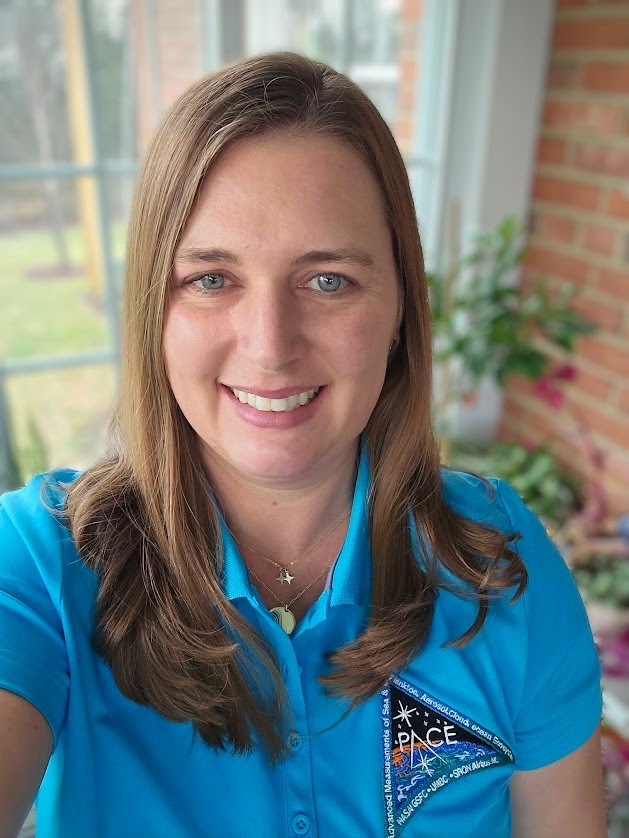
Kate A. McGinnis smiles for a selfie in a room with a brick wall, in front of a window and plant. She's wearing a blue polo with the PACE mission patch.
Kate A. McGinnis is a systems engineer at NASA’s Goddard Space Flight Center in Greenbelt, Md.
Courtesy of Kate A. McGinnis

What do you do and what is most interesting about your role here at Goddard?

As a PACE systems engineer, I really love seeing the spacecraft come together at the top level. It has been great working with the systems team and the rest of the PACE team as we enter our environmental test phase and see the final spacecraft take shape.

Why did you become a systems engineer? What is your educational background?

I have always been interested in space. I wanted to be an astronaut, but I used to get airsick, so my parents encouraged me to look around elsewhere. I loved building things with Legos and K’NEX. In first grade, I built a space shuttle for “show and tell.” It was my pride and joy.

In 2007 and 2008, respectively, I earned a B.S. and master’s in mechanical engineering from Cornell University. In 2016, I got a master’s in space policy from George Washington University because I wanted to see the top level of space policy to understand why we build what we build.

Why did you want to work at Goddard?

My first job was working on proposals for science spacecraft. While there, I met several Goddard scientists. I also met astronaut Sally Ride at an event at the Visitor Center. She truly inspired me to work at Goddard. She has always been a hero of mine because she showed that a woman could be at the top level of science, NASA, and space. It took me awhile to get here, through various jobs in the space industry including working on commercial communications satellites and science satellites for NOAA, the National Oceanic and Atmospheric Administration.

In 2017, I came to Goddard to work on satellite servicing as part of the OSAM-1 mission. In 2021, I became part of the PACE team to work on integration and testing (I&T), which was a new area for me.

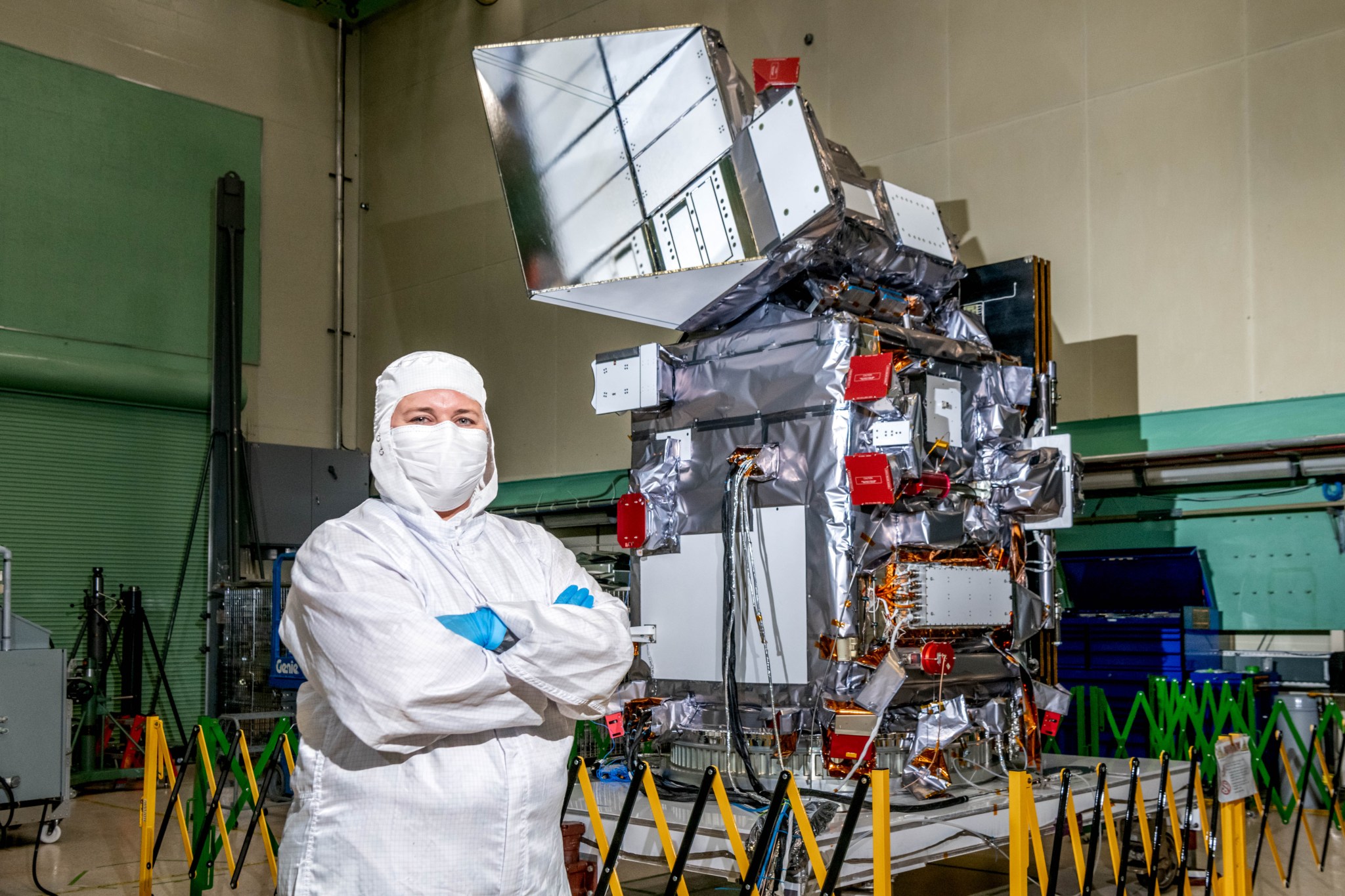
A woman stands slightly to the left of center in the image, seen from the waist up. She is wearing a white clean room suit that covers her torso, arms, and over the top of her head and forehead. She also wears a white mask that covers her nose and mouth and blue latex gloves. She is holding her arms out and above her head in a celebratory stance. Behind her and slightly to the right is the PACE observatory, which is large, silver colored, and is covered in wires and other metallic pieces of instrumentation and materials. stands slightly to the left of center in the image, seen from the waist up. She is wearing a white clean room suit that covers her torso, arms, and over the top of her head and forehead. She also wears a white mask that covers her nose and mouth and blue latex gloves. She is holding her arms out and above her head in a celebratory stance. Behind her and slightly to the right is the PACE observatory, which is large, silver colored, and is covered in wires and other metallic pieces of instrumentation and materials.
“When I am finally sitting in the control room, watching all these screens, it is always a moment of excitement but also nervousness,” said Kate. “I am the one who says “Systems is ‘go’,” which starts the test.”
Credit: NASA/Dennis Henry

What is cool about spacecraft I&T?

The spacecraft test program at Goddard is designed to get as close as possible to the environments of launch and space. Our goal is to really put the satellite through a full range of tests to ensure it survives the tough environment of the ride on the rocket and is still able to do all we need it to do in space.

Coming from a mechanical background, I worked a lot on the vibration, acoustic, and shock tests. For the vibration test, we crane-lift the satellite onto a vibration table and shake the whole thing. For the acoustic test, we blast the spacecraft with sound in an acoustic chamber because when we launch, noise from the rocket engines blasting reflects off the launch pad back into the rocket and the spacecraft. The sound is so loud that it is even louder than the U.S. Marine Band playing at full volume. For the shock tests, we simulate the spacecraft detaching from the rocket. We lift the spacecraft up and fire the attachment ring locks, and the ring drops onto a foam pad.

What goes through you head before you say “Systems is ‘go’” for a test?

Our control room is near the test chambers, but we can’t see the testing directly. We use cameras to monitor the spacecraft. Before these tests, I am a little nervous. It takes years working on all the plans to get ready for the test.

When I am finally sitting in the control room, watching all these screens, it is always a moment of excitement but also nervousness. I am the one who says “Systems is ‘go’,” which starts the test. Then I am really focused on the telemetry screens and video feed. These tests happen so quickly so we have automated systems to abort if necessary.

When the test is completed, it can take some time to review all the data. Waiting is a bit nerve-wracking. Meantime, we run an aliveness test on the spacecraft to make sure everything still powers on.

At the end of a successful test, it is a big relief, but it is also very exciting. We know we are ready for the next step.

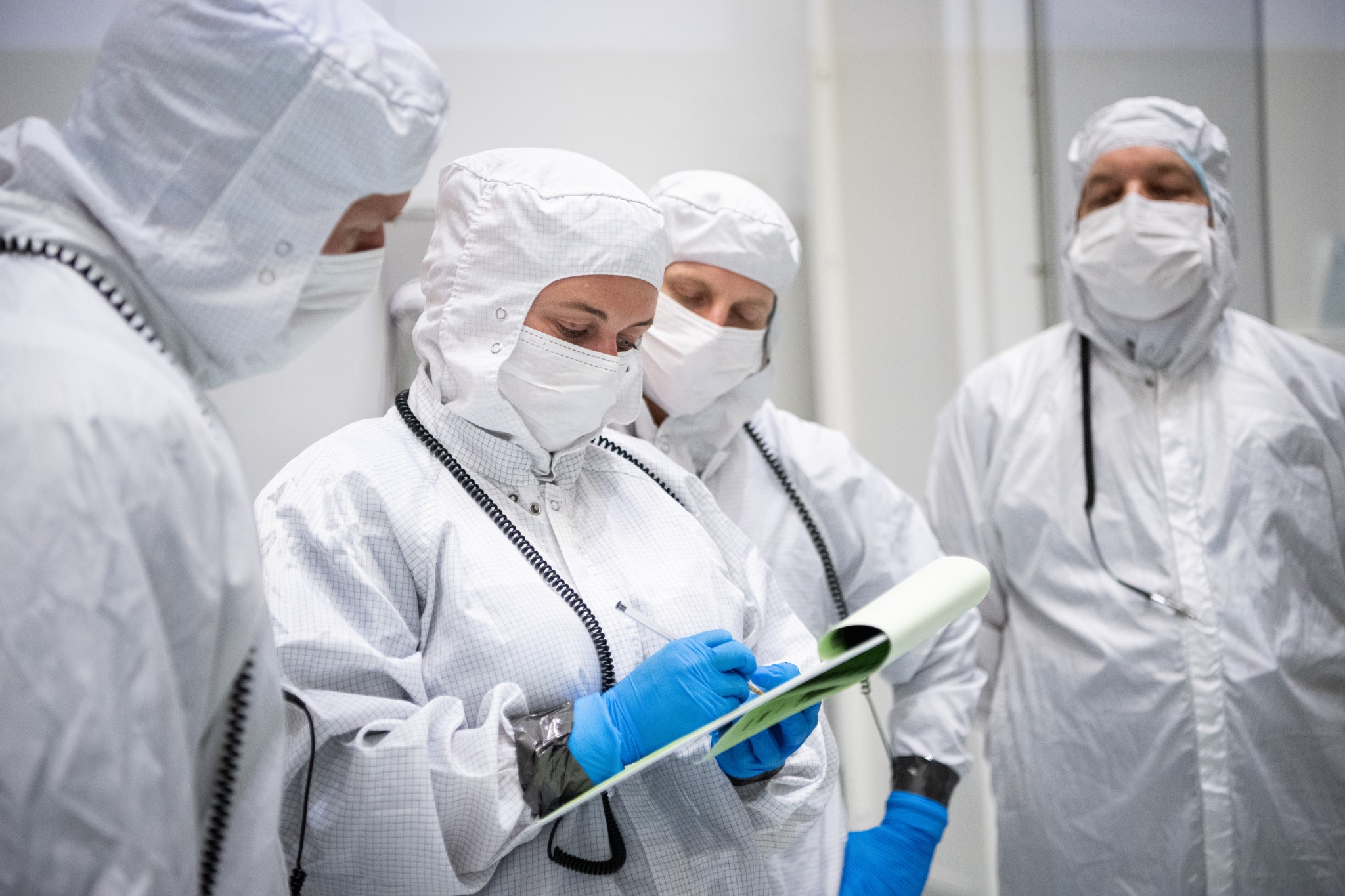
Four people stand in a white room wearing white clean suits with blue gloves. They have black cords draped over their shoulders and the woman in the middle is holding a note pad and pen, the other three people are looking at what she's writing.
Credit: NASA

What will be your involvement with the launch?

PACE launched on Feb. 8, 2024, from Kennedy Space Center in Florida. Part of our team was at the launch and the rest of us were here at Goddard in the Launch Support Room and the Missions Operations Center, which is basically mission control for PACE.

The data from PACE will help us better understand the ocean. Our main instrument is the Ocean Color Instrument, built in-house at Goddard, which will be able to distinguish the different colors of the ocean to a whole new level to give information on phytoplankton and therefore ocean health. We have two other instruments, polarimeters HARP2 and SPEXOne from our partners at University of Maryland, Baltimore County and SRON (the Netherlands Institute for Space Research) respectively.

Who is your mentor?

Bob Tornabene, who is at NASA’s Glenn Research Center in Cleveland, has given me a great perspective on systems engineering as a whole, not just at Goddard. He has taught me a lot about being part of a team, how to find out where you are needed and step into that role to help the team. I’ve also learned so much from my coworkers at Goddard.

What do you do for fun?

I have a lot of fun taking my 5-year-old son to science activities including those at our Visitor Center. We’re also always building and fixing things around our house. He wants to help me build the Ikea shelves we just bought, but he often runs away with the tools to work on his own “projects.” My husband is also a Goddard engineer, so I think our son is destined to become an engineer too.

I read a lot, especially science fiction. I also read space and science books to my son. Currently I am reading him “The Nine Planets,” a book from my childhood. I’ve had to explain what happened to Pluto, but we also get to talk about what neat missions Goddard might work on next.

What is your motivational motto?

Just keep moving forward.

By Elizabeth M. Jarrell
NASA’s Goddard Space Flight Center, Greenbelt, Md.

A graphic with a collection of people's portraits grouped together in front of a soft blue galaxy background. The people come from various races, ethnicities, and genders. A soft yellow star shines in the upper left corner, and the stylized text

Conversations With Goddard is a collection of Q&A profiles highlighting the breadth and depth of NASA’s Goddard Space Flight Center’s talented and diverse workforce. The Conversations have been published twice a month on average since May 2011. Read past editions on Goddard’s “Our People” webpage.

Share

Details

Last Updated

Apr 16, 2024

Editor
Madison Olson
Contact
Elizabeth M. Jarrell
Location
NASA Goddard Space Flight Center

Powered by WPeMatico

Get The Details…
Madison Olson