Crew Works Health, Spacesuits, and Cargo Mission Preps on Tuesday

Crew Works Health, Spacesuits, and Cargo Mission Preps on Tuesday

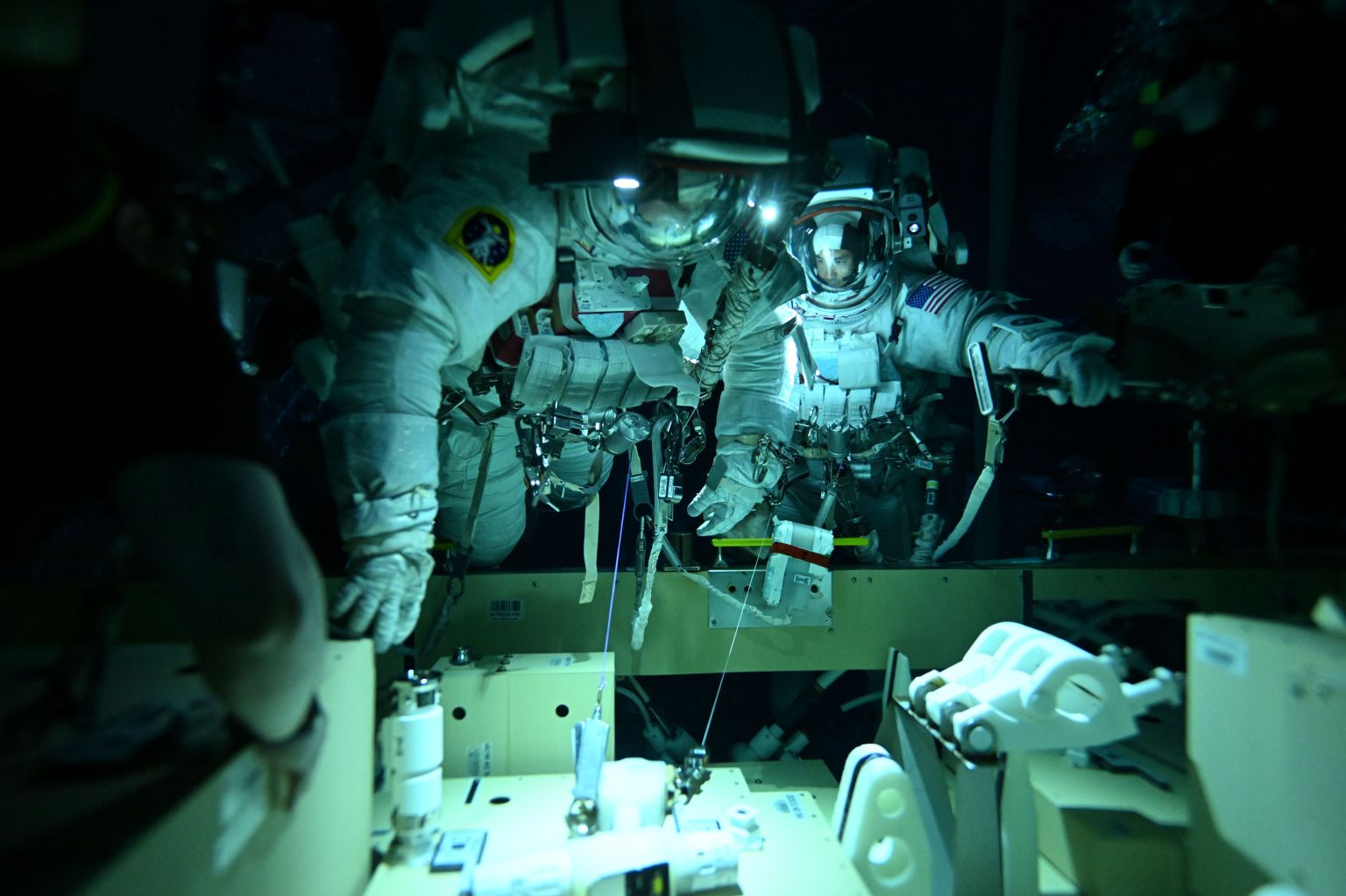
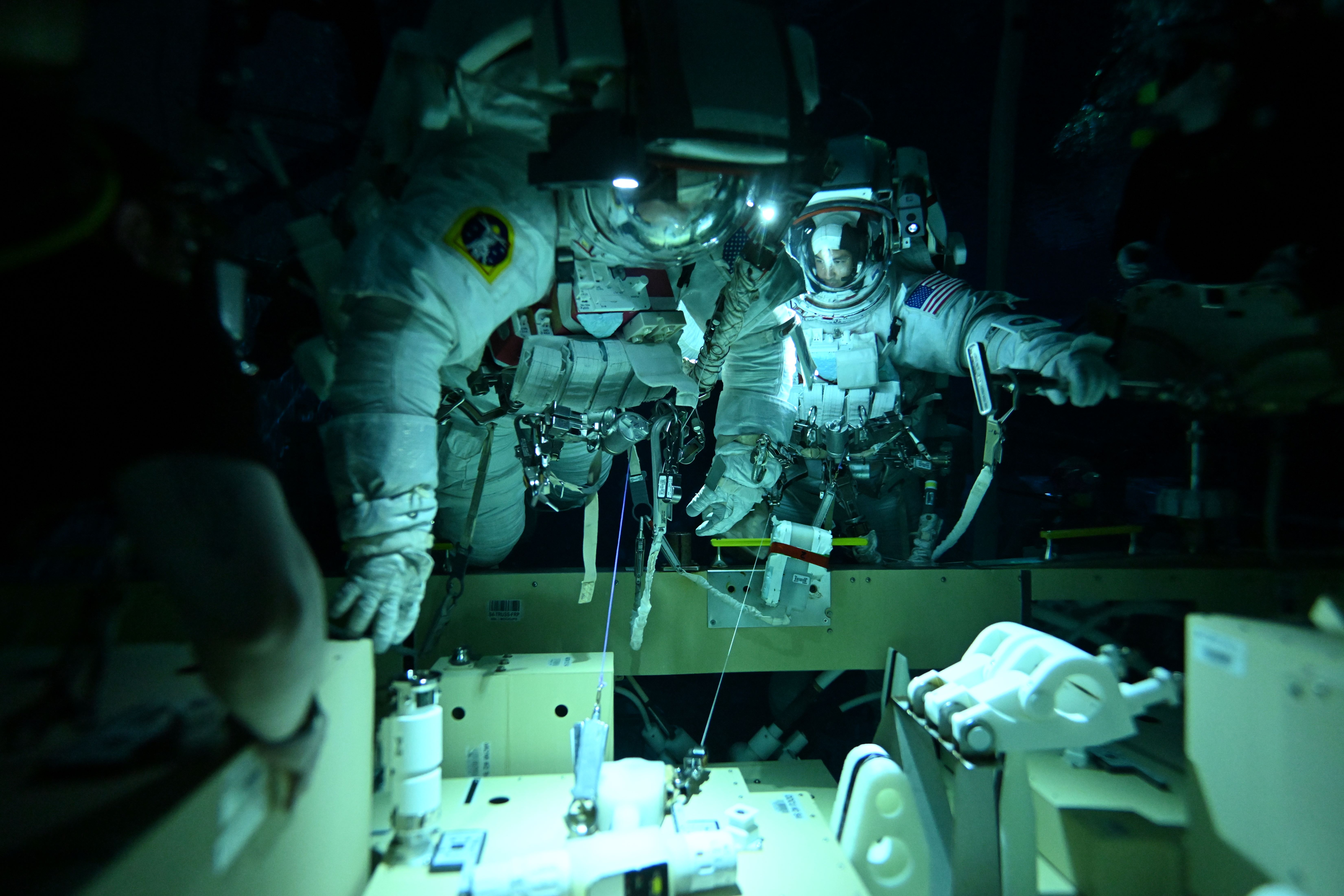
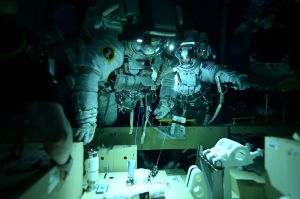
NASA astronaut and Expedition 74 flight engineer Jack Hathaway configures a spacesuit installing its components, checking a helmet, and cleaning suit seals inside the International Space Station's Quest airlock.
NASA astronaut Jack Hathaway configures a spacesuit installing its components, checking a helmet, and cleaning suit seals inside the International Space Station’s Quest airlock.
NASA/Jessica Meir

Health monitoring, spacesuit checks, and preparations for an upcoming cargo mission kept the Expedition 74 crew busy on Tuesday. The International Space Station residents rounded out the day with a variety of maintenance on science hardware and life support equipment.

Flight engineer Sophie Adenot of ESA (European Space Agency) began her shift attaching sensors to her forehead, chest, and legs to measure blood flow, breathing rate, and muscle activity for the PhysioTool technology demonstration. Next, she pedaled on the Destiny laboratory module’s exercise cycle as the sensors sent her health data to a wearable recording device. After her workout, she plugged in the device containing her biomedical data into a computer tablet for downlinking to doctors on Earth for analysis.

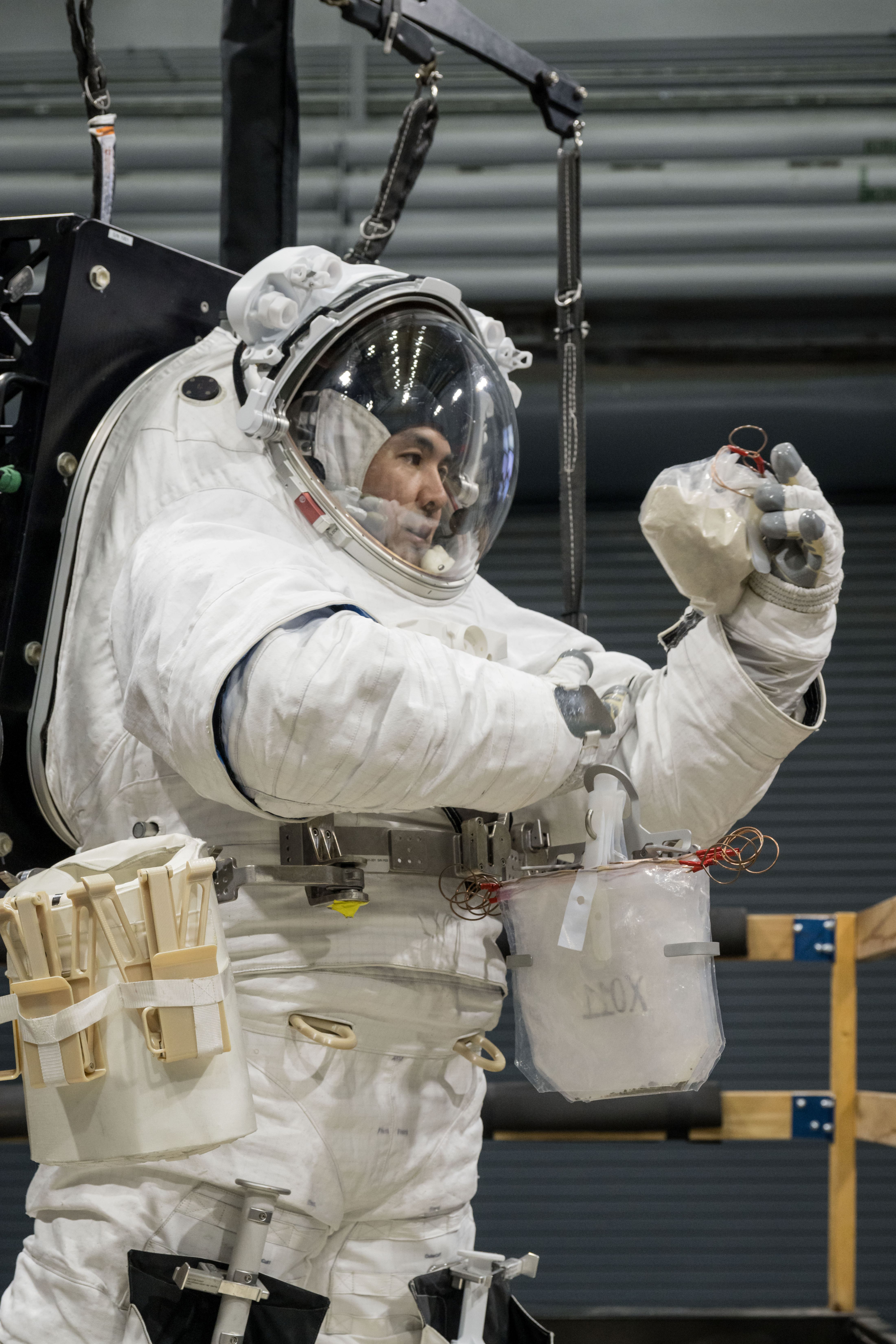
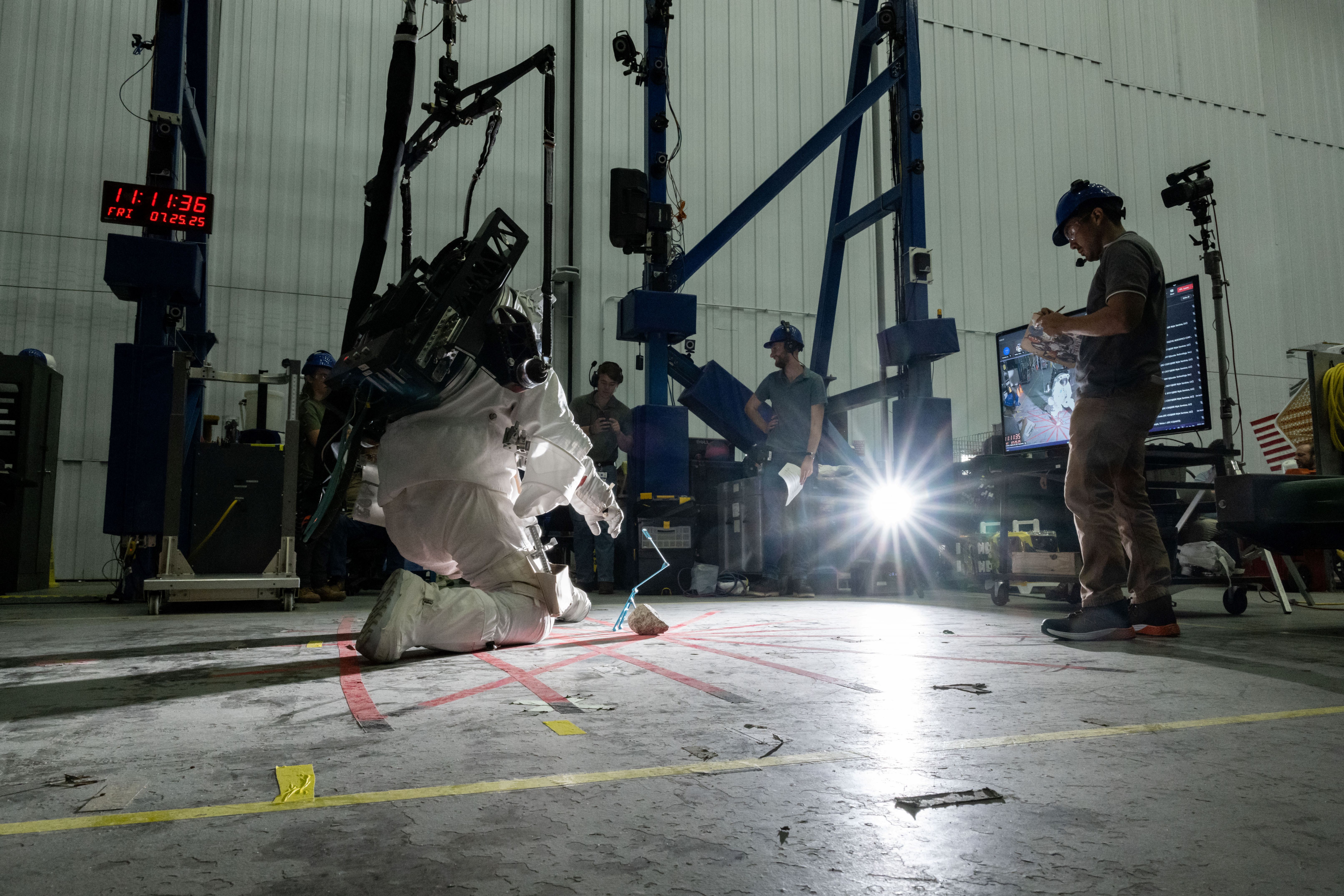
Afterward, Adenot assisted NASA flight engineers Jessica Meir and Jack Hathaway as they swapped and serviced components on a spacesuit inside the Quest airlock. The trio took turns cleaning the suit’s life support gear, checking for water leaks, and verifying the spacesuit’s functionality in advance of a future spacewalk. At the end of their shift, the three astronauts reviewed plans for the upcoming NASA SpaceX CRS-34 cargo mission due to launch on Tuesday, May 12, to resupply the crew. They studied the Dragon spacecraft’s automated approach and docking maneuvers and prepared for cargo operations after the spacecraft delivers several tons of new science experiments and lab hardware.

NASA flight engineer Chris Williams spent the first half of his shift inside the Kibo laboratory module uninstalling botany research gear from an EXPRESS rack with assistance from Hathaway. After lunchtime, Williams configured a sensor-packed Bio-Monitor vest and headband that he wore beginning a 48-hour session measuring his cardiovascular health for the CIPHER suite of 14 human research investigations. The wearable biomedical device, similar to the PhysioTool hardware, comfortably tracks a crew member’s health data as they work throughout the day then transfers it to a computer where doctors can access it for analysis on the ground.

Roscosmos flight engineer Sergey Mikaev was back on Orlan spacesuit duty working throughout his shift installing communications, electronics, and life support hardware on the same suit he had serviced on Monday. Station commander Sergey Kud-Sverchkov and flight engineer Andrey Fedyaev once again took turns conducting a photographic inspection of windows inside the Zvezda and Rassvet modules. The duo also worked together continuing to unpack supplies delivered aboard the Progress 95 cargo spacecraft on April 27.

Learn more about station activities by following the space station blog, @space_station on X, as well as the ISS Facebook and ISS Instagram accounts.

Get the latest from NASA delivered every week. Subscribe here.

Powered by WPeMatico

Get The Details…

Mark A. Garcia
NASA’s Perseverance Mars Rover Surveys ‘Crocodile Bridge’

NASA’s Perseverance Mars Rover Surveys ‘Crocodile Bridge’

2 Min Read

NASA’s Perseverance Mars Rover Surveys ‘Crocodile Bridge’

A rock-strewn, brownish-red Martian plain is bordered by a series of ridges and hilltops on the horizon, with rover tracks leading from them to the foreground on the right side of the image, where small portions of Perseverance rover are visible.
PIA26699
Credits:
NASA/JPL-Caltech/ASU/MSSS

Description

NASA’s Perseverance Mars rover used its Mastcam-Z camera system to capture this 360-degree panorama of a region nicknamed “Crocodile Bridge” on Jezero Crater’s rim. The panorama is made up of 980 images, 971 of which were taken on Dec. 18, 2025, the 1,717th Martian day, or sol, of the mission. An additional nine were taken on Jan. 25, 2026, Sol 1,754. This natural-color view has been processed to show the landscape as the human eye would see it.

Jezero Crater’s rim and the regions around it hold some of the oldest rocks anywhere in the solar system; they serve as time capsules of the Red Planet’s early history, when its crust and atmosphere were still forming. No terrain this ancient exists on Earth, where tectonic plates constantly recycle the surface. (Mars lacks tectonic plates, allowing some of this very old material to be preserved.)

“Crocodile Bridge” represents a transition into an area nicknamed “Lac de Charmes,” which Perseverance will explore for several months later this year.

[Full-resolution image versions of figures A through E can be downloaded at the bottom of this page.]

A rock-strewn, brownish-red Martian plain is bordered by a series of ridges and hilltops on the horizon, with rover tracks leading from them to the foreground on the right side of the image, where small portions of Perseverance rover are visible.
Figure A (low resolution)

Figure A is the natural-color view panorama.

A rock-strewn, brownish-red Martian plain is bordered by a series of ridges and hilltops on the horizon, with rover tracks leading from them to the foreground on the right side of the image, where small portions of Perseverance rover are visible.
Figure B (low resolution)

Figure B is the same panorama in an enhanced-color view, which brings out subtle details.

A rock-strewn, brownish-red Martian plain is bordered by a series of ridges and hilltops on the horizon, with rover tracks leading from them to the foreground on the right side of the image, where small portions of Perseverance rover are visible.
Figure C (low resolution)

Figure C is an anaglyph (3D) version of the natural-color view of the panorama.

A rock-strewn, brownish-red Martian plain is bordered by a series of ridges and hilltops on the horizon, with rover tracks leading from them to the foreground on the right side of the image, where small portions of Perseverance rover are visible.
Figure D (low resolution)

Figure D is an anaglyph red-color view of the enhanced version of the panorama.

A rock-strewn, brownish-red Martian plain is bordered by a series of ridges and hilltops on the horizon, with rover tracks leading from them to the foreground on the right side of the image, where small portions of Perseverance rover are visible.
Figure E (low resolution)

Figure E is an anaglyph blue-color view of the enhanced version of the panorama.

Managed for NASA by Caltech, NASA’s Jet Propulsion Laboratory in Southern California built and manages operations of the Perseverance rover on behalf of the agency’s Science Mission Directorate as part of NASA’s Mars Exploration Program portfolio.

Arizona State University leads the operations of the Mastcam-Z instrument, working in collaboration with Malin Space Science Systems in San Diego, on the design, fabrication, testing, and operation of the cameras, and in collaboration with the Niels Bohr Institute of the University of Copenhagen on the design, fabrication, and testing of the calibration targets.

To learn more about Perseverance, visit:

science.nasa.gov/mission/mars-2020-perseverance

Powered by WPeMatico

Get The Details…

Curiosity Blog, Sols 4879-4885: Struggle at Atacama

Curiosity Blog, Sols 4879-4885: Struggle at Atacama

3 min read

Curiosity Blog, Sols 4879-4885: Struggle at Atacama

A partially obscured color photograph from the Curiosity rover showing its drill hovering above a tan, fractured Martian rock. A perfectly round drill hole is visible in the rock directly below the hardware.
NASA’s Mars rover Curiosity acquired this image, of its drill (above, now free of the Atacama block) and the stubborn stone block, again back on the surface (below), on May 2, 2026. Curiosity captured the image using its Mast Camera (Mastcam) on Sol 4883, or Martian day 4,883 of the Mars Science Laboratory mission, at 09:14:58 UTC.
NASA/JPL-Caltech/MSSS

Written by William Farrand, Senior Research Scientist, Space Science Institute

Earth planning date: Friday, May 1, 2026

Chile’s Atacama desert is the driest mid-latitude desert in the world, receiving only 15 millimeters (0.59 inches) of precipitation per year. Only the dry valleys of Antarctica receive less precipitation. These environmental conditions have made the Atacama a challenging place to survive in. Like its namesake, the Atacama drill target on Mars presented a challenge to the Curiosity rover and to the rover team. 

The planning week began with the downlinked data indicating that a successful drill hole was made in the Atacama target, but the rock being drilled into was a detached block and as the arm was raised to extract the drill, the rock came along with it! Not being in the sample collection business, like her twin rover Perseverance, Curiosity’s rover planners went to work to develop a plan to extract the drill bit from the rock. These included efforts at changing the orientation of the drill bit, and attached block, as well as carrying out percussion to try to vibrate the rock off. Ultimately, as a result of activities like these in the Sol 4883-4885 plan, we freed the drill from the Atacama block.

With in-situ science activities precluded due to the efforts to free the drill bit from the Atacama block, the science at that time instead focused on remote sensing. The Sol 4879-4880 plan included ChemCam LIBS measurements of a dark cobble, “Pichiacani,” and a dark pebble, “Poco a Poco.” ChemCam also attempted passive reflectance measurements of white blocks on the slope of the distant Paniri butte and RMI imaging of Valle Grande. Mastcam collected documentation images of the ChemCam targets and also carried out change detection imaging of the target “Playa los Metales.”

The Sol 4881-4882 plan consisted of LIBS scanning of bedrock targets “El Plomo” and “El Turbio.” Mastcam change detection on the Playa los Metales regions continued. Mastcam also extended the previously collected “Kimsa Chata” mosaic. In the Sol 4883-4885 plan, the team was able to take advantage of the efforts to remove the Atacama block by carrying out ChemCam LIBS observations of the granular material below where the block had been. This included the target “Cuturipa,” below where the block had been, and a profile of the wall of the cavity where the block had been, which was given the target name “Chaitén.” ChemCam also observed a light-toned block, “Chiloé,” that had been covered by the Atacama block. ChemCam RMI imaging was planned for the layering of the Mishe Mokwa butte and of “Azul Pampa,” a rock with prominent polygonal patterns. The plan also included a Navcam dust-devil survey, ChemCam passive-sky measurements, and an APXS atmospheric observation.

Future activities involve wrapping up the drill campaign on Atacama and, nominally, seeking a more firmly rooted drill target in order to collect drill tailings for analysis, which were lost from Atacama as part of the effort to dislodge the drill bit from the rock.

A rover sits on the hilly, orange Martian surface beneath a flat grey sky, surrounded by chunks of rock.
NASA’s Curiosity rover at the base of Mount Sharp
NASA/JPL-Caltech/MSSS

Share

Details

Last Updated
May 05, 2026

Related Terms

Powered by WPeMatico

Get The Details…

650 NASA Volunteers Have Co-Authored Scientific Papers

650 NASA Volunteers Have Co-Authored Scientific Papers

After a recent count, NASA Citizen Science is proud to report that more than 650 people who have volunteered to participate in NASA citizen science projects have co-authored peer-reviewed research papers with scientists on those project teams. These volunteers made incredible contributions like:

And all of them saw their passion and dedication translated into lasting contributions to the scientific literature that will inform generations of researchers to come.

Explore these frequently asked questions and discover how you, too, can be a part of scientific discovery and become a co-author.

Why do peer-reviewed research papers matter?

When scientists make a discovery, they write up the details of their research and its results in a manuscript and submit it to a scientific journal. The journal’s editors subject the manuscript to the ‘peer-review’ process, in which they invite other scientists to verify and validate the methods used and the novelty and importance of the results. Peer-reviewed research papers are the primary way scientists document what they discover or learn and share it with each other and the world. Once a paper passes the peer-review process, it is published where other scientists can read it, criticize it, and build on it.

Contributing to published scientific literature is an important and celebrated part of a scientific career – for PhD scientists and citizen scientists alike. A list of published papers is the core of any scientist’s resume, and any budding scientist’s first publication is widely considered a milestone worth celebrating. Three cheers for each and every one of the 650 published citizen science project volunteers!

How can I get involved in writing a scientific paper through NASA citizen science? 

Sometimes, volunteers get lucky – they’re simply notified by the project science team that their contributions have made it into a scientific paper. However, if you are determined to become a published author, it helps to choose your project carefully and then to take initiative.

First, find a project that interests you. In the words of citizen scientist Michael Primm, “pick one or more [projects that] appeal to you, and try them out for size. If you don’t like them, try other ones.” Once you have a project you like, do the task frequently enough to get comfortable and confident. Read all the project material you can, including any frequently asked questions and blog posts the team may have written. Many of the extraordinary breakthroughs in these projects come from participants noticing patterns in the data that are unusual – you can’t do this unless you’ve developed a good sense of what’s “normal.” 

“Find a project where you can communicate directly with the scientists involved,” said Marc Kuchner, citizen science officer, NASA Headquarters in Washington. “That way, you can get the coaching and mentorship you need to learn the paper-writing process.” A good place to start is with the projects listed on the publications by NASA citizen scientists webpage, since these projects have track records of involving volunteers in papers. 

“After you’ve followed the instructions and participated in a project, it’s all about asking questions!” said Kuchner. “Ask other participants first, and read the project’s FAQ and Research pages. Dig into scientific journal articles, if you can. Before long, you’ll find yourself with a novel and meaningful question nobody knows the answer to. Then you’ll have an excellent reason to start a conversation with the science team.”

Second, look for ways to interact with project scientists and teams and stay informed and involved. Many NASA citizen science project teams have regular calls or meetings with participants. They also sometimes give participants the option to sign up for an email list, through which they share additional opportunities to interact with the scientists leading the projects.

“Don’t be afraid to ask for help, either from your fellow citizen scientists or even the pros of the project you’re working on,” said citizen scientist Les Hamlet, co-author of three papers and counting. 

NASA partner SciStarter also hosts a series of Do NASA Science Live virtual events, which offer another way to meet scientists. These virtual events, held roughly once a month, feature experts from NASA citizen science projects who are eager to interact with volunteers. You can see the schedule and sign up here for the next Do NASA Science Live event.

Many projects have virtual bulletin boards, like the “TALK” boards of Zooniverse-hosted projects, which can facilitate discussions with the science team. Or you can reach out by email to the science team by looking them up on the project’s team page. Just remember these science teams are busy, so do your homework first by reading all the project materials before you reach out.

NASA volunteer Michiharu Hyogo offered some tips to help others get started on the journey toward becoming a published author. There are also numerous online resources and guides for anyone new to writing scientific papers.

What if I’m still a student? Can I get involved in writing a paper?

Yes, the same advice above applies to students. There’s no better way to explore whether or not you’d like to pursue a career in science or a new scientific field of study than to do the work of a scientist and get involved in the process of publishing your findings. If you become a published co-author, you’ll also have the added advantage of listing your publication on your resume for internship, undergraduate, or graduate school applications. Several high school students and many undergraduate or graduate students have written papers with NASA citizen science project teams, including Matteo Kimura, Emily Burns-Kaurin, Darcy Wenn, and Michaela B. Allen.

Collage of five NASA citizen scientists presenting their research in conference and lab settings, including standing by scientific posters, giving a talk on stage, and posing with displays. Clockwise from upper left: Peter Jalowiczor, Michael Hunnekuhl, Danny Roylance, Michaela Allen, and Svetoslav Alexandrov.
A few NASA citizen scientists who have co-authored scientific papers present their findings. Clockwise from the upper left: Peter Jalowiczor, Michael Hunnekul, Danny Roylance, Michaela Allen, and Svetoslav Alexandrov.

Ride the rollercoaster!

Science can be unpredictable, which can make writing papers feel like a roller-coaster ride at times. “Don’t give up if your first try was not successful,” said published citizen scientist Michael Hunnekuhl. Most projects take years to produce results. Sometimes, nature doesn’t cooperate, and a science team must change directions instead of writing the paper they initially imagined. But with 42 citizen science projects online, NASA has plenty of room for your science ambitions. Go to https://science.nasa.gov/citizen-science/, pick a project, and start your science journey today.

Share

Details

Last Updated
May 05, 2026
Editor
NASA Science Editorial Team

Powered by WPeMatico

Get The Details…