Dragon Capture Confirmed Over Canada

Dragon Capture Confirmed Over Canada
SpaceX Dragon
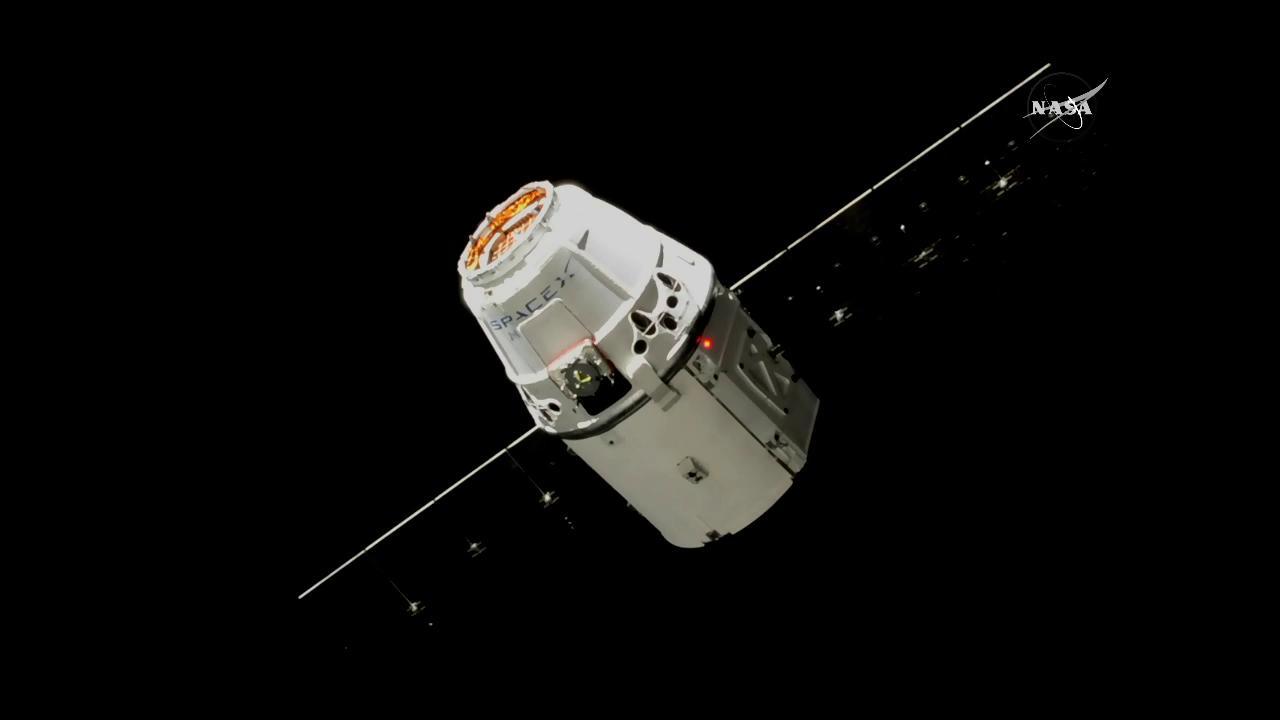
The SpaceX Dragon is pictured about 30 meters from the International Space Station. It would be captured minutes later when it reached its capture point 10 meters from the station Credit: NASA TV

While the International Space Station was traveling more than 256 miles over Quebec, Canada, NASA astronauts Ricky Arnold and Drew Feustel, captured the Dragon spacecraft at 6:54 a.m. EDT using the space station’s Canadarm2 robotic arm.

Ground controllers will now send commands to begin the robotic installation of the spacecraft on bottom of the station’s Harmony module. NASA Television coverage of installation is scheduled to begin at 9 a.m. Watch online at www.nasa.gov/live.

The Dragon lifted off on a SpaceX Falcon 9 rocket from Space Launch Complex 40 at Cape Canaveral Air Force Station in Florida Friday, June 29 with more than 5,900 pounds of research, equipment, cargo and supplies that will support dozens of investigations aboard the orbiting laboratory.

Among the hardware flying to the space station is a spare Canadian-built Latching End Effector (LEE), the part used as the “hands” that grapple payloads and visiting cargo spaceships such as Dragon. This was the 30th grapple of an arriving spacecraft, and the 15th time the Canadarm2 has captured a Dragon. Each end of the Canadarm2 robotic arm has an identical LEE, and they also enable Canadarm2 to “walk” to different locations on the orbiting outpost.

Among the research arriving on Dragon is a cellular biology investigation (Micro-12) to understand how microgravity affects the growth, gene expression and ability of a model bacterium to transfer electrons through its cell membrane along the bacterial nanowires it produces. Such bacteria could be used in microbial fuel cells to make electricity from waste organic material.

An Earth science instrument called the ECOsystem Spaceborne Thermal Radiometer Experiment on Space Station (ECOSTRESS) will provide a new space-based measurement of how plants respond to changes in water availability. This data can help society better manage agricultural water use.

Keep up to date with the latest news from the crew living in space by following https://blogs.nasa.gov/spacestation/, @space_station and @ISS_Research on Twitter, and the ISS Facebook and ISS Instagram accounts.

Get The Details…
Mark Garcia

ISS

Powered by WPeMatico
Dragon Blasts Off Carrying Science and Supplies for Station Crew

Dragon Blasts Off Carrying Science and Supplies for Station Crew

The SpaceX Dragon cargo craft was successfully launched
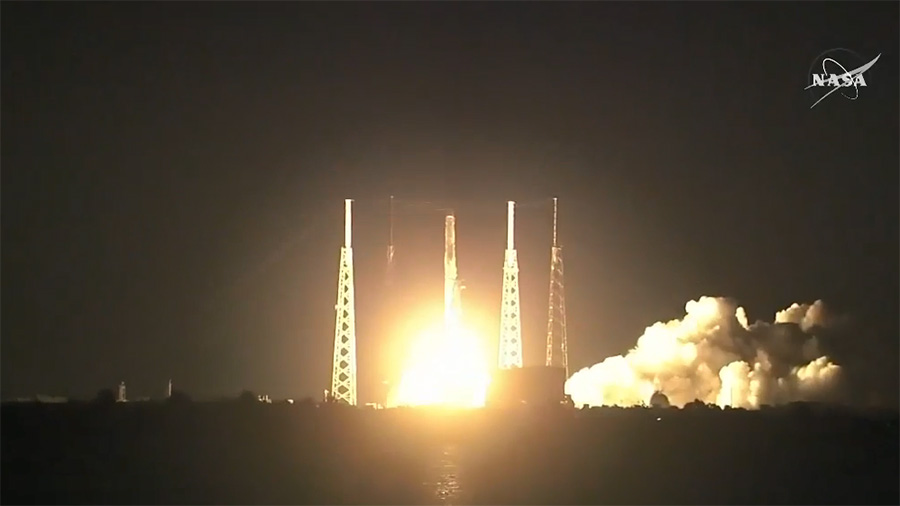
The SpaceX Dragon cargo craft was successfully launched on the Falcon 9 rocket from Launch Pad LC-40 at Kennedy Space Center, Florida.

Dragon successfully launched on the SpaceX Falcon 9 rocket at 5:42 a.m. EDT from Cape Canaveral Air Force Station. The spacecraft’s solar arrays have deployed. It will arrive at the International Space Station Monday morning carrying more than 5,900 pounds of research investigations and equipment, cargo and supplies that will support some of the hundreds of investigations aboard the orbiting laboratory.

A postlaunch press conference will take place at 8 a.m. on NASA Television and the agency’s website.

Participants are:

  • Kirk Shireman, manager, International Space Station Program, Johnson Space Center
  • Jessica Jensen, director, Dragon Mission Management, SpaceX

NASA astronauts Ricky Arnold and Drew Feustel will use the space station’s Canadarm2 robotic arm to capture Dragon when it arrives at the station. Live coverage of the rendezvous and capture will air on NASA Television and the agency’s website beginning at 5:30 a.m. Monday, July 2. Installation coverage is set to begin at 9 a.m.

Research materials flying inside Dragon’s pressurized cargo area include a cellular biology investigation (Micro-12) to understand how microgravity affects the growth, gene expression and ability of a model bacterium to transfer electrons through its cell membrane along the bacterial nanowires it produces. Such bacteria could be used in microbial fuel cells to make electricity from waste organic material.

An Earth science instrument called the ECOsystem Spaceborne Thermal Radiometer Experiment on Space Station (ECOSTRESS) will provide a new space-based measurement of how plants respond to changes in water availability. This data can help society better manage agricultural water use.

An observational pilot study with the Crew Interactive MObile companioN (CIMON) aims to provide first insights into the effects of crew support from an artificial intelligence (AI) in terms of efficiency and acceptance during long-term missions in space.

Among the hundreds of pounds of hardware flying to the space station is a spare Canadian-built Latching End Effector (LEE). Each end of the Canadarm2 robotic arm has an identical LEE, and they are used as the “hands” that grapple payloads and visiting cargo spaceships. They also enable Canadarm2 to “walk” to different locations on the orbiting outpost.

Learn more about station activities by following @space_station and @ISS_Research on Twitter as well as the ISS Facebook and ISS Instagram accounts.

Get The Details…
Mark Garcia

ISS

Powered by WPeMatico
Cancer and Cement Studies on Station Could Lead to Earth Benefits

Cancer and Cement Studies on Station Could Lead to Earth Benefits

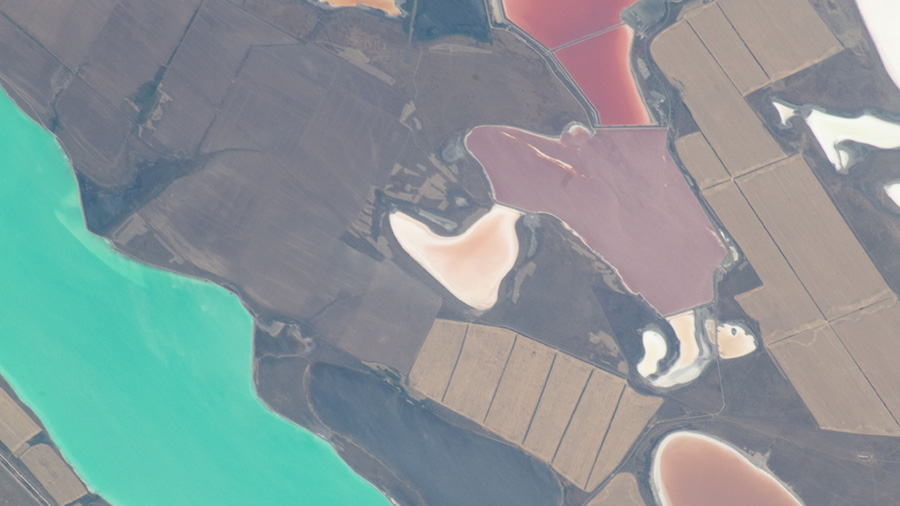
Lagoons in the Crimea
An Expedition 56 crew member aboard the International Space Station pictured lagoons in the Crimea between the Sea of Azov and the Black Sea which appear different colors due to shallow waters and their varied chemical composition.

Today’s science activities aboard the International Space Station are looking to improve cancer therapies and benefit cement processing on Earth. Meanwhile, two astronauts are practicing to capture the SpaceX Dragon cargo craft next week.

Cancer research in space can unlock positive benefits that are cloaked by Earth’s gravity possibly leading to advanced therapies. Flight Engineer Serena Auñón-Chancellor is preparing for the Angiex Cancer Therapy experiment which will be delivered aboard the SpaceX Dragon. She is setting up the Microgravity Science Glovebox for the study that may lead to safer, more effective vascular-targeted drugs without animal testing.

Flight Engineer Ricky Arnold mixed cement samples today for stowage and future analysis on Earth. Studying how cement reacts in space during the hardening process may help engineers better understand its microstructure and material properties. Observations could improve cement processing techniques on Earth and lead to the design of safer, lightweight space habitats.

Arnold will lead Monday morning’s capture of the SpaceX Dragon when he commands the Canadarm2 to grapple the space freighter Monday at 7 a.m. EDT. Commander Drew Feustel will back him up in the Cupola monitoring its approach and rendezvous. The duo set up the Cupola today and practiced the robotic maneuvers they will use to capture Dragon when it reaches a point about 10 meters from the station.

NASA TV begins its live broadcast Friday at 5:15 a.m. EDT of Dragon’s launch aboard the SpaceX Falcon 9 rocket. Dragon will blast off at 5:42 a.m. from the Kennedy Space Center on a three-day trip to the orbital lab carrying almost six thousand pounds of new science experiments, crew supplies and space station hardware. NASA TV will be back on the air Monday at 5:30 a.m. covering Dragon’s approach and rendezvous and again at 9 a.m. for Dragon’s installation to the Harmony module.


Get weekly video highlights at: http://jscfeatures.jsc.nasa.gov/videoupdate/

Get The Details…
Mark Garcia

ISS

Powered by WPeMatico
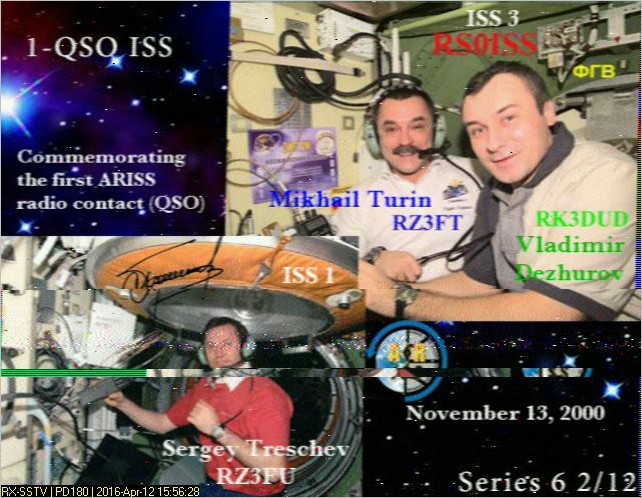
Receive SSTV from Space June 29-July 1

Receive SSTV from Space June 29-July 1


ISS SSTV image 2 received by Mike Rupprecht DK3WN April 12, 2016 at 1556 UT

ISS SSTV image received by Mike Rupprecht DK3WN April 12, 2016 at 1556 UT

ARISS Russia is planning a special Slow Scan Television (SSTV) event  from the International Space Station Station around 09:00 GMT on Friday, June 29 and continuing until 18:30 GMT Sunday, July 1.

Supporting this event is a computer on the ISS Russian Segment, which stores images that are then transmitted to Earth using amateur radio, specifically the onboard Kenwood TM-D710E transceiver.

These images will commemorate the various satellites that were hand-deployed from the ISS. These will include the first satellite deployment from ISS: Suitsat-1/Radioskaf-1 which was developed by ARISS and deployed in February 2006.

The transmissions will be made on 145.800 MHz FM using the PD-120 SSTV mode.

Note the ISS transmissions use the 5 kHz deviation FM standard rather than the narrow 2.5 kHz used in Europe. If your transceiver has selectable FM filters try using the wider filter. Handheld transceivers generally have a single wide filter fitted as standard and you should get good results outdoors using just a 1/4 wave whip antenna.

The ISS Fan Club site will show you when the space station is in range http://www.issfanclub.com/

ISS SSTV information and links at https://amsat-uk.org/beginners/iss-sstv/

Post your images on the ARISS-SSTV gallery at http://www.spaceflightsoftware.com/ARISS_SSTV/

If you don’t have an amateur radio receiver you can still listen to the ISS by using an Online Radio, also known as a WebSDR. Select a Frequency of 145800.0 kHz and Mode FM:
• Farnham WebSDR when ISS is in range of London http://farnham-sdr.com/
• R4UAB WebSDR when ISS is over Russia

Please note that the event is dependent on other activities, schedules and crew responsibilities on the ISS and subject to change at any time. You can check for updates regarding planned operation at:
ISS Ham https://twitter.com/RF2Space
ARISS Status https://twitter.com/ARISS_status
ARISS SSTV Blog https://ariss-sstv.blogspot.com/
AMSAT Bulletin Board http://www.amsat.org/mailman/listinfo/amsat-bb

If you receive a full or partial picture from the Space Station your Local Newspaper may like to know http://www.southgatearc.org/news/2016/july/now-is-a-great-time-to-get-ham-radio-publicity.htm

The RSGB produce a handy Media Guide and Template press release for anyone to download and adapt, see http://rsgb.org/main/clubs/media-guide-for-affiliated-societies/

An example of the publicity you can get for the hobby by telling your Local Newspaper
https://amsat-uk.org/2015/04/15/iss-sstv-in-the-press/

Get The Details…
m5aka

AMSAT-UK

Powered by WPeMatico

Crew Sets Up Station for New Research Delivery Aboard Dragon

Crew Sets Up Station for New Research Delivery Aboard Dragon

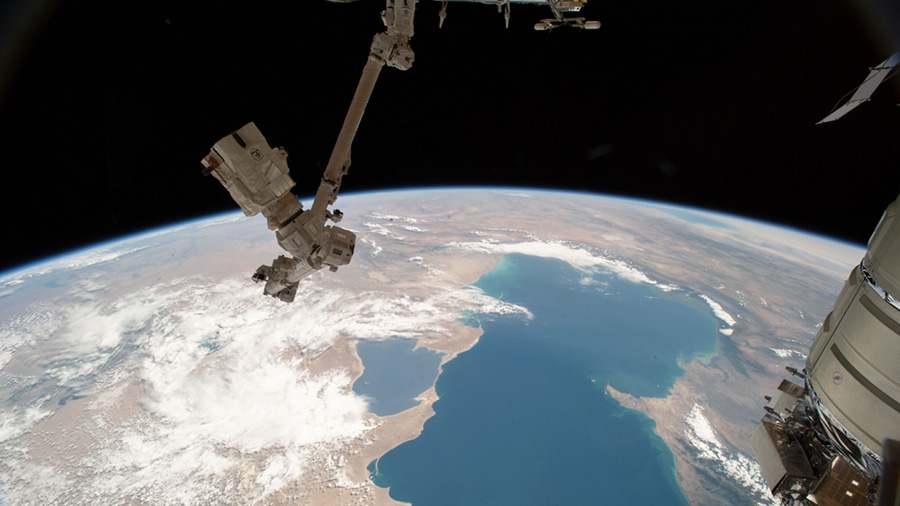
The Canadarm2 and the Caspian Sea
Canada’s 57.7-foot-long robotic arm, also known as the Canadarm2, with a latching end effector at its tip (used to grapple approaching spacecraft and portable data grapple fixtures) is pictured in the foreground as the International Space Station was orbiting over the Caspian Sea.

The Expedition 56 crew members are configuring the International Space Station for several new experiments being delivered on the upcoming SpaceX Dragon cargo mission. The orbital residents also explored space physics and serviced U.S. spacesuits.

NASA astronauts Drew Feustel and Ricky Arnold worked on science hardware today to support new research being delivered aboard Dragon when it arrives Monday at 7 a.m. EDT. The duo also continued studying the robotics procedures necessary to capture Dragon after its approach and rendezvous next week.

Feustel cleaned a mouse habitat for the Rodent Research-7 experiment observing microbes in the gastrointestinal system in mice. Arnold checked out the functionality of the Veggie facility that will process plants for the Veg-03 study researching how to grow food in space.

Flight Engineer Serena Auñón-Chancellor looked at how cement solidifies in space exploring its microstructure and material properties. Results could impact the design of lightweight space habitats and improve cement and concrete processing on Earth.

Finally, Alexander Gerst of the European Space Agency looked at spacesuit gear and set up the Quest airlock for future spacewalk operations. Gerst purged nitrogen from the suit’s oxygen lines and helped ground controllers prepare for overnight oxygen leak checks.

Get The Details…
Mark Garcia

ISS

Powered by WPeMatico