Robotics and Space Biology Today as Cosmonauts Look to Next Spacewalk

Robotics and Space Biology Today as Cosmonauts Look to Next Spacewalk
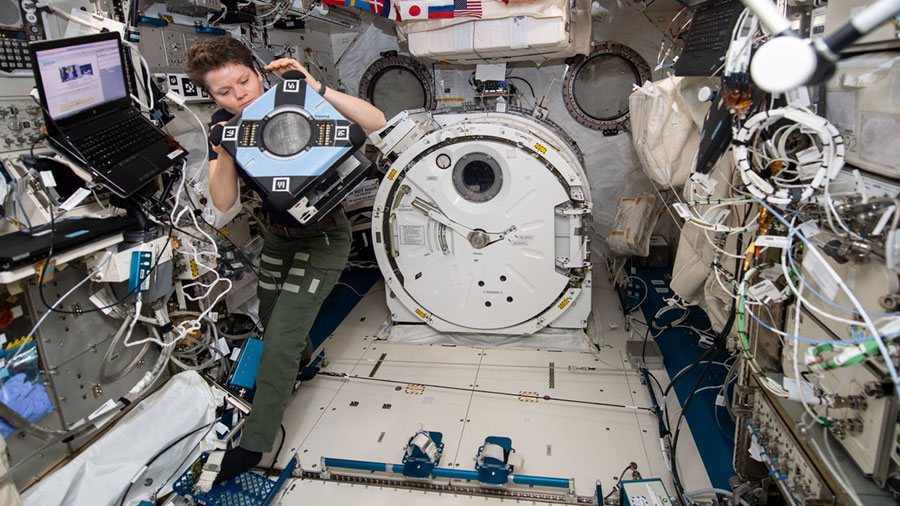
NASA astronaut Anne McClain checks out new Astrobee hardware
NASA astronaut Anne McClain works inside the Japanese Kibo laboratory module checking out the new Astrobee hardware. The cube-shaped, free-flying robotic assistant could save the crew time performing routine maintenance duties and providing additional lab monitoring capabilities.

A pair of robotic arms from Canada and Japan continued swapping experiment hardware on the International Space Station over the weekend. Meanwhile, the Expedition 59 crew started the week exploring robotics and biology today while a pair of cosmonauts look to the next spacewalk.

The 57.7-foot-long Canadarm2 robotic arm started removing a pair of external investigations last week from the SpaceX Dragon’s unpressurized trunk. The remotely controlled Canadarm2 first grabbed the new Orbiting Carbon Observatory-3 (OCO-3) then handed it off to the Japan Aerospace Exploration Agency’s (JAXA) robotic arm for installation on the Kibo lab module’s external pallet.

The Canadarm2 next removed the Space Test Program-Houston 6 (STP-H6) experiment from Dragon and installed it on the station’s truss structure. STP-H6 provides a platform for studying space physics to improve spacecraft navigation and communication techniques. The Canadian robotic arm then removed the completed SCAN radio communications study from the truss and placed it inside Dragon’s trunk.

JAXA’s robotic arm also retrieved the Cloud-Aerosol Transport System (CATS) experiment from the station and handed it off to the Canadarm2 for installation inside Dragon’s trunk. CATS successfully began demonstrating atmospheric monitoring after its delivery aboard a SpaceX Dragon cargo craft in January 2015. CATS and SCAN will now burn up in the atmosphere when Dragon’s trunk separates from the resupply ship before it returns to Earth at the end of May.

Back inside the orbital lab today, NASA astronaut Anne McClain calibrated the Astrobee and mapped the Kibo lab module with the free-flying robotic assistant. Flight Engineers Nick Hague and Christina Koch continued exploring how space changes the immune system, pathogens and kidney cells.

Two cosmonauts, Commander Oleg Kononenko and Flight Engineer Alexey Ovchinin, are planning for the fourth spacewalk at the station this year on May 29. The duo is timelined for about six hours of experiment retrieval work, window cleaning and sample collecting on the station’s Russian segment.

Get The Details…

Mark Garcia

Powered by WPeMatico

Human Research as Canadian, Japanese Robot Arms Swap Experiments

Human Research as Canadian, Japanese Robot Arms Swap Experiments

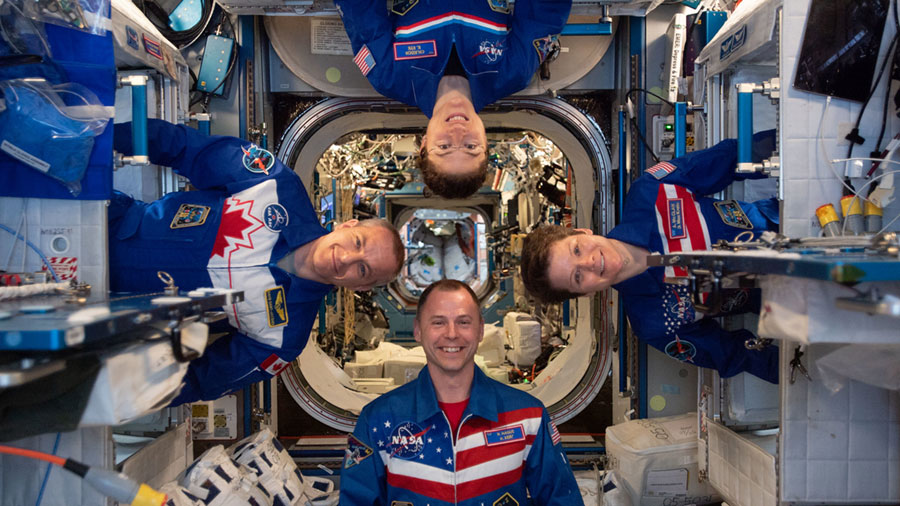
Four Expedition 59 astronauts
Four Expedition 59 astronauts pose for a playful portrait inside the Harmony module. Clockwise from left are astronaut David Saint-Jacques of the Canadian Space Agency and NASA astronauts Christina Koch, Anne McClain and Nick Hague.

The Expedition 59 crew focused intensely on human research today to improve the health of people on Earth and in space. The residents aboard the International Space Station are busy exploring how the human body and other organisms adapt to space helping NASA prepare to go to the moon by 2024.

Astronauts Christina Koch and Anne McClain split Friday checking on the Kidney Cells experiment seeking innovative treatments for kidney stones, osteoporosis and toxic chemical exposures. Counteracting the space-exacerbated symptoms is critical to the success of a long-term spaceflight to the moon and Mars.

McClain started her day with Commander Oleg Kononenko and Flight Engineers Nick Hague and Alexey Ovchinin researching space-caused head and eye pressure. The quartet tested a specialized suit, the Lower Body Negative Pressure suit, that reverses the upward flow of blood and other fluids toward an astronaut’s head. The crewmates also participated in ultrasound scans of their eyes and veins for the long-running Fluid Shifts study.

In addition, a pair of Canadian and Japanese robotic arms on the station are coordinating to swap external payloads over the weekend. Two Earth and space research facilities inside the SpaceX Dragon’s trunk are being removed for installation on the station. An older atmospheric experiment that has completed its mission will be placed back in Dragon’s trunk.

The Canadarm2 robotic arm removed the Orbiting Carbon Observatory-3 (OCO-3) from the Dragon’s unpressurized trunk. It handed off the OCO-3, a global carbon detection device, to Japan’s smaller robotic arm for installation on the Kibo lab module’s external pallet. Next, the Canadarm2 will extract and install the Space Test Program-Houston 6 hardware for space physics research on the station’s truss structure.

Finally, Japan’s robotic arm attached to Kibo will hand off the Cloud-Aerosol Transport System (CATS) to the Canadarm2 for installation in Dragon’s trunk. Before Dragon splashes down in the Pacific at the end of May, its trunk with CATS inside will separate during reentry and burn up over Earth’s atmosphere.

A SpaceX Dragon resupply ship delivered CATS in January of 2015 for robotic installation on Kibo’s external pallet. CATS successfully demonstrated low cost atmospheric monitoring techniques from the station.

Get The Details…

Mark Garcia

Powered by WPeMatico

Crew Relaxes as Two Robotic Arms Prepare for Payload Handoffs

Crew Relaxes as Two Robotic Arms Prepare for Payload Handoffs

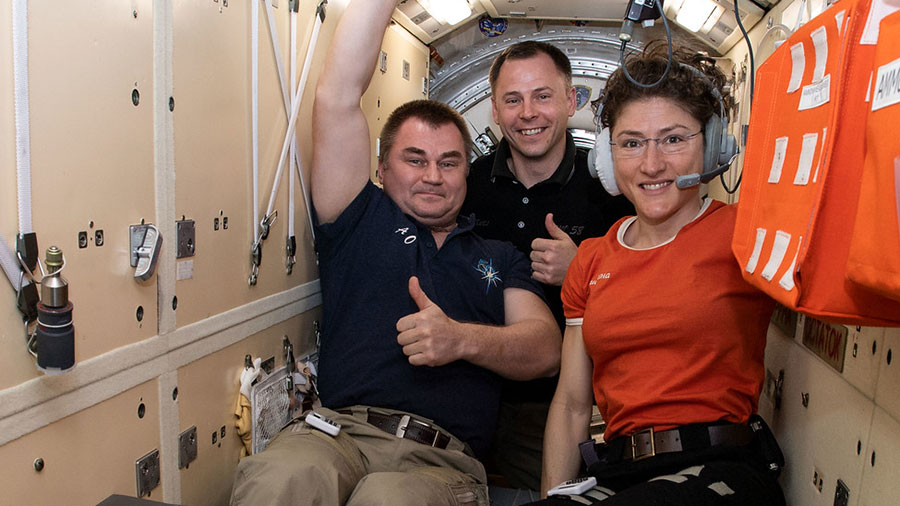
The three crewmates who rode the Soyuz MS-12 spacecraft
The three crewmates who rode the Soyuz MS-12 spacecraft to the International Space Station gather inside the Rassvet module after conducting a periodic routine emergency drill. From left are, Soyuz Commander Alexey Ovchinin of Roscosmos and NASA Flight Engineers Nick Hague and Christina Koch.

The Expedition 59 crew has a light duty day today with some science work on the schedule. Meanwhile, robotics controllers are preparing to swap external payloads in the unpressurized trunk of the SpaceX Dragon cargo craft.

NASA Flight Engineer Christina Koch checked samples today as she continued exploring why pathogens become more virulent in space. Later, she set up hardware for the Kidney Cells experiment that seeks innovative treatments for humans on Earth and in space.

Astronaut Nick Hague of NASA retrieved sample trays from a materials exposure experiment brought back inside the Kibo lab module. Fellow NASA astronaut Anne McClain checked on mice being observed for changes to their immune systems in microgravity.

Two new experiments are ready for robotic extraction from the SpaceX Dragon and installation on the International Space Station starting Thursday night and into the weekend. An older experiment will be removed from the station and placed back in Dragon.

The remotely controlled Canadarm2 robotic arm will first extract the Orbiting Carbon Observatory-3 (OCO-3) from Dragon’s trunk. Japan’s robotic arm will then take hold of the OCO-3 and install the global carbon detection device on Kibo’s external pallet. The Canadarm2 will then extract and install the Space Test Program-Houston 6 hardware for space physics research on the station’s truss structure.

Finally, the Japanese robotic arm will hand off the Cloud-Aerosol Transport System (CATS) to the Canadarm2 for installation in Dragon’s trunk. CATS will burn up over Earth’s atmosphere when Dragon’s trunk separates during its reentry at the end of May. A SpaceX Dragon resupply ship delivered CATS in January of 2015 for robotic installation outside Kibo. CATS successfully demonstrated low cost atmospheric monitoring techniques from the station.

Get The Details…

Mark Garcia

Powered by WPeMatico

Science Aboard Station Today Impacts Astronaut Health Long-Term

Science Aboard Station Today Impacts Astronaut Health Long-Term

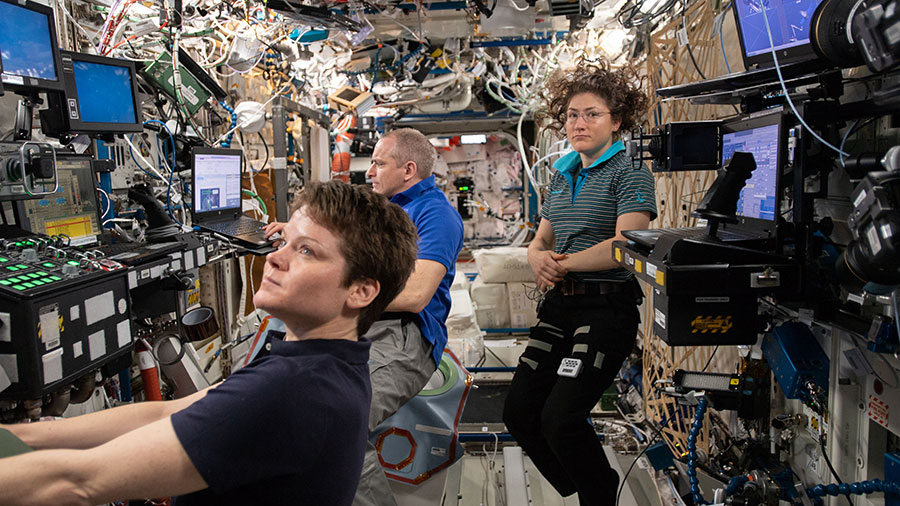
Expedition 59 Flight Engineers (from left) Anne McClain, David Saint-Jacques and Christina Koch
Expedition 59 Flight Engineers (from left) Anne McClain, David Saint-Jacques and Christina Koch are gathered inside the U.S. Destiny laboratory.

The International Space Station has all but one of its seven ports occupied by two crew ships and four cargo ships today. With plenty of food, fuel and supplies, the Expedition 59 crew is busy conducting new science experiments delivered to the orbital lab.

The crew researched an array of space biology today including pathogen virulence, immune system changes and upper body pressure that can affect mission success. Human research and life science is key in microgravity as NASA learns to support healthy astronauts for longer missions farther into space.

NASA Flight Engineer Christina Koch continued studying why pathogens increase in virulence due to the weightless environment of space. She performed inoculation procedures on cell cultures to help scientists understand critical cellular and molecular changes that occur on the absence of gravity.

Koch then joined fellow astronauts Anne McClain and David Saint-Jacques in the afternoon exploring how the immune system responds during a long-term space mission. The crew is observing dozens of mice on the orbital lab to characterize the response changes since the mouse immune system closely parallels that of humans.

McClain also participated on more Fluid Shifts research with Flight Engineers Alexey Ovchinin and Flight Engineer Nick Hague. The trio worked with a variety of biomedical hardware today observing the impacts of increased head and eye pressure caused by microgravity. The long-running human research experiment seeks to reverse the upward flow of fluids and alleviate the symptoms reported by astronauts.

Get The Details…

Mark Garcia

Powered by WPeMatico

New Science Being Unpacked and Worked Aboard Orbital Lab

New Science Being Unpacked and Worked Aboard Orbital Lab

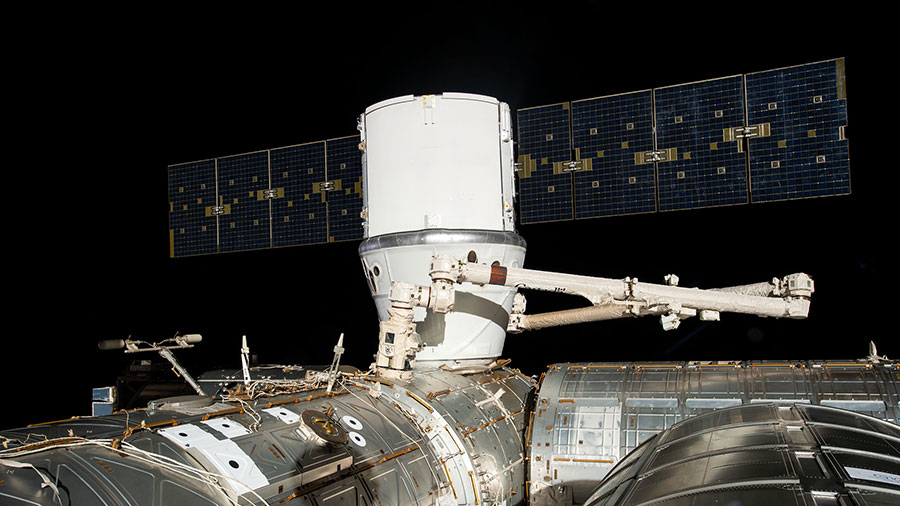
The SpaceX Dragon cargo craft is installed to the Harmony module
The SpaceX Dragon cargo craft is installed to the Harmony module’s Earth-facing port a few hours after it was captured by astronauts David Saint-Jacques and Nick Hague with the Canadarm2 robotic arm on May 6, 2019.

Six spaceships are now parked at the International Space Station and the Expedition 59 crew is working on the newest science delivered Monday. Astronauts will continue to live and work in space longer and scientists want to know how humans and a variety of other organisms adapt to support these missions.

NASA astronaut Anne McClain tended to several dozen mice delivered to the orbital lab Monday on the SpaceX Dragon cargo craft. The rodents’ immune systems are similar to humans and scientists are monitoring them to detect any changes caused microgravity.

NASA astronaut Christina Koch set up the Microgravity Science Glovebox today to begin operations with the new Micro-14 pathogen study. Microgravity can increase the virulence of pathogens and doctors are seeking to understand the process to keep space crews safe and healthy.

Koch and McClain both started Tuesday unpacking frozen biological samples from Dragon. The duo stowed the samples into different science freezers aboard the station for later analysis and experimental work.

McClain, Commander Oleg Kononenko and Flight Engineer Nick Hague also explored head and eye pressure caused by upward fluid shifts due to the effects of microgravity. The long-running human research experiment seeks to reverse the upward flow and alleviate the symptoms reported by astronauts.

Get The Details…

Mark Garcia

Powered by WPeMatico