Vision, Psychology Tests Ahead of First U.S. Commercial Crew Mission

Vision, Psychology Tests Ahead of First U.S. Commercial Crew Mission
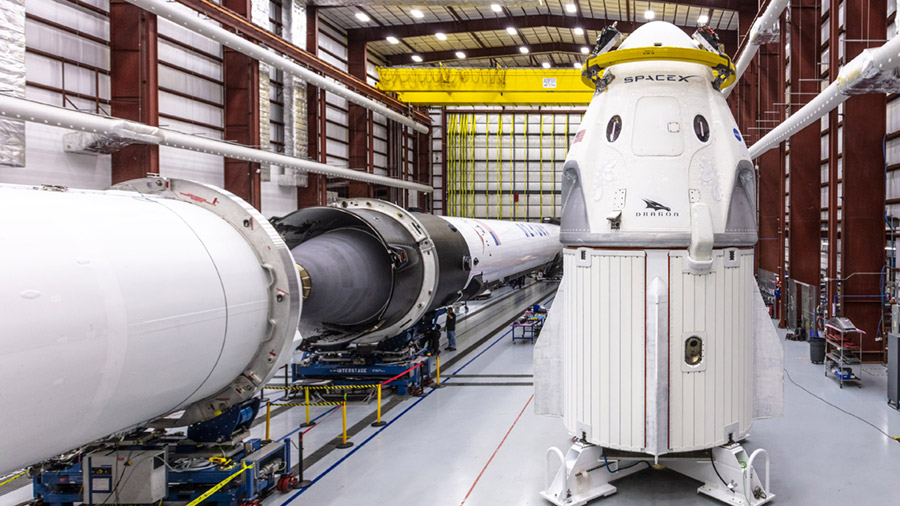
SpaceX’s Crew Dragon spacecraft and Falcon 9 rocket
SpaceX’s Crew Dragon spacecraft and Falcon 9 rocket are positioned at the company’s hangar at Launch Complex 39A at NASA’s Kennedy Space Center in Florida, ahead of the Demo-1 flight test. Credit: SpaceX

The Expedition 58 crew continued filming in virtual reality onboard the International Space Station today. The orbital residents also conducted behavior tests and eye checks throughout Thursday while preparing for the first U.S. commercial crew vehicle mission.

NASA astronaut Anne McClain logged into specialized software for a test session with the Behavioral Core Measures study. The neuropsychological test measures cognition as an astronaut conducts simulated robotic activities on a laptop computer.

Afterward, she joined Canadian Space Agency (CSA) astronaut David Saint-Jacques for eye checks in the Harmony module at the end of the day. The two swapped Crew Medical Officer roles and scanned each other’s eyes using optical tomography coherence gear. Both astronauts started the day with a standard vision test in the Destiny lab module reading characters from an eye chart.

Saint-Jacques set up a virtual reality camera in the cupola, the station’s “window to the world.” The high-tech space footage will be used to create a short cinematic, immersive film for audiences on Earth. The CSA astronaut also activated a camera to capture imagery for the Meteor space-based observation study.

The astronauts are also counting down to Sunday’s arrival of the first U.S. commercial crew vehicle on the SpaceX DM-1 mission. The uncrewed SpaceX Crew Dragon will launch from Kennedy Space Center at 2:49 a.m. EST Saturday. McClain and Saint-Jacques will greet the Crew Dragon after it docks to the Harmony module’s International Docking Adapter Sunday around 6 a.m.

Get The Details…

Mark Garcia

Crew Studies How Space Affects the Mind and Heart

Crew Studies How Space Affects the Mind and Heart

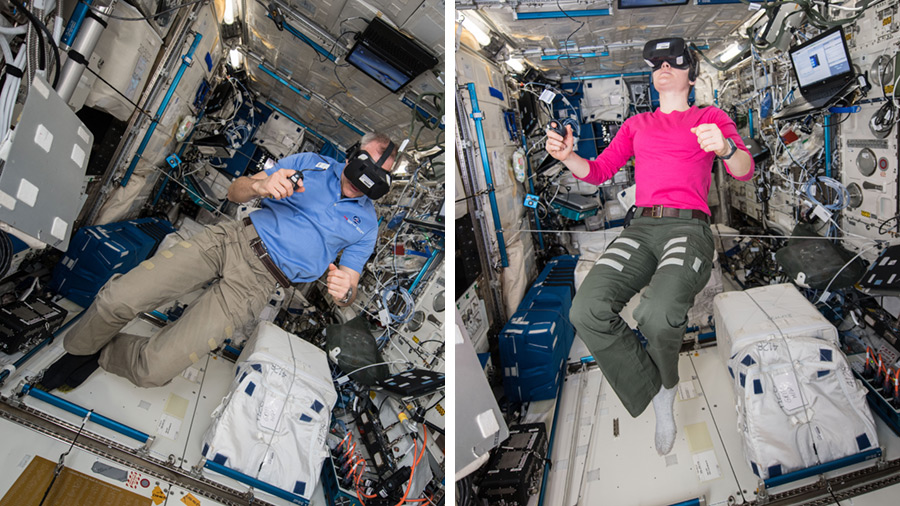
Astronauts David Saint-Jacques and Anne McClain
Astronauts (from left) David Saint-Jacques and Anne McClain wear a head-mounted display for the Time Perception study which hypothesizes that crews underestimate the duration of time in space.

The Expedition 58 crew explored how living in space impacts perception and psychology today. The trio also studied satellite navigation and continued reviewing this weekend’s arrival of the first SpaceX Crew Dragon spacecraft.

Astronauts Anne McClain and David Saint-Jacques partnered up this morning inside Europe’s Columbus lab module for the Vection space perception experiment. The duo wore virtual reality goggles, earplugs and a neck brace to study microgravity’s effect on the vestibular system. They took turns performing a series of tasks documenting perception of motion, orientation, height and depth. Results may improve astronaut training and the design of future space habitats.

McClain then spent the rest of the day in the Japanese Kibo lab module operating a pair of tiny internal satellites for the SmoothNav study. The experiment is researching how autonomous satellites may benefit future public and private space exploration.

Saint-Jacques went in to the afternoon reviewing rendezvous and docking operations when the uncrewed SpaceX DM-1 spacecraft arrives Sunday at 6 a.m. EST. He wrapped up his workday helping psychologists understand the adverse effects of living in space on an astronaut’s cognition and behavior.

Commander Oleg Kononenko participated in a Russian cardiopulmonary study before installing communications gear in the Zvezda service module. In the afternoon, two-time station commander collected radiation readings and ensured the upkeep of Russian life support systems.

Get The Details…

Mark Garcia

Next Crew Arrives at Launch Site as Station Preps for First SpaceX Crew Dragon

Next Crew Arrives at Launch Site as Station Preps for First SpaceX Crew Dragon

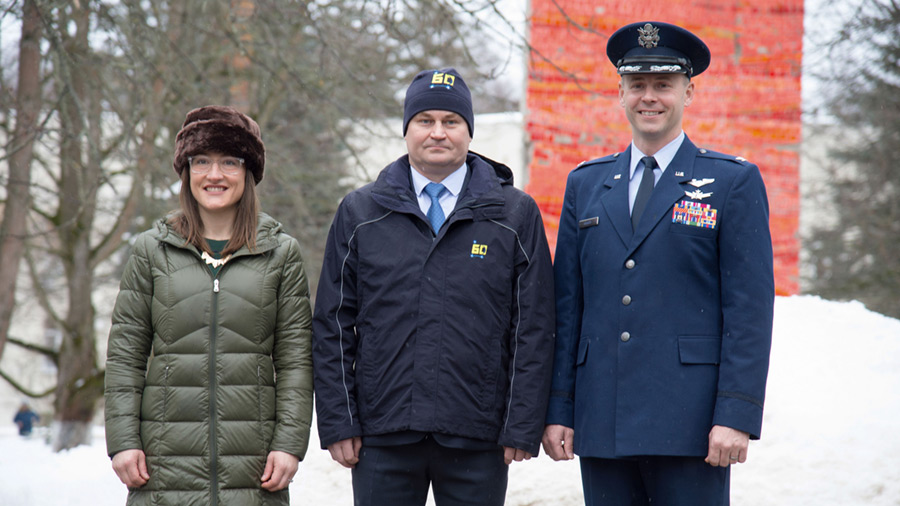
Expedition 59 crew members
Expedition 59 crew members (from left) Christina Koch, Alexey Ovchinin and Nick Hague are pictured before departing for their launch site at the Baikonur Cosmodrome in Kazakhstan.

The Expedition 59-60 crew arrived at the Baikonur Cosmodrome launch site in Kazakhstan today. Commander Alexey Ovchinin and Flight Engineers Nick Hague and Christina Koch are final training before their March 14 liftoff aboard the Soyuz MS-12 spacecraft. They will take a six-hour ride to their new orbital home where they will live and work until October.

Meanwhile, the Expedition 58 crew is back at today aboard the International Space Station after taking the day off Monday. The orbital lab is also flying at higher altitude to get ready for the arrival Russian crew and cargo ships starting next month.

The space station is orbiting two miles higher at its perigee after the docked Progress 71 resupply ship fired its engines for seven minutes and 31 seconds Monday night. This places the station at the correct altitude for the March 14 arrival of the Expedition 59-60 crew and the Progress 72 cargo craft docking on April 4.

The station astronauts are training all week for the arrival of the first SpaceX Crew Dragon spaceship this weekend. The uncrewed SpaceX DM-1, or Demonstration Mission-1, will launch Saturday at 2:49 a.m. EST from Kennedy Space Center in Florida. The Crew Dragon will arrive at the station on Sunday and dock around 6 a.m. to the International Docking Adapter (IDA) on the Harmony module.

Astronauts Anne McClain and David Saint-Jacques will monitor the Crew Dragon’s approach and rendezvous on Sunday. The vehicle is targeting a 6 a.m. EST docking to the IDA where the hatches will swing open about two-and-a-half hours later. It will undock on March 8 and return to Earth with a splashdown in the Pacific Ocean ending its mission.

Get The Details…

Mark Garcia

Virtual Reality Filming, Spacesuit Work Highlight Day on Station

Virtual Reality Filming, Spacesuit Work Highlight Day on Station

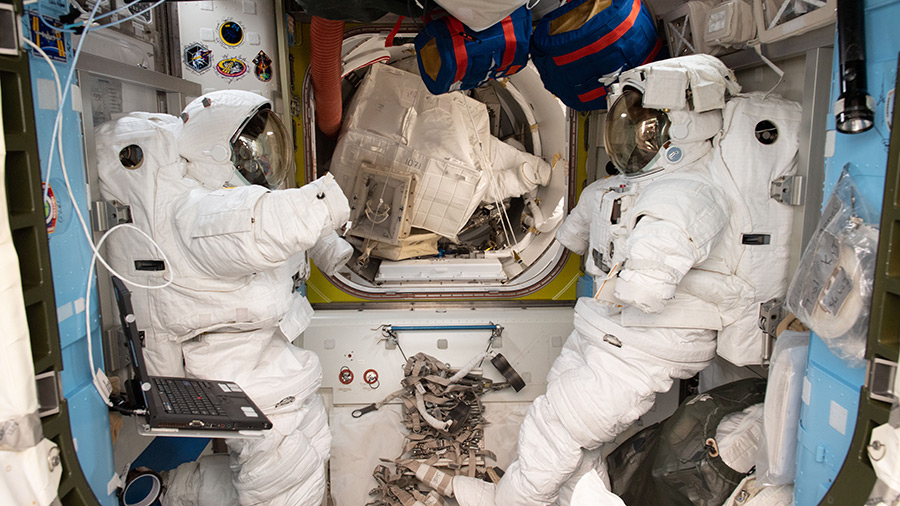
A pair of U.S. spacesuits
A pair of U.S. spacesuits are pictured during servicing work inside the Quest airlock where U.S. spacewalks are staged.

Virtual Reality Film, Spacesuit Work Highlight Day on Station

Virtual reality filming and spacesuit cleaning highlighted the day aboard the International Space Station. The Expedition 58 crew also configured a diverse array of life science and physics hardware.

NASA astronaut Anne McClain set up a virtual reality camera inside the Tranquility module after lunch today. She has been filming hours of footage this month depicting a first-person’s view of life throughout the station. The final film will be an immersive, cinematic experience to educate audiences on Earth about life in space.

McClain started the day installing mouse habitat gear inside the Cell Biology Experiment Facility. The research device, located in Japan’s Kibo lab module, will house mice for an upcoming accelerated aging and disease study.

Flight Engineer David Saint-Jacques was back on spacesuit duty today scrubbing cooling loops and checking the conductivity of water samples. The astronaut from the Canadian Space Agency also tested cables inside the Materials Science Research Rack. The refrigerator-sized rack explores chemical and thermal properties of materials such as metals, alloys and polymers to create new and improved elements and applications.

In the Russian segment of the orbital lab, Commander Oleg Kononenko worked on ventilation systems and collected air samples from the Zarya and Zvezda service modules. The veteran cosmonaut also photographed hardware for a blood pressure study and tested Earth observation techniques using a camera equipped with small ultrasound emitters.

Back on Earth in Star City, Russia, three Expedition 59 crew members have wrapped up two days of classes and tests qualifying for their March 14 launch to the orbital lab. Commander Alexey Ovchinin and Flight Engineers Nick Hague and Christina Koch will end their stay at the Gagarin Cosmonaut Training Center on Feb. 26 and fly to the Baikonur Cosmodrome launch site in Kazakhstan. The trio will lift off inside the Soyuz MS-12 crew ship and take a six-hour ride to their new home in space.

Get The Details…

Mark Garcia

Astronauts Focus on Spacesuits, High-Temp Physics and Storm Photography

Astronauts Focus on Spacesuits, High-Temp Physics and Storm Photography

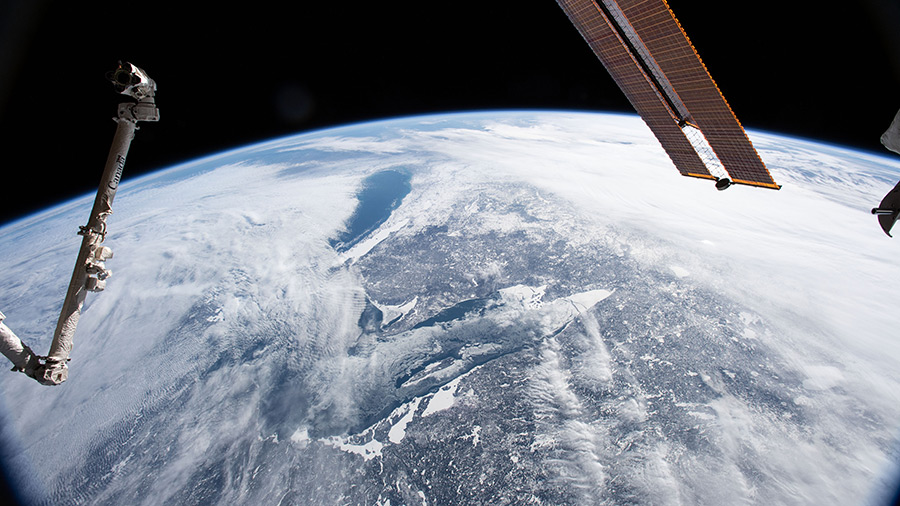
Lake Superior and Lake Michigan surrounded by the cloudy and frozen terrain
Lake Superior and Lake Michigan is surrounded by the cloudy and frozen terrain of the North American continent.

Spacesuit servicing and high-temperature physics kept the crew busy today aboard the International Space Station. The Expedition 58 astronauts also researched meteorology from the station and explored more Earth phenomena from space.

Astronaut David Saint-Jacques is returning a U.S. spacesuit to service today inside the U.S. Quest airlock. He verified successful installation of suit components and checked for water leaks in the suit at full operational pressure. NASA is planning a set of maintenance spacewalks at the station planned for March 22, 29, and April 8.

In the Kibo lab module from Japan, astronaut Anne McClain cleaned sample cartridges in a specialized thermo-physical research device called the Electrostatic Levitation Furnace. The high-temperature facility levitates, solidifies and melts samples that may contribute to the synthesis of new materials difficult to achieve on Earth.

She later set up camera hardware for the Tropical Cyclone experiment to demonstrate storm predictions from the station. McClain targeted a moonlit Typhoon Oma today off the coast of Queensland, Australia from inside the cupola.

Commander Oleg Kononenko worked on a suite of science experiments Wednesday in the Russian segment of the station. The veteran cosmonaut photographed terrestrial landmarks to document forest conditions and the effects of natural and man-made disasters. He also studied how space impacts the cardiovascular system and the piloting skills of a cosmonaut.

Back on Earth, three Expedition 59 crew members are preparing for their March 14 launch to the orbital lab aboard the Soyuz MS-12 crew ship. Commander Alexey Ovchinin and Flight Engineers Nick Hague and Christina Koch are in Star City, Russia for final training before heading to the Baikonur Cosmodrome launch site in Kazakhstan on Feb. 26.

Get The Details…

Mark Garcia