Crew Resumes Normal Ops Before Crew Dragon Leaves Friday

Crew Resumes Normal Ops Before Crew Dragon Leaves Friday

Astronauts (from left) Anne McClain and David Saint Jacques
Astronauts (from left) Anne McClain and David Saint Jacques are pictured in between a pair of spacesuits that are stowed and serviced inside the Quest airlock where U.S. spacewalks are staged.

The three Expedition 58 crew members are back to normal operations today with the newest SpaceX Crew Dragon spaceship integrated to the International Space Station. Dragon will leave the station Friday as the next crew prepares to launch on March 14.

Astronauts Anne McClain and David Saint-Jacques called down to mission controllers today to discuss Crew Dragon operations. The duo also linked up with SpaceX personnel throughout the United States describing life on orbit and their impressions of the new crew vehicle.

McClain started today resizing U.S. spacesuits ahead of a set of spacewalks planned for March and April. She later worked on life support systems and plumbing maintenance in the Unity and Tranquility modules.

Saint-Jacques collected station water samples for microbial analysis. He then inspected tethers the astronauts will use to stay attached to the station during the upcoming spacewalks.

Commander Oleg Kononenko replaced fuel bottles used during experiment operations inside the Combustion Integrated Rack. The veteran cosmonaut also explored low temperature gas mixtures for the Plasma Krysyall-4 experiment collaboration between Europe and Russia.

The SpaceX Crew Dragon undocks Friday at 2:31 a.m. EST. Splashdown in the Atlantic Ocean is scheduled around 8:45 a.m. EST. NASA TV will cover all the activities live after closing the hatch Thursday.

On the other side of the world in Kazakhstan, three new Expedition 59 crew members are in final training awaiting their launch to the station. Commander Alexey Ovchinin and Flight Engineers Nick Hague and Christina Koch are set to blastoff March 14 at 3:14 p.m. and dock less than six hours later to their new home in space.

Get The Details…

Mark Garcia

Making Space for SpaceX Crew Dragon, Spacewalk Prep and Science

Making Space for SpaceX Crew Dragon, Spacewalk Prep and Science

Expedition 58 welcomes Crew Dragon
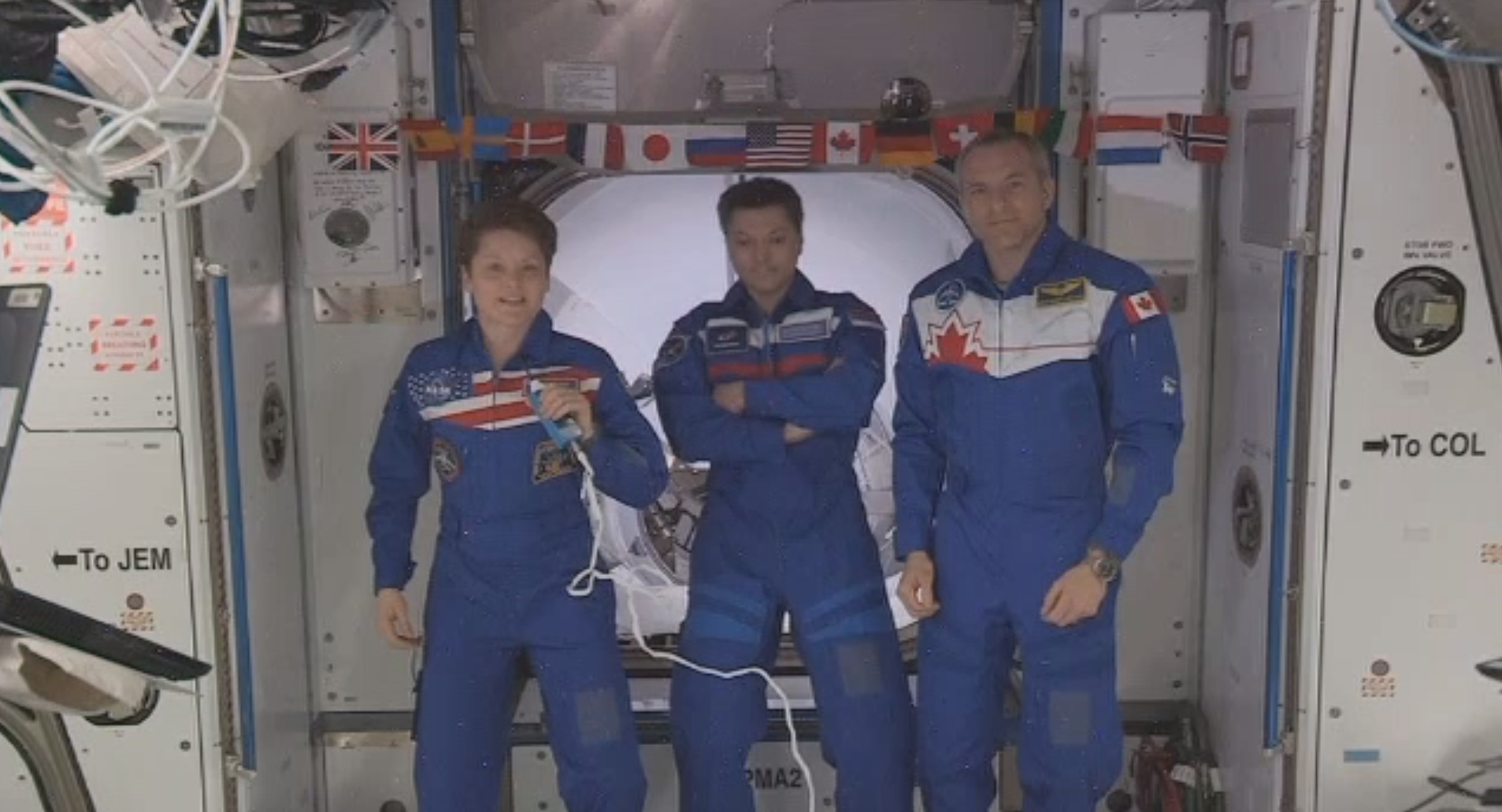
Expedition 58 crew members Anne McClain, David Saint-Jacques and Oleg Konenenko welcome the SpaceX Crew Dragon to the International Space Station after a successful docking on March 3, 2019, ushering in the era of NASA’s Commercial Crew Program. Image Credit: NASA TV

Expedition 58 capped off its busy weekend with additional outfitting for the SpaceX Crew Dragon, which had only completed its hard dock to the International Space Station yesterday morning as part of the Demo-1 uncrewed flight test.

After opening the hatch between the two spacecraft, the crewmates configured Crew Dragon for its stay while barnacled to the orbiting laboratory. This work included installation of the intramodule ventilation system, which helps cycle air from Crew Dragon to station. The crew members ticked off additional items from their checklist, also installing window covers and checking valves before taking part in a welcoming ceremony for the visiting vehicle at 10:45 a.m. EST Sunday, which aired on NASA Television.

Today, NASA astronaut Anne McClain, David Saint-Jacques of the Canadian Space Agency and Russian cosmonaut and Expedition 58 Commander Oleg Kononenko went over emergency procedures specific to Crew Dragon’s stay in orbit. While Crew Dragon is designed to remain docked to the space station for up to 210 days, this test of the spacecraft will be much shorter, ending early Friday morning. Crew Dragon is expected to return to Earth with a splashdown in the Atlantic Ocean at approximately 8:45 a.m. on Friday, March 8—a little more than six hours after its separation from station.

While Kononenko was focused on the Plasma Kristall-4 experiment, which investigates the liquid phase and flow phenomena of complex plasmas, for this week’s runs, McClain and Saint-Jacques spent most of the day in the Quest airlock. The pair worked on their EMU [Extravehicular Mobility Unit] spacesuits, making sure their suits fit in advance of a series of spacewalks currently slated for late March and early April.

Saint-Jacques also made time in the day to connect with junior high school and college students in Hallifax, Nova Scotia, through a space-to-ground downlink where he shared his perspective of living and working aboard the world’s only microgravity laboratory.

More details about the mission and NASA’s commercial crew program can be found in the press kit online and by following the commercial crew blog, @commercial_crew and commercial crew on Facebook.

Learn more about station activities by following @space_station and @ISS_Research on Twitter, as well as the ISS Facebook and ISS Instagram accounts.

Get The Details…

Catherine Williams

SpaceX Crew Dragon Hatch Open

SpaceX Crew Dragon Hatch Open

Expedition 58 crew members enter the SpaceX Crew Dragon
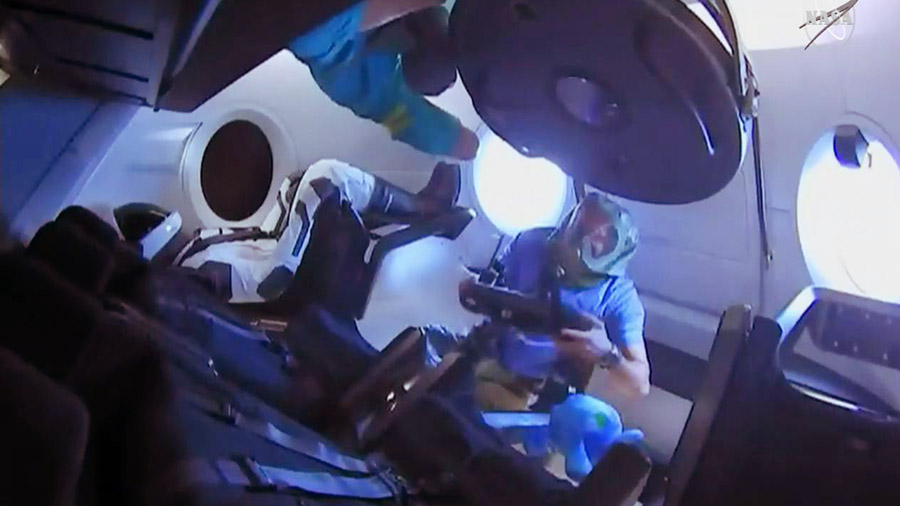
Expedition 58 crew members enter the SpaceX Crew Dragon for the first time. They are wearing protective gear to avoid breathing particulate matter that may shaken loose during launch.

Aboard the space station, NASA astronaut Anne McClain, David Saint-Jacques of the Canadian Space Agency, and Russian cosmonaut and Expedition 58 commander Oleg Kononenko opened the hatch between the Crew Dragon and the orbital laboratory at 8:07 a.m. EST.

The crew members opened the hatch to Crew Dragon following standard leak checks and pressurization since the spacecraft completed its hard dock to the station at 6:02 a.m., the first autonomous docking of any U.S. spacecraft to the International Space Station.

In addition to carrying Ripley, an anthropomorphic test device outfitted with sensors to provide data about potential effects on future astronauts who will travel in the Crew Dragon. NASA also sent more than 400 pounds of crew supplies and equipment to the space station, including bulk overwrap bags containing more than 1,000 food and drink packages for the crew.

For operational missions, Crew Dragon will be able to launch as many as four crew members and carry more than 220 pounds of cargo, enabling the expansion of the inhabitants of the space station, increasing the time dedicated to research in the unique microgravity environment, and returning more science back to Earth.

The Expedition 58 crew members will host a welcoming ceremony for the Crew Dragon that will air on NASA Television and the agency’s website beginning at 10:45 a.m.

More details about the mission and NASA’s commercial crew program can be found in the press kit online and by following the commercial crew blog, @commercial_crew and commercial crew on Facebook.

Learn more about station activities by following @space_station and @ISS_Research on Twitter as well as the ISS Facebook and ISS Instagram accounts.

Get The Details…

Mark Garcia

SpaceX Crew Dragon Successfully Docks to Station

SpaceX Crew Dragon Successfully Docks to Station

The SpaceX Crew Dragon
The SpaceX Crew Dragon is docked to the station’s international docking adapter which is attached to the forward end of the Harmony module. Credit: NASA TV

After making 18 orbits of Earth since its launch early Saturday morning, the Crew Dragon spacecraft successfully attached to the International Space Station’s Harmony module forward port via “soft capture” at 5:51 a.m. EST while the station was traveling more than 250 miles over the Pacific Ocean, just north of New Zealand.

As the spacecraft approached the space station, it demonstrated its automated control and maneuvering capabilities by arriving in place at about 492 feet (150 meters) away from the orbital laboratory then reversing course and backing away from the station to 590 feet (180 meters) before the final docking sequence from about 65 feet (20 meters) away.

The Crew Dragon used the station’s new international docking adapter for the first time since astronauts installed it during a spacewalk in August 2016, following its delivery to the station in the trunk of a SpaceX Dragon spacecraft on its ninth commercial resupply services mission.

For the Demo-1 mission, Crew Dragon is delivering more than 400 pounds of crew supplies and equipment to the space station. A lifelike test device named Ripley also is aboard the spacecraft, outfitted with sensors to provide data about potential effects on humans traveling in Crew Dragon.

The Crew Dragon is designed to stay docked to station for up to 210 days, although the spacecraft used for this flight test will remain docked to the space station only five days, departing Friday, March 8.

Opening of the Crew Dragon hatch will air on NASA Television and the agency’s website beginning at 8:30 a.m.

More details about the mission and NASA’s commercial crew program can be found in the press kit online and by following the commercial crew blog, @commercial_crew and commercial crew on Facebook.

Learn more about station activities by following @space_station and @ISS_Research on Twitter as well as the ISS Facebook and ISS Instagram accounts.

Get The Details…

Mark Garcia

Flowers Sent to Mission Control Celebrating SpaceX DM-1 Launch

Flowers Sent to Mission Control Celebrating SpaceX DM-1 Launch

Flowers Celebrating the SpaceX DM-1 Launch

The last time the Shelton family sent Mission Control Center (MCC) a bouquet of roses was July 9, 2011, the day after the last U.S. space shuttle launched. That was the 110th bouquet from the family and the last U.S. human spaceflight. The Shelton’s continued their tradition Saturday when they sent their 111th bouquet to MCC celebrating the launch of the first SpaceX Crew Dragon.

Ever since the Challenger accident, Mark and Terry Shelton have sent a vase of roses to Mission Control. The two live in the Dallas area and have no job connection to the space program. But they like to show their appreciation by including a rose for each crew member plus a single white one to represent astronauts who died in past accidents.

SpaceX DM-1 Launch
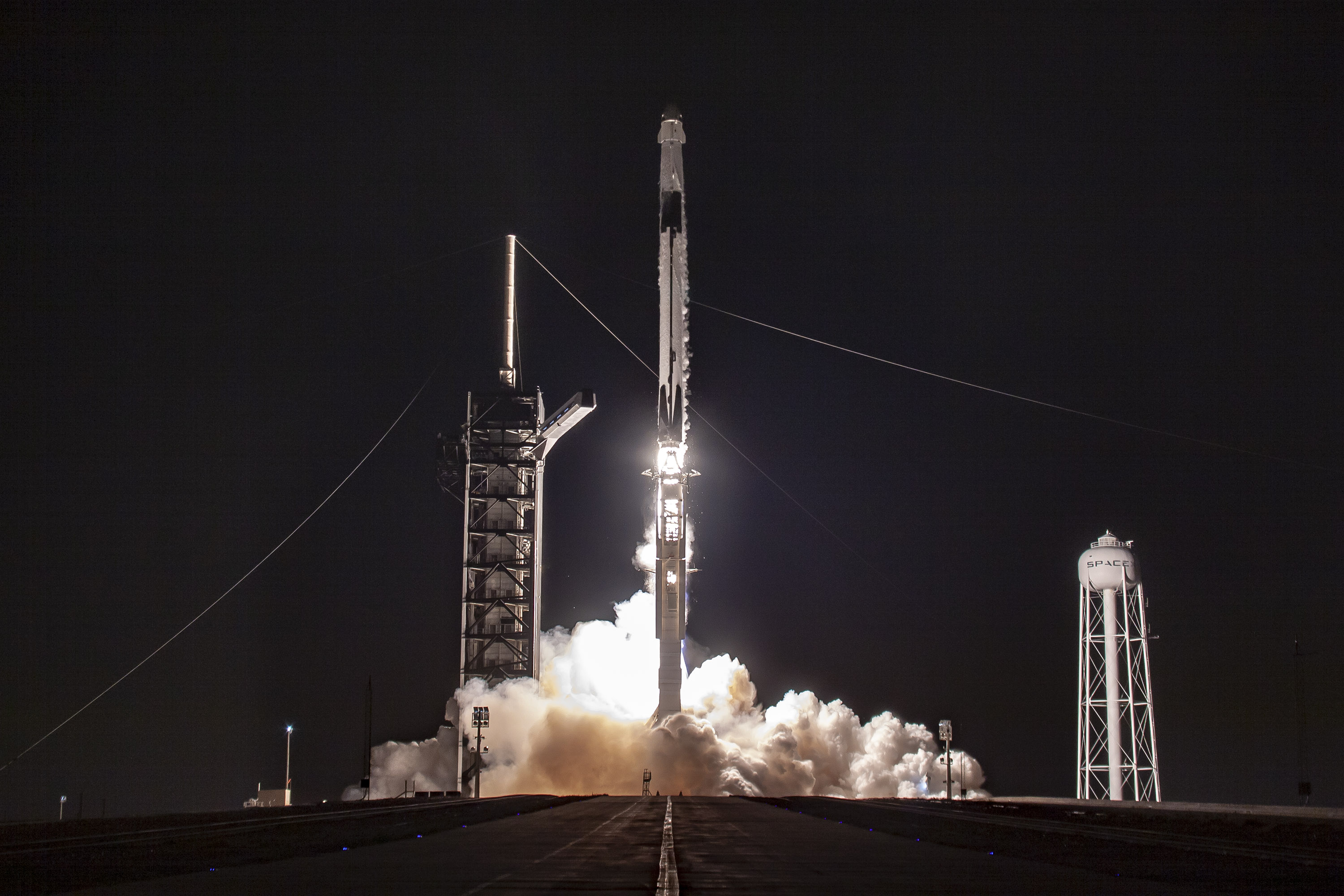
March 2, 2019 liftoff of the SpaceX Falcon 9 rocket carrying the company’s Crew Dragon spacecraft on its historic inaugural flight to the International Space Station.

Get The Details…

Mark Garcia