Station Preps for Japan, US Ship Operations Next Month

Station Preps for Japan, US Ship Operations Next Month

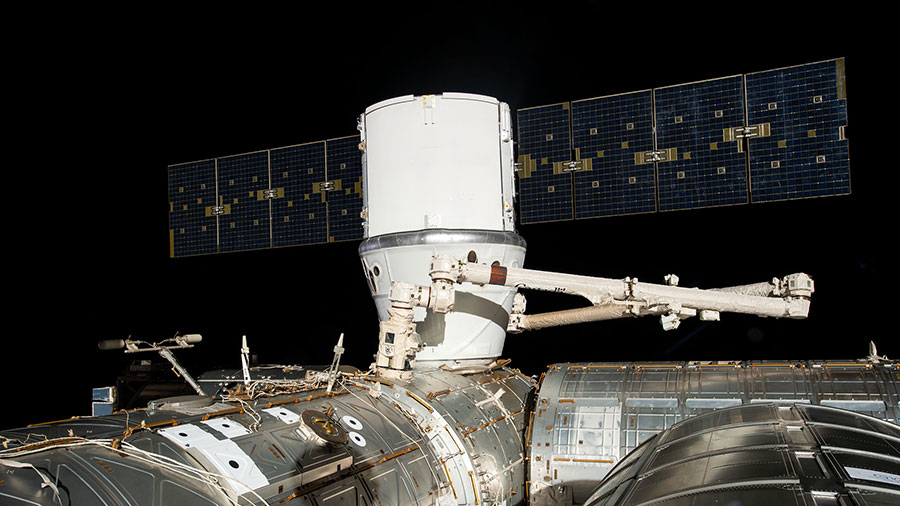
The H-II Transfer Vehicle-7 (HTV-7) from the Japan Aerospace Exploration Agency
The H-II Transfer Vehicle-7 (HTV-7) from the Japan Aerospace Exploration Agency (JAXA) is viewed from one of seven windows inside the cupola, the International Space Station’s “window to the world.” The orbital complex was flying at an altitude of about 257 miles off the coast of Canada above the Gulf of St. Lawrence.

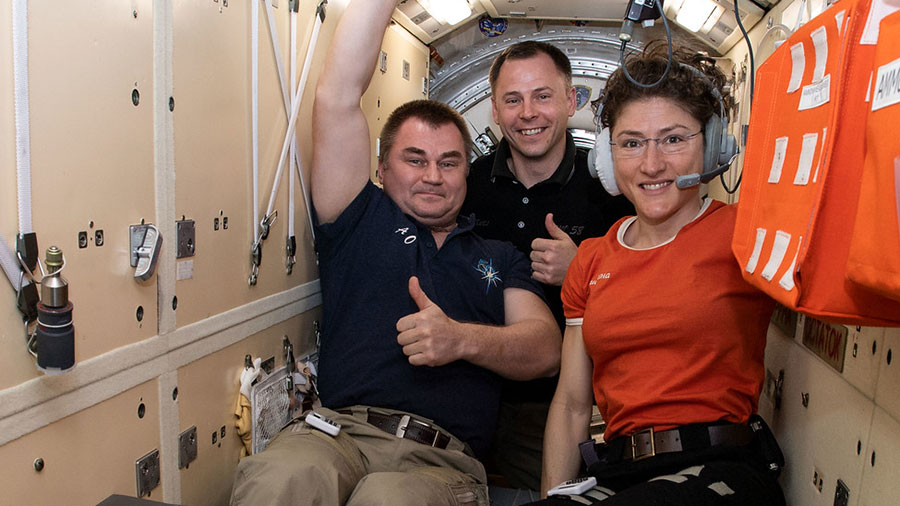
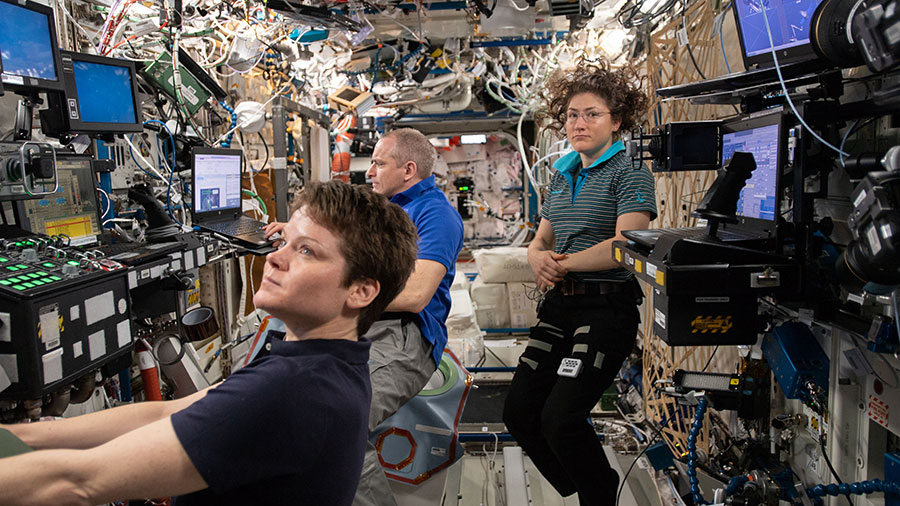
The International Space Station is getting ready for Japanese and U.S. cargo ship operations next month. In the meantime, the three residents onboard the orbital lab today configured science hardware and checked out safety gear.

Serena Auñón-Chancellor from NASA worked in the Japanese Kibo laboratory today replacing gear inside a Multi-Purpose Small Payload Rack (MSPR). The MSPR provides a workspace that supplies power and video enabling research into a variety of smaller experiments. She spent the majority of the day working on video cable connections and swapping out a computer in the MSPR.

She and Commander Commander Alexander Gerst started Tuesday practicing wearing and using breathing gear connected to an oxygen port in the event of a space emergency. Gerst then helped out with the MSPR work before the duo moved on to packing Japan’s HTV-7 resupply ship.

Sergey Prokopyev of Roscosmos worked out on a treadmill today to help Russian scientists understand how the human body is impacted by exercise in microgravity. He then spent the afternoon on computer and life support maintenance.

The packed HTV-7 is due to be removed from the Harmony module with the Canadarm2 and released back into Earth orbit in November. Its release will cap a 47 day stay at the station but the vehicle has one more mission before its fiery destruction over the Pacific Ocean. The HTV-7 will release a small reentry capsule for recovery in the Pacific Ocean by the Japan Aerospace Exploration Agency. The recovery mission is a test of the Japanese space agency’s ability to retrieve experiment samples safely and quickly from the station.

An American cargo ship is due to replenish the Expedition 57 crew a few days after the HTV-7 leaves. Northrup Grumman’s Cygnus space freighter will take a three-day trip in space before it is captured with the Canadarm2 and berthed to the Unity module. Cygnus will stay attached to the station for 86 days of cargo operations.

Get The Details…

Mark Garcia
{authorlink}
ISS

Powered by WPeMatico

Genetics, Vision and Earth Studies Aboard Station Today

Genetics, Vision and Earth Studies Aboard Station Today

The Northern European countries of Denmark, Germany, Sweden and Poland
The International Space Station was orbiting 257 miles above the English Channel when this photograph was taken of the Northern European countries of Denmark, Germany, Sweden and Poland. Japan’s H-II Transfer Vehicle-7, or HTV-7 resupply ship, is pictured at right attached the Harmony module.

Three Expedition 57 crew members are orbiting Earth today researching RNA sequencing and eye health aboard the International Space Station. The trio from the U.S., Germany and Russia also replaced combustion research hardware and activated Earth observation gear.

Flight Engineer Serena Auñón-Chancellor from NASA is helping scientists identify microbes and understand how their genetics change in space. She extracted and processed microbial samples today from swabbed station surfaces for later genetic sequencing using specialized hardware. Results will also help researchers observe how life adapts to the weightlessness of microgravity.

Auñón-Chancellor then observed and photographed samples for a protein crystal study to help doctors improve the development of disease-treating drugs. She then joined Commander Alexander Gerst of ESA (European Space Agency) for eye scans with an ultrasound device to learn how long-term missions affect vision.

Gerst started his day in the U.S. Destiny lab module replacing hardware inside the Combustion Integrated Rack that enables gas and flame studies. He later wrapped up the workday photographing how quartz and clay particles sediment in space.

Sergey Prokopyev of Roscosmos worked inside the Unity module setting up Earth photography gear for the long-running EarthKAM experiment. The study enables school students to remotely operate the station digital camera to photograph and download imagery of Earth landmarks such as coastlines and mountains.

Get The Details…

Mark Garcia
{authorlink}
ISS

Powered by WPeMatico

SSTV from Space for JOTA and Space Station Active

SSTV from Space for JOTA and Space Station Active

Serena Auñón-Chancellor KG5TMT

Serena Auñón-Chancellor KG5TMT

NASA astronaut Serena Auñón-Chancellor KG5TMT, who is currently on the International Space Station, was active on 145.800 MHz FM making contacts on Saturday, October 20 using the callsign NA1SS. Watch a video at https://twitter.com/supercazzola/status/1053659932292247552

The ISS packet radio digipeater on 145.825 MHz was active during Jamboree On The Air (JOTA) and Lauren 2E0HLR took advantage of this to demonstrate reception of APRS packets from the Space Station to Scouts, see https://twitter.com/G0PEKand2E0HLR/status/1053708000127578113

Adil Namakoe YD3HNL has released a video of the Slow Scan TV pictures he received during Jamboree On The Air from the amateur radio satellite IO-86

Watch IO-86 SSTV MODE #JOTA PASS 20102018

Adil Namakoe YD3HNL
https://twitter.com/adilnamakoe/
https://www.facebook.com/adil.namakoe

Get The Details…

m5aka

AMSAT-UK

Powered by WPeMatico

Liquid and Flame Science Work amid Japanese, Russian Maintenance

Liquid and Flame Science Work amid Japanese, Russian Maintenance

The Soyuz MS-09 crew ship (foreground) and the Progress 70 resupply ship
Two Russian spacecraft, the Soyuz MS-09 crew ship (foreground) and the Progress 70 resupply ship, are pictured docked to the International Space Station as the orbital complex orbited nearly 257 miles above Ukraine.

Two Expedition 57 astronauts are working to understand what happens to fluids being transported by spacecraft today. Another crew member also worked on combustion science gear as well as Japanese and Russian systems.

Fluid physics and combustion research on the International Space Station helps scientists understand how well-known phenomena on Earth behaves in microgravity. For instance, fluids sloshing around inside fuel tanks can impact how a spaceship steers in space. The way flames burn and create soot in space can also create safety issues for crews.

Flight Engineer Serena Auñón-Chancellor and Commander Alexander Gerst of ESA (European Space Agency) explored how fluids affect spacecraft maneuvers today. The duo set up a pair of tiny mobile satellites known as SPHERES for the test inside Japan’s Kibo lab module. The SPHERES Tether Slosh experiment is observing what happens when the satellites tow a liquid-filled tank versus a solid mass body with a Kevlar tether.

Sergey Prokopyev of Roscosmos opened up the Combustion Integrated Rack in the afternoon and replaced manifold bottles that contain gases for flame experiments. The flight engineer also packed items for disposal on a Japanese cargo ship and checked on Russian ventilation and air conditioning systems.

Get The Details…

Mark Garcia
{authorlink}
ISS

Powered by WPeMatico

Three Station Crew Explores Space Science After Hague Interview

Three Station Crew Explores Space Science After Hague Interview

The three Expedition 57 crew members
The three Expedition 57 crew members are gathered inside the cupola, the International Space Station’s “window to the world,” for a portrait wearing t-shirts displaying their home in space. From left are Sergey Prokopyev of Roscosmos, Serena Auñón-Chancellor of NASA and Alexander Gerst of ESA (European Space Agency). The space station was orbiting nearly 253 miles above the Solomon Islands in the South Pacific Ocean.

The three Expedition 57 crew members living aboard the International Space Station today explored a variety of phenomena impacted by exposure to microgravity. In Houston, NASA astronaut Nick Hague talked about his Soyuz contingency landing after last week’s failed ascent to orbit.

Flight Engineer Serena Auñón-Chancellor started Wednesday morning relocating samples collected from biology experiments into a Kibo lab module science freezer. The NASA astronaut then spent the rest of the day researching how to grow protein crystals real-time on the space station.

The commander, Alexander Gerst of ESA (European Space Agency), put on his plumber’s cap in the morning for maintenance on the orbital lab’s toilet. The German astronaut then spent the afternoon working on gear inside the Destiny lab module before updating a warning procedures book.

In the Russian segment of the orbital lab, cosmonaut Sergey Prokopyev split his time between physics and human research. The flight engineer started the day exploring how forces such as exercising or spacecraft dockings impact the station’s structure. He then participated in a study observing interactions between a space crew and Mission Control in Moscow.

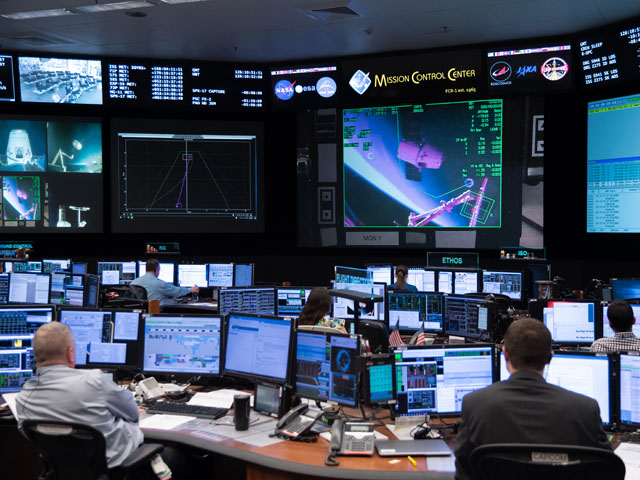
Finally, Hague talked to reporters and answered social media questions on Monday in Houston about his aborted mission to the station. The interviews and question and answer session was broadcast live on NASA TV and Facebook Live. The replay can also be seen on YouTube.

Get The Details…

Mark Garcia
{authorlink}
ISS

Powered by WPeMatico