The Marshall Star for March 20, 2024

The Marshall Star for March 20, 2024
22 Min Read

The Marshall Star for March 20, 2024

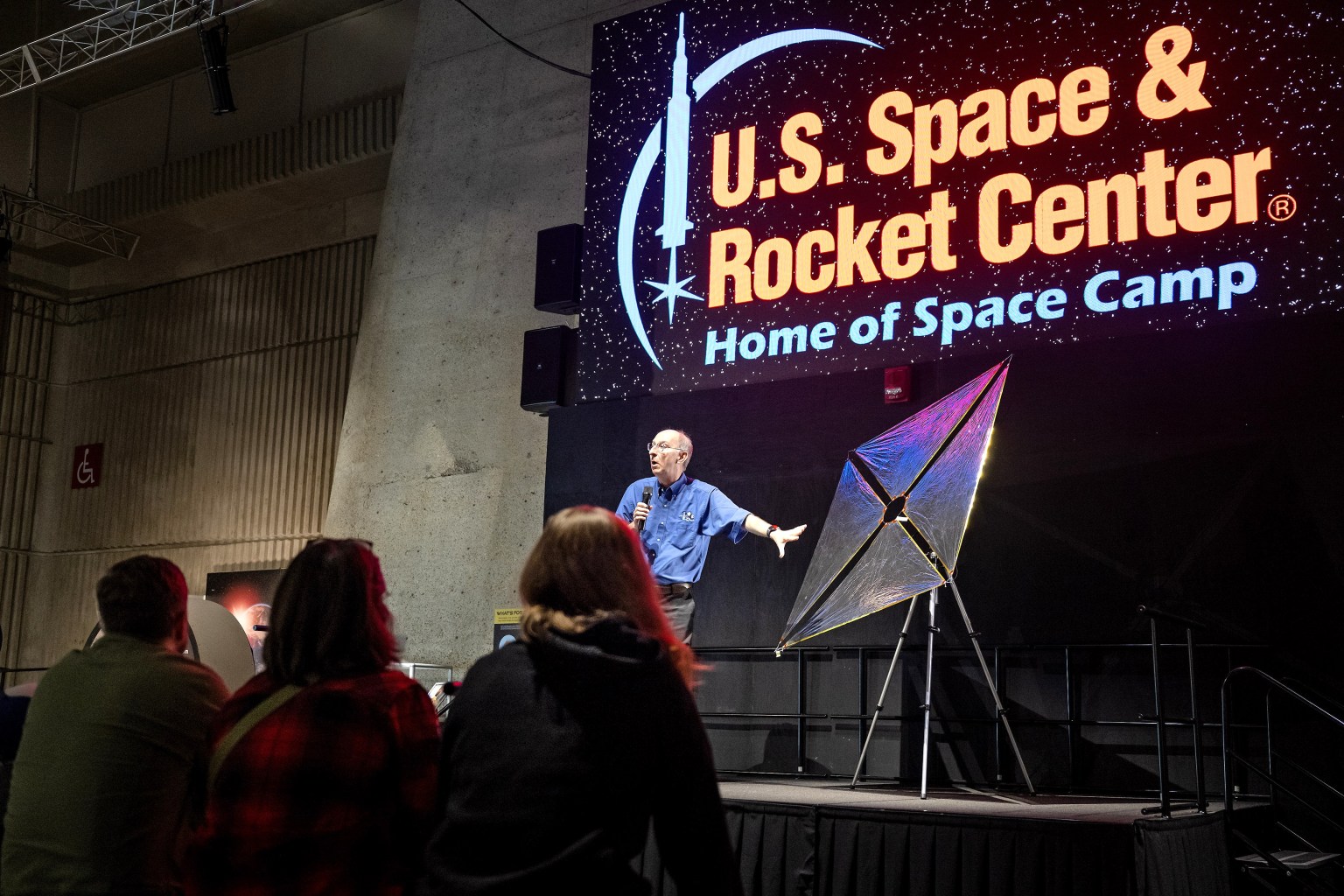
NASA technologist Les Johnson, on stage, discusses how the solar sail can use solar propulsion to travel farther in space than anyone has traveled before during an exhibit held March 12 at the U.S. Space & Rocket Center.

Marshall Technologist Talks Solar Sail Technology in Rocket Center Exhibit

By Jessica Barnett

Space enthusiasts at the U.S. Space & Rocket Center were treated to a special exhibit featuring technologist Les Johnson of NASA’s Marshall Space Flight Center and a look at the future of solar sail technology.
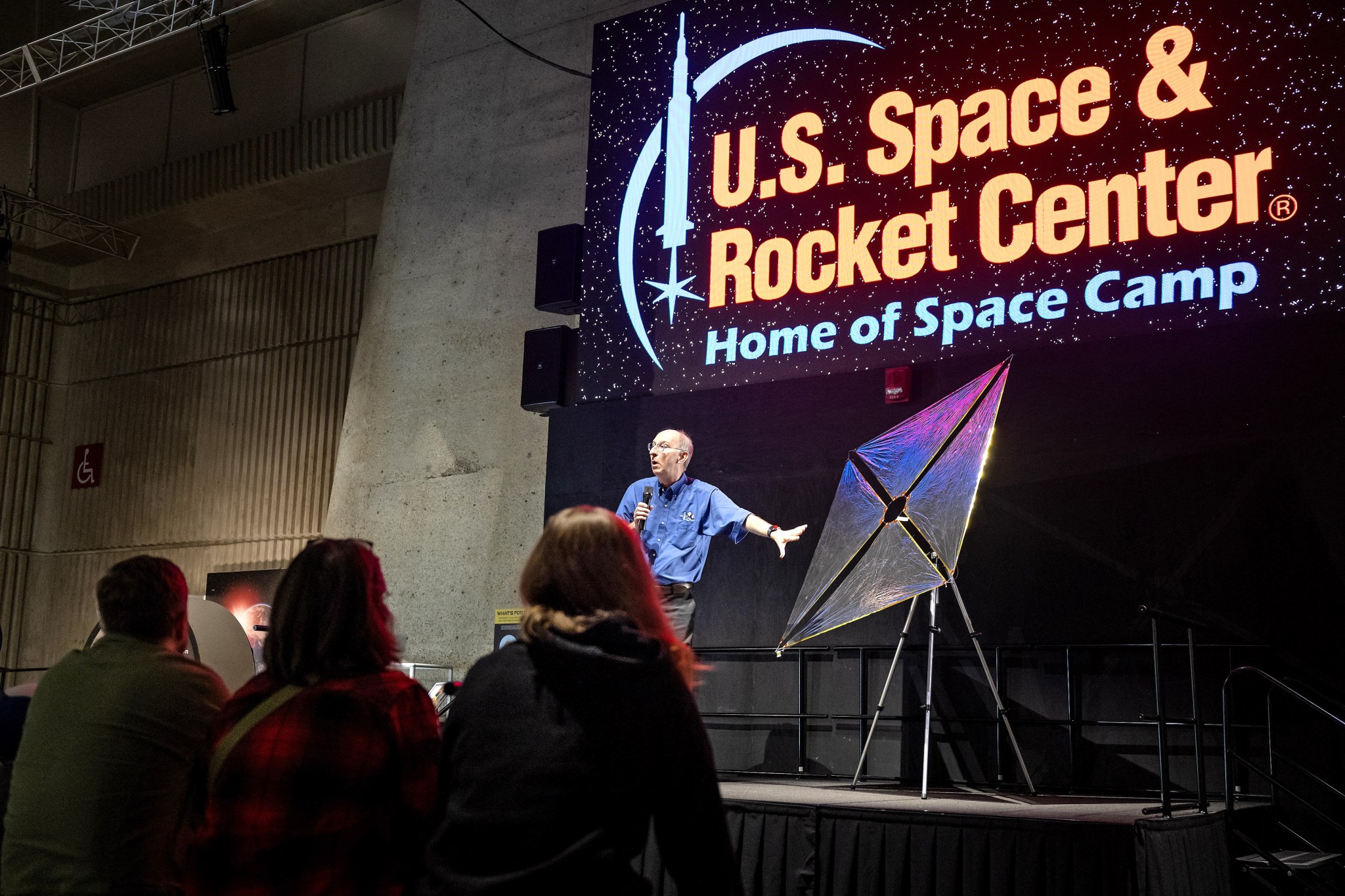
NASA technologist Les Johnson, on stage, discusses how the solar sail can use solar propulsion to travel farther in space than anyone has traveled before during an exhibit held March 12 at the U.S. Space & Rocket Center.
NASA/Charles Beason

Johnson shared the latest updates on the solar sail technology through brief presentations onstage in the Rocket Center’s atrium as well as one-on-one interactions with museum guests at the various displays set up near the stage. He discussed how the technology will work, showed a video of the solar sail team testing one of the sail’s four quadrants, and discussed what it could mean for the future of space exploration.

“I’m excited about this type of propulsion, because it’s free, it doesn’t run out of fuel, and you can use it to do amazing things in the future,” Johnson said. “We could build really big sails – 10 to 100 times bigger than the Solar Cruiser sail – and instead of using sunlight, we could shine lasers on it and go out in the solar system, literally where we’ve never been before.”

NASA continues to unfurl plans for solar sail technology as a promising method of deep space transportation. The agency cleared a key technology milestone in January with one of four identical solar sail quadrants successfully deploying. Together, the solar sail quadrants will make up the 17,800-square-foot sail.

Marshall leads the solar sail team, which includes Florida-based Redwire Corporation as prime contractor and Huntsville-based NeXolve as subcontractor.

Barnett, a Media Fusion employee, supports the Marshall Office of Communications.

› Back to Top

Robert Champion Named Manager of SLS Exploration Upper Stage Office at Marshall

Robert Champion has been named as manager of the SLS (Space Launch System) Exploration Upper Stage Office at NASA’s Marshall Space Flight Center, effective March 24th.

In his role, he will be responsible for the continued development of the exploration upper stage on the more powerful SLS Block 1B rocket, which is set to debut for the Artemis IV mission. Marshall manages the SLS Program.
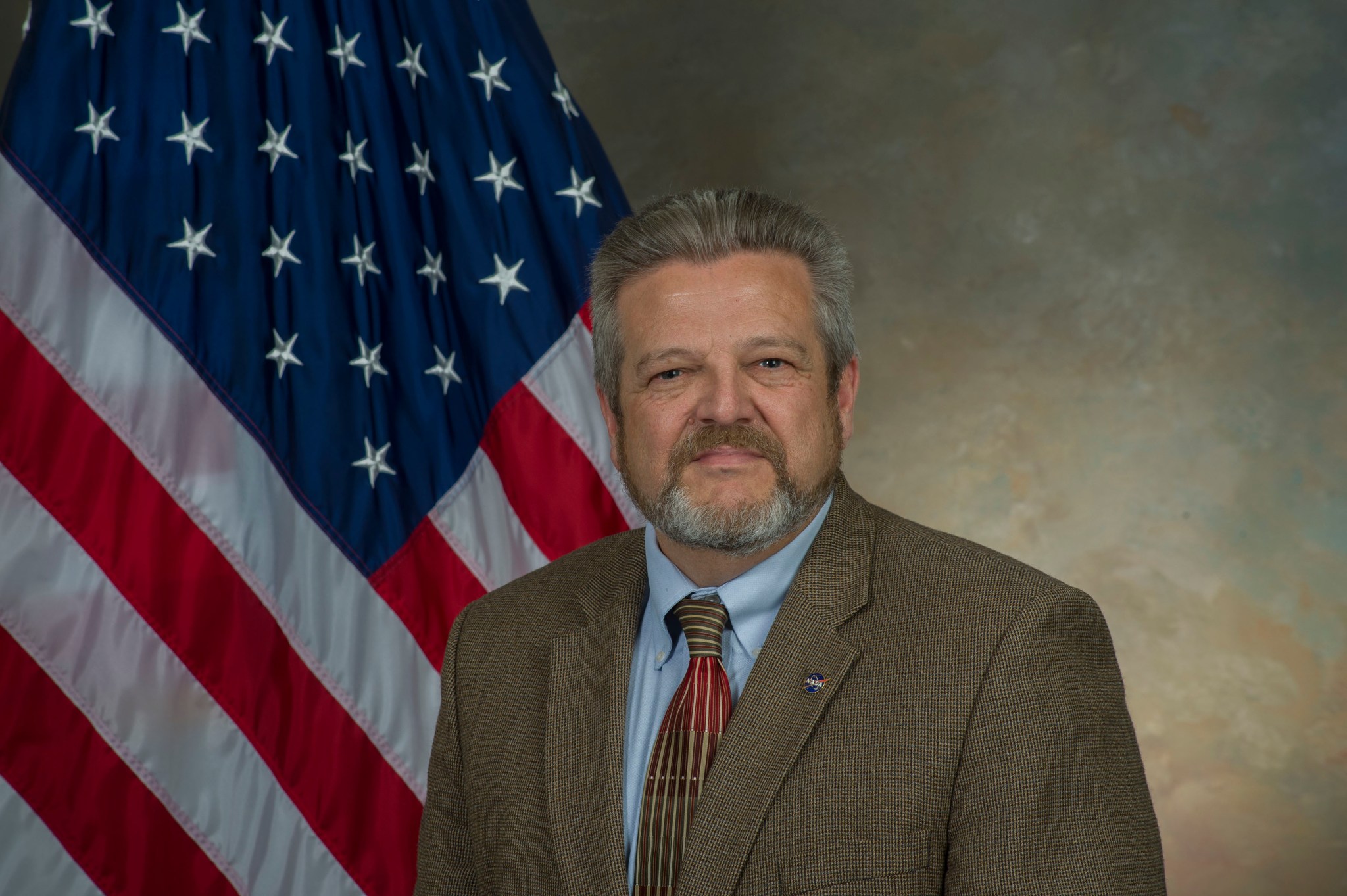
Robert Champion
Robert Champion has been named as manager of the SLS (Space Launch System) Exploration Upper Stage Office at NASA’s Marshall Space Flight Center.
NASA

Champion has been director of the Office of Center Operations at Marshall since 2021. In that role, he managed center services that included industrial labor relations, environmental engineering, occupational health, facility management, logistics and transportation, protective services, emergency management, and subordinate site operations.

Champion previously served as the director of NASA’s Michoud Assembly Facility in New Orleans from 2019 to 2021; deputy director of Marshall’s Propulsion Systems Department from 2015 to 2019; deputy director of Marshall’s Space Systems Department from 2014 to 2015; and deputy director at Michoud from 2010 to 2014.

His 37-year career at NASA has included leadership roles in engineering, program and project organizations focused on launch vehicle development, system engineering, and propulsion systems.

Champion has received several of NASA’s highest awards, including the Presidential Rank Award, the Exceptional Achievement Medal, the Medal for Exceptional Service, Space Flight Awareness Honoree, Director’s Commendation, and the Contracting Officers Technical Representative of the Year.  He was selected as an American Institute of Aeronautics and Astronautics Associate fellow and received the organization’s 2018-2019 Holger Toftoy Award for outstanding technical management in the fields of aeronautics and astronautics.

A native of Woodstock, Alabama, Champion holds a bachelor’s degree in aerospace engineering from Auburn University. He lives in Hazel Green with his wife, Maria Shelby. Combined, they have six adult children and six grandchildren.

› Back to Top

June Malone Named Director of the Office of Center Operations at Marshall 

June Malone has been named as director of the Office of Center Operations at NASA’s Marshall Space Flight Center, effective March 24.

With an annual budget of approximately $94 million, the organization includes 120 engineers and specialized civil servants and more than 500 contractors. Services provided by Center Operations include industrial labor relations, environmental engineering, occupational health, facility management, logistics and transportation, protective services, emergency management, and subordinate site operations.

June Malone
June Malone has been named as director of the Office of Center Operations at NASA’s Marshall Space Flight Center.
NASA

Malone has been director of the Office of Strategic Analysis & Communications at Marshall since 2021. In that role, she led the organization in providing strategic planning, objective analysis, and comprehensive communication to support the policy, program, and budget decisions for the center.

Malone has worked in a variety of leadership roles throughout her 30-year NASA career. She previously was manager for Marshall’s Office of Communications from 2019 to 2021, overseeing the center’s full communications portfolio, including media, social media, website content, exhibits, history, and employee communications. Previously in 2019, she worked in Marshall’s Office of Human Capital, where she established a new Human Resources Business Partner organization and operating model. She also held a year-long position in 2016-2017 as deputy director of the Office of Strategic Analysis & Communications.

From 2014-2016 and again 2017-2019, Malone was manager of Marshall’s Office of Communication, guiding media and social media for all center projects, programs, and activities, including crisis and risk communication. She has managed public affairs and media relations activities for the Space Shuttle Propulsion Projects Office, the Space Launch Initiative, the Advanced Space Transportation Program, and the full suite of science and engineering work at Marshall. She was the primary NASA spokesperson for the Space Shuttle Propulsion Projects Office, communicating with media and the public on technical subjects and controversial issues that included the Columbia accident and Return to Flight.

Prior to joining NASA in 1991, Malone was an active-duty Air Force officer from 1985-1991. She worked at the Pentagon on the secretary of the Air Force staff in the Office of Public Affairs as a public affairs officer, and subsequently at Tactical Air Command at Langley Air Force Base in Hampton, Virginia, during Operation Desert Storm. She formulated and implemented public affairs and media relations policy, strategic public affairs activities, and media relations plans.

Malone holds a bachelor’s degree in communications from Southern Illinois University and a master’s degree in communications research from The Florida State University in Tallahassee. Her awards include a Silver Snoopy, NASA Outstanding Leadership Medal, Air Force Meritorious Service Medal, and Rotary National Award for Communication.

An Illinois native, Malone and her husband, Roy, reside in Huntsville. Their son, Wil, is a NASA engineer, and their daughter, Madison, is a medical doctor in San Francisco.

› Back to Top

NASA Lights ‘Beacon’ on Moon with Autonomous Navigation System Test

By Rick Smith

For 30 total minutes in February, NASA lit a beacon on the Moon – successfully testing a sophisticated positioning system that will make it safer for Artemis-era explorers to visit and establish a permanent human presence on the lunar surface.
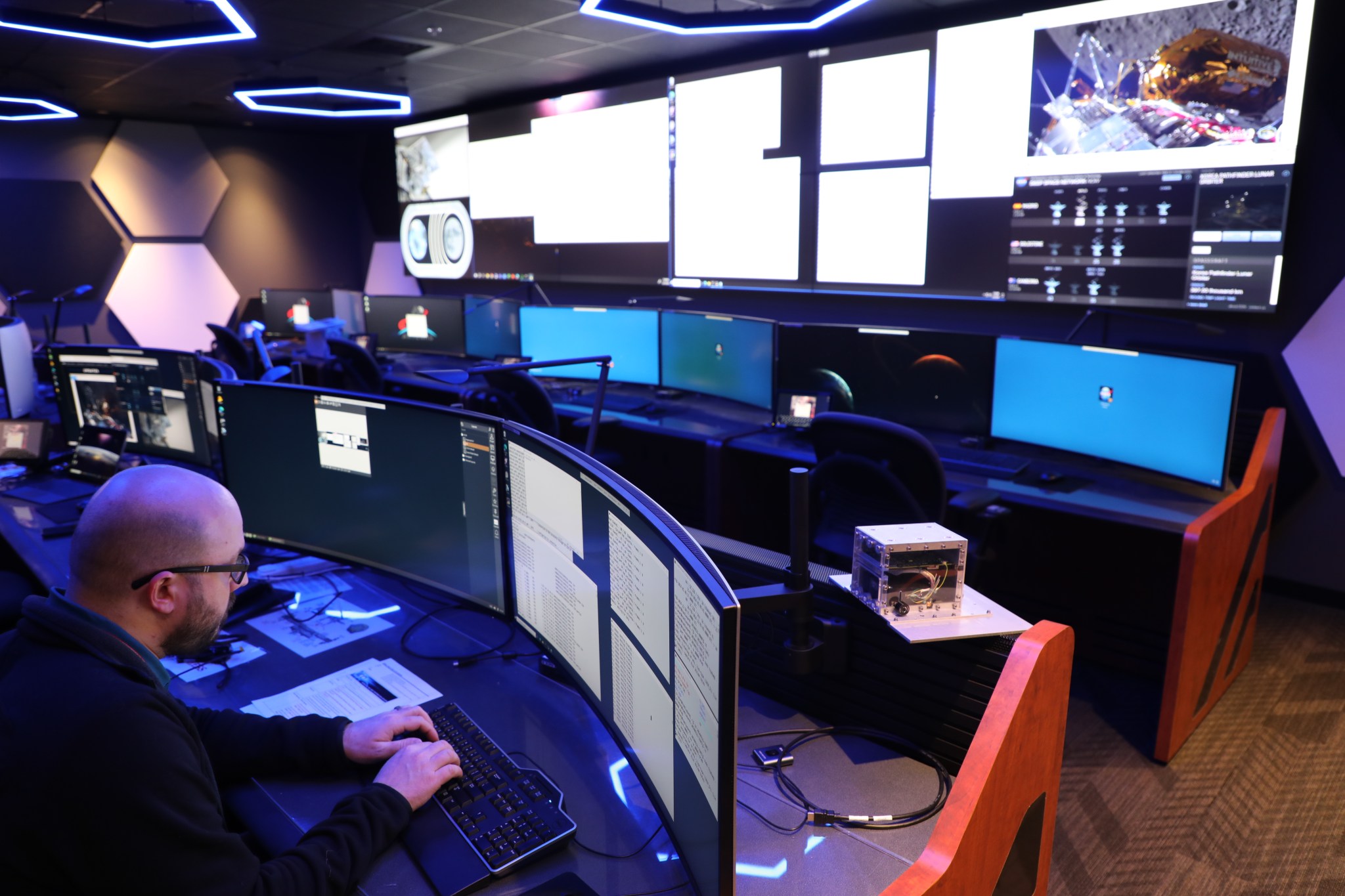
A man sits in front of a computer screen in a large control room with huge screens in the background.
Evan Anzalone, at lower left, principal investigator for the Lunar Node-1 demonstrator payload, monitors the LN-1 mission from the Lunar Utilization Control Area in the Huntsville Operations Support Center at NASA’s Marshall Space Flight Center. LN-1 successfully tested an autonomous navigation and geo-positioning system that will make Artemis-era lunar explorers safer as they work to establish a permanent human presence on the lunar surface.
NASA

The Lunar Node 1 demonstrator, or LN-1, is an autonomous navigation system intended to provide a real-time, point-to-point communications network on the Moon. The system – tested during Intuitive Machines’ IM-1 mission as part of NASA’s CLPS (Commercial Lunar Payload Services) initiative – could link orbiters, landers, and even individual astronauts on the surface, digitally verifying each explorer’s position relative to other networked spacecraft, ground stations, or rovers on the move.

That system would be a marked improvement over conventional, Earth-based radio data relays, NASA researchers said – even more so compared to Apollo-era astronauts trying to “eyeball” distance and direction on the vast, mostly grey lunar surface.

“We’ve lit a temporary beacon on the lunar shore,” said Evan Anzalone, LN-1 principal investigator at NASA’s Marshall Space Flight Center. “Now, we seek to deliver a sustainable local network – a series of lighthouses that point the way for spacecraft and ground crews to safely, confidently spread out and explore.”

The experiment was launched Feb. 15 as a payload on the IM-1 mission. The Nova-C lander, named Odysseus, successfully touched down Feb. 22 near Malapert A, a lunar impact crater near the Moon’s South Pole region, executing the first American commercial uncrewed landing on the Moon. The lander spent its subsequent days on the surface conducting six science and technology demonstrations, among them LN-1, before it officially powered down on Feb. 29.

“This feat from Intuitive Machines, SpaceX, and NASA demonstrates the promise of American leadership in space and the power of commercial partnerships under NASA’s CLPS initiative,” NASA Administrator Bill Nelson said in a statement after the landing. “Further, this success opens the door for new voyages under Artemis to send astronauts to the Moon, then on to Mars.” 

During IM-1’s translunar journey, the Marshall team conducted daily tests of the LN-1 beacon. The original plan was for the payload to transmit its beacon around the clock upon landing. NASA’s Deep Space Network, the international giant radio antenna array, would have received that signal for, on average, 10 hours daily.

Instead, due to the lander’s touchdown orientation, LN-1 conducted two 15-minute transmissions from the surface. DSN assets successfully locked on the signal, feeding telemetry, navigation measurements, and other data to researchers at Marshall, NASA’s Jet Propulsion Laboratory, and Morehead State University in Morehead, Kentucky. The team continues to evaluate the data.

LN-1 even provided critical backup to IM-1’s onboard navigation system, noted Dr. Susan Lederer, CLPS project scientist at NASA’s Johnson Space Center. The LN-1 team “really stepped up to the task,” she said, by relaying spacecraft positioning data during translunar flight to NASA’s Deep Space Network satellites at the Goldstone and Madrid Deep Space Communications Complexes in Fort Irwin, California, and Robledo de Chavela, Spain, respectively.
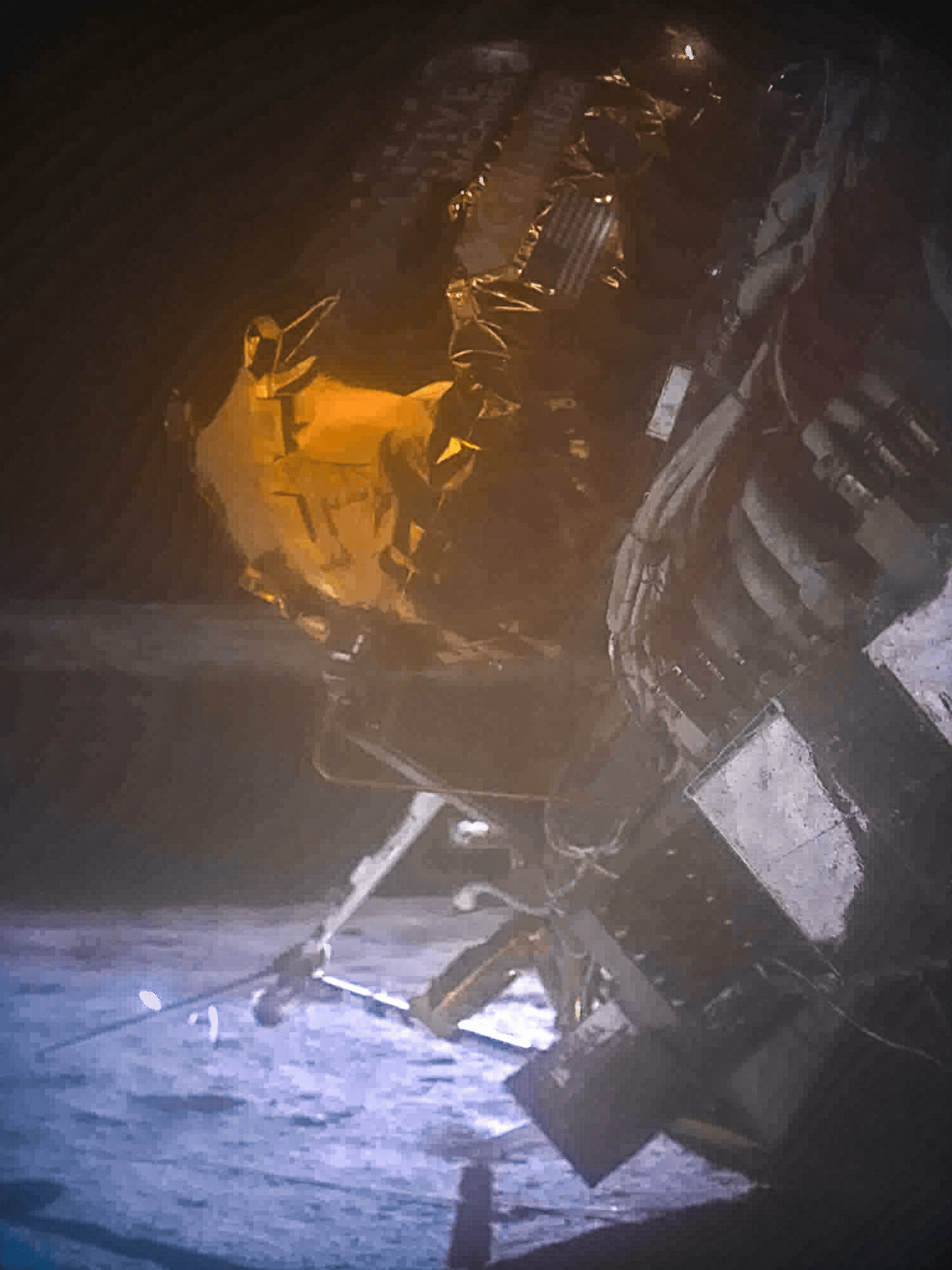
This image from the lander’s narrow-field-of-view camera was retrieved on Feb. 27. It shows spacecraft hardware in the foreground, and the gaping maw of a 2-billion-year-old lunar crater beyond. It’s approximately 500 meters to the near lip of the crater, and another 500 meters to its far side. Inky black space extends above the horizon.
Taken on Feb. 27, Odysseus captured an image using its narrow-field-of-view camera.
Intuitive Machines

In time, navigation aids such as Lunar Node-1 could be used to augment navigation and communication relays and surface nodes, providing increased robustness and capability to a variety of users in orbit and on the surface.

As the lunar infrastructure expands, Anzalone envisions LN-1 evolving into something akin to a network that monitors and maintains a busy metropolitan subway system, tracking every “train” in real time, and operating as one part of a larger, LunaNet-compatible architecture, augmenting other NASA and international investments, including the Japanese Aerospace Exploration Agency’s Lunar Navigation Satellite System.

And the technology promises even greater value to NASA’s Moon to Mars efforts, he said. LN-1 may improve data delivery to lunar explorers by just a matter of seconds over conventional relays – but real-time navigation and positioning becomes much more vital on Mars, where transmission delays from Earth can take up to 20 minutes.

“That’s a very long time to wait for a spacecraft pilot making a precision orbital adjustment, or humans traversing uncharted Martian landscapes,” Anzalone said. “LN-1 can make lighthouse beacons of every explorer, vehicle, temporary or long-term camp, and site of interest we send to the Moon and to Mars.”

Marshall engineers designed, developed, integrated, and tested LN-1 as part of the NPLP (NASA-Provided Lunar Payloads) project funded by the agency’s Science Mission Directorate. Marshall also developed MAPS (Multi-spacecraft Autonomous Positioning System), the underlying networked computer navigation software. MAPS previously was tested on the International Space Station in 2018, using NASA’s Space Communications and Navigations (SCaN) Testbed.

NASA’s CLPS initiative oversees industry development, testing, and launch of small robotic landers and rovers supporting NASA’s Artemis campaign. Learn more here.

Smith, an Aeyon/MTS employee, supports the Marshall Office of Communications.

› Back to Top

NASA Artemis Mission Progresses with SpaceX Starship Test Flight

As part of NASA’s Artemis campaign to return humans to the Moon for the benefit of all, the agency is working with SpaceX to develop the company’s Starship human landing system (HLS), which will land astronauts near the Moon’s South Pole during the Artemis III and Artemis IV missions. On March 14, SpaceX launched the third integrated flight test of its Super Heavy booster and Starship upper stage, an important milestone toward providing NASA with a Starship HLS for its Artemis missions.

SpaceX launched the third integrated flight test of its Super Heavy booster and Starship upper stage from the company’s Starbase orbital launch pad at 8:25 a.m. CT on March 14. This flight test is an important milestone toward providing NASA with a Starship HLS for its Artemis missions.
SpaceX

A complement of 33 Raptor engines, fueled by super-cooled liquid methane and liquid oxygen, powered the Super Heavy booster with Starship stacked on top, from the company’s Starbase orbital launch pad at 8:25 a.m. CDT. Starship, using six Raptor engines, separated from the Super Heavy booster employing a hot-staging technique to fire the engines before separation at approximately three minutes into the flight, in accordance with the flight plan. This was the third flight test of the integrated Super Heavy-Starship system.

“With each flight test, SpaceX attempts increasingly ambitious objectives for Starship to learn as much as possible for future mission systems development. The ability to test key systems and processes in flight scenarios like these integrated tests allows both NASA and SpaceX to gather crucial data needed for the continued development of Starship HLS,” said Lisa Watson-Morgan, HLS Program Manager at NASA’s Marshall Space Flight Center.

This test accomplished several important firsts that will contribute to the development of Starship for Artemis lunar landing missions. The spacecraft reached its expected orbit and Starship completed the full-duration ascent burn.

One objective closely tied to future Artemis operations is the transfer of thousands of pounds of cryogenic propellant between internal tanks during the spacecraft’s coast phase as part of NASA’s Space Technology Missions Directorate 2020 Tipping Point awards. The propellant transfer demonstration operations were completed, and the NASA-SpaceX team is currently reviewing the flight data that was received. This Tipping Point technology demonstration is one of more than 20 development activities NASA is undertaking to solve the challenges of using cryogenic fluids during future missions.

As a key step toward understanding how super-cooled propellant sloshes within the tanks when the engines shut down, and how that movement affects Starship’s stability while in orbit, engineers will study flight test data to assess the performance of thrusters that control Starship’s orientation in space. They are also interested to learn more about how the fluid’s movement within the tanks can be settled to maximize propellant transfer efficiency and ensure Raptor engines receive needed propellant conditions to support restart in orbit.

“Storing and transferring cryogenic propellant in orbit has never been attempted on this scale before,” said Jeremy Kenny, project manager, NASA’s Cryogenic Fluid Management Portfolio at Marshall. “But this is a game-changing technology that must be developed and matured for science and exploration missions at the Moon, Mars, and those that will venture even deeper into our solar system.”

Under NASA’s Artemis campaign, the agency will land the first woman, first person of color, and its first international partner astronaut on the lunar surface and prepare for human expeditions to Mars. Commercial human landing systems are critical to deep space exploration, along with the Space Launch System rocket, Orion spacecraft, advanced spacesuits and rovers, exploration ground systems, and the Gateway space station.

Read more about NASA’s Human Landing System.

› Back to Top

Evolved Adapter for Future NASA SLS Flights Readied for Testing

A test article of the universal stage adapter for NASA’s more powerful version of its SLS (Space Launch System) rocket arrived to Building 4619 at NASA’s Marshall Space Flight Center on Feb. 22 from Leidos in Decatur, Alabama.
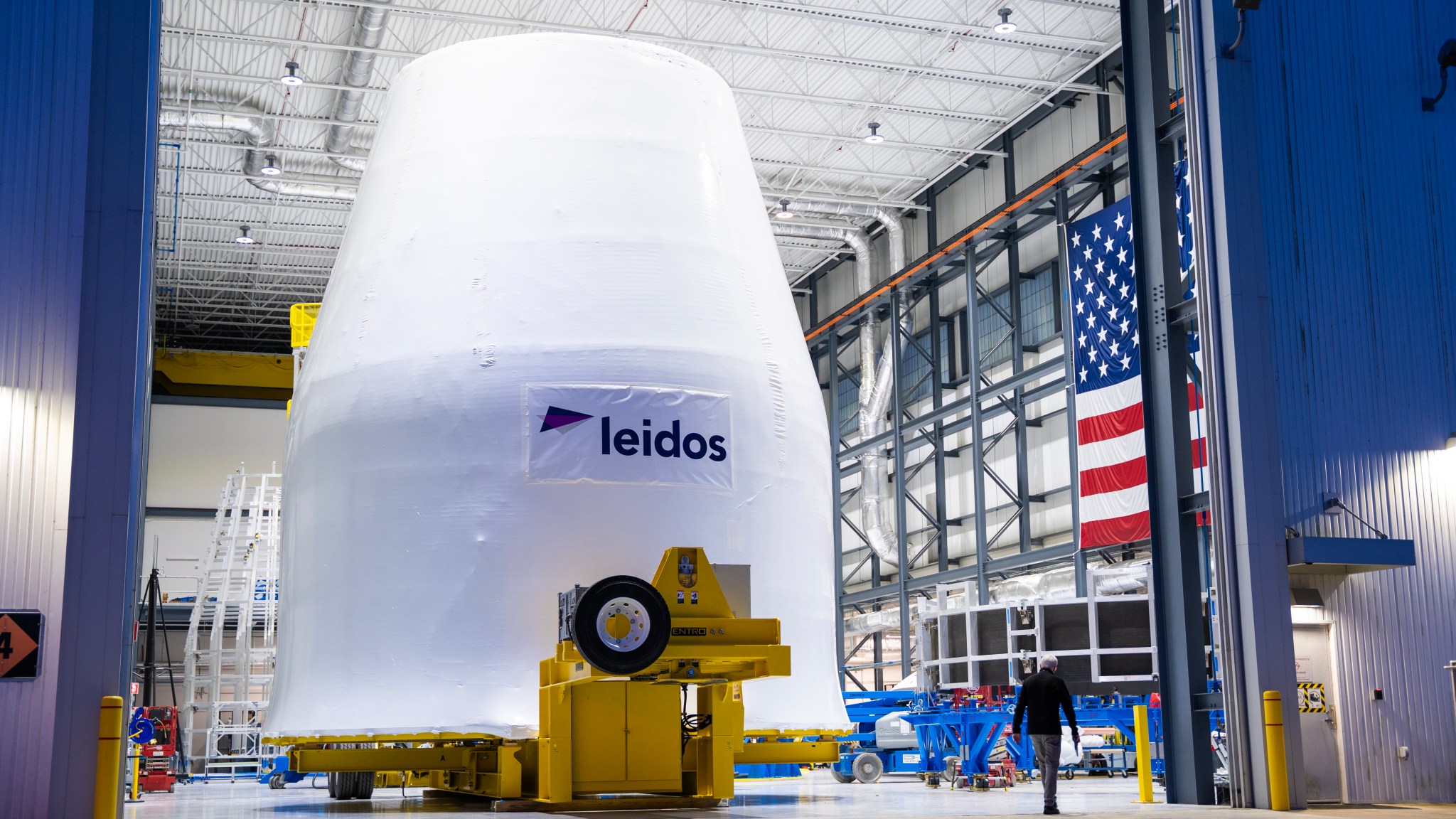
A test version of the universal stage adapter for the SLS (Space Launch System) rocket for Artemis 4 is seen inside Marshall Space Flight Center’s facility in Huntsville, Alabama. The adapter sits on a yellow piece of hardware. There is an American flag hanging on the wall to the right and the word “Leidos” is painted black on the white adapter.
A test article of the universal stage adapter for NASA’s more powerful version of its SLS (Space Launch System) rocket arrived to Building 4619 at NASA’s Marshall Space Flight Center on Feb. 22 from Leidos in Decatur, Alabama.
NASA/Sam Lott

The universal stage adapter will connect the rocket’s upgraded in-space propulsion stage, called the exploration upper stage, to NASA’s Orion spacecraft as part of the evolved Block 1B configuration of the SLS rocket. It will also serve as a compartment capable of accommodating large payloads, such as modules or other exploration spacecraft. The SLS Block 1B variant will debut on Artemis IV and will increase SLS’s payload capability to send more than 84,000 pounds to the Moon in a single launch.

In Building 4619’s Load Test Annex High Bay at Marshall, the development test article will first undergo modal testing that will shake the hardware to validate dynamic models. Later, during ultimate load testing, force will be applied vertically and to the sides of the hardware. Unlike the flight hardware, the development test article has flaws intentionally included in its design, which will help engineers verify that the adapter can withstand the extreme forces it will face during launch and flight.

The test article joins an already-rich history of rocket hardware that has undergone high-and-low pressure, acoustic, and extreme temperature testing in the multipurpose, high-bay test facility; it will be tested in the same location that once bent, compressed, and torqued the core stage intertank test article for SLS rocket’s Block 1 configuration. Leidos, the prime contractor for the universal stage adapter, manufactured the full-scale prototype at its Aerospace Structures Complex in Decatur.

NASA is working to land the first woman, first person of color, and its first international partner astronaut on the Moon under Artemis. SLS is part of NASA’s backbone for deep space exploration, along with the Orion spacecraft and Gateway in orbit around the Moon and commercial human landing systems, next-generational spacesuits, and rovers on the lunar surface. SLS is the only rocket that can send Orion, astronauts, and supplies to the Moon in a single launch.

Marshall manages the SLS and human landing system programs.

› Back to Top

NASA Study: Asteroid’s Orbit, Shape Changed After DART Impact

When NASA’s DART (Double Asteroid Redirection Test) deliberately smashed into a 560-foot-wide asteroid on Sept. 26, 2022, it made its mark in more ways than one. The demonstration showed that a kinetic impactor could deflect a hazardous asteroid should one ever be on a collision course with Earth. Now a new study published in the Planetary Science Journal shows the impact changed not only the motion of the asteroid, but also its shape.
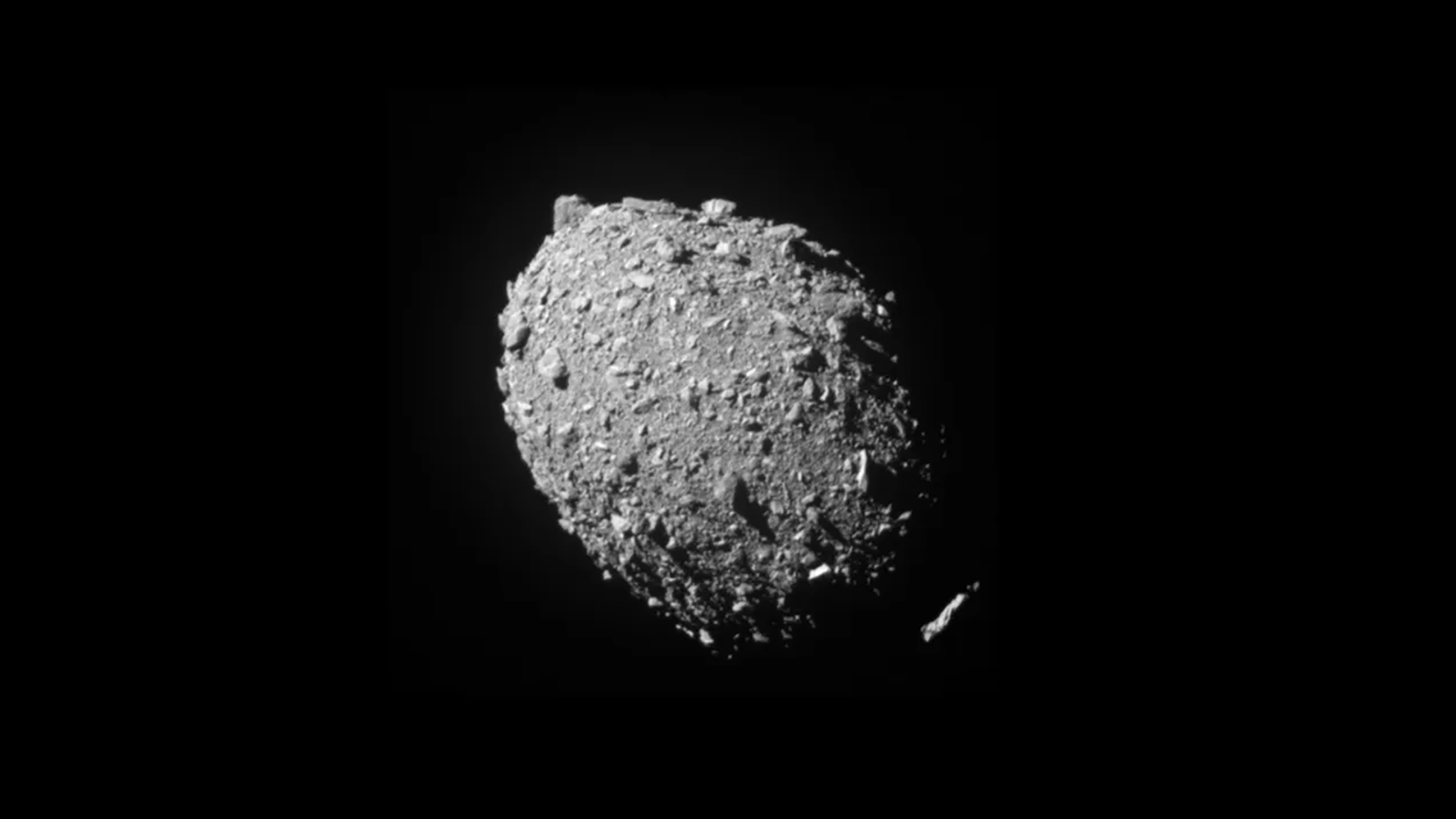
The asteroid Dimorphos was captured by NASA’s DART mission just two seconds before the spacecraft struck its surface on Sept. 26, 2022. Observations of the asteroid before and after impact suggest it is a loosely packed “rubble pile” object.
NASA/Johns Hopkins APL

DART’s target, the asteroid Dimorphos, orbits a larger near-Earth asteroid called Didymos. Before the impact, Dimorphos had a roughly symmetrical “oblate spheroid” shape – like a squashed ball that is wider than it is tall. With a well-defined, circular orbit at a distance of about 3,900 feet from Didymos, Dimorphos took 11 hours and 55 minutes to complete one loop around Didymos.

“When DART made impact, things got very interesting,” said Shantanu Naidu, a navigation engineer at NASA’s Jet Propulsion Laboratory in Southern California, who led the study. “Dimorphos’ orbit is no longer circular: Its orbital period” – the time it takes to complete a single orbit – “is now 33 minutes and 15 seconds shorter. And the entire shape of the asteroid has changed, from a relatively symmetrical object to a ‘triaxial ellipsoid’ – something more like an oblong watermelon.”

Naidu’s team used three data sources in their computer models to deduce what had happened to the asteroid after impact. The first source was aboard DART: The spacecraft captured images as it approached the asteroid and sent them back to Earth via NASA’s Deep Space Network (DSN). These images provided close-up measurements of the gap between Didymos and Dimorphos while also gauging the dimensions of both asteroids just prior to impact.

The second data source was the DSN’s Goldstone Solar System Radar, located near Barstow, California, which bounced radio waves off both asteroids to precisely measure the position and velocity of Dimorphos relative to Didymos after impact. Radar observations quickly helped NASA conclude that DART’s effect on the asteroid greatly exceeded the minimum expectations.

The third and most significant source of data: ground telescopes around the world that measured both asteroids’ “light curve,” or how the sunlight reflecting off the asteroids’ surfaces changed over time. By comparing the light curves before and after impact, the researchers could learn how DART altered Dimorphos’ motion.

As Dimorphos orbits, it periodically passes in front of and then behind Didymos. In these so-called “mutual events,” one asteroid can cast a shadow on the other, or block our view from Earth. In either case, a temporary dimming – a dip in the light curve – will be recorded by telescopes.

See the DART impact with NASA’s Eyes on the Solar System.

“We used the timing of this precise series of light-curve dips to deduce the shape of the orbit, and because our models were so sensitive, we could also figure out the shape of the asteroid,” said Steve Chesley, a senior research scientist at JPL and study co-author. The team found Dimorphos’ orbit is now slightly elongated, or eccentric. “Before impact,” Chesley continued, “the times of the events occurred regularly, showing a circular orbit. After impact, there were very slight timing differences, showing something was askew. We never expected to get this kind of accuracy.”
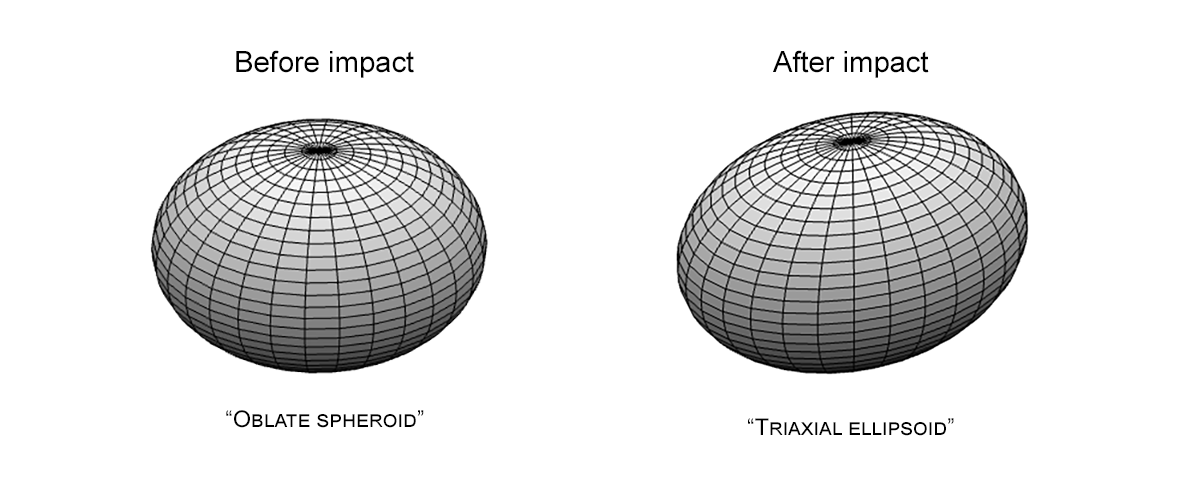
This illustration shows the approximate shape change that the asteroid Dimorphos experienced after DART hit it. Before impact, left, the asteroid was shaped like a squashed ball; after impact it took on a more elongated shape, like a watermelon.
NASA/JPL-Caltech

The models are so precise, they even show that Dimorphos rocks back and forth as it orbits Didymos, Naidu said.

The team’s models also calculated how Dimorphos’ orbital period evolved. Immediately after impact, DART reduced the average distance between the two asteroids, shortening Dimorphos’ orbital period by 32 minutes and 42 seconds, to 11 hours, 22 minutes, and 37 seconds.

Over the following weeks, the asteroid’s orbital period continued to shorten as Dimorphos lost more rocky material to space, finally settling at 11 hours, 22 minutes, and 3 seconds per orbit – 33 minutes and 15 seconds less time than before impact. This calculation is accurate to within 1 ½ seconds, Naidu said. Dimorphos now has a mean orbital distance from Didymos of about 3,780 feet – about 120 feet closer than before impact.

“The results of this study agree with others that are being published,” said Tom Statler, lead scientist for solar system small bodies at NASA Headquarters. “Seeing separate groups analyze the data and independently come to the same conclusions is a hallmark of a solid scientific result. DART is not only showing us the pathway to an asteroid-deflection technology, it’s revealing new fundamental understanding of what asteroids are and how they behave.”

These results and observations of the debris left after impact indicate that Dimorphos is a loosely packed “rubble pile” object, similar to asteroid Bennu. ESA’s (European Space Agency) Hera mission, planned to launch in October 2024, will travel to the asteroid pair to carry out a detailed survey and confirm how DART reshaped Dimorphos.

DART was designed, built, and operated by the Johns Hopkins Applied Physics Laboratory (APL) in Laurel, Maryland, for NASA’s Planetary Defense Coordination Office, which oversees the agency’s ongoing efforts in planetary defense. The mission is a project of the agency’s Planetary Mission Program Office, which is at NASA’s Marshall Space Flight Center. DART was humanity’s first mission to intentionally move a celestial object.

JPL, a division of Caltech in Pasadena, California, manages the DSN for NASA’s Space Communications and Navigation (SCaN) program within the Space Operations Mission Directorate at the agency’s headquarters.

› Back to Top

Crew, Cargo Launches to Space Station Scheduled for March 21

Equipment installs, health investigations, and training occupied the schedule aboard the International Space Station on March 19 as the seven orbital residents near the arrival of three crew members and a cargo delivery.
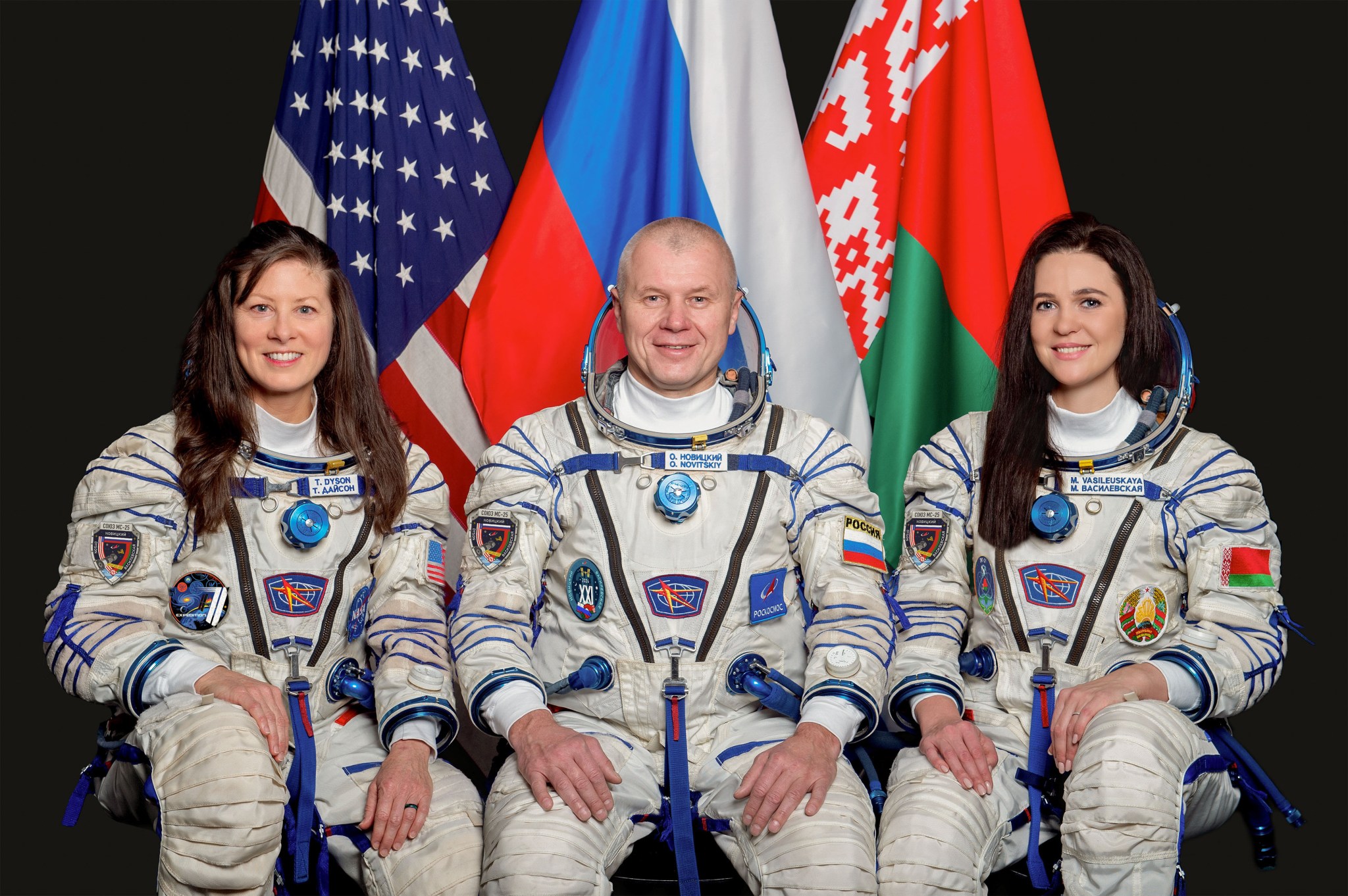
NASA astronaut Tracy C. Dyson, Roscosmos cosmonaut Oleg Novitskiy, and spaceflight participant Marina Vasilevskaya of Belarus pose for a portrait at the Gagarin Cosmonaut Training Center on Nov. 2, 2023.
Credits: GCTC/Andrey Shelepin

NASA’s SpaceX 30th commercial resupply mission to the station is scheduled for launch at 3:55 p.m. CDT March 21 from Space Launch Complex 40 in Florida. The Dragon cargo craft will deliver food, supplies, and new science investigations to the crew, including a set of sensors for the free-flying Astrobee robots and a new botany experiment to examine how two types of grass capture carbon dioxide from the atmosphere. Dragon will autonomously dock to the zenith port of the Harmony module at 6:30 a.m. March 23.

Ahead of Dragon’s liftoff, three crew members – NASA astronaut Tracy Dyson, cosmonaut Oleg Novitsky, and Flight Engineer Marina Vasilevskaya of Belarus – will launch from the Baikonur Cosmodrome in Kazakhstan at 8:21 a.m. March 21. The international crew will take a short ride to the station, docking only a few hours later at 11:39 p.m., before opening the hatch and joining the Expedition 70 crew in microgravity. Dyson will begin a six-month microgravity research mission once aboard, while Novitsky and Vasilevskaya will spend 12 days on station before departing back to Earth with NASA astronaut Loral O’Hara.

NASA TV will cover both launches beginning at 7:20 a.m. and 3:35 p.m. respectively.

Aboard station, the crew returned to work March 19 following a few days off-duty. Throughout the day, O’Hara and two of her NASA crewmates, Michael Barratt and Matthew Dominick, completed a round of SpaceX Dragon rendezvous training ahead of Dragon’s cargo arrival.

The HOSC (Huntsville Operations Support Center) at NASA’s Marshall Space Flight Center provides engineering and mission operations support for the space station, the Commercial Crew Program, and Artemis missions, as well as science and technology demonstration missions. The Payload Operations Integration Center within the HOSC operates, plans, and coordinates the science experiments onboard the space station 365 days a year, 24 hours a day.

› Back to Top

Europa Clipper Mission Highlighted on ‘This Week at NASA’

Technicians at NASA’s Kennedy Space Center recently fully extended the first of two five-panel solar arrays for the agency’s Europa Clipper spacecraft. The mission is featured in “This Week @ NASA,” a weekly video program broadcast on NASA-TV and posted online.

The 46.5-foot arrays also will be inspected and cleaned as part of assembly, test, and launch operations. Targeted for launch in October 2024, the mission will study Jupiter’s moon Europa, which is believed to have a global ocean beneath its icy crust that has more water than all of Earth’s oceans combined.

Managed by Caltech in Pasadena, California, JPL leads the development of the Europa Clipper mission in partnership with the Johns Hopkins Applied Physics Laboratory (APL) in Laurel, Maryland, for NASA’s Science Mission Directorate. APL designed the main spacecraft body in collaboration with JPL and NASA’s Goddard Space Flight Center. The Planetary Missions Program Office at NASA’s Marshall Space Flight Center executes program management of the Europa Clipper mission.

View this and previous episodes at “This Week @NASA” on NASA’s YouTube page.

› Back to Top

Powered by WPeMatico

Get The Details…
Lee Mohon
Following Safe Return, NASA’s SpaceX Crew-7 to Recount Space Mission
Following Safe Return, NASA’s SpaceX Crew-7 to Recount Space Mission
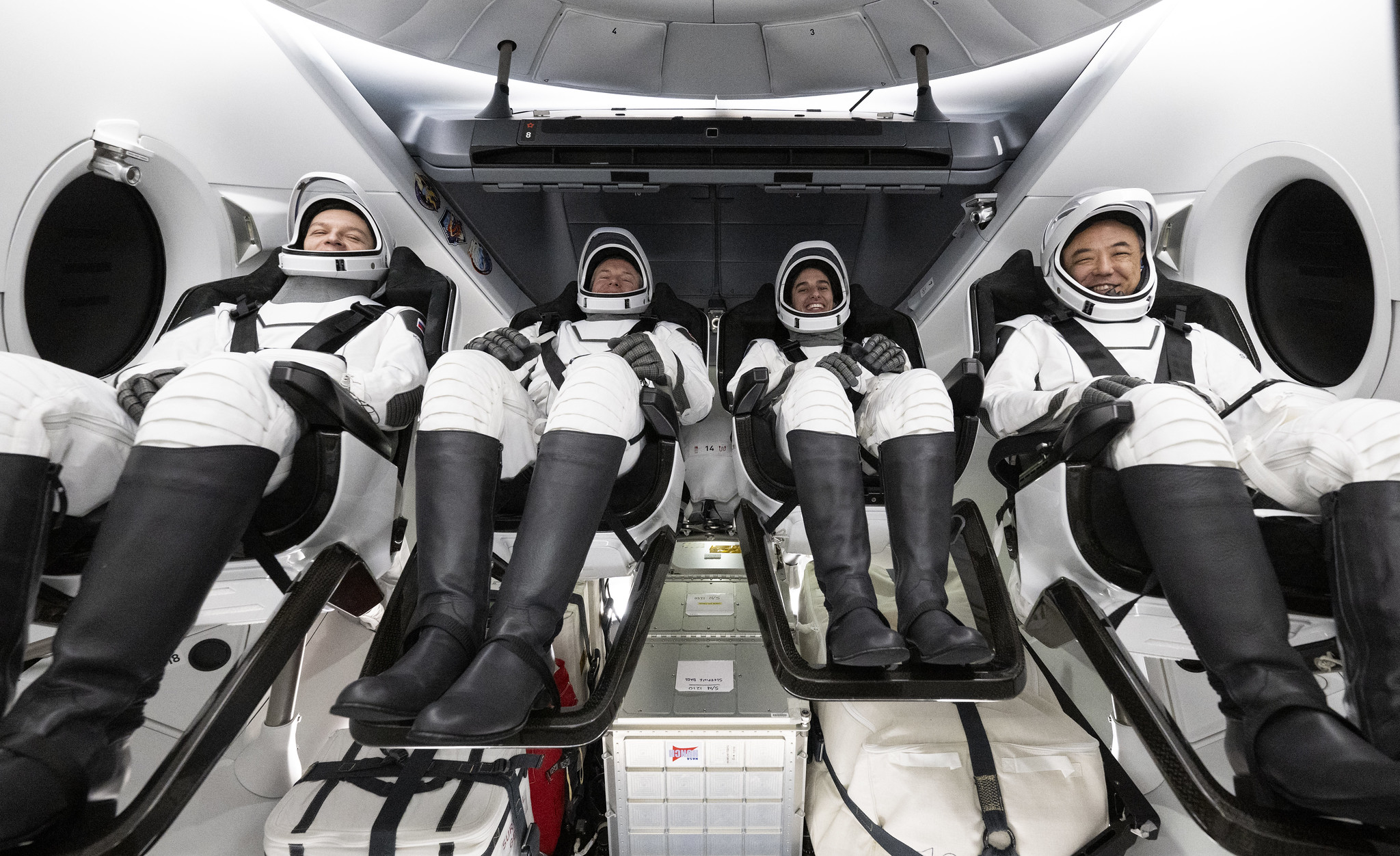
The four crew members of NASA’s SpaceX Crew-7 mission are seated inside the SpaceX Dragon spacecraft after landing in the Gulf of Mexico on March 12, 2024.
Credits: NASA/Joel Kowsky

After spending 199 days in space, NASA’s SpaceX Crew-7 crew members will discuss their science mission aboard the International Space Station during a news conference at 2:30 p.m. EDT Monday, March 25, at the agency’s Johnson Space Center in Houston.

NASA astronaut Jasmin Moghbeli, ESA (European Space Agency) astronaut Andreas Mogensen, JAXA (Japan Aerospace Exploration Agency) astronaut Satoshi Furukawa, and Roscosmos cosmonaut Konstantin Borisov returned to Earth aboard a SpaceX Dragon spacecraft, splashing down at 5:47 a.m., March 12, off the coast of Pensacola, Florida, before flying back to Houston. Crew will answer media questions about their mission aboard the space station and their return to Earth.

Event coverage will stream live on NASA+, NASA Television, and the agency’s website. Learn how to stream NASA TV through a variety of platforms including social media.

Media are invited to attend in-person or virtually. Media must RSVP to the Johnson newsroom no later than 12:30 p.m. March 25 at jsccommu@mail.nasa.gov or 281-483-5111. Media should dial-in to the news conference by 2 p.m. the day of the event to ask a question. Questions also may be submitted on social media using #AskNASA. A copy of NASA’s media accreditation policy is online.

The crew spent six-and-a-half months in space, with 197 days total aboard the space station. During the mission, Moghbeli completed a spacewalk, a first in her career, alongside NASA astronaut Loral O’Hara. It was the first spaceflight for Moghbeli and Borisov, and the second for Furukawa and Mogensen.

The crew lived and worked aboard the station since Aug. 26, 2023. During the mission, crew contributed to hundreds of experiments and technology demonstrations, including studying plant immune function in microgravity, testing materials in the space environment, and observing thunderstorms to understand the effects of lightning and electrical activity on Earth’s climate and atmosphere. These experiments are helping to prepare for exploration beyond low Earth orbit and to benefit life on Earth.

They spent five days with the newly arrived crew of NASA’s SpaceX Crew-8 mission, who docked to the station on March 5, and conducted a direct handover introducing three first-time flyers to the space station, discussing ongoing tasks and system statuses.

Get the latest NASA space station news, images, and features on Instagram, Facebook, and X.

Learn more about NASA’s Commercial Crew Program:

https://www.nasa.gov/commercialcrew

-end-

Josh Finch / Claire O’Shea
Headquarters, Washington
202-358-1100
joshua.a.finch@nasa.gov / claire.a.o’shea@nasa.gov

Chelsey Ballarte
Johnson Space Center, Houston
281-483-5111
chelsey.n.ballarte@nasa.gov

Powered by WPeMatico

Get The Details…
Tiernan P. Doyle

Meet the Women Launching, Recovering Artemis Missions 

Meet the Women Launching, Recovering Artemis Missions 

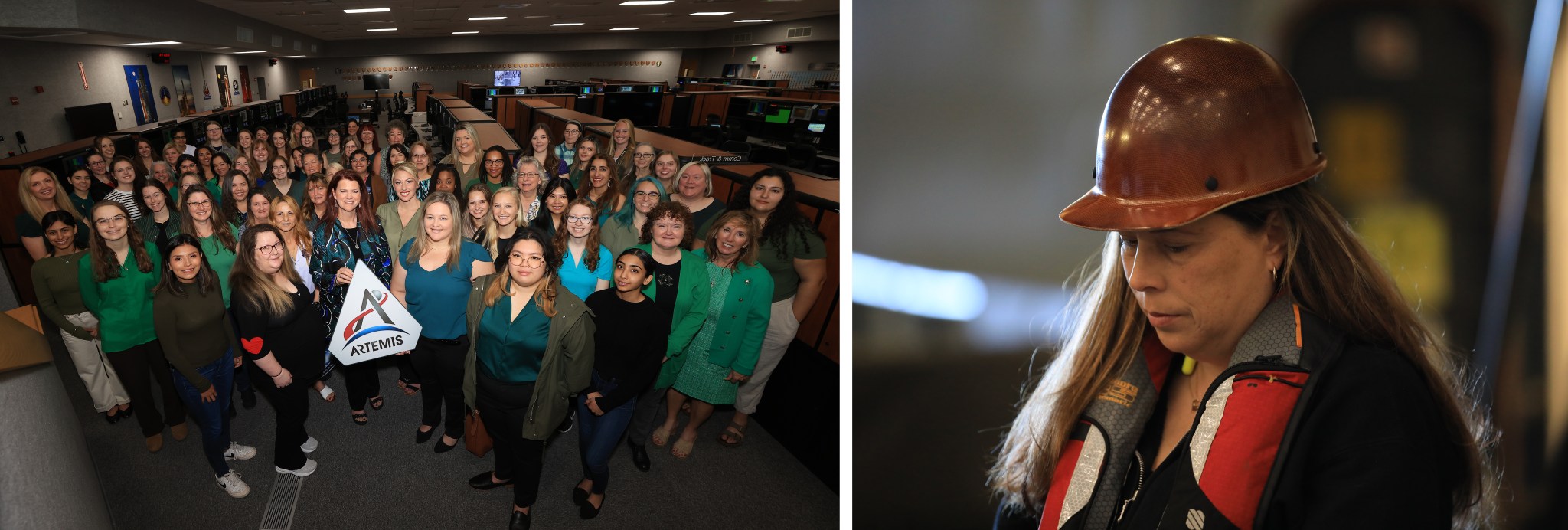
A photo collage of the women of Artemis and Liliana Villarreal.
NASA/Kim Shiflett and Isaac Watson

In celebration of Women’s History Month, NASA highlights the multifaceted group of women behind the launch and recovery efforts for Artemis missions. They are a driving force in preparing and planning for crewed missions and are helping inspire the next generation of space explorers – the Artemis Generation. 

On the left is Artemis Launch Director Charlie Blackwell-Thompson and some of the women of the launch team wearing green to symbolize they are “go” for launch. As the agency prepares to return to the Moon under Artemis, the teams in the launch control center at NASA’s Kennedy Space Center in Florida are responsible for launching the SLS (Space Launch System) rocket and Orion spacecraft. The team consists of about 30% women, in contrast to when there was only one woman sitting on launch console during the Apollo 11 Moon landing mission.  

On the right is Artemis Landing and Recovery Director Lili Villarreal during Underway Recovery Test-11. This most recent recovery test marked the first time teams and the Artemis II astronauts practiced the procedures and operations they will undergo after Orion splashes down in the Pacific Ocean at the end of the Artemis II test flight.  

Powered by WPeMatico

Get The Details…
Antonia Jaramillo

55 Years Ago: Four Months Until the Moon Landing

55 Years Ago: Four Months Until the Moon Landing

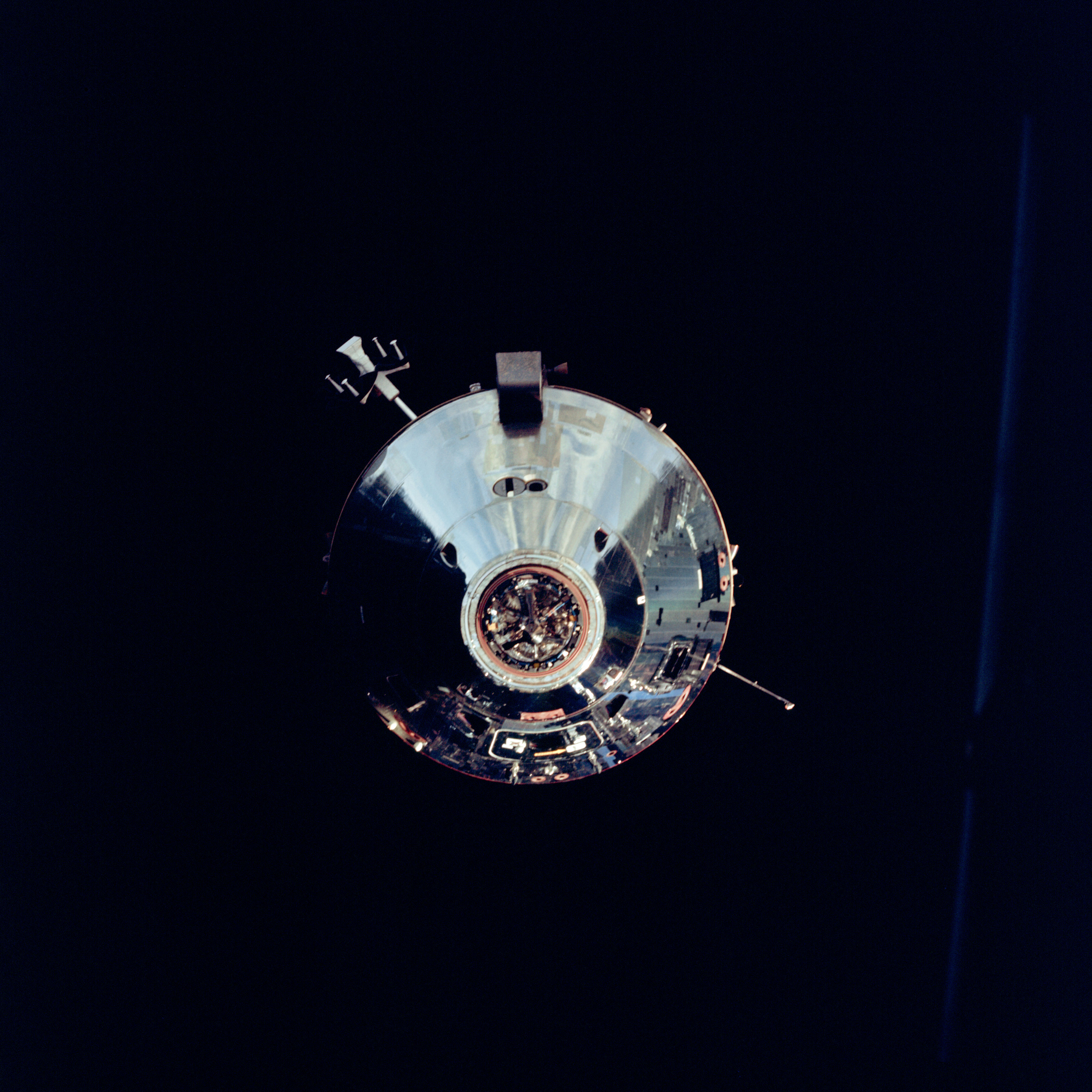
The road to the Moon landing cleared a major hurdle in March 1969 with the flight of Apollo 9 that tested all components of the spacecraft in low Earth orbit. Astronauts James A. McDivitt and Russell L. Schweickart flew the Lunar Module (LM) Spider while David R. Scott awaited their return in the Command Module (CM) Gumdrop. The success of Apollo 9 paved the way for Apollo 10, the next mission planned for May, to test the combined spacecraft in lunar orbit. Preparations for Apollo 10 continued with the rollout of the Saturn V to its launch pad. And if that dress rehearsal mission completed all its objectives, Apollo 11 could achieve the first Moon landing in July. The astronauts for that mission continued their training as engineers tested the spacecraft and assembled the rocket.

Apollo 9

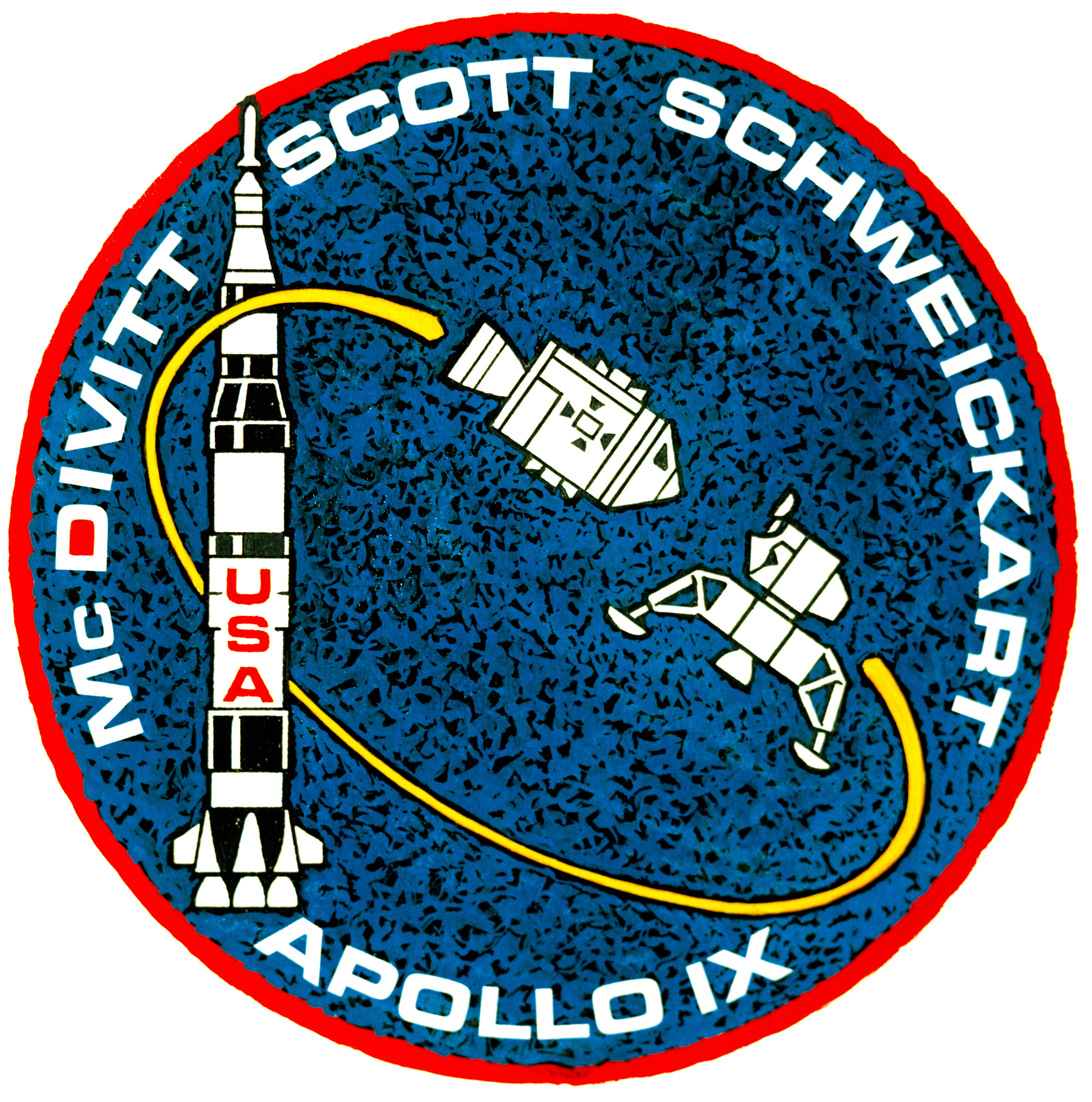
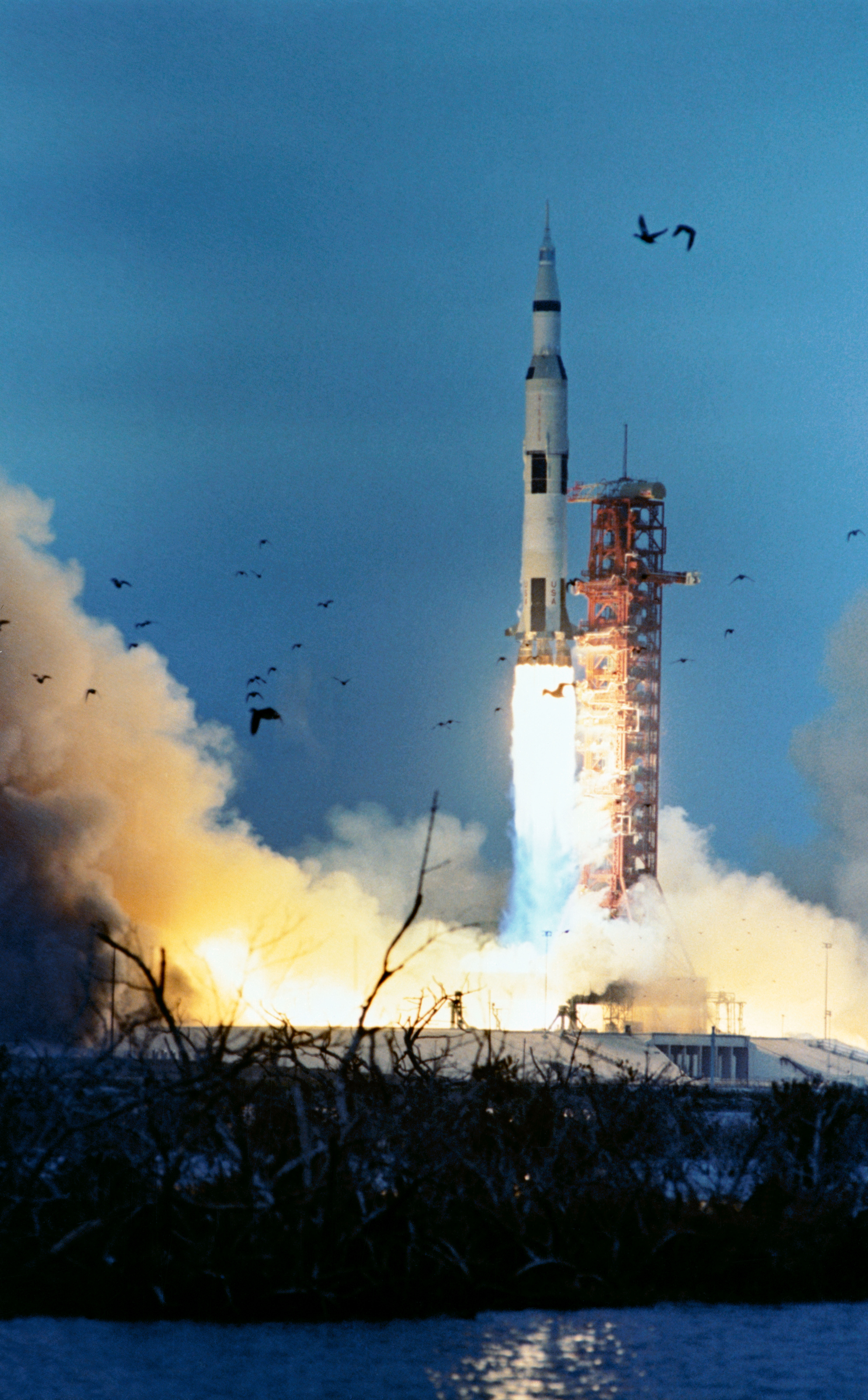
Apollo 9 astronauts James A. McDivitt, left, David R. Scott, and Russell L. Schweickart pose in front of their Saturn V rocket at NASA’s Kennedy Space Center in Florida The Apollo 9 crew patch Liftoff of Apollo 9
Left: Apollo 9 astronauts James A. McDivitt, left, David R. Scott, and Russell L. Schweickart pose in front of their Saturn V rocket at NASA’s Kennedy Space Center in Florida. Middle: The Apollo 9 crew patch. Right: Liftoff of Apollo 9!

At 11 a.m. on March 3, 1969, Apollo 9 lifted off from Launch Pad 39A at NASA’s Kennedy Space Center (KSC) in Florida. For only the second time, the giant Saturn V lifted three astronauts into space. Although planned for Feb. 28, managers delayed the liftoff by three days to give the astronauts time to recover from upper respiratory infections. The incident prompted NASA to institute a preflight medical quarantine for astronauts on future missions to minimize their risk of contracting infectious diseases.

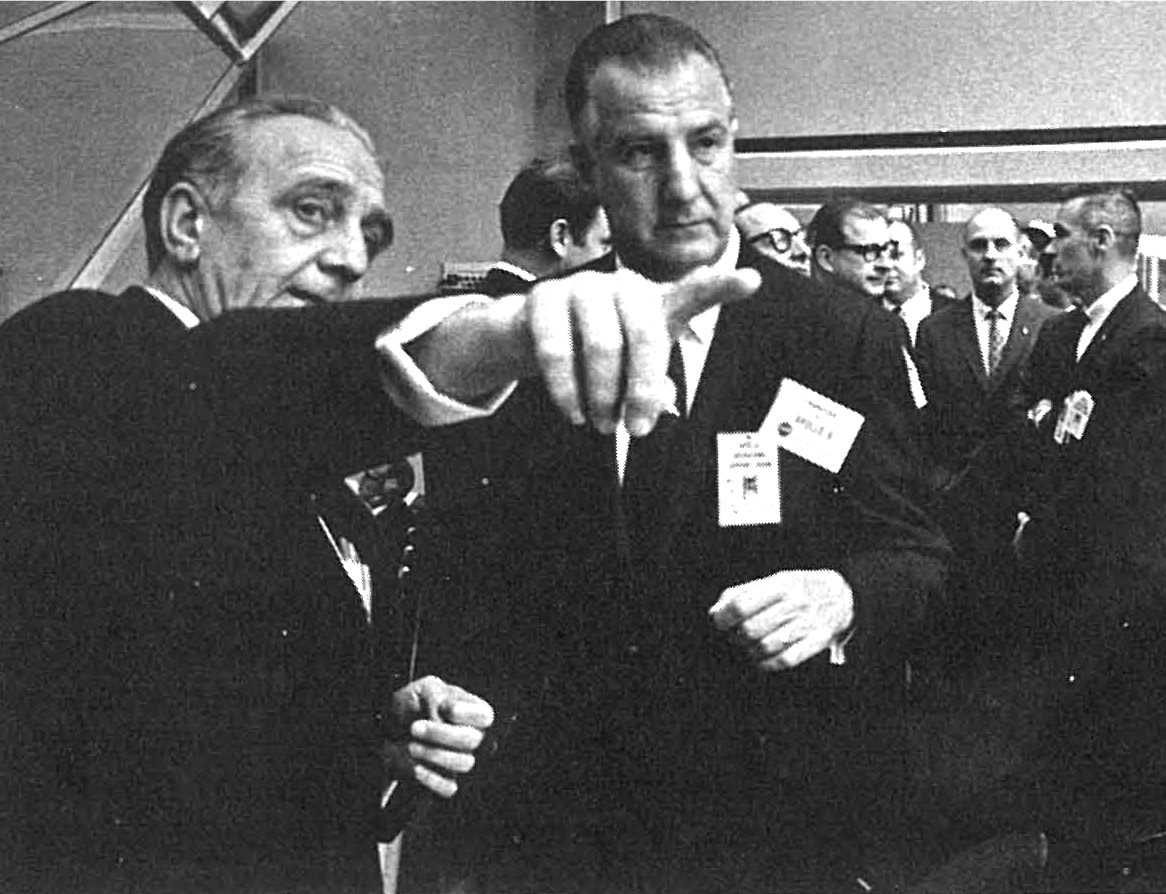
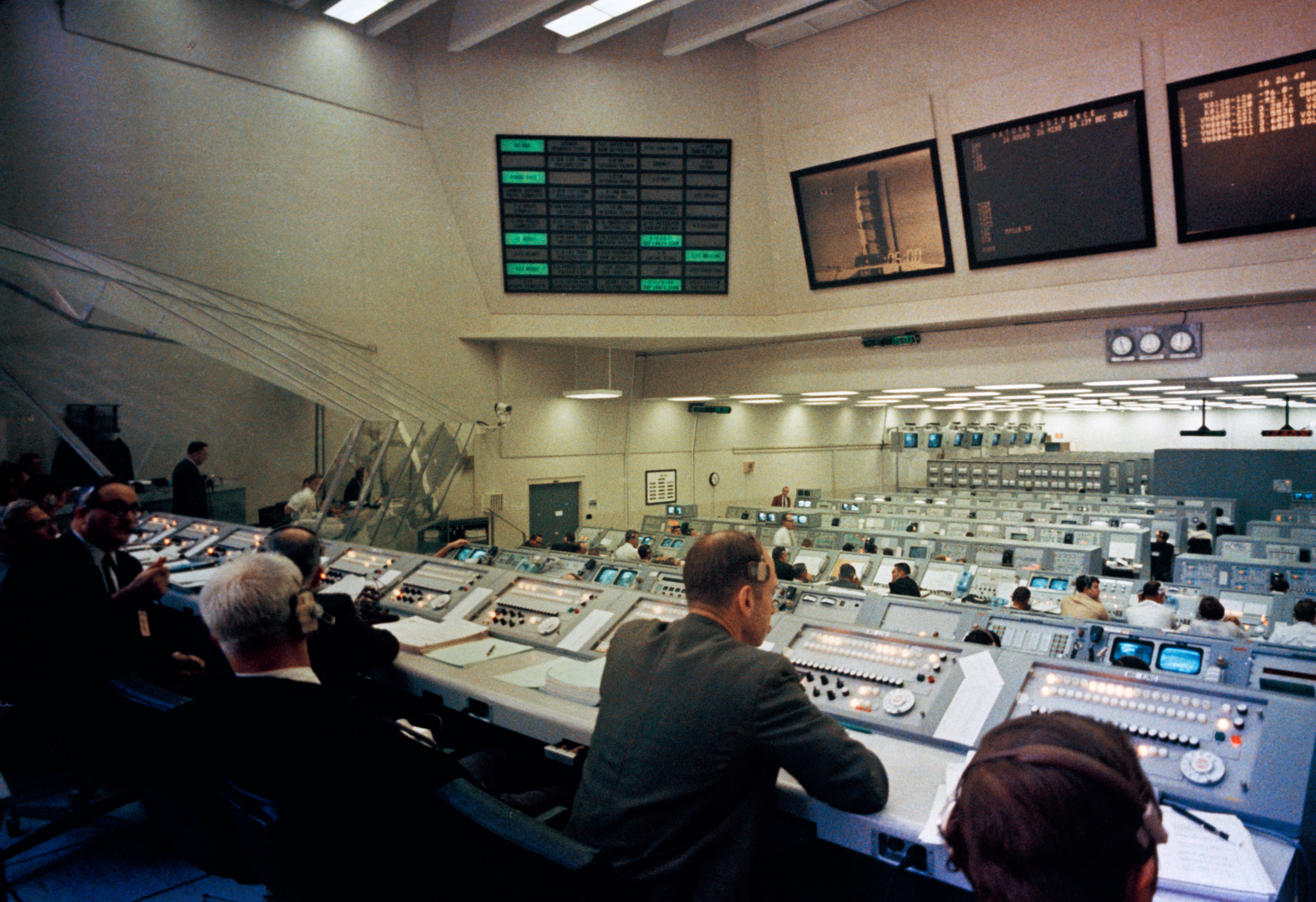
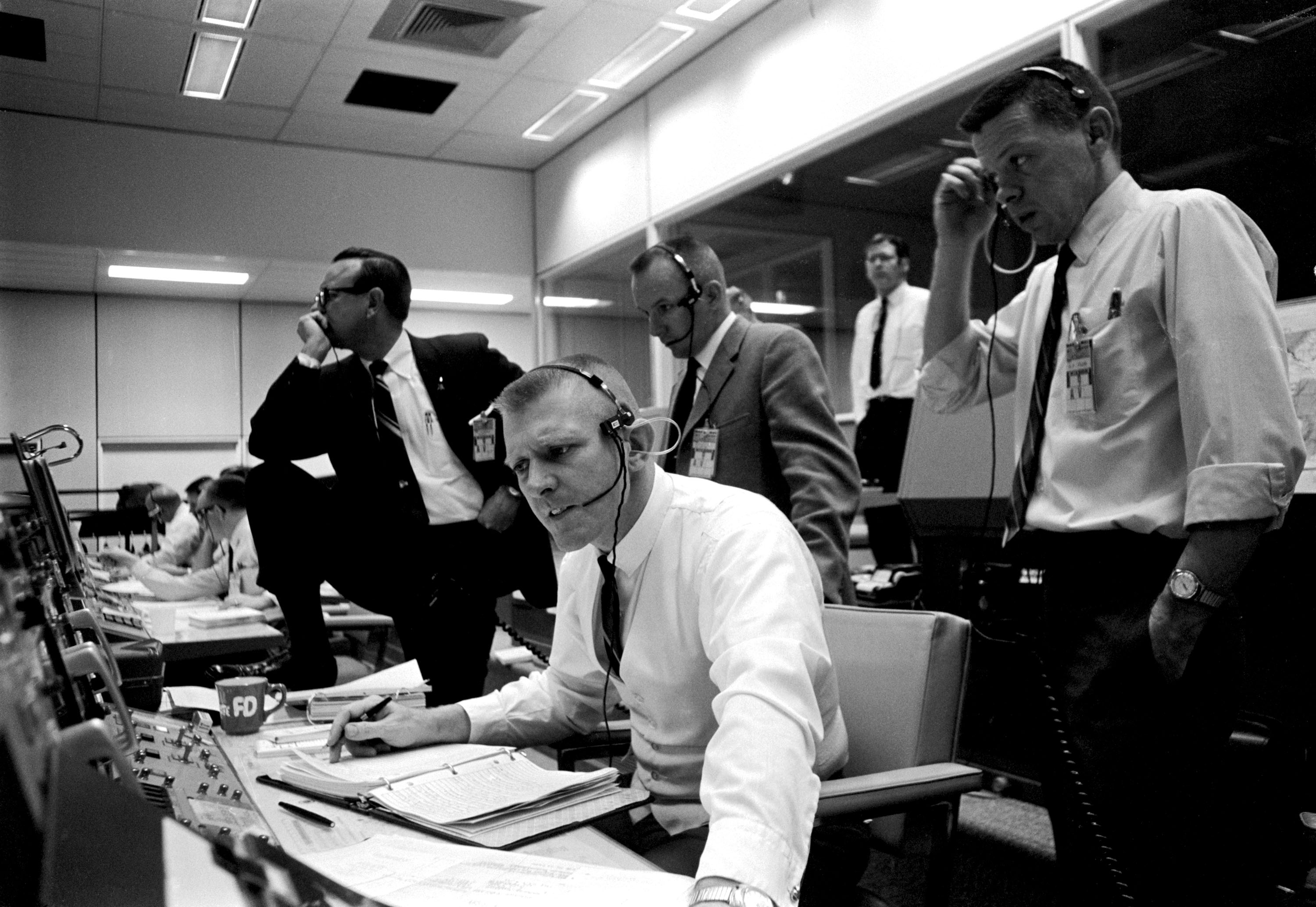
In the Launch Control Center (LCC) at NASA’s Kennedy Space Center (KSC) in Florida, KSC Director Kurt H. Debus, left, gives a tour to Vice President Spiro T. Agnew as they await the launch of Apollo 9 Controllers in the LCC’s Firing Room 2 monitor Apollo 9’s countdown In Mission Control at the Manned Spacecraft Center, now NASA’s Johnson Space Center in Houston, Apollo 9 Lead Flight Director Eugene F. Kranz, seated, monitors the flight’s progress
Left: In the Launch Control Center (LCC) at NASA’s Kennedy Space Center (KSC) in Florida, KSC Director Kurt H. Debus, left, gives a tour to Vice President Spiro T. Agnew as they await the launch of Apollo 9. Middle: Controllers in the LCC’s Firing Room 2 monitor Apollo 9’s countdown. Right: In Mission Control at the Manned Spacecraft Center, now NASA’s Johnson Space Center in Houston, Apollo 9 Lead Flight Director Eugene F. Kranz, seated, monitors the flight’s progress.

Controllers in Firing Room 2 of the Launch Control Center (LCC) monitored Apollo 9’s smooth countdown. Vice President Spiro T. Agnew, who chaired the National Aeronautics and Space Council, attended the launch, escorted by NASA Acting Administrator Thomas O. Paine and KSC Director Kurt H. Debus. As soon as the Saturn V cleared the launch tower, control of the flight switched from the LCC to Mission Control at the Manned Spacecraft Center (MSC), now NASA’s Johnson Space Center in Houston. Apollo 9 Lead Flight Director Eugene F. Kranz and his team of controllers monitored the launch. Eleven minutes after liftoff, the Saturn V’s three stages placed Apollo 9 in orbit around the Earth. During the 10-day mission, Flight Directors Gerald D. Griffin and M.P. “Pete” Frank took their turns along with Kranz leading their teams to monitor the flight.

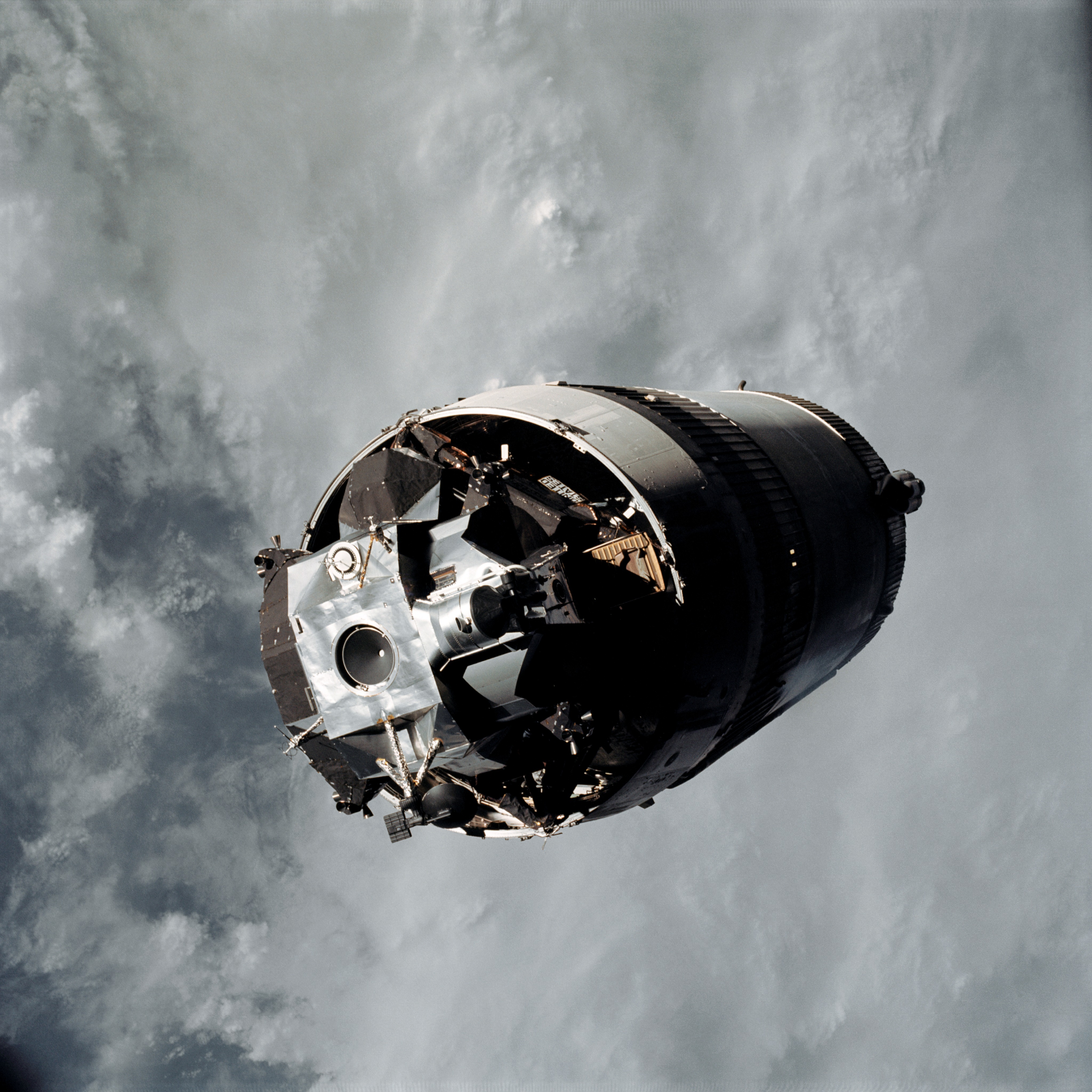
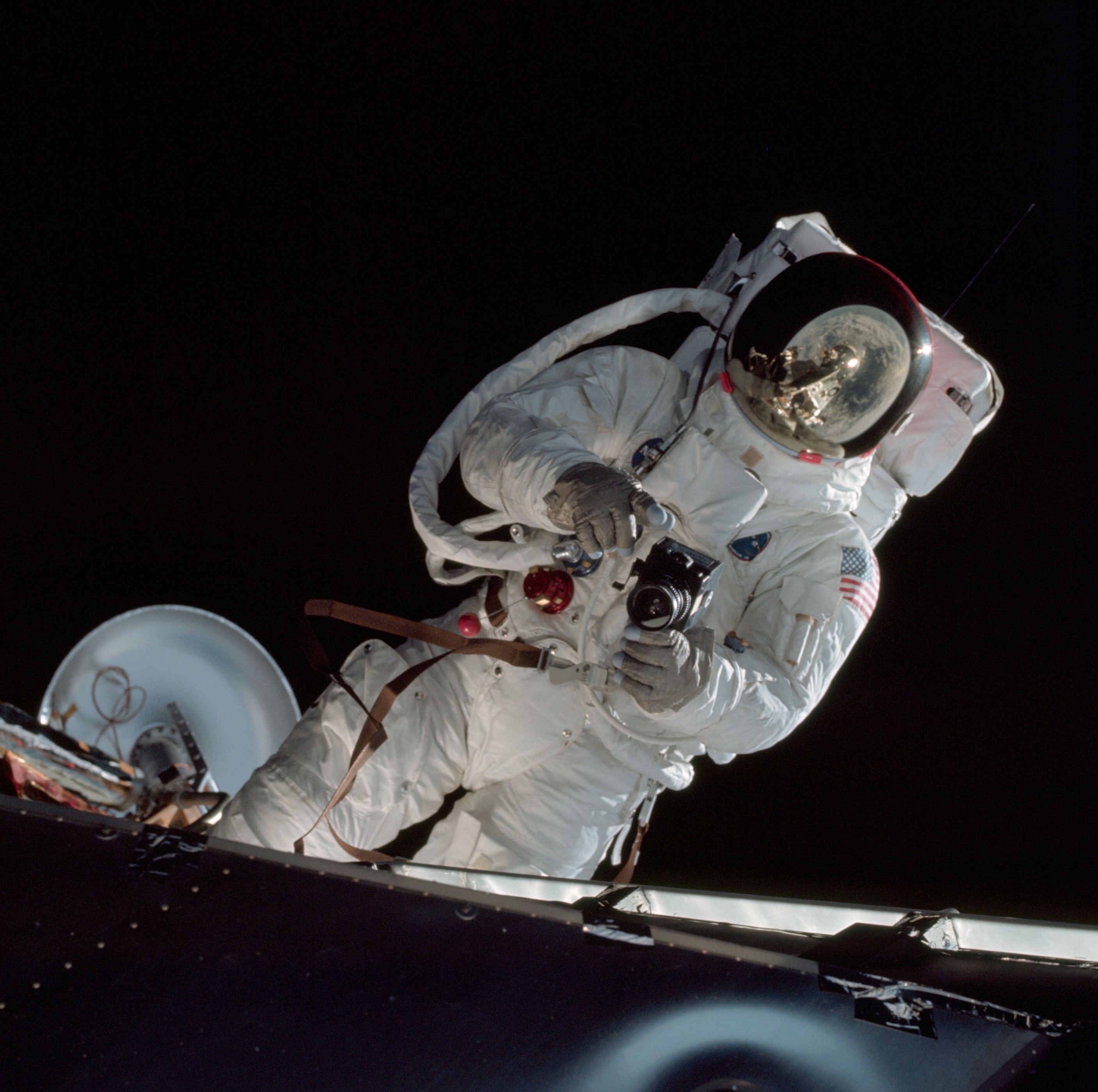
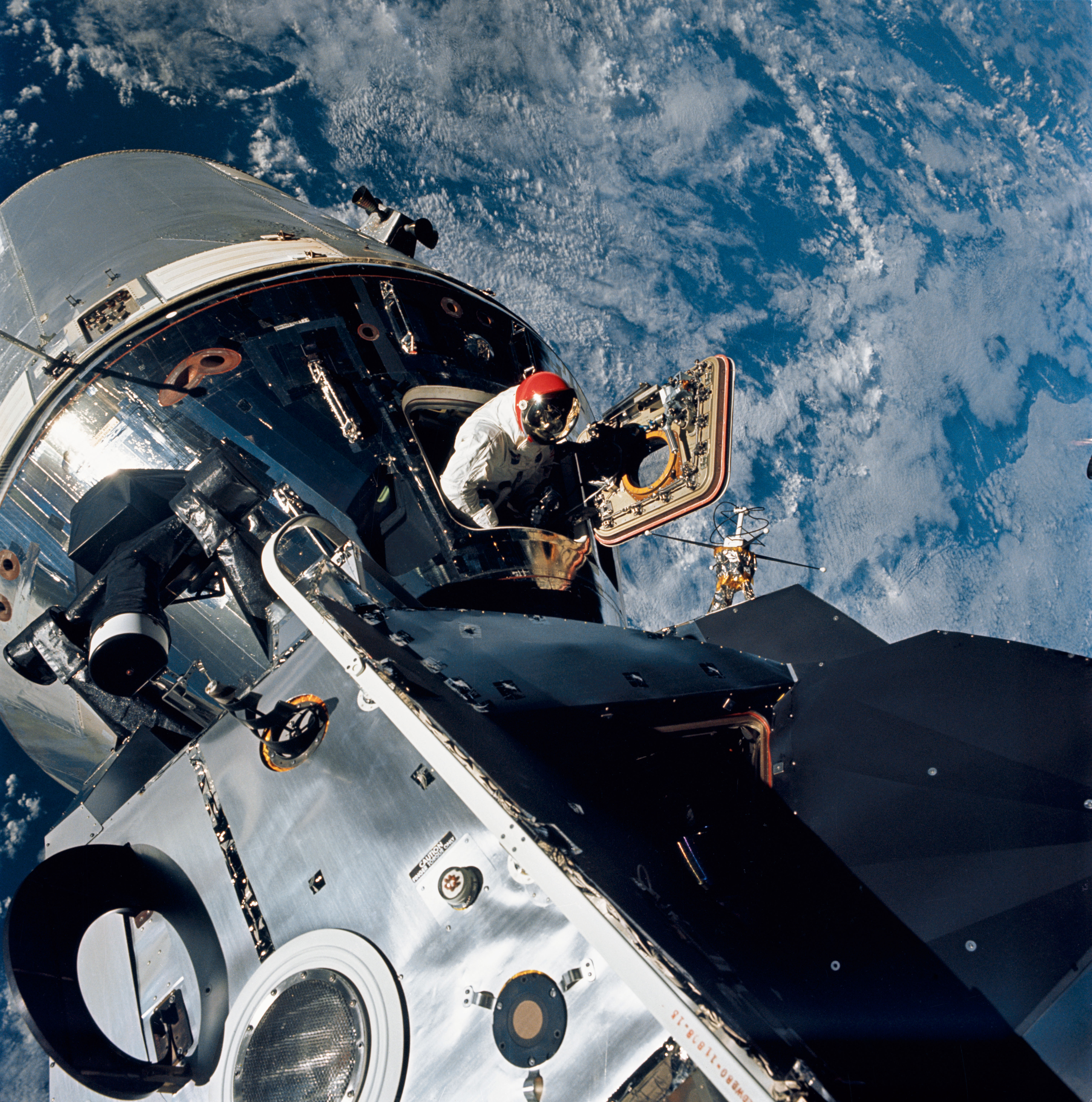
The Lunar Module Spider still attached to the Saturn V rocket’s S-IVB third stage Apollo 9 astronaut Russell L. Schweickart on Spider’s front porch during the mission’s dual spacewalk – note fellow astronaut David R. Scott reflected in Schweickart’s visor Scott in the open hatch of the Command Module Gumdrop
Left: The Lunar Module Spider still attached to the Saturn V rocket’s S-IVB third stage. Middle: Apollo 9 astronaut Russell L. Schweickart on Spider’s front porch during the mission’s dual spacewalk – note fellow astronaut David R. Scott reflected in Schweickart’s visor. Right: Scott in the open hatch of the Command Module Gumdrop.

Two hours and 41 minutes after launch, the Command and Service Module (CSM) separated from the S-IVB third stage and pulled a safe distance away to begin the Transposition and Docking maneuver. Scott turned Gumdrop around to face Spider, still attached to the S-IVB, and slowly closed the gap between the two spacecraft, completing the first successful docking of the Apollo program. About an hour later, springs ejected the docked spacecraft from the S-IVB. Over the next few hours, ground controllers twice restarted the S-IVB’s engine to simulate a Trans Lunar Injection, eventually sending the spent rocket stage into solar orbit. Meanwhile, the astronauts pressurized the tunnel between Gumdrop and Spider and connected umbilicals to power the LM while the two spacecraft remained docked. The astronauts next performed the first of eight planned burns of the Service Module’s (SM) Service Propulsion System (SPS) engine, a five-second maneuver that raised the spacecraft’s orbit. The burn validated that the docking mechanism between the two vehicles and that the LM itself could withstand the firing of the large SPS engine. The crew settled down for their first night’s sleep in space – for the first time in the Apollo Program, all crew members slept at the same time and not in shifts as on previous missions. The next day, the crew conducted three SPS engine burns of varying durations to demonstrate the controllability of the docked vehicles using the spacecraft’s digital autopilot.

The third day saw the initial activation of the LM Spider. Schweickart first and then McDivitt floated through the tunnel from Gumdrop. They closed the hatch, brought the LM’s systems to life, and extended the vehicle’s four landing legs. McDivitt informed Mission Control that Schweickart had experienced symptoms of space motion sickness, including vomiting twice, but that he now felt better.  Mission Control, in consultation with flight surgeons and the crew, agreed that the mission could continue as planned, but out of an abundance of caution they curtailed the spacewalk scheduled for the next day. Instead of translating to Gumdrop and back as originally planned, Schweickart would remain on Spider’s front porch to evaluate the spacesuit and the Portable Life Support System (PLSS) backpack. Schweickart and McDivitt then began the first TV transmission of the mission, a seven-minute broadcast showing the duo in the confined space of the LM.

McDivitt and Schweickart moved on to perform the first test of the Descent Propulsion System (DPS) engine, the rocket used to land the LM on the Moon. Although successfully tested during the uncrewed Apollo 5 mission in January 1968, this test included a CSM docked to the LM. The burn evaluated if the LM’s engine could serve as a backup in case of a problem with the SPS – in retrospect a very useful test given Apollo 13 relied on the method just over a year later. After the 372-second burn, capsule communicator (capcom) Stuart A. Roosa called up to the crew, “Spider, that was a beautiful burn, man, you were right down the tube,” generating this response from McDivitt, “Looked pretty neat from here, too.” McDivitt and Schweickart deactivated Spider for the night and transferred back to Gumdrop. The crew conducted the 43-second fifth burn of the SPS to circularize the spacecraft’s orbit.

The Apollo 9 astronauts began their fourth day in space by donning their spacesuits and Schweicakrt and McDivitt once again transferred to Spider. In the LM, Schweickart, fully recovered from his earlier illness, donned the PLSS that provided him with oxygen during his spacewalk. Scott received his life support via umbilicals connected to the CM and McDivitt similarly used the LM’s life support system.  McDivitt depressurized Spider, and minutes later Scott did the same with Gumdrop. Schweickart floated out through the LM’s side hatch onto the front porch, exclaiming “Hey, this is like spectacular.” He placed his feet into specialized gold-painted foot restraints dubbed the “golden slippers.” Scott then opened the CM side hatch and floated partway out of the spacecraft. Mission Control now communicated with three different parties, with Schweickart picking up the callsign Red Rover, a nod to his red hair. Scott retrieved thermal samples from the outside of Gumdrop. Schweickart did the same from the outside of Spider and tested out the handrails near the hatch and found them to be easy for maneuvering. Scott and Schweickart reentered their respective vehicles, having each spent about 37 minutes outside. Mission Control considered this first, and the only one before the Moon landing, test of the spacesuits and PLSS a complete success. After a 15-minute TV broadcast, McDivitt and Schweickart returned to Gumdrop to rejoin Scott for the night.

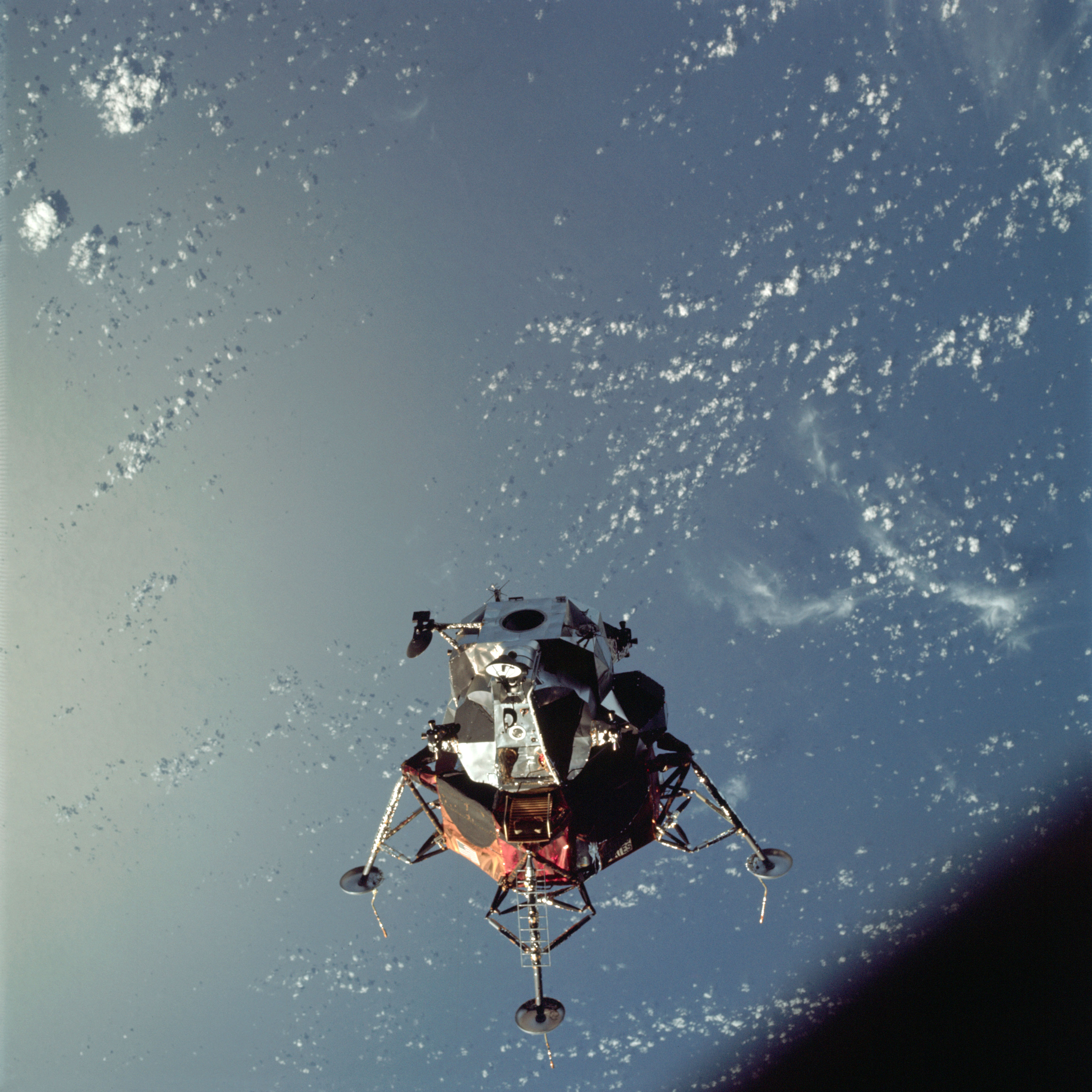
The Lunar Module (LM) Spider with James A. McDivitt and Russell L. Schweickart aboard, begins its departure from the Command Module (CM) Gumdrop, with David R. Scott aboard McDivitt and Schweickart aboard Spider’s ascent stage have returned to Gumdrop View of Gumdrop from Spider
Left: The Lunar Module (LM) Spider with James A. McDivitt and Russell L. Schweickart aboard, begins its departure from the Command Module (CM) Gumdrop, with David R. Scott aboard. Middle: McDivitt and Schweickart aboard Spider’s ascent stage have returned to Gumdrop. Right: View of Gumdrop from Spider.

For their fifth day in space, the Apollo 9 crew had a full plate – undocking of Spider from Gumdrop, testing the LM’s Descent and Ascent Stage engines by conducting separation maneuvers followed by a rendezvous and docking with the CM. This marked the first time astronauts flew in a spacecraft not designed to reenter the Earth’s atmosphere, making redocking with Gumdrop essential. Spider backed away from Gumdrop to about 50 feet and began a slow turn so Scott in the CM could inspect it. He commented about Spider, “That’s a nice looking machine.” A small 10-second burn by the SM’s Reaction Control System (RCS) thrusters increased the separation distance to about three miles. About 45 minutes after undocking, McDivitt fired Spider’s DPS engine for 19 seconds, first at 10% thrust then throttling it up to 40% thrust, to begin the separation maneuver that placed it about 50 miles from Gumdrop before orbital mechanics brought the two spacecraft closer again. The next maneuver in the separation sequence, a 22-second DPS burn, opened the distance to about 100 miles. 

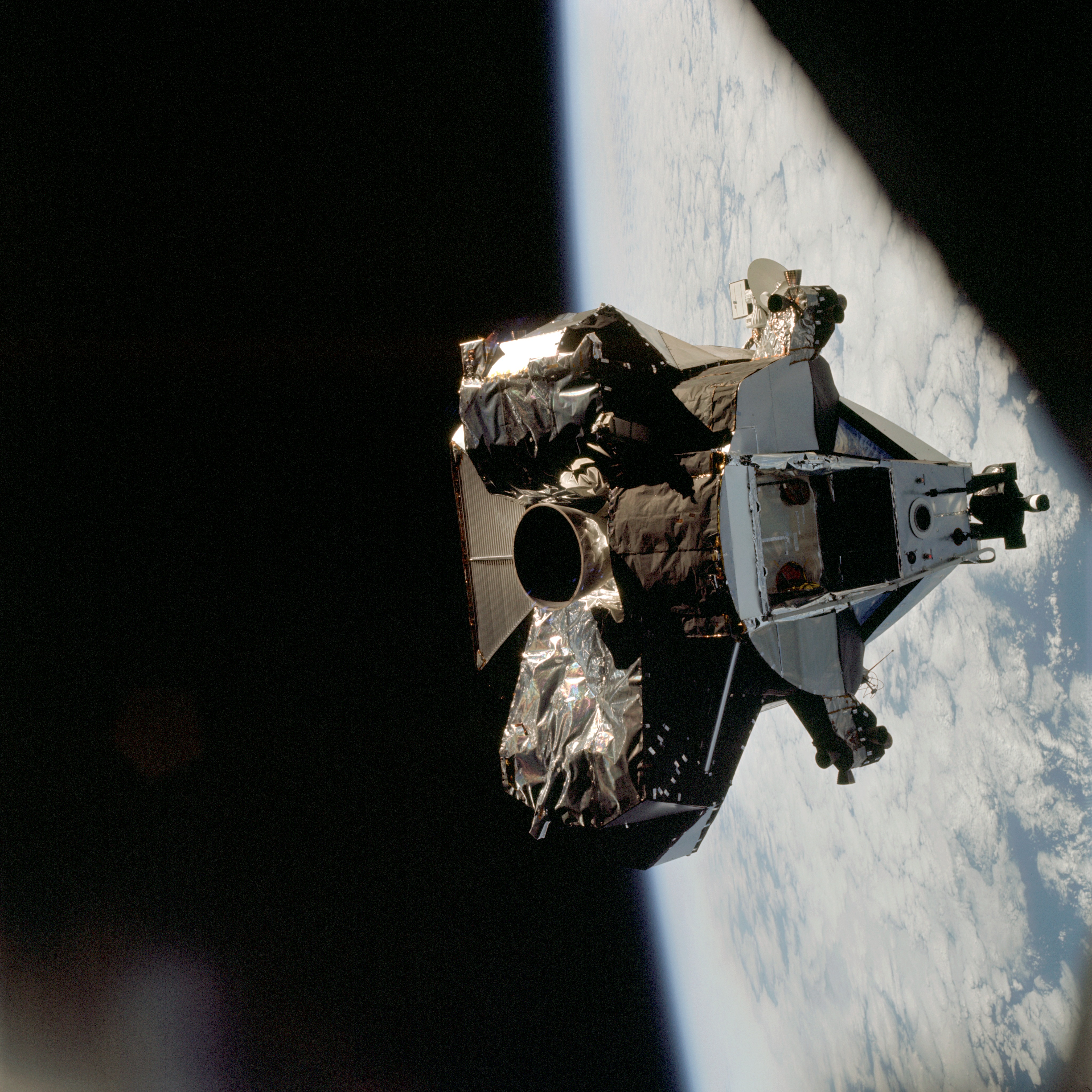
To begin the rendezvous back to Gumdrop, McDivitt first fired Spider’s Ascent Stage RCS thrusters for 32 seconds, at the same time jettisoning the Descent Stage. It remained in orbit until March 22, burning up on reentry over the Indian Ocean. The next rendezvous maneuver, lasting three seconds, tested the Ascent Propulsion System (APS) engine for the first time, followed by a second APS burn lasting 38 seconds, putting Spider on an intercept course with Gumdrop. Two small course corrections refined the trajectory and Spider stopped about 100 feet from Gumdrop to begin a pitchover maneuver, allowing Scott to inspect the ascent stage including its engine, commenting, “You’re the biggest, friendliest, funniest looking Spider I’ve ever seen.” The two craft docked, having flown separately for six hours 23 minutes. Two hours after docking, McDivitt and Schweickart rejoined Scott in Gumdrop, and then they jettisoned Spider. Mission Control commanded Spider’s APS to fire for six minutes, placing it into a highly elliptical Earth orbit from which it did not decay until Oct. 23, 1981. The Apollo 9 astronauts had met their mission’s primary objectives, and they still had five more days in space.

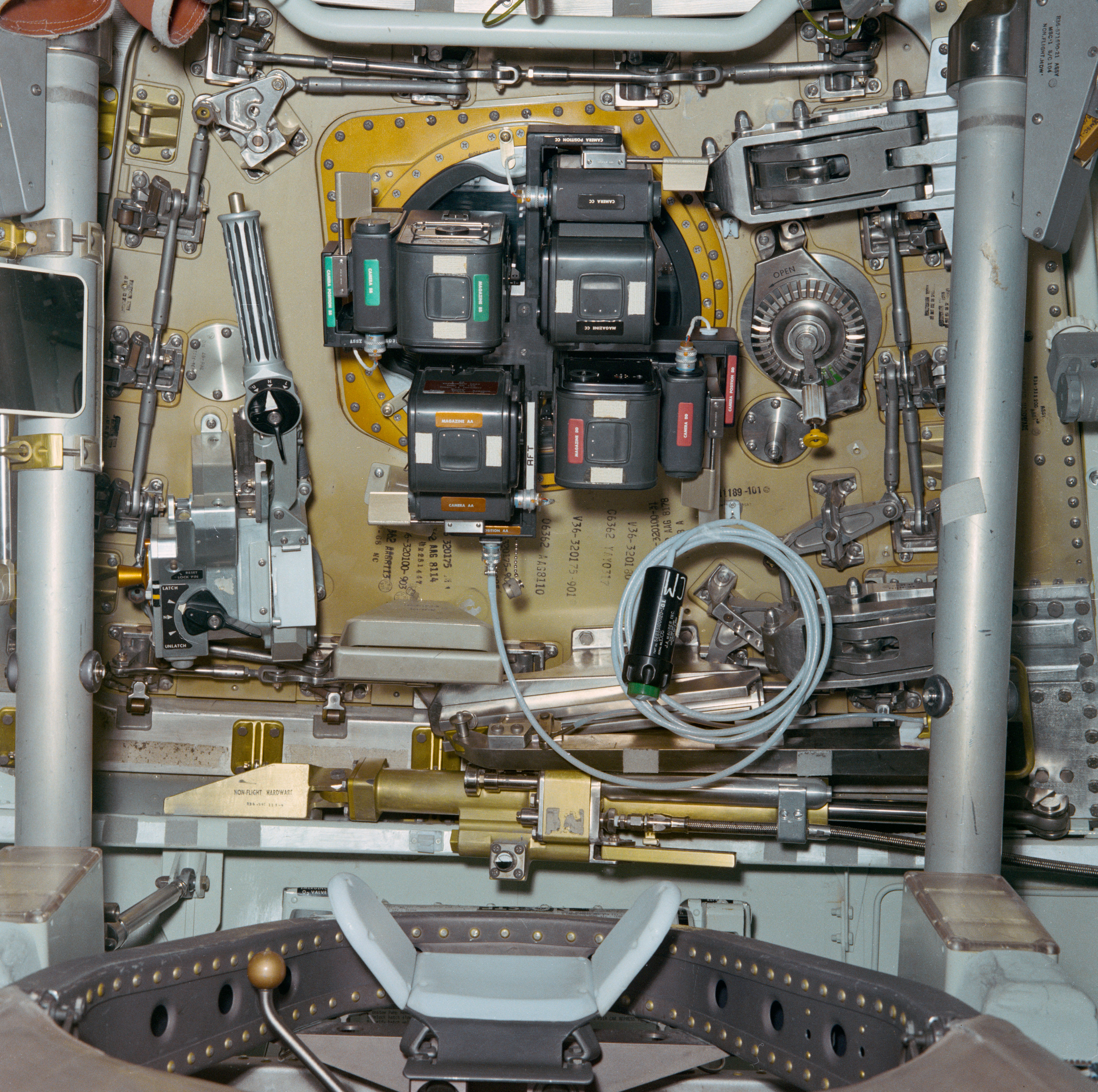
Experiment S065 multispectral camera installed on the Command Module’s side hatch window Multispectral image of the San Diego area Color infrared image of the Salton Sea area in California
Left: Experiment S065 multispectral camera installed on the Command Module’s side hatch window. Middle: Multispectral image of the San Diego area. Right: Color infrared image of the Salton Sea area in California.

The first major task of flight day six involved the sixth SPS engine. This brief one and a half second burn lowered the low point of Gumdrop’s orbit, to enhance a backup capability to use the RCS thrusters for the deorbit burn at the end of the mission, should a problem arise with the SPS. Shortly after this burn, the crew set up the one formal scientific investigation of their mission – Experiment S065 Multispectral Terrain Photography, a cluster of four Hasselblad 70 mm cameras mounted in Gumdrop’s round hatch window. The experiment provided photographs taken simultaneously in four specific portions of the visible and near infrared spectrum. The experiment served as a precursor for the Earth Resources Technology Satellite (ERTS), later renamed Landsat, and for multispectral photography conducted aboard the Skylab space station in the early 1970s. Over the next four days, the astronauts continued observations with the S065 camera system, exposing 127 complete four-frame sets.

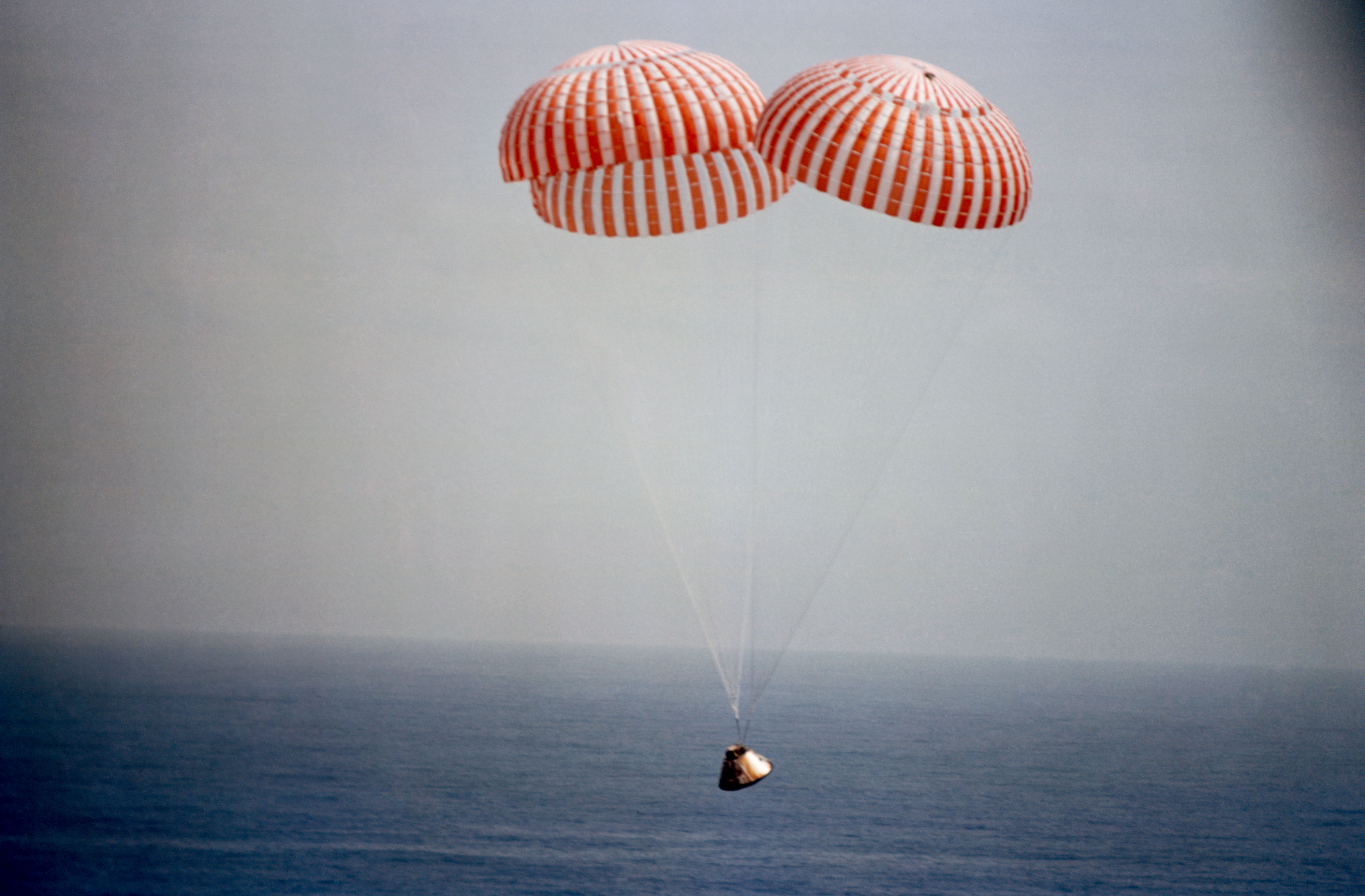
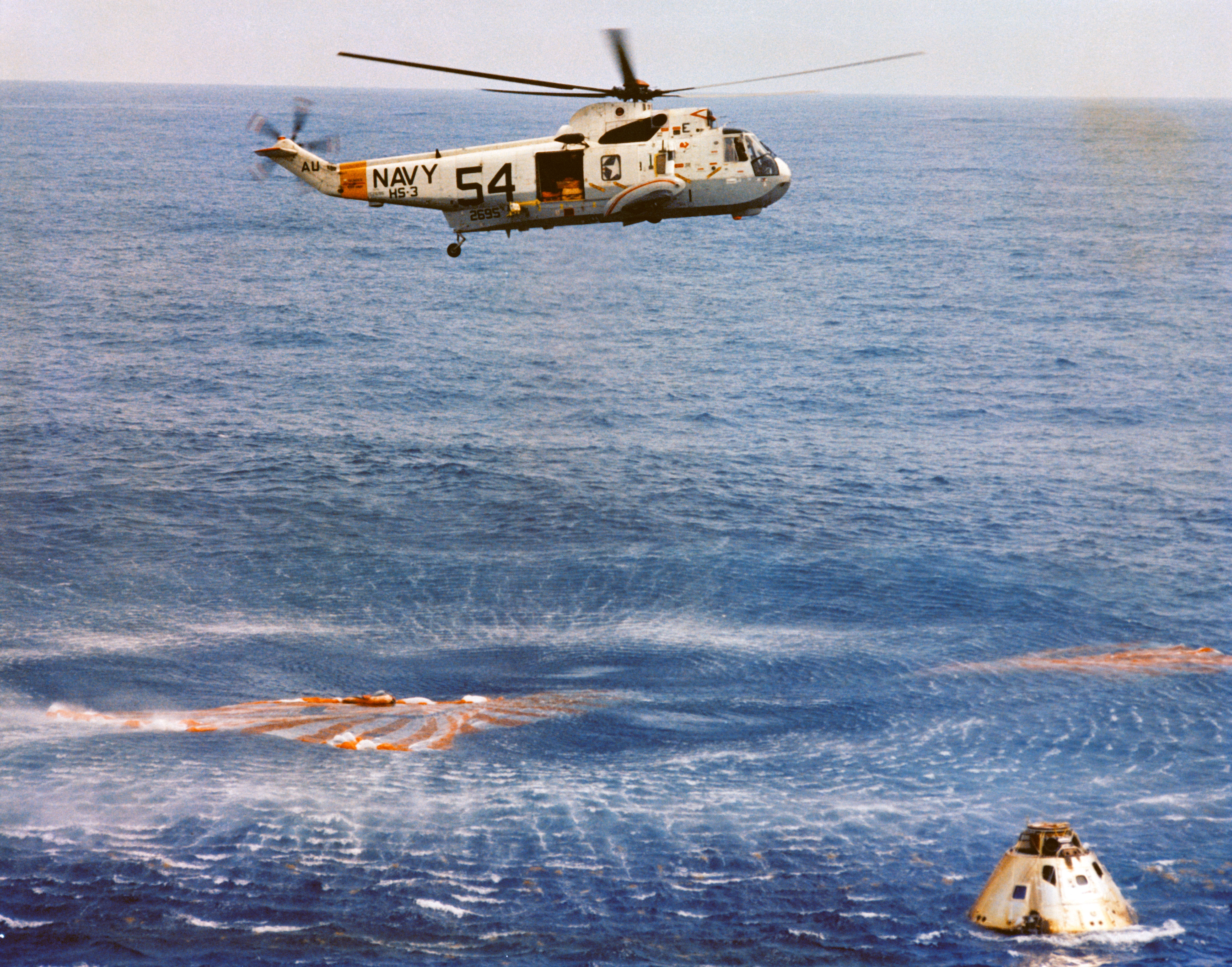
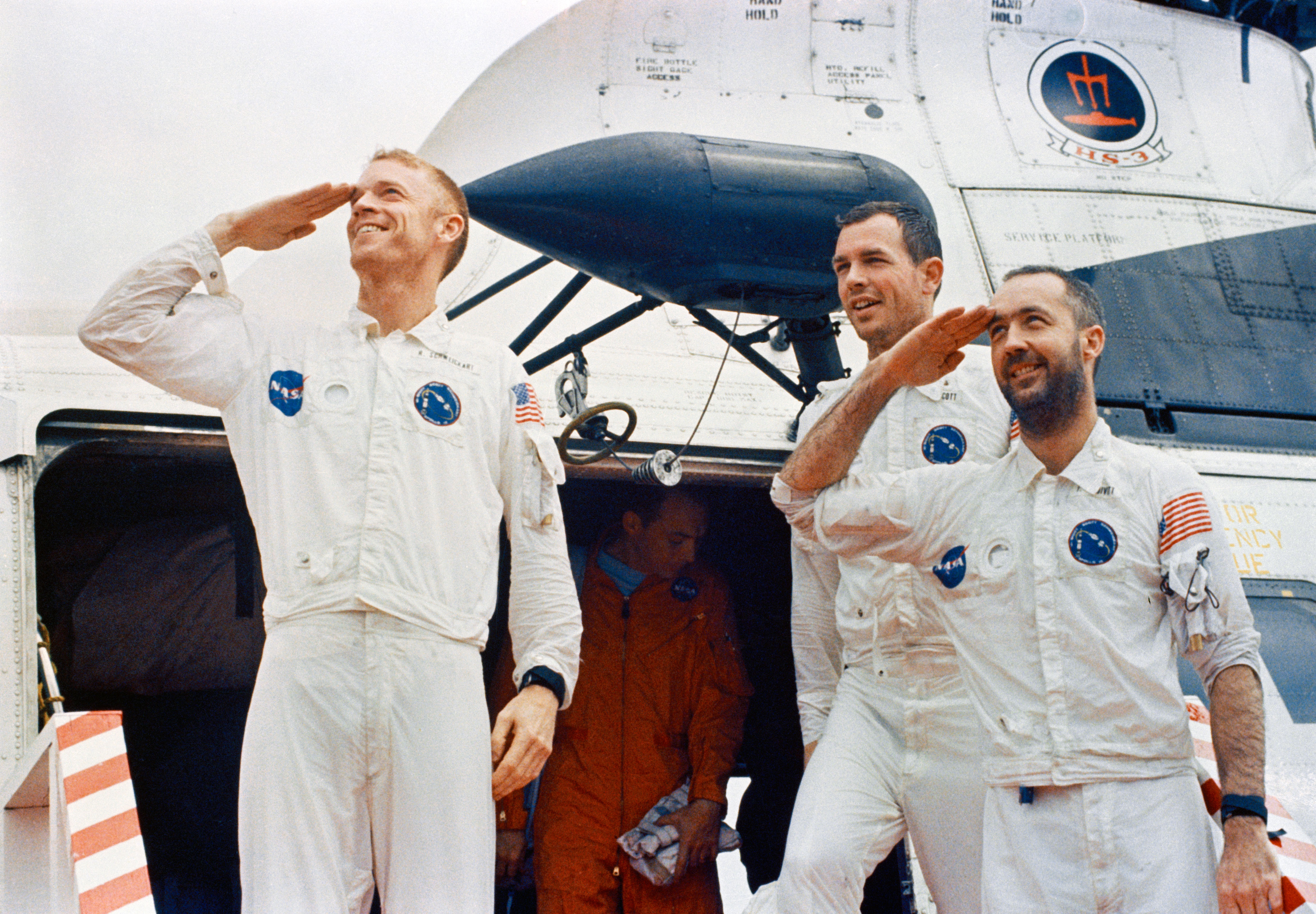
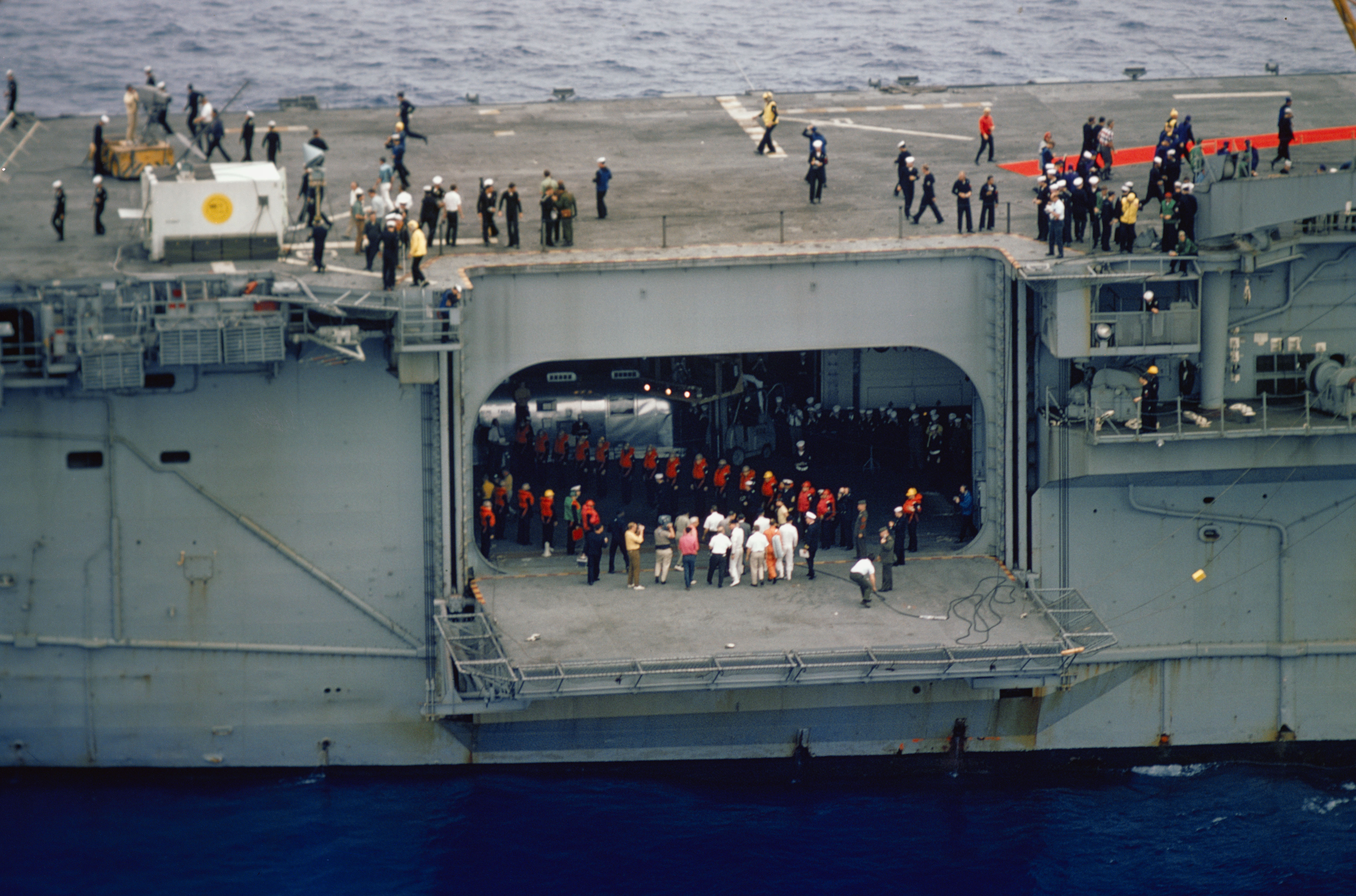
The Apollo 9 Command Module Gumdrop descends on its three main parachutes just moments before touchdown Minutes after splashdown, the rescue helicopter from the U.S.S. Guadalcanal prepares to drop swimmers into the water to safe the capsule and retrieve the astronauts Apollo 9 astronauts Russell L. Schweickart, left, David R. Scott, and James A. McDivitt safely aboard the Guadalcanal
Left: The Apollo 9 Command Module Gumdrop descends on its three main parachutes just moments before touchdown. Middle: Minutes after splashdown, the rescue helicopter from the U.S.S. Guadalcanal prepares to drop swimmers into the water to safe the capsule and retrieve the astronauts. Right: Apollo 9 astronauts Russell L. Schweickart, left, David R. Scott, and James A. McDivitt safely aboard the Guadalcanal.

On flight day eight, the crew completed the seventh SPS burn, a 25-second firing to establish the proper trajectory for the deorbit burn. On Mar. 13, 1969, after 151 revolutions around the Earth and while passing over Hawaii, the crew fired the SPS engine for the eighth and final time. Lasting just under 12 seconds, the burn brought Apollo 9 out of orbit. Gumdrop separated from its SM and pointed its heat shield in the direction of flight. During reentry, a sheath of ionized gas formed around the capsule by the rapid deceleration led to a 4-minute radio blackout, after which the drogue parachutes deployed. The three main parachutes opened at 10,000 feet altitude, slowing the spacecraft to about 22 miles per hour at splashdown.

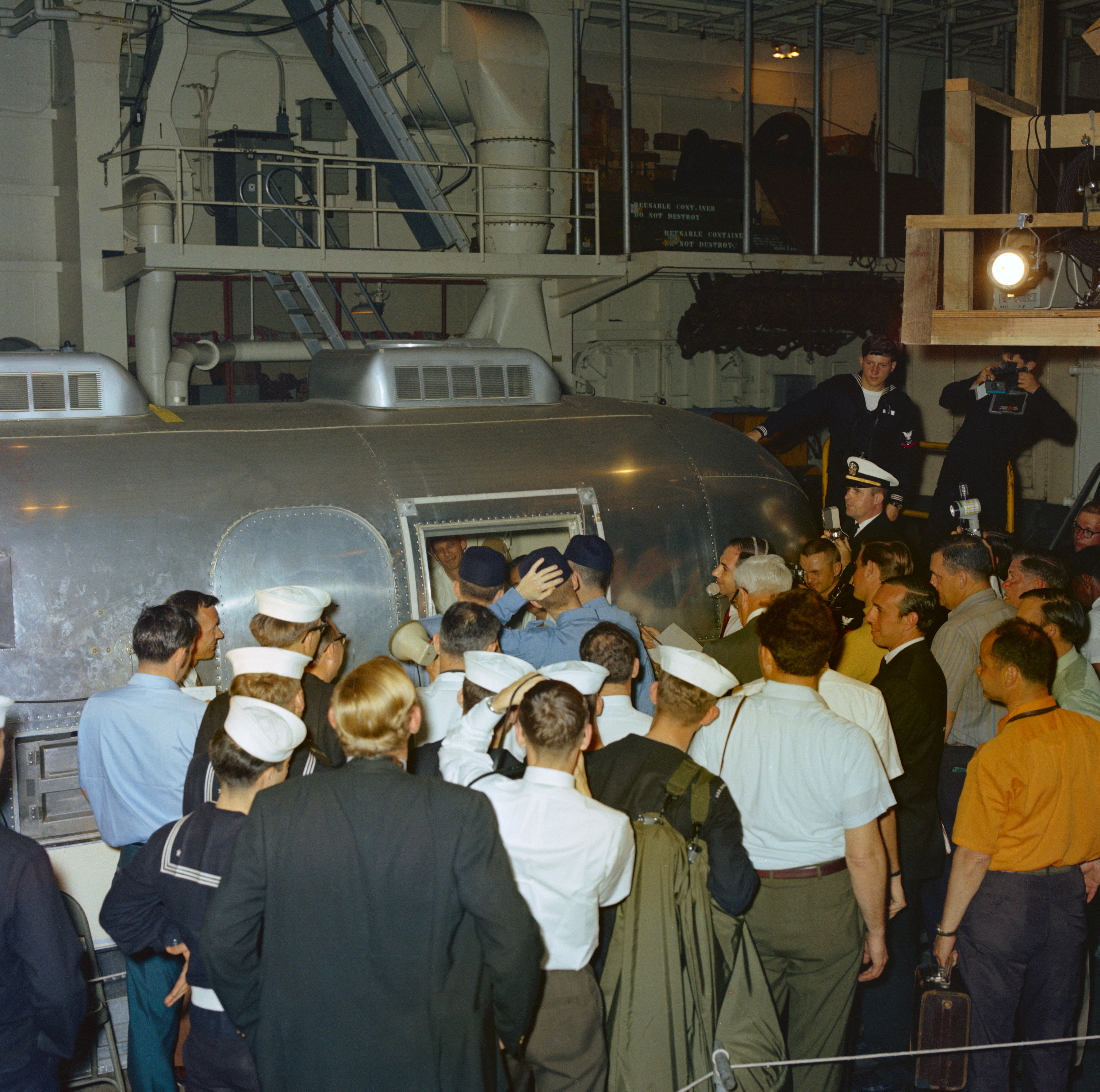
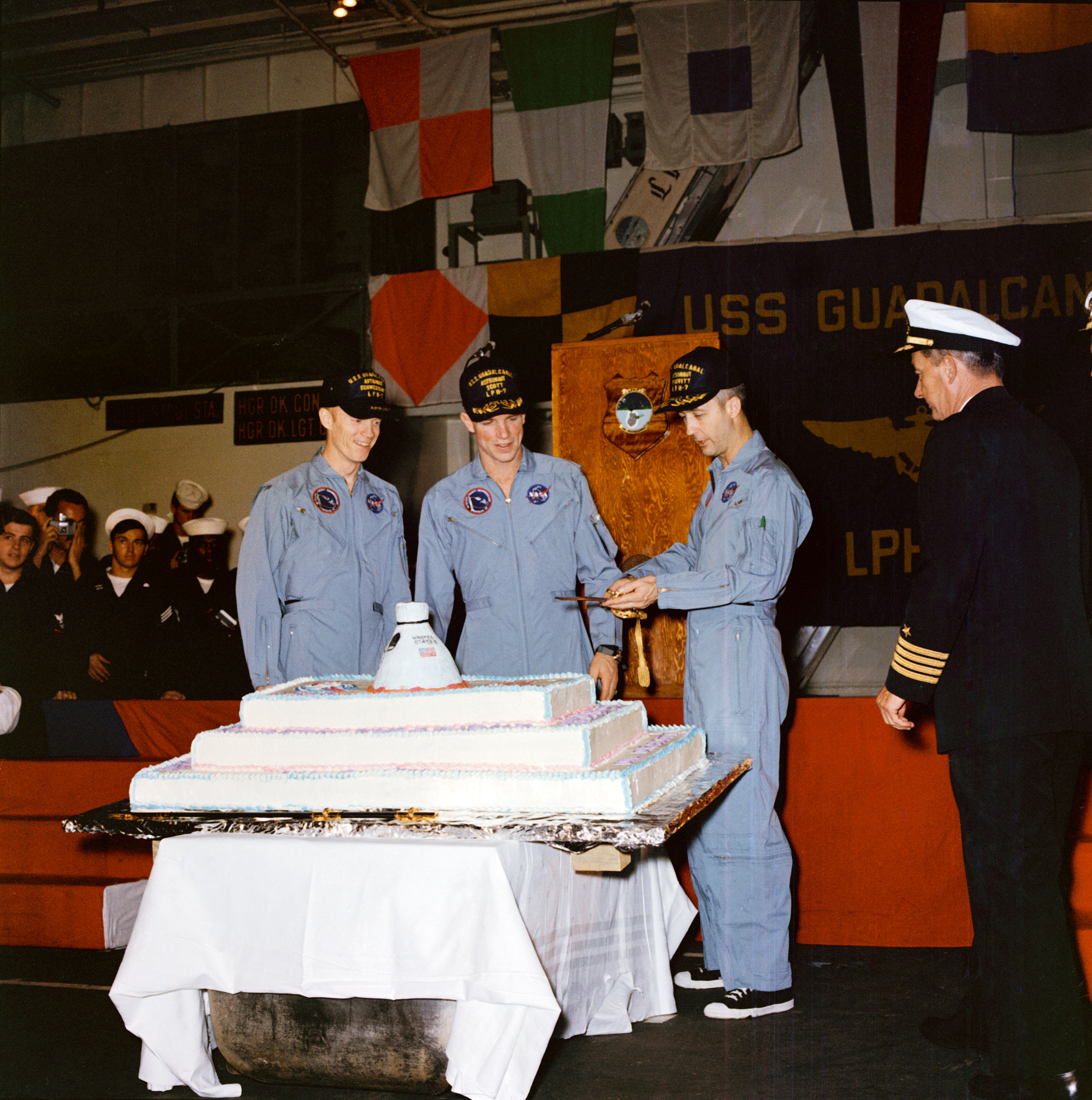
The Apollo 9 astronauts, in white overalls, on the elevator deck of the U.S.S. Guadalcanal, with the Mobile Quarantine Facility (MQF) visible in the background The Apollo 9 astronauts, wearing blue baseball caps, peer into the window of the MQF and greet the occupants Apollo 9 astronauts Russell L. Schweickart, left, David R. Scott, and James A. McDivitt prepare to cut the cake in their honor aboard the Guadalcanal
Left: The Apollo 9 astronauts, in white overalls, on the elevator deck of the U.S.S. Guadalcanal, with the Mobile Quarantine Facility (MQF) visible in the background. Middle: The Apollo 9 astronauts, wearing blue baseball caps, peer into the window of the MQF and greet the occupants. Right: Apollo 9 astronauts Russell L. Schweickart, left, David R. Scott, and James A. McDivitt prepare to cut the cake in their honor aboard the Guadalcanal.

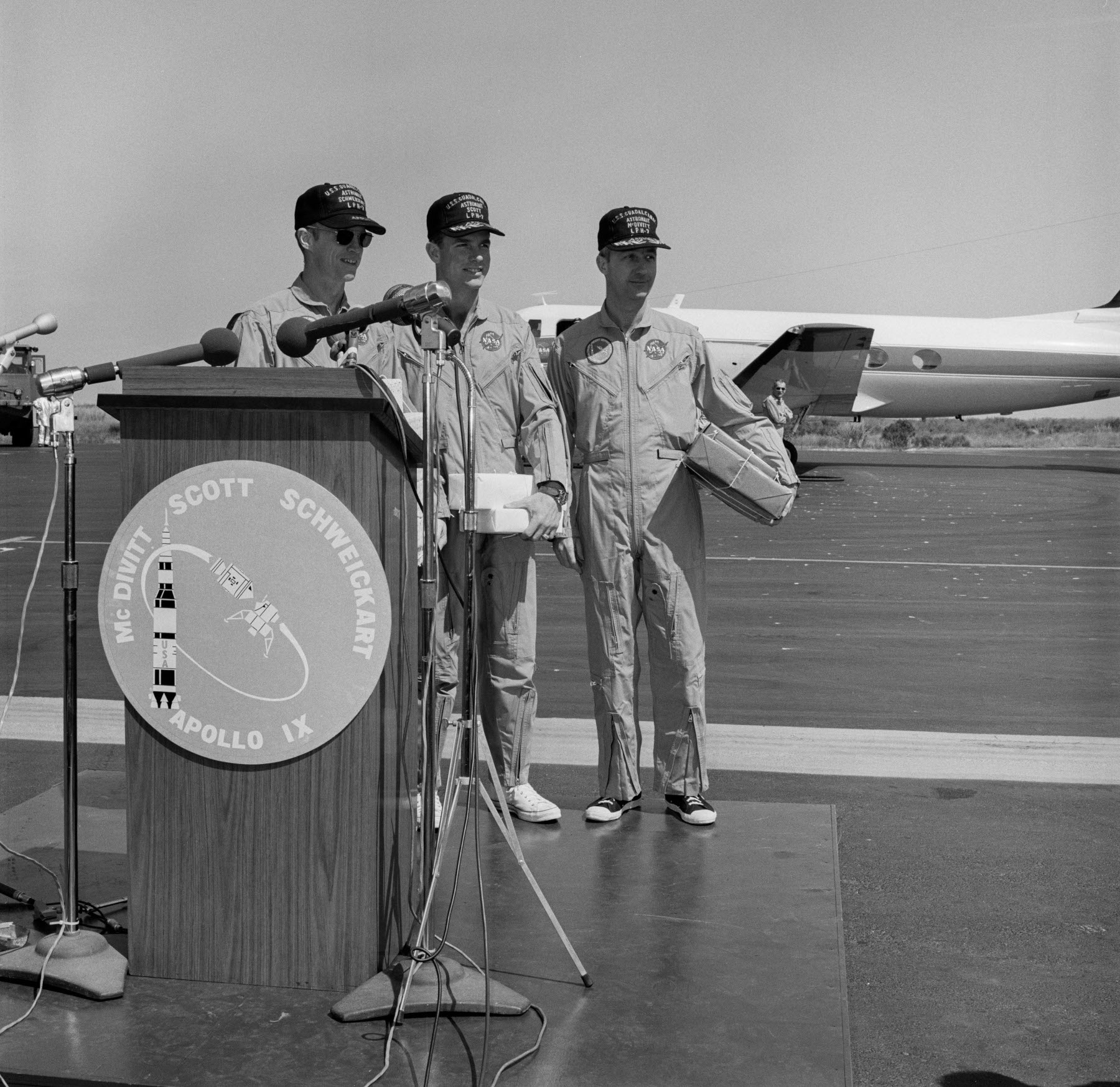
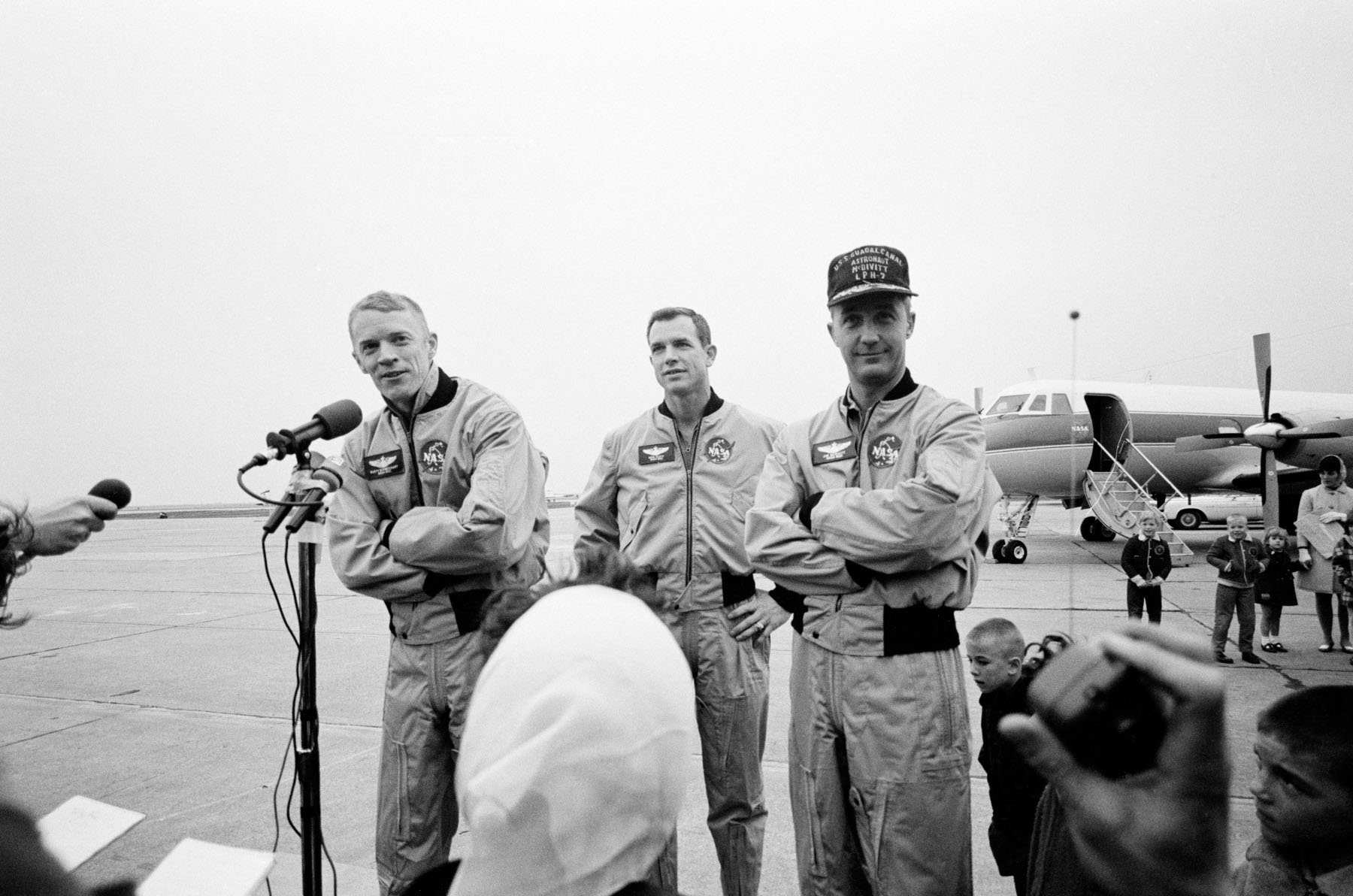
Apollo 9 astronauts’ return trip from the U.S.S. Guadalcanal to Houston. Carrying flowers after a stopover on Eleuthera in The Bahamas. Apollo 9 astronauts’ return trip from the U.S.S. Guadalcanal to Houston. A brief layover at NASA’s Kennedy Space Center in Florida Apollo 9 astronauts’ return trip from the U.S.S. Guadalcanal to Houston. Arriving at Ellington Air Force Base in Houston
The Apollo 9 astronauts’ return trip from the U.S.S. Guadalcanal to Houston. Left: Carrying flowers after a stopover on Eleuthera in The Bahamas. Middle: A brief layover at NASA’s Kennedy Space Center in Florida. Right: Arriving at Ellington Air Force Base in Houston.

The splashdown occurred in the Atlantic Ocean about 670 miles south-southwest of Bermuda, and about 3 miles from the prime recovery ship the U.S.S. Guadalcanal (LPH-7). McDivitt, Scott, and Schweickart had spent 241 hours and 54 seconds in space. Forty-nine minutes after splashdown, recovery teams had the crew aboard the recovery ship. The next day, a helicopter flew them to Eleuthera in the Bahamas, where they boarded a plane to KSC for a brief ceremony, and then back to Houston for a large welcome home reception and a reunion with their families at Ellington Air Force Base. The successful Apollo 9 mission, the most complex crewed space mission flown to that time, brought the Moon landing one step closer.

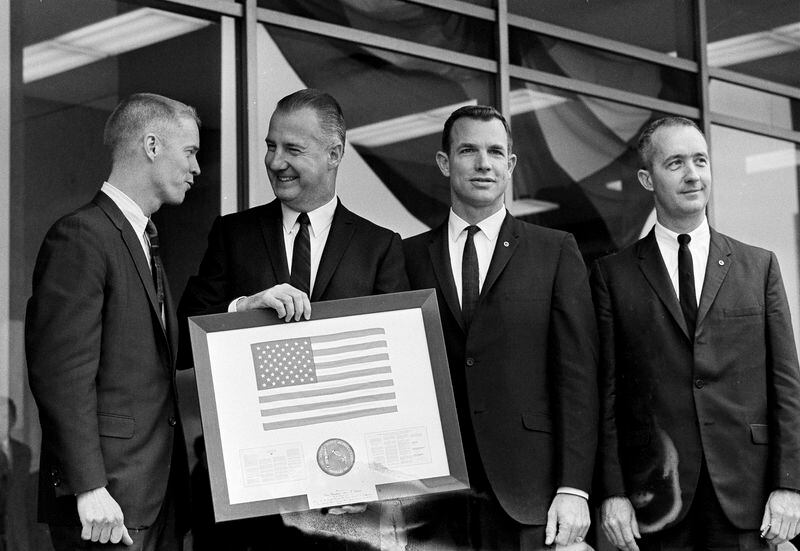
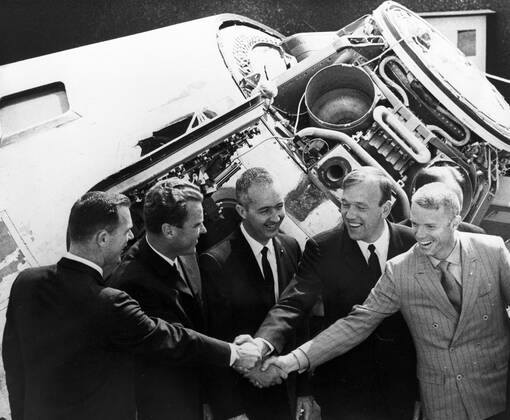
In Washington, D.C., Vice President Spiro T. Agnew, second from left, accepts a framed American flag flown in space by Apollo 9 astronauts Russell L. Schweickart, left, David R. Scott, and James A. McDivitt In front of the Apollo 8 Command Module at the 1969 Paris Air Show, astronauts meet cosmonauts – Scott, Vladimir A. Shatalov, McDivitt, Aleksei S. Yeliseyev, and Schweickart
Left: In Washington, D.C., Vice President Spiro T. Agnew, second from left, accepts a framed American flag flown in space by Apollo 9 astronauts Russell L. Schweickart, left, David R. Scott, and James A. McDivitt. Right: In front of the Apollo 8 Command Module at the 1969 Paris Air Show, astronauts meet cosmonauts – Scott, Vladimir A. Shatalov, McDivitt, Aleksei S. Yeliseyev, and Schweickart.

Following postflight debriefs, McDivitt, Scott, and Schweickart traveled to Washington, D.C., where on March 26, Vice President Agnew presented them with Distinguished Service Medals for their execution of the historic Apollo 9 mission. They in turn presented the Vice President with a framed American flag they had taken to space. Among other postflight events and celebrations, the trio attended the Paris Air Show and on May 29 met Soviet cosmonauts Vladimir A. Shatalov and Aleksei S. Yeliseyev who had flown as part of the Soyuz 4 and 5 docking and spacewalk crew exchange mission in January 1969.

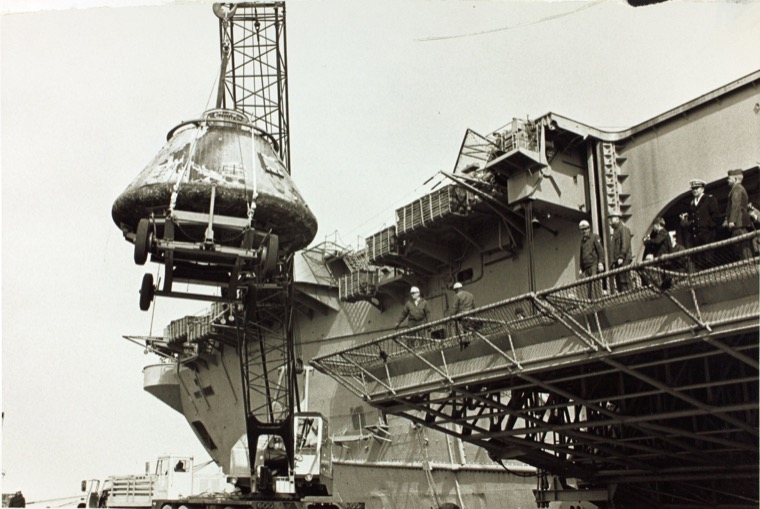
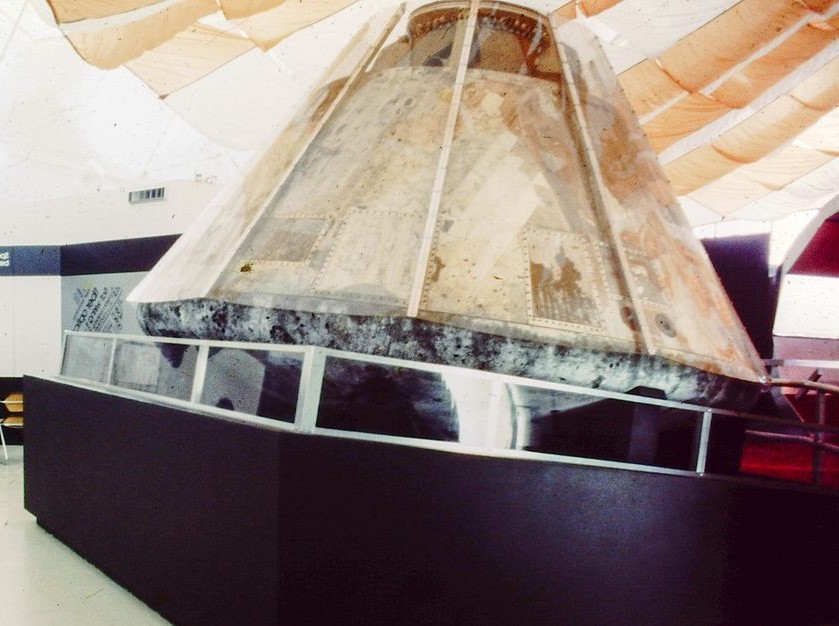
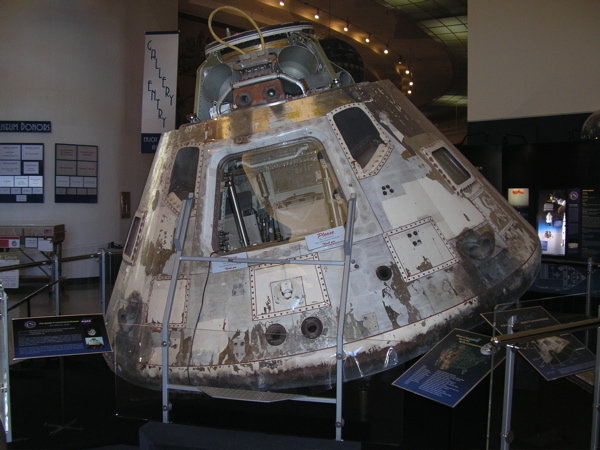
Workers at Norfolk Naval Air Station in Virginia offload the Apollo 9 Command Module Gumdrop from the U.S.S. Guadalcanal for its cross country trip to California Gumdrop on display at the Michigan Space and Science Center in Jackson Gumdrop on display at the San Diego Air & Space Museum
Left: Workers at Norfolk Naval Air Station in Virginia offload the Apollo 9 Command Module Gumdrop from the U.S.S. Guadalcanal for its cross country trip to California. Middle: Gumdrop on display at the Michigan Space and Science Center in Jackson. Image credit: courtesy Atlas Obscura. Right: Gumdrop on display at the San Diego Air & Space Museum.

Workers offloaded Gumdrop from the Guadalcanal in Norfolk, Virginia, for transport aboard a U.S. Air Force cargo jet to Long Beach, California, from where they trucked it to the North American Rockwell plant in Downey for postflight inspection. NASA transferred Gumdrop to the Smithsonian Institution in 1973. In 1977, it went on display at the Michigan Space and Science Center in Jackson, Michigan, McDivitt’s hometown. When that facility closed in 2004, Gumdrop transferred to the San Diego Air & Space Museum, where visitors can view it today.

Apollo 10

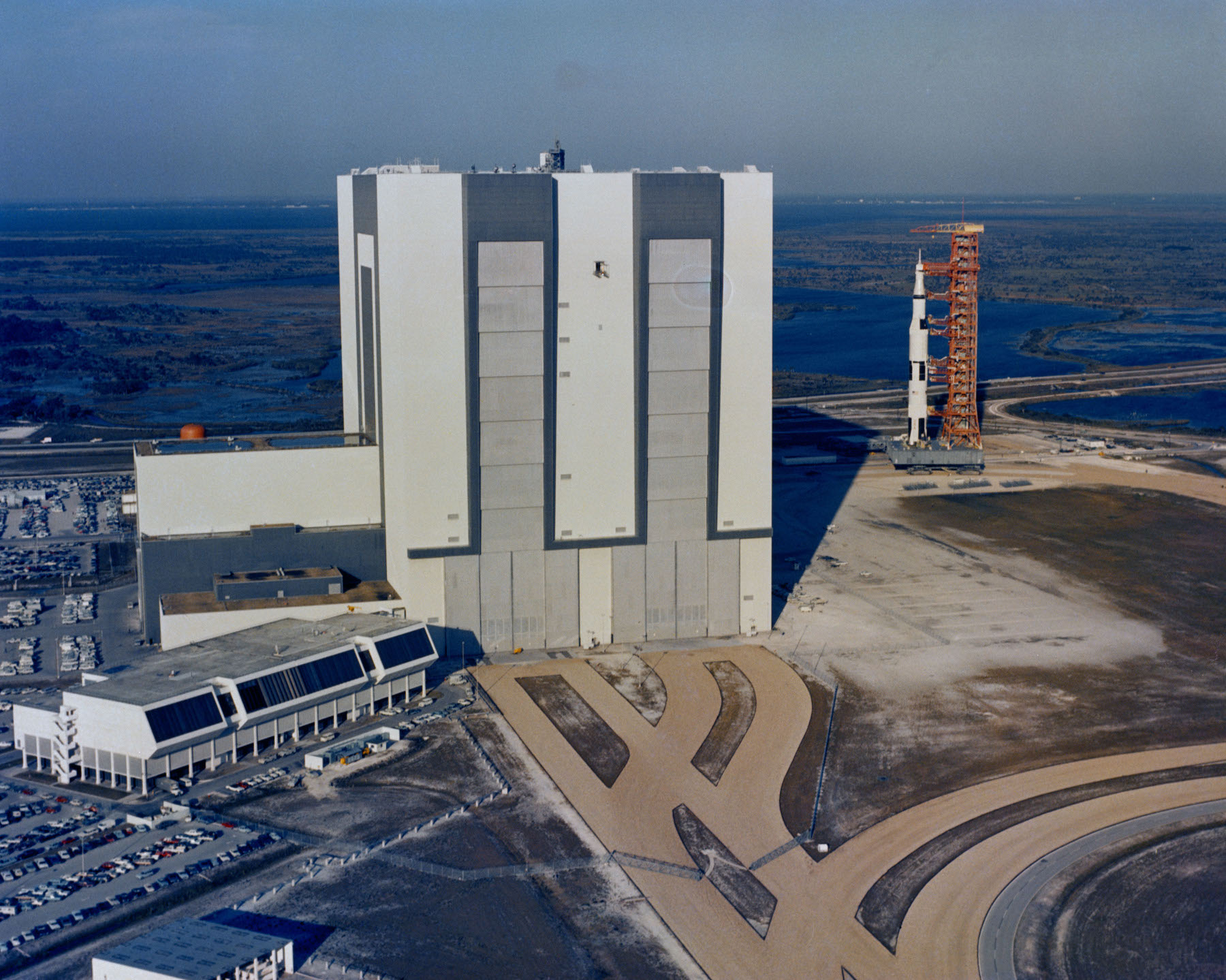
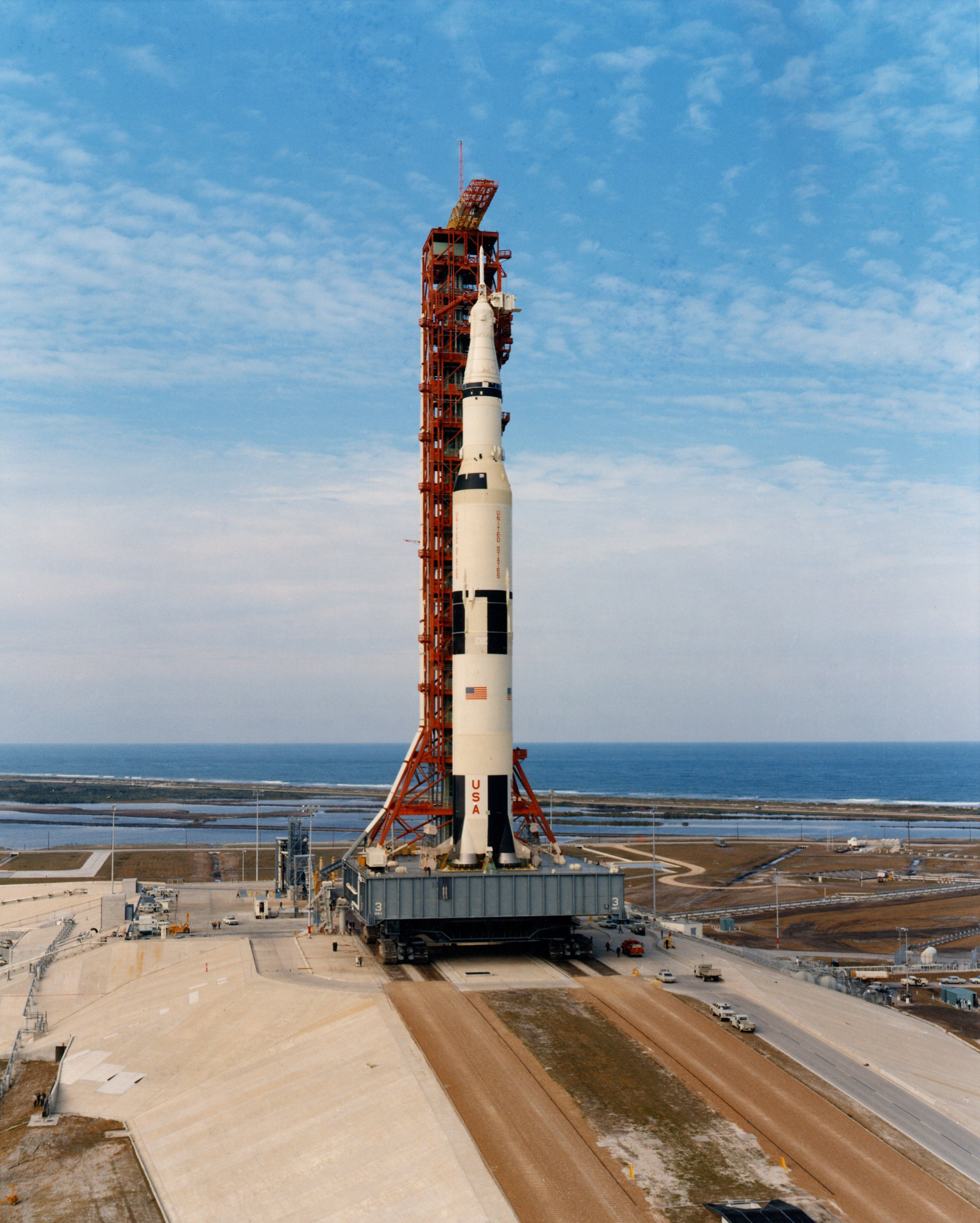
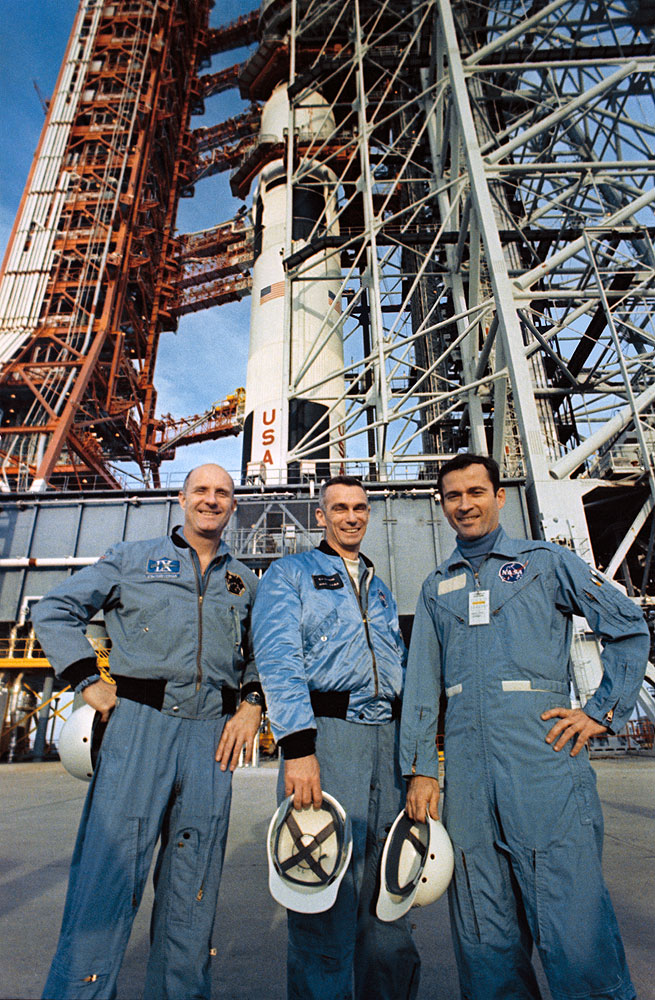
The Apollo 10 Saturn V leaves the Vehicle Assembly Building at NASA’s Kennedy Space Center in Florida The Apollo 10 Saturn V has reached Launch Pad 39B Apollo 10 astronauts John W. Young, left, Eugene A. Cernan, and Thomas P. Stafford pose before their Saturn V rocket
Left: The Apollo 10 Saturn V leaves the Vehicle Assembly Building at NASA’s Kennedy Space Center in Florida. Middle: The Apollo 10 Saturn V has reached Launch Pad 39B. Right: Apollo 10 astronauts John W. Young, left, Eugene A. Cernan, and Thomas P. Stafford pose before their Saturn V rocket.

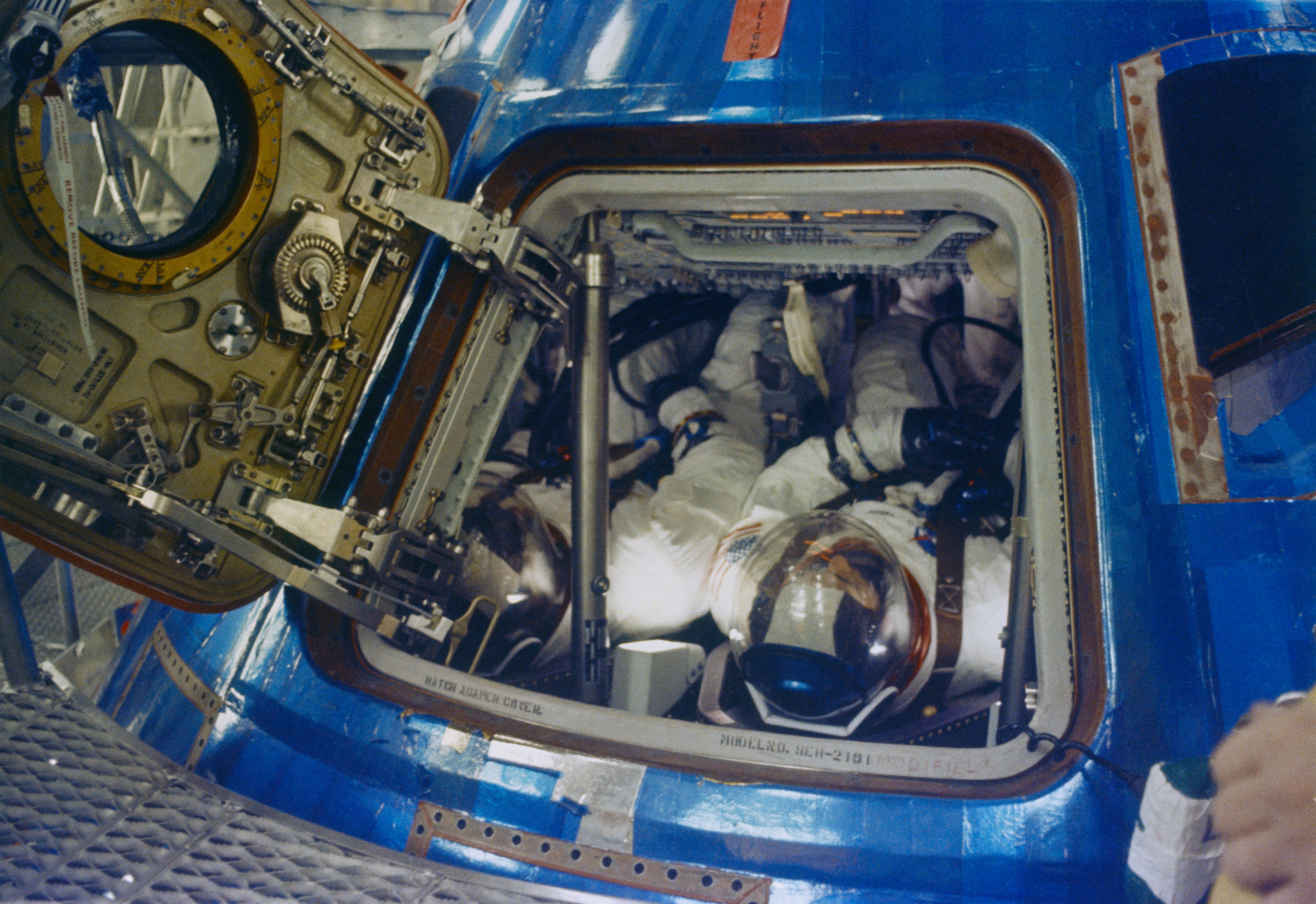
On March 11, as the Apollo 9 astronauts neared the end of their mission, workers at KSC rolled the Apollo 10 Saturn V vehicle from the Vehicle Assembly Building (VAB) to its launch pad. Apollo 10’s assembly marked the first use of the VAB’s High Bay 2, requiring the stack to exit the VAB’s rear and make a sweeping loop around the building to reach the crawlerway to the launch pads. Apollo 10 also marked the first use of Pad 39B. On March 17, NASA managers formally set Apollo 10’s launch date as May 18. Apollo 10 astronauts Thomas P. Stafford, John W. Young, and Eugene A. Cernan and their backups L. Gordon Cooper, Donn F. Eisele, and Edgar D. Mitchell continued training in spacecraft simulators and testing their spacesuits in vacuum chambers. On March 27, the prime crew conducted a walk-through of Pad 39B and trained on emergency escape procedures. The next day, the backup crew practiced water egress training in the Water Immersion Facility in MSC’s Building 260, and repeated the training in the Gulf of Mexico the following week.

Apollo 11

Apollo 11 astronauts Neil A. Armstrong, left, Edwin E. “Buzz” Aldrin, and Michael Collins, not visible, prepare for an altitude chamber test of their Command Module at NASA’s Kennedy Space Center (KSC) in Florida Apollo 11 backup crew members James A. Lovell and Frew W. Haise have entered the chamber for a Lunar Module altitude test In KSC’s Vehicle Assembly Building, workers lower the S-IVB third stage onto the Apollo 11 Saturn V rocket
Left: Apollo 11 astronauts Neil A. Armstrong, left, Edwin E. “Buzz” Aldrin, and Michael Collins, not visible, prepare for an altitude chamber test of their Command Module at NASA’s Kennedy Space Center (KSC) in Florida. Middle: Apollo 11 backup crew members James A. Lovell and Frew W. Haise have entered the chamber for a Lunar Module altitude test. Right: In KSC’s Vehicle Assembly Building, workers lower the S-IVB third stage onto the Apollo 11 Saturn V rocket.

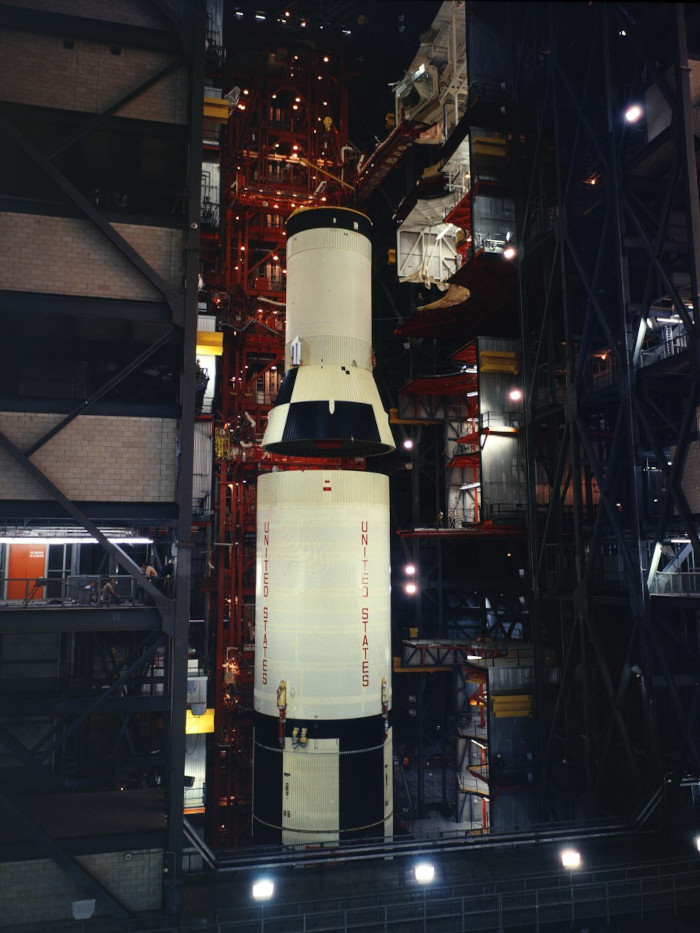
Workers in the VAB’s High Bay 3 stacked the Apollo 11 Saturn V’s S-IC first stage on Feb. 21. They added the S-II second stage and S-IVB third stage on March 4 and 5, respectively. The spacecraft for Apollo 11 continued testing in KSC’s Manned Spacecraft Operations Building (MSOB). With their historic mission only five months away, the Apollo 11 prime crew of Neil A. Armstrong, Michael Collins, and Edwin E. “Buzz” Aldrin and their backups James A. Lovell, William A. Anders, and Fred W. Haise busied themselves training for the Moon landing, spending time in spacecraft simulators. The prime and backup crews participated in altitude chamber tests of both their CM and LM.

Mobile Quarantine Facility, Lunar Receiving Laboratory, and Lunar Module Drop Tests

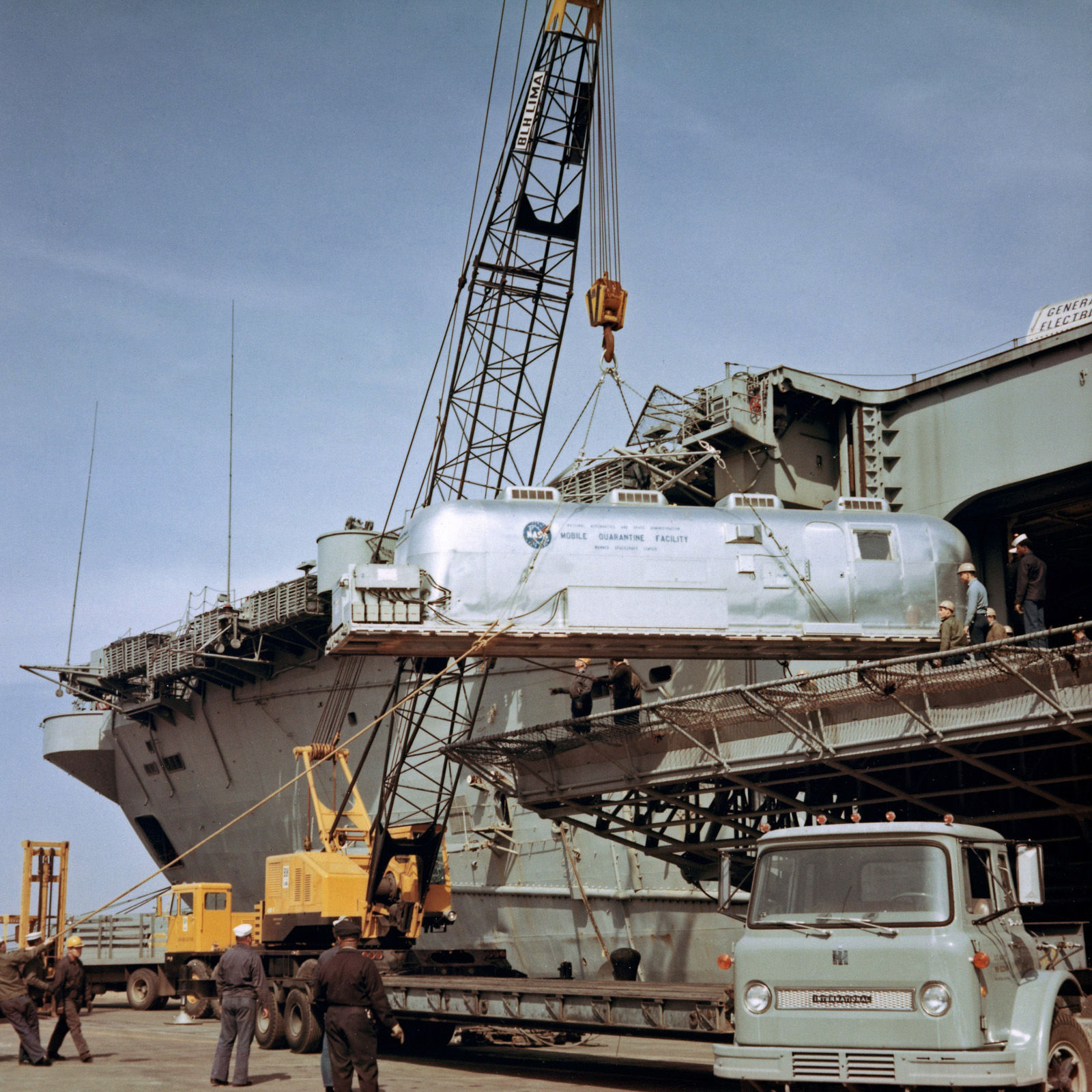
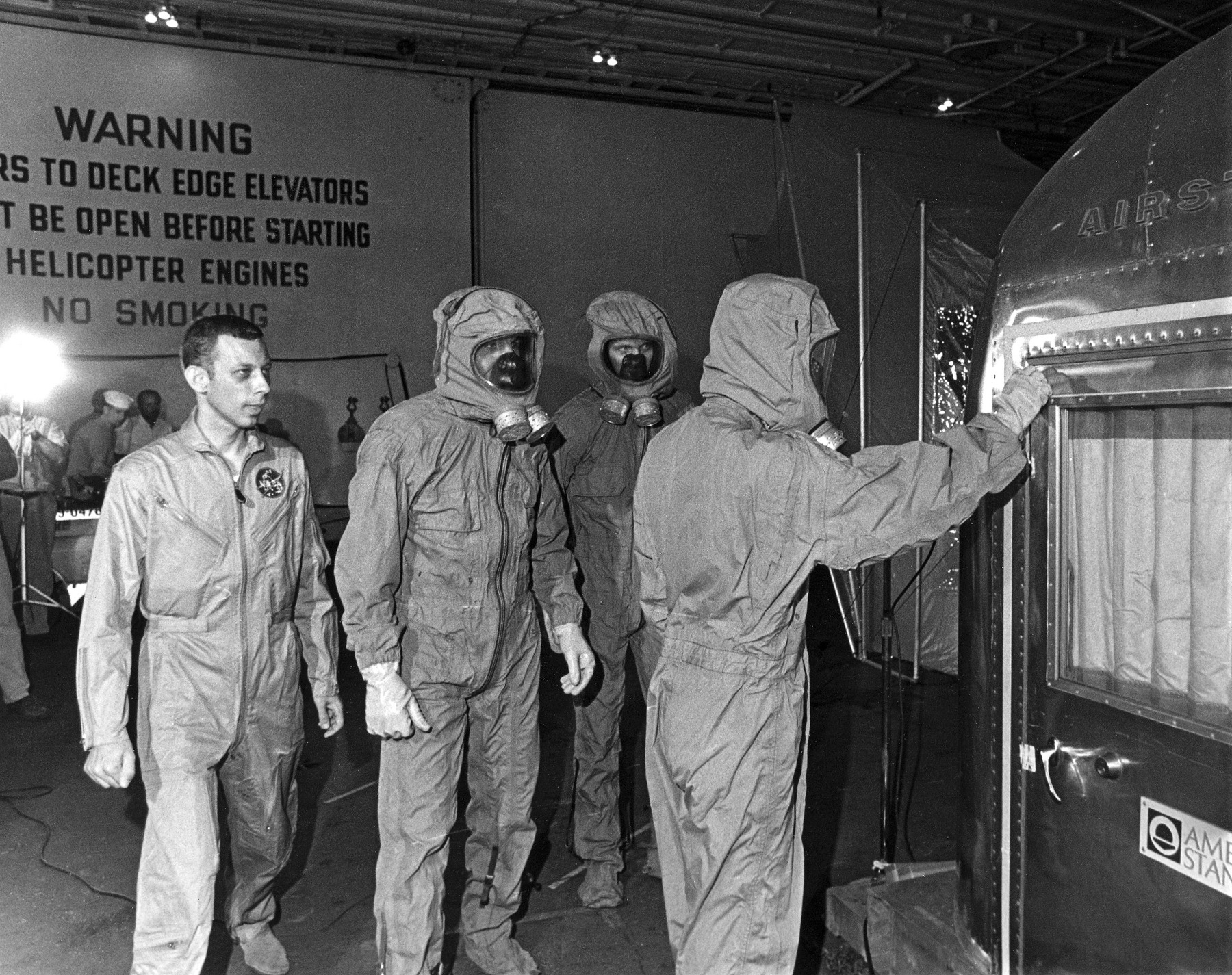
Flight surgeon Dr. William R. Carpentier, left, and the three astronaut surrogates wearing Biological Isolation Garments, prepare to enter the Mobile Quarantine Facility (MQF) aboard the U.S.S. Guadalcanal Dr. Carpentier, left, astronaut surrogates Paul H. Kruppenbacher, Arthur E. Lizza, and Michael T. “Tex” Ward, and engineer John K. Hirasake inside the MQF aboard the Guadalcanal Workers at Norfolk Naval Air Station in Virginia lift the MQF off the Guadalcanal onto a truck for its return to Houston
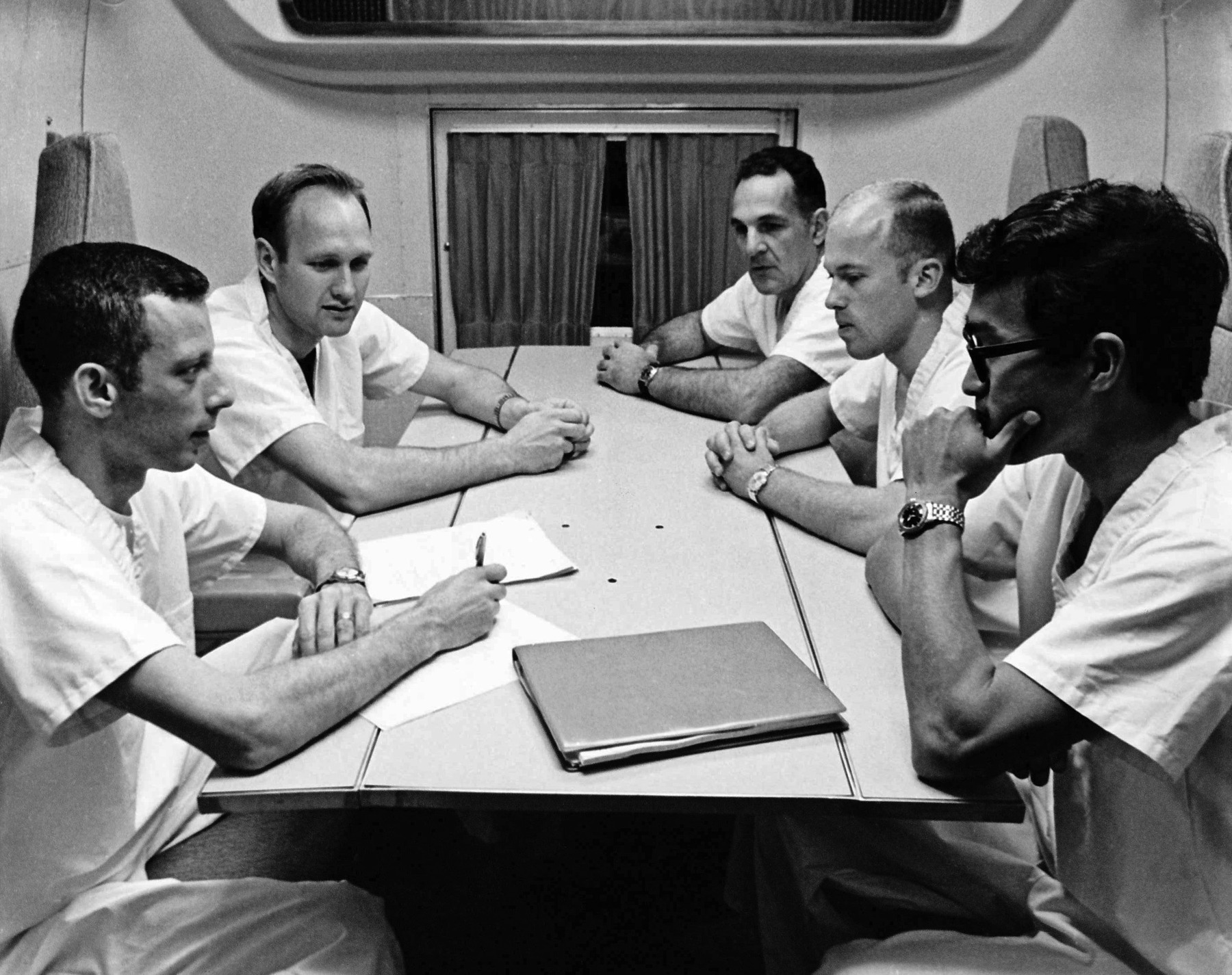
Left: Flight surgeon Dr. William R. Carpentier, left, and the three astronaut surrogates wearing Biological Isolation Garments, prepare to enter the Mobile Quarantine Facility (MQF) aboard the U.S.S. Guadalcanal. Middle: Dr. Carpentier, left, astronaut surrogates Paul H. Kruppenbacher, Arthur E. Lizza, and Michael T. “Tex” Ward, and engineer John K. Hirasake inside the MQF aboard the Guadalcanal. Right: Workers at Norfolk Naval Air Station in Virginia lift the MQF off the Guadalcanal onto a truck for its return to Houston.

Preparations for ground support facilities for the first lunar landing mission continued. In conjunction with the Apollo 9 splashdown and recovery operations aboard the Guadalcanal, NASA conducted a simulation of recovery operations of astronauts returning from a lunar mission. NASA Flight Surgeon Dr. William R. Carpentier, project engineer John K. Hirasaki, and three astronaut stand-ins, Paul H. Kruppenbacher, Michael T. “Tex” Ward, and Arthur E. Lizza, spent 10 days inside a Mobile Quarantine Facility (MQF), a modified Airstream trailer designed to temporarily house astronauts returning from the Moon. The three astronaut surrogates began the simulation by entering a mockup CM that sailors placed in the ocean and recovered as if returning from a space mission. The trio donned Biological Isolation Garments (BIG), meant to prevent contamination of Earth by any possible lunar organisms. Once on board the Guadalcanal, the three accompanied by Carpentier and Hirasaki entered the MQF for four days, where the just-recovered Apollo 9 crew visited them through the window of the trailer. The five stayed inside the MQF except for the short time it was transferred from the Guadalcanal to a waiting transport aircraft at Norfolk Naval Air Station and flown back to Houston. After offloading, the MQF and its five inhabitants transferred to the Lunar Receiving Laboratory (LRL) in MSC’s Building 37 to begin a simulated quarantine. Overall, the exercise tested the procedures for the activities after the first lunar landing mission, with many lessons learned.

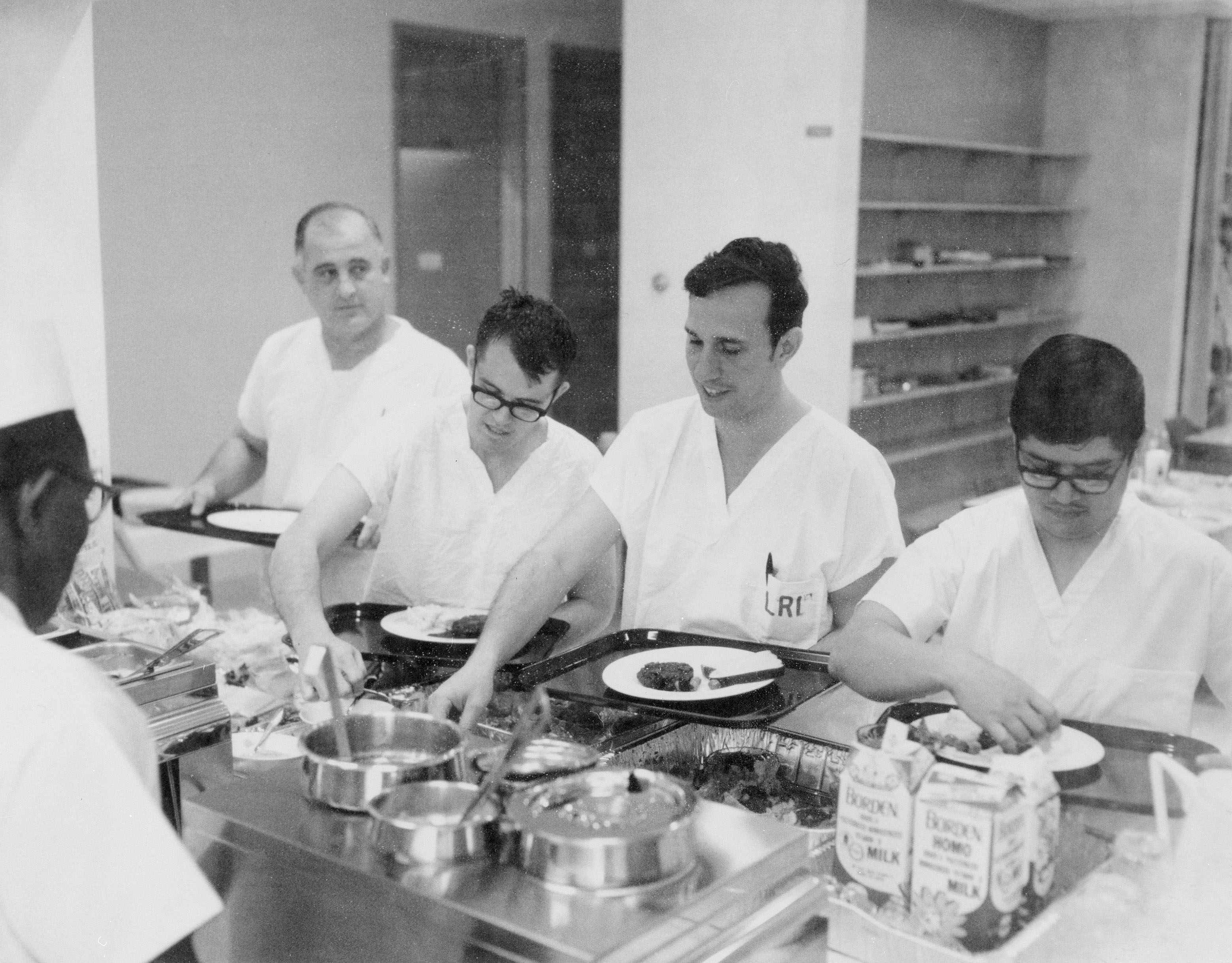
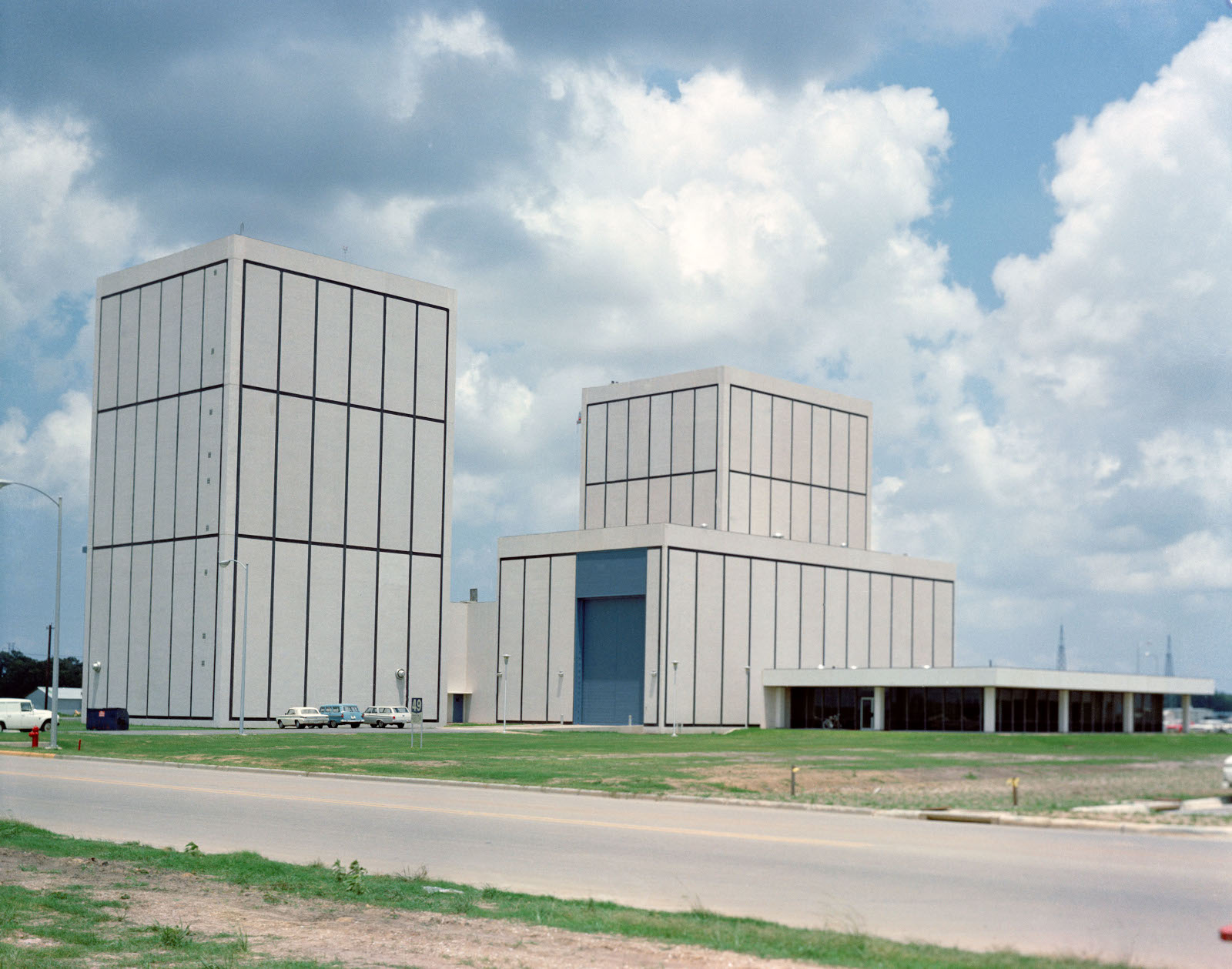
During a simulation, workers line up in the kitchen of the Crew Reception Area of the Lunar Receiving Laboratory at the Manned Spacecraft Center (MSC), now NASA’s Johnson Space Center in Houston The Vibration and Acoustics Test Facility (VATF) at MSC The Lunar Module during drop testing in the VATF
Left: During a simulation, workers line up in the kitchen of the Crew Reception Area of the Lunar Receiving Laboratory at the Manned Spacecraft Center (MSC), now NASA’s Johnson Space Center in Houston. Middle: The Vibration and Acoustics Test Facility (VATF) at MSC. Right: The Lunar Module during drop testing in the VATF.

Managers, scientists, technicians, and engineers conducted a 30-day simulation in the LRL, the most complex test of the facility to verify that all its components would be ready to support crewmembers and their samples returning from the Moon, possibly by July 1969. A separate seven-day simulation of the astronaut quarantine capabilities in the LRL’s Crew Reception Area began on March 25. Fifteen NASA and contractor employees, most of whom would participate in the activities following the actual lunar landing mission, demonstrated the logistics of maintaining astronauts and support staff in isolation. All biological barriers operated during the simulation, and the only contact test personnel had with the outside world was via telephone or through glass walls.  The first part of the test included the simulated arrival of lunar materials and film, followed the next day by the arrival of the stand-in crew. The last part of the test included the process for releasing the crew and personnel from quarantine.

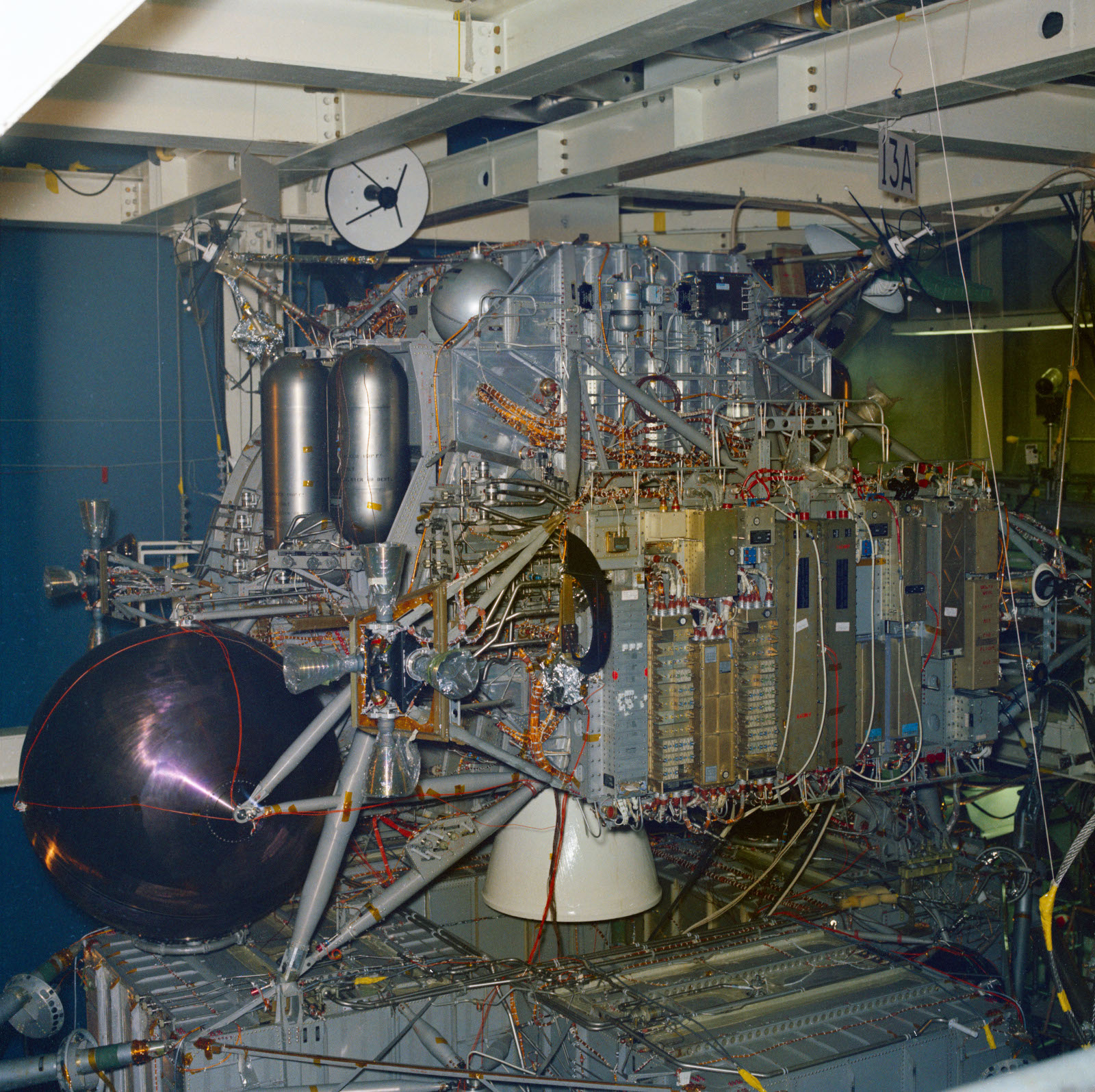
The Structures and Mechanics Division at MSC conducted a series of drop tests in the Vibration and Acoustic Test Facility (VATF) to verify that the LM’s systems would operate following a lunar landing. The LM’s manufacturer, the Grumman Aircraft Engineering Corporation, located in Bethpage, New York, provided technical support for the tests using LM-2, a flight qualified  vehicle with all subsystems installed. To simulate the LM’s configuration at landing, workers filled the tanks in the ascent stage with inert fluid to mimic a full load of fuel, while keeping the descent stage tanks mostly empty as they would be following the powered descent from orbit. The series of five tests began on March 21, 1969, and finished on May 7. Engineers dropped LM-2 from heights ranging from eight to 24 inches onto artificial slopes and obstructions to simulate landings on rough lunar terrain. Successful completion of the drop tests removed a constraint from carrying out the first lunar landing. Visitors can view LM-2 on display at the Smithsonian Institution’s National Air and Space Museum in Washington, D.C.

Apollo 12

The S-IVB third stage for the Apollo 12 Saturn V arrives at NASA’s Kennedy Space Center (KSC) in Florida The Apollo 12 Lunar Module arrives at KSC In KSC’s Manned Spacecraft Operations Building, workers uncrate the Apollo 12 Command and Service Modules, foreground, as they continue work on the Apollo 11 spacecraft
Left: The S-IVB third stage for the Apollo 12 Saturn V arrives at NASA’s Kennedy Space Center (KSC) in Florida. Middle: The Apollo 12 Lunar Module arrives at KSC. Right: In KSC’s Manned Spacecraft Operations Building, workers uncrate the Apollo 12 Command and Service Modules, foreground, as they continue work on the Apollo 11 spacecraft.

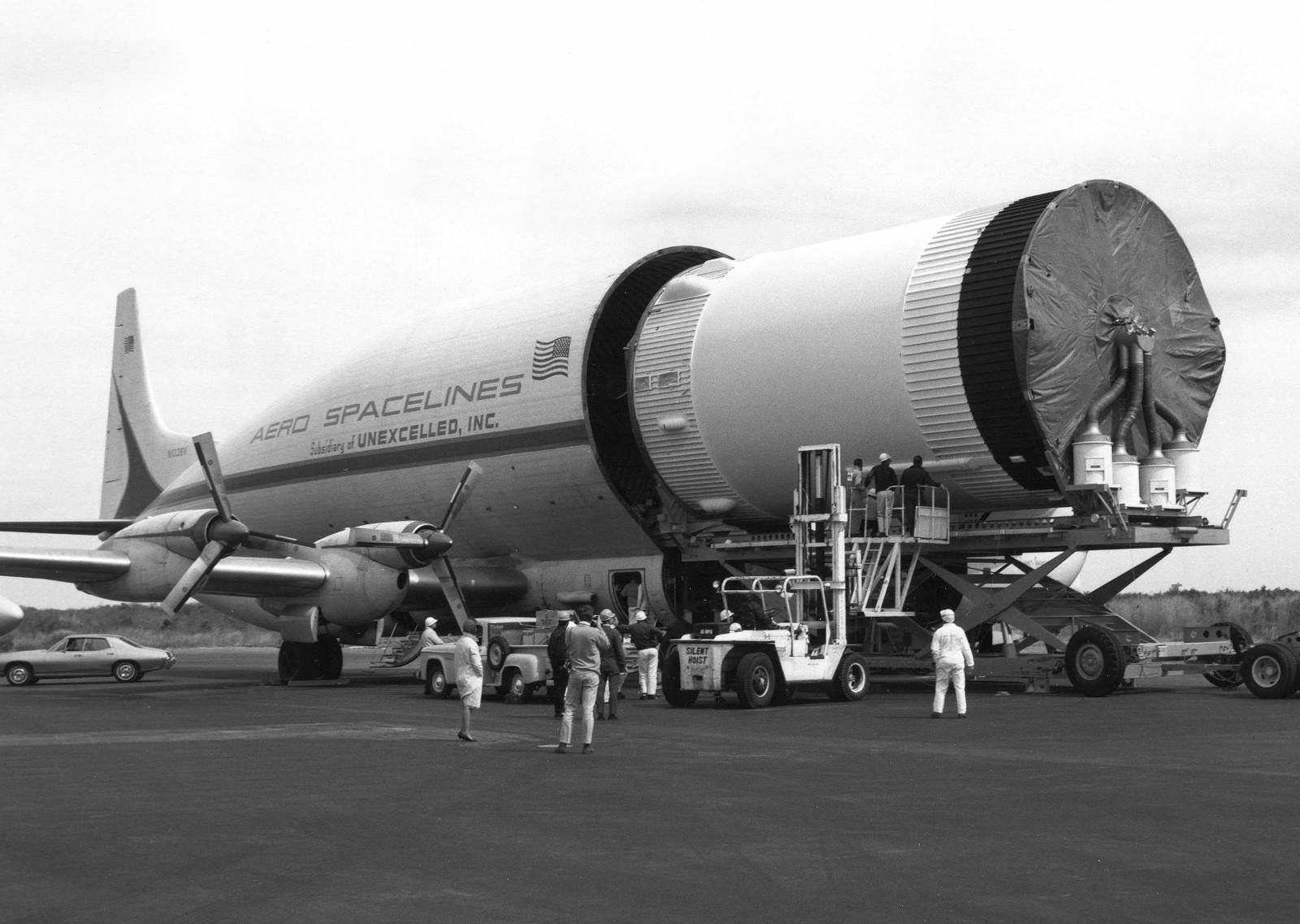
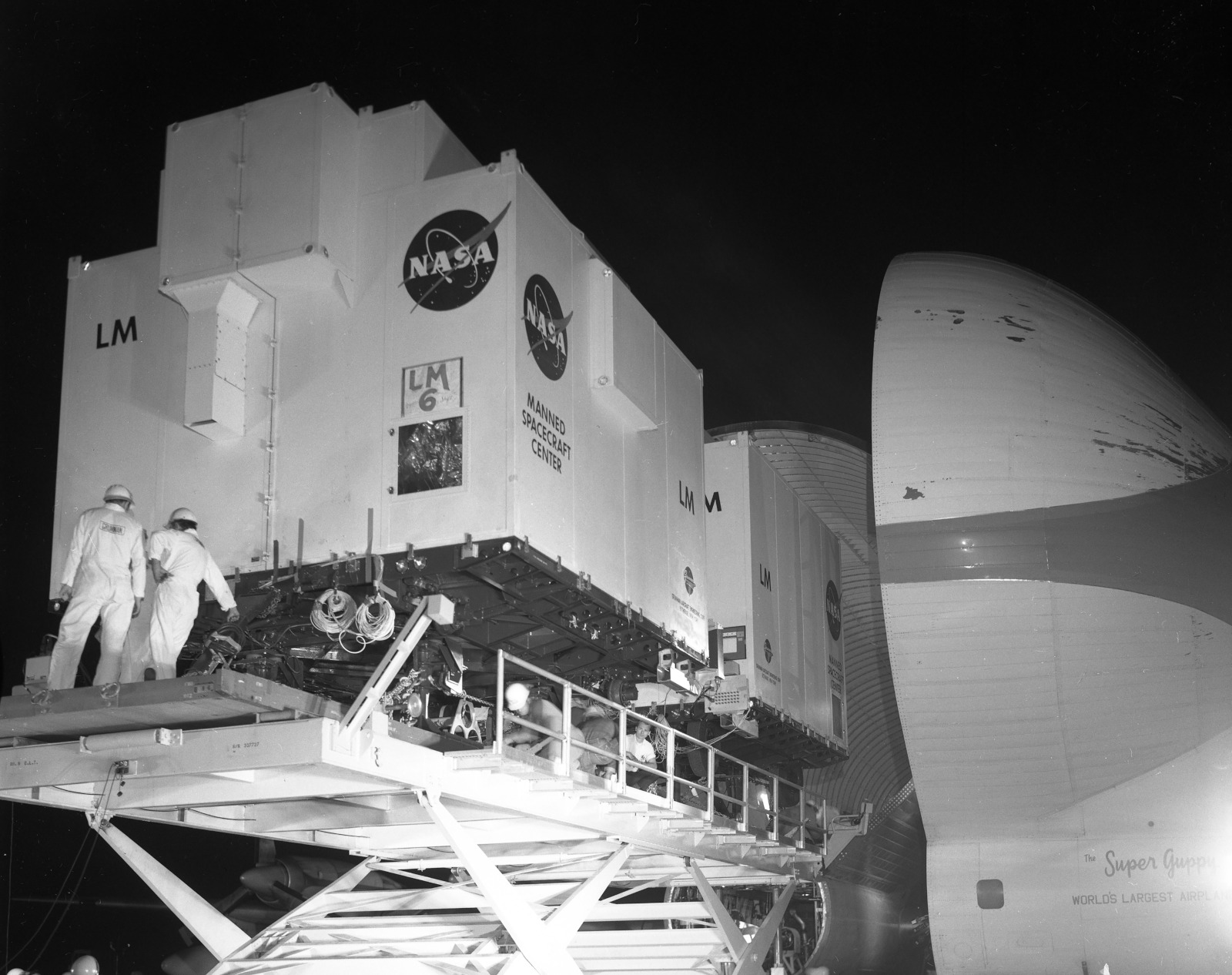
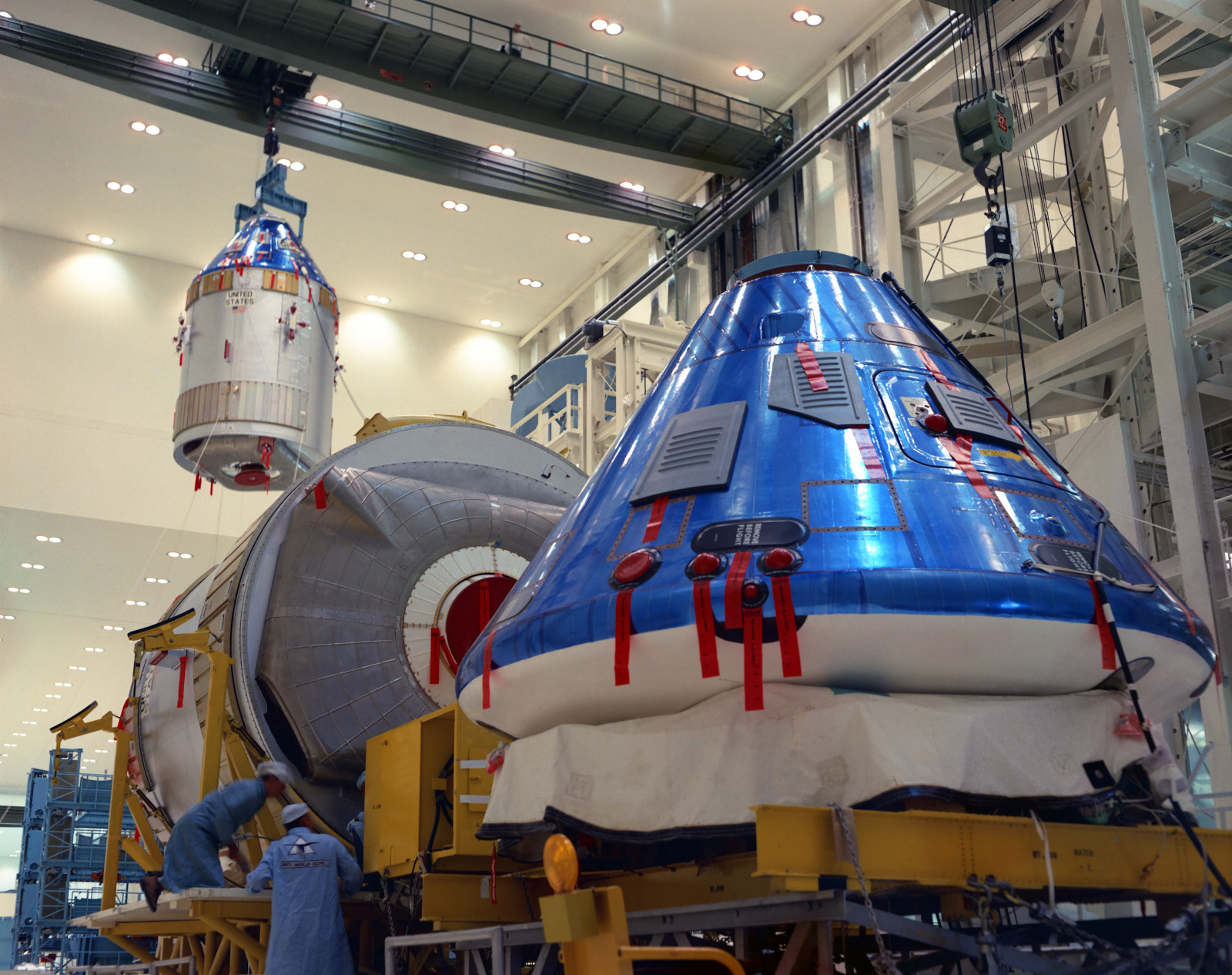
In case Apollo 11 could not achieve the Moon landing in July, NASA planned to try again with Apollo 12 in September. To protect for that launch date, components of the rocket and spacecraft began arriving at KSC. The Saturn V’s S-IVB third stage arrived on March 10 and workers placed it in storage in the VAB until the other two stages arrived in April and May. The Apollo 12 LM’s two stages arrived on March 24, and workers transported them to the MSOB. The CM and SM arrived four days later, and they shared space in the MSOB with the Apollo 11 spacecraft undergoing testing.

To be continued …

News from around the world in March 1969:

March 2 – First test flight of the Anglo-French Concorde supersonic jet transport in Toulouse.

March 3 – The U.S. Navy established the Navy Fighter Weapons School, better known as Top Gun, at Naval Air Station Miramar in California.

March 16 – Historical musical “1776” opens, runs for 1,217 performances, and wins three Tony Awards

March 17 – Golda Meir becomes Israel’s fourth and first, and so far only, woman prime minister.

March 26 – “Marcus Welby, M.D.” debuts as a TV movie on ABC, then becomes a series.

March 27 – Mariner 7 joins Mariner 6 on a journey to fly by Mars.

March 28 – Dwight D. Eisenhower, 34th president of the U.S., died at age 78.

March 31 – Kurt Vonnegut’s novel “Slaughterhouse-Five” was published.

Share

Details

Last Updated

Mar 20, 2024

Related Terms

Powered by WPeMatico

Get The Details…
Kelli Mars

Key Test Drive of Orion on NASA’s Artemis II to Aid Future Missions

Key Test Drive of Orion on NASA’s Artemis II to Aid Future Missions

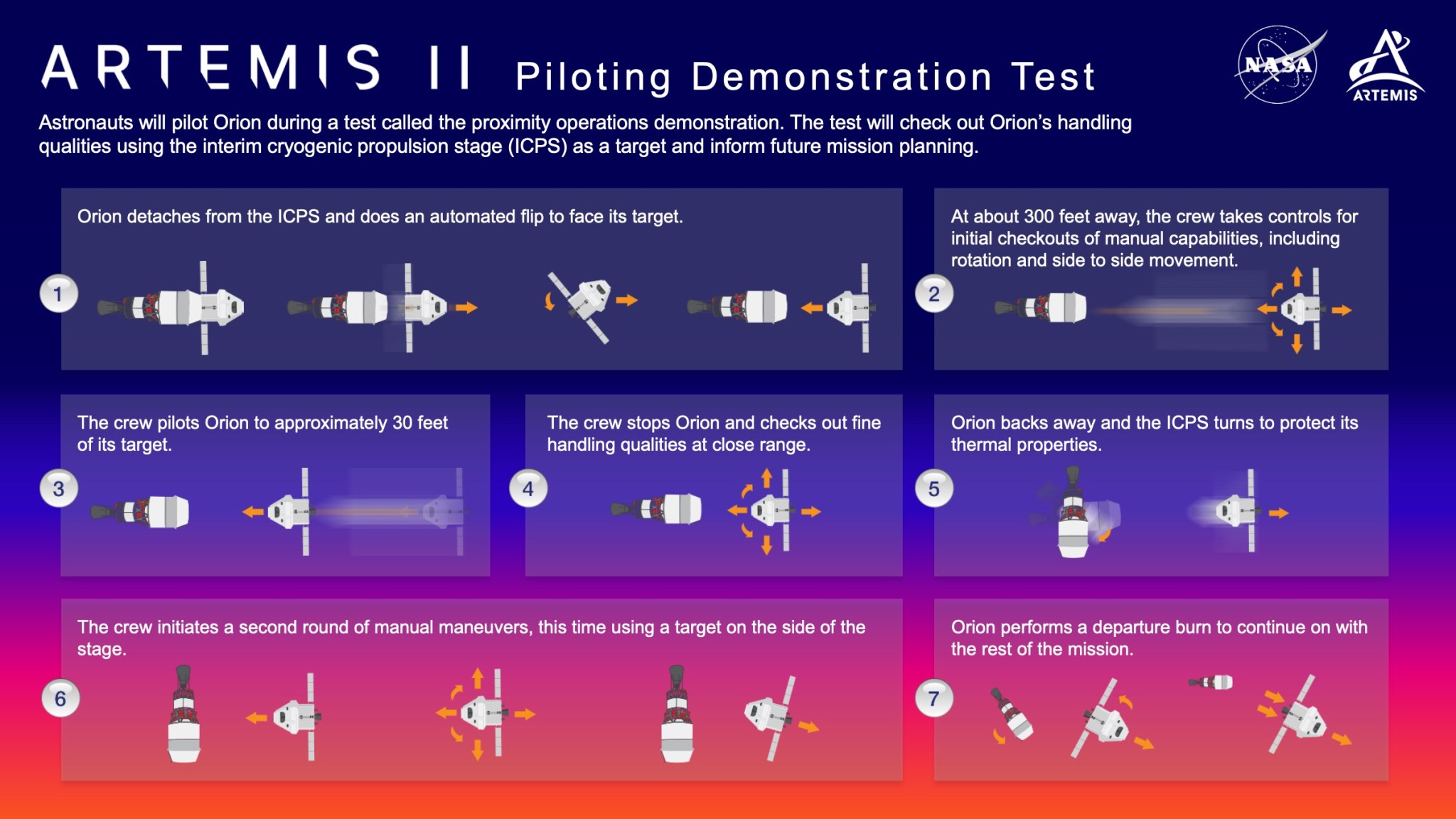
Astronauts will test drive NASA’s Orion spacecraft for the first time during the agency’s Artemis II test flight next year. While many of the spacecraft’s maneuvers like big propulsive burns are automated, a key test called the proximity operations demonstration will evaluate the manual handling qualities of Orion.

During the approximately 70-minute demonstration set to begin about three hours into the mission, the crew will command Orion through a series of moves using the detached upper stage of the SLS (Space Launch System) rocket as a mark. The in-space propulsion stage, called the ICPS (interim cryogenic propulsion stage), includes an approximately two-foot target that will be used to evaluate how Orion flies with astronauts at the controls.

“There are always differences between a ground simulation and what an actual spacecraft will fly like in space,” said Brian Anderson, Orion rendezvous, proximity operations, and docking manager within the Orion Program at NASA’s Johnson Space Center in Houston. “The demonstration is a flight test objective that helps us reduce risk for future missions that involve rendezvous and docking with other spacecraft.”

After NASA’s Reid Wiseman, Victor Glover, and Christina Koch, and CSA (Canadian Space Agency) astronaut Jeremy Hansen are safely in space, the Moon rocket’s upper stage will fire twice to put Orion on a high Earth orbit trajectory. Then, the spacecraft will automatically separate from the rocket stage, firing several separation bolts before springs push Orion a safe distance away.

As the spacecraft and its crew move away, Orion will perform an automated backflip to turn around and face the stage. At approximately 300 feet away, Orion will stop its relative motion. The crew will take control and use the translational and rotational hand controllers and display system to make very small movements to ensure Orion is responding as expected.

Next, the crew will very slowly pilot Orion to within approximately 30 feet of the stage. A two-foot auxiliary target mounted inside the top of the stage, similar to the docking target used by spacecraft visiting the International Space Station, will guide their aim.

“The crew will view the target by using a docking camera mounted inside the docking hatch window on the top of the crew module to see how well aligned they are with the docking target mounted to the ICPS,” Anderson said.

“It’s a good stand in for what crews will see when they dock with Starship on Artemis III and to the Gateway on future missions.”

About 30 feet from the stage, Orion will stop and the crew will checkout the spacecraft’s fine handling qualities to evaluate how it performs in close proximity to another spacecraft. Small maneuvers performed very close to the ICPS will be done using the reaction control system thrusters on Orion’s European Service Module.

Orion will then back away and allow the stage to turn to protect its thermal properties. The crew will follow the stage, initiate a second round of manual maneuvers using another target mounted on the side of the stage, approach within approximately 30 feet, perform another fine handling quality check out, then back away.

At the end of the demonstration, Orion will perform an automated departure burn to move away from the ICPS before the stage then fires to re-enter Earth’s atmosphere over a remote location in the Pacific Ocean. During Orion’s departure burn, engineers will use the spacecraft’s docking camera to gather precise positioning measurements, which will help inform navigation during rendezvous activities on future missions in the lunar environment, where there is no GPS system. 

Because the Artemis II Orion is not docking with another spacecraft, it is not equipped with a docking module containing lights and therefore is reliant on the ICPS to be lit enough by the Sun to allow the crew to see the targets.

“As with many of our tests, it’s possible the proximity operations demonstration won’t go exactly as expected,” said Anderson. “Even if we don’t accomplish every part of the demonstration, we’ll continue on with the test flight as planned to accomplish our primary objectives, including evaluating Orion’s systems with crew aboard in the deep space environment and keeping the crew safe during the mission.”

The approximately 10-day Artemis II flight will test NASA’s foundational human deep space exploration capabilities, the SLS rocket and Orion spacecraft, for the first time with astronauts and will pave the way for lunar surface missions, including landing the first woman, first person of color, and first international partner astronaut on the Moon.

Powered by WPeMatico

Get The Details…
Rachel H. Kraft