How NASA Uses Simple Technology to Track Lunar Missions

How NASA Uses Simple Technology to Track Lunar Missions

NASA is using a simple but effective technology called Laser Retroreflective Arrays (LRAs) to determine the locations of lunar landers more accurately. They will be attached to most of the landers from United States companies as part of NASA’s Commercial Lunar Payload Service (CLPS) initiative. LRAs are inexpensive, small, and lightweight, allowing future lunar orbiters or landers to locate them on the Moon.

NASA is using a simple but effective technology called Laser Retroreflective Arrays (LRAs) to determine the locations of lunar landers more accurately. They will be attached to landers sent to the Moon as part of NASA’s Commercial Lunar Payload Service (CLPS) initiative. LRAs are inexpensive, small, and lightweight.
Credit: NASA’s Goddard Space Flight Center/Scientific Visualization Studio James Tralie (ADNET Systems, Inc.). Lead Producer Xiaoli Sun (NASA/GSFC): Scientist
This video can be freely shared and downloaded at https://svs.gsfc.nasa.gov/14517.

These devices consist of a small aluminum hemisphere, 2 inches (5 centimeters) in diameter and 0.7 ounces (20 grams) in weight, inset with eight 0.5-inch-diameter (1.27-centimeter) corner cube retroreflectors made of fused silica glass. LRAs are targeted for inclusion on most of the upcoming CLPS deliveries headed to the lunar surface.

Photo of a Laser Retroreflector Array (LRA).
This photograph shows a mockup laser retroreflector array (LRA) at NASA’s Goddard Space Flight Center, Greenbelt, Maryland, demonstrating the basic design: a metallic semi-hemispheric disc, with eight silica glass cubes embedded in its surface.
NASA/Goddard

LRAs are designed to reflect laser light shone on them from a large range of angles. Dr. Daniel Cremons of NASA’s Goddard Space Flight Center in Greenbelt, Maryland, deputy principal investigator for the LRA project, describes this as being similar to the reflective strips featured on road signs to aid in nighttime driving here on Earth. “Unlike a mirror where it has to be pointed exactly back at you, you can come in at a wide variety of angles and the light will head directly back to the source,” he said.

By shining a laser beam from one spacecraft toward the retroreflectors on another and measuring how long it takes for the light to get back to its source, scientists can determine the distance between them.

“We have been putting these on satellites and ranging to them from ground-based lasers for years,” said Dr. Xiaoli Sun, also of NASA Goddard and principal investigator for the LRA project. “Then, twenty years ago, someone got the idea to put them on the landers. Then you can range to those landers from orbit and know where they are on the surface.”

Image of the laser-ranging facility at NASA Goddard Space Flight Center.
This photograph shows the Laser Ranging Facility at the Geophysical and Astronomical Observatory at NASA’s Goddard Spaceflight Center, Greenbelt, Maryland, shining ranging lasers at NASA’s Lunar Reconnaissance Orbiter spacecraft.
NASA

It is important to know the location of landers on the surface of another planetary body and these LRAs act as markers that work with orbiting satellites to establish a navigation aid like the global positioning system (GPS) we take for granted here on Earth.

Laser ranging is also used for docking spacecraft, like the cargo spacecraft that are used for the International Space Station, pointed out Cremons. The LRAs light up when you shine light on them which helps to guide precision docking. They can also be detected by lidars on spacecraft from far away to determine their range and approach speed down to very tight accuracy ratings, and free from the need for illumination from the Sun, which allows docking to happen at nighttime. He adds that the reflectors could allow spacecraft to accurately range-find their way to a landing pad, even without the aid of external light to guide the approach. This means that LRAs can eventually be used to help spacecraft land in otherwise pitch-dark places close to permanently shadowed regions near the lunar South Pole, which are prime target areas for crewed missions because of the resources that might exist there, such as water ice.

Since LRAs are small and made of simple materials, they can fly on scientific missions as a beneficial but low-risk add-on. “By itself, it’s completely passive,” said Cremons. “LRAs will survive the harsh lunar environment and continue to be usable on the surface for decades. Additionally, besides navigating and finding out where your landers are, you can also use laser ranging to tell where your orbiter is around the Moon.”

This means that, as more landers, rovers, and orbiters are sent to the Moon bearing one or more LRAs, our ability to accurately gauge the location of each will only improve. As such, as we deploy more LRAs to the lunar surface, this growing network will allow scientists to gauge the location of key landers and other points of interest more and more accurately, allowing for bigger, better science to be accomplished.

NASA’s Lunar Reconnaissance Orbiter (LRO) is currently the only NASA spacecraft orbiting the Moon with laser-ranging capability. LRO has already succeeded in ranging to the LRA on the Indian Space Research Organization’s Vikram lander on the lunar surface and will continue to range to LRAs on future landers.

Under Artemis, CLPS deliveries will perform science experiments, test technologies, and demonstrate capabilities to help NASA explore the Moon and prepare for human missions. With Artemis missions, NASA will land the first woman and first person of color on the Moon, using innovative technologies to explore more of the lunar surface than ever before. The agency will collaborate with commercial and international partners and establish the first long-term presence on the Moon. Then, NASA will use what we learn on and around the Moon to take the next giant leap: sending the first astronauts to Mars.

By Nick Oakes

NASA Goddard Space Flight Center

Share

Details

Last Updated

Feb 13, 2024

Editor
William Steigerwald
Contact
Nancy N. Jones
Location
Goddard Space Flight Center

Powered by WPeMatico

Get The Details…
William Steigerwald

NASA Collaborates in an International Air Quality Study

NASA Collaborates in an International Air Quality Study

3 min read

Preparations for Next Moonwalk Simulations Underway (and Underwater)

The DC-8 aircraft takes off from Palmdale, California, ascending against a cloudy gray sky.
NASA’s DC-8 aircraft takes off from NASA’s Armstrong Flight Research Center Building 703 in Palmdale, California, to conduct test flights as part of the Airborne and Satellite Investigation of Asian Air Quality, or ASIA-AQ mission, that will collect detailed air quality data over several locations in Asia.
NASA/Carla Thomas

NASA and international researchers are studying the air quality in Asia as part of a global effort to better understand the air we breathe. In collaboration with Korea’s National Institute of Environmental Research (NIER), the Airborne and Satellite Investigation of Asian Air Quality, or ASIA-AQ mission, will collect detailed atmospheric data over several locations in Asia.

Utilizing aircraft, satellites, and ground-based instruments, the ASIA-AQ team will gather and share data with air quality and government agencies to be used for air quality research and understanding worldwide.

“Our purpose is to improve the understanding of the factors that control air quality,” said Jim Crawford, principal investigator for the ASIA-AQ mission at NASA’s Langley Research Center in Hampton, Virginia. “Multi-perspective observations are needed because satellites, ground-sites, and aircraft each see different aspects of air quality that need to be connected.”

While satellite views and ground measurements provide significant data, alone they cannot completely illustrate air quality problems and the sources that cause them. By adding airborne measurements to models along with satellite and ground-based observations, scientists can achieve a multi-dimensional, detailed perspective that evaluates our air quality models from all angles.

A pair of NASA science aircraft will help provide those additional dimensions to air quality observations. The DC-8 from NASA’s Armstrong Flight Research Center in Edwards, California, is outfitted with 26 instruments and will fly at low-altitudes to collect data from the atmosphere closest to the ground where people and habitats are impacted. Meanwhile, the G-III from NASA’s Langley Research Center in Hampton, Virginia, will fly at 28,000 feet altitude to create a high-resolution map of the pollution distribution in each study area, and how it changes throughout the day. Together with Korean aircraft from NIER, the NASA planes and instruments will supplement and cross-reference the observations made from the ground and satellite instruments.

“Science missions for air quality [like ASIA-AQ] take a holistic approach of multiple perspectives to better understand our pollution issues,” said Laura Judd, platform scientist for NASA’s G-III aircraft. “If we can better understand how models simulate our air pollution, then we can forecast when these events unfold, and be able to disseminate that information to the public to make informed decisions.”

Pollution changes as populations shift, economies ebb and flow, and industries move or evolve. The ASIA-AQ project will improve our ability to measure those changes and how they connect to the global scale. Bringing scientists, aircraft, and instruments together from across Asia and around the world, ASIA-AQ demonstrates how scientific advancement is a collaborative effort.

“Scientists and agencies in each of the participating countries will ensure that ASIA-AQ targets the most important open air quality questions in their specific region,” said Barry Lefer, NASA program scientist for air quality research at NASA Headquarters. “And they’ll be the ones to implement improvements in their forecast models and advocate for policy changes.” ASIA-AQ is a joint effort between NASA and Korea’s National Institute of Environmental Research (NIER) and several international organizations including the Department of Environment and Natural Resources Philippines (DENR), the Universiti Kebangsaan Malaysia (UKM), the Geo-Informatics and Space Technology Development Agency Thailand (GISTDA) and the Ministry of Environment Taiwan (MOENV).

Powered by WPeMatico

Get The Details…
Dede Dinius

NASA Solar Sail Technology Passes Crucial Deployment Test

NASA Solar Sail Technology Passes Crucial Deployment Test

4 min read

Preparations for Next Moonwalk Simulations Underway (and Underwater)

A man and woman stand in front of a silver solar sail on the floor.
NASA Marshall Space Flight Center technologists Les Johnson and Leslie McNutt at Redwire Space on Jan. 30, 2024, following a successful solar sail deployment test. NASA cleared a key technology milestone at Redwire’s new facility in Longmont, Colorado, with the successful deployment of one of four identical solar sail quadrants.
Redwire Space

By Wayne Smith

In his youth, NASA technologist Les Johnson was riveted by the 1974 novel “The Mote in God’s Eye,” by Jerry Pournelle and Larry Niven, in which an alien spacecraft propelled by solar sails visits humanity. Today, Johnson and a NASA team are preparing to test a similar technology.

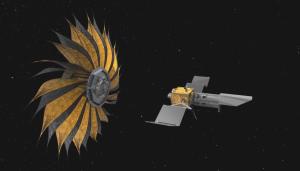
NASA continues to unfurl plans for solar sail technology as a promising method of deep space transportation. The agency cleared a key technology milestone in January with the successful deployment of one of four identical solar sail quadrants. The deployment was showcased Jan. 30 at Redwire Corp.’s new facility in Longmont, Colorado. NASA’s Marshall Space Flight Center in Huntsville, Alabama, leads the solar sail team, comprised of prime contractor Redwire, which developed the deployment mechanisms and the nearly 100-foot-long booms, and subcontractor NeXolve, of Huntsville, which provided the sail membrane. In addition to leading the project, Marshall developed the algorithms needed to control and navigate with the sail when it flies in space.

NASA and industry partners used two 100-foot lightweight composite booms to stretch out a 4,445-square-footsquare-foot (400-square-meter) prototype solar sail quadrant for the first time Jan. 30, 2024. While just one quarter of the sail was unfurled in the deployment at Redwire, the complete sail will measure 17,780 square feet when fully deployed, with the thickness less than a human hair at 2 and a half microns. The sail is made of a polymer material coated with aluminum. (Redwire Space)

The sail is a propulsion system powered by sunlight reflecting from the sail, much like a sailboat reflects the wind. While just one quarter of the sail was unfurled in the deployment at Redwire, the complete sail will measure 17,780 square feet when fully deployed, with the thickness less than a human hair at 2 and a half microns. The sail is made of a polymer material coated with aluminum.

NASA’s Science Mission Directorate recently funded the solar sail technology to reach a new technology readiness level, or TRL 6, which means it’s ready for proposals to be flown on science missions.

“This was a major last step on the ground before it’s ready to be proposed for space missions,” Johnson, who has been involved with sail technology at Marshall for about 25 years, said. “What’s next is for scientists to propose the use of solar sails in their missions. We’ve met our goal and demonstrated that we’re ready to be flown.”

A solar sail traveling through deep space provides many potential benefits to missions using the technology because it doesn’t require any fuel, allowing very high propulsive performance with very little mass. This in-space propulsion system is well suited for low-mass missions in novel orbits.

“Once you get away from Earth’s gravity and into space, what is important is efficiency and enough thrust to travel from one position to another,” Johnson said.

A solar sail achieves that by reflecting sunlight – the greater the size of the sail, the greater thrust it can provide.

Les Johnson

Les Johnson

NASA technologist

Some of the missions of interest using solar sail technology include studying space weather and its effects on the Earth, or for advanced studies of the north and south poles of the Sun. The latter has been limited because the propulsion required to  get a spacecraft into a polar orbit around the sun is very high and simply not feasible using most of the propulsion systems available today. Solar sail propulsion is also possible for enhancing future missions to Venus or Mercury, given their closeness to the Sun and the enhanced thrust a solar sail would achieve in the more intense sunlight there.

Moreover, it’s the ultimate green propulsion system, Johnson said – as long as the Sun is shining, the sail will have propulsion. Where the sunlight is less, he envisions a future where lasers could be used to accelerate the solar sails to high speeds, pushing them outside the solar system and beyond, perhaps even to another star. “In the future, we might place big lasers in space that shine their beams on the sails as they depart the solar system, accelerating them to higher and higher speeds, until eventually they are going fast enough to reach another star in a reasonable amount of time.”

To learn more about solar sails and other NASA advanced space technology, visit:

https://www.nasa.gov/space-technology-mission-directorate

Jonathan Deal
Marshall Space Flight Center, Huntsville, Ala.
256-544-0034
jonathan.e.deal@nasa.gov

Powered by WPeMatico

Get The Details…
Beth Ridgeway

Astronaut Charles Bolden Preps for Deorbit

Astronaut Charles Bolden Preps for Deorbit

Astronaut Charles F. Bolden, a Black man, looks over his right shoulder and smiles at the camera. He is wearing an orange launch and entry suit and square tinted glasses without temples. He is sitting at the commander's station, which has many switches and dials, along with a notebook, a 3-ring binder, and various sheets of paper.
STS-60 commander Charles F. Bolden is seen at the commander’s station on the forward flight deck of the space shuttle Discovery. He is wearing the orange launch and entry suit. Bolden and his crewmates performed proximity operations with the Russian Mir space station.
NASA

Astronaut Charles F. Bolden, STS-60 commander, sits at the commander’s station on the forward flight deck of the space shuttle Discovery in this image from February 1994. While aboard Discovery, the crew attempted to deploy the Wake Shield Facility-1, a deployable/retrievable experiment platform designed to leave a vacuum wake in low earth orbit that is 10,000 times greater than achievable on Earth. The crew also conducted in-flight medical and radiological investigations and spoke with world leaders from space.

Bolden was a member of NASA’s Astronaut Office for 14 years. After joining the office in 1980, he traveled to orbit four times aboard the space shuttle between 1986 and 1994, commanding two of the missions and piloting two others. 

He then became the 12th NASA Administrator. During his tenure, the agency’s support of commercial space transportation systems for reaching low Earth orbit enabled successful commercial cargo resupply of the space station and significant progress toward returning the capability for American companies to launch astronauts from American soil by 2017. Bolden also supported NASA’s contributions toward development of developing cleaner, faster, and quieter airplanes. The agency’s dynamic science activities under Bolden include an unprecedented landing on Mars with the Curiosity rover, launch of a spacecraft to Jupiter, enhancing the nation’s fleet of Earth-observing satellites, and continued progress toward the launch of the James Webb Space Telescope.

Watch the first episode of “The Color of Space: The Series” and delve deep into the extraordinary life of Charlie Bolden.

Credit: NASA

Powered by WPeMatico

Get The Details…
Monika Luabeya

Collins Aerospace Tests NASA Space Station Suit in Weightlessness

Collins Aerospace Tests NASA Space Station Suit in Weightlessness

A key NASA design milestone was recently completed by Collins Aerospace as the company works to develop a next-generation spacesuit for use on the International Space Station.

The milestone – a pressure garment system fit and functionality test in a microgravity-like environment – marked an important step toward developing a suit for NASA that can be used for continuing operations and advancing scientific discovery in low Earth orbit.

The agency selected Collins to develop a new spacesuit that can replace the current space station spacesuit, known technically as an extravehicular mobility unit, which has been worn by astronauts to assemble and maintain the space station for over two decades.

The Collins test was conducted aboard a commercial microgravity aircraft to provide brief periods of weightlessness. During a parabolic flight, a pilot creates weightless conditions for around 20 seconds at a time by conducting a series of roller-coaster-like maneuvers. This allows engineers, scientists, and students to test hardware and conduct scientific experiments in a space-like gravity environment without ever going into space. 

The test was a key step in NASA’s preliminary design review process, one of a series of checkpoints in the project’s design lifecycle, that ensures the design meets all system requirements before manufacturing of flight-ready units can begin.

Collins will continue testing its spacesuit in a vacuum chamber, where air will be removed to create a vacuum to see how the spacesuit performs in a space-like atmosphere, as well as at the agency’s Neutral Buoyancy Laboratory, a 40-foot deep pool at NASA’s Johnson Space Center in Houston, that simulates a microgravity environment for astronaut spacewalk training.

This next-generation spacesuit is designed to advance NASA’s spacewalking capabilities in low Earth orbit. It is being developed to support station maintenance and operations as NASA and its international partners continue carrying out scientific research that benefits humanity and demonstrates new technologies for future human and robotic missions.

Powered by WPeMatico

Get The Details…
Victoria Ugalde