NASA Innovation on Display at AAS Goddard Space Science Symposium 

NASA Innovation on Display at AAS Goddard Space Science Symposium 

From the search for habitable worlds beyond our solar system to Earth science missions closer to home, NASA shared its goals for the next decades of exploration at this year’s Goddard Space Science Symposium, held March 20-22, 2024, at the University of Maryland in College Park. 

“We wanted to help bring focus to this long-term vision by gathering people from all areas of the industry to discuss the plan, the associated opportunities and challenges, and how we will all work together to succeed,” said Jim Way, executive director at the American Astronautical Society (AAS), which co-hosted the symposium with NASA’s Goddard Space Flight Center in Greenbelt, Maryland. 

NASA Goddard and AAS collaborated to develop this year’s theme, “Space 2040: Pathways to the Future.” About 340 in-person attendees participated in panels featuring NASA scientists, researchers, and experts, as well as government and industry partners.  

Goddard Center Director Makenzie Lystrup kicked off the symposium by emphasizing the role partnerships have to play in science and space exploration.  

“The world is changing, and the space industry in particular; we’ve got to adapt to that,” Lystrup said. “Goddard needs to adapt to that, NASA needs to adapt, and I think that that can be scary. But also, this is the time when innovation can really come out. And so, I think that the sharing of ideas, and the willingness to try new things, is more important now than it ever has been.”

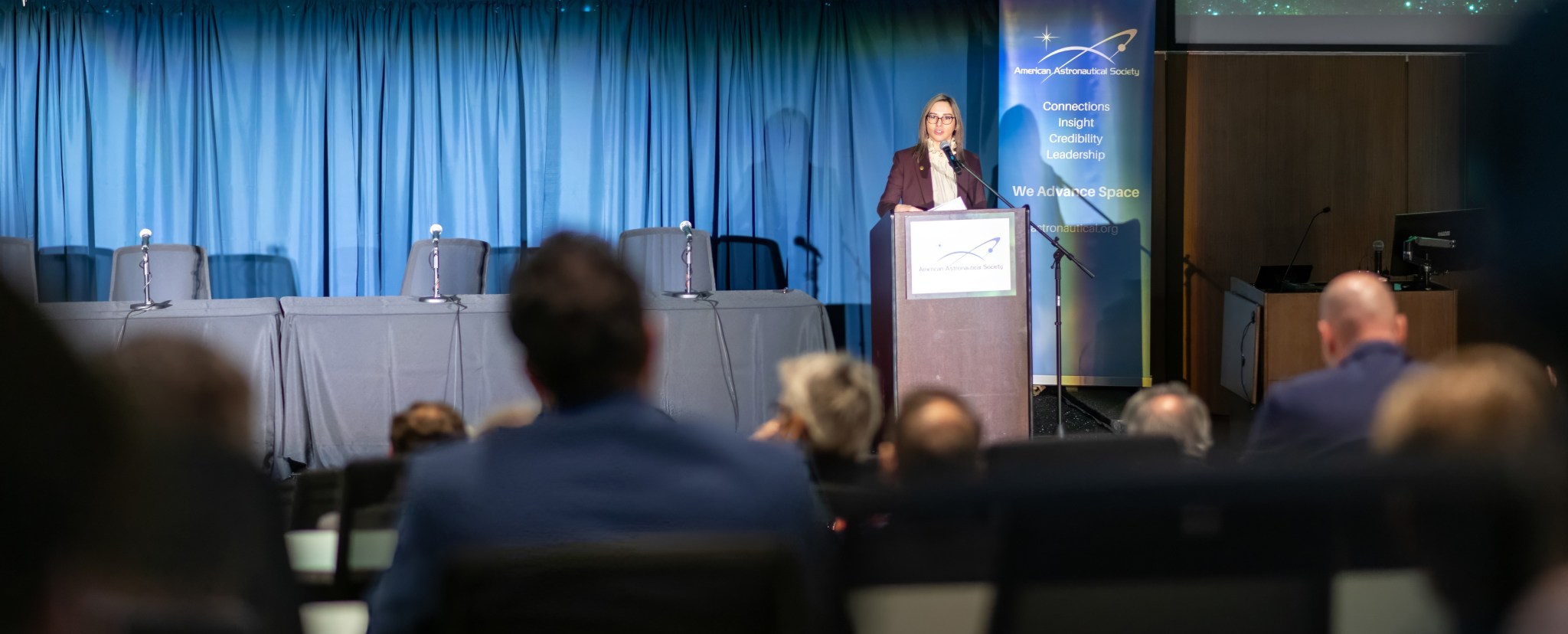
far shot of Dr. Makenzie Lystrup speaking at a podium against a curtained backdrop; attendees in foreground
Makenzie Lystrup, center director at NASA’s Goddard Space Flight Center in Greenbelt, Md., gives opening remarks at the 61st Goddard Space Science Symposium sponsored by the American Astronautical Society on March 20, 2024, at the University of Maryland in College Park.
NASA/Tabatha Luskey

During the symposium, Goddard employees, students, and members of the industry and government workforce listened to discussions on space weather, climate science, interplanetary missions, and more. Nicola Fox, associate administrator of NASA’s Science Mission Directorate at the agency’s headquarters in Washington, gave the opening keynote address on March 20. Fox spoke about NASA’s current and future missions, highlighting the intersections between NASA sciences.  

“I love to think about the interconnections in the science that we do,” Fox said. “Everybody knows that all the really interesting stuff – it’s not even just science – interesting stuff happens on the boundaries.”

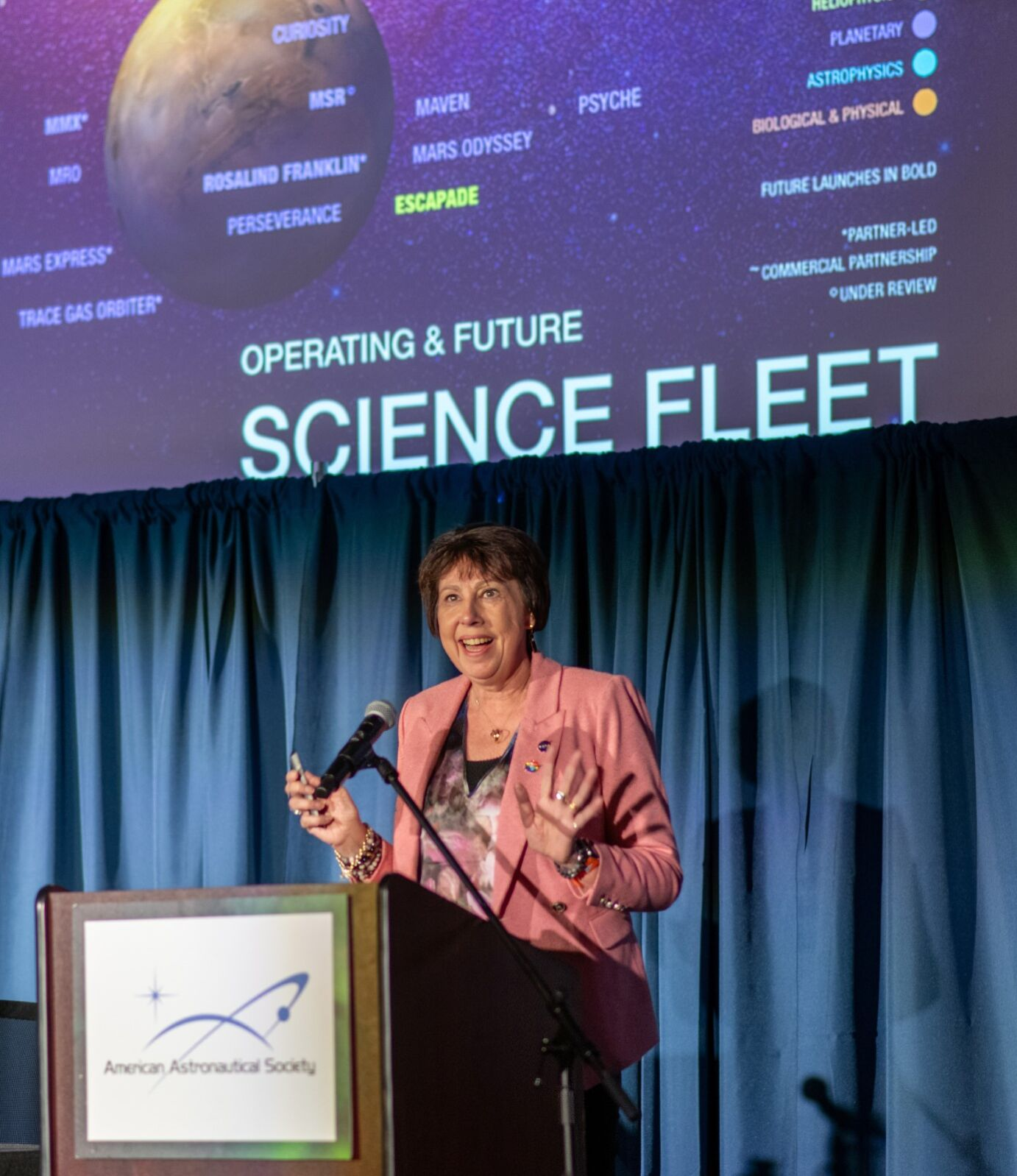
mid shot of Dr. Nicola Fox at a podium with a "SCIENCE FLEET" graphic displaying on a screen above her head
NASA Associate Administrator for the Science Mission Directorate Nicola Fox speaks about NASA’s operating and future science fleet during her keynote address at the symposium on March 20.
NASA/Tabatha Luskey

The symposium concluded with early science results from NASA’s OSIRIS-REx mission, which returned a sample from the asteroid Bennu in September 2023. Mission scientists brought a small piece of the sample for attendees to view. 

“That smudge you see is a pristine sample of the early solar system that we took 200 million miles away, and they’re finding some little preliminary results already,” said Michelle Thaller, co-chair of the 2024 planning committee and assistant director for science communication at Goddard. 

This year marked the 61st symposium, making it the longest running event hosted by AAS. Formerly known as the Robert H. Goddard Memorial Symposium, the event demonstrates the longstanding relationship between Goddard and AAS.

By Julia Tilton
NASA’s Goddard Space Flight Center, Greenbelt, Md.

Share

Details

Last Updated

Mar 22, 2024

Editor
Rob Garner
Contact
Rob Garner
Location
Goddard Space Flight Center

Powered by WPeMatico

Get The Details…
Rob Garner

NASA Invites Media to Eclipse Mission Sounding Rocket Media Day 

NASA Invites Media to Eclipse Mission Sounding Rocket Media Day 

2 min read

Preparations for Next Moonwalk Simulations Underway (and Underwater)

Media are invited to apply for accreditation to attend a pre-launch media day to learn about a sounding rocket mission set to launch from Virginia’s Eastern Shore during the 2024 solar eclipse. The April 2 media day event includes opportunities to hear from subject matter experts, tour the facility, and interview members of the research team. Media day activities will take place on Tuesday, April 2, from 9 a.m.- noon at NASA’s Wallops Flight Facility in Wallops Island, Virginia.

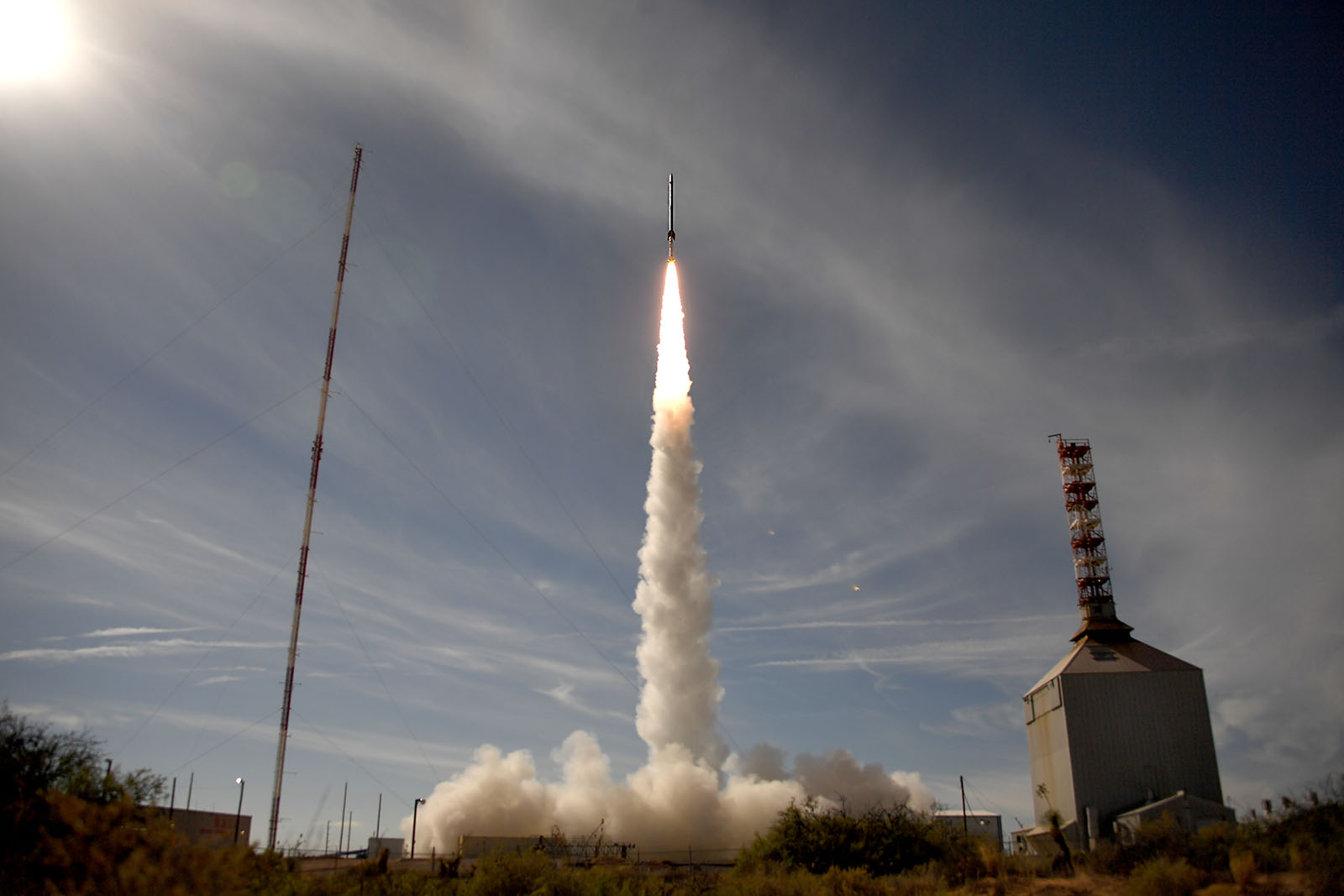
A wide shot of a sounding rocket just after lifting off from a launch pad, a trail of smoke underneath it.
A sounding rocket launches from White Sands, New Mexico, during the Oct. 14, 2024, annular solar eclipse for the APEP mission.
U.S. Army/Judy Hawkins

The application deadline for media who are U.S. citizens is Friday, March 29, at 2 p.m. EDT. All media must send their accreditation request to the Wallops Office of Communications.

Media must arrive at Wallops no later than 9 a.m. on Tuesday, April 2, to complete the badging process prior to the media day tour and interviews.  

This NASA mission, known as Atmospheric Perturbations around Eclipse Path (APEP), is led by Dr. Aroh Barjatya, a professor of engineering physics at Embry-Riddle Aeronautical University in Daytona Beach, Florida. Three sounding rockets will be launched during the solar eclipse on April 8 to study how the sudden drop in sunlight affects our upper atmosphere. 

Media Contact
Amy Barra 
NASA’s Wallops Flight Facility, Wallops Island, Virginia

Share

Details

Last Updated

Mar 20, 2024

Editor
Jamie Adkins
Contact
Location
Wallops Flight Facility

Powered by WPeMatico

Get The Details…
Amy Barra

International Space Station welcomes biological and physical science experiments

International Space Station welcomes biological and physical science experiments

3 min read

International Space Station welcomes biological and physical science experiments

NASA is sending several biological and physical sciences experiments and equipment aboard SpaceX’s 30th commercial resupply services mission. Studying biological and physical phenomena under extreme conditions allows researchers to advance the fundamental scientific knowledge required to go farther and stay longer in space, while also benefitting life on Earth. Not only can these experiments provide pioneering scientific discovery – they enable sustainable deep space exploration and support transformative engineering.

The commercial resupply launch took place Thursday, March 21, at Cape Canaveral Space Force Station in Florida.

Understanding Antibiotic Resistance in Space

The emergence of antibiotic-resistant bacteria poses a significant threat to human health, both on Earth and in space. Common, harmless bacteria like Enterococcus faecalis (EF) and Enterococcus faecium, can be found on the International Space Station just as they are on Earth — and yet, they exhibit resistance to antibiotics and are hardier than their counterparts down on the ground. This raises concerns about potential more harmful bacteria causing infections for astronauts, especially during long-duration missions, as standard antibiotic treatments might prove ineffective.

To address this issue, Genomic Enumeration of Antibiotic Resistance in Space will survey the space station for antibiotic-resistant microbes. By analyzing the genetic makeup of these bacteria, scientists hope to understand how they adapt to the unique environment of space. This knowledge will be instrumental in developing protective measures for astronauts’ health on future long-duration missions. Additionally, it could contribute to a broader understanding of antibiotic resistance, benefiting healthcare practices on Earth.

Principal Investigator: Dr. Christopher Carr, Georgia Institute of Technology, Atlanta, GA
Georgia Tech

Cold Atom Lab Science Module – 1

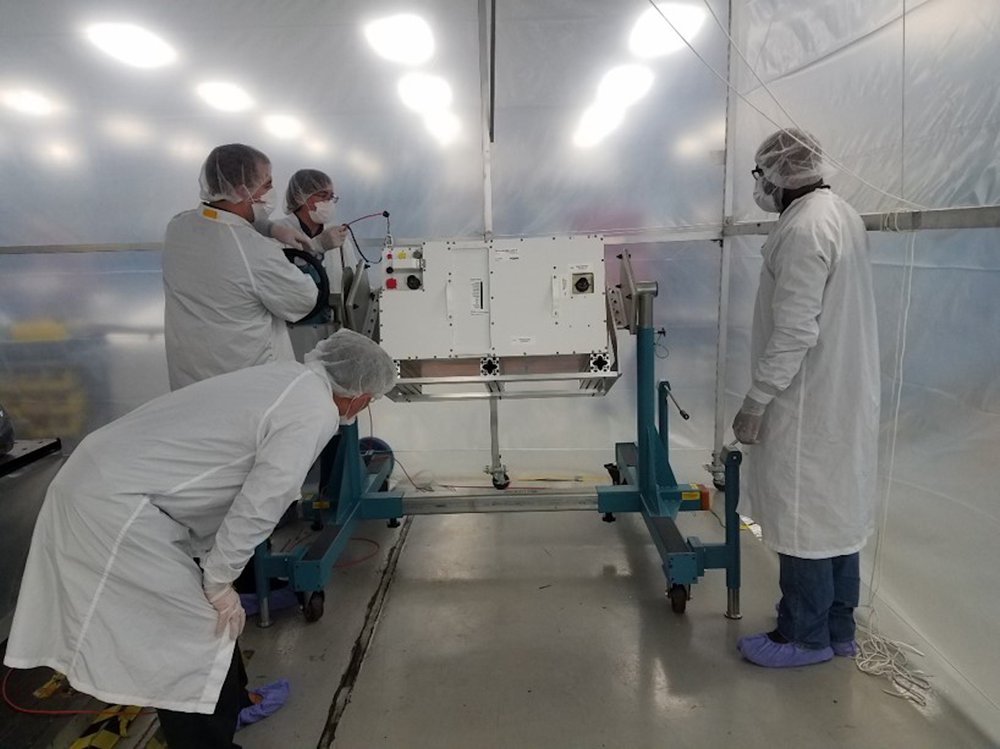
A temporary replacement module for the Cold Atom Lab will be aboard SpaceX-30. The module will enable NASA to continue pioneering quantum experiments aboard the International Space Station while researchers troubleshoot upgraded equipment delivered to station in August 2023 that they were unable to bring online.

The Cold Atom Laboratory quad locker sitting in a fixture that will allow the hardware to be packaged for shipment to the launch facility.
NASA/Jet Propulsion Laboratory

Levitation of High Temperature Metals

Japan Aerospace Exploration Agency (JAXA) partner-lead investigation

The objective of the Electrostatic Levitation Furnace-1 reflight is to investigate the effects of the interfacial phenomena between molten steel and slag (oxide) melts during processing from the viewpoint of the thermophysical properties. During steel making processes, such as continuous casting, the impurity in the cast steel is influenced by the interplay between the molten steel and molten slags.  Understanding the interfacial phenomena could help produce higher purity steels. Success could increase the space station’s commercial utilization and improve oxide melt manufacturing and application on Earth.

Portrait of a Caucasian man with glasses. He is wearing a black suit, white dress shirt and tie with blue pattern.

Flow Boiling Condensation Module Power Filter Module (support hardware)

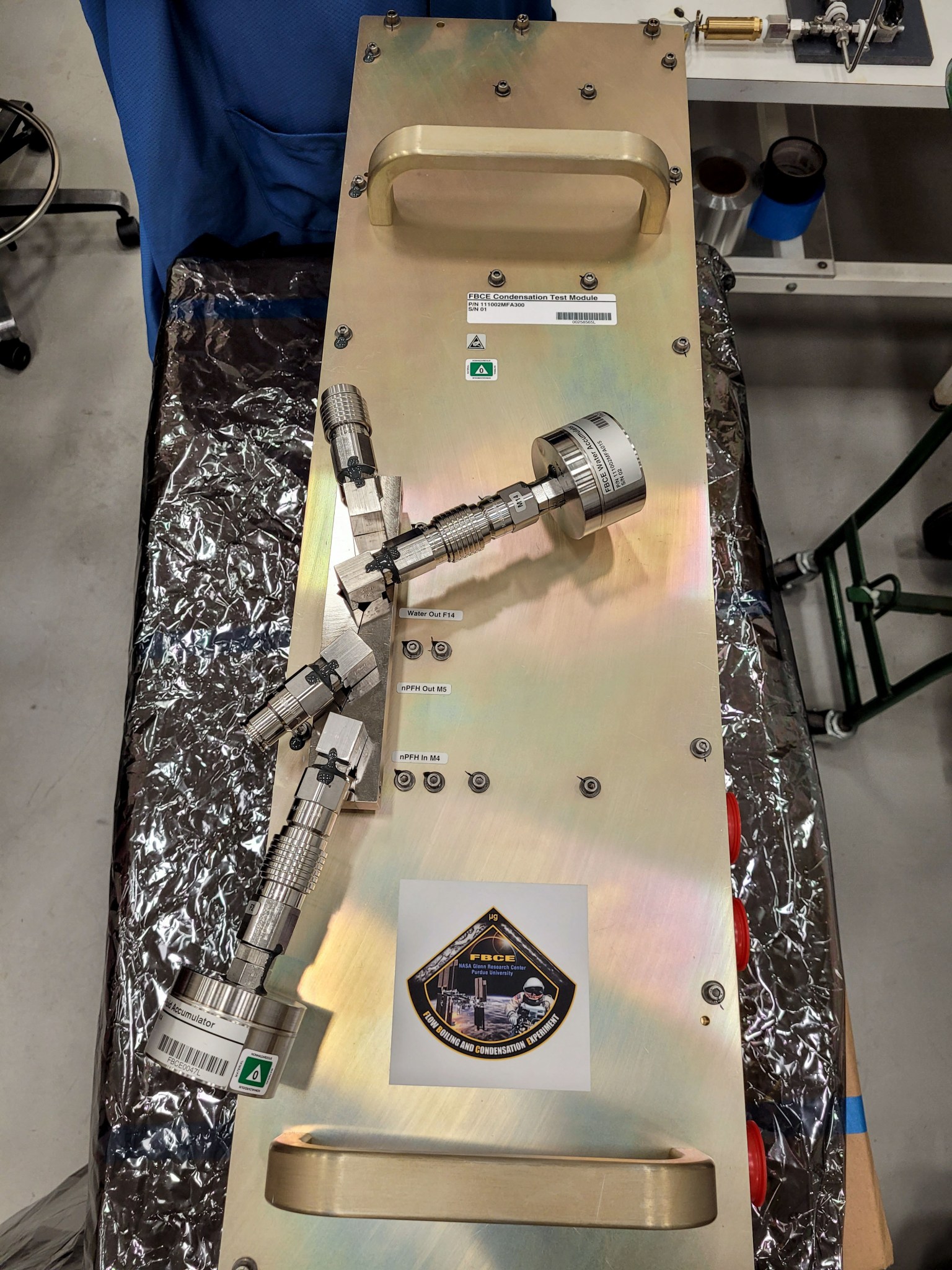
During the initial checkouts following launch of the Condensation Module Power Filter  hardware on NG-19 in August 2023, an anomaly was observed in the test section thermocouple readings. The team investigated the issue and recommended replacement of the power filter module to fix the anomalous thermocouple readings. The PFM filters out undesirable electromagnetic emissions noise for the payload electronics.

Top view of the FBCE-CM-HT hardware. This investigation gathers data to characterize the function of condensation surfaces and to validate flow velocity models. Results could identify optimal flow rates at various gravitational levels to safely dissipate heat, supporting design of systems for use in space and on Earth. Image courtesy of NASA Glenn Research Center.
NASA Glenn Research Center

About NASA’s Biological and Physical Sciences

NASA’s Biological and Physical Sciences Division pioneers’ scientific discovery and enables exploration by using space environments to conduct investigations not possible on Earth. Studying biological and physical phenomena under extreme conditions allows researchers to advance the fundamental scientific knowledge required to go farther and stay longer in space, while also benefitting life on Earth.

Powered by WPeMatico

Get The Details…

Hubble Spots the Spider Galaxy

Hubble Spots the Spider Galaxy

2 min read

Hubble Spots the Spider Galaxy

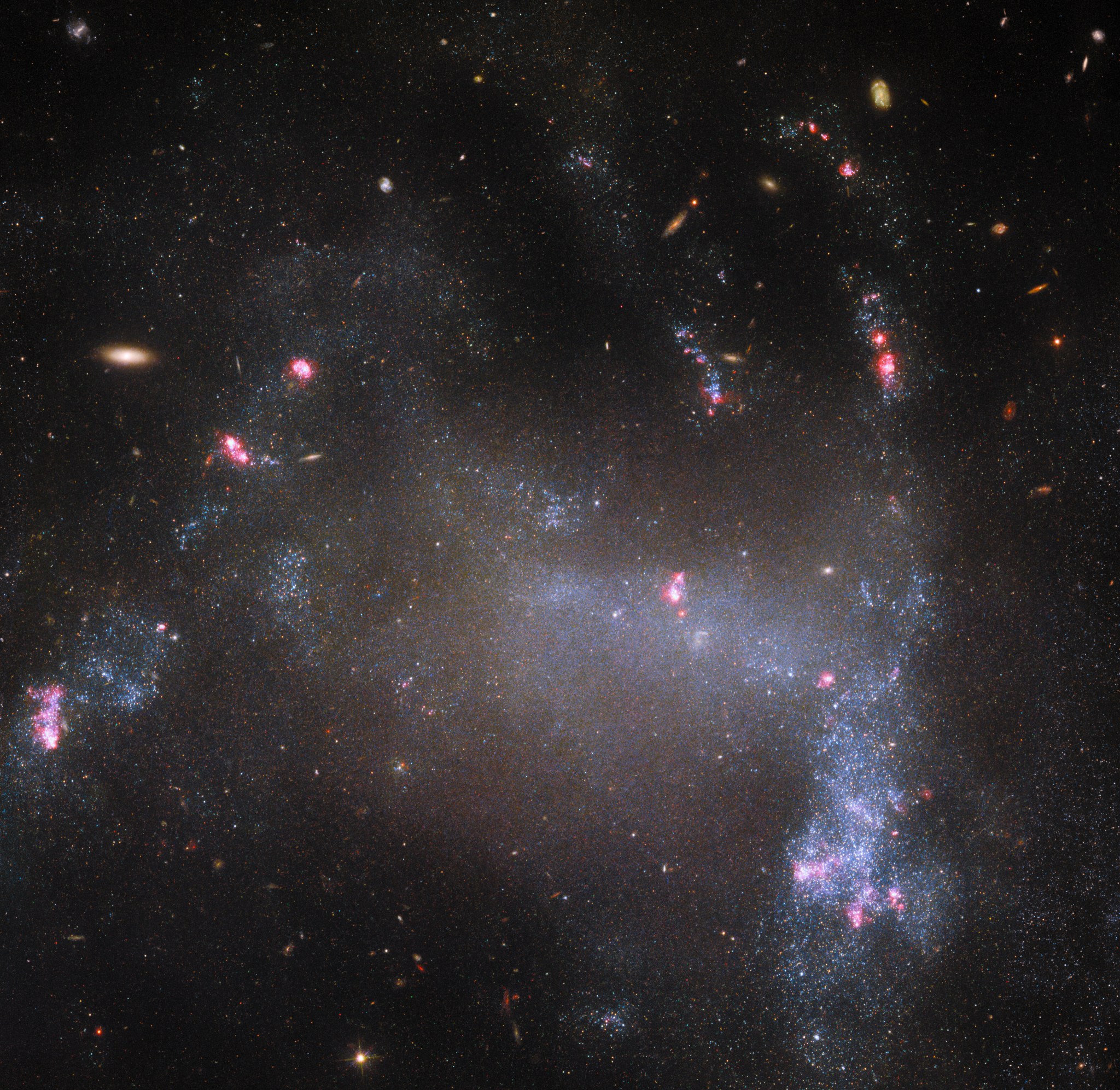
An irregular galaxy with a large central body of dull-colored stars and distorted arms around it. Brightly glowing pink areas where stars are forming dot the arms, along with bluish gas that is brighter than the galactic core. Two large arms flank the left and right of the body, and smaller streams of stars emerge from the top. Other distant galaxies are visible on the edges of the image.
This image from the NASA/ESA Hubble Space Telescope shows the irregular galaxy UGC 5829.
ESA/Hubble & NASA, R. Tully, M. Messa

This image from the NASA/ESA Hubble Space Telescope shows the gauzy-looking celestial body UGC 5829, an irregular galaxy that lies about 30 million light-years away. Despite the lack of observations of this relatively faint galaxy, UGC 5829 has a distinct and descriptive name: the Spider Galaxy. Perhaps its distorted galactic arms with their glowing, star-forming tips hint at the clawed legs of an arachnid.

The data in this image come from two Hubble observing programs. The first used Hubble’s Advanced Camera for Surveys to look at relatively nearby galaxies in an effort to build color versus brightness diagrams of the stars in these galaxies. Each observation only took one Hubble orbit (about 95 minutes) but provided a valuable archival record of the types of stars in different galaxies and therefore different environments.

The second program used Hubble’s Wide Field Camera 3 to look at star clusters in dwarf galaxies. Their observations leveraged Hubble’s ultraviolet capabilities along with its ability to see fine details to better understand the environment where stars form in dwarf galaxies. The star-forming regions of UGC 5829 are readily visible in this image as bright-pink nebulae or clouds.

Text credit: European Space Agency (ESA)

Media Contact:

Claire Andreoli
NASA’s Goddard Space Flight CenterGreenbelt, MD
claire.andreoli@nasa.gov

Share

Details

Last Updated
Mar 22, 2024
Editor
Andrea Gianopoulos

Powered by WPeMatico

Get The Details…

45 Years Ago: Space Shuttle Columbia Arrives at NASA’s Kennedy Space Center

45 Years Ago: Space Shuttle Columbia Arrives at NASA’s Kennedy Space Center

On March 24, 1979, space shuttle Columbia arrived at NASA’s Kennedy Space Center (KSC) for the very first time. Following Presidential direction to build the space shuttle in 1972, Congress quickly approved and funded the program later that year. Construction of the first orbital vehicle, later named Columbia, began in 1975. Four years later, Columbia completed its first transcontinental flight, arriving at KSC to begin preparations for its first mission. The first shuttle flight in April 1981 ushered in an era of reusable space transportation.
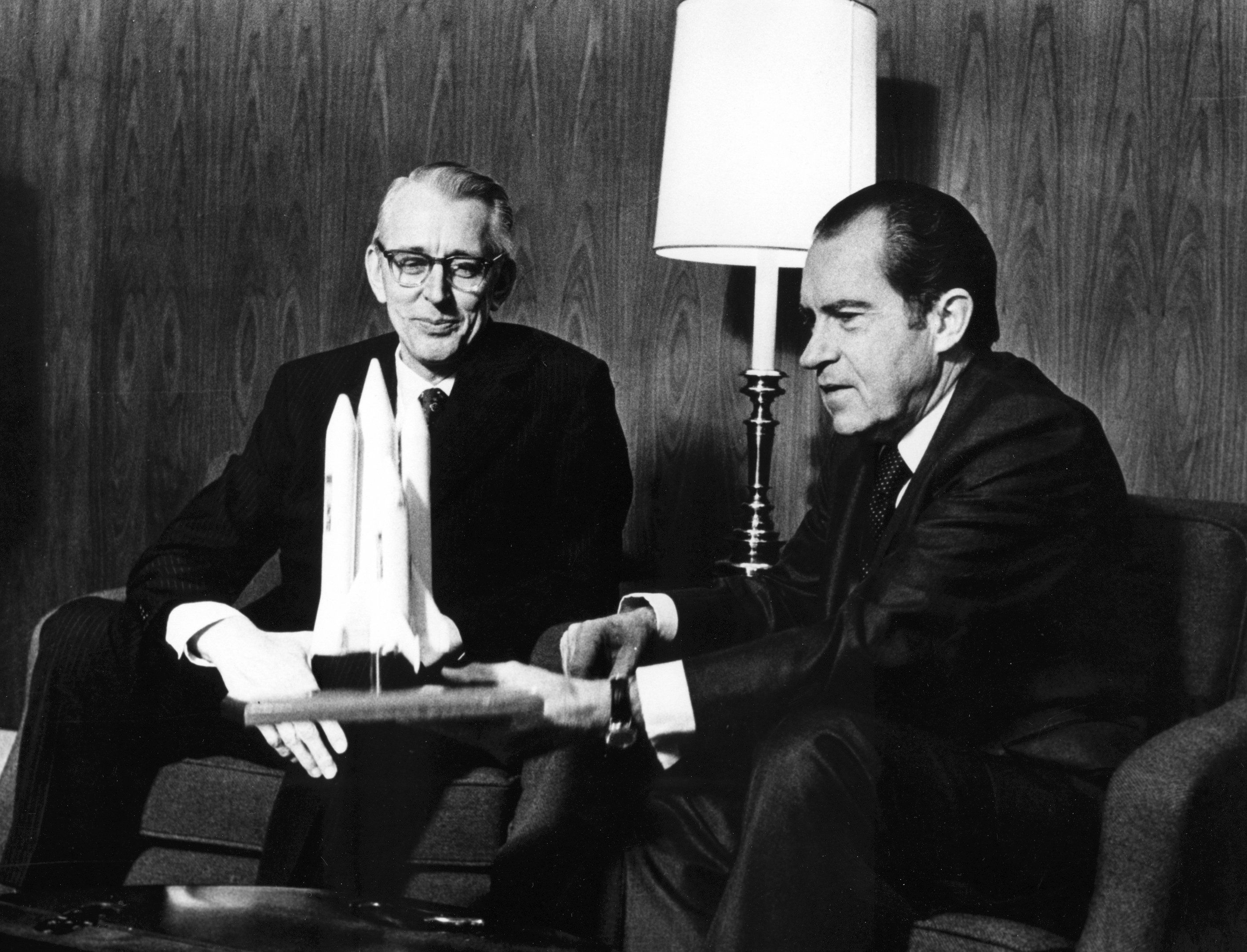
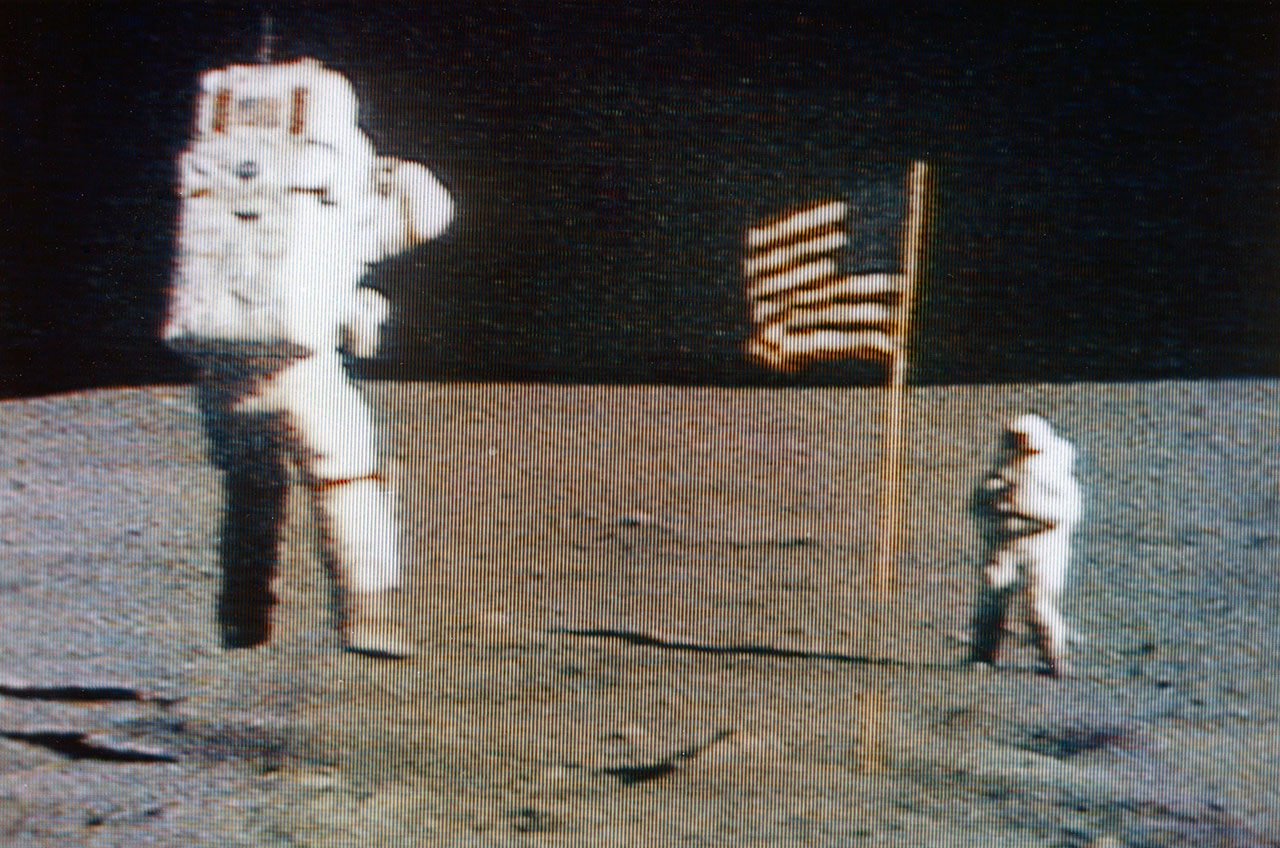
NASA Administrator James C. Fletcher, left, presents a model of the space shuttle to President Richard M. Nixon in January 1972 Apollo 16 astronauts John W. Young, left, and Charles M. Duke on the Moon in April 1972
Left: NASA Administrator James C. Fletcher, left, presents a model of the space shuttle to President Richard M. Nixon in January 1972. Right: Apollo 16 astronauts John W. Young, left, and Charles M. Duke on the Moon in April 1972.

On Jan. 5, 1972, President Richard M. Nixon directed NASA to build the space shuttle, formally called the Space Transportation System (STS), stating that “it would revolutionize transportation into near space.” NASA Administrator James C. Fletcher hailed the President’s decision as “an historic step in the nation’s space program,” adding that it would change what humans can accomplish in space. Apollo 16 astronauts John W. Young and Charles M. Duke learned of the space shuttle’s approval while exploring the Moon in April 1972. Mission Control informed them that Congress had authorized the development of the space shuttle. Young and Duke both enthusiastically responded to the positive news with “Beautiful! Wonderful! Beautiful!” Young added with some foresight, “The country needs that shuttle mighty bad. You’ll see.” He had no way of knowing that nine years later, he would command the first ship of the space shuttle fleet, Columbia, on its maiden voyage.
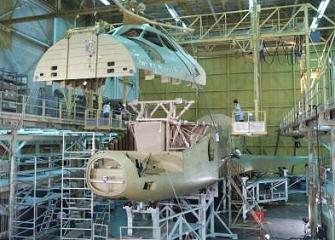
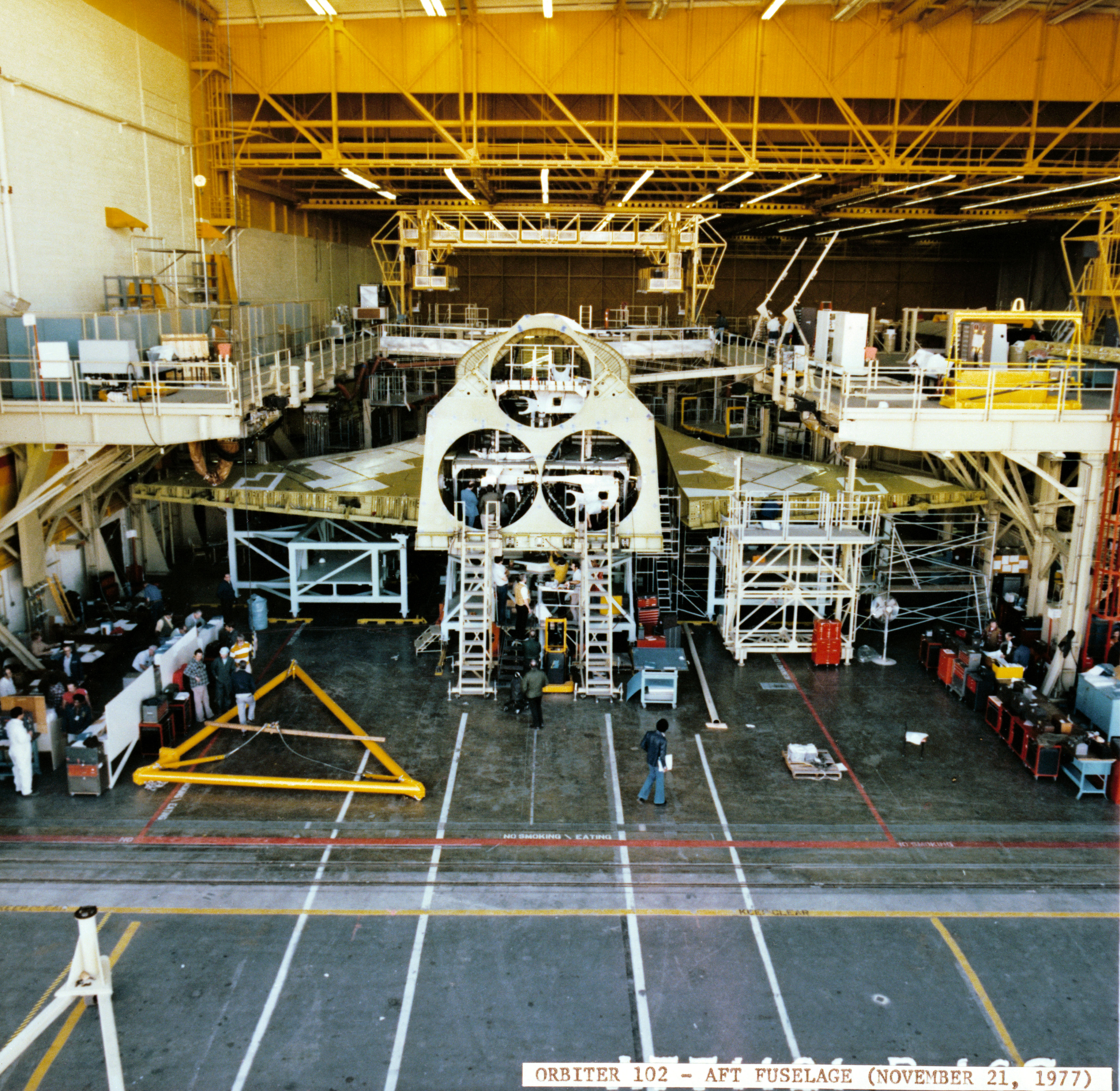
Space Shuttle Columbia’s crew compartment during assembly in 1976 Columbia’s aft fuselage and wings during assembly in November 1977 Space Shuttle Columbia just prior to rollout from Rockwell’s plant in Palmdale in March 1979
Left: Columbia’s crew compartment during assembly in 1976. Middle: Columbia’s aft fuselage and wings during assembly in November 1977. Right: Columbia just prior to rollout from Rockwell’s plant in Palmdale in March 1979.

Once Congress authorized the funds, on July 26, 1972, NASA awarded the contract to the North American Rockwell Corporation of Downey, California, to begin construction of the first orbital vehicle. Officially known as Orbital Vehicle-102 (OV-102), in January 1979 NASA named it Columbia after Captain Robert Gary’s sloop that explored the Pacific Northwest in the 1790s and took the honor as the first American ship to circumnavigate the globe, as well as after the Apollo 11 Command Module. Construction of Columbia’s first components at Rockwell’s Palmdale, California, plant began on March 25, 1975.
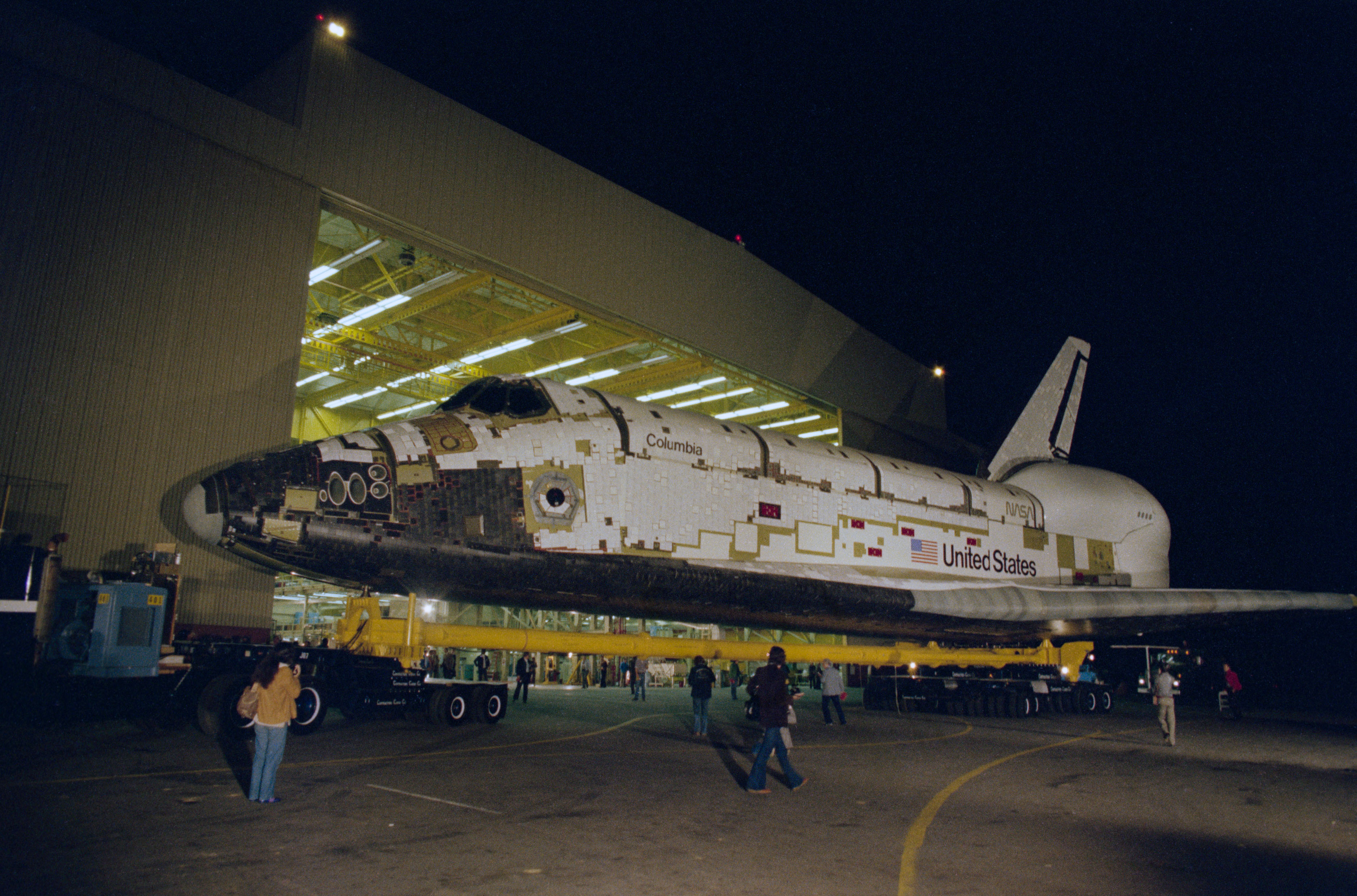
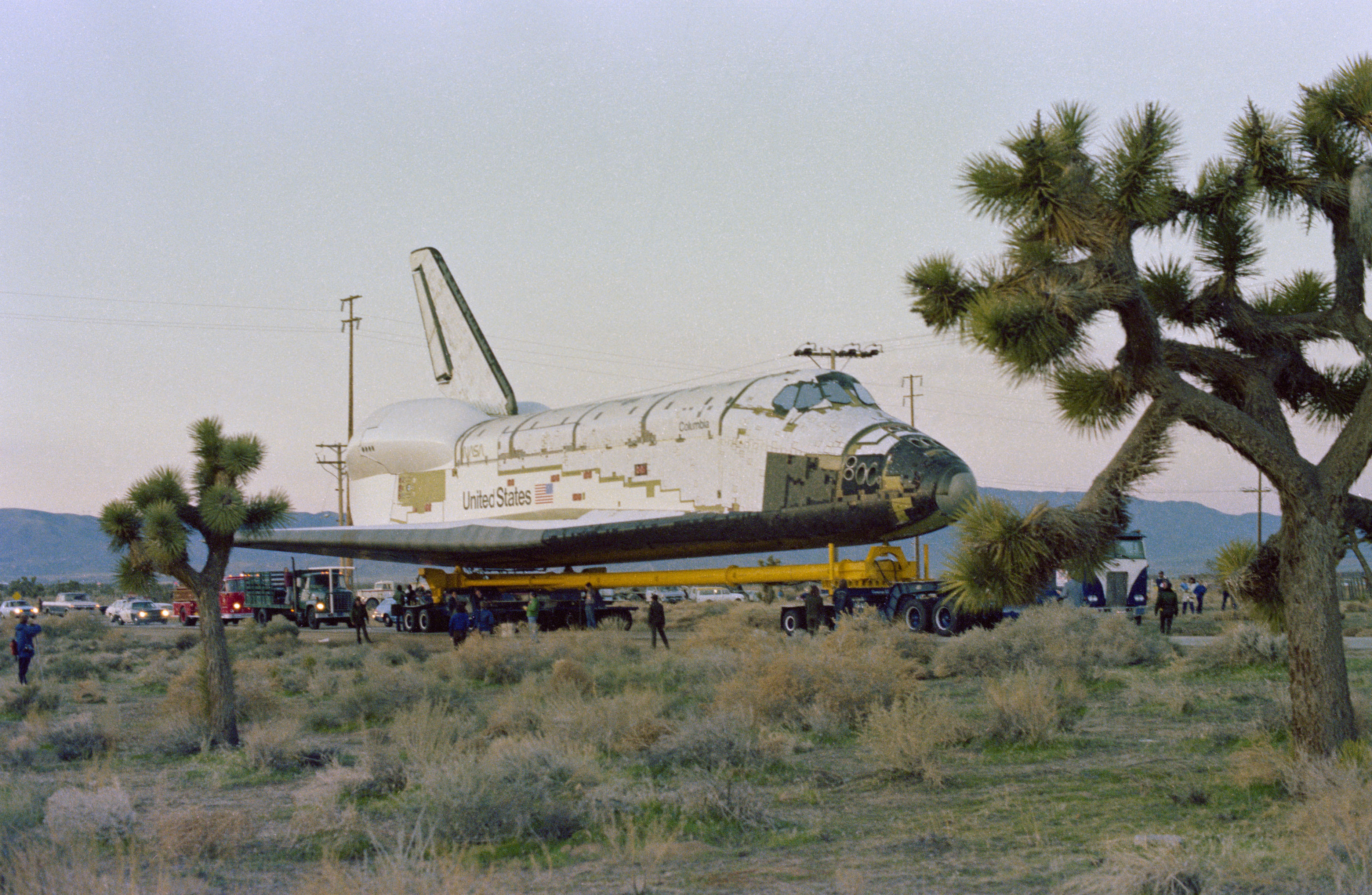
Workers roll Columbia out from its hangar at Rockwell’s Palmdale, California, plant Workers transport Columbia from Rockwell’s Palmdale facility to NASA’s Dryden, now Armstrong, Flight Research Center Columbia atop the Shuttle Carrier Aircraft takes off from Dryden to begin the cross-country ferry flight
Left: Workers roll Columbia out from its hangar at Rockwell’s Palmdale, California, plant. Middle: Workers transport Columbia from Rockwell’s Palmdale facility to NASA’s Dryden, now Armstrong, Flight Research Center. Right: Columbia atop the Shuttle Carrier Aircraft takes off from Dryden to begin the cross-country ferry flight. 

Nearly four years later, on March 8, 1979, Columbia rolled out of the Palmdale facility to begin its multi-day transcontinental journey to KSC. For the first step of the journey, workers towed Columbia from Palmdale overland to NASA’s Dryden, now Armstrong, Flight Research Center at Edwards Air Force Base (AFB) 36 miles away. Two days later, workers there hoisted Columbia onto the Shuttle Carrier Aircraft (SCA), a Boeing 747 aircraft modified to transport space shuttle orbiters. During a test flight, thousands of the orbiter’s thermal protection system tiles fell off. Workers returned Columbia to a hangar where over 100 men and women worked for nine days reapplying the tiles. Weather then delayed Columbia’s departure until March 20, when the SCA/shuttle duo flew from Dryden to Biggs AFB in El Paso, Texas.
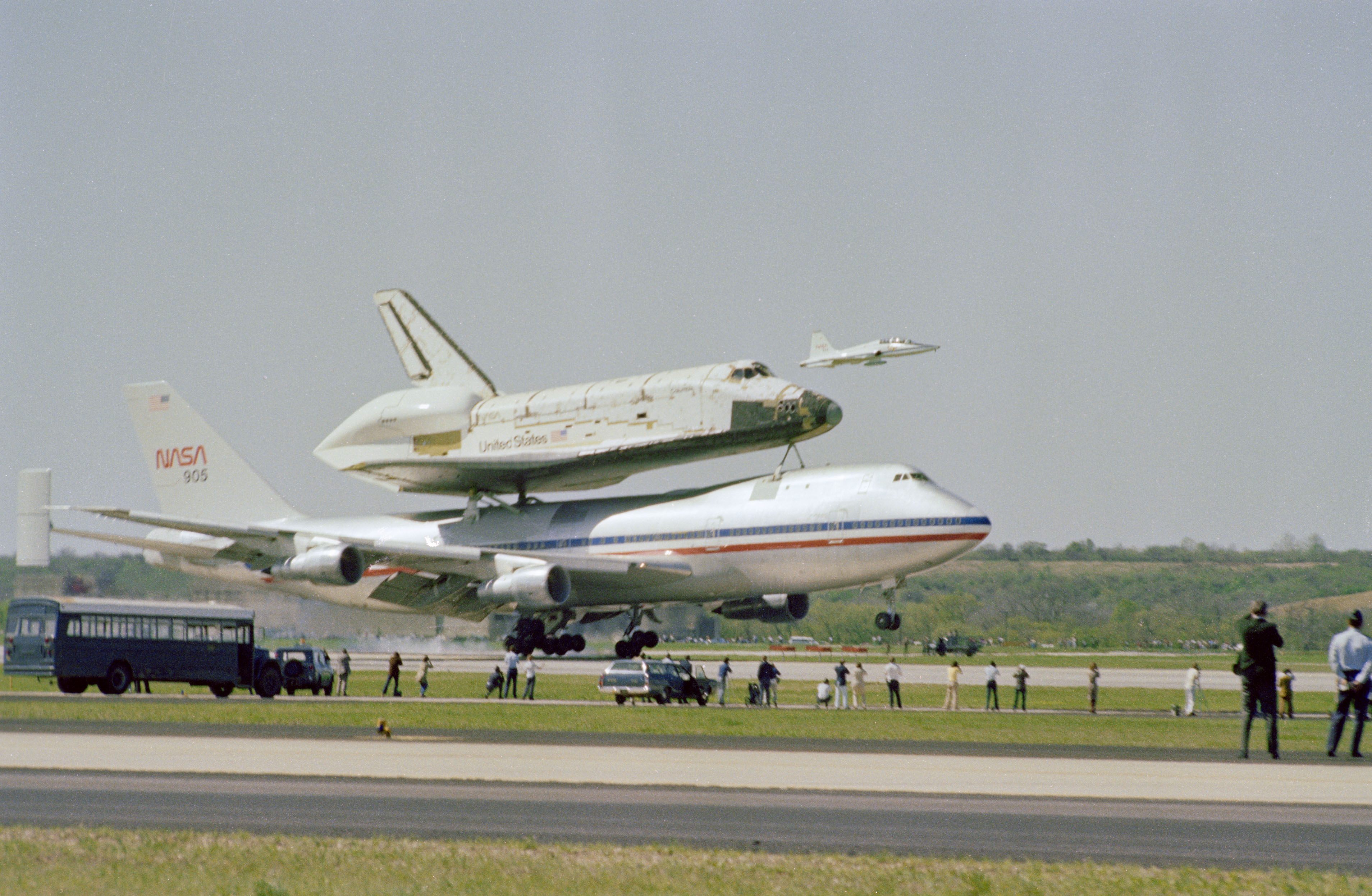
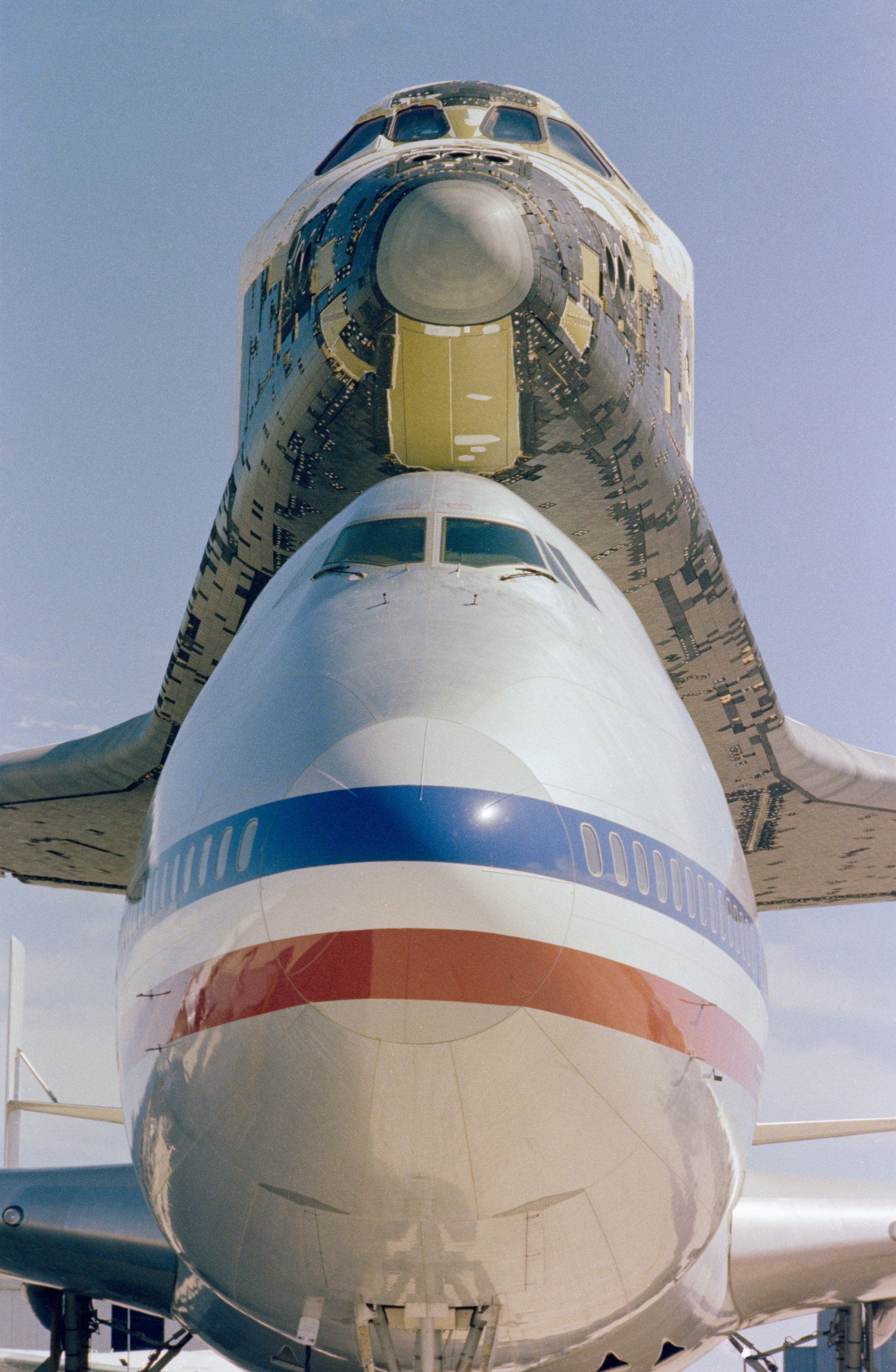
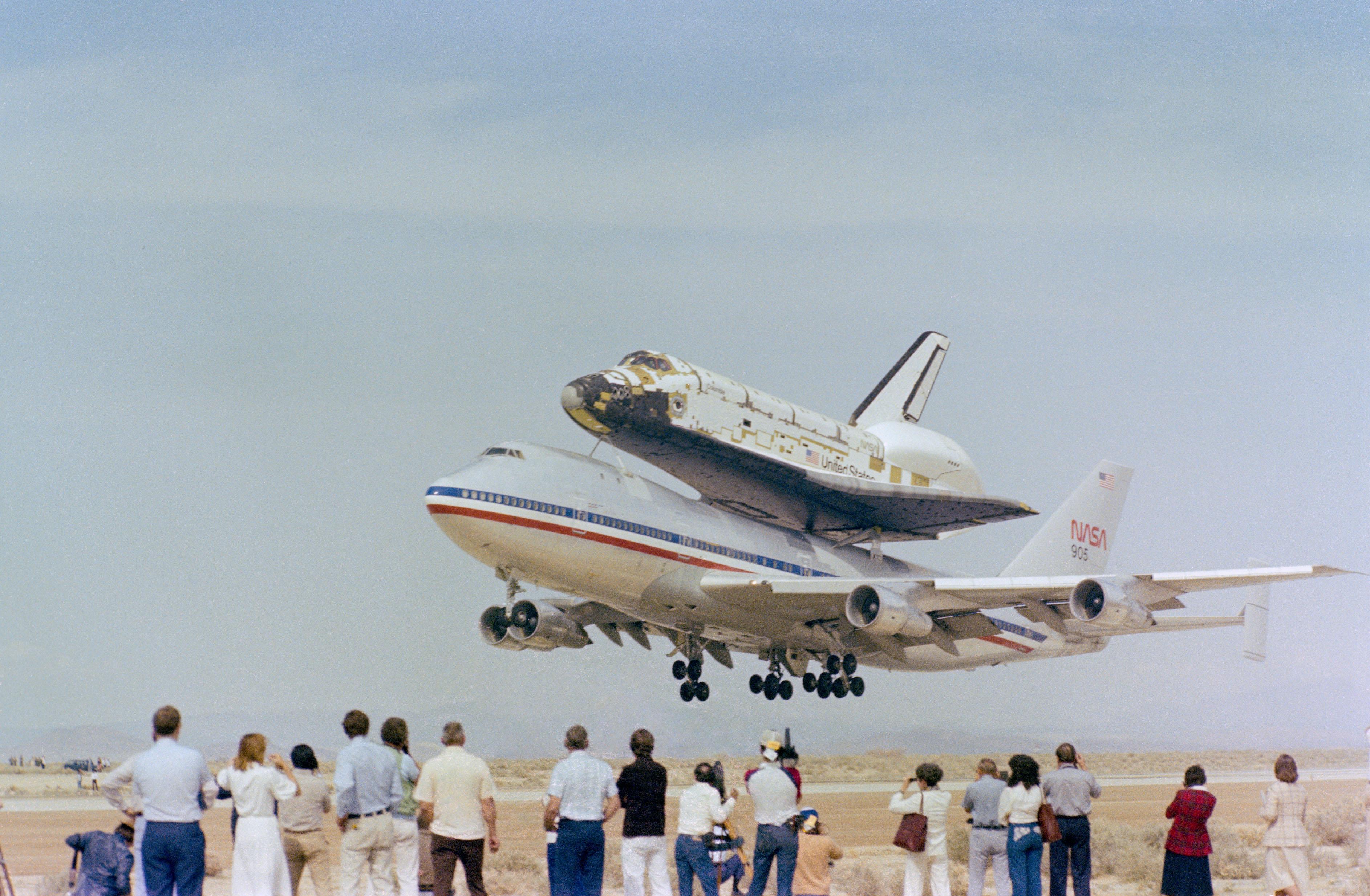
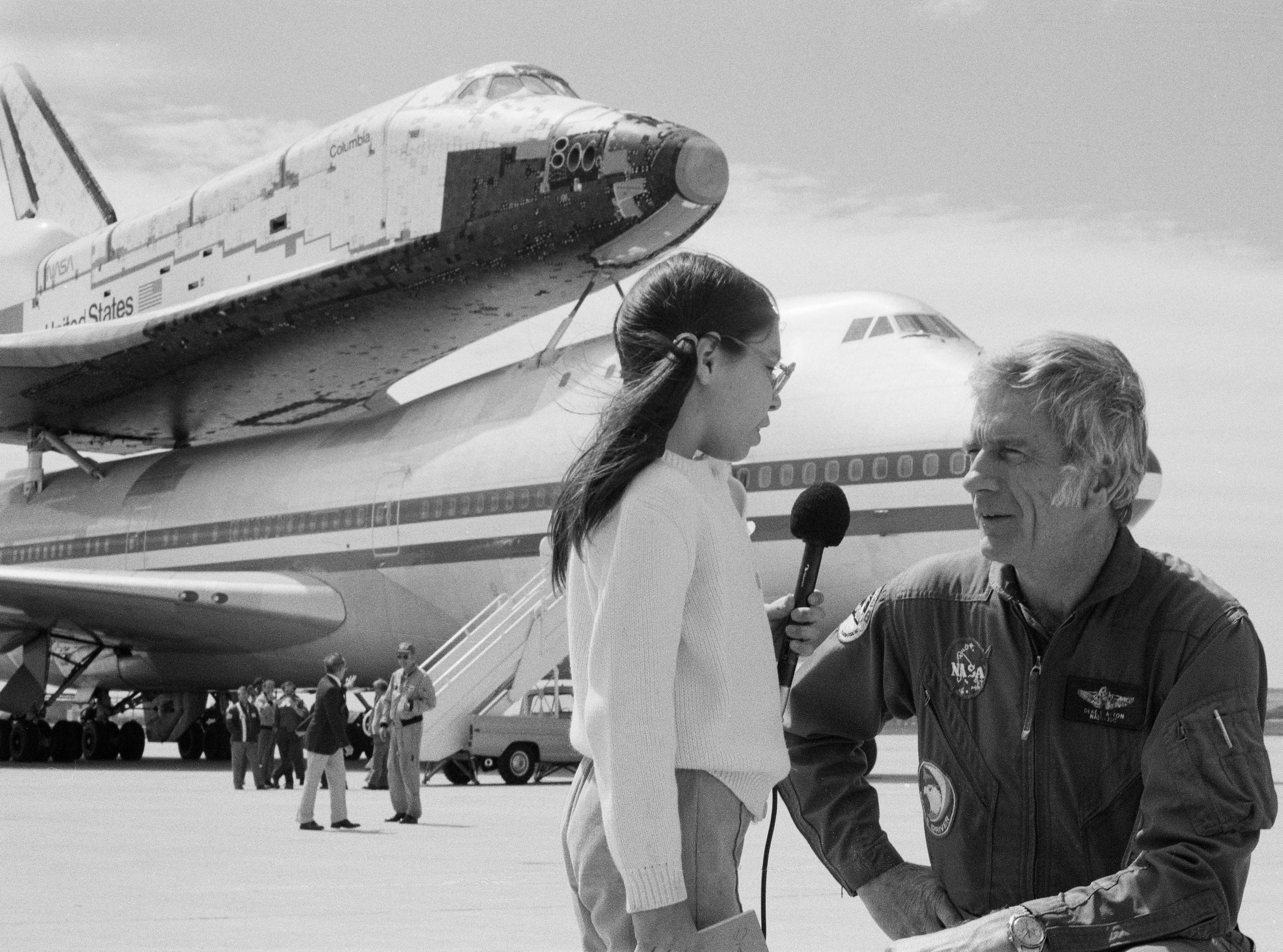
Space shuttle Columbia atop its Shuttle Carrier Aircraft (SCA) touches down at Kelly Air Force Base (AFB) in San Antonio for an overnight stop Head on view of Space Shuttle Columbia atop the SCA Tina Aguilar, age nine, an aspiring young reporter, interviews astronaut Donald K. “Deke” Slayton in front of Columbia and the SCA at Kelly AFB
Left: Space shuttle Columbia atop its Shuttle Carrier Aircraft (SCA) touches down at Kelly Air Force Base (AFB) in San Antonio for an overnight stop. Middle: Head on view of Columbia atop the SCA. Right: Tina Aguilar, age nine, an aspiring young reporter, interviews astronaut Donald K. “Deke” Slayton in front of Columbia and the SCA at Kelly AFB.

Weather delayed Columbia’s departure for the planned refueling stop at Kelly AFB in San Antonio, until the next day. About 200,000 people went to view the shuttle during its overnight layover in San Antonio prior to its departure on March 23.
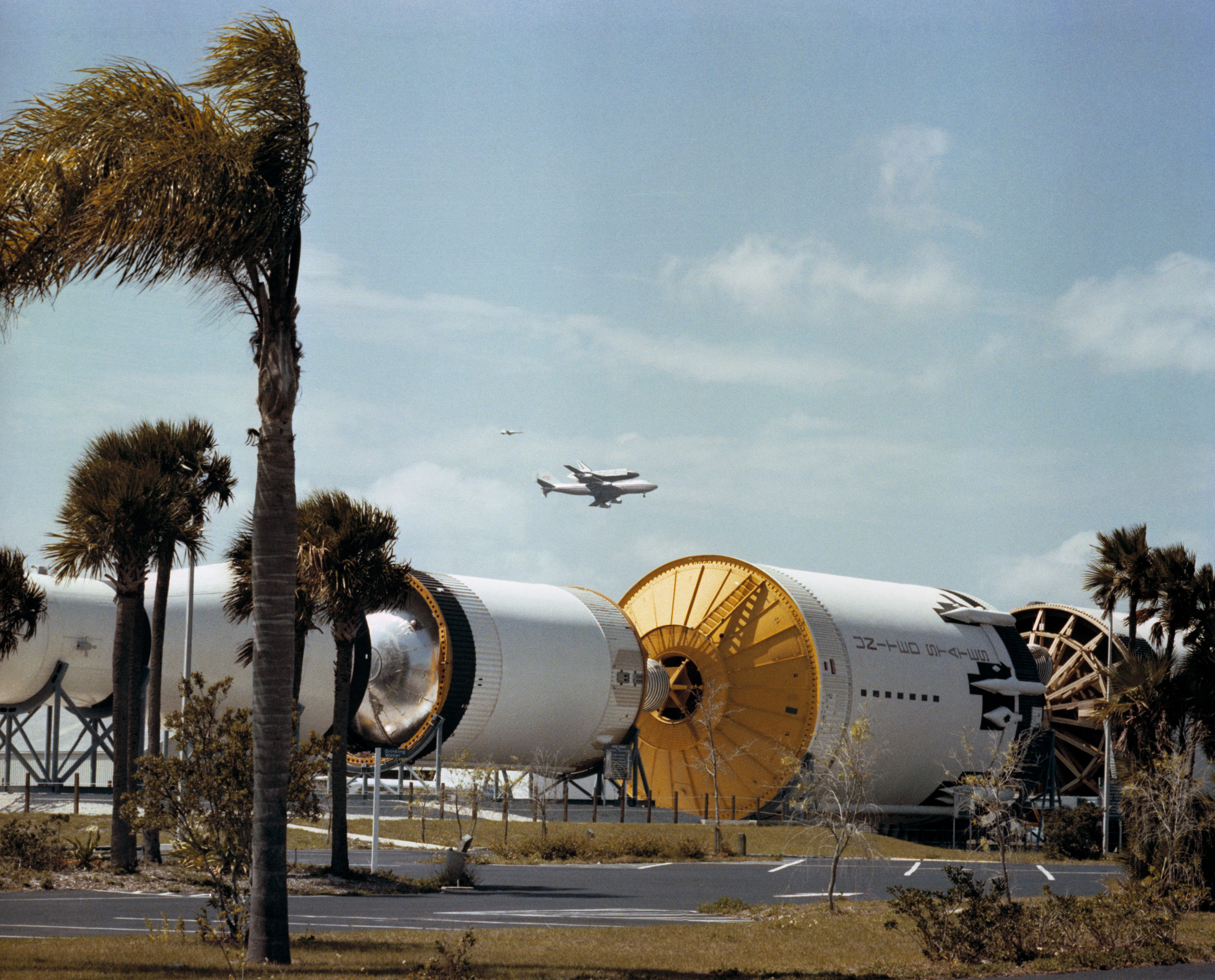
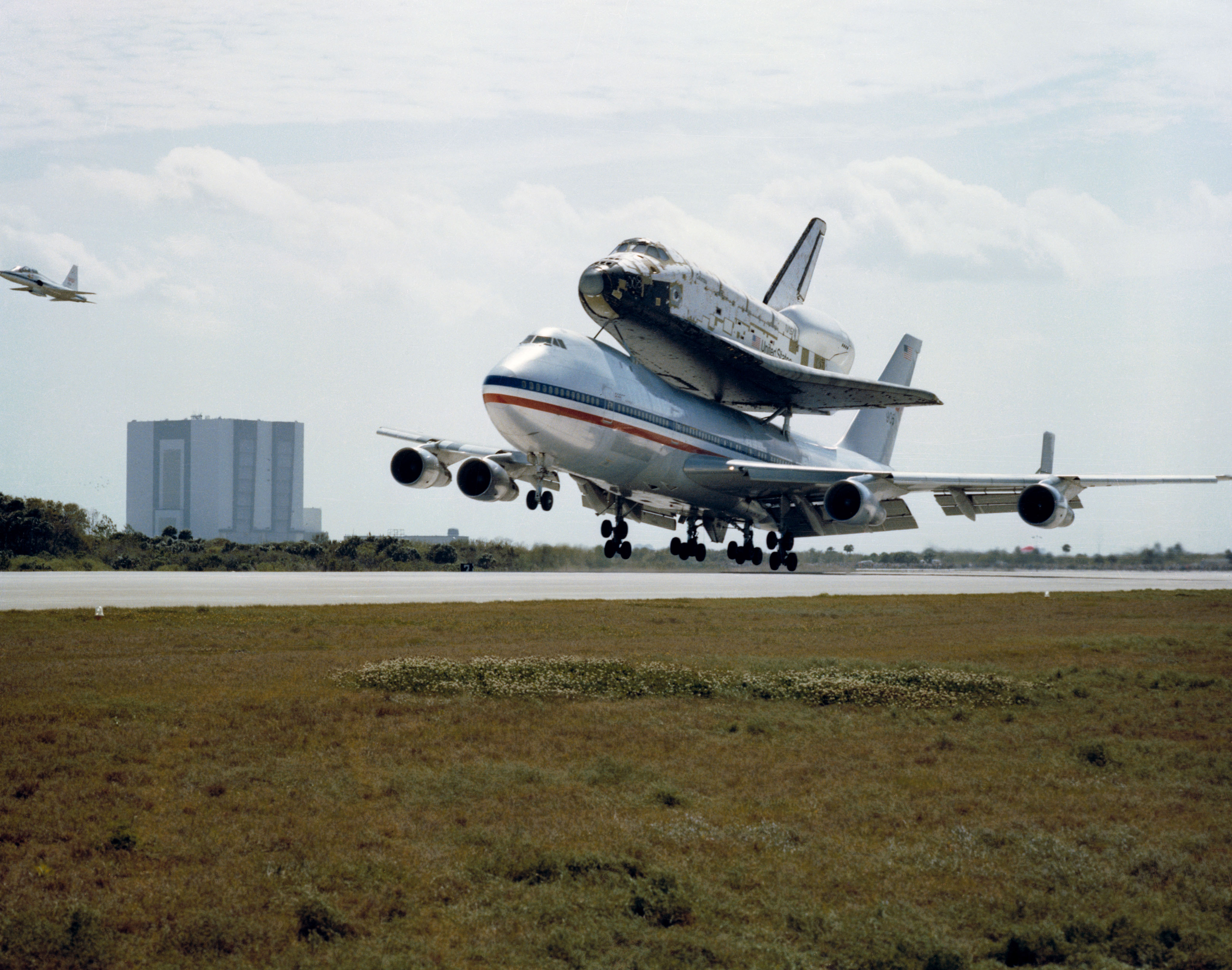
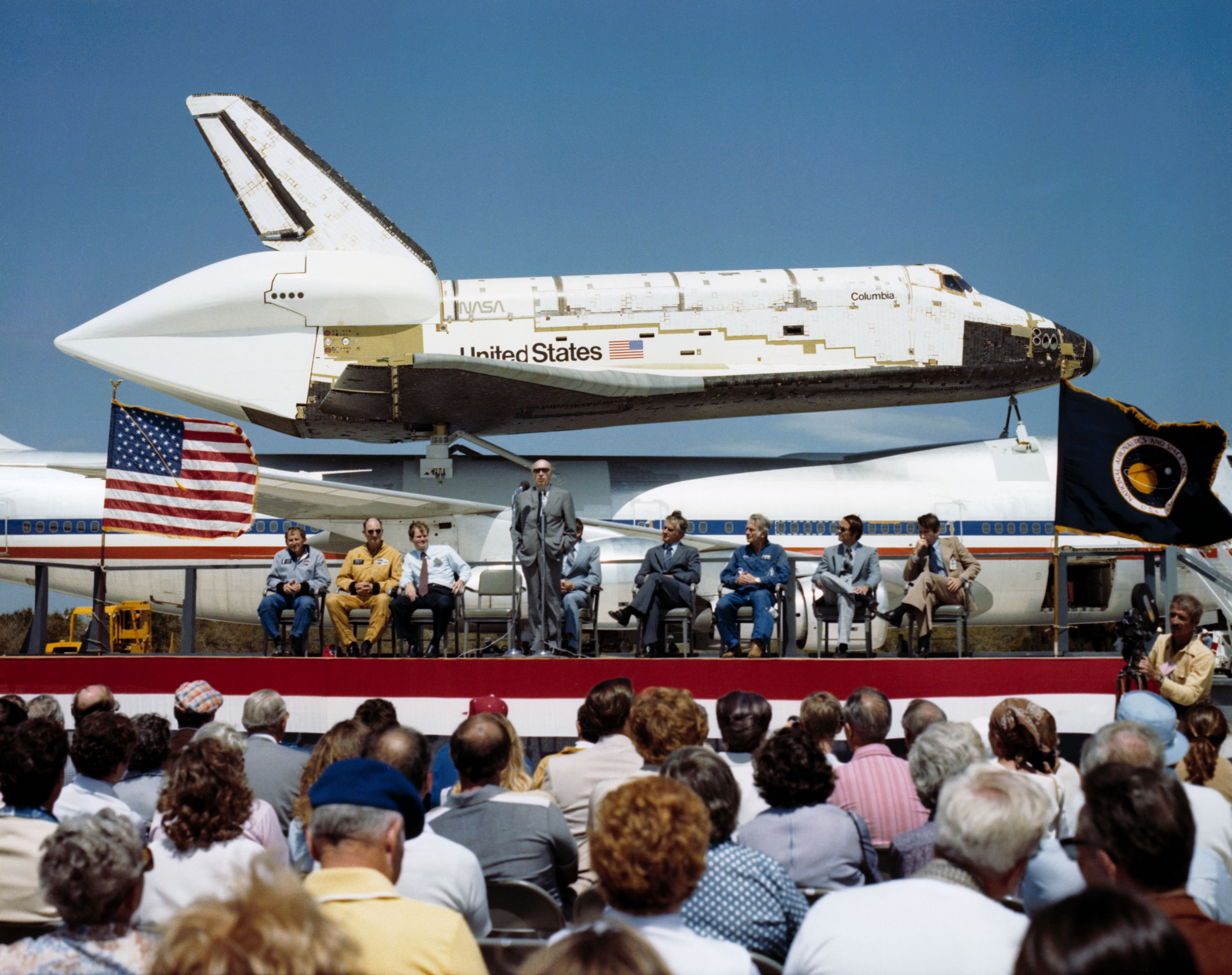
Space shuttle Columbia atop its Shuttle Carrier Aircraft (SCA) flies over the Saturn V display at NASA’s Kennedy Space Center (KSC) in Florida Columbia atop the SCA touches down at KSC’s Shuttle Landing Facility (SLF), with the Vehicle Assembly Building visible in the background At the SLF, NASA Administrator Robert A. Frosch addresses the crowd assembled to welcome Columbia to KSC, as other dignitaries listen
Left: The past meets the future, as space shuttle Columbia atop its Shuttle Carrier Aircraft (SCA) flies over the Saturn V display at NASA’s Kennedy Space Center (KSC) in Florida. Middle: Columbia atop the SCA touches down at KSC’s Shuttle Landing Facility (SLF), with the Vehicle Assembly Building visible in the background. Right: At the SLF, NASA Administrator Robert A. Frosch addresses the crowd assembled to welcome Columbia to KSC, as other dignitaries listen.

After another overnight stop at Eglin AFB in Florida, Columbia atop the SCA touched down at KSC’s Shuttle Landing Facility (SLF) on March 24, a crowd of about 3,000 cheering its arrival. Dignitaries in attendance at a brief welcoming ceremony at the SLF included NASA Administrator Robert A. Frosch, KSC Director Lee R. Scherer, SCA pilots Joseph S. Algranti and Fitzhugh L. Fulton, program manager for Shuttle Flight Test Operations NASA astronaut Donald K. “Deke” Slayton, and astronauts John W. Young and Robert L. Crippen, designated as the commander and pilot for STS-1, the first space shuttle mission. Also in attendance, U.S. Congressman C. William “Bill” Nelson whose district included KSC and now serves as NASA’s 14th administrator, and Florida Lieutenant Governor J. Wayne Mixson.
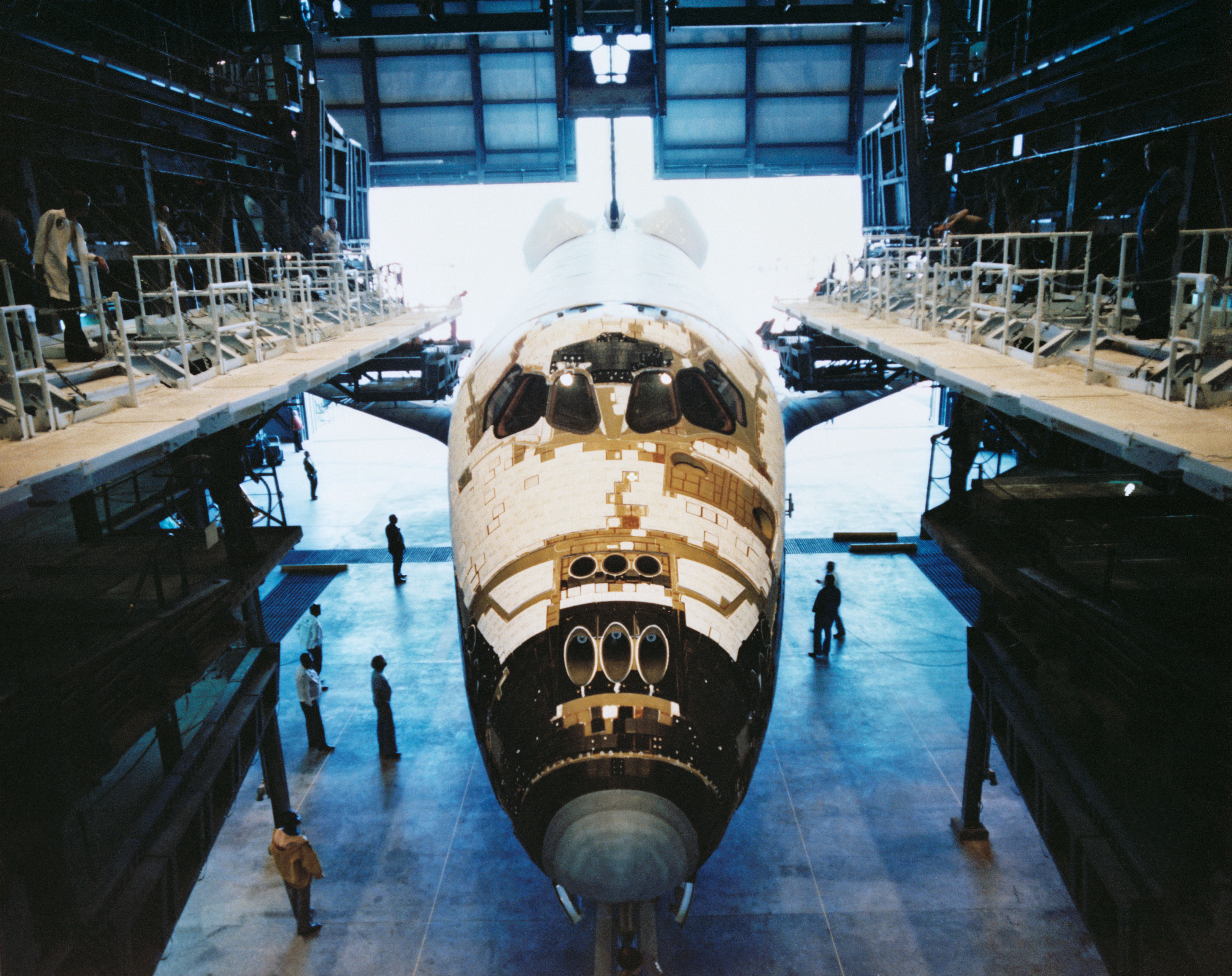
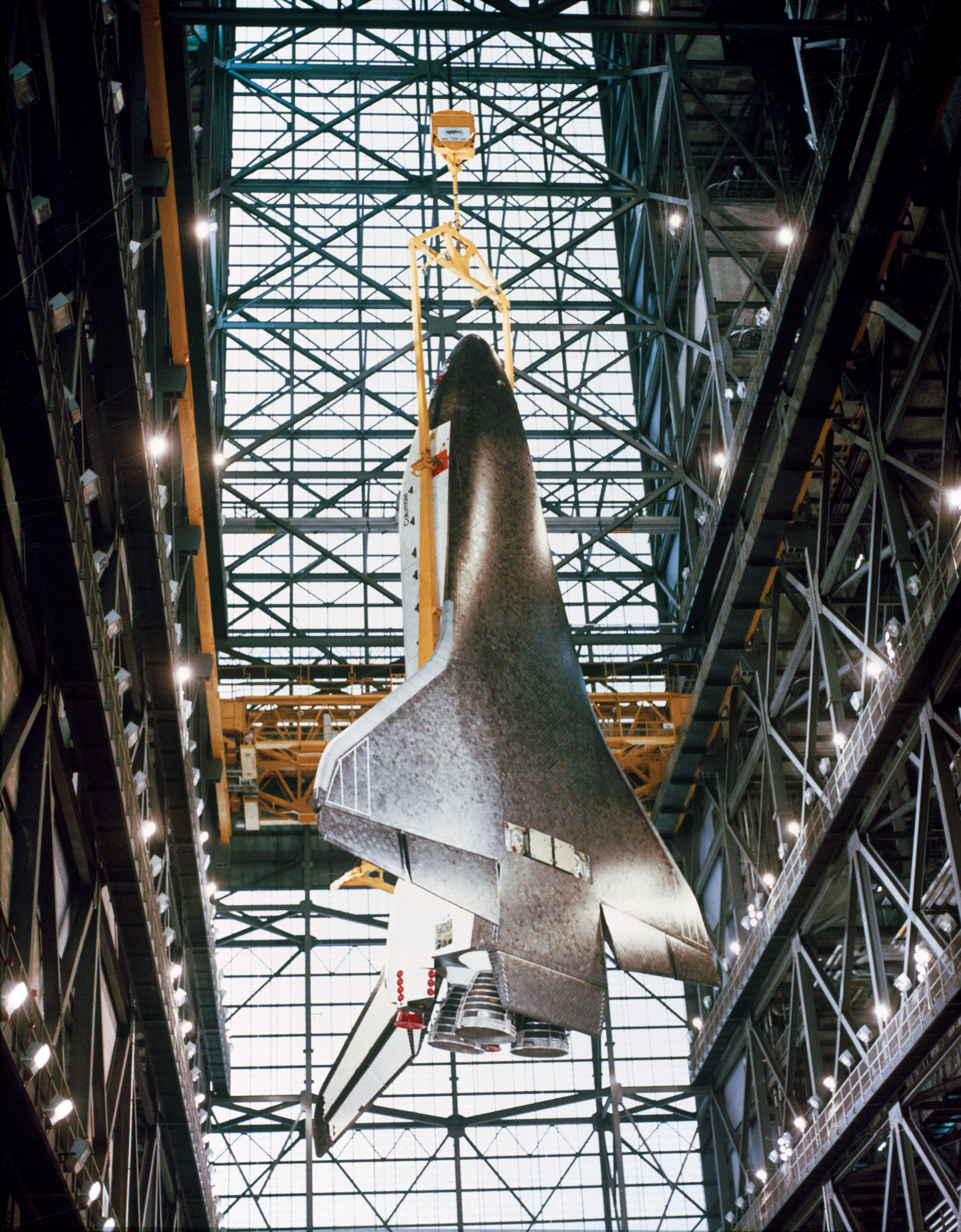
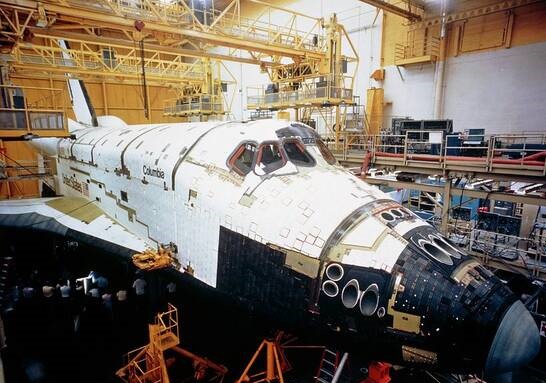
Columbia in the Orbiter Processing Facility at NASA’s Kennedy Space Center (KSC) in Florida Workers hoist Columbia in KSC’s Vehicle Assembly Building (VAB) for mating with its external tank and solid rocket boosters Space Shuttle Columbia rolls out of the VAB on its way to Launch Pad 39A
Left: Columbia in the Orbiter Processing Facility at NASA’s Kennedy Space Center (KSC) in Florida. Middle: Workers hoist Columbia in KSC’s Vehicle Assembly Building (VAB) for mating with its external tank and solid rocket boosters. Right: Columbia rolls out of the VAB on its way to Launch Pad 39A.

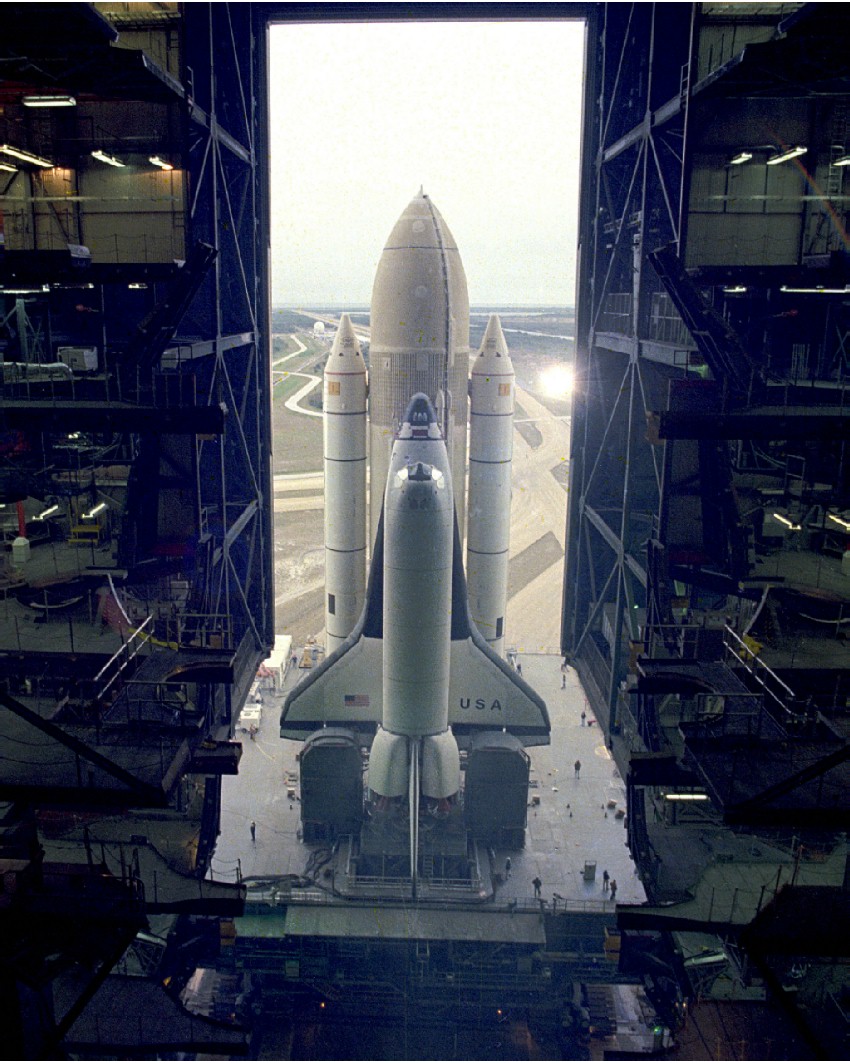
The next day, after removing Columbia from the back of the SCA, workers towed it into the Orbiter Processing Facility, where the orbiter spent the next 19 months preparing for its first flight. Rollover to the Vehicle Assembly Building (VAB) for mating with its External Tank and the two Solid Rocket Boosters took place Nov. 24, 1980. After a series of integrated tests, the shuttle stack rolled out of the VAB and made the 3.5-mile trip to Launch Pad 39A on Dec. 29, 1980. Young and Crippen flew Columbia’s historic first mission, STS-1, in April 1981, ushering in an era of reusable space transportation.

Share

Details

Last Updated

Mar 21, 2024

Related Terms

Powered by WPeMatico

Get The Details…
Kelli Mars