NASA VIPER Robotic Moon Rover Team Raises Its Mighty Mast
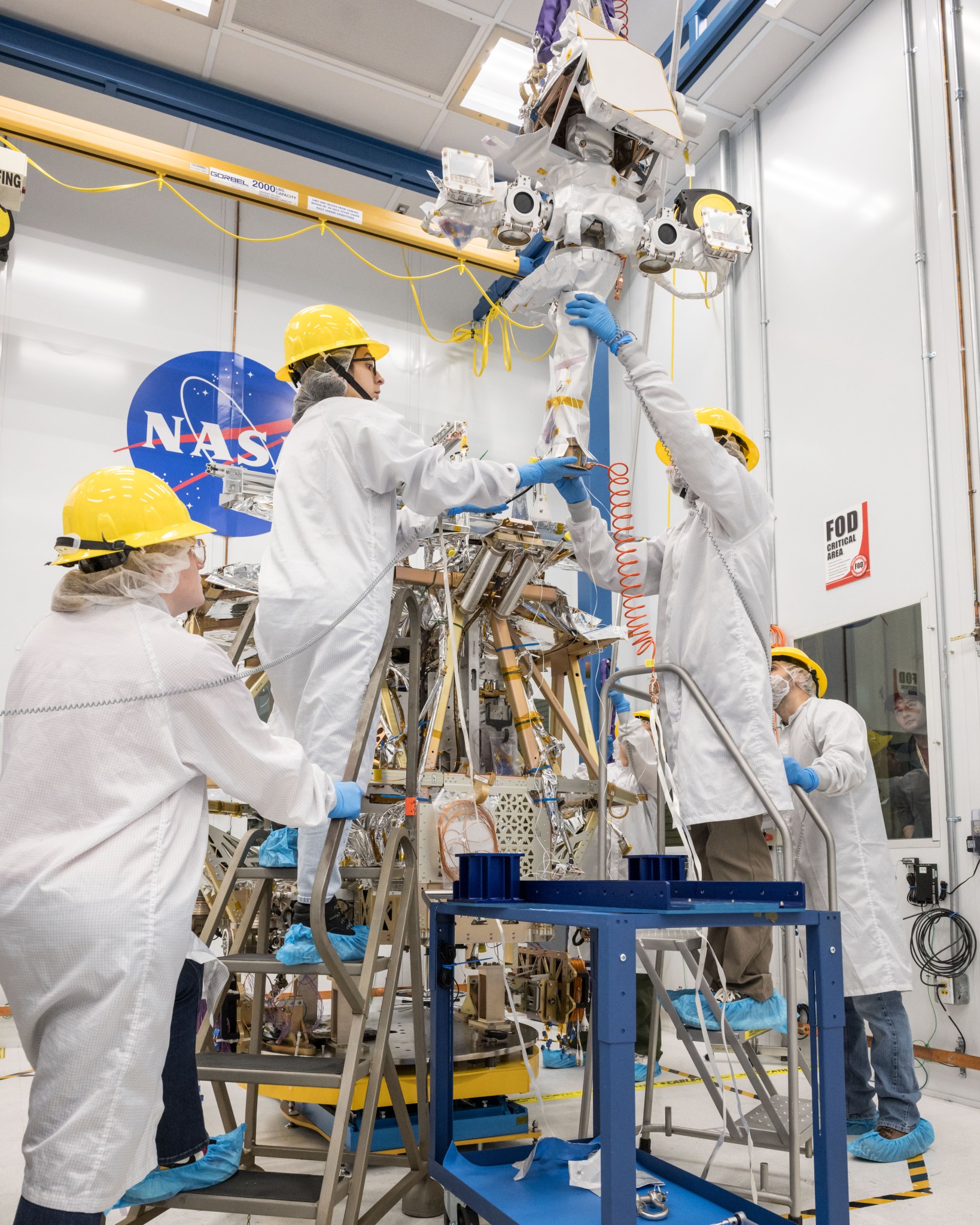
A team of engineers lifts the mast into place atop of NASA’s VIPER robotic Moon rover in a clean room at NASA’s Johnson Space Center in Houston.
NASA/Helen Arase Vargas
NASA’s VIPER – short for the Volatiles Investigating Polar Exploration Rover – now stands taller and more capable than ever. And that’s thanks to its mast.
VIPER’s mast, and the suite of instruments affixed to it, looks a lot like the rover’s “neck” and “head.” The mast instruments are designed to help the team of rover drivers and real-time scientists send commands and receive data while the rover navigates around hazardous crater slopes, boulders, and places that risk communications blackouts. The team will use these instruments, along with four science payloads, to scout the lunar South Pole. During its approximately 100-day mission, VIPER seeks to better understand the origin of water and other resources on the Moon, as well as the extreme environment where NASA plans to send astronauts as part of the Artemis campaign.
The tip of VIPER’s mast stands approximately eight feet (2.5 meters) above its wheel rims and is equipped with a pair of stereo navigation cameras, a pair of powerful LED headlights, as well as a low- and high-gain antenna to transmit data to and receive data from the Deep Space Network (DSN) antennas on Earth.
The stereo navigation cameras – the “eyes” of the rover – are mounted to a part of the mast that gimbals, allowing the team to pan them as much as 400 degrees around and tilt them up and down as much as 75 degrees. The VIPER team will use the navigation cameras to take sweeping panoramas of the rover’s surroundings and images to detect and further study surface features such as rocks and craters as small as four inches (10 cm) in diameter – or about the length of a pencil – from as far as 50 feet (15 meters) away. And because the navigation cameras are mounted up high, it gives the VIPER team a near human-like perspective as the rover explores areas of scientific interest around the Moon’s South Pole.
Due to the extremes of light and darkness found on the Moon, VIPER will be the first planetary rover to have headlights. The headlights will cast a narrow, long-distance beam – much like a car’s high beams – to help the team reveal obstacles or interesting terrain features that would otherwise stay hidden in the shadows. Positioned next to the rover’s two navigation cameras, the lights feature arrays of blue LEDs that the rover navigation team determined would provide the best visibility given the challenging lighting conditions on the Moon.
In order to transmit large amounts of data across the 240,000 miles (384,000 km) that separate Earth and the Moon, VIPER has a gimballing precision-pointed, high-gain antenna that will send information along a very focused, narrow beam. Its low-gain antenna also will send data but using radio waves at a much lower data rate. The ability for the antennas to maintain the correct orientation, even while driving, serves a critical function: without it, the rover cannot receive commands while in motion on the Moon and cannot transmit any of its data back to Earth for scientists to achieve their mission goals. All that data is then transferred from the DSN to the Multi-Mission Operations and Control Center at NASA’s Ames Research Center in California’s Silicon Valley, where rover operations are based.
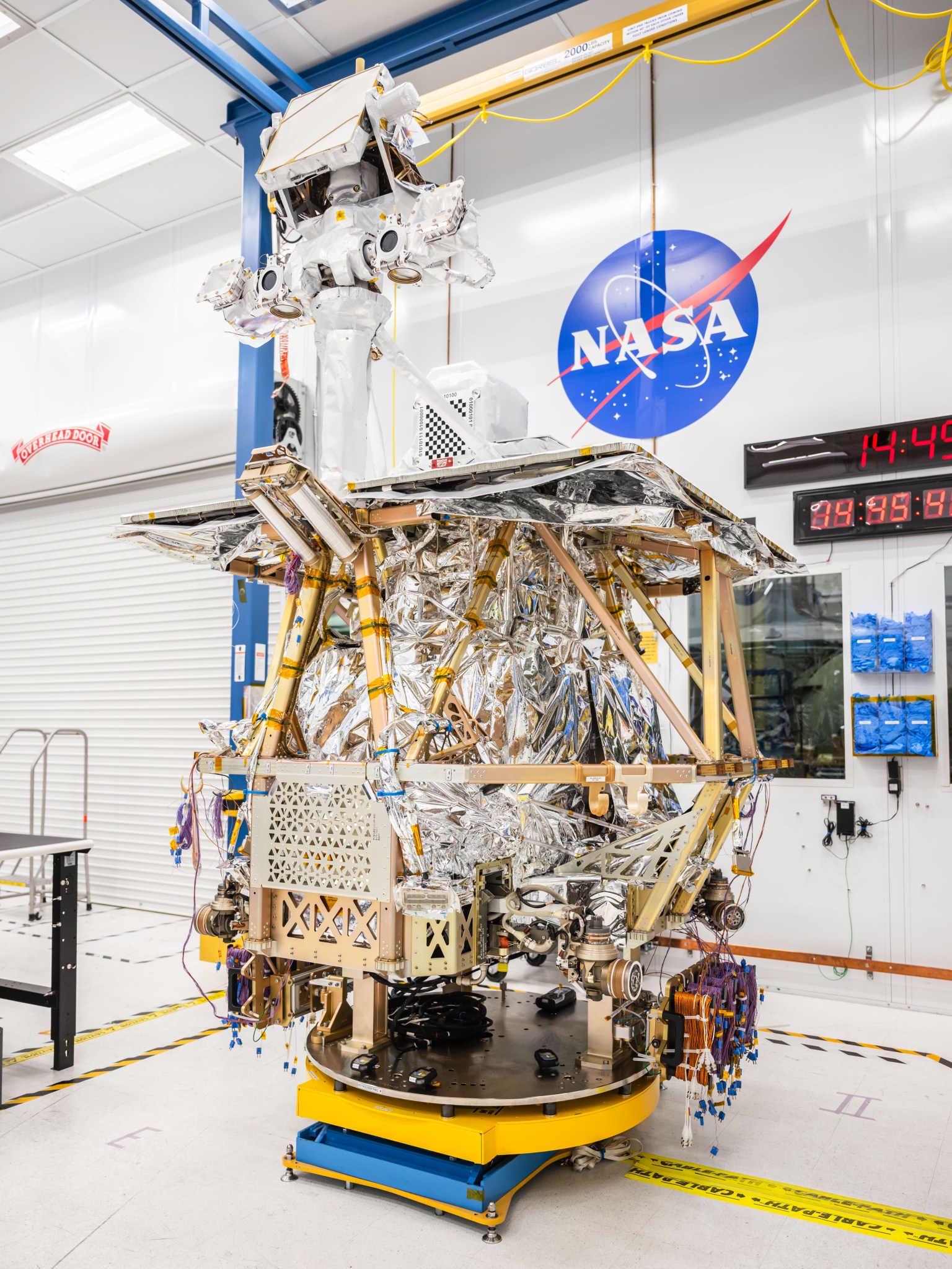
NASA’s VIPER robotic Moon rover stands taller than ever after engineers integrated its mast in a clean room at NASA’s Johnson Space Center in Houston.
NASA/Josh Valcarcel
Prior to installation on the rover, engineers put the mast through a variety of testing. This included time in a thermal vacuum chamber to verify the white coating surrounding the mast insulates as intended. After the mast’s integration in the clean room at NASA’s Johnson Space Center in Houston, the team also successfully performed check-outs of its components and for the first time sent data through the rover using its antennas.
VIPER is part of the Lunar Discovery and Exploration Program and is managed by the Planetary Science Division of NASA’s Science Mission Directorate at NASA Headquarters in Washington. VIPER will launch to the Moon aboard Astrobotic’s Griffin lunar lander on a SpaceX Falcon Heavy rocket as part of NASA’s Commercial Lunar Payload Services initiative. It will reach its destination at Mons Mouton near the Moon’s South Pole.
Citizen Scientists Invited to Collect Data for NASA During Eclipse
4 min read
Citizen Scientists Invited to Collect Data for NASA During Eclipse
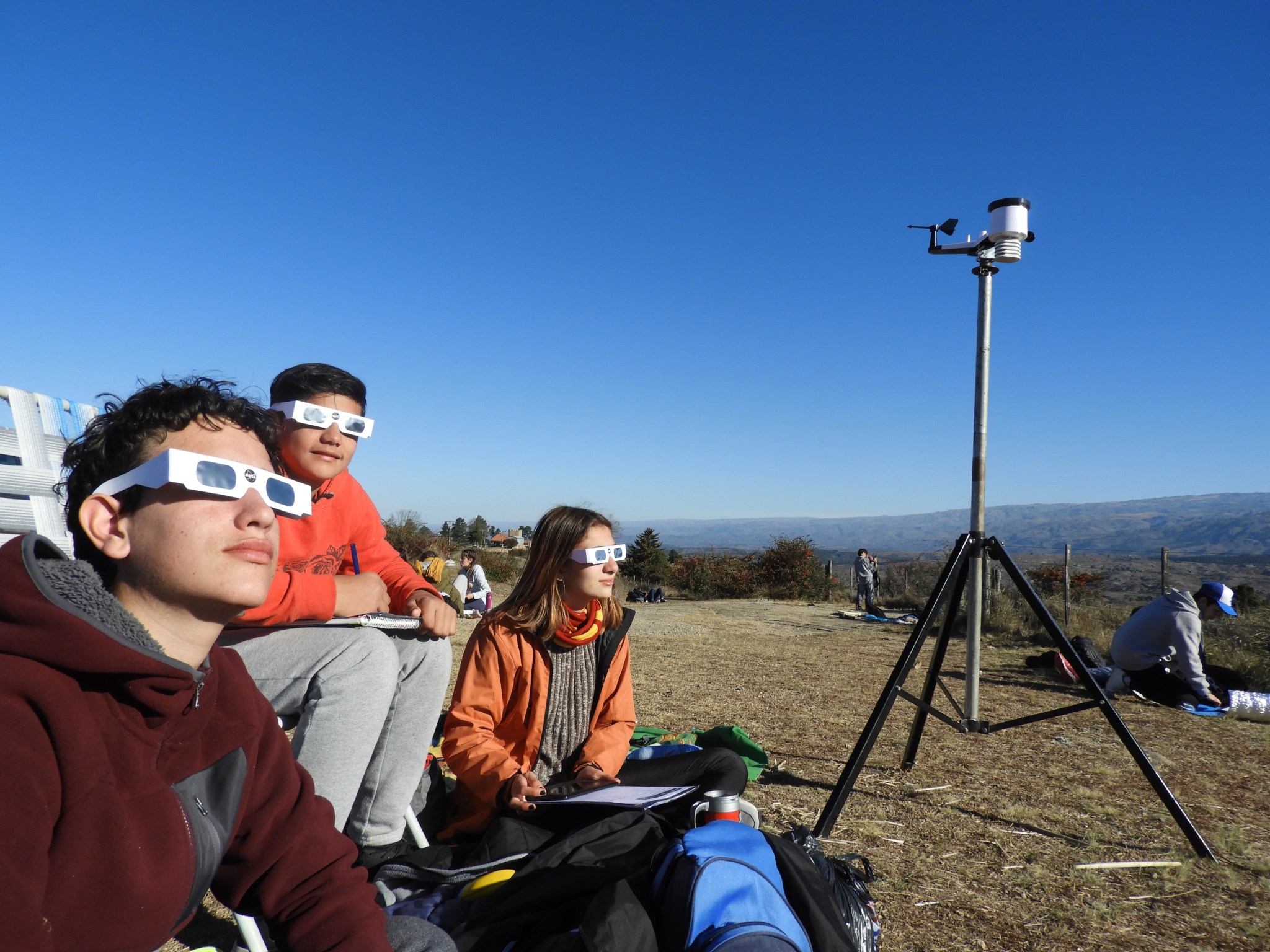
Argentine students gather cloud observations and temperature data to upload through the GLOBE Eclipse tool during the eclipse that crossed South America on July 2, 2019.
Pablo Cecchi
On April 8, 2024, as the Moon passes between the Sun and Earth, thousands of amateur citizen scientists will measure air temperatures and snap pictures of clouds. The data they collect will aid researchers who are investigating how the Sun influences climates in different environments.
Among those citizen scientists are the fifth- and sixth-grade students at Alpena Elementary in northwest Arkansas. In the weeks leading up to the eclipse, these students are visiting the school’s weather station 10 times a day to collect temperature readings and monitor cloud cover. They will then upload the data to a phone-based app that’s part of a NASA-led program called GLOBE, short for Global Learning and Observations to Benefit the Environment.
The goal, according to Alpena Elementary science and math teacher Roger Rose, is to “make science and math more real” for his students. “It makes them feel like they’re doing something that’s important and worthwhile.”
The GLOBE eclipse tool is a small part of the much broader GLOBE project, through which students and citizen scientists collect data on plants, soil, water, the atmosphere, and even mosquitoes. And while some of these studies require equipment, contributors to the eclipse project will only need a thermometer and a smart phone with the GLOBE Observer app downloaded. They can access the eclipse tool in the app.
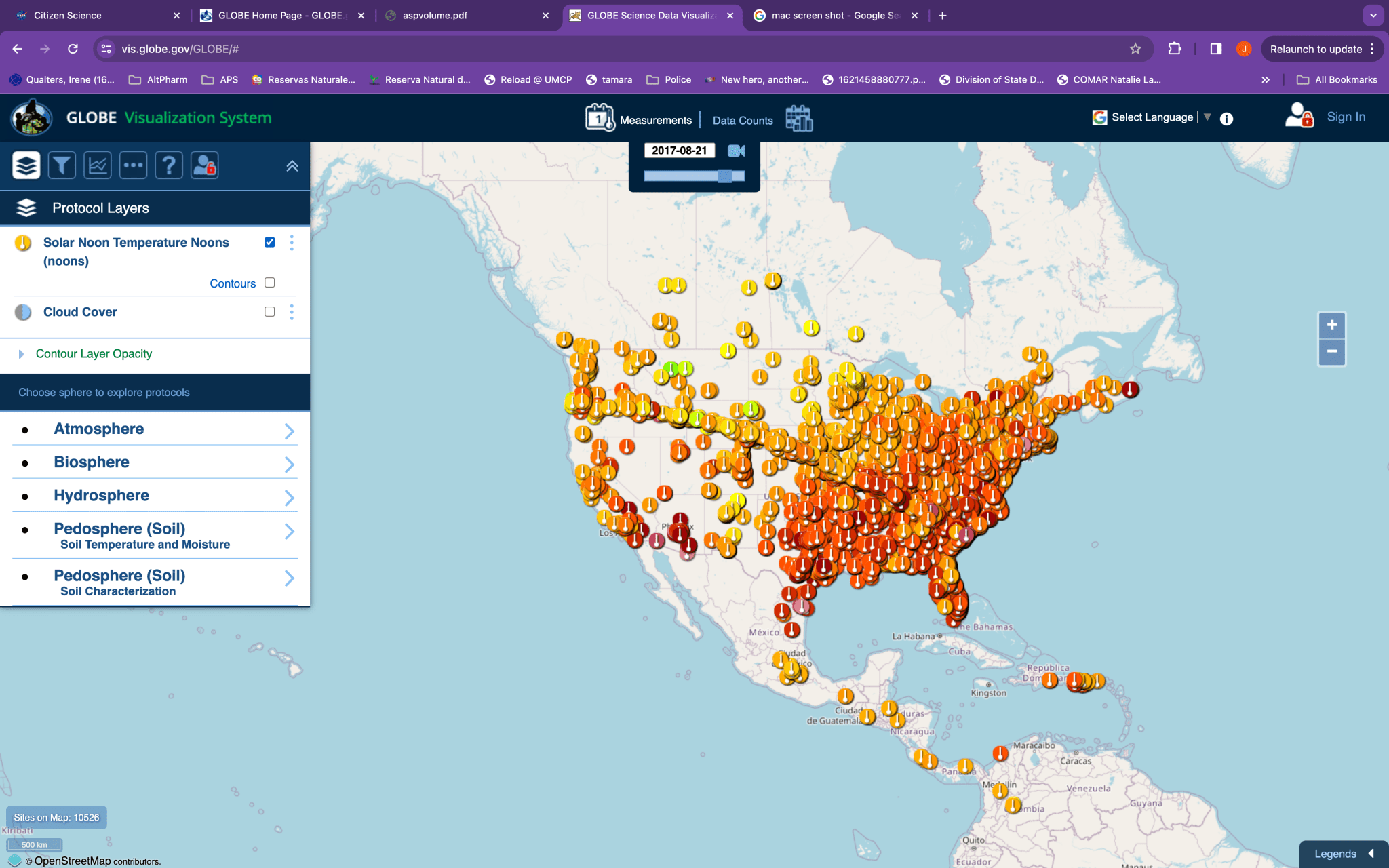
This is not the first time the GLOBE eclipse tool has been deployed in North America. During the 2017 North American eclipse, NASA researchers examined the relationship between clouds and air temperature and found that temperature swings during the eclipse were greatest in areas with less cloud cover, while temperature fluctuations in cloudier regions were more muted. It’s a finding that would have been difficult, perhaps impossible, without the assistance of numerous amateur observers along the eclipse path, said Marilé Colón Robles, a meteorologist based at NASA’s Langley Research Center in Hampton, Virginia, and the GLOBE project scientist overseeing the cloud study portion of the project.
GLOBE program volunteers across North America uploaded data coinciding with the July 21, 2017 event to this map. A high concentration of observers make the path of totality in the western part of the U.S. stand out.
Globe program
The number of weather stations along this year’s eclipse path is limited, and while satellites give us a global view, they can’t provide the same level of detail as people on the ground, said Ashlee Autore, a NASA Langley data scientist who will be conducting a follow-up to the 2017 study. “The power of citizen science is that people make the observations, and they can move.”
It’s still unclear how temperature fluctuations during a total eclipse compare across different climate regions, Colón Robles said. “This upcoming eclipse is passing through desert regions, mountainous regions, as well as more moist regions near the oceans.” Acquiring observations across these areas, she said, “will help us dig deeper into questions about regional connections between cloud cover and ground-level temperatures.” The studies should give scientists a better handle on the flow of energy from the Sun that’s crucial for understanding climate.
In many areas, citizen scientists are expected to gather en masse. “We’re inviting basically all of El Paso to campus,” said geophysicist and GLOBE partner John Olgin of El Paso Community College in Texas. The area will experience the eclipse in near totality, with about 80% of the Sun covered at the peak. It’s enough to make for an engaging event involving citizen scientists from the U.S. and Juarez, Mexico, just across the Rio Grande.
Just a few minutes of midday darkness will have the long-term benefits of increasing awareness of NASA citizen science programs, Olgin said: “It’s going to inspire people to say, ‘Hey look, you can actually do stuff with NASA.’”
More than 30 million people live along the path of the 2024 eclipse, and hundreds of millions more will see a partial eclipse. It will be another 20 years before so many people in North America experience another total solar eclipse again.
With this in mind, Colón Robles has a piece of advice: As the Moon actively blocks the Sun, set your phone and thermometer aside, and marvel at one of the most extraordinary astronomical events of your lifetime.
Visit NASA’s Citizen Science page to learn how you can help NASA scientists study the Earth during eclipses and all year round. The GLOBE Program page provides connections to communities of GLOBE participants in 127 countries, access to data for retrieval and analysis, a roadmap for new participants, and other resources.
Jupiter plows through the Pleiades on March 14, a chance to spot Mercury at month’s end along with a subtle lunar eclipse, and a comet worth keeping an eye on!
March skywatching highlights:
March 10 – New moon
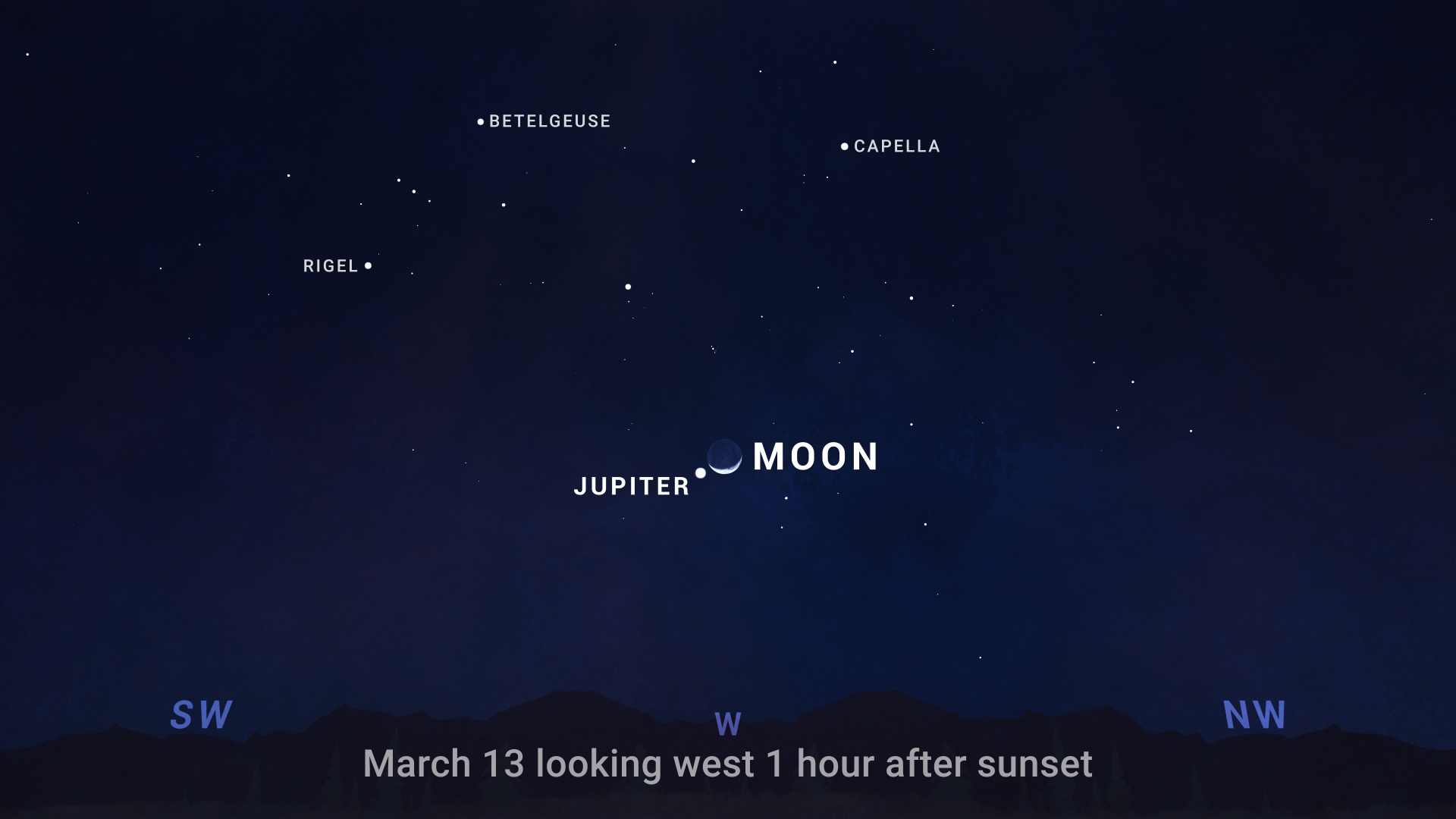
March 13 – The Moon joins Jupiter tonight in the west, following sunset. They make a great pairing through binoculars.
March 14 – Tonight the crescent Moon moves through the Pleiades star cluster, creating a dazzling sight for skywatchers observing with binoculars.
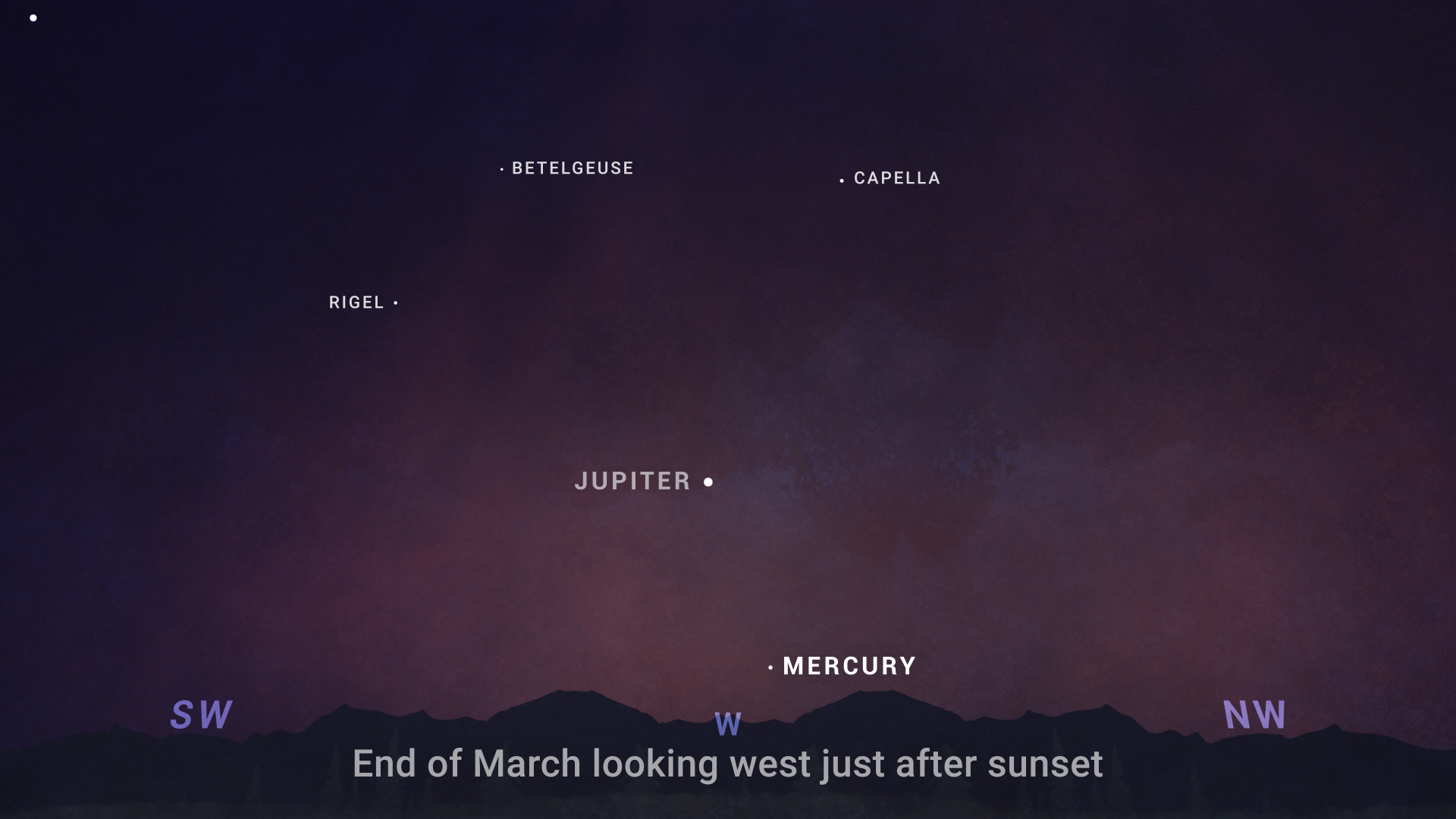
March 21-25 – Northern Hemisphere viewers have their best chance of the year to spot Mercury in the evening sky. Look for it shining brightly, low in the west, starting half an hour after sunset.
March 24-25 – A subtle lunar eclipse called a penumbral eclipse will cause a slight decrease in the Moon’s brightness tonight. It’s usually difficult to see, but you might see the difference if you look before the eclipse and then at the peak. At the peak observers can sometimes see a subtle gradient in brightness across the Moon’s face.
March 25 – Full moon
March 25 – The full moon dims slightly during a penumbral lunar eclipse tonight, as it passes through the outer part of Earth’s shadow, the penumbra. The decrease in brightening for this type of eclipse is subtle, but you might be able to notice a slight gradient in brightness across the Moon’s face around the peak of the event.
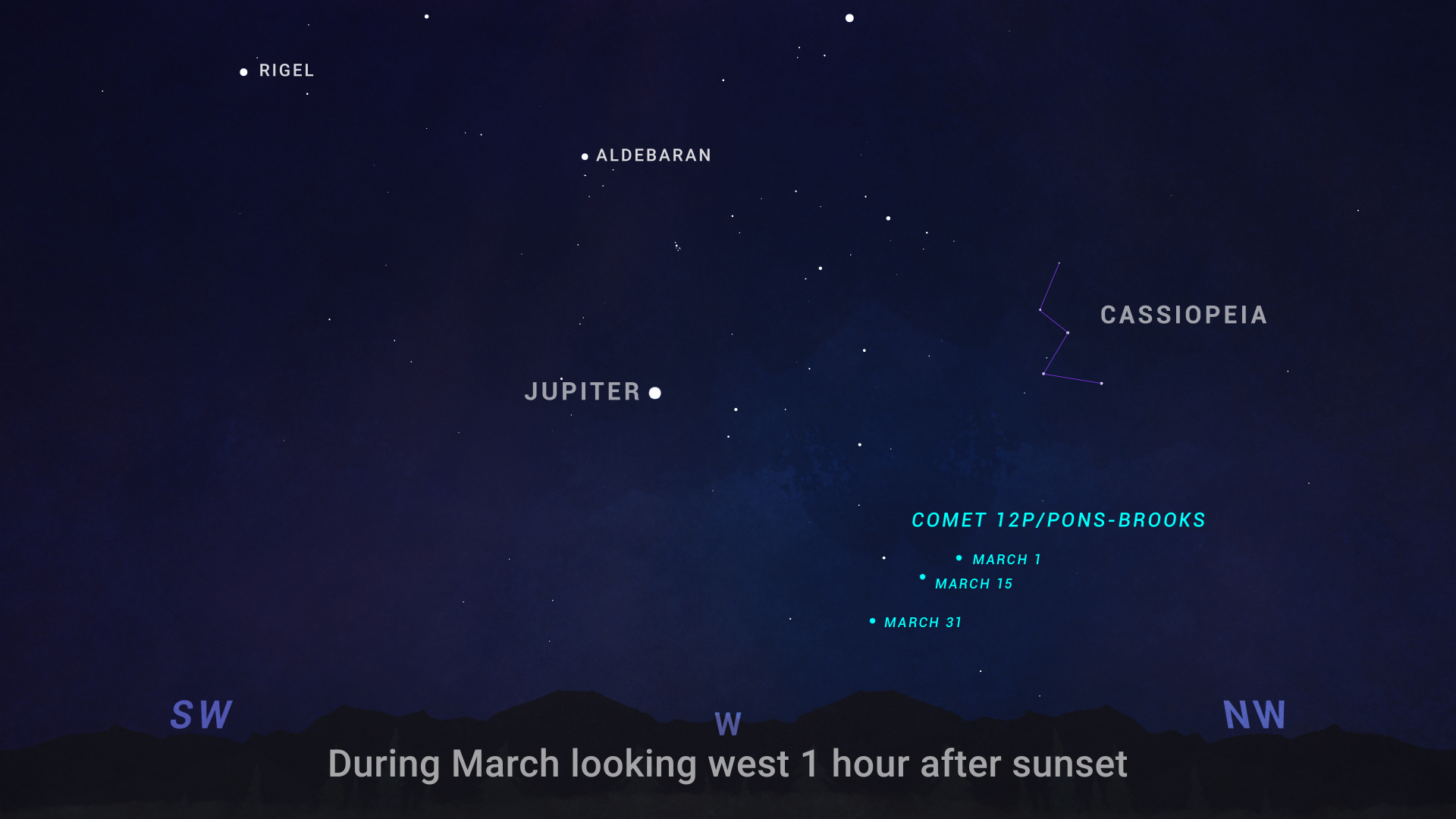
All month – Comet 12P/Pons-Brooks is heading toward its closest approach to the Sun on its 71-year orbit, and is bright enough to observe in telescopes and binoculars. There’s a possibility it might become just visible to the unaided eye by late March or sometime in April.
Sky chart showing the changing position of Comet 12P/Pons-Brooks during the month of March. Find the comet in the west-northwest as soon as the sky is fully dark. It moves lower as the month continues
Video Transcript
Text of the current month’s video.
What’s Up for March? Some close pair-ups with the Moon, and Mercury makes an appearance, a subtle lunar eclipse, and a chance to catch a comet.
In March, you’ll find Jupiter shining brightly in the west during the early evening hours all month long. And on March 13th, it’s joined by a crescent Moon so close that the pair will be visible together through binoculars.
Sky chart showing Jupiter with the Moon on the evening of March 13, one hour after sunset.
NASA/JPL-Caltech
On the following evening, the Moon visits the Pleiades. This is another close pairing – with the five-day-old lunar crescent hanging right next to the bright star cluster – that will look great through a small telescope or binoculars.
Near the end of March, observers in the Northern Hemisphere will have the best opportunity of the year to catch a glimpse of Mercury in the evening sky. Look for it shining brightly low in the west following sunset.
Sky chart showing Jupiter and Mercury on the evenings of March 21-25 about 30-40 minutes after sunset.
NASA/JPL-Caltech
Overnight on March 24th and into the 25th, the Moon will pass through the outer part of Earth’s shadow, creating a faint lunar eclipse called a penumbral eclipse. Now, the more spectacular variety of lunar eclipses happens when the Moon passes through Earth’s inner shadow, or umbra. That’s when we see a dark “bite” taken out of the Moon, or in the case of a total lunar eclipse, a reddish, so-called “blood moon.” Penumbral eclipses cause only a slight dimming of the Moon’s brightness, so if you’re not looking for it, you might not know there was an eclipse happening. But if you glance at the Moon early in the night, and then later, around the peak of the eclipse, you might notice the difference in brightness.
Even faint lunar eclipses like this one are always accompanied by a solar eclipse either a couple of weeks before or after. And on April 8th, a total solar eclipse will sweep across the U.S. (We’ll tell you more about that in next month’s video.)
There’s a comet making its way into the inner solar system that’s already observable with a telescope, and might start to become visible to the unaided eye by late March or in April. It’s a mountain of rock, dust, and ice several miles wide named 12P/Pons-Brooks.
It has a stretched-out, 71-year-long orbit that carries it as far from the Sun as the orbit of Neptune and nearly as close as the orbit of Venus. Fortunately, because this orbit is tilted, it doesn’t cross our planet’s path, so there’s no chance of a collision.
Comet 12P has been observed on several of its previous appearances going back hundreds of years, and one thing it’s known for is its occasional outbursts. Sometimes this comet suddenly brightens by quite bit, due to bursts of gas and dust being released from beneath its surface. If this happens in the March-April timeframe as the comet nears the Sun, it could become bright enough to observe with the eye alone.
But even without additional brightening from outbursts, the comet is predicted to peak at a brightness that should make it easy to see with binoculars, and possibly just naked-eye visible under dark skies by the end of March.
Now, comets are notoriously unpredictable, so it’s hard to know for sure how bright Pons-Brooks will get as it nears the Sun, but it’s certainly worth a look. You can find it low in the west-northwest part of the sky at the end of evening twilight.
Comets, along with asteroids, are leftover pieces of the materials that formed the Sun and planets. So catch a comet and glimpse one of the building blocks of our solar system with your own eyes.
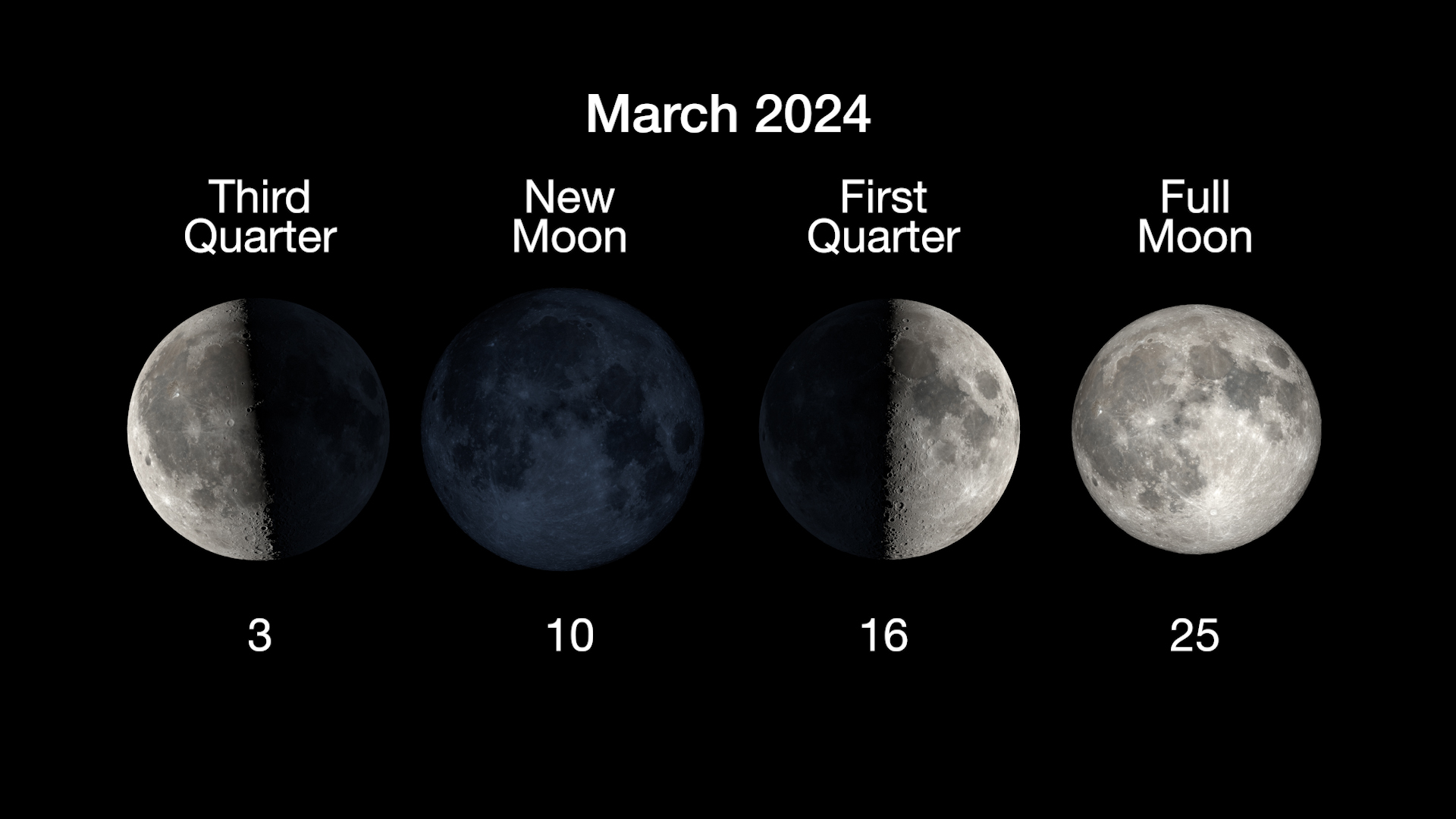
Here are the phases of the Moon for March.
The phases of the Moon for March 2024.
NASA/JPL-Caltech
Stay up to date on NASA’s missions exploring the solar system and beyond at science.nasa.gov. I’m Preston Dyches from NASA’s Jet Propulsion Laboratory, and that’s What’s Up for this month.
“What’s Up” is NASA’s longest running web video series. It had its first episode in April 2007 with original host Jane Houston Jones. Today, Preston Dyches, Christopher Harris, and Lisa Poje are the science communicators and space enthusiasts who produce this monthly video series at NASA’s Jet Propulsion Laboratory. Additional astronomy subject matter guidance is provided by JPL’s Bill Dunford, Gary Spiers, Lyle Tavernier, and GSFC’s Molly Wasser.
NASA Names Finalists to Help Deal with Dust in Human Lander Challenge
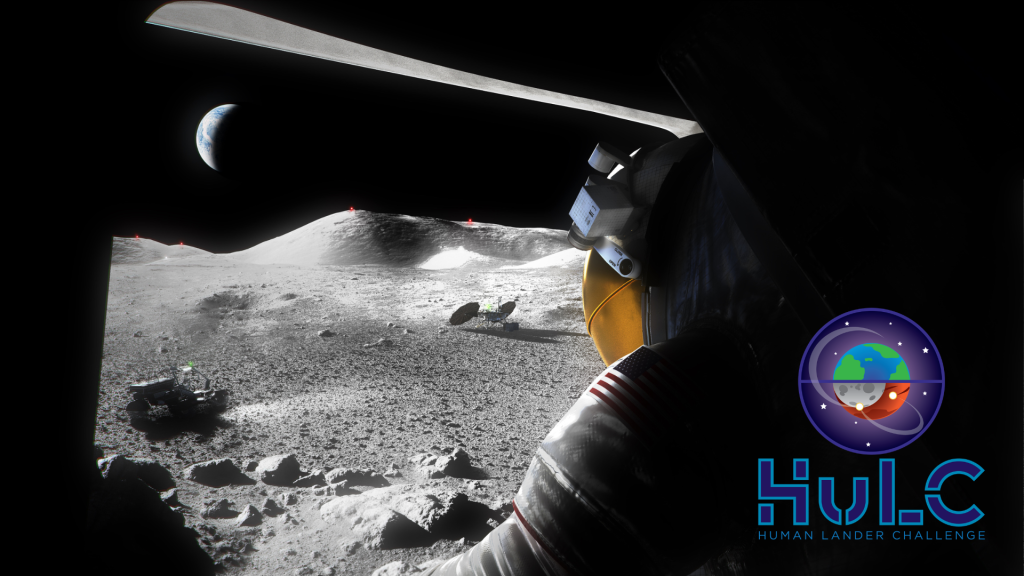
NASA selected 12 finalist teams to compete in the next round of the Human Lander Challenge (HuLC) competition. In 2023, NASA invited undergraduate and graduate students from accredited colleges and universities in the United States to propose innovative solutions to manage the lunar dust a spacecraft stirs up when landing on the Moon.
NASA’s Artemis campaign will establish a long-term human presence on and around the Moon for the benefit of all, and one of the challenges the agency and its partners must address is the particularly dusty aspect of landing on the lunar surface. These university-level teams will spend the next several months continuing to develop their concepts for managing or preventing the cloud of dust created when using rocket engines to land on unprepared surfaces like the Moon. This effect is called plume surface interaction and can damage assets NASA plans to establish on the Moon’s surface, like habitats and scientific experiments.
“Each team brings a unique perspective and I’m excited to see the cumulation of each team’s extensive research and concept development at the 2024 Forum,” said Jamshid Samareh, lead for the technology identification and assessment team at NASA’s Langley Research Center in Hampton, Virginia. “Their proposed system-level designs showcase the brilliance and dedication of the Artemis Generation to our collective mission. I am confident their work will propel us closer to the Moon and hopefully inspire future advancements in space exploration.”
The 2024 HuLC Finalist Teams are:
Colorado School of Mines
“Prudent Landers – FAST”
Advisor: Mark Florida, Dr. Angel Abbud-Madrid, David Purcell
Embry-Riddle Aeronautical University
“Plume Additive for Reducing Surface Ejecta and Cratering (PARSEC)”
Advisor: Dr. Siwei Fan
Embry-Riddle Aeronautical University
“Ceramic Research Advancement Technology at Embry-Riddle (C.R.A.T.E.R.)”
“Synthetic Orbital Landing Area for Crater Elimination (SOLACE)”
Advisor: Dr. Helen Reed
Texas State University
“Numerical Simulation and Physical Validation of Regolith Ejecta During Plume Surface Interaction”
Advisor: Dr. Bin Xiao
The College of New Jersey
“TCNJ Adaptable Regolith Retention Program (TARRP)”
Advisor: Mohammed Alabsi
University of California San Diego
“Microwave Lunar Sintering of Nanophase Iron Enriched Lunar Regolith for the Creation of a Lunar Landing Pad”
Advisor: Dr. Amy Eguchi, Dr. Zahra Sadeghizadeh, Dr. Ross Turner
University of Colorado Boulder (Graduate Team)
“Lunar Surface Assessment Tool (LSAT): A Simulation of Lunar Dust Dynamics for Risk Analysis”
Advisor: James Nabity
University of Illinois Urbana-Champaign
“HINDER: Holistic Integration of Navigational Dynamics for Erosion Reduction”
Advisor: Laura Villafane Roca
University of Michigan
“ARC-LIGHT: Algorithm for Robust Characterization of Lunar surface Imaging for Ground Hazards and Trajectory”
Advisor: Mirko Gamba, Chris Ruf
The finalist selection process involved a rigorous assessment of each team’s proposal package submission, consisting of a 5–7-page concept proposal and a two-minute summary video. The judging panel made up of subject matter experts from NASA’s Human Landing System Program considered factors such as feasibility, innovation, and adherence to NASA’s safety standards. Each team will receive a $7,000 stipend award to facilitate further development of their proposed concept and their full participation in the 2024 HuLC Forum in Huntsville, Alabama this June. The 12 finalists will make final presentations to a panel of NASA and industry experts at the onsite HuLC Forum. The top three winning teams will share a prize purse of $18,000.
Through Artemis, NASA will land the first woman, first person of color, and its first international partner astronaut on the Moon, paving the way for a long-term, sustainable lunar presence to explore more of the lunar surface than ever before and prepare for future astronaut missions to Mars.
For full competition details, visit the Human Lander Challenge website:
March-April 2024: The Next Full Moon is the Crow, Crust, Sap, Sugar, or Worm Moon
29 Min Read
March-April 2024: The Next Full Moon is the Crow, Crust, Sap, Sugar, or Worm Moon
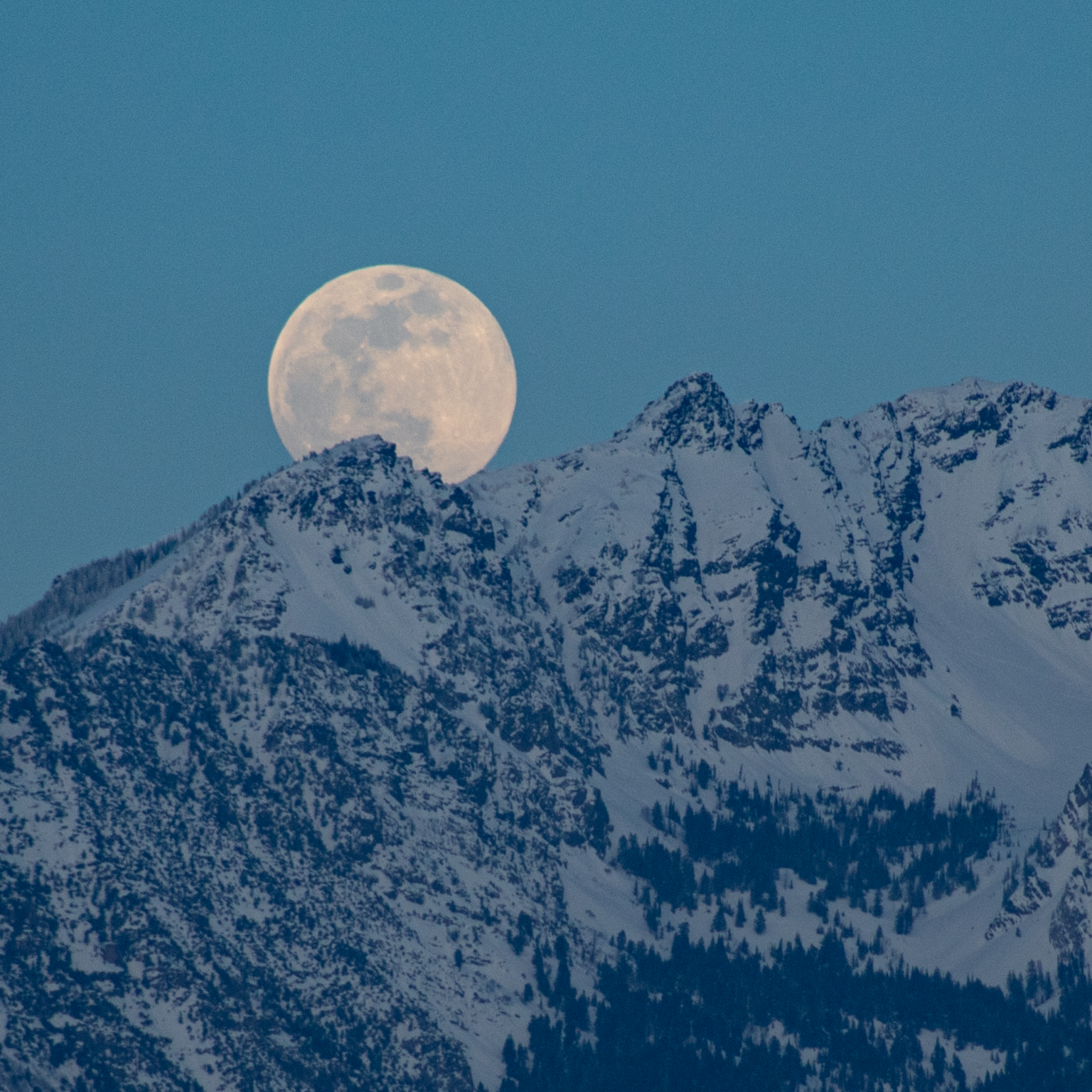
A full moon rises over Utah.
Credits: NASA/Bill Dunford
The next full moon is the Crow, Crust, Sap, Sugar, or Worm Moon; the Paschal Moon; Purim; the Holi Festival Moon; Madin Poya; the Pothole Moon; a Micromoon, and a Partial Lunar Eclipse.
The next full moon will be on Monday morning, March 25, 2024, appearing opposite the Sun in Earth-based longitude at 3 AM EDT. This will be on Sunday evening from Alaska Time westward to the International Date Line. Around this time the Moon will pass through the partial shadow of the Earth (called a penumbral lunar eclipse). The slight dimming of the Moon will be difficult to notice, but see if you can tell if the lower part of the Moon is dimmer than the upper part. The Moon will begin entering the Earth’s shadow at 12:53 AM, reach greatest eclipse at 3:13 AM with 96% of the Moon in partial shadow, and exit the shadow at 5:32 AM. Since this full Moon is a little over a day after apogee (when the Moon is at its farthest from the Earth in its orbit) this is a micromoon, the opposite of a supermoon. The Moon will appear full for about 3 days around this time, from Saturday evening through Tuesday morning.
The Maine Farmers’ Almanac began publishing “Indian” names for full Moons in the 1930s and these names are now widely known and used. According to this almanac, as the full Moon in March the tribes of the northeastern United States called this the Crow, Crust, Sap, Sugar, or Worm Moon. The more northern tribes of the northeastern States knew this as the Crow Moon, with the cawing of crows signaling the end of winter. Other northern names were the Crust Moon, because the snow cover became crusted from thawing by day and freezing by night, or the Sap (or Sugar) Moon as this was the time for tapping maple trees. The more southern tribes called this the Worm Moon after the earthworm casts that appeared as the ground thawed. It makes sense that only the southern tribes called this the Worm Moon. When glaciers covered the northern part of North America they wiped out the native earthworms. After these glaciers melted about 12,000 years ago the more northern forests grew back without earthworms. Most of the earthworms in these areas are invasive species introduced from Europe and Asia.
In the western Christian ecclesiastical calendar this is the Paschal Moon, from which the date of Easter is calculated. Paschal is the Latinized version of Pesach, Hebrew for Passover. Initially, the Christian holiday of Easter, also called Pascha, was celebrated on the first Sunday after the first full Moon of spring. However, there are differences between the times of these astronomical events and the calendars now used by the Eastern and Western churches. Western Christianity will be celebrating Easter on Sunday, March 31, 2024, the Sunday after this first full Moon of spring. The date of Eastern Orthodox Easter is based on the Julian calendar and will be on Sunday, May 5.
Many lunar and lunisolar calendars start the months on the new Moon with the full Moon in the middle of the month. Lunisolar calendars add or repeat a month as needed to keep the lunar months aligned with the solar seasons. This full Moon is in the middle of the second month of Adar in the Hebrew calendar and corresponds with Purim, celebrated from sunset on March 23 to sunset on March 24, 2024, the 14th of the Adar II (a day later in Jerusalem and ancient walled cities). Purim marks the Jewish people’s deliverance from a royal death decree around the fourth century BCE as told in the Book of Esther. Purim is celebrated by exchanging gifts of food and drink, feasting, and donating to charity.
In the Islamic calendar this full Moon is near the middle of the holy month of Ramadan. Ramadan is honored as the month in which the Quran was revealed. Observing this annual month of charitable acts, prayer, and fasting from dawn to sunset is one of the Five Pillars of Islam.
As the full Moon in the Hindu month Phalguna, this Moon corresponds with the Holi festival, celebrating the victory of good over evil and the start of spring. This two-day long festival is also known as the Festival of Love, Festival of Colors, or the Festival of Spring. Holi begins with a bonfire the evening before the day of the full Moon, continues on the day of the full Moon with a free-for-all game involving the spraying of colored powders and/or colored water on whomever wanders by, and ends with evening visits with friends and family.
Every full Moon is a holiday in Sri Lanka. This full Moon is Medin or Madin Poya, marking the Buddha’s first visit to his father after his enlightenment.
Continuing the tradition of naming Moons after prominent phenomena tied to the time of year, a few years ago my friend Tom Van Wagner suggested naming this the Pothole Moon. It may be a case of confirmation bias, but whether in my car or on my bicycle I notice more potholes this time of year.
As usual, the wearing of suitably celebratory celestial attire is encouraged in honor of the full Moon.
As for other celestial events between now and the full Moon after next (with specific times and angles based on the location of NASA Headquarters in Washington, DC):
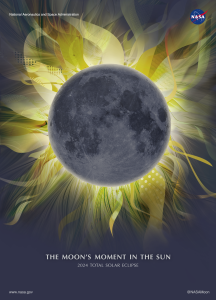
Total Eclipse of the Sun
There will be a total eclipse of the Sun on Monday, April 8, 2024. This total eclipse will be visible in a swath ranging from 142 (88 miles) wide near the start and end to 203 km (126 miles) wide near the middle of the swath. The path of the total eclipse will begin in the Pacific south of the equator, start passing over North America on the coast of Mexico near Mazatlán, cross the USA from Texas to Maine, exit North America from Canada on the coast of Newfoundland, and end in the North Atlantic. Outside of this narrow swath, most of North and Central America will see a partial solar eclipse. See https://science.nasa.gov/solar-system/skywatching/eclipses/solar-eclipses/2024-solar-eclipse/total-solar-eclipse-2024-the-moons-moment-in-the-sun/ for more information.
Assuming you can find a place with clear skies near the centerline of this swath, this eclipse, in particular, should be quite a show. Compared to the eclipse in 2017, the Moon will be nearer its closest to the Earth, making its shadow larger, the sky darker, and the eclipse longer. In addition, the Sun will be nearer its maximum in its 11-year cycle, so the corona, which can only be seen during a total eclipse, should be more spectacular. If the sky is clear during the eclipse, you will be able to see the planets and some stars that are not normally visible this time of year. Bright Jupiter will be to the upper left of the eclipse, with Venus, Saturn, and Mars to the lower right. In the unlikely event that the comet 12P/Pons-Brooks has an outburst that makes it significantly brighter (described below), you may be able to see it to the right of Jupiter (if it isn’t obvious, I recommend enjoying the eclipse rather than spending time searching for a comet you might not be able to see).
Plenty of information about this total eclipse is available elsewhere, so I will refrain from adding much more, but please read and pay attention to eye safety. The only time it is safe to look directly at the Sun is when it is completely blocked by the Moon, so that you can only see the much fainter corona. Staring directly at even a small sliver of the Sun can do permanent eye damage.
This eclipse will be passing through or near many populated areas, making it possible to trade off waiting for more accurate weather forecasts for clear skies against the difficulties of making last minute bookings or dealing with traffic jams if you wait until the day of the eclipse to drive to the zone of totality.
Total eclipses of the Sun are rare and spectacular events. I recognize that not everyone will be able to drop everything and go see this one, but seeing at least one good, total eclipse in a clear sky should be on your bucket list. A partial eclipse is just not the same. The only other reason I can think of for not going where you can see this total eclipse (other than you absolutely can’t at this time) is that if you see this eclipse, you are likely to want to see more, and will begin making plans to go to North Africa in 2026, Australia in 2028, etc. The next three eclipses visible from parts of North America will be in 2044, 2045, and 2052.
Comet 12P/Pons-Brooks
During this lunar cycle, comet 12P/Pons-Brooks will be visible with binoculars or a telescope, and may become bright enough to be a naked eye comet. In my quick searches of the web I found visual guides that provide specific information on when and where to look from your location on any given night. However, I did not see a concise guide to when might be the best time to look for this comet, so here is my meager attempt.
Several things make a difference in how easy it is to see a comet.
The greatest uncertainty is how much dust and gas it will be giving off, as it is the sunlight illuminating these plumes that make the comet bright. This comet has already had outbursts that have made it temporarily 10 to 100 times brighter. It may be less likely such outbursts will occur as the comet moves closer to the Sun, but this is uncertain. As the astronomer David H. Levy said, “Comets are like cats; they have tails, and they do precisely what they want.”
My recommendation is to pay attention to the news and check regularly to see if the comet has had an outburst, as this may push its brightness into the visible range. In addition, I plan to look for the comet with binoculars, both on April 8 and 9 before moonlight begins to interfere and in the weeks before closest approach to the Sun on April 21. The next couple of paragraphs give my reasoning (which you are welcome to skip if you like).
We can’t predict outbursts, but we can predict other influences on the brightness of the comet.
If the gas and dust from the comet isn’t changing, an easy calculation is to assume the comet will scatter light uniformly in all directions, so that all you need to consider is the distance between the Sun and the comet and the distance between the comet and the Earth. This suggests that the comet will be at its brightest around April 20 and 21, 2024, when it will be passing its closest to the Sun and receiving (and reflecting towards Earth) the maximum amount of sunlight.
How easy the comet will be to see will also depend on how much glow there is from twilight (which depends on how far the Sun is below the horizon), whether (and how much) moonlight there is (increased moonlight will brighten the background sky), and how high the comet is above the horizon.
In the evenings, nautical twilight ends when the Sun reaches 12 degrees below the horizon (the estimate of when the horizon will be too dark for sailors at sea to use for navigation). In mid-to-late April (for the DC area), nautical twilight ends about 1 hour after sunset (the start and end of twilight I use throughout these Moon Missives is based on nautical twilight). Astronomical twilight is when the Sun is between 12 and 18 degrees below the horizon, when the sky looks dark but there can be enough residual glow that the faintest stars and diffuse objects (like nebulae, galaxies, faint meteors, and comets on the edge of visibility) may be masked. When the Sun is more than 18 degrees below the horizon the sky is about as dark as it is going to get.
When the Moon is in the sky it will add its light to the background brightness of the sky. The amount of light added will increase as the Moon waxes from a faint, thin crescent to a bright, nearly full Moon.
The evening of April 8, 2024, as nautical twilight ends (at 8:39 PM EDT), the crescent Moon will have already set and the comet will be 11.4 degrees above the west-northwestern horizon. The combined effect of the range from the Sun and the Earth gives a geometric estimate of 91% of the maximum brightness at its closest to the Sun in late April. By the time astronomical twilight ends (at 9:12 PM) the comet will still be 5 degrees above the horizon.
The evening of April 9, it might be interesting to see the comet and the thin, waxing crescent Moon low on the horizon as twilight ends, as the Moon will not be very bright and should not interfere much with seeing the comet. Nautical twilight will end (at 8:40 PM) with the Moon 4.2 degrees above the horizon and the comet above the Moon at 10.8 degrees above the horizon. The Moon will set (at 9:08 PM) just 5 minutes before astronomical twilight ends (at 9:13 PM), when the comet will be 4.6 degrees above the horizon. The distance-based estimate of brightness will have increased to 93% of the peak in late April.
Between April 10 and April 21, the geometric estimate of the brightness of the comet will gradually increase, but so will interference from the brightness of the waxing Moon, and the comet will shift closer to the horizon each evening. On the evening of April 21 the geometric brightness of the comet will be at its greatest, but the Moon will be 96% illuminated and the comet will be only 2.7 degrees above the horizon as nautical twilight ends. April 24 will be the last evening that the comet will be above the horizon before nautical twilight ends (at 8:57 PM).
Note that as our opportunity to view this comet from northern latitudes gets worse in late April, the opportunity for viewers in the Southern Hemisphere will get better.
Length of Daylight
As spring continues the daily periods of sunlight continue to lengthen, having changed at their fastest around the equinox on March 19, 2024. On Monday, March 25 (the day of the full Moon), morning twilight will begin at 6:05 AM, sunrise will be at 7:03 AM, solar noon will be at 1:14 PM when the Sun will reach its maximum altitude of 53.3 degrees, sunset will be at 7:25 PM, and evening twilight will end at 8:24 PM. By Tuesday, April 23 (the day of the full Moon after next), morning twilight will begin at 5:18 AM, sunrise will be at 6:20 AM, solar noon will be at 1:06 PM when the Sun will reach its maximum altitude of 64.0 degrees, sunset will be at 7:53 PM, and evening twilight will end at 8:56 PM.
Meteor Showers
Two meteor showers, the Lyrids (006 LYR) and the π-Puppids (137 PPU), will peak near the end of this lunar cycle but the nearly full Moon will interfere with seeing these meteors.
Evening Sky Highlights
On the evening of Sunday, March 24 (the evening before the full Moon), as twilight ends (at 8:22 PM EDT), the rising Moon will be 14 degrees above the east-southeastern horizon. The bright planet Jupiter will be 27 degrees above the western horizon and the planet Mercury will be to the lower right of Jupiter at 7 degrees above the horizon. The bright object appearing closest to overhead will be Pollux at 78 degrees above the south-southeastern horizon. Pollux is the 17th brightest star in our night sky and the brighter of the twin stars in the constellation Gemini the twins. Pollux is an orange tinted star about 34 light-years from Earth. It is not quite twice the mass of our Sun but about 9 times the diameter and 33 times the brightness.
As this lunar cycle progresses, the background of stars will appear to shift westward each evening (as the Earth moves around the Sun). Mercury will be dimming as it shifts toward the west-northwestern horizon, with April 3 the last evening it will be above the horizon as twilight ends and April 11 when it will pass between the Earth and the Sun, shifting from the evening to the morning sky. We are approaching the end of the opportunity to view Jupiter for this apparition, as it will shift lower towards the west-northwestern horizon each evening. The waxing Moon will pass by Jupiter on April 10, Pollux on April 14 and 15, Regulus on April 17 and 18, and Spica on April 22. By the evening of Tuesday, April 23 (the evening of the day of the full Moon after next), as twilight ends (at 8:56 PM EDT), the rising Moon will be 10 degrees above the east-southeastern horizon. The bright planet Jupiter will be 4 degrees above the west-northwestern horizon. The bright object appearing closest to overhead will be Regulus at 63 degrees above the southern horizon. Regulus is the 21st brightest star in our night sky and the brightest star in the constellation Leo the lion. The Arabic name for Regulus translates as “the heart of the lion.” Although we see Regulus as a single star, it is actually four stars (two pairs of stars orbiting each other). Regulus is about 79 light-years from us.
Morning Sky Highlights
On the morning of Monday, March 25 (the morning after the full Moon), as twilight begins (at 6:05 AM EDT), the setting Moon will be 12 degrees above the west-southwestern horizon. The planet Mars will be 3 degrees above the east-southeastern horizon. The bright object appearing closest to overhead will be the star Vega at 73 degrees above the eastern horizon. Vega is the brightest star in the constellation Lyra the lyre and is one of the three bright stars in the “Summer Triangle” along with Deneb and Altair. Vega is the 5th brightest star in our night sky, about 25 light-years from Earth, twice the mass of our Sun, and shines 40 times brighter than our Sun.
As this lunar cycle progresses, the background of stars will appear to shift westward each evening, while Mars will hover low on the east-southeastern horizon, drifting slightly to the left. The waning Moon will pass by Spica on March 26 and 27, and Antares on March 30. April 1 will be the first morning the planet Saturn will be above the eastern horizon as morning twilight begins, shifting towards Mars each morning. On April 6 the thin, waning crescent Moon will form a triangle with Saturn and Mars, but will be low on the east-southeastern horizon and difficult to see, with the Moon rising just 3 minutes before morning twilight begins. On April 10 Mars and Saturn will appear closest to each other, after which they will appear to separate. By the morning of Tuesday, April 23 (the morning of the day of the full Moon after next), as twilight begins (at 5:18 AM EDT), the setting full Moon will be 7 degrees above the west-southwestern horizon with the bright star Spica 2.5 degrees to the lower left of the Moon. The planet Mars will be 5 degrees above the eastern horizon and the planet Saturn will be 7 degrees above the east-southeastern horizon. The bright object appearing closest to overhead will still be the star Vega at 86 degrees above the eastern horizon.
Detailed Daily Guide
Here for your reference is a day-by-day listing of celestial events between now and the full Moon after next. The times and angles are based on the location of NASA Headquarters in Washington, DC, and some of these details may differ for where you are (I use parentheses to indicate times specific to the DC area).
Monday evening into Tuesday morning, March 18 to 19, 2024, the bright star Pollux (the brighter of the twin stars in the constellation Gemini the twins) will appear near the waxing gibbous Moon. Pollux will be 3.5 degrees to the left as twilight ends (at 8:16 PM EDT) and will shift clockwise around the Moon until the Moon sets on the northwestern horizon (at 4:42 AM) when Pollux will be 2 degrees to the upper right.
Tuesday evening, March 19, 2024, at 11:06 PM EDT, will be the vernal equinox, the astronomical end of winter and start of spring. For a location on the equator in the ocean north of Western New Guinea the Sun will pass directly overhead as it shifts from the Southern to the Northern Hemisphere.
Thursday morning, March 21, 2024, if you have a very clear view of the horizon about halfway between east and east-southeast, you might be able to see the planet Saturn less than a degree to the lower left of the bright planet Venus. Because of the glow of dawn this will be hard to see. Venus will shine brighter than any star, but Saturn will rise last (at 6:32 AM), 21 minutes after twilight begins (at 6:11 AM EDT), and will be only a little brighter than the star Pollux, the 17th brightest star in our night sky. You may need binoculars to see the pair, but make sure you stop looking well before sunrise.
The next morning, Friday, March 22, 2024, the planet Venus will have shifted to less than a degree to the left of the planet Saturn, with the pair rising together (at 6:29 AM EDT) 19 minutes after twilight begins (at 6:10 AM).
Thursday evening into Friday morning, March 21 to 22, 2024, the bright star Regulus will appear near the waxing gibbous Moon. As twilight ends (at 8:19 PM EDT) Regulus will be 5 degrees to the lower right of the Moon. Regulus will gradually shift closer to the Moon, initially swinging towards the left (appearing 4 degrees below and a little to the left) as the Moon reaches its highest (at 11:13 PM). At about 2:30 AM (when Regulus will be 3 degrees to the lower left) Regulus will switch and start swinging towards the right. As Regulus sets (at 5:58 AM) it will be 2.5 degrees below the Moon, with morning twilight beginning 12 minutes later (at 6:10 AM) and the Moon setting 3 minutes after that (at 6:13 AM).
Saturday night, March 23, 2024, at 11:46 AM EDT, the Moon will be at apogee, its farthest from the Earth for this orbit.
Sunday evening, March 24, 2024, at 5:59 PM EDT, will be when the planet Mercury reaches its greatest angular separation from the Sun as seen from Earth for this apparition (called greatest elongation). This will be the evening when the planet Mercury will appear highest above the western horizon (6.5 degrees) as twilight ends (at 8:22 PM).
As mentioned above, the next full Moon will be on Monday morning, March 25, 2024. The Moon will pass through the partial shadow of the Earth (called a penumbral lunar eclipse), beginning to enter the shadow at 12:53 AM EDT, reaching greatest eclipse at 3:13 AM when 96% of the Moon will be in partial shadow, and exiting the shadow at 5:32 AM. The slight dimming of the Moon will be difficult to notice. Since this is a little over a day after apogee (when the Moon is at its farthest from the Earth in its orbit) this will be a micromoon, the opposite of a supermoon. The Moon will appear full for about 3 days around this time, from Saturday evening through Tuesday morning.
Tuesday morning, March 26, 2024, the bright star Spica will appear near the full Moon. As the Moon reaches its highest in the sky for the night (at 1:52 AM EDT), Spica will be 8 degrees to the lower left of the Moon. By the time twilight begins (at 6:03 AM), Spica will be 6 degrees to the left of the Moon.
Tuesday evening into Wednesday morning, March 26 to 27, 2024, the Moon will have shifted to the other side of Spica. As the Moon rises on the east-southeastern horizon (at 8:59 PM EDT), Spica will be 3 degrees to the upper right of the Moon. By the time the Moon reaches its highest for the night (at 2:32 AM), Spica will be 5 degrees to the upper right. Spica will be 6 degrees to the lower right as twilight begins (at 6:02 AM).
Saturday morning, March 30, 2024, the bright star Antares will appear near the waning gibbous Moon. As Antares rises on the southeastern horizon (at 12:37 AM EDT) it will be 5 degrees to the lower left of the Moon. The Moon will reach its highest for the night (at 4:52 AM) with Antares 3 degrees to the left. As twilight begins (at 5:57 AM) Antares will be a little less than 3 degrees to the upper left of the Moon.
Monday morning, April 1, 2024, will be the first morning that the planet Saturn will be above the eastern horizon as twilight begins (at 5:55 AM EDT).
Monday night, April 1, 2024, the waning Moon will appear half-full as it reaches its last quarter at 11:15 PM EDT (when the Moon will be below the horizon).
Wednesday evening, April 3, 2024, will be the last evening that the planet Mercury will be above the horizon as twilight ends.
Saturday morning, April 6, 2024, if you have a very clear view of the east-southeastern horizon, you might be able to see the thin, waning crescent Moon near the planets Saturn and Mars. The Moon will rise last (at 5:42 AM EDT) just 3 minutes before twilight begins, with
Saturn 2 degrees to the upper left of the Moon and Mars 4 degrees to the upper right of the Moon.
You will need binoculars to see them in the glow of dawn, but on Sunday morning, April 7, 2024, the bright planet Venus will appear 3.5 degrees to the left of the very thin, waning crescent Moon low on the eastern horizon. Venus will rise last (at 6:14 AM EDT) 31 minutes after twilight begins and 29 minutes before sunrise. If you are using binoculars to scan for this pairing, be sure to stop looking well before any chance of sunrise (as using high powered lenses to focus intense sunlight directly into your eyes is a really bad idea).
Sunday afternoon, April 7, 2024, at 1:52 PM EDT, the Moon will be at perigee, its closest to the Earth for this orbit.
There will be an eclipse of the Sun on Monday, April 8, 2024. For information on the total solar eclipse (not visible from the Washington, DC area) see the summary section above. The Washington, DC area will only see a partial eclipse, starting at about 2:04 PM EDT, reaching its peak at about 3:21 PM when 88.9% of the Sun will be blocked by the Moon, and ending at 4:33 PM. Please pay attention to eye safety and do not look at the Sun directly without eclipse glasses. When the Moon is blocking most of the Sun, what remains will appear like a crescent. One of the interesting effects is that the sunlight through trees, etc., that we normally see as mottled sunlight (round blotches of light) is actually made up of many small images of the round Sun. When the Sun appears as a crescent these mottled patches will appear as many small crescents.
The eclipse will also be the new Moon, when the Moon passes between the Earth and the Sun and is not usually visible from the Earth (except when its silhouette causes an eclipse). The day of or the day after the new Moon marks the start of the new month for most lunisolar calendars. Sundown on Monday, April 8, 2024, marks the start of Nisan in the Hebrew calendar. Pesach or Passover begins on the 15th day of Nisan. The third month of the Chinese calendar starts on Tuesday, April 9, 2023.
Monday evening, April 8, 2024, as nautical or evening twilight ends (at 8:39 PM EDT), comet 12P/Pons-Brooks will be 11.4 degrees above the west-northwestern horizon. The crescent Moon will have already set, making this the last evening to see this comet without moonlight. By the time astronomical twilight ends (at 9:12 PM) the comet will still be 5 degrees above the horizon.
In the Islamic calendar the months traditionally start with the first sighting of the waxing crescent Moon. Many Muslim communities now follow the Umm al-Qura Calendar of Saudi Arabia, which uses astronomical calculations to start months in a more predictable way. This calendar predicts the holy month of Ramadan will end and ShawwÄl will begin with sunset on Tuesday, April 9, 2024. Because of the religious significance of the end of Ramadan, ShawwÄl is one of 4 months in the Islamic year where the start of the month is updated in the Umm al-Qura Calendar based upon the actual sighting of the crescent Moon. Starting with the sighting of the crescent Moon, the end of the Ramadan fast will be celebrated with Eid al-Fitr (the Feast of Breaking the Fast), a celebration lasting from 1 to 3 days.
Tuesday evening, April 9, 2024, it should be interesting to see the comet 12P/Pons-Brooks and the thin, waxing crescent Moon low on the horizon as twilight ends, as the Moon will not be very bright and should not interfere much with seeing the comet. Nautical or evening twilight will end (at 8:40 PM EDT) with the Moon 4.2 degrees above the horizon and the comet above the Moon at 10.8 degrees above the horizon. The Moon will set (at 9:08 PM) just 5 minutes before astronomical twilight ends (at 9:13 PM), when the comet will be 4.6 degrees above the horizon.
In the mornings throughout this lunar cycle the planets Saturn and Mars will appear near each other low on the east-southeastern horizon. Both will appear to shift higher each morning, with Saturn shifting more than Mars. Wednesday morning, April 10, 2024, will be when the pair will be at their closest. As twilight begins (at 5:38 AM EDT) the slightly brighter Saturn will appear 3 degrees above the horizon with Mars 0.5 degrees above Saturn.
Wednesday evening, April 10, 2024, the bright planet Jupiter will appear 4 degrees to the lower left of the waxing crescent Moon. The Moon will be 17 degrees above the west-northwestern horizon as twilight ends (at 8:41 PM EDT) and Jupiter will set first 77 minutes later (at 9:58 PM).
Thursday evening, April 11, 2024, the Pleiades star cluster will appear 6 degrees to the lower right of the waxing crescent Moon. The Moon will be 30 degrees above the western horizon as twilight ends (at 8:42 PM EDT) and the Pleiades will set first a little over 2 hours later (at about 11 PM).
Thursday evening, April 11, 2024, the planet Mercury will be passing between the Earth and the Sun, called inferior conjunction. Planets that orbit inside of the orbit of Earth can have two types of conjunctions with the Sun, inferior (when passing between the Earth and the Sun) and superior (when passing on the far side of the Sun). Mercury will be shifting from the evening sky to the morning sky and will begin emerging from the glow of the dawn on the eastern horizon later in April (depending upon viewing conditions).
Sunday evening into early Monday morning, April 14 to 15, 2024, the bright star Pollux (the brighter of the twins in the constellation Gemini the twins) will appear to the upper left of the waxing crescent Moon. As twilight ends (at 8:45 PM EDT) Pollux will be 8 degrees from the Moon. By the time the Moon sets on the west-northwestern horizon (at 2:39 AM), Pollux will be 5 degrees from the Moon.
Monday afternoon, April 15, 2024, the Moon will appear half-full as it reaches its first quarter at 3:13 PM EDT (when it will be daylight with the Moon visible in the eastern sky).
Monday evening into early Tuesday morning, April 15 to 16, 2024, the half-Moon will have shifted such that the bright star Pollux will appear to the lower right of the Moon. As twilight ends (at 8:45 PM EDT) Pollux will be 6 degrees from the Moon and the pair will appear to separate as the night progresses, reaching 8 degrees apart around 1:30 AM.
Wednesday evening into Thursday morning, April 17 to 18, 2024, the bright star Regulus will appear to the lower left of the waxing gibbous Moon. As twilight ends (at 8:49 PM EDT) Regulus will be 7.5 degrees from the Moon. When Regulus sets on the west-northwestern horizon (at 4:12 AM) it will be 4.5 degrees from the Moon.
Thursday evening into Friday morning, April 18 to 19, 2024, the waxing gibbous Moon will have shifted to the other side of the bright star Regulus. As twilight ends (at 8:50 PM EDT) Regulus will be 6 degrees to the upper right of the Moon. About 1 hour later (at 9:53 PM) the Moon will reach its highest for the night with Regulus 6 degrees to the right. Regulus will appear to rotate clockwise around and to separate from the Moon as the night progresses, reaching about 8 degrees to the lower right around 3 AM.
Friday night, April 19, 2024, at 10:09 PM EDT, the Moon will be at apogee, its farthest from the Earth for this orbit.
Friday morning, April 19, 2024, will be the first morning that the planet Mercury will rise more than 30 minutes before sunrise, a very rough estimate of the earliest it might start being visible in the glow of dawn on the eastern horizon. Mercury will be quite faint, but will brighten each morning as it presents a larger illuminated crescent towards the Earth. However, this will not be a favorable apparition for Mercury viewing, as even at its highest it will not rise before twilight begins.
Sunday, April 21, 2024 will be when the comet 12P/Pons-Brooks will be at its closest to the Sun, and the week or two before this might be a good time to look for this comet with binoculars. If the trail of gas and dust the comet is giving off doesn’t change significantly (a very big and uncertain “if”) then the brightness of the comet should gradually increase to a maximum on April 21. However, interference from the light of the waxing Moon will also increase beginning April 9, and the comet will shift closer to the horizon each evening. As twilight ends on April 21 (at 8:53 PM EDT) the Moon will be 96% illuminated and the comet will be only 2.7 degrees above the horizon. April 24 will be the last evening that the comet will be above the horizon before evening twilight ends (at 8:57 PM).
Monday evening into Tuesday morning, April 22 to 23, 2024, the bright star Spica will appear to the lower right of the full Moon. Spica will be a little more than 1 degree from the Moon as twilight ends. They will be at their closest a little before midnight. Spica will be 1 degree from the Moon as the Moon reaches its highest for the night (at 12:31 AM) and will be 2.5 degrees from the Moon as twilight begins (at 5:18 AM).
The full Moon after next will be Tuesday evening, April 23, 2024, at 7:49 PM EDT. This will be on Wednesday from the UK, Ireland, and Portugal eastward across Europe, Africa, Asia, and Australia to the International Date Line in the mid-Pacific. The Moon will appear full for about 3 days centered on this time, from Monday morning to Thursday morning.