NASA’s Curiosity Views a Sand-Capped Butte

NASA’s Curiosity Views a Sand-Capped Butte

1 Min Read

NASA’s Curiosity Views a Sand-Capped Butte

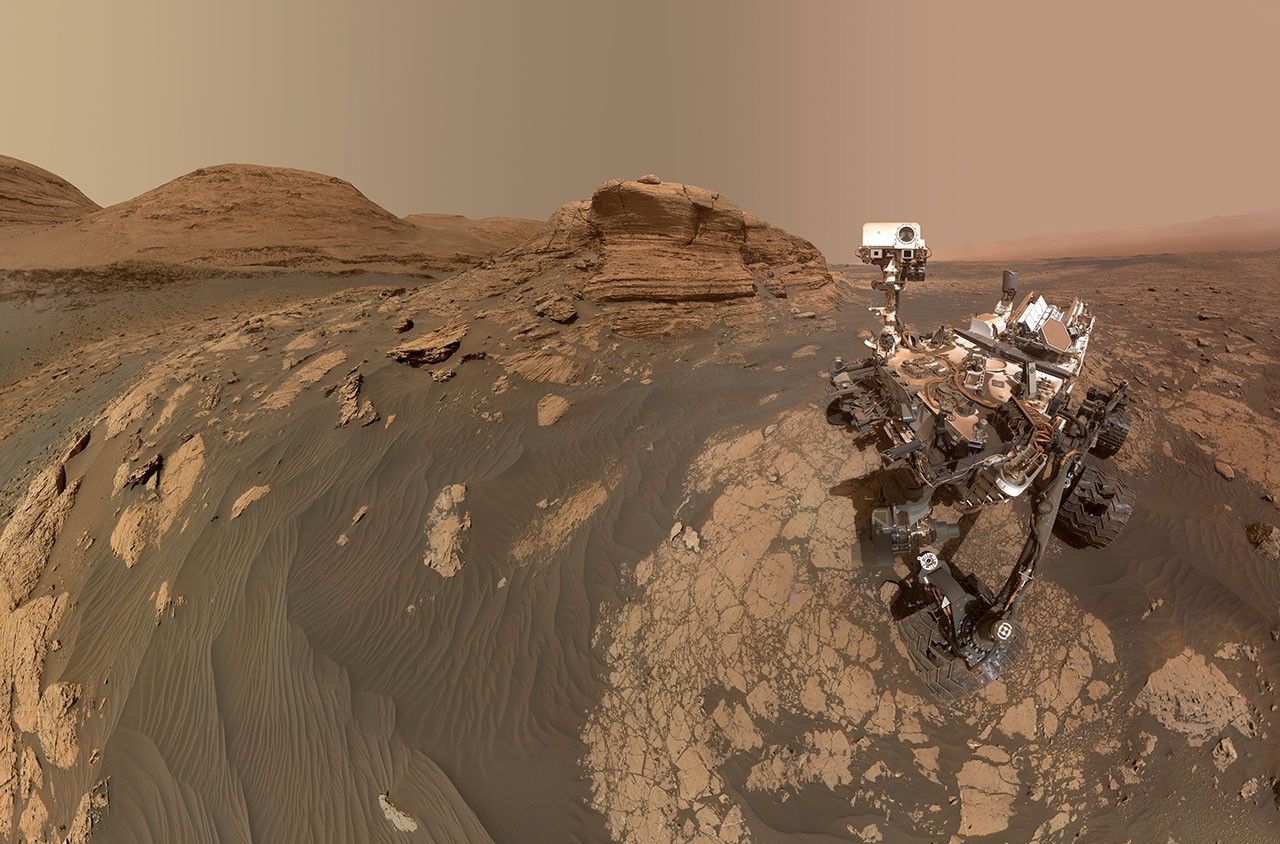
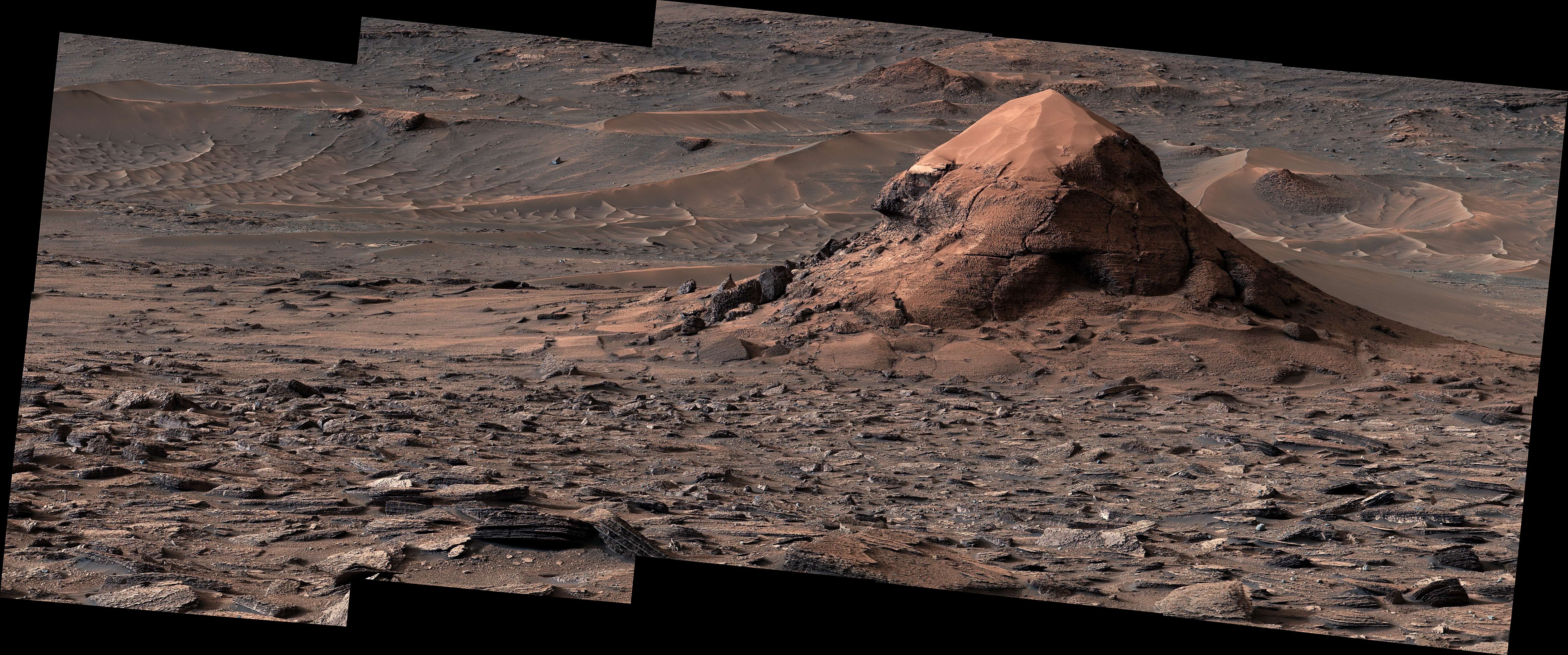
A layered, rocky mound topped with smooth sand sits amid a vast, rocky expanse on Mars, illustrating the complex geological history being studied by NASA's Curiosity rover.
PIA26730
Credits:
NASA/JPL-Caltech/MSSS

Description

NASA’s Curiosity Mars rover captured this sand-capped butte, nicknamed “Miraflores,” estimated to be about 20 feet (6 meters) tall, with its Mast Camera, or Mastcam, on June 11, 2026, the 4,923rd Martian day, or sol, of the mission. The butte was left behind as surrounding rock eroded away over time, deepening the broad valley Curiosity is climbing through. 

The surrounding area includes an expanse of terrain covered in surface features called polygons.

The panorama is made up of 11 individual images that were sent to Earth and stitched together. The color has been adjusted to match lighting conditions as the human eye would see them on Earth.

Curiosity was built by NASA’s Jet Propulsion Laboratory, which is managed by Caltech in Pasadena, California. JPL leads the mission on behalf of NASA’s Science Mission Directorate in Washington as part of NASA’s Mars Exploration Program portfolio. Malin Space Science Systems in San Diego built and operates Mastcam.

To learn more about Curiosity, visit:

science.nasa.gov/mission/msl-curiosity

Powered by WPeMatico

Get The Details…

NASA’s Curiosity Discovers a Field of Martian Polygons

NASA’s Curiosity Discovers a Field of Martian Polygons

2 Min Read

NASA’s Curiosity Discovers a Field of Martian Polygons

A panoramic view of a sweeping Martian plain covered in patterned fractures leading toward distant hills showcases the terrain explored by NASA's Curiosity rover to investigate the planet's past environment.
PIA26729
Credits:
NASA/JPL-Caltech/MSSS

Description

NASA’s Curiosity Mars rover captured this 360-degree view of an expanse of terrain covered in surface features called polygons on June 19 and 20, 2026, the 4,930th and 4,931st Martian days, or sols, of the mission. The rover has found polygons several times in the past, but never so many in one place. Across the center of this image, the surface is covered by shapes ranging in size from roughly 2 to 4 inches (5 to 10 centimeters) in diameter. The features also surround and wrap around a sand-capped butte nicknamed “Miraflores,” seen at far right in the image.

A panoramic view of a sweeping Martian plain covered in patterned fractures leading toward distant hills showcases the terrain explored by NASA's Curiosity rover to investigate the planet's past environment.
Figure A

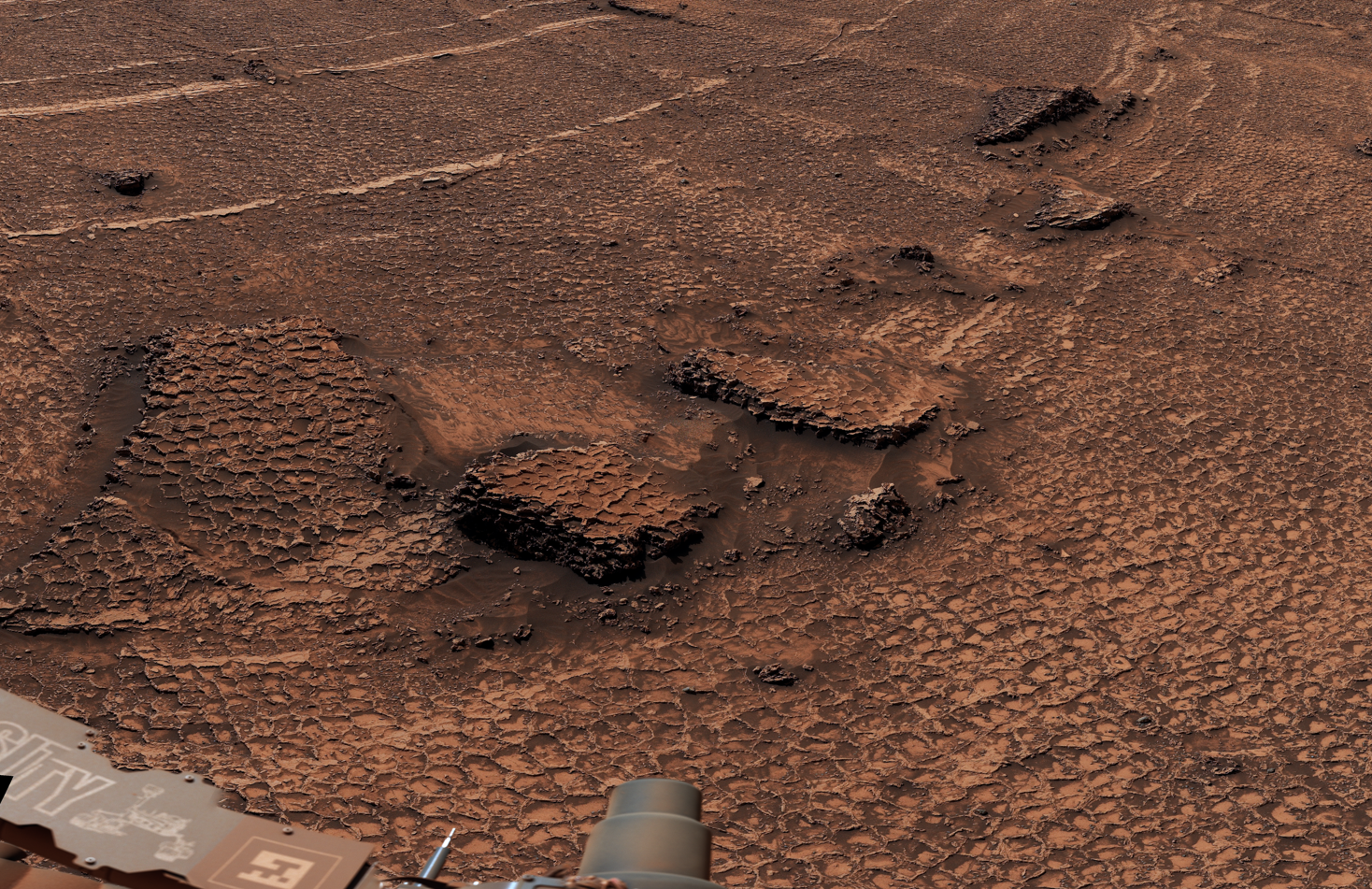
Figure A is a crop from the bottom-center of the panorama highlighting the polygons and their honeycomb-like textures.

Polygonal textures can form from a variety of conditions, including drying out of the surface (like in mud cracks), temperature cycles, compaction after being buried, or shrinkage of the sediment from loss of water or mineral changes. Scientists are measuring characteristics of these polygons to home in on which process formed them.

This panorama was captured by Curiosity’s Mast Camera, or Mastcam, as the rover continued its ascent of the foothills of Mount Sharp, a 3-mile-tall (5-kilometer-tall) mountain that it’s been climbing since 2014. 

The panorama is made up of 340 individual images that were sent to Earth and stitched together. The color has been adjusted to match lighting conditions as the human eye would see them on Earth.

Curiosity was built by NASA’s Jet Propulsion Laboratory, which is managed by Caltech in Pasadena, California. JPL leads the mission on behalf of NASA’s Science Mission Directorate in Washington as part of NASA’s Mars Exploration Program portfolio. Malin Space Science Systems in San Diego built and operates Mastcam.

To learn more about Curiosity, visit:

science.nasa.gov/mission/msl-curiosity

Powered by WPeMatico

Get The Details…

NASA’s Curiosity Mars Rover Discovers Field of Honeycomb Textures

NASA’s Curiosity Mars Rover Discovers Field of Honeycomb Textures

3 min read

Preparations for Next Moonwalk Simulations Underway (and Underwater)

A panoramic view of a sweeping Martian plain covered in patterned fractures leading toward distant hills showcases the terrain explored by NASA's Curiosity rover to investigate the planet's past environment.
NASA’s Curiosity rover discovered an expanse of terrain covered in surface features called polygons. Scientists have never seen so many of these features in one place and are unsure how they formed.
NASA/JPL-Caltech/MSSS

As NASA’s Curiosity rover recently began climbing up a Martian valley nicknamed “Valle Grande,” it sent back images that were a familiar sight to mission scientists: honeycomb-like textures called polygonal fractures, each one about 1.5 to 3 inches (4 to 8 centimeters) across. The mission has spotted small patches of these geometric shapes several times before, but nothing at the scale discovered in Valle Grande.

In a 360-degree panorama that the rover captured on June 19 and 20, the 4,930th and 4,931st Martian days, or sols, of the mission, the polygonal shapes spread in all directions for as far as the rover can see. They even wrap around the sides of a nearby butte nicknamed “Miraflores,” which stands 20 feet (6 meters) tall and is topped with a thick cap of sand.

“We’ve seen a lot of fascinating landscapes through Curiosity’s eyes, but this sea of polygons took our breath away,” said the mission’s project scientist, Ashwin Vasavada of NASA’s Jet Propulsion Laboratory in Southern California. “We measured their shapes and chemistry carefully and are hopeful there are clues in the data as to how these features formed.”

NASA’s Curiosity rover captures a rocky, reddish Martian landscape filled with polygonal fractures.
A close-up of the polygon fractures discovered by NASA’s Curiosity Mars rover highlights their honeycomb-like textures
NASA/JPL-Caltech/MSSS

Some of the polygons that the mission has spotted in the past clearly formed as mud cracks, though a variety of processes can contribute to their honeycomb textures, including cycles of warm and cold temperatures or compression that squeezed water out of the sediment when the surface was buried.

These newly discovered polygons are among the many surprises Curiosity has trundled across since landing on Mars 14 years ago, on Aug. 5, 2012. Besides sulfur crystals, shiny meteorites, and other interesting geologic features, the rover has made major discoveries about the ancient Martian environment — most importantly, that it had the water, chemistry, and nutrients to support microbial life.

Billions of years ago, lakes and streams dappled the lower foothills of Mount Sharp, a 3-mile-tall (5-kilometer-tall) mountain that Curiosity has been ascending since 2014. The rover has previously uncovered chemistry left over from Mars’ watery history, including carbon-based molecules believed to be precursors to RNA and DNA, two nucleic acids that carry genetic information. Scientists have no way of knowing whether these organic molecules were created by biologic or geologic processes — either path is possible — but their discovery reconfirmed that ancient Mars had the right chemistry to support life.

NASA’s Curiosity Mars rover captured this sand-capped butte, nicknamed “Miraflores,” estimated to be about 20 feet (6 meters) tall, on June 11, 2026. The surrounding area includes an expanse of terrain covered in surface features called polygons.
NASA/JPL-Caltech/MSSS

Managed by Caltech in Pasadena, JPL built Curiosity and leads the mission on behalf of NASA’s Science Mission Directorate in Washington as part of the agency’s Mars Exploration Program portfolio.

To learn more about Curiosity, visit:

https://science.nasa.gov/mission/msl-curiosity

News Media Contacts

Andrew Good
Jet Propulsion Laboratory, Pasadena, Calif.
818-393-2433
andrew.c.good@jpl.nasa.gov


Karen Fox / Alana Johnson
NASA Headquarters, Washington
240-285-5155 / 202-672-4780
karen.c.fox@nasa.gov / alana.r.johnson@nasa.gov

2026-051

Powered by WPeMatico

Get The Details…
Stephen Carney

APOD: 2026 July 29 – Psyche Receives Gravity Assist from Mars

APOD: 2026 July 29 – Psyche Receives Gravity Assist from Mars

APOD

Astronomy Picture of the Day

Discover the cosmos! Each day a different image or photograph of our fascinating universe is featured, along with a brief explanation written by a professional astronomer.

Psyche Receives Gravity Assist from Mars

Explanation: Solar System bodies make deep space exploration more fuel efficient! Today’s video shows the Psyche spacecraft gaining speed and changing its trajectory with minimal fuel spent due to a gravity assist from Mars in May 2026. Mars has an average orbital speed of almost 87,000 km/h (54,000 mph) around the Sun. Its orbital motion and its gravity allowed Mars to pull Psyche along with it, increasing the spacecraft’s speed. Gravity assists have been used since 1959’s Luna 3 mission to allow for spacecraft (the Voyagers, Cassini) to reach farther than they could with fuel alone. This assist helped the Psyche spacecraft on its journey to the Psyche asteroid, which it will reach in 2029. While passing Mars, the spacecraft tested instruments that will analyze the asteroid’s composition and magnetic field. This is the first mission to an asteroid thought to be largely made of metal, an essential building block for planets, rather than rock or ice.

Find dark skies and look up this August to witness the Perseids meteor shower uninhibited by the Moon!

Tomorrow’s picture: a red Sun

Date July 29, 2026
Credit NASA/JPL-Caltech/ASU/True Story Films
Authors & editors: Robert Nemiroff, Jerry Bonnell, Cecilia Chirenti, Keighley Rockcliffe
A service of: ASD at NASA / GSFC,
NASA Science Activation & Michigan Tech. U.

Powered by WPeMatico

Get The Details…

Understanding How Martian Auroras Are Made

Understanding How Martian Auroras Are Made

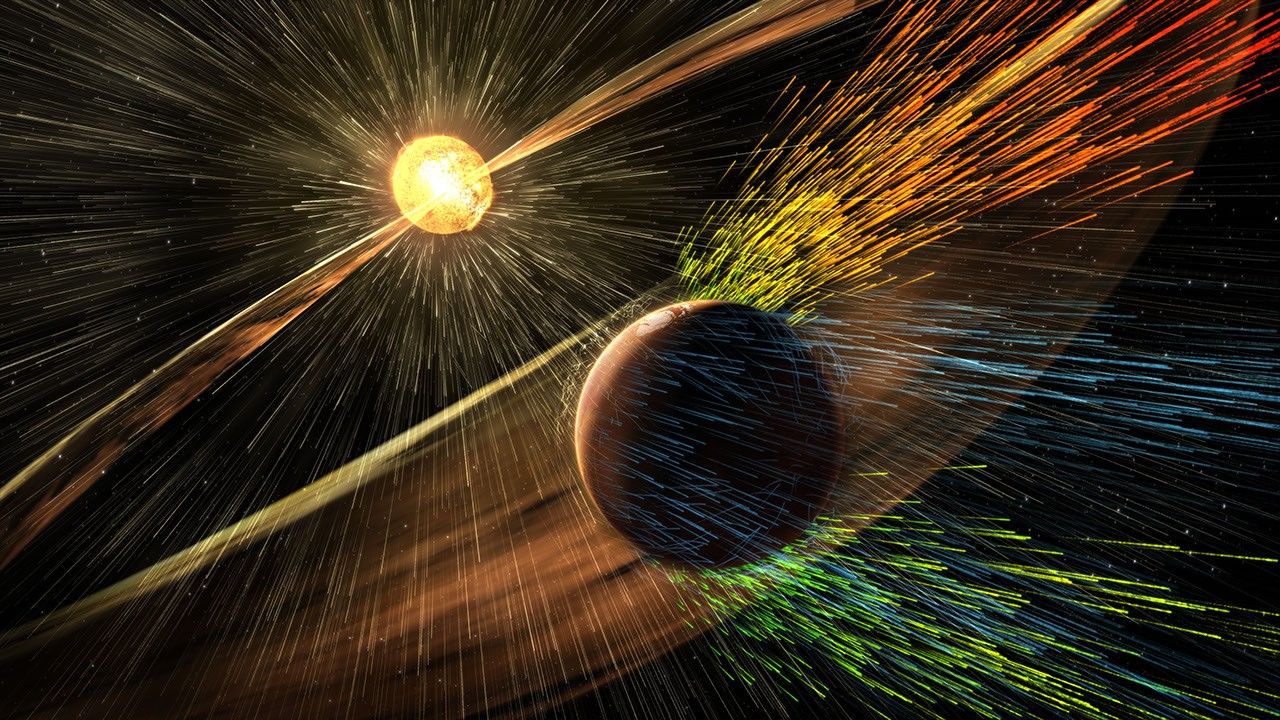
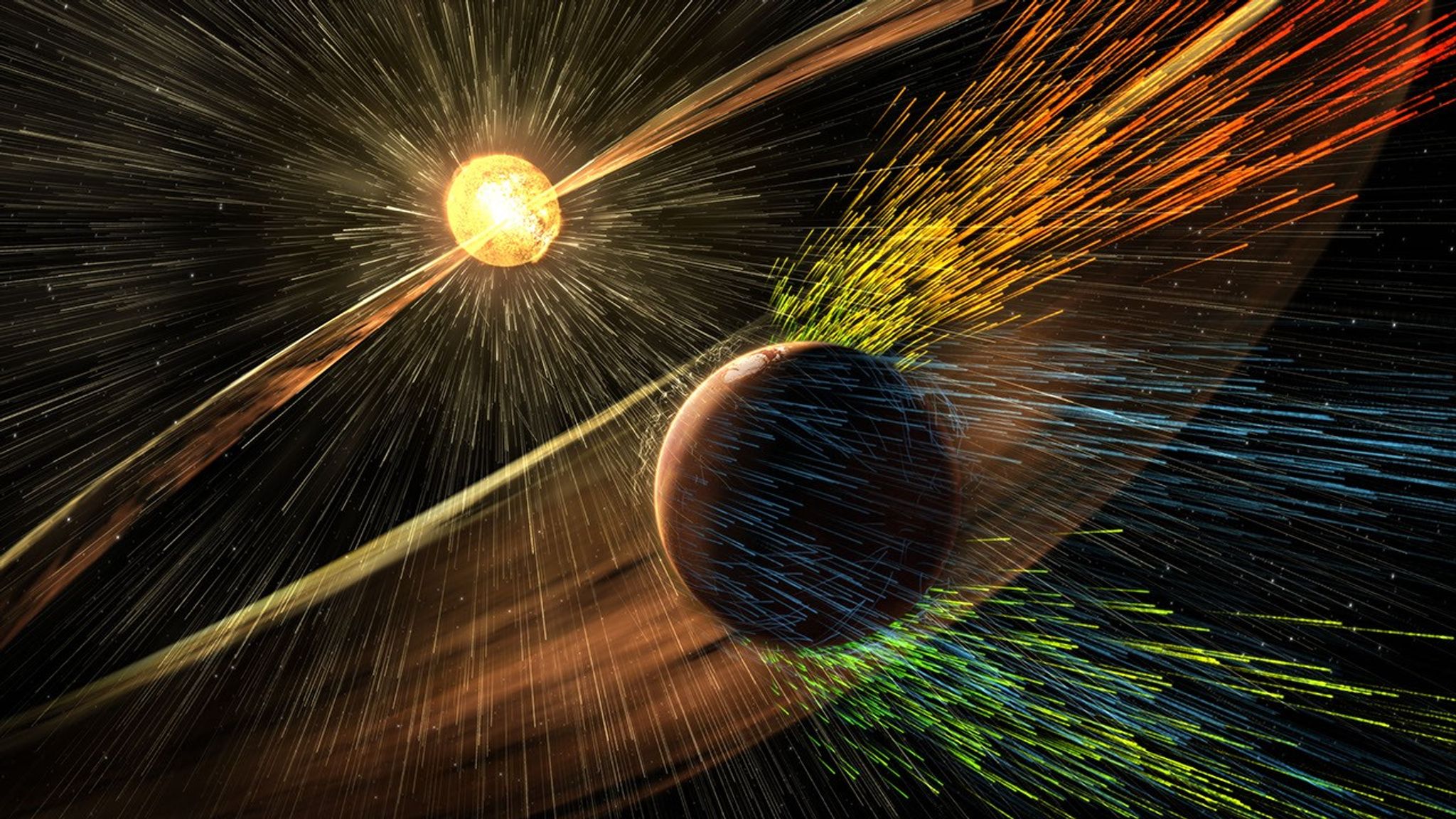
In this illustration, yellow charged particles from the Sun strip off rainbow-colored charged particles from Mars (in the foreground). The Martian particles stream away from the planet, toward the viewer and off to the right of the image. The Sun illuminates the far side of Mars.
NASA

This July 23, 2026, illustration depicts charged particles from a solar storm stripping away charged particles of Mars’ atmosphere, one of the processes of Martian atmosphere loss studied by NASA’s MAVEN (Mars Atmosphere and Volatile Evolution) mission. NASA MAVEN mission scientists have found that certain types of auroras on Mars form in a similar way to Earth-based auroras.

Read more about this discovery.

Image credit: NASA

Powered by WPeMatico

Get The Details…
HQ Web Team