Hubble Spots a Spiral in the Celestial River

Hubble Spots a Spiral in the Celestial River

2 min read

Hubble Spots a Spiral in the Celestial River

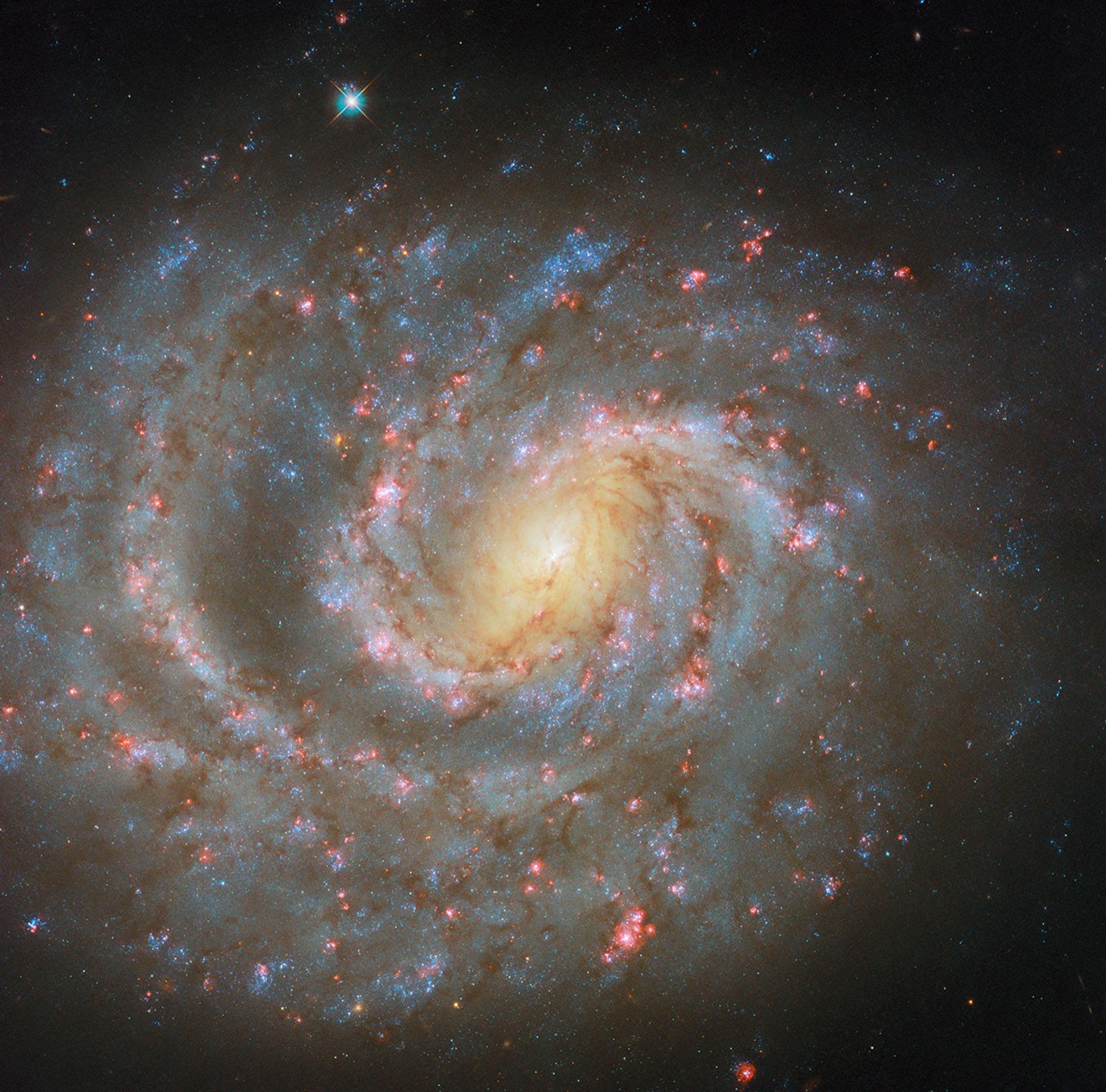
A spiral galaxy filling the view. Its disk holds many bright red spots where stars are forming, dark reddish threads of dust that obscure light, and bluish glowing areas that hold concentrations of older stars. It has a large, glowing yellow oval area at the center, from which two spiral arms wind through the galaxy’s disk. One side of the disk appears rounded (bottom of the image) while the opposite side appears somewhat squared-off (top of the image).
This NASA/ESA Hubble Space Telescope image features the spiral galaxy NGC 1637.
ESA/Hubble & NASA, D. Thilker

The subject of this NASA/ESA Hubble Space Telescope image is NGC 1637, a spiral galaxy located 38 million light-years from Earth in the constellation Eridanus, the River.

This image comes from an observing program dedicated to studying star formation in nearby galaxies. Stars form in cold, dusty gas clouds that collapse under their own gravity. As young stars grow, they heat their nurseries through starlight, winds, and powerful outflows. Together, these factors play a role in controlling the rate at which future generations of stars form.

NGC 1637 holds evidence of star formation scattered throughout its disk, if you know where to look. The galaxy’s spiral arms have pockets of pink clouds, many with bright blue stars. The pinkish color comes from hydrogen atoms excited by ultraviolet light from young, massive stars forming within the clouds. This contrasts with the warm yellow glow of the galaxy’s center, which is home to a densely packed collection of older, redder stars.

The stars that set their cloudy birthplaces aglow are comparatively short-lived, and many of these stars will explode as supernovae just a few million years after they’re born. In 1999, NGC 1637 played host to a supernova named SN 1999EM, lauded as the brightest supernova seen that year. When a massive star expires as a supernova, the explosion outshines its entire home galaxy for a short time. While a supernova marks the end of a star’s life, it can also jump start the formation of new stars by compressing nearby clouds of gas, beginning the stellar lifecycle anew.

Explore More

Media Contact:

Claire Andreoli (claire.andreoli@nasa.gov)
NASA’s Goddard Space Flight CenterGreenbelt, MD

Share

Details

Last Updated

Dec 06, 2024

Editor
Andrea Gianopoulos

Powered by WPeMatico

Get The Details…

NASA to Test Technology for X-59’s Unique Shock Wave Measurements

NASA to Test Technology for X-59’s Unique Shock Wave Measurements

3 min read

Preparations for Next Moonwalk Simulations Underway (and Underwater)

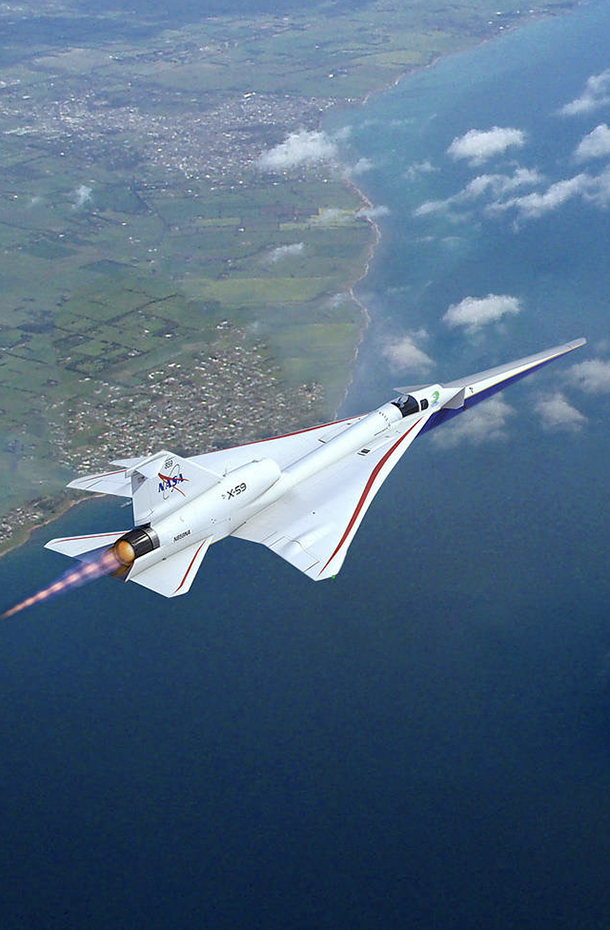
NASA will soon test advancements made on a key tool for measuring the unique “sonic thumps” that its quiet supersonic X-59 research aircraft will make while flying.

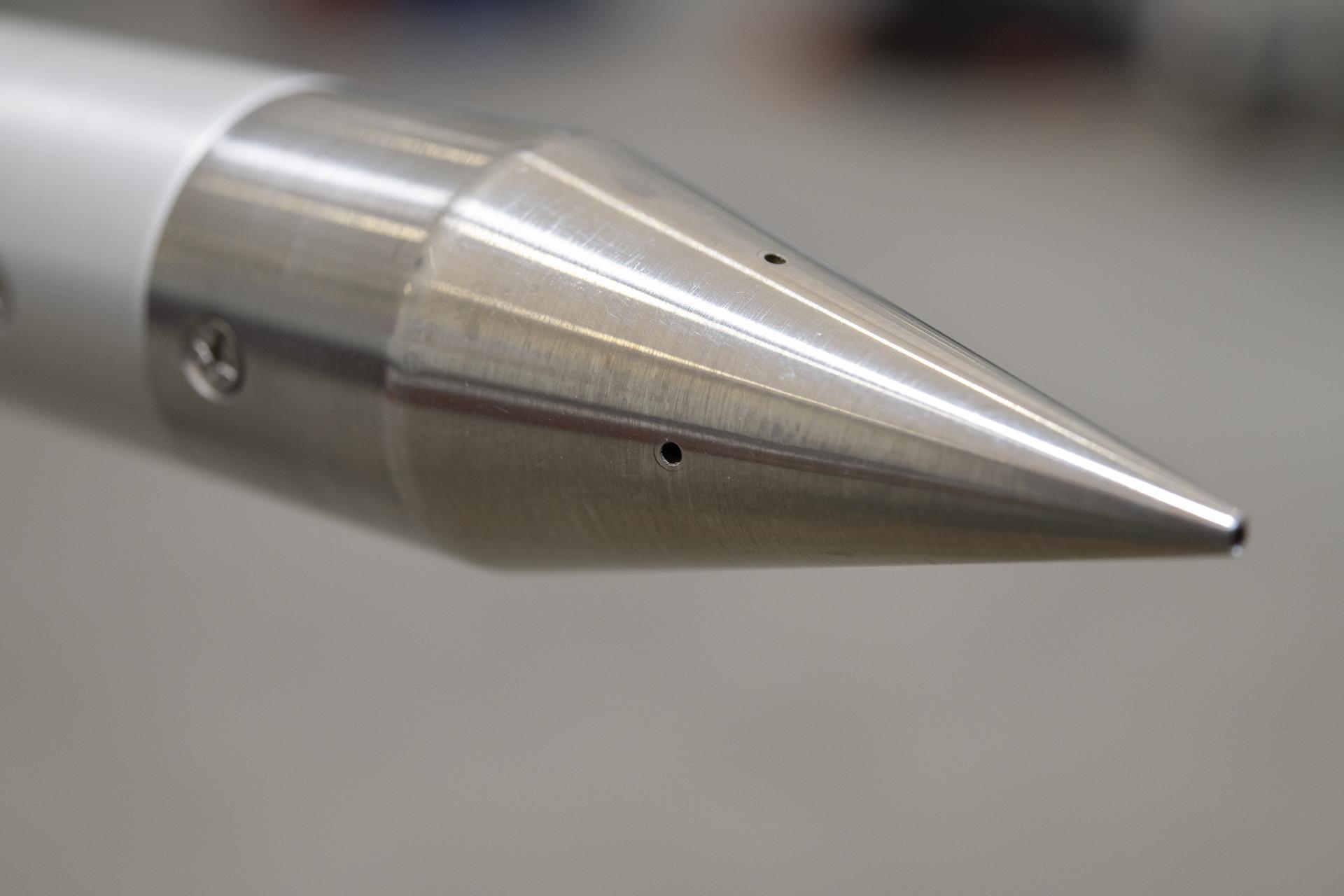
A shock-sensing probe is a cone-shaped air data probe developed with specific features to capture the unique shock waves the X-59 will produce. Researchers at NASA’s Armstrong Flight Research Center in Edwards, California developed two versions of the probe to collect precise pressure data during supersonic flight. One probe is optimized for near-field measurements, capturing shock waves that occur very close to where the X-59 will generate them. The second shock-sensing probe will measure the mid-field, collecting data at altitudes between 5,000 to 20,000 feet below the aircraft.

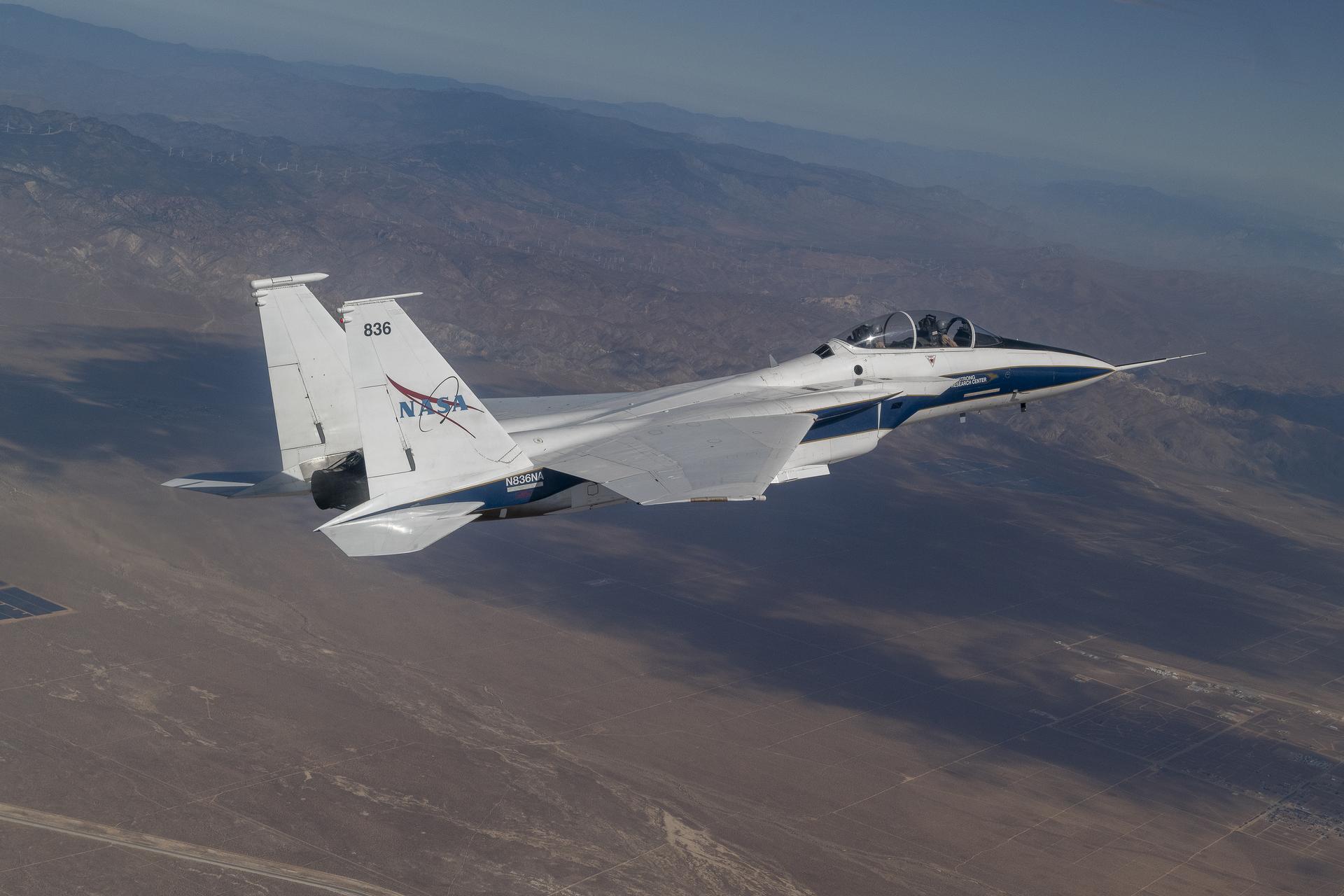
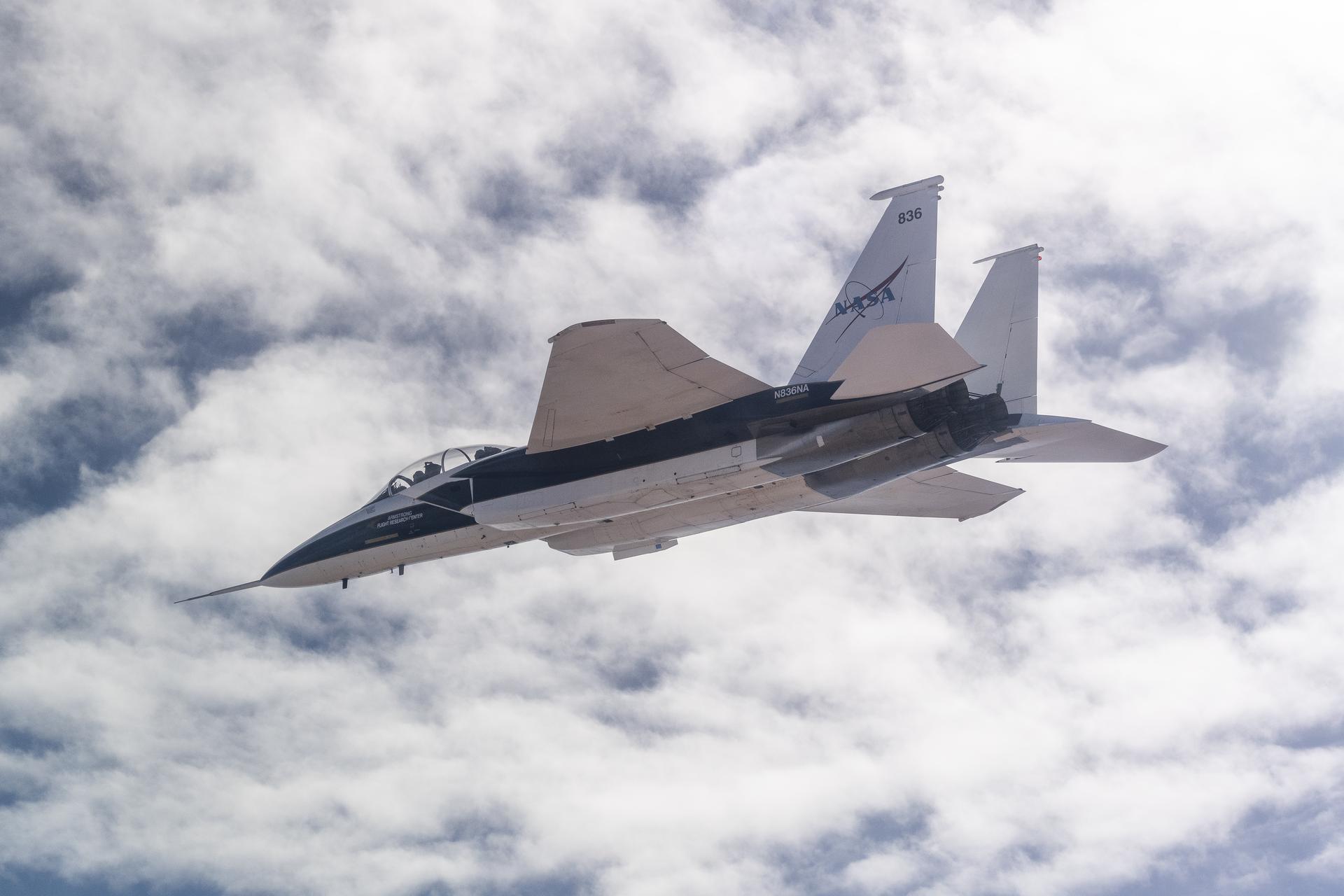
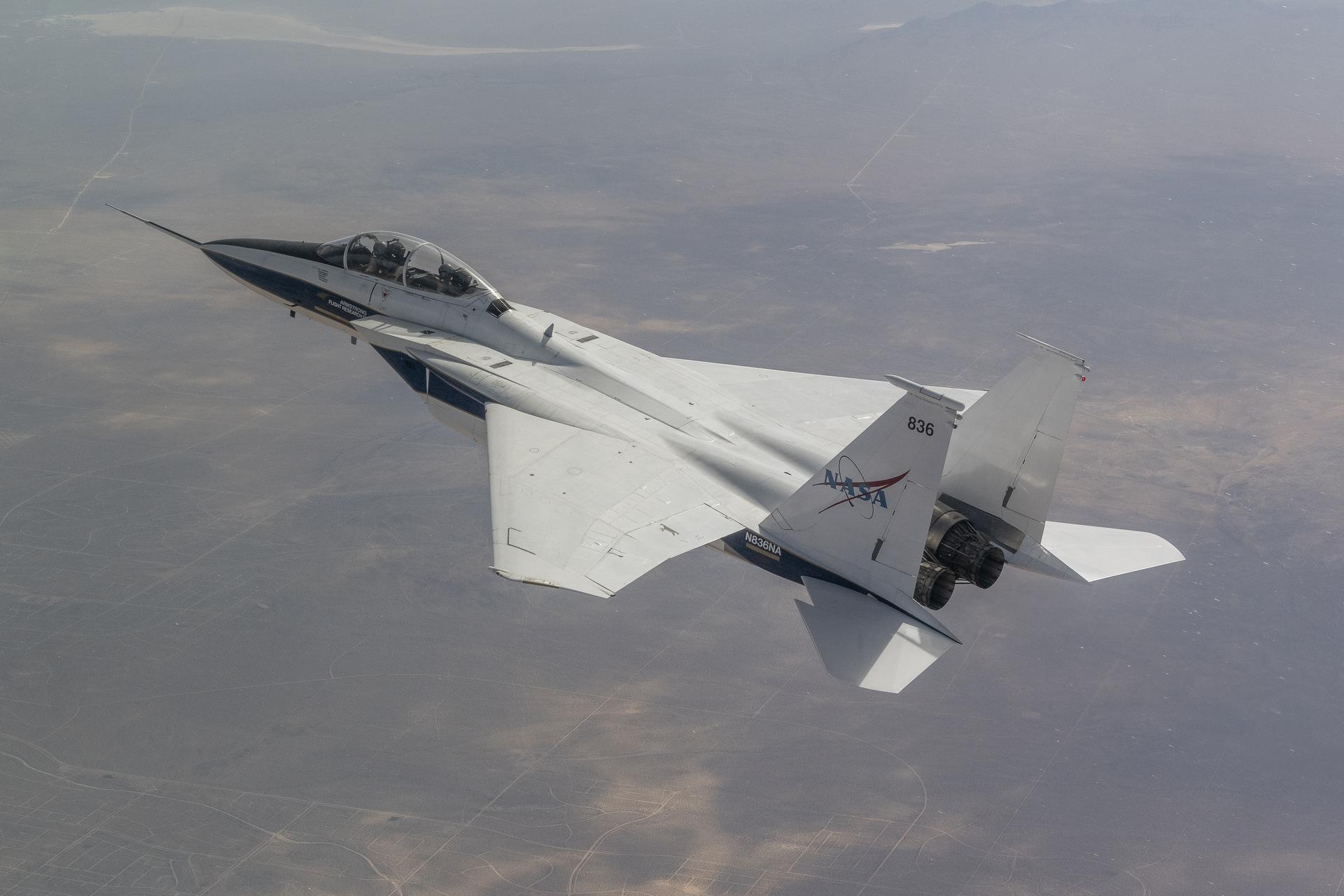
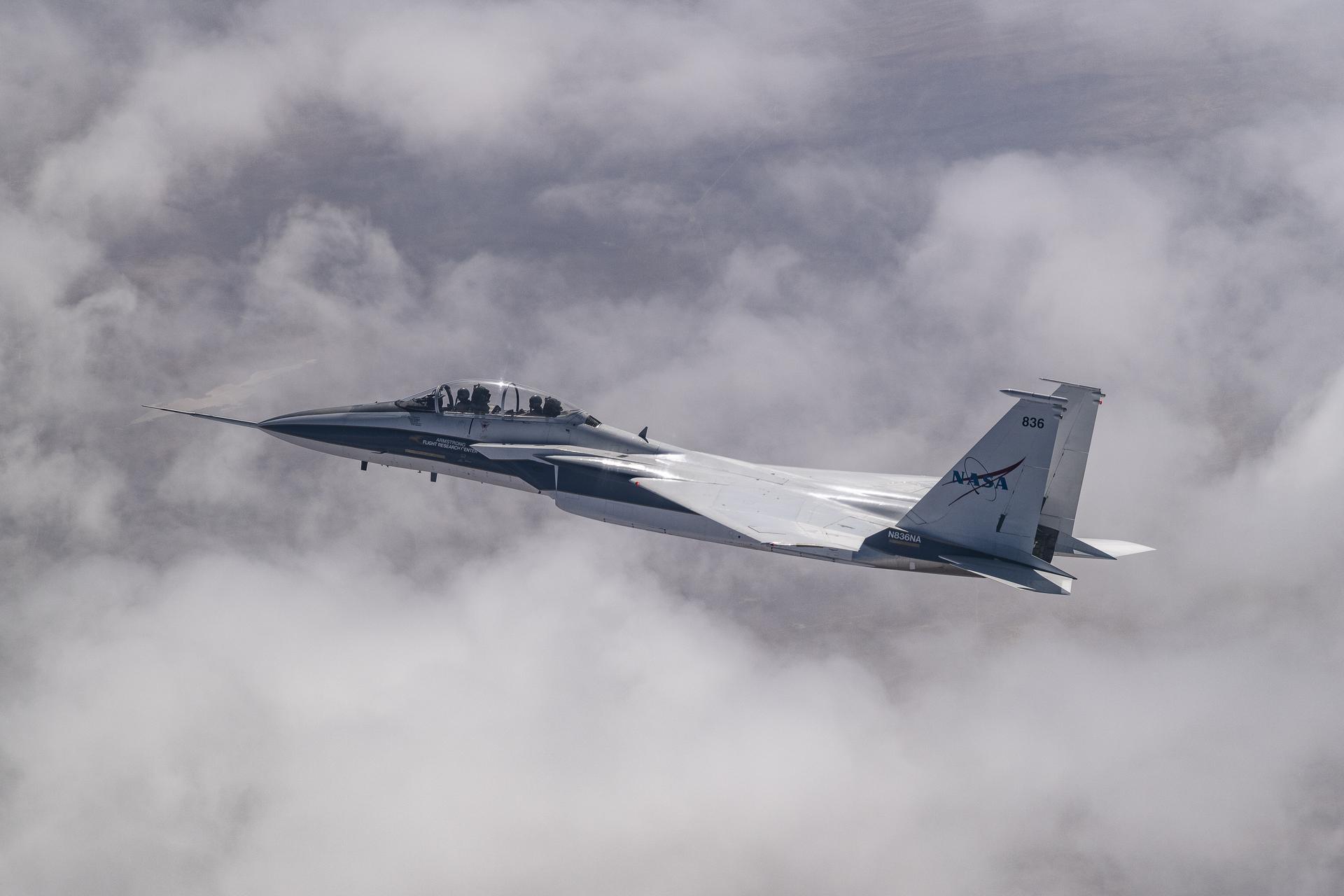
When an aircraft flies supersonic, it generates shockwaves that travel through the surrounding air, producing loud sonic booms. The X-59 is designed to divert those shock waves, reducing the loud sonic booms to quieter sonic thumps. During test flights, an F-15B aircraft with a shock-sensing probe attached to its nose will fly with the X-59. The roughly 6-foot probe will continuously collect thousands of pressure samples per second, capturing air pressure changes as it flies through shock waves. Data from the sensors will be vital for validating computer models that predict the strength of the shock waves produced by the X-59, the centerpiece of NASA’s Quesst mission.

“A shock-sensing probe acts as the truth source, comparing the predicted data with the real-world measurements,” said Mike Frederick, NASA principal investigator for the probe.

For the near-field probe, the F-15B will fly close behind the X-59 at its cruising altitude of approximately 55,000 feet, utilizing a “follow-the-leader” setup allowing researchers to analyze shock waves in real time. The mid-field probe, intended for separate missions, will collect more useful data as the shock waves travel closer to the ground.

The probes’ ability to capture small pressure changes is especially important for the X-59, as its shock waves are expected to be much weaker than those of most supersonic aircraft. By comparing the probes’ data to predictions from advanced computer models, researchers can better evaluate their accuracy.

“The probes have five pressure ports, one at the tip and four around the cone,” said Frederick. “These ports measure static pressure changes as the aircraft flies through shock waves, helping us understand the shock characteristics of a particular aircraft.” The ports combine their measurements to calculate the local pressure, speed, and direction of airflow.

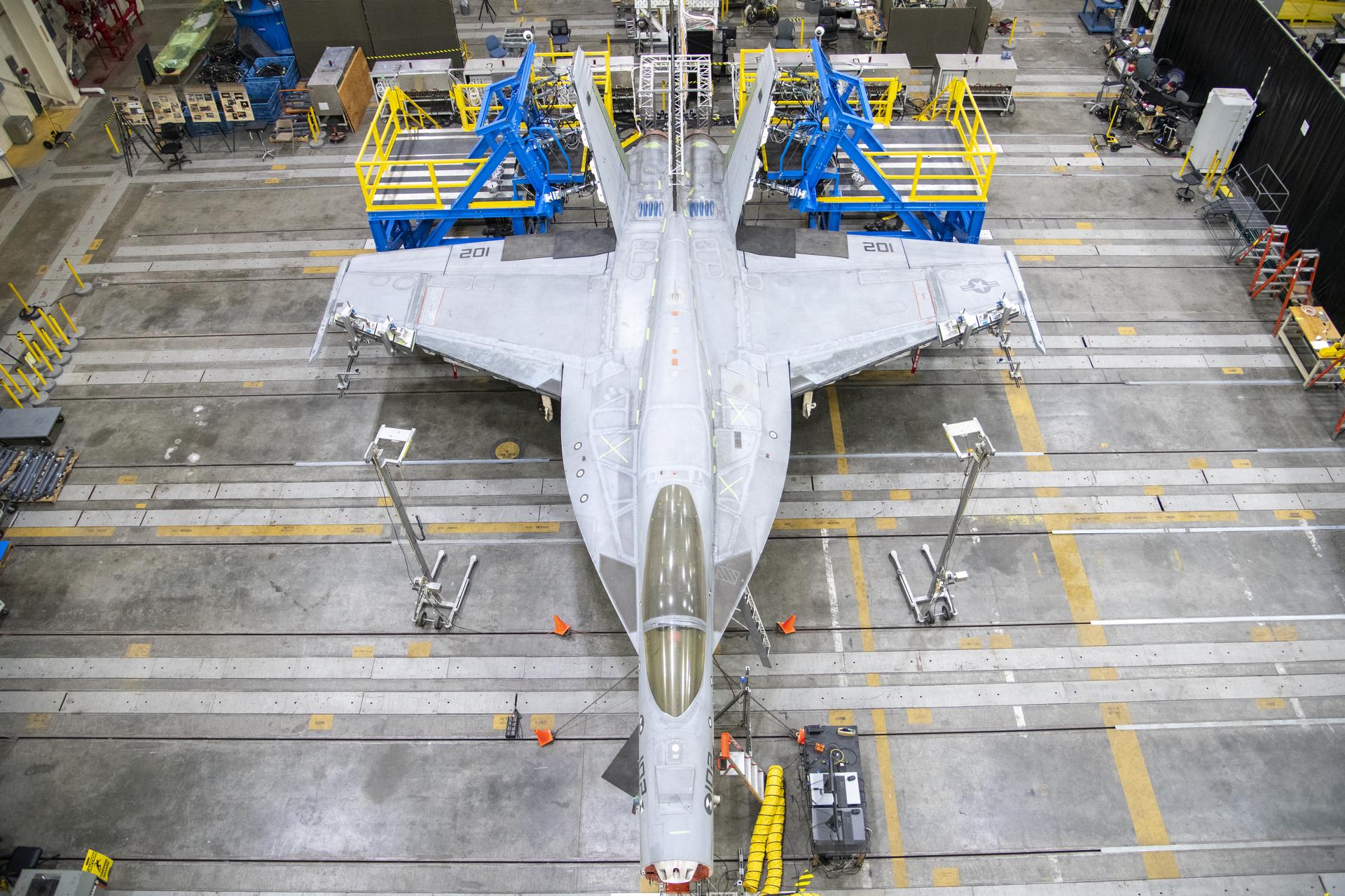
Researchers will soon evaluate upgrades to the near-field shock-sensing probe through test flights, where the probe, mounted on one F-15B, will collect data by chasing a second F-15 during supersonic flight. The upgrades include having the probe’s pressure transducers – devices that measure the air pressure on the cone – just 5 inches from its ports. Previous designs placed those transducers nearly 12 feet away, delaying recording time and distorting measurements.

Temperature sensitivity on previous designs also presented a challenge, causing fluctuations in accuracy with changing conditions. To solve this, the team designed a heating system to maintain the pressure transducers at a consistent temperature during flight.

“The probe will meet the resolution and accuracy requirements from the Quesst mission,” Frederick said. “This project shows how NASA can take existing technology and adapt it to solve new challenges.”

Powered by WPeMatico

Get The Details…
Dede Dinius

NASA Invites Media to Administrator Flight in Electra Hybrid-Electric Aircraft

NASA Invites Media to Administrator Flight in Electra Hybrid-Electric Aircraft

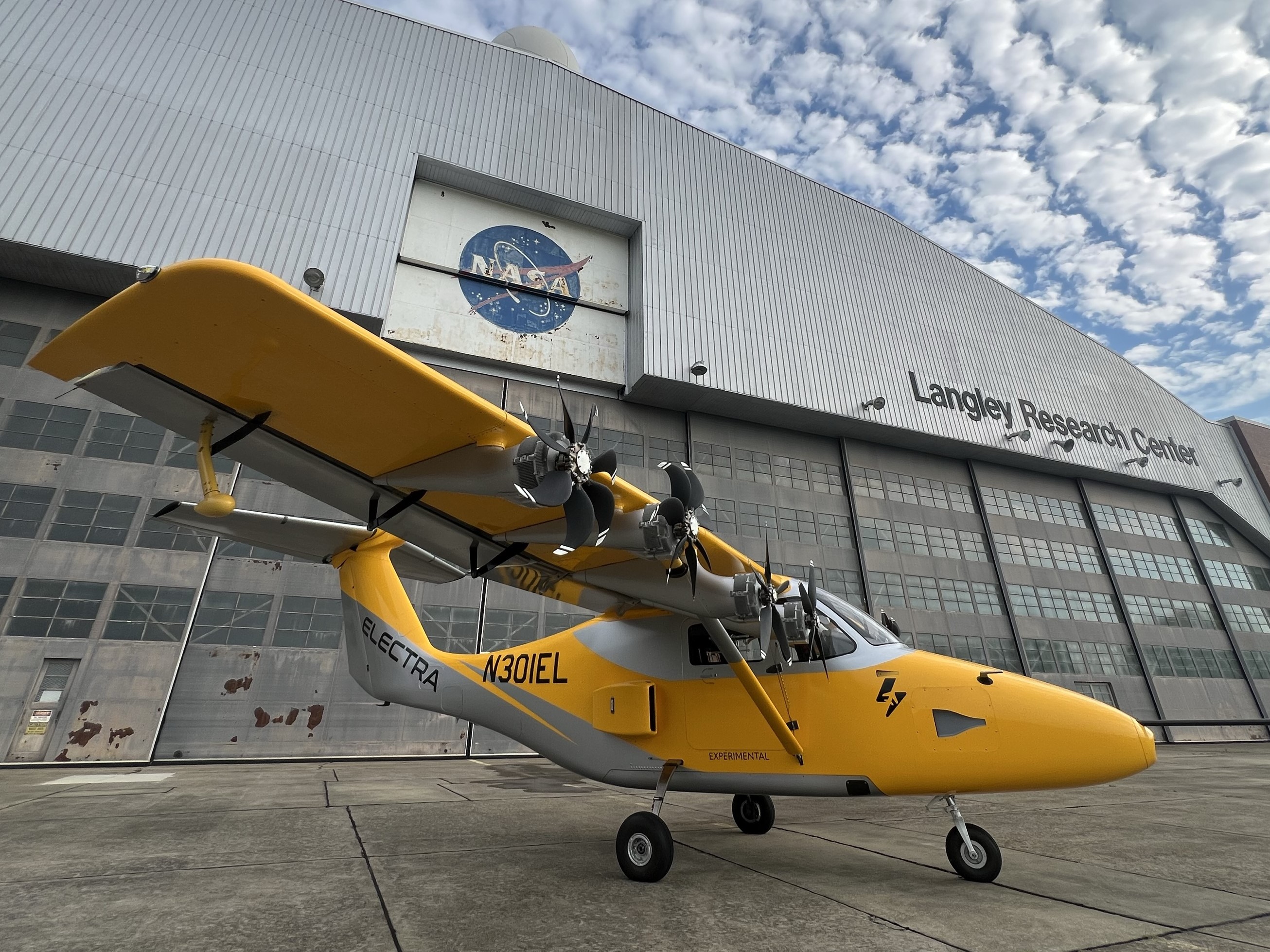
Electra’s EL2 Goldfinch experimental prototype aircraft reference, photographed outside of NASA s Langley Research Center in Hampton, Virginia.
Credit: Electra

NASA Administrator Bill Nelson will fly in aircraft manufacturer Electra’s EL2 Goldfinch experimental prototype aircraft on Sunday, Dec. 8. Members of the media are invited to speak with Nelson and Electra leaders just prior to the flight at 11:45 a.m. EST at Manassas Regional Airport in Manassas, Virginia.

Electra designed the experimental aircraft with the goals of reducing emissions and noise and connecting new locations for regional air travel, including underserved communities.

Media will be able to view and film the flight, which is set to feature ultra-short takeoffs and landings with as few as 150 feet of ground roll. The flight also is set to include a battery-only landing. Media interested in participating must RSVP to Rob Margetta at robert.j.margetta@nasa.gov.

NASA’s aeronautics research works to develop new generations of sustainable aviation technologies that will create new options for both U.S. passengers and cargo. Agency-supported research aims to provide industry providers like Electra, and others, data that can help inform the designs of innovative, greener aircraft with reduced operating costs. NASA investments have included projects that explore electrified aircraft technologies, and work that helped refine the electric short-takeoff and landing concept.

The agency’s work with private sector aviation providers helps NASA in its effort to bring sustainable solutions to the American public. In November, NASA selected Electra as one of five recipients of its Advanced Aircraft Concepts for Environmental Sustainability 2050 awards, through which they will develop design studies and explore key technologies to push the boundaries of possibility for next-generation sustainable commercial aircraft. These new studies will help the agency identify and select promising aircraft concepts and technologies for further investigations.

https://www.nasa.gov/aeronautics

-end-

Meira Bernstein / Rob Margetta
Headquarters, Washington
202-358-1600
meira.b.bernstein@nasa.gov / robert.j.margetta@nasa.gov

Powered by WPeMatico

Get The Details…
Tiernan P. Doyle

10 Years Ago: Orion Flies its First Mission

10 Years Ago: Orion Flies its First Mission

A new American human-rated spacecraft made its first foray into space on Dec. 5, 2014. Under contract to NASA, Lockheed Martin builds Orion as the vehicle to take American astronauts back to the Moon and eventually beyond. Orion’s overall shape harkens back to the Apollo Command and Service Modules, but using today’s technology is a larger and far more capable vehicle for NASA’s Artemis Program.

Orion’s first mission, called Engineering Flight Test-1 (EFT-1), used a Delta-IV Heavy booster, at the time the most powerful operational rocket. The 4.5-hour mission demonstrated Orion’s space-worthiness, tested the spacecraft’s heat shield during reentry into the Earth’s atmosphere, and proved the capsule’s recovery systems. Although the EFT-1 mission didn’t include a crew, the Orion capsule flew higher and faster than any human-rated spacecraft in more than 40 years.

A spacecraft is launching from a launch pad. Fire and smoke billows around the rocket as it lifts into the air.
The United Launch Alliance Delta IV Heavy rocket with NASA’s Orion spacecraft mounted atop, lifts off from Cape Canaveral Air Force Station’s Space Launch Complex 37B in Florida.
NASA/Bill Ingalls

At 7:05 a.m. EST on Dec. 5, 2014, the three-core first stage of the Delta-IV Heavy rocket ignited, lifting the Orion spacecraft off from Launch Complex 37B at Cape Canaveral Air Force, now Space Force, Station (CCAFS) in Florida to begin the EFT-1 mission. Three minutes and fifty-eight seconds after liftoff, the two side boosters separated as the center core continued firing for another 93 seconds. The second stage ignited thirteen seconds after separation to begin the first of three planned burns. During the first burn, the Service Module’s protective fairing separated, followed by the Launch Abort System. Lasting about 11 and a half minutes, this first burn of the second stage placed the spacecraft into a preliminary 115-by-552-mile parking orbit. While completing one revolution around the Earth, controllers in Mission Control at NASA’s Johnson Space Center in Houston, led by Flight Director Michael L. Sarafin, verified the functioning of the spacecraft’s systems. The second stage ignited a second time, firing for 4 minutes and 42 seconds to raise Orion’s apogee or high point above the Earth to 3,600 miles. During the coast to apogee, Orion remained attached to the second stage and completed its first crossing through the inner Van Allen radiation belt.

A group of employees sit around individual monitors in an office. The office has a large screen on the far wall with images projected on it. The screen shows a map of the earth. The employees are all focused.
Mission Control at NASA’s Johnson Space Center in Houston, Texas during the EFT-1 mission.
NASA/Mark Sowa

Three hours and five minutes after launch, Orion reached its apogee and began its descent back toward Earth, separating from the second stage about 18 minutes later. The second stage conducted a one-minute disposal burn to ensure it didn’t interfere with the spacecraft’s trajectory. During the passage back through the Van Allen belt, Orion fired its thrusters for 10 seconds to adjust its course for reentry. At an altitude of 400,000 feet, the spacecraft encountered the first tendrils of the Earth’s atmosphere at a point called Entry Interface, traveling at 20,000 miles per hour (mph). A buildup of ionized gases caused by the reentry heating resulted in a communications blackout with Orion for about two and a half minutes. The spacecraft experienced maximum heating of about 4,000 degrees Fahrenheit, proving the worthiness of the heat shield. After release of Orion’s forward bay cover, two drogue parachutes deployed to slow and stabilize the spacecraft. Next followed deployment of the three main parachutes that slowed the spacecraft to 20 mph. Splashdown occurred 4 hours and 24 minutes after launch about 600 miles southwest of San Diego, California. A video of the Orion EFT-1 mission can be viewed here.

A white spacecraft in the shape of a capsule is hanging from two large parachutes that are red and white in color. The spacecraft is about to splash into the blue ocean.
Crew module splashing down during EFT-1 in the Pacific ocean.
NASA

Standing by to recover the Orion capsule, U.S. Navy Divers assigned to Explosive Ordnance Disposal Mobile Unit 11 and Fleet Combat Camera Pacific and crew members from amphibious transport dock U.S.S. Anchorage (LPD-23) stepped into action, first placing a flotation collar around the spacecraft. After securing a tow line to the capsule, the sailors towed it aboard the amphibious well deck of Anchorage, which set sail for Naval Base San Diego arriving there on Dec 8. Engineers from NASA and Lockheed Martin conducted a preliminary inspection of the spacecraft during the cruise to San Diego and found that it survived its trip into space in excellent condition.

People in a high-speed boat are approaching a grey spacecraft shaped like a capsule that is on the water. The capsule has an American flag on it and inflated orange balloons on the top. Two other smaller boats are behind the first boat on standby. The boats are there to help the crew in the grey capsule exit the spacecraft.
U.S. Navy divers approach the Orion capsule during recovery operations.
U.S. Navy

The Orion EFT-1 mission met all its objectives and received many accolades. “Today was a great day for America,” said Flight Director Sarafin from his console at Mission Control. “It is hard to have a better day than today,” said Mark S. Geyer, Orion program manager. “We’re already working on the next capsule,” said W. Michael “Mike” Hawes, Lockheed Martin’s Orion program manager, adding, “We’ll learn a tremendous amount from what we did today.” NASA Associate Administrator for Human Exploration and Operations William H. Gerstenmaier praised all personnel involved with the EFT-1 mission, “What a tremendous team effort.” NASA Administrator Charles F. Bolden summarized his thoughts about the mission, “Today’s flight test of Orion is a huge step for NASA and a really critical part of our work to pioneer deep space.”

A group of people are standing around the weathered Orion capsule sitting on top of a white structure in a large hangar. A wide opening is at the mouth of the hangar where the group of people are standing.
Former NASA Administrator Charles F. Bolden inspects Orion EFT-1 capsule at NASA’s Kennedy Space Center in Florida.
NASA

After its arrival at Naval Base San Diego, workers placed the Orion capsule aboard a truck that delivered it to NASA’s Kennedy Space Center (KSC) in Florida on Dec. 18. After engineers conducted a thorough inspection of the spacecraft at KSC, workers trucked it to the Lockheed Martin facility in Littleton, Colorado, where it arrived on Sept. 1, 2015. Engineers completed final inspections and decontamination of the vehicle. The KSC Visitor Complex has the capsule on display.

The white Orion capsule with the red NASA logo floats in space against a black background. The Moon and Earth are in the background to the right of the capsule. The Earth is smaller than the Moon. The Moon sits to the left of the Earth.
The Orion capsule during the Artemis I mission, with the Moon and Earth in the background.
NASA

The next time an Orion spacecraft flew in space during the Artemis I mission, the Space Launch System (SLS) carried it into orbit after launch from KSC’s Launch Complex 39B. The thunderous night launch took place on Nov. 16, 2022. The first in a series of increasingly complex missions, Artemis I provided a foundation for human deep space exploration and demonstrated our commitment and capability to extend human existence to the Moon and beyond. The uncrewed Orion spacecraft spent 25.5 days in space, including 6 days in a retrograde orbit around the Moon, concluding with a splashdown in the Pacific Ocean on Dec. 11, exactly 50 years after the Apollo 17 Moon landing.

Four crew members in blue jumpsuits are standing next to each other in front of the Orion capsule.
The Artemis II crew poses in front of the Orion capsule at NASA’s Kennedy Space Center in Florida.
NASA/Kim Shiflett

On April 3, 2023, NASA named the four-person crew for the Artemis II mission, the first flight to take humans beyond low Earth orbit since Apollo 17 in December 1972. The crew includes NASA astronauts G. Reid Wiseman as commander, Victor J. Glover as pilot, and Christina H. Koch as a mission specialist as well as Canadian Space Agency astronaut Jeremy R. Hansen as the other mission specialist. The four will take an Orion spacecraft on a 10-day journey around the Moon to human rate the spacecraft and SLS.

Interested in learning more about the Artemis Program? Go to https://www.nasa.gov/humans-in-space/artemis/

Powered by WPeMatico

Get The Details…
Heather Kinney

Space Station Trajectory Data

Space Station Trajectory Data

The long exposure photograph taken by NASA astronaut Matthew Dominick shows star trails, streaks of city lights, and two Roscosmos crew ships, the Soyuz MS-26 docked to the Rassvet module (foreground) and the Soyuz MS-25 (background) docked to the Prichal docking module, as the International Space Station orbited 265 miles above central China.
iss071e650763 (Sept. 14, 2024) — The long exposure photograph taken by NASA astronaut Matthew Dominick shows star trails, streaks of city lights, and two Roscosmos crew ships, the Soyuz MS-26 docked to the Rassvet module (foreground) and the Soyuz MS-25 (background) docked to the Prichal docking module, as the International Space Station orbited 265 miles above central China.
NASA

Space Station trajectory data is now available to the public!

This data, called an ephemeris, is generated by the ISS Trajectory Operations and Planning Officer (TOPO) flight controllers in the Mission Control Center at NASA’s Johnson Space Center. TOPO keeps track of where the ISS is, where it is going to be, and most importantly makes sure it isn’t at risk of colliding with other objects in space. At ISS’s altitude, a very thin atmosphere is still present. This thin atmosphere creates drag and over time can cause TOPO’s predicted ISS trajectory to accumulate error. Because of this, TOPO updates the predicted trajectory approximately three times a week, so the ISS Flight Control Team has the best trajectory estimate possible. An accurate trajectory is essential for maintaining communications links, planning visiting vehicle rendezvous, and ensuring ISS’s path is clear of any potential collisions.

The links above and below are to the most current posted ephemeris. The ephemeris is in the CCSDS Orbital Ephemeris Message (OEM) standard and is available in .txt and .xml file formats. Each file contains header lines with the ISS mass in kg, drag area in m2, and drag coefficient used in generating the ephemeris. The header also contains lines with details for the first and last ascending nodes within the ephemeris span. Following this is a listing of upcoming ISS translation maneuvers, called “reboosts,” and visiting vehicle launches, arrivals, and departures.

After the header, ISS state vectors in the Mean of J2000 (J2K) reference frame are listed at four-minute intervals spanning a total length of 15 days. During reboosts (translation maneuvers), the state vectors are reported in two-second intervals. Each state vector lists the time in UTC; position X, Y, and Z in km; and velocity X, Y, and Z in km/s.

Orbit Ephemeris Message (OEM)

Users of this data should monitor this page for information regarding any future changes to the file format. Past data postings can be found archived on data.nasa.gov by searching “ISS COORDS.”

NOTE: NASA is providing this information for use by the general public. The OEM data format is supported natively by many commercial spaceflight software applications. Please consult your application’s support documentation for specific details on how to deploy this data.

Powered by WPeMatico

Get The Details…
Mark A. Garcia