University High Triumphs at JPL-Hosted Ocean Sciences Bowl
3 min read
Preparations for Next Moonwalk Simulations Underway (and Underwater)
This team from University High School in Irvine, California, won the 2025 regional Oceans Science Bowl, hosted by NASA’s Jet Propulsion Laboratory. From left: Nethra Iyer, Joanne Chen, Matthew Feng, Avery Hexun, Angelina Yan, and coach David Knight.
NASA/JPL-Caltech
The annual regional event puts students’ knowledge of ocean-related science to the test in a fast-paced academic competition.
A team of students from University High School in Irvine earned first place at a fast-paced regional academic competition focused on ocean science disciplines and hosted by NASA’S Jet Propulsion Laboratory in Southern California.
Eight teams from Los Angeles and Orange counties competed at the March 29 event, dubbed the Los Angeles Surf Bowl. It was the last of about 20 regional competitions held across the U.S. this year in the lead-up to the virtual National Ocean Sciences Bowl finals event in mid-May.
Santa Monica High School earned second place; Francisco Bravo Medical Magnet High School in Los Angeles came in third. With its victory, University repeated its winning performance from last year. The school also won the JPL-hosted regional Science Bowl earlier this month.
Teams from all eight schools that participated in the JPL-hosted 2025 regional Ocean Sciences Bowl pose alongside volunteers and coaches.
NASA/JPL-Caltech
For the Ocean Sciences Bowl, teams are composed of four to five students and a coach. To prepare for the event, team members spend months answering multiple-choice questions with a “Jeopardy!”-style buzzer in just five seconds. Questions come in several categories, including biology, chemistry, geology, and physics along with related geography, technology, history, policy, and current events topics.
A question in the chemistry category might be “What chemical is the principal source of energy at many of Earth’s hydrothermal vent systems?” (It’s hydrogen sulfide.) Other questions can be considerably more challenging.
When a team member buzzes in and gives the correct answer to a multiple-choice question, the team earns a bonus question, which allows teammates to consult with one another to come up with an answer. More complicated “team challenge questions” prompt students to work together for a longer period. The theme of this year’s competition is “Sounding the Depths: Understanding Ocean Acoustics.”
University High junior Matthew Feng, a return competitor, said the team’s success felt like a payoff for hours of studying together, including on weekends. He keeps coming back to the competition partly for the sense of community and also for the personal challenge, he said. “It’s nice to compete and meet people, see people who were here last year,” Matthew added. “Pushing yourself mentally — the first year I was shaking so hard because I wasn’t used to that much adrenaline.”
Since 2000, JPL’s Public Services Office has coordinated the Los Angeles regional contest with the help of volunteers from laboratory staff and former Ocean Sciences Bowl participants in the local community. JPL is managed for NASA by Caltech.
The National Ocean Sciences Bowl is a program of the Center for Ocean Leadership at the University Corporation for Atmospheric Research, a nonprofit consortium of colleges and universities focused in part on Earth science-related education.
El X-59 de la NASA completa la prueba de ‘control de crucero’ mantenimiento automático de velocidad del motor
3 min read
Preparations for Next Moonwalk Simulations Underway (and Underwater)
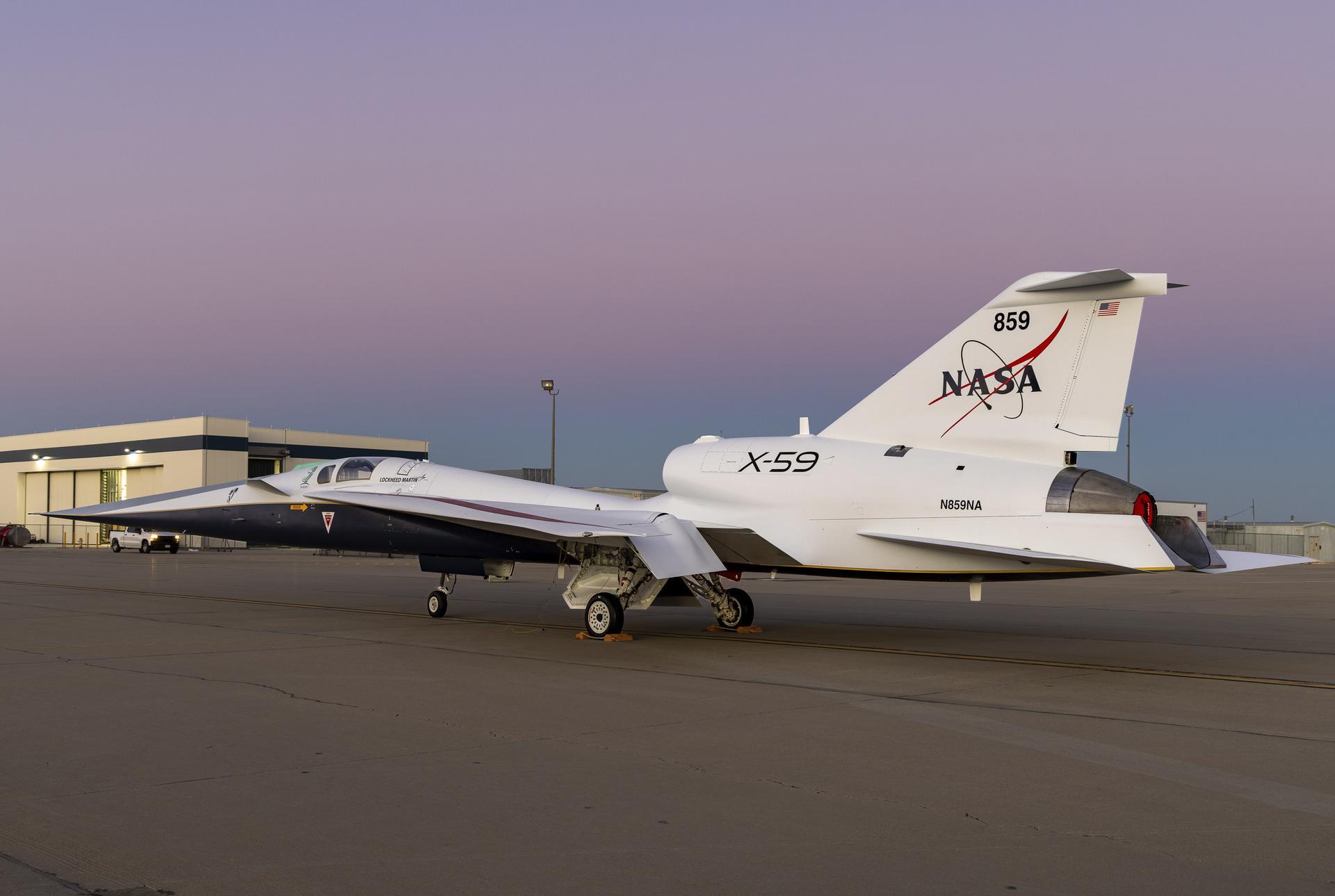
El avión de investigación supersónico silencioso X-59 de la NASA se encuentra en una rampa de Lockheed Martin Skunk Works en Palmdale, California, durante el atardecer. Esta aeronave única en su tipo es propulsada por un motor General Electric F414, una variante de los motores utilizados en los aviones F/A-18. El motor está montado sobre el fuselaje para reducir la cantidad de ondas de choque que llegan al suelo. El X-59 es la pieza central de la misión Quesst de la NASA, que busca demostrar el vuelo supersónico silencioso y permitir futuros viajes comerciales sobre tierra – más rápidos que la velocidad del sonido.
Lockheed Martin Corporation/Garry Tice
El avión de investigación supersónico silencioso X-59 de la NASA se encuentra en una rampa de Lockheed Martin Skunk Works en Palmdale, California, durante el atardecer. Esta aeronave única en su tipo es propulsada por un motor General Electric F414, una variante de los motores utilizados en los aviones F/A-18. El motor está montado sobre el fuselaje para reducir la cantidad de ondas de choque que llegan al suelo. El X-59 es la pieza central de la misión Quesst de la NASA, que busca demostrar el vuelo supersónico silencioso y permitir futuros viajes comerciales sobre tierra – más rápidos que la velocidad del sonido.
El equipo detrás del X-59 de la NASA completó en marzo otra prueba crítica en tierra, garantizando que el silencioso avión supersónico será capaz de mantener una velocidad específica durante su funcionamiento. Esta prueba, conocida como mantenimiento automático de velocidad del motor, es el más reciente marcador de progreso a medida que el X-59 se acerca a su primer vuelo este año.
“El mantenimiento automático de la velocidad del motor es básicamente la versión de control de crucero de la aeronave,” explicó Paul Dees, jefe adjunto de propulsión de la NASA del X-59 en el Centro de Investigación de Vuelo Armstrong de la agencia en Edwards, California. “El piloto activa el control de velocidad a su velocidad actual y luego puede aumentarla o ajustarla gradualmente según sea necesario.”
El equipo del X-59 ya había realizado una prueba similar en el motor, pero sólo como un sistema aislado. La prueba de marzo verificó que la retención de velocidad funciona correctamente tras su integración en la aviónica de la aeronave.
“Necesitábamos verificar que el mantenimiento automático de velocidad funcionara no sólo dentro del propio motor, sino como parte de todo el sistema del avión,” explicó Dees. “Esta prueba confirmó que todos los componentes – software, enlaces mecánicos y leyes de control – funcionan juntos según lo previsto.”
El éxito de la prueba confirmó la habilidad de la aeronave para controlar la velocidad con precisión, lo cual será muy invaluable durante el vuelo. Esta capacidad aumentará la seguridad de los pilotos, permitiéndoles enfocarse en otros aspectos críticos de la operación de vuelo.
“El piloto va a estar muy ocupado durante el primer vuelo, asegurándose de que la aeronave sea estable y controlable,” dijo Dees. “Al tener la función del mantenimiento automático de velocidad, de reduce parte de esa carga de trabajo, lo que hace que el primer vuelo sea mucho más seguro.”
Inicialmente el equipo tenía planeado comprobar el mantenimiento automático de velocidad como parte de una próxima serie de pruebas en tierra donde alimentarían la aeronave con un sólido conjunto de datos para verificar su funcionalidad tanto en condiciones normales como de fallo, conocidas como pruebas de pájaro de aluminio (una estructura que se utiliza para probar los sistemas de una aeronave en un laboratorio, simulando un vuelo real). Sin embargo, el equipo se dio cuenta que había una oportunidad de probarlo antes.
“Fue un objetivo de oportunidad,” dijo Dees. “Nos dimos cuenta de que estábamos listos para probar el mantenimiento automático de velocidad del motor por separado mientras otros sistemas continuaban con la finalización de su software. Si podemos aprender algo antes, siempre es mejor.”
Con cada prueba exitosa, el equipo integrado de la NASA y Lockheed Martin acerca el X-59 al primer vuelo, y hacer historia en la aviación a través de su tecnología supersónica silenciosa.
She Speaks for the Samples: Meet Dr. Juliane Gross, Artemis Campaign Sample Curation Lead
Based at NASA’s Johnson Space Center in Houston, the Astromaterials Research and Exploration Science Division, or ARES, curates the most extensive collection of extraterrestrial materials on Earth, ranging from microscopic cosmic dust particles to Apollo-era Moon rocks. Soon, ARES’ team of world-leading sample scientists hopes to add something new to its collection – lunar samples from the Moon’s South Pole region.
As the Artemis campaign sample curation lead, Dr. Juliane Gross is helping ARES and NASA prepare to collect and return those samples safely. “I’m responsible for representing the voice of the Moon rocks and advocating for their protection, preservation, and maintaining their integrity during the planning and execution of all stages of the different Artemis sample return missions,” she said.
Juliane Gross leads a geology lesson for Artemis II crew members as part of their field training in Iceland in 2024.
NASA
Her multifaceted role includes preparing the Johnson facility that will receive new lunar samples, developing curation strategies, and collaborating with mission teams to plan sampling operations, which encompass collection, handling, transport, and storage processes for all stages of Artemis missions. She trains program managers and engineers on the importance of sample return and teaches crew members how to identify lunar samples and collect them without contamination. She also works with the different programs and teams that oversee the vehicles used at different stages of lunar missions – collaborating with the human landing system team around tool storage and delivery to the lunar surface, the Orion Program to coordinate sample stowage for the return to Earth, and Exploration Ground Systems to plan sample recovery after splashdown.
Once samples are returned to Earth, Gross and the ARES curation team will conduct a preliminary examination of the materials and release a sample catalog from which members of the global scientific community may request loans to carry out their respective research.
Working across Artemis teams raised an unexpected but fun challenge for Gross – learning to communicate effectively with colleagues who have different academic and professional backgrounds. “Scientists like me speak a different language than engineers, and we all speak a different language than managers or the general public,” she said. “I have worked hard to find common vocabulary and to ‘translate’ science needs into the different types of languages that exist within the Artemis campaign. I’m trying to use our differences as strengths to enable mission success and to connect and build relationships with all these different teams through my love and passion for the Moon and rocks from the Moon.”
That passion emerged shortly after Gross completed her Ph.D. in geology, while working on lunar samples with the Lunar and Planetary Institute. She went on to become a research scientist with the American Museum of Natural History in New York, and then a tenured professor of planetary sciences at Rutgers University in Piscataway, New Jersey.
In 2019, NASA asked Gross to join the Apollo Next Generation Sample Analysis Program. Under the program, NASA preserved some of the 382 kilograms of lunar samples returned by Apollo missions, keeping them sealed for future generations to open and analyze. “NASA had the foresight to understand that technology would evolve and our level of sophistication for handling and examining samples would greatly increase,” Gross said.
She and two other scientists had the incredible opportunity to open and examine two samples returned by Apollo 17. Their work served as a practice run for Artemis sample returns while building upon the fundamental insights into the shared origin and history of Earth and the Moon that scientists previously derived from other Apollo samples. For example, the team extracted gas from one sample that will provide information about the volatiles that future lunar missions may encounter around the Moon’s South Pole.
“The Apollo Next Generation Sample Analysis Program linked the first generation of lunar explorers from Apollo with future explorers of the Moon with Artemis,” Gross said. “I’m very proud to have played such an important role in this initiative that now feeds forward to Artemis.”
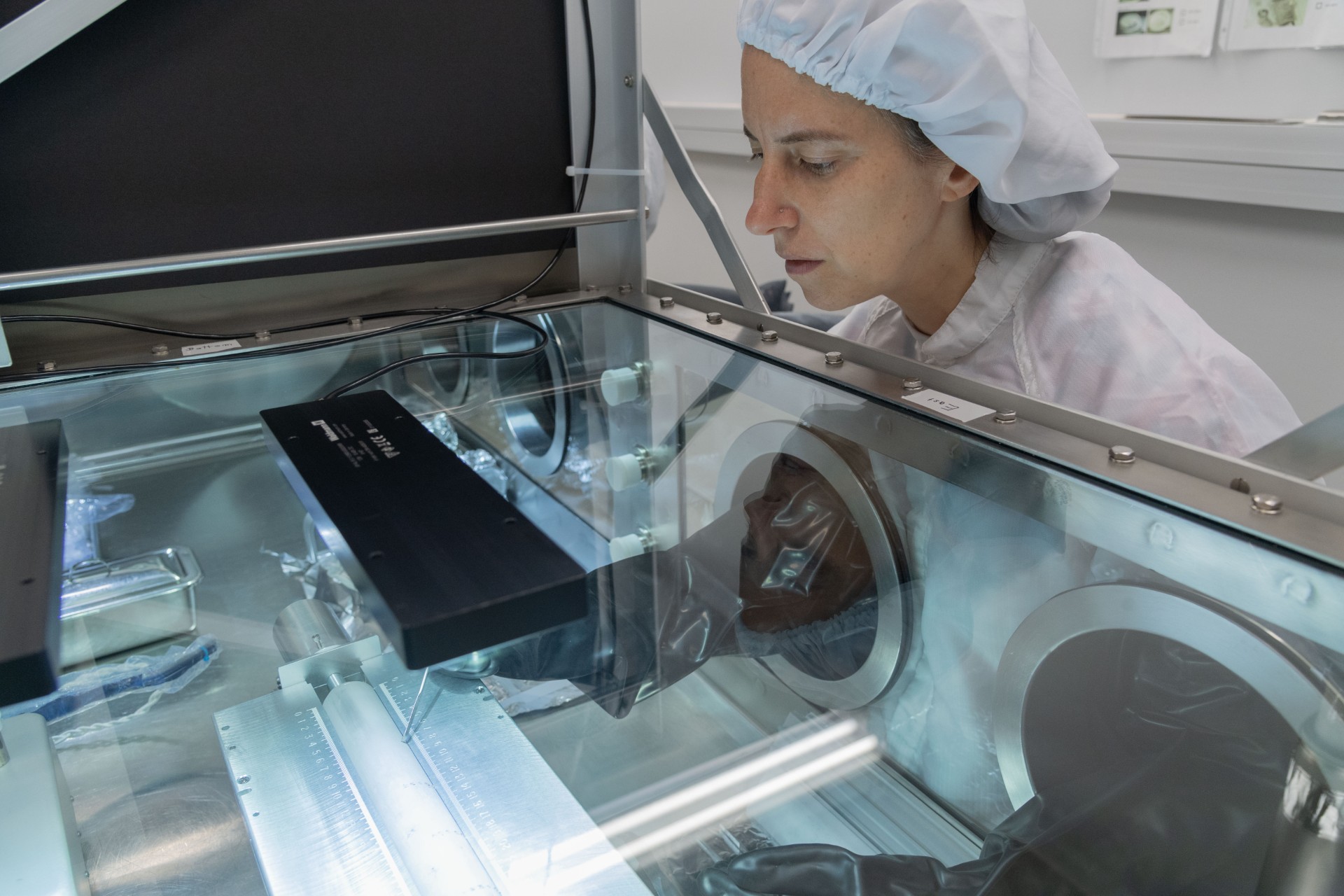
Juliane Gross examines lunar samples returned by Apollo 17 in Johnson Space Center’s Lunar Sample Laboratory Facility.
NASA
Gross’ connection with NASA began even earlier in her career. She was selected to join the agency-sponsored Antarctic Search for Meteorites team and lived in the deep ice fields of Antarctica for two months with seven other people. “We lived in tiny two-person tents without any support and recovered a total of 263 space rocks under challenging conditions,” she said. “I experienced the powerful forces of Antarctica and traveled 332 miles on skidoos. My body changed in the cold – I stuffed my face with enough butter, chocolate, and peanut M&Ms to last a lifetime and yet I lost weight.”
This formative experience taught Gross to find and celebrate beauty, even in her toughest moments. “I drank tea made with Antarctic glacier ice that is thousands to millions of years old. I will never forget the beautiful bell-like sounds that snow crystals make when being blown across the ice, the rainbow-sparkling ice crystals on a really cold day, the vast expanses of ice sheets looking like oceans frozen in eternity, and the icy bite of the wind on any unprotected skin that made me feel so alive and reminded me how vulnerable and precious life is,” she said. “And I will never ever forget the thrill and utter joy of finding a meteorite that you know no one on this planet has ever seen before you.”
Gross ultimately received the Antarctica Service Medal of the United States Armed Forces from the U.S. Department of Defense for her work.
Juliane Gross returns to McMurdo Station in Antarctica after working in the deep field for two months as part of the Antarctic Search for Meteorites team.
Image courtesy of Juliane Gross
Transitioning from full-time academia to her current position at NASA has been a big adjustment for Gross, but she has learned to love the change and the growth opportunities that come with it. “Being part of this incredible moment in history when we are about to return to the Moon with Artemis, our Apollo of today, feels so special and humbling that it made the transition easier,” she said.
The job has also increased Gross’ love and excitement for space exploration and reminds her every day why sample return missions are important. “The Moon is a museum of planetary history,” she said. “It has recorded and preserved the changes that affected the Earth-Moon system and is the best and most accessible place in the solar system to study planet-altering processes that have affected our corner of the universe.”
Still, “The Moon is only our next frontier,” she said. “Keep looking up and never give up. Ad astra!”
Watch below to learn about NASA’s rich history of geology training and hear how scientists and engineers are getting ready to bring back samples that will help us learn about the origins of our solar system.
NASA Awards Astrophysics Postdoctoral Fellowships for 2025
5 min read
NASA Awards Astrophysics Postdoctoral Fellowships for 2025
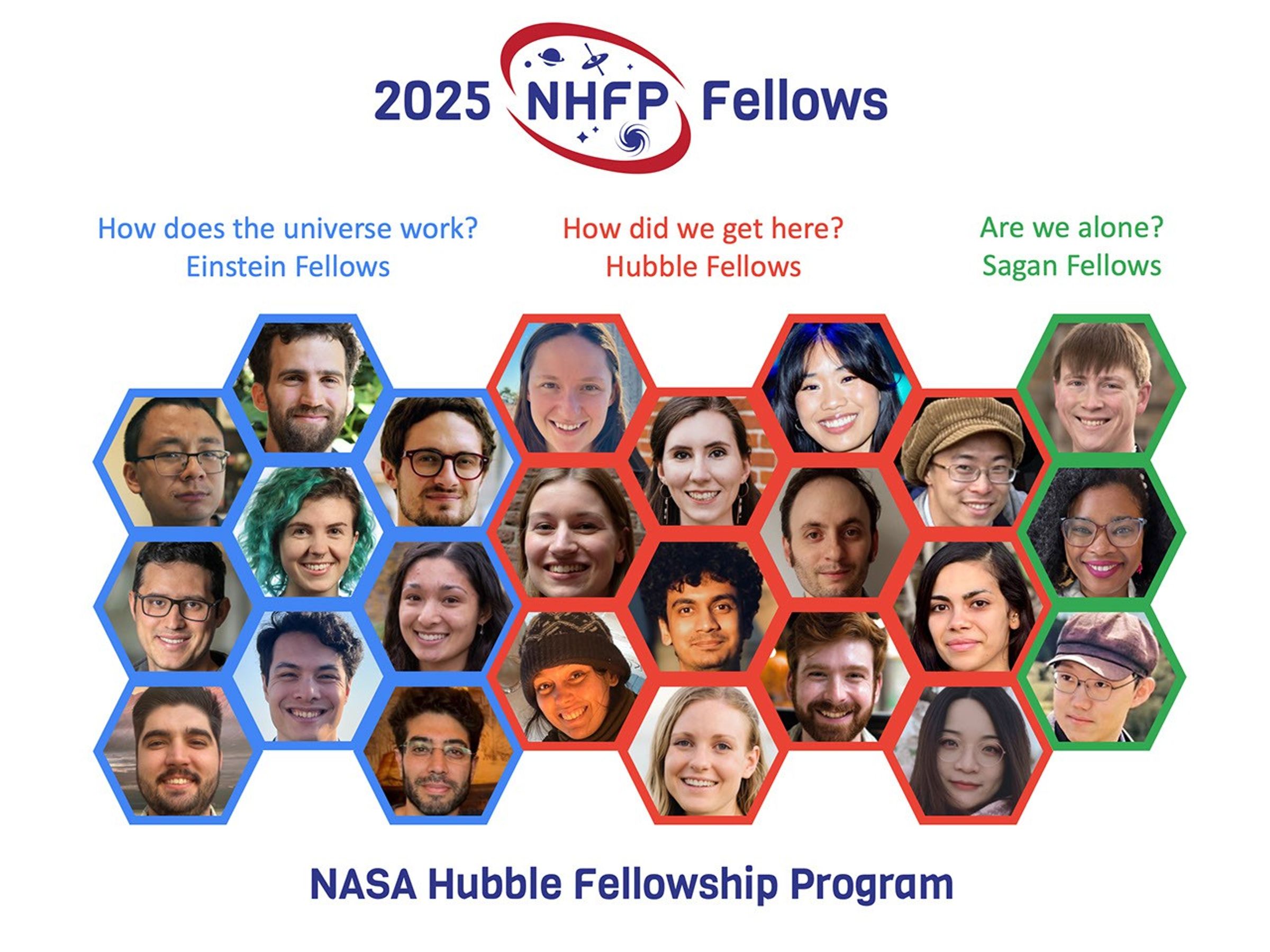
The highly competitive NASA Hubble Fellowship Program (NHFP) recently named 24 new fellows to its 2025 class. The NHFP fosters excellence and leadership in astrophysics by supporting exceptionally promising and innovative early-career astrophysicists. Over 650 applicants vied for the 2025 fellowships. Each fellowship provides the awardee up to three years of support at a U.S. institution.
Once selected, fellows are named to one of three sub-categories corresponding to three broad scientific questions that NASA seeks to answer about the universe:
How does the universe work? – Einstein Fellows
How did we get here? – Hubble Fellows
Are we alone? – Sagan Fellows
“The 2025 class of the NASA Hubble Fellowship Program is comprised of outstanding NASA Astrophysics researchers,” said Shawn Domagal-Goldman, acting director of the Astrophysics Division at NASA Headquarters in Washington. “This class of competitively-selected fellows will inspire future generations through the products of their research, and by sharing the results of that work with the public. Their efforts will help NASA continue its worldwide leadership in space-based astrophysics research.”
The class of 2025 NHFP Fellows are shown in this photo montage (left to right, top to bottom): The Einstein Fellows (seen in the blue hexagons) are: Shi-Fan Chen, Nicolas Garavito Camargo, Jason Hinkle, Itai Linial, Kenzie Nimmo, Massimo Pascale, Elia Pizzati, Jillian Rastinejad and Aaron Tohuvavohu. The Hubble Fellows (seen in the red hexagons) are: Aliza Beverage, Anna de Graaff, Karia Dilbert, Emily Griffith, Viraj Karambelkar, Lindsey Kwok, Abigail Lee, Aaron Pearlman, Dominick Rowan, Nicholas Rui, Nadine Soliman, Bingjie Wang. The Sagan Fellows (seen in green hexagons) are: Kyle Franson, Caprice Phillips, and Keming Zhang.
NASA, ESA, Megan Crane (Caltech/IPAC)
The list below provides the names of the 2025 awardees, their fellowship host institutions, and their proposed research topics.
The 2025 NHFP Einstein Fellows are:
Shi-Fan Chen, Columbia University, Galaxies, Shapes and Weak Lensing in the Effective Field Theory of Large-Scale Structure
Nicolas Garavito Camargo, University of Maryland, College Park, Local Group Galaxies in Disequilibrium; Building New Frameworks to Constrain the Nature of Dark Matter
Jason Hinkle, University of Illinois, Urbana-Champaign, Nuclear Transients in the Golden Era of Time-Domain Astronomy
Itai Linial, New York University, Repeating Nuclear Transients – Probes of Supermassive Black Holes and Their Environments
Kenzie Nimmo, Northwestern University, From Glimmering Jewels to Cosmic Ubiquity: Unraveling the Origins of FRBs
Massimo Pascale, University of California, Los Angeles, The Universe Seen Through Strong Gravitational Lensing
Elia Pizzati, Harvard University, The Missing Link: Connecting Black Hole Growth and Quasar Light Curves in the Young Universe
Jillian Rastinejad, University of Maryland, College Park, Illuminating the Explosive Origins of the Heavy Elements
Aaron Tohuvavohu, California Institute of Technology, Ultraviolet Space Telescopes for the new era of Time Domain and Multi-Messenger Astronomy
The 2025 NHFP Hubble Fellows are:
Aliza Beverage, Carnegie Observatories, Revealing Massive Galaxies Formation Using Chemical Abundances
Anna de Graaff, Harvard University, Early giants in context: How could galaxies in the first billion years grow so rapidly?
Karia Dibert, California Institute of Technology, Superconducting on-chip spectrometers for high-redshift astrophysics and cosmology
Emily Griffith, University of Colorado, Boulder, Beyond Mg and Fe: Exploring Detailed Nucleosynthetic Patterns
Viraj Karambelkar, Columbia University, The Anthropology of Merging Stars
Lindsey Kwok, Northwestern University, Determining the Astrophysical Origins of White-Dwarf Supernovae with JWST Infrared Spectroscopy
Abigail Lee, University of California, Berkeley, AGB Stars in the Era of NIR Astronomy: New Probes of Cosmology and Galaxy Evolution
Aaron Pearlman, Massachusetts Institute of Technology, Pinpointing the Origins of Fast Radio Bursts and Tracing Baryons in the Cosmic Web
Dominick Rowan, University of California, Berkeley, Fundamental Stellar Parameters Across the Hertzsprung-Russell Diagram
Nicholas Rui, Princeton University, A seismic atlas of the stellar merger sky
Nadine Soliman, Institute for Advanced Study, Micro Foundations, Macro Realities: Modeling the Multi-scale Physics Shaping Planets, Stars and Galaxies
Bingjie Wang, Princeton University, Inference at the Edge of the Universe
The 2025 NHFP Sagan Fellows are:
Kyle Franson, University of California, Santa Cruz, Mapping the Formation, Migration, and Thermal Evolution of Giant Planets with Direct Imaging and Astrometry
Caprice Phillips, University of California, Santa Cruz, Aging in the Cosmos: JWST Insights into the Evolution of Brown Dwarf Atmospheres and Clouds
Keming Zhang, Institute for Advanced Study, Understanding the Origin and Abundance of Free-Floating Planets via Microlensing and Machine Learning
The class of 2025 NHFP Fellows are shown in this photo montage (left to right, top to bottom): The Einstein Fellows (seen in the blue hexagons) are: Shi-Fan Chen, Nicolas Garavito Camargo, Jason Hinkle, Itai Linial, Kenzie Nimmo, Massimo Pascale, Elia Pizzati, Jillian Rastinejad and Aaron Tohuvavohu.
The Hubble Fellows (seen in the red hexagons) are: Aliza Beverage, Anna de Graaff, Karia Dilbert, Emily Griffith, Viraj Karambelkar, Lindsey Kwok, Abigail Lee, Aaron Pearlman, Dominick Rowan, Nicholas Rui, Nadine Soliman, Bingjie Wang.
The Sagan Fellows (seen in green hexagons) are: Kyle Franson, Caprice Phillips, and Keming Zhang.
For short bios and photos, please visit the link at the end of the article.
An important part of the NHFP is the annual Symposium, which allows Fellows the opportunity to present results of their research, and to meet each other and the scientific and administrative staff who manage the program. The 2024 symposium was held at the NASA Exoplanet Science Institute (NExScI) in Pasadena, California. Science topics ranged through exoplanets, gravitational waves, fast radio bursts, cosmology and more. Non-science sessions included discussions about career paths and developing mentorship skills, as well as an open mic highlighting an array of talents other than astrophysics.
The Space Telescope Science Institute in Baltimore, Maryland, administers the NHFP on behalf of NASA, in collaboration with the Chandra X-ray Center at the Smithsonian Astrophysical Observatory in Cambridge, Massachusetts, and the NASA Exoplanet Science Institute and the Jet Propulsion Laboratory, in Pasadena, California.
NASA Awards Launch Services Contract for SpaceX Starship
NASA logo.
NASA has awarded SpaceX of Starbase, Texas, a modification under the NASA Launch Services (NLS) II contract to add Starship to their existing Falcon 9 and Falcon Heavy launch service offerings.
The NLS II contracts provide a broad range of commercial launch services for NASA’s planetary, Earth-observing, exploration, and scientific satellites. These high-priority, low and medium risk tolerant missions have full NASA technical oversight and mission assurance, resulting in the highest probability of launch success.
The NLS II contracts are multiple award, indefinite-delivery/indefinite-quantity, with an ordering period through June 2030 and an overall period of performance through December 2032. The contracts include an on-ramp provision that provides an opportunity annually for new launch service providers to add their launch service on an NLS II contract and compete for future missions and allows existing contractors to introduce launch services not currently on their NLS II contracts.
NASA’s Launch Services Program Office at the agency’s Kennedy Space Center in Florida manages the NLS II contracts. For more information about NASA and agency programs, visit: