NASA Langley Participates in Air Power Over Hampton Roads
NASA Langley highlights its Cirrus Design SR22 during Air Power Over Hampton Roads STEM Day.
NASA/Angelique Herring
NASA Langley Research Center’s integral role in the past, present, and future of flight was on full display April 25-27 during the Air Power Over Hampton Roads air show.
The air show, held at Joint Base Langley-Eustis (JBLE), which neighbors NASA Langley in Hampton, Virginia, attracted thousands of spectators throughout the weekend.
The weekend kicked off with a STEM Day on April 25. Langley’s Office of STEM Engagement (OSTEM) offered educational and engaging activities, exhibits, and displays to share NASA missions and encourage K-12 students from local schools to explore the possibilities that science, technology, engineering, and math offer.
“Participation in the air show allows us to share NASA’s work in aeronautics with the public and provides an opportunity for Langley researchers and engineers to work directly with students and families to share the exciting work they do,” said Bonnie Murray, Langley OSTEM Student Services manager.
NASA Langley personnel inspire young minds during Air Power Over Hampton Roads STEM Day.
NASA/Angelique Herring
Langley OSTEM’s participation continued throughout the weekend as a part of the air show’s STEM Expo, where visitors to the NASA booths tested a paper helicopter in a small-scale wind tunnel to explore flight dynamics, learned how NASA uses X-planes for research and designed their own X-plane, and tested experimental paper airplanes of various designs. By observing flight of the plane designs and making improvements to each one, students participated in the engineering design process. NASA subject matter experts in attendance guided students through these activities, inspired young minds by sharing some of their innovations, and promoted a variety of STEM career paths.
“Through engagement in the NASA STEM Zone activities, students had an opportunity to see themselves in the role of a NASA researcher,” Murray said. “Authentic learning experiences such as these help build children’s STEM identity, increasing the likelihood of them pursuing STEM careers in the future.”
A child enjoys NASA STEM activities during Air Power Over Hampton Roads STEM Day.
NASA/Angelique Herring
The air show’s static aircraft displays included NASA Langley’s Cirrus Design SR22, a research aircraft used to support NASA’s airborne science program, the science community, and aeronautics research.
“Reflective of our strong, long-standing partnership with JBLE, NASA Langley was proud to participate in this year’s Air Power Over Hampton Roads air show,” said Glenn Jamison, director of Langley’s Research Services Directorate. “Our relationship spans back to 1917 when NACA and Langley Field evolved together over formative years in aerodynamic research, sharing the airspace and facilities here in Hampton. Today, we continue our collaboration with JBLE in pursuing shared interests and finding innovative solutions to complex problems.”
The displays also featured several small Unmanned Aircraft Systems (sUAS) and NASA’s P-3 Orion, a research aircraft based at NASA’s Wallops Flight Facility on Wallops Island, Virginia.
Air show visitors could explore a picture display that highlighted NASA Langley’s rich aviation legacy, from its founding in 1917 to Langley’s work today to accelerate advancements in aeronautics, science, and space technology and exploration. Spacey Casey, a crowd favorite, greeted and took pictures with educators, students, and guests throughout the weekend, bringing out-of-this-world smiles to their faces. Members of Langley’s Office of the Director also represented the center at the event.
NASA’s Webb Lifts Veil on Common but Mysterious Type of Exoplanet
6 Min Read
NASA’s Webb Lifts Veil on Common but Mysterious Type of Exoplanet
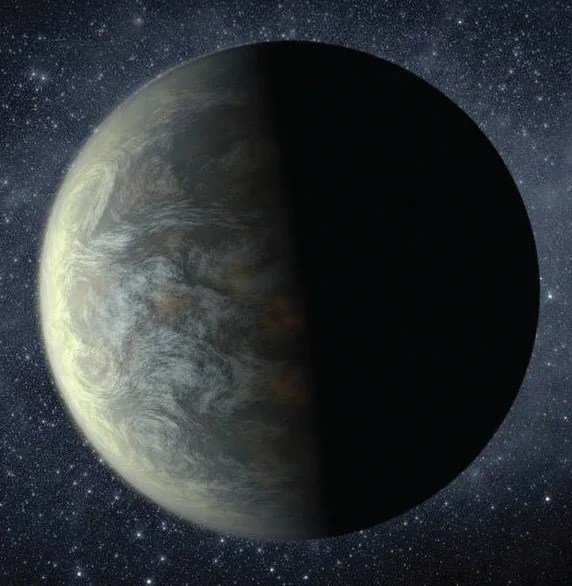
This artist’s concept shows what the hot sub-Neptune exoplanet TOI-421 b could look like. It is based on spectroscopic data gathered by Webb, as well as previous observations from other telescopes on the ground and in space.
Credits: Illustration: NASA, ESA, CSA, Dani Player (STScI)
Though they don’t orbit around our Sun, sub-Neptunes are the most common type of exoplanet, or planet outside our solar system, that have been observed in our galaxy. These small, gassy planets are shrouded in mystery…and often, a lot of haze. Now, by observing exoplanet TOI-421 b, NASA’s James Webb Space Telescope is helping scientists understand sub-Neptunes in a way that was not possible prior to the telescope’s launch.
“I had been waiting my entire career for Webb so that we could meaningfully characterize the atmospheres of these smaller planets,” said principal investigator Eliza Kempton of the University of Maryland, College Park. “By studying their atmospheres, we’re getting a better understanding of how sub-Neptunes formed and evolved, and part of that is understanding why they don’t exist in our solar system.”
Image A: Artist’s Concept of TOI-421 b
This artist’s concept shows what the hot sub-Neptune exoplanet TOI-421 b could look like. It is based on spectroscopic data gathered by Webb, as well as previous observations from other telescopes on the ground and in space.
Illustration: NASA, ESA, CSA, Dani Player (STScI)
Small, Cool, Shrouded in Haze
The existence of sub-Neptunes was unexpected before they were discovered by NASA’s retired Kepler space telescope in the last decade. Now, astronomers are trying to understand where these planets came from and why are they so common.
Before Webb, scientists had very little information on them. While sub-Neptunes are a few times larger than Earth, they are still much smaller than gas-giant planets and typically cooler than hot Jupiters, making them much more challenging to observe than their gas-giant counterparts.
A key finding prior to Webb was that most sub-Neptune atmospheres had flat or featureless transmission spectra. This means that when scientists observed the spectrum of the planet as it passed in front of its host star, instead of seeing spectral features – the chemical fingerprints that would reveal the composition of the atmosphere – they saw only a flat-line spectrum. Astronomers concluded from all of those flat-line spectra that at least certain sub-Neptunes were probably very highly obscured by either clouds or hazes.
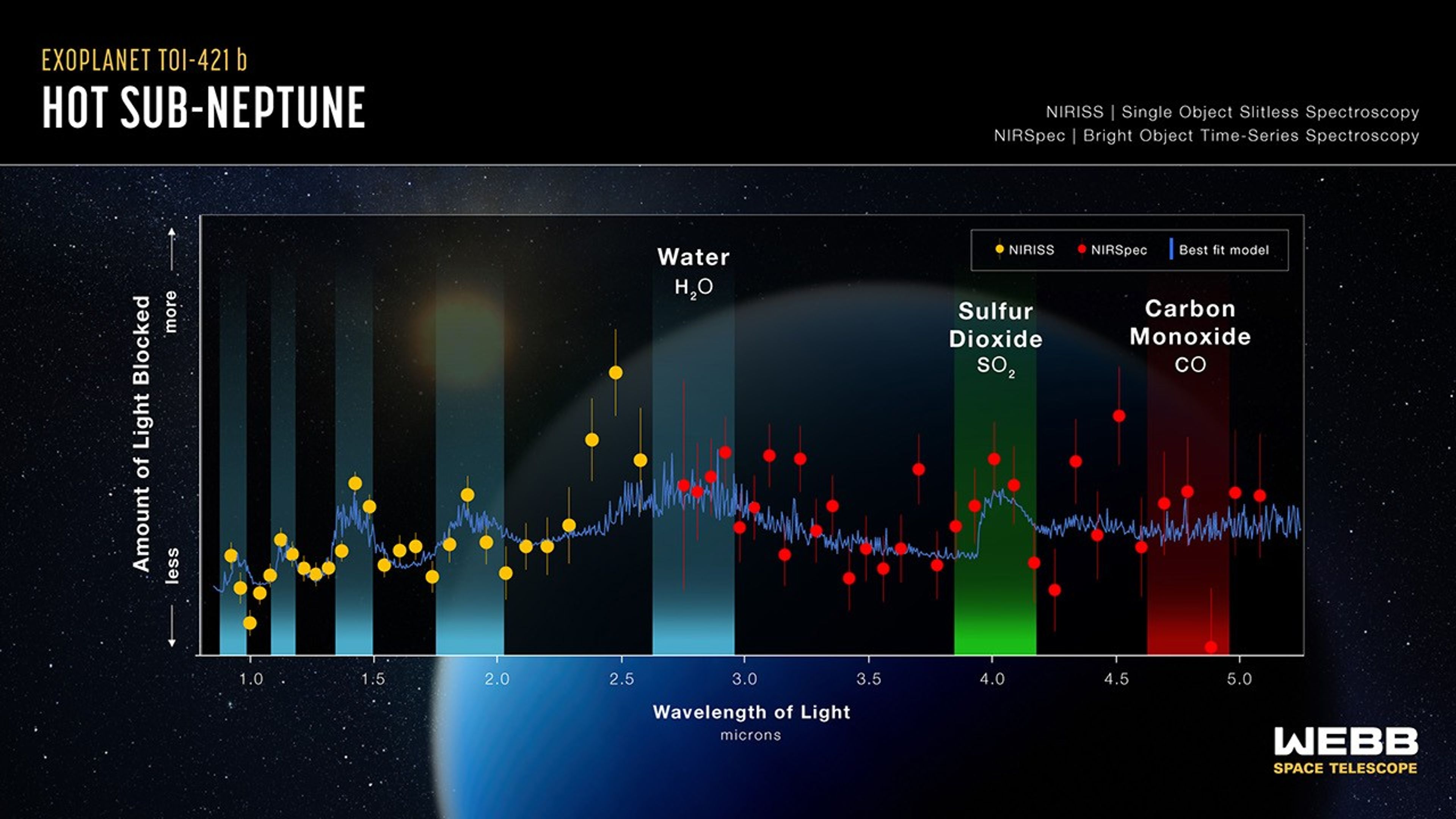
Image B: Spectrum of TOI-421 b
A transmission spectrum captured by NASA’s James Webb Space Telescope reveals chemicals in the atmosphere of the hot sub-Neptune exoplanet TOI-421 b.
Illustration: NASA, ESA, CSA, Joseph Olmsted (STScI)
A Different Kind of Sub-Neptune?
“Why did we observe this planet, TOI-421 b? It’s because we thought that maybe it wouldn’t have hazes,” said Kempton. “And the reason is that there were some previous data that implied that maybe planets over a certain temperature range were less enshrouded by haze or clouds than others.”
That temperature threshold is about 1,070 degrees Fahrenheit. Below that, scientists hypothesized that a complex set of photochemical reactions would occur between sunlight and methane gas, and that would trigger the haze. But hotter planets shouldn’t have methane and therefore perhaps shouldn’t have haze.
The temperature of TOI-421 b is about 1,340 degrees Fahrenheit, well above the presumed threshold. Without haze or clouds, researchers expected to see a clear atmosphere – and they did!
A Surprising Finding
“We saw spectral features that we attribute to various gases, and that allowed us to determine the composition of the atmosphere,” said the University of Maryland’s Brian Davenport, a third-year Ph.D. student who conducted the primary data analysis. “Whereas with many of the other sub-Neptunes that had been previously observed, we know their atmospheres are made of something, but they’re being blocked by haze.”
The team found water vapor in the planet’s atmosphere, as well as tentative signatures of carbon monoxide and sulfur dioxide. Then there are molecules they didn’t detect, such as methane and carbon dioxide. From the data, they can also infer that a large amount of hydrogen is in TOI-421 b’s atmosphere.
The lightweight hydrogen atmosphere was the big surprise to the researchers. “We had recently wrapped our mind around the idea that those first few sub-Neptunes observed by Webb had heavy-molecule atmospheres, so that had become our expectation, and then we found the opposite,” said Kempton. This suggests TOI-421 b may have formed and evolved differently from the cooler sub-Neptunes observed previously.
Is TOI-421 b Unique?
The hydrogen-dominated atmosphere is also interesting because it mimics the composition of TOI-421 b’s host star. “If you just took the same gas that made the host star, plopped it on top of a planet’s atmosphere, and put it at the much cooler temperature of this planet, you would get the same combination of gases. That process is more in line with the giant planets in our solar system, and it is different from other sub-Neptunes that have been observed with Webb so far,” said Kempton.
Aside from being hotter than other sub-Neptunes previously observed with Webb, TOI-421 b orbits a Sun-like star. Most of the other sub-Neptunes that have been observed so far orbit smaller, cooler stars called red dwarfs.
Is TOI-421b emblematic of hot sub-Neptunes orbiting Sun-like stars, or is it just that exoplanets are very diverse? To find out, the researchers would like to observe more hot sub-Neptunes to determine if this is a unique case or a broader trend. They hope to gain insights into the formation and evolution of these common exoplanets.
“We’ve unlocked a new way to look at these sub-Neptunes,” said Davenport. “These high-temperature planets are amenable to characterization. So by looking at sub-Neptunes of this temperature, we’re perhaps more likely to accelerate our ability to learn about these planets.”
The team’s findings appear on May 5 in the Astrophysical Journal Letters.
The James Webb Space Telescope is the world’s premier space science observatory. Webb is solving mysteries in our solar system, looking beyond to distant worlds around other stars, and probing the mysterious structures and origins of our universe and our place in it. Webb is an international program led by NASA with its partners, ESA (European Space Agency) and CSA (Canadian Space Agency).
GSFC Office of the Chief Knowledge Officer – Case Studies
The Goddard OCKO has a large collection of case studies covering a wide range of missions and technical topics, including launch decision making, project management, procurement, instrument development, risk management, systems engineering and more. These case studies can be used to facilitate learning of critical knowledge and lessons that enable mission success.
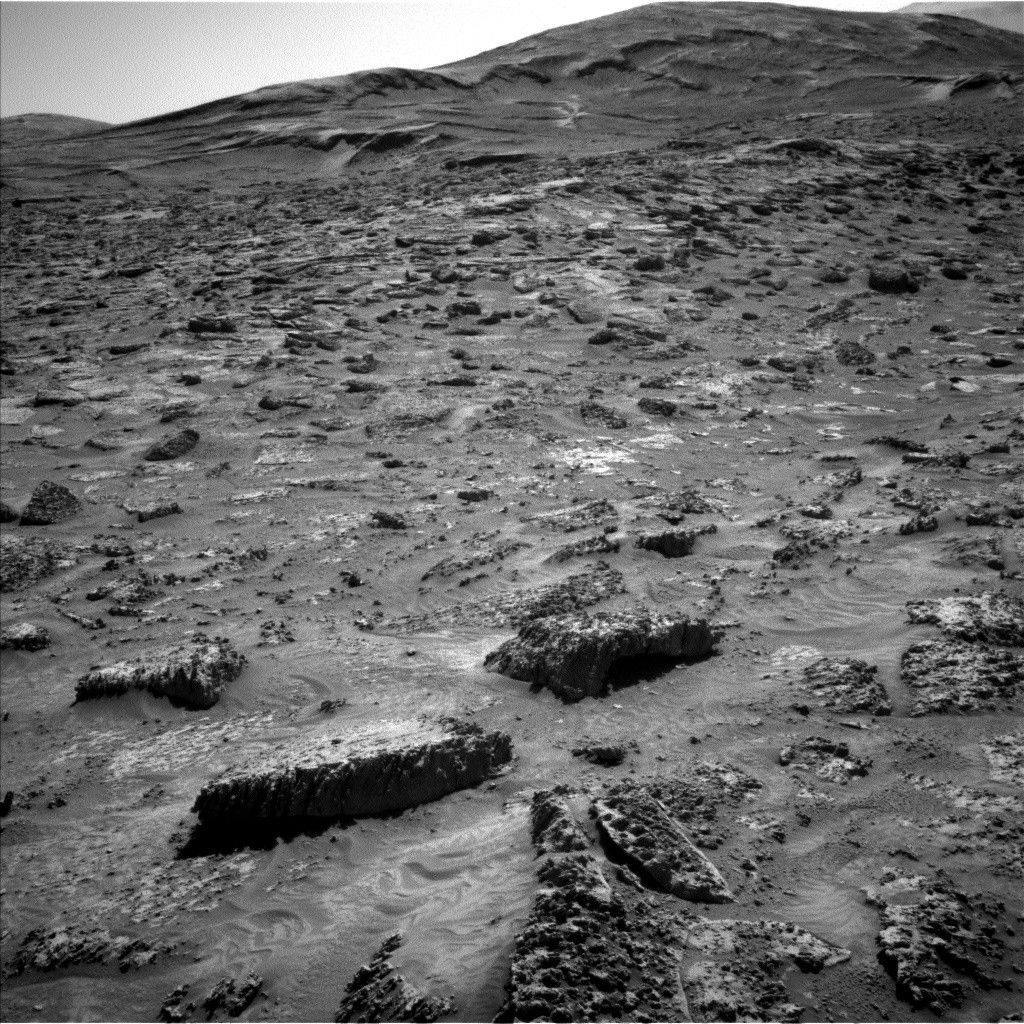
NASA’s Mars rover Curiosity acquired this image looking directly west and showing a first ground view of the boxwork structures the rover is driving toward. The boxwork structures are visible in the distance as smoother terrain criss-crossed by ridges, just below the hilltops. Curiosity acquired this image using its Left Navigation Camera on April 30, 2025 – Sol 4526, or Martian day 4,526 of the Mars Science Laboratory mission – at 14:10:41 UTC.
NASA/JPL-Caltech
Written by Natalie Moore, Mission Operations Specialist at Malin Space Science Systems
Earth planning date: Wednesday, April 30, 2025
We’re back in our standard “touch and go” plan regime today, where we sandwich a midday remote science block between morning-APXS and afternoon-MAHLI contact science arm blocks. We had our first late-slide 9 a.m. PDT start in quite a while due to our “isolated nominal” plan on Monday! This meant the whole team was ready and “patiently” (read: not-so-patiently) waiting for our drive data to come down around 8:40 this morning. Thankfully, everything we were waiting for came down to Earth and told us Curiosity was right where we wanted her to be! The planning begins…
Sol 4527 contains most of our activities in this plan. We start off about 10:00 local Gale time with a DRT and APXS analysis of contact science target “Tamarack Valley,” a rough but brushable bedrock target in our workspace. We leave the arm unstowed (and out of the way) for our remote science block spanning the hours of about 12:35-13:45. That block starts with a large, 76-frame stereo Mastcam mosaic covering the boxwork structures to the west while ChemCam’s instrument cools down to allow for LIBS.
After Mastcam is done, ChemCam shoots their LIBS on a rougher bedrock target named “Aguanga,” and an RMI mosaic of the boxwork structures included in the Mastcam mosaic. About 14:00 local time, MAHLI finishes the contact science with a full suite of Tamarack Valley (25-centimeter, 5-centimeter stereo, and 1-centimeter images). Then we drive! Hopefully about 30 meters closer (about 98 feet) to the boxwork structures for our weekend plan.
Curiosity takes the second sol easier with some Navcam dust-devil and horizon movies, along with a rover-decided LIBS target at our new location to start off science decisions for Friday.
The Soyuz MS-26 spacecraft is pictured backing away from the International Space Station shortly after undocking on April 19, 2025. Three hours later, the spacecraft landed in Kazakhstan, returning astronaut Don Pettit and cosmonauts Alexey Ovchinin and Ivan Vagner to Earth.
While aboard the International Space Station, Pettit conducted hundreds of hours of scientific investigations, including research to enhance on-orbit metal 3D printing capabilities, advance water sanitization technologies, explore plant growth under varying water conditions, and investigate fire behavior in microgravity, all contributing to future space missions.