NASA’s Dragonfly Mission Sets Sights on Titan’s Mysteries
6 min read
NASA’s Dragonfly Mission Sets Sights on Titan’s Mysteries
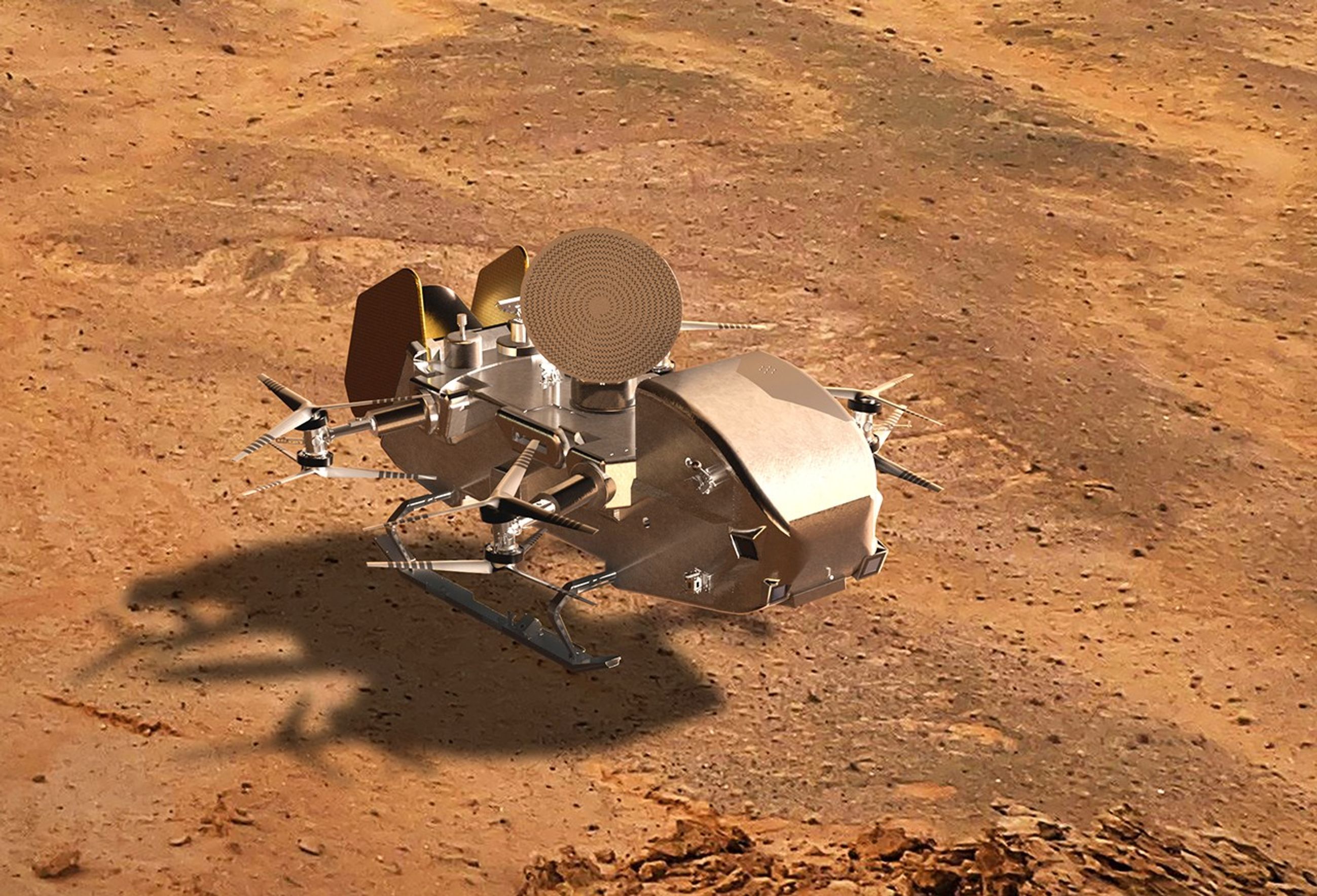
When it descends through the thick golden haze on Saturn’s moon Titan, NASA’s Dragonfly rotorcraft will find eerily familiar terrain. Dunes wrap around Titan’s equator. Clouds drift across its skies. Rain drizzles. Rivers flow, forming canyons, lakes and seas.
But not everything is as familiar as it seems. At minus 292 degrees Fahrenheit, the dune sands aren’t silicate grains but organic material. The rivers, lakes and seas hold liquid methane and ethane, not water. Titan is a frigid world laden with organic molecules.
Yet Dragonfly, a car-sized rotorcraft set to launch no earlier than 2028, will explore this frigid world to potentially answer one of science’s biggest questions: How did life begin?
Seeking answers about life in a place where it likely can’t survive seems odd. But that’s precisely the point.
“Dragonfly isn’t a mission to detect life — it’s a mission to investigate the chemistry that came before biology here on Earth,” said Zibi Turtle, principal investigator for Dragonfly and a planetary scientist at the Johns Hopkins Applied Physics Laboratory in Laurel, Maryland. “On Titan, we can explore the chemical processes that may have led to life on Earth without life complicating the picture.”
On Earth, life has reshaped nearly everything, burying its chemical forebears beneath eons of evolution. Even today’s microbes rely on a slew of reactions to keep squirming.
“You need to have gone from simple to complex chemistry before jumping to biology, but we don’t know all the steps,” Turtle said. “Titan allows us to uncover some of them.”
Titan is an untouched chemical laboratory where all the ingredients for known life — organics, liquid water and an energy source — have interacted in the past. What Dragonfly uncovers will illuminate a past since erased on Earth and refine our understanding of habitability and whether the chemistry that sparked life here is a universal rule — or a wonderous cosmic fluke.
Before NASA’s Cassini-Huygens mission, researchers didn’t know just how rich Titan is in organic molecules. The mission’s data, combined with laboratory experiments, revealed a molecular smorgasbord — ethane, propane, acetylene, acetone, vinyl cyanide, benzene, cyanogen, and more.
These molecules fall to the surface, forming thick deposits on Titan’s ice bedrock. Scientists believe life-related chemistry could start there — if given some liquid water, such as from an asteroid impact.
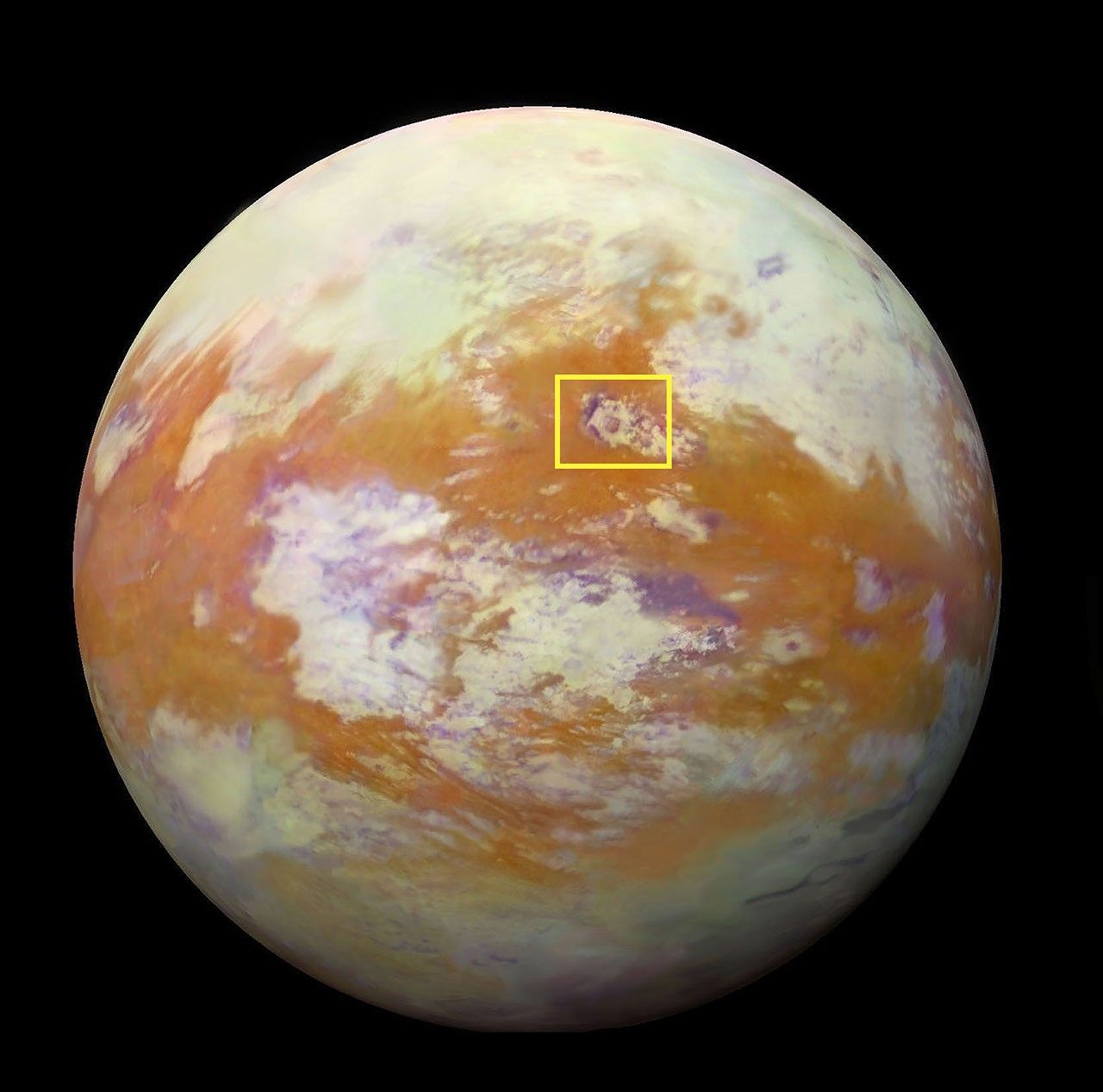
Enter Selk crater, a 50-mile-wide impact site. It’s a key Dragonfly destination, not only because it’s covered in organics, but because it may have had liquid water for an extended time.
The impact that formed Selk melted the icy bedrock, creating a temporary pool that could have remained liquid for hundreds to thousands of years under an insulating ice layer, like winter ponds on Earth. If a natural antifreeze like ammonia were mixed in, the pool could have remained unfrozen even longer, blending water with organics and the impactor’s silicon, phosphorus, sulfur and iron to form a primordial soup.
“It’s essentially a long-running chemical experiment,” said Sarah Hörst, an atmospheric chemist at Johns Hopkins University and co-investigator on Dragonfly’s science team. “That’s why Titan is exciting. It’s a natural version of our origin-of-life experiments — except it’s been running much longer and on a planetary scale.”
For decades, scientists have simulated Earth’s early conditions, mixing water with simple organics to create a “prebiotic soup” and jumpstarting reactions with an electrical shock. The problem is time. Most tests last weeks, maybe months or years.
The melt pools at Selk crater, however, possibly lasted tens of thousands of years. Still shorter than the hundreds of millions of years it took life to emerge on Earth, but potentially enough time for critical chemistry to occur.
“We don’t know if Earth life took so long because conditions had to stabilize or because the chemistry itself needed time,” Hörst said. “But models show that if you toss Titan’s organics into water, tens of thousands of years is plenty of time for chemistry to happen.”
Dragonfly will test that theory. Landing near Selk, it will fly from site to site, analyzing the surface chemistry to investigate the frozen remains of what could have been prebiotic chemistry in action.
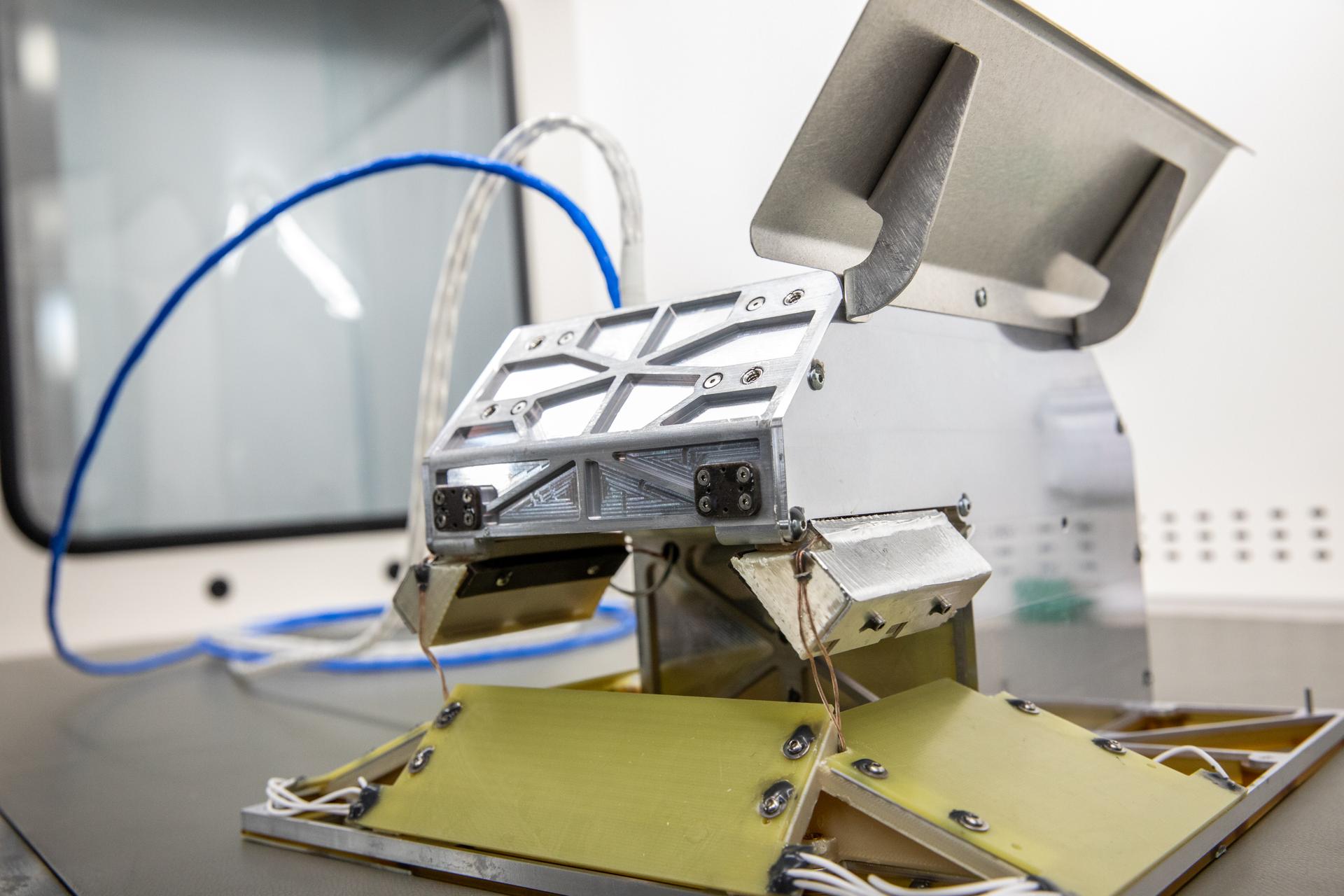
Morgan Cable, a research scientist at NASA’s Jet Propulsion Laboratory in Southern California and co-investigator on Dragonfly, is particularly excited about the Dragonfly Mass Spectrometer (DraMS) instrument. Developed by NASA’s Goddard Space Flight Center in Greenbelt, Maryland, with a key subsystem provided by the CNES (Centre National d’Etudes Spatiales), DraMS will search for indicators of complex chemistry.
“We’re not looking for exact molecules, but patterns that suggest complexity,” Cable said. On Earth, for example, amino acids — fundamental to proteins — appear in specific patterns. A world without life would mainly manufacture the simplest amino acids and form fewer complex ones.
Generally, Titan isn’t regarded as habitable; it’s too cold for the chemistry of life as we know it to occur, and there’s is no liquid water on the surface, where the organics and likely energy sources exist.
Still, scientists have assumed that if a place has life’s ingredients and enough time, complex chemistry — and eventually life — should emerge. If Titan proves otherwise, it may mean we’ve misunderstood something about life’s start and it may be rarer than we thought.
“We won’t know how easy or difficult it is for these chemical steps to occur if we don’t go, so we need to go and look,” Cable said. “That’s the fun thing about going to a world like Titan. We’re like detectives with our magnifying glasses, looking at everything and wondering what this is.”
Dragonfly is being designed and built under the direction of the Johns Hopkins Applied Physics Laboratory (APL), which manages the mission for NASA. The team includes key partners at NASA’s Goddard Space Flight Center and NASA’s Jet Propulsion Laboratory. Dragonfly is managed by NASA’s Marshall Space Flight Center in Huntsville, Alabama, for the agency’s Science Mission Directorate at NASA Headquarters in Washington.
For more information on Dragonfly, visit:
https://science.nasa.gov/mission/dragonfly/
By Jeremy Rehm
Johns Hopkins Applied Physics Laboratory, Laurel, Md.
Media Contacts:
Karen Fox / Molly Wasser
Headquarters, Washington
202-358-1600
karen.c.fox@nasa.gov / molly.l.wasser@nasa.gov
Mike Buckley
Johns Hopkins Applied Physics Laboratory
443-567-3145
michael.buckley@jhuapl.edu
Keep Exploring
Discover More Topics From NASA
Powered by WPeMatico
Get The Details…