Autonomous Tritium Micropowered Sensors

Autonomous Tritium Micropowered Sensors

3 min read

Preparations for Next Moonwalk Simulations Underway (and Underwater)
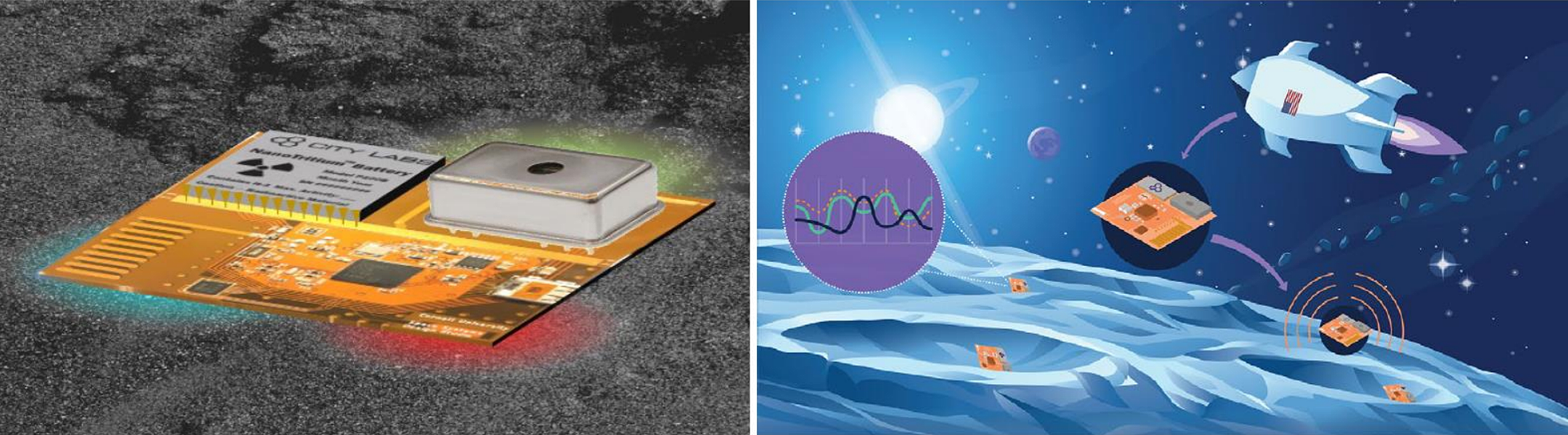
Autonomous Tritium Micropowered Sensors concept in space
Artist concept highlighting the novel approach proposed by the 2025 NIAC awarded selection of Autonomous Tritium Micropowered Sensors concept.
NASA/Peter Cabauy

Peter Cabauy
City Labs, Inc.

The NIAC Phase I study confirmed the feasibility of nuclear-micropowered probes (NMPs) using tritium betavoltaic power technology for autonomous exploration of the Moon’s permanently shadowed regions (PSRs). This work advanced the technology’s readiness level (TRL) from TRL 1 to TRL 2, validating theoretical models and feasibility assessments. Phase II will refine the technology, address challenges, and elevate the TRL to 3, with a roadmap for further maturation toward TRL 4 and beyond, supporting NASA’s mission for lunar and planetary exploration. A key innovation is tritium betavoltaic power sources, providing long-duration energy in extreme environments. The proposed 5cm x 5cm gram-scale device supports lunar spectroscopy and other applications. In-situ analyses at the Moon’s south pole are challenging due to cold, limited solar power, and prolonged darkness. Tritium betavoltaics harvest energy from radioactive decay, enabling autonomous sensing in environments unsuitable for conventional photovoltaics and chemical-based batteries.

The proposal focuses on designing an ultrathin light weight tritium betavoltaic into an NMP for integrating various scientific instruments. Tritium-powered NMPs support diverse applications, from planetary science to scouting missions for human exploration. This approach enables large-scale deployment for high-resolution remote sensing. For instance, a distributed NMP array could map lunar water resources, aiding Artemis missions. Beyond the Moon, tritium-powered platforms enable a class of missions to Mars, Europa, Enceladus, and asteroids, where alternative power sources are impractical.

Phase II objectives focus on improving energy conversion efficiency and resilience of tritium betavoltaic power sources, targeting 1-10 μW continuous electrical power with higher thermal output. The project will optimize NMP integration with sensor platforms, enhancing power management, data transmission, and environmental survivability in PSR conditions. Environmental testing will assess survivability under lunar landing conditions, including decelerations of 27,000-270,000g and interactions with lunar regolith. The goal is to advance TRL from 2 to 3 by demonstrating proof-of-concept prototypes and preparing for TRL 4. Pathways for NASA mission integration will be explored, assessing scalability, applicability, and cost-effectiveness compared to alternative technologies.

A key discovery in Phase I was the thermal-survivability benefit of the betavoltaic’s tritium metal hydride, which generates enough heat to keep electronic components operational. This dual functionality–as both a power source and thermal stabilizer–allows NMP components to function within temperature specifications, a breakthrough for autonomous sensing in extreme environments. Beyond lunar applications, this technology could revolutionize planetary science, deep-space exploration, and terrestrial use cases. It could aid Mars missions, where dust storms and long nights challenge solar power, and Europa landers, which need persistent low-power operation. Earth-based applications such as biomedical implants and environmental monitoring could benefit from the proposed advancements in betavoltaic energy storage and micro-scale sensors. The Phase II study supports NASA’s Artemis objectives by enabling sustainable lunar exploration through enhanced resource characterization and autonomous monitoring. Tritium-powered sensing has strategic value for PSR scouting, planetary-surface mapping, and deep-space monitoring. By positioning tritium betavoltaic NMPs as a power solution for extreme environments, this study lays the foundation for transitioning the technology from concept to implementation, advancing space exploration and scientific discovery.

2025 Selections

Share

Details

Last Updated

May 27, 2025

Editor
Loura Hall

Powered by WPeMatico

Get The Details…
Loura Hall
Addressing Key Challenges To Mapping Sub-cm Orbital Debris in LEO via Plasma Soliton Detection

Addressing Key Challenges To Mapping Sub-cm Orbital Debris in LEO via Plasma Soliton Detection

3 min read

Preparations for Next Moonwalk Simulations Underway (and Underwater)

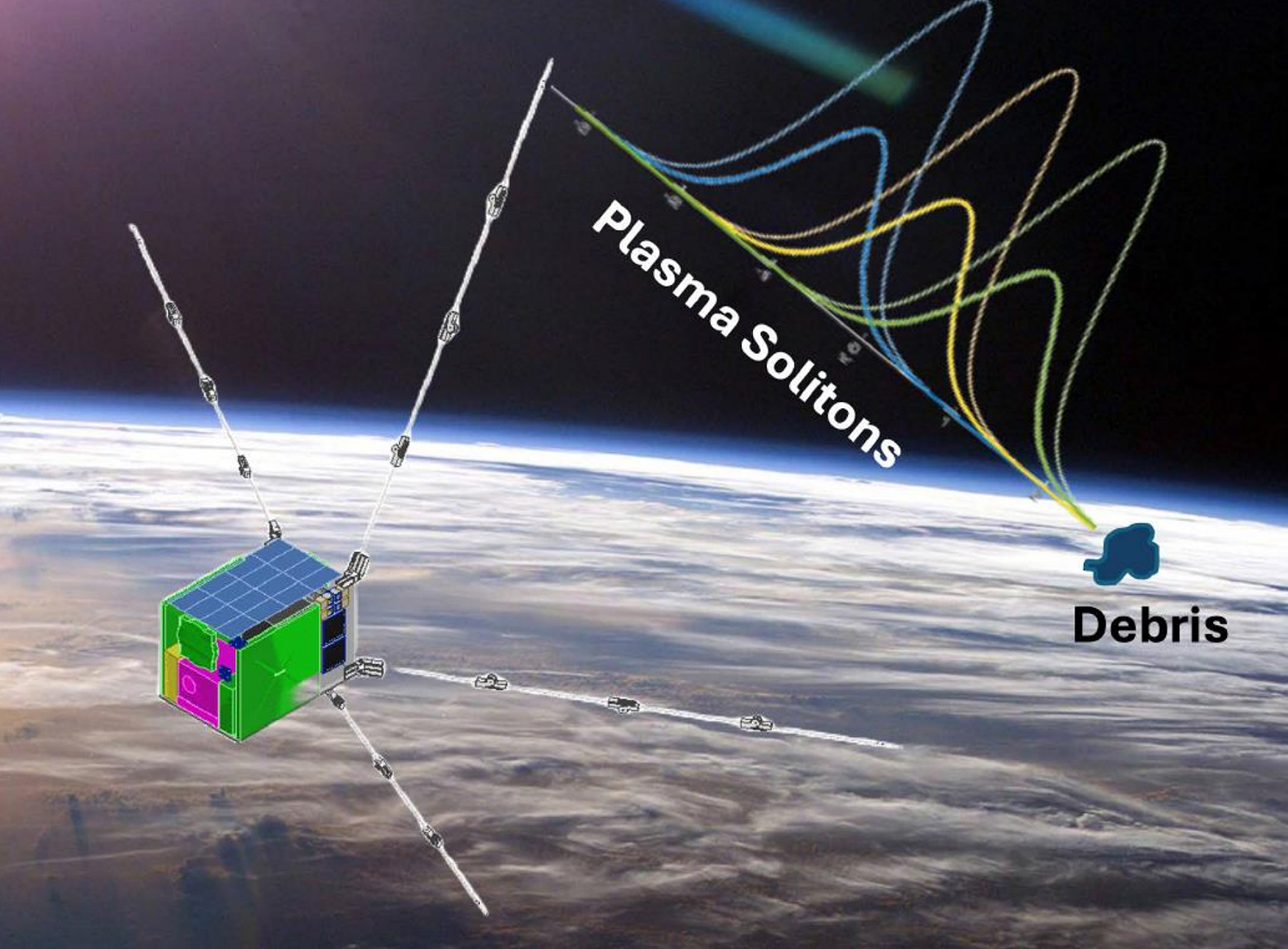
Artist rendition of novel concept for Plasma solutions
Artist concept highlighting the novel approach proposed by the 2025 NIAC awarded selection of the Mapping Sub-cm Orbital Debris in LEO concept.
NASA/Christine Hartzell

Christine Hartzell
University of Maryland, College Park

The proposed investigation will address key technological challenges associated with a previously funded NIAC Phase I award titled “On-Orbit, Collision-Free Mapping of Small Orbital Debris”. Sub-cm orbital debris in LEO is not detectable or trackable using conventional technologies and poses a major hazard to crewed and un-crewed spacecraft. Orbital debris is a concern to NASA, as well as commercial and DoD satellite providers. In recent years, beginning with our NIAC Phase I award, we have been developing the idea that the sub-cm orbital debris environment may be monitored by detecting the plasma signature of the debris, rather than optical or radar observations of the debris itself. Our prior work has shown that sub-cm orbital debris may produce plasma solitons, which are a type of wave in the ionosphere plasma that do not disperse as readily as traditional waves. Debris may produce solitons that are co-located with the debris (called pinned solitons) or that travel ahead of the debris (called precursor solitons). We have developed computational models to predict the characteristics of the plasma solitons generated by a given piece of debris. These solitons may be detectable by 12U smallsats outfitted with multi-needle Langmuir probes.

In this Phase II NIAC award, we will address two key technical challenges that significantly effect the value of soliton-based debris detection: 1. Develop an algorithm to constrain debris size and speed based on observed soliton characteristics. Our prior investigations have produced predictions of soliton characteristics as a function of debris characteristics. However, the inverse problem is not analytically solvable. We will develop machine learning algorithms to address this challenge. 2. Evaluate the feasibility and value of detecting soliton velocity. Multiple observations of the same soliton may allow us to constrain the distance that the soliton has traveled from the debris. When combined with the other characteristics of the soliton and knowledge of the local plasma environment, back propagation of the soliton in plasma simulations may allow us to extract the position and velocity vectors of the debris. If it is possible to determine debris size, position and velocity from soliton observations, this would provide a breakthrough in space situational awareness for debris that is currently undetectable using conventional technology. However, even if only debris size and speed can be inferred from soliton detections, this technology is still a revolutionary improvement on existing methods of characterizing the debris flux, which provide data only on a multi-year cadence. This proposed investigation will answer key technological questions about how much information can be extracted from observed soliton signals and trade mission architectures for complexity and returned data value. Additionally, we will develop a roadmap to continue to advance this technology.

2025 Selections

Share

Details

Last Updated

May 27, 2025

Editor
Loura Hall

Powered by WPeMatico

Get The Details…
Loura Hall
Breathing Beyond Earth: A Reliable Oxygen Production Architecture for Human Space Exploration

Breathing Beyond Earth: A Reliable Oxygen Production Architecture for Human Space Exploration

3 min read

Preparations for Next Moonwalk Simulations Underway (and Underwater)

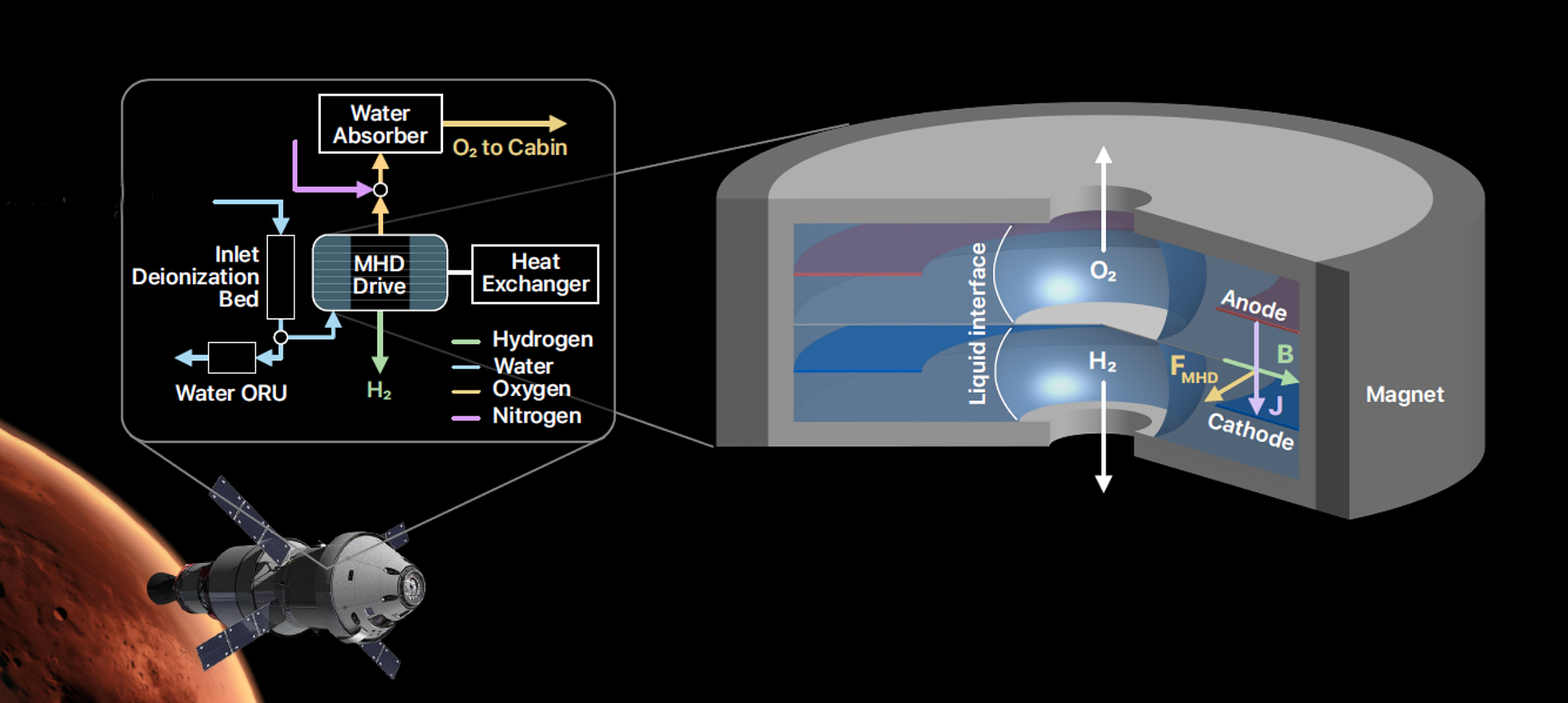
Labeled diagram of the Breathing Beyond Earth concept in space with Mars.
Artist concept highlighting the novel approach proposed by the 2025 NIAC awarded selection of the Breathing Beyond Earth concept.
NASA/Alvaro Romero-Calvo

Alvaro Romero-Calvo
Georgia Tech Research Corporation

The reliable and efficient operation of spacecraft life support systems is challenged in microgravity by the near absence of buoyancy. This impacts the electrolytic production of oxygen and hydrogen from water by forcing the adoption of complex multiphase flow management technologies. Still, water splitting plays an essential role in human spaceflight, closing the regenerative environmental control and life support loop and connecting the water and atmosphere management subsystems. Existing oxygen generation systems, although successful for short-term crewed missions, lack the reliability and efficiency required for long-duration spaceflight and, in particular, for Mars exploration.

During our Phase I NIAC effort, we demonstrated the basic feasibility of a novel water-splitting architecture that leverages contactless magnetohydrodynamic (MHD) forces to produce and separate oxygen and hydrogen gas bubbles in microgravity. The system, known as the Magnetohydrodynamic Oxygen Generation Assembly (MOGA), avoids the use of forced water recirculation loops or moving parts such as pumps or centrifuges for phase separation. This fundamental paradigm shift results in multiple operational advantages with respect to the state-of-the-art: increased robustness to over- and under-voltages in the cell stack, minimal risk of electrolyte leaching, wider operational temperature and humidity levels, simpler transient operation, increased material durability, enhanced system stability during dormant periods, modest water purity requirements, reduced microbial growth, and better component-level swap-ability, all of which result in an exceptionally robust system. Overall, these architectural features lead to a 32.9% mass reduction and 20.4% astronaut maintenance time savings with respect to the Oxygen Generation Assembly at the ISS for a four-crew Mars transfer, making the system ideally suited for long-duration missions. In Phase II, we seek to answer some of the key remaining unknowns surrounding this architecture, particularly regarding (i) the long-term electrochemical and multiphase flow behavior of the system in microgravity and its impact on power consumption and liquid interface stability, (ii) the transient operational modes of the MHD drive during start-up, shutdown, and dormancy, and (iii) architectural improvements for manufacturability and ease of repair. Toward that end, we will leverage our combined expertise in microgravity research by partnering with the ZARM Institute in Bremen and the German Aerospace Center to fly, free of charge to NASA, a large-scale magnetohydrodynamic drive system and demonstrate critical processes and components. An external review board composed of industry experts will assess the evolution of the project and inform commercial infusion. This effort will result in a TRL-4 system that will also benefit additional technologies of interest to NASA and the general public, such as water-based SmallSat propulsion and in-situ resource utilization.

2025 Selections

Share

Details

Last Updated

May 27, 2025

Editor
Loura Hall

Powered by WPeMatico

Get The Details…
Loura Hall
TFINER – Thin Film Isotope Nuclear Engine Rocket

TFINER – Thin Film Isotope Nuclear Engine Rocket

2 min read

Preparations for Next Moonwalk Simulations Underway (and Underwater)

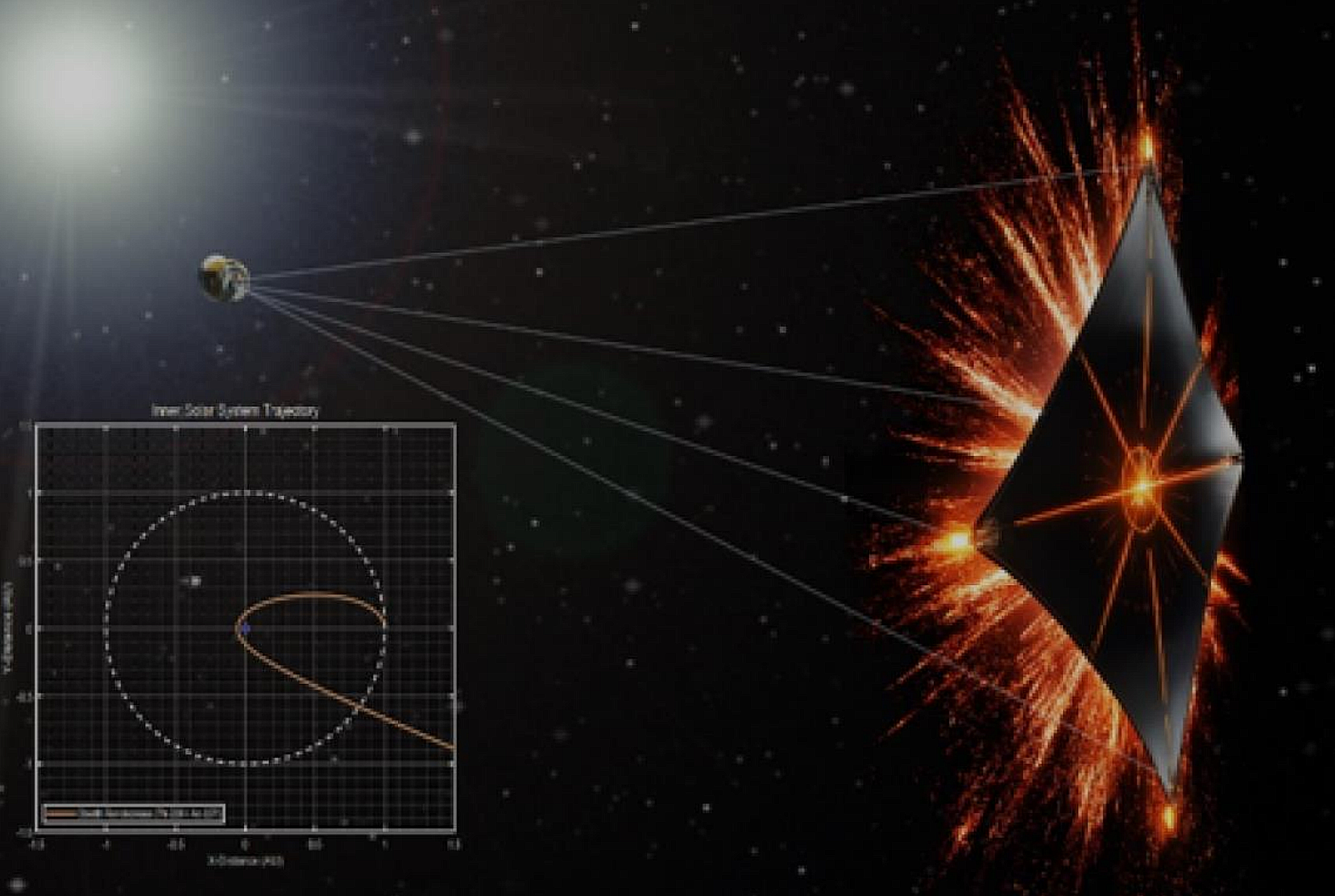
Artist rendition of novel concept in space with Earth in distance and solar sail
Artist concept highlighting the novel approach proposed by the 2025 NIAC awarded selection of the TFINER concept.
NASA/James Bickford

James Bickford
Charles Stark Draper Laboratory, Inc.

The Thin-Film Nuclear Engine Rocket (TFINER) is a novel space propulsion technology that enables aggressive space exploration for missions that are impossible with existing approaches. The concept uses thin layers of energetic radioisotopes to directly generate thrust. The emission direction of its natural decay products is biased by a substrate to accelerate the spacecraft. A single stage design is very simple and can generate velocity changes of ~100 km/s using a few kilograms of fuel and potentially more than 150 km/s for more advanced architectures.

The propulsion system enables a rendezvous with intriguing interstellar objects such as ‘Oumuamua that are on hyperbolic orbits through our solar system. A particular advantage is the ability to maneuver in deep space to find objects with uncertainty in their location. The same capabilities also enable a fast trip to the solar gravitational focus to image multiple potentially habitable exoplanets. Both types of missions require propulsion outside the solar system that is an order of magnitude beyond the performance of existing technology. The phase 2 effort will continue to mature TFINER and the mission design. The program will work towards small scale thruster experiments in the near term. In parallel, isotope production paths that can also be leveraged for other space exploration and medical applications will be pursued. Finally, advanced architectures such as an Oberth solar dive maneuver and hybrid approaches that leverage solar sails near the Sun, will be explored to enhance mission performance.

2025 Selections

Share

Details

Last Updated

May 27, 2025

Editor
Loura Hall

Powered by WPeMatico

Get The Details…
Loura Hall
Photophoretic Propulsion Enabling Mesosphere Exploration

Photophoretic Propulsion Enabling Mesosphere Exploration

2 min read

Preparations for Next Moonwalk Simulations Underway (and Underwater)

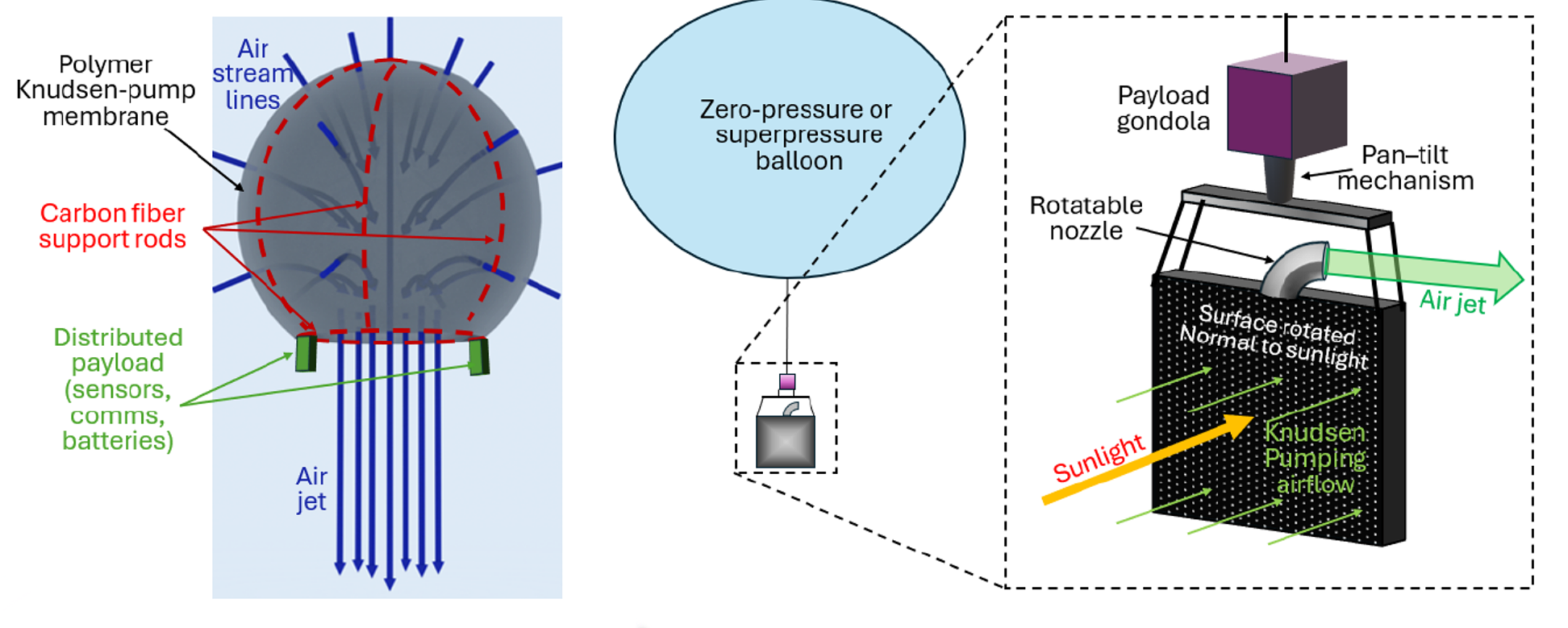
Labeled diagram depicting Photophoretic Propulsion
Artist concept highlighting the novel approach proposed by the 2025 NIAC awarded selection of Photophoretic Propulsion Enabling Mesosphere Exploration concept.
NASA/Igor Bargatin

Igor Bargatin
University of Pennsylvania

We propose to use the photophoretic levitation and propulsion mechanism to create no-moving-parts flying vehicles that can be used to explore Earth’s upper atmosphere. The photophoretic force arises when a solid is heated relative to the ambient gas through illumination, inducing momentum exchange between the solid and the gas. The force creates lift in structures that absorb light on the bottom yet stay cool on the top, and we engineered our plate mechanical metamaterials to maximize this lift force and payload. The levitation and payload capabilities of our plates typically peak at ambient pressures in the 0.1-1000 Pa range, ideal for applications in Earth’s mesosphere and Mars’s low gravity and thin atmosphere. For example, in the Earth’s mesosphere (i.e., at altitudes from ~50 to ~80 km), the air is too thin for conventional airplanes or balloons but too thick for satellites, such that measurements can be performed for only a few minutes at a time during the short flight of a research rocket. However, the range of ambient pressures in the mesosphere (1-100 Pa) is nearly optimal for our plates’ payload capabilities. Phase 2 of the proposal focuses on the scalable fabrication of Knudsen pump structures that will enable missions with kg-scale payloads in the mesosphere as well as trajectory control with 1 m/s velocity control in existing stratospheric balloon vehicles.

2025 Selections

Share

Details

Last Updated

May 27, 2025

Editor
Loura Hall

Powered by WPeMatico

Get The Details…
Loura Hall