Artemis Astronauts & Orion Leadership Visit NASA Ames

Artemis Astronauts & Orion Leadership Visit NASA Ames

2 min read

Preparations for Next Moonwalk Simulations Underway (and Underwater)

Two astronauts in blue jumpsuits stand at the left of the image, listening to a man speaking on the right side of the image. People and equipment fill the background.
Astronauts Victor Glover and Christina Koch tour the Arc Jet Facility at NASA’s Ames Research Center, learning more about the testing equipment’s capabilities to analyze thermal protection systems from George Raiche, thermophysics facilities branch chief at Ames.
NASA/Donald Richey

As NASA prepares to send astronauts to the Moon aboard the Orion spacecraft, research, testing, and development at NASA’s Ames Research Center in California’s Silicon Valley has played a critical role.

Recently, Ames welcomed Artemis II astronauts Christina Koch and Victor Glover and Orion leaders Debbie Korth, deputy program manager, and Luis Saucedo, deputy crew and service module manager, to tour Ames facilities that support the Orion Program and celebrate the achievements of employees.

The group started their visit at the Arc Jet Complex, where researchers use extremely hot, high-speed gases to simulate the intense heat of atmospheric reentry before visiting the Sensors & Thermal Protection Systems Advanced Research Laboratories. The team works to develop sensors and flight instrumentation that measure heat shield response throughout a mission.

These systems were used to develop and test Orion’s thermal protection system to ensure the safety of astronauts during future missions. After the successful return of the Artemis I Orion spacecraft, Ames research was essential when analyzing unexpected charring loss on the heat shield.

A woman speaks at a podium, with an American flag and two astronauts in blue jumpsuits in the background.
Debbie Korth, Orion deputy program manager, presents awards to the Ames workforce at the Orion Circle of Excellence Awards Ceremony, while astronauts Christina Koch and Victor Glover look on.
NASA/Donald Richey

The visit culminated in an award ceremony to honor employees with outstanding performance and a legacy of service to the Orion Program. Thirty-two employees were honored for their individual or team contributions.

“The Ames workforce has played an important role in developing, testing, and validating the Orion spacecraft’s thermal protection system as well as supporting its software and guidance, navigation, and control,” said Eugene Tu, NASA Ames center director. “I’m pleased to see their contributions recognized and celebrated by program leadership and two of the astronauts whose safety and success were in mind when ensuring these systems are safe, reliable, and the highest quality possible.”

Powered by WPeMatico

Get The Details…
Tara Friesen

What Are the Dangers of Going to Space? We Asked a NASA Expert: Episode 55

What Are the Dangers of Going to Space? We Asked a NASA Expert: Episode 55

2 min read

Preparations for Next Moonwalk Simulations Underway (and Underwater)

What are the dangers of going to space?

For human spaceflight, the first thing I think about is the astronauts actually strapping themselves to a rocket. And if that isn’t dangerous enough, once they launch and they’re out into space in deep exploration, we have to worry about radiation.

Radiation is coming at them from all directions. From the Sun, we have solar particles. We have galactic cosmic rays that are all over in the universe. And those cause damage to DNA. On Earth here, we use sunscreen to protect us from DNA damage. Our astronauts are protected from the shielding that’s around them in the space vehicles.

We also have to worry about microgravity. So what happens there? We see a lot of bone and muscle loss in our astronauts. And so to prevent this, we actually have the astronauts exercising for hours every day. And of course we don’t want to run out of food on a space exploration mission. So we want to make sure that we have everything that the astronauts need to take with them to make sure that we can sustain them.

There are many risks associated with human space exploration. NASA has been planning for these missions to make our astronauts return home safely.

[END VIDEO TRANSCRIPT]

Full Episode List

Full YouTube Playlist

Powered by WPeMatico

Get The Details…
Emily Furfaro

NASA Sets Coverage for Crew Launch to Join Station Expedition 72/73

NASA Sets Coverage for Crew Launch to Join Station Expedition 72/73

The Roscosmos Soyuz MS-27 spacecraft will launch from the Baikonur Cosmodrome in Kazakhstan to the International Space Station with (pictured left to right) NASA astronaut Jonny Kim and Roscosmos cosmonauts Sergey Ryzhikov and Alexey Zubritsky.
Credit: Gagarin Cosmonaut Training Center

NASA astronaut Jonny Kim will launch aboard the Roscosmos Soyuz MS-27 spacecraft to the International Space Station, accompanied by cosmonauts Sergey Ryzhikov and Alexey Zubritsky, where they will join the Expedition 72/73 crew in advancing scientific research.

Kim, Ryzhikov, and Zubritsky will lift off at 1:47 a.m. EDT Tuesday, April 8 (10:47 a.m. Baikonur time) from the Baikonur Cosmodrome in Kazakhstan.

Watch live launch and docking coverage on NASA+. Learn how to watch NASA content through a variety of platforms.

After a two-orbit, three-hour trajectory to the station, the spacecraft will dock automatically to the station’s Prichal module at approximately 5:03 a.m. Shortly after, hatches will open between Soyuz and the space station.

Once aboard, the trio will join NASA astronauts Nichole Ayers, Anne McClain, and Don Pettit, JAXA (Japan Aerospace Exploration Agency) astronaut Takuya Onishi, and Roscosmos cosmonauts Alexey Ovchinin, Kirill Peskov, and Ivan Vagner.

NASA’s coverage is as follows (all times Eastern and subject to change based on real-time operations):

Tuesday, April 8

12:45 a.m. – Launch coverage begins on NASA+.

1:47 a.m. – Launch

4:15 a.m. – Rendezvous and docking coverage begins on NASA+.

5:03 a.m. – Docking

7 a.m. – Hatch opening and welcome remarks coverage begins on NASA+.

7:20 a.m. – Hatch opening

The trio will spend approximately eight months aboard the orbital laboratory as Expedition 72 and 73 crew members before returning to Earth in December. This will be the first flight for Kim and Zubritsky, and the third for Ryzhikov.

For more than two decades, people have lived and worked continuously aboard the International Space Station, advancing scientific knowledge and making research breakthroughs that are not possible on Earth. The station is a critical testbed for NASA to understand and overcome the challenges of long-duration spaceflight and to expand commercial opportunities in low Earth orbit. As commercial companies focus on providing human space transportation services and destinations as part of a robust low Earth orbit economy, NASA is focusing more resources on deep space missions to the Moon as part of the Artemis campaign in preparation for future human missions to Mars.

Learn more about International Space Station research and operations at:

https://www.nasa.gov/station

-end-

Joshua Finch / Jimi Russell
Headquarters, Washington
202-358-1100
joshua.a.finch@nasa.gov / james.j.russell@nasa.gov

Sandra Jones
Johnson Space Center, Houston
281-483-5111
sandra.p.jones@nasa.gov

Powered by WPeMatico

Get The Details…
Tiernan P. Doyle

X-ray Clues Reveal Destroyed Planet

X-ray Clues Reveal Destroyed Planet

The Helix Nebula is a cloud of gas ejected by a dying star, known as a white dwarf. In the composite image, the cloud of gas strongly resembles a creature’s eye. Here, a hazy blue cloud is surrounded by misty, concentric rings of pale yellow, rose pink, and blood orange. Each ring appears dusted with flecks of gold, particularly the outer edges of the eye-shape. The entire image is speckled with glowing dots in blues, whites, yellows, and purples. At the center of the hazy blue gas cloud, is a bright white dot with a pink outer ring, and a smaller white dot.
In about 5 billion years, our Sun will run out of fuel and expand, possibly engulfing Earth. These end stages of a star’s life can be utterly beautiful – as is the case with this planetary nebula called the Helix Nebula. Astronomers study these objects by looking at all kinds of light.
X-ray: NASA/CXC/SAO/Univ Mexico/S. Estrada-Dorado et al.; Ultraviolet: NASA/JPL; Optical: NASA/ESA/STScI (M. Meixner)/NRAO (T.A. Rector); Infrared: ESO/VISTA/J. Emerson; Image Processing: NASA/CXC/SAO/K. Arcand

This image of the Helix Nebula, released on March 4, 2025, shows a potentially destructive white dwarf at the nebula’s center: this star may have destroyed a planet. This has never been seen before – and could explain a mysterious X-ray signal that astronomers have detected from the nebula for over 40 years.

This view combines X-rays from NASA’s Chandra X-ray Observatory (magenta), optical light data from NASA’s Hubble Space Telescope (orange, light blue), infrared data from the European Southern Observatory VISTA telescope (gold, dark blue), and ultraviolet data from GALEX (purple) of the Helix Nebula. Data from Chandra indicates that this white dwarf has destroyed a very closely orbiting planet.

Image credit: X-ray: NASA/CXC/SAO/Univ Mexico/S. Estrada-Dorado et al.; Ultraviolet: NASA/JPL; Optical: NASA/ESA/STScI (M. Meixner)/NRAO (T.A. Rector); Infrared: ESO/VISTA/J. Emerson; Image Processing: NASA/CXC/SAO/K. Arcand

Powered by WPeMatico

Get The Details…
Monika Luabeya

NASA Continues Support for Private Astronaut Missions to Space Station

NASA Continues Support for Private Astronaut Missions to Space Station

3 min read

Preparations for Next Moonwalk Simulations Underway (and Underwater)

The International Space Station is pictured from the SpaceX Dragon crew spacecraft by a SpaceX Crew-8 member shortly after undocking from the Harmony module's space-facing port. The orbital outpost was soaring 272 miles above the cloudy Patagonia region of South America at the time of this photograph.
The International Space Station is pictured from the SpaceX Dragon spacecraft by a Crew-8 member shortly after undocking from the Harmony module’s space-facing port as the orbital outpost was soaring 272 miles above the cloudy Patagonia region of South America.
NASA

NASA is seeking proposals for two new private astronaut missions to the International Space Station, targeted for 2026 and 2027, as the agency continues its commitment to expanding access to space. These private missions enable American commercial companies to further develop capabilities and support a continuous human presence in low Earth orbit.

“We are in an incredible time for human spaceflight, with more opportunities to access space and grow a thriving commercial economy in low Earth orbit,” said Dana Weigel, program manager for the International Space Station at NASA’s Johnson Space Center in Houston. “NASA remains committed to supporting this expansion by leveraging our decades of expertise to help industry gain the experience needed to train and manage crews, conduct research, and develop future destinations. Private astronaut missions are a key part of this effort, providing companies with hands-on opportunities to refine their capabilities and build partnerships that will shape the future of low Earth orbit.”

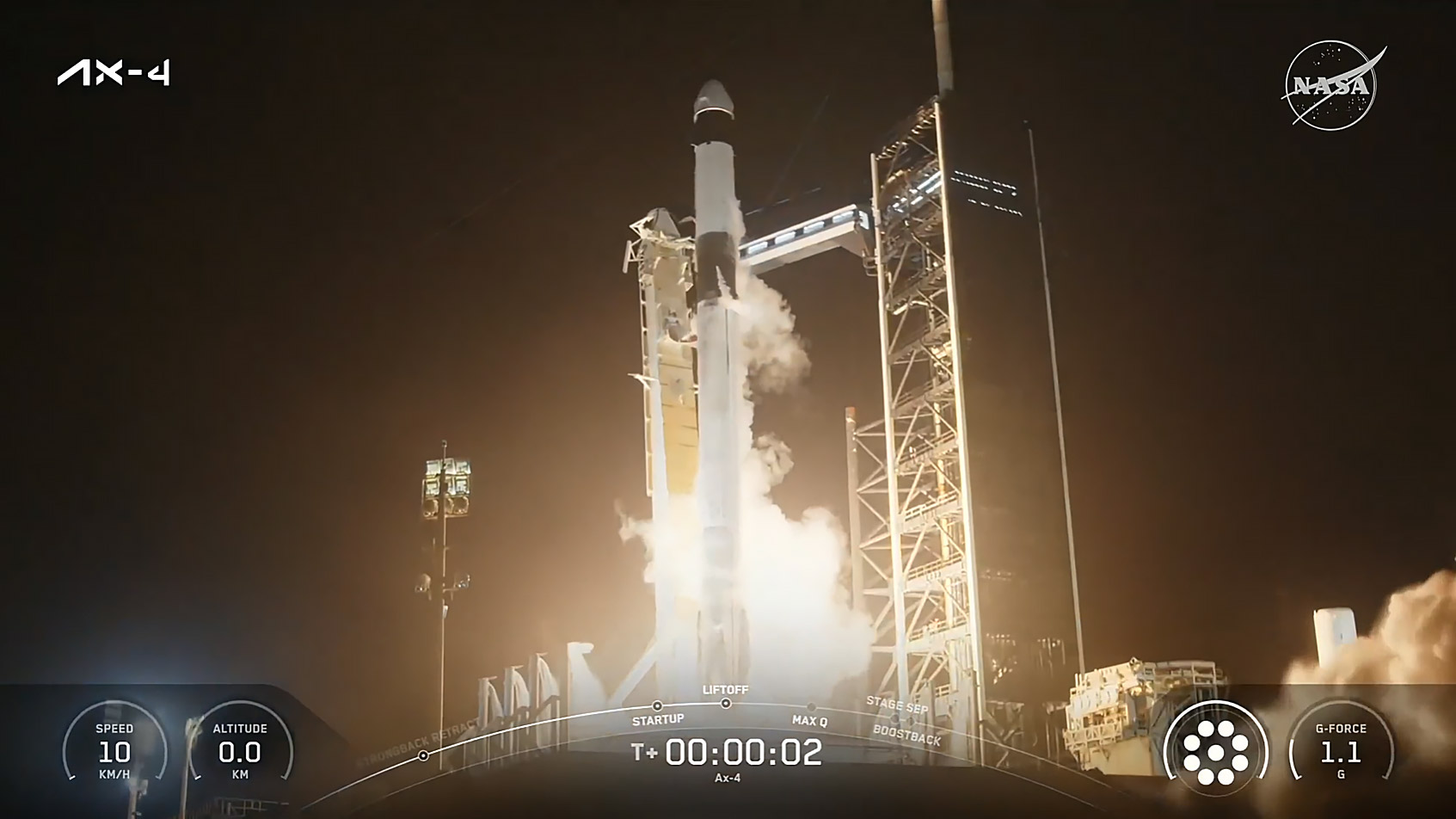
The new flight opportunities will be the fifth and sixth private astronaut missions to the orbiting laboratory coordinated by NASA. The first three missions were accomplished by Axiom Space in April 2022, May 2023, and January 2024, with a fourth scheduled for no earlier than May 2025.

Each of the new missions may be docked to the space station for up to 14 days. Specific dates depend on spacecraft traffic at the space station and in-orbit activity planning and constraints. Private astronaut missions must be brokered by a U.S. entity and use U.S. transportation spacecraft that meet NASA’s International Space Station visiting vehicle requirements, policies, and procedures. For additional details, refer to Focus Area 4A of NASA Research Announcement (NRA) NNJ13ZBG001N.

Proposals are due by 5 p.m. EDT on Friday, May 30, 2025.

For solicitation information, visit:

https://www.nasa.gov/johnson/jsc-procurement/pam

For more than two decades, people have lived and worked continuously aboard the International Space Station, advancing scientific knowledge and demonstrating new technologies, making research breakthroughs not possible on Earth. The station is a critical testbed for NASA to understand and overcome the challenges of long-duration spaceflight and to expand commercial opportunities in low Earth orbit. As commercial companies focus on providing human space transportation services and destinations as part of a robust low Earth orbit economy, NASA’s Artemis campaign is underway at the Moon, where the agency is preparing for future human exploration of Mars.

Learn more about the International Space Station at: 

https://www.nasa.gov/station

Powered by WPeMatico

Get The Details…
Ana Guzman