Sols 4500-4501: Bedrock With a Side of Sand

Sols 4500-4501: Bedrock With a Side of Sand

3 min read

Sols 4500-4501: Bedrock With a Side of Sand

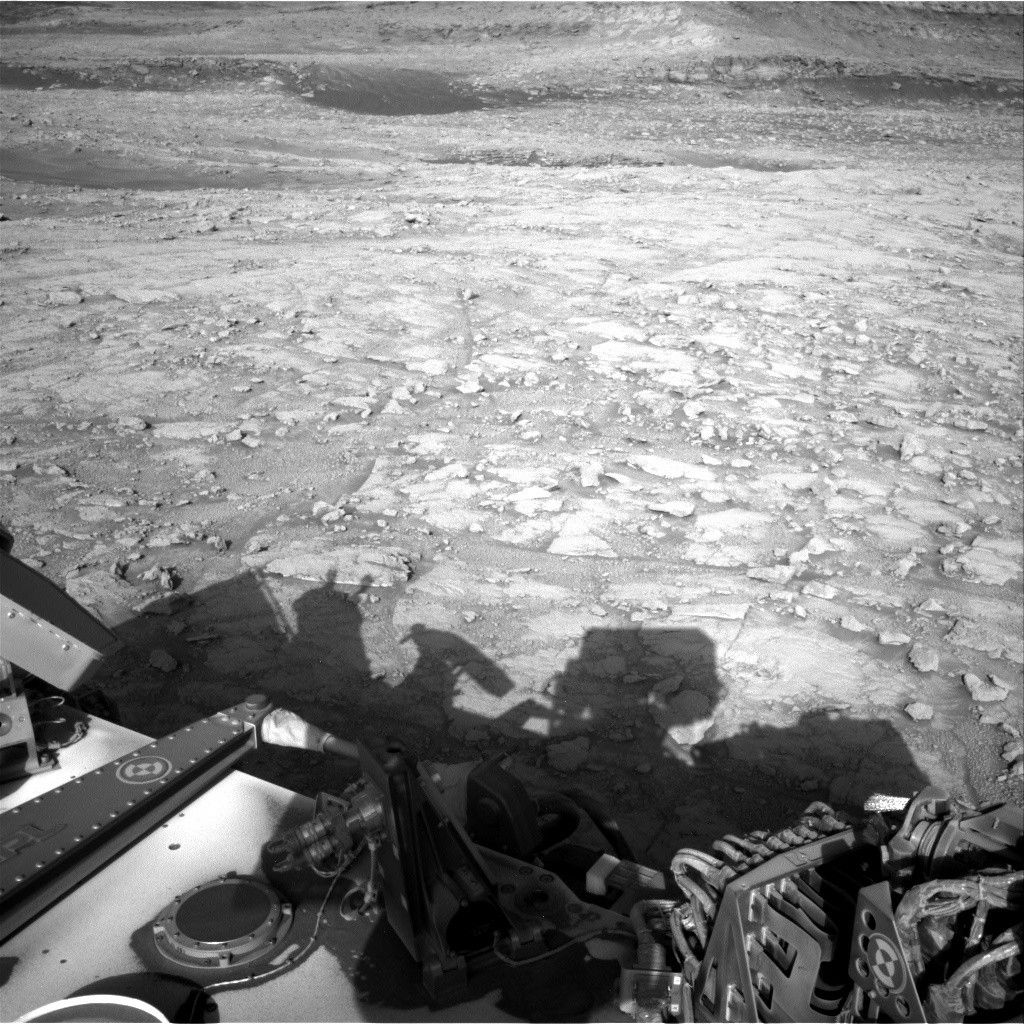
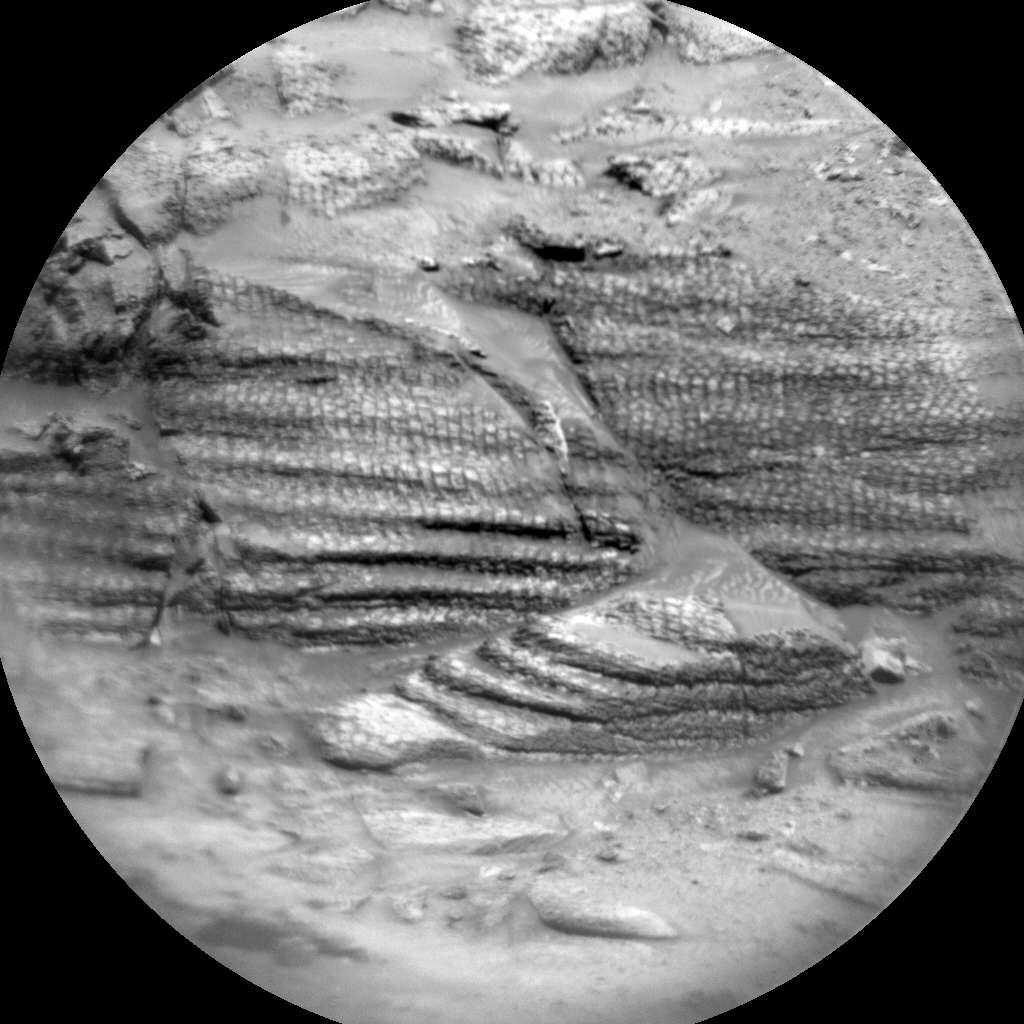
A grayscale photograph of the Martian surface from the Curiosity rover captures medium gray soil in front of the rover, wavy in most areas, as if sculpted by wind or water, with rocks everywhere protruding up through it. They are lighter-toned than the ground, some rounded, others looking like cracked, smooth plates. One large, jagged, light-colored rock stands out, in the center of the image. A part of the rover is visible in the frame, at bottom center.
NASA’s Mars rover Curiosity acquired this image using its Left Navigation Camera on March 28, 2025 — Sol 4494, or Martian day 4,494 of the Mars Science Laboratory mission — at 17:06:34 UTC.
NASA/JPL-Caltech

Written by Sharon Wilson Purdy, Planetary Geologist at Smithsonian National Air and Space Museum

Earth planning date: Wednesday, April 2, 2025

Wow, sol 4500. What an impressive number of sols (Martian days) exploring the Red Planet! This delightfully even sol number made me wonder where the Mars Exploration Rover (MER) Opportunity was at this point in her mission (Opportunity’s twin rover, Spirit, explored Gusev crater on Mars for roughly 2210 sols). As it turns out, Opportunity was driving over fairly smooth terrain on sol 4500 and was approaching a light-toned rounded hill named “Spirit Mound” on the western rim of Endeavour crater in Meridiani Planum

I am always so impressed and proud when I stop to think about the incredible fleet of rovers we have safely landed and operated on Mars, and the amazing scientific discoveries that have resulted from these missions!

Today I served on science operations as the “keeper of the plan” for the geology and mineralogy theme group. In this role, I assembled the activities in our team planning software for this two-sol plan. Our small plan becomes part of a much larger set of instructions that will be relayed up to the rover later today. Currently, the Curiosity rover is driving up Mount Sharp over broken-up blocks of bedrock and sand through a small canyon en route to the boxwork structures ahead. This bumpy terrain can sometimes make it hard to pass the “Slip Risk Assessment Process” (SRAP) where all six wheels are required to be stable on the ground before we can unstow our robotic arm to use the contact science instruments. After our successful 8-meter drive (about 26 feet) from yestersol we passed SRAP and got to work selecting targets for contact and remote observations.

The team chose to characterize a bedrock target in front of us called “Chuckwalla” using the dust removal tool (DRT), APXS, and MAHLI.  ChemCam used its LIBS instrument to analyze the chemistry of a nearby bedrock target with a knobby texture, “Pechacho,” and took a long distance RMI image to study the interesting layering in the “Devil’s Gate” butte. Mastcam assembled an impressive portfolio of observations in this two-sol plan. The team imaged variations in bedrock textures at “Jalama” and “Julian” and documented the nature of the “Mishe Mokwa” ridgeline. In addition, Mastcam imaged darker rocks within a previously acquired mosaic of Devil’s Gate and investigated narrow troughs (small depressions) within the sand in the workspace.

The environmental theme group, with their eye on the sky, included activities to measure the optical depth of the atmosphere, constrain aerosol scattering properties, and observe clouds. A very busy day of planning for sols 4500-4501, with many more to come!

Share

Details

Last Updated
Apr 07, 2025

Related Terms

Powered by WPeMatico

Get The Details…

From FIRST Robotics to NASA Rockets: Angel Saenz’s Journey to White Sands

From FIRST Robotics to NASA Rockets: Angel Saenz’s Journey to White Sands

Long before joining NASA’s Test and Evaluation Support Team contract in October 2024, Angel Saenz was already an engineer at heart.

A STEM education program at his high school helped unlock that passion, setting him on a path that would eventually lead to NASA’s White Sands Test Facility in Las Cruces, New Mexico.

NASA engineer Angel Saenz poses next to a large golden ball on a white stand.
Angel Saenz poses in front of a composite overwrap pressure vessel outside of his office at White Sands Test Facility in Las Cruces, New Mexico.
NASA/Anthony L. Quiterio

The program – FIRST Robotics Competition – is run by global nonprofit, FIRST (For Inspiration and Recognition of Science and Technology). It was the brainchild of prolific inventor Dean Kamen, best known for creating the Segway.

In what the organization calls “the ultimate sport for the mind,” teams of students spend six weeks working under adult mentors—and strict rules—to design, program, and build industrial-sized robots before facing off in a themed tournament. Teams earn points for accomplishing various engineering feats, launching, grappling, and climbing their way through the obstacles of a game that’s less football and more American Ninja Warrior.

Competing during the 2013 and 2014 seasons with the White Sands-sponsored Deming Thundercats, Saenz said FIRST was a link between abstract mathematical ideas and real-world applications.

“Before joining FIRST, equations were just something I was told to solve for a grade, but now I was applying them and seeing how they were actually useful,” he said.

By turning education into an extracurricular activity as compelling as video games and as competitive as any varsity sport, FIRST completely reshaped Saenz’s approach to learning.

“There are lots of other things kids can choose to do outside of school, but engineering was always that thing for me,” he said. “I associate it with being a fun activity, I see it more as a hobby.”

That kind of energy—as any engineer knows—cannot be destroyed. Today Saenz channels it into his work, tackling challenges with White Sand’s Composite Pressure group where he tests and analyzes pressure vessel systems, enabling their safe use in space programs.

“Having that foundation really helps ground me,” he said. “When I see a problem, I can look back and say, ‘That’s like what happened in FIRST Robotics and here’s how we solved it.’”

Deming High School teacher and robotics mentor David Wertz recognized Saenz’s aptitude for engineering, even when Saenz could not yet see it in himself.

“He wasn’t aware that we were using the engineering process as we built our robot,” Wertz said, “but he was always looking for ways to iterate and improve our designs.”

Saenz credits those early hands-on experiences for giving him a head start.

“It taught me a lot of concepts that weren’t supposed to be learned until college,” he said.

Armed with that knowledge, Saenz graduated from New Mexico State University in 2019 with a dual degree in mechanical and aerospace engineering.

Now 28 years old, Saenz is already an accomplished professional. He adds White Sands to an impressive resume that includes past experiences with Albuquerque-based global manufacturing company Jabil and Kirtland Airforce Base.

Though only five months into the job, Saenz’s future at White Sands was set into motion more than a decade ago when he took a field trip to the site with Wertz in 2013.

“The kind invitations to present at White Sands or to take a tour of the facility has inspired many of the students to pursue degrees in engineering and STEM,” Wertz said. “The partnership continues to allow students to see the opportunities that are available for them if they are willing to put in the work.”

In a full-circle moment, Saenz and Mr. Wertz recently found themselves together at White Sands once again for the 2024 Environmental, Innovation, Safety, and Health Day event. This time not as student and teacher, but as industry colleagues in a reunion that could not have been better engineered.

NASA engineer Angel Saenz with his mentor and teacher, David Wertz.
David Wertz and Angel Saenz attend White Sand’s Environmental, Innovation, Safety, and Health Day event on October 31, 2024.

The 2025 FIRST Robotics World Competition will take place in Houston at the George R. Brown Convention Center from April 16 to April 19. NASA will host an exciting robotics exhibit at the event, showcasing the future of technology and spaceflight. As many as 60,000 energetic fans, students, and industry leaders are expected to attend. Read more about NASA’s involvement with FIRST Robotics here.

Powered by WPeMatico

Get The Details…
Linda E. Grimm

Gateway’s First Habitation Module Arrives Stateside

Gateway’s First Habitation Module Arrives Stateside

A large, boxy container is lowered onto a flatbed by a crane at right. The container has an Artemis logo on the back and a Northrop Grumman logo on the left side. There are more logos on it, but they are difficult to see. There are several people in orange or yellow high-visibility vests near the container. The night sky makes up the background of the image. The sky darkens as you look upward; the last of a sunset tints the very bottom a rosy pink. You can see a sliver of the Moon toward the top.
NASA/Josh Valcarcel

From the mountains of Turin to the deserts of Arizona, a core element of Gateway, humanity’s first lunar space station, is now one step closer to the Moon. As seen in this April 1, 2025, photo, HALO (Habitation and Logistics Outpost), Gateway’s first pressurized module and one of its foundational elements, recently arrived in Gilbert, Arizona, following its fabrication by Thales Alenia Space in Turin, Italy. Now on U.S. soil, the module will undergo final outfitting by primary contractor Northrop Grumman before it’s integrated with the Power and Propulsion Element at NASA’s Kennedy Space Center. Together, the two modules will launch to lunar orbit aboard a SpaceX Falcon Heavy rocket ahead of the Artemis IV mission.

HALO will support astronauts visiting Gateway and function as a command and control hub for the space station. It will feature docking ports for spacecraft such as NASA’s Orion, logistics vehicles and lunar landers, and provide data handling, energy storage, power distribution, thermal regulation, and communications and tracking capabilities.

HALO’s arrival marks a major milestone in the construction of Gateway, a cornerstone of NASA’s Artemis campaign to advance science and exploration on and around the Moon in preparation for the next giant leap: the first human missions to Mars.

Image credit: NASA/Josh Valcarcel

Powered by WPeMatico

Get The Details…
Briana R. Zamora

NASA+ to Stream Nomination Hearing for Next Agency Administrator

NASA+ to Stream Nomination Hearing for Next Agency Administrator

The letters NASA on a blue circle with red and white detail, all surrounded by a black background
Credit: NASA

Jared Isaacman is set to participate in a hearing to become the next NASA administrator at 10 a.m. EDT on Wednesday, April 9, before the U.S. Senate Committee on Commerce, Science, and Transportation. The nomination hearing will take place at Russell Senate Office Building in Washington.

The agency will stream the hearing on NASA+, and the committee will stream it on its website and YouTube channel. Learn how to watch NASA content on a variety of agency platforms, including social media.

President Trump formally nominated Isaacman for NASA administrator on Jan. 20. The following is a statement from acting NASA Administrator Janet Petro on the nomination hearing:

“I’m glad the Senate has scheduled a hearing to consider Jared Isaacman’s nomination as NASA administrator. Isaacman’s experience in commercial spaceflight and his commitment to advancing space capabilities align with NASA’s ongoing efforts to enhance America’s position as the global leader in space exploration. Upon confirmation, his leadership will support our work to drive American innovation, strengthen partnerships, and further the essential mission of the agency for the benefit of all.”

Media interested in participating in the event must contact Bethany Stevens and their respective Senate media gallery to RSVP. Contact details are available on the committee’s website.

For more information about NASA missions, visit:

https://www.nasa.gov

-end-

Bethany Stevens / Cheryl Warner
Headquarters, Washington
202-358-1600
bethany.c.stevens@nasa.gov / cheryl.m.warner@nasa.gov

Share

Details

Last Updated

Apr 07, 2025

Editor
Jessica Taveau

Related Terms

Powered by WPeMatico

Get The Details…
Jessica Taveau

Back to Earth, Forward to the Future: NASA’s SpaceX Crew-9 Returns  

Back to Earth, Forward to the Future: NASA’s SpaceX Crew-9 Returns  

After months of groundbreaking research, exploration, and teamwork aboard the International Space Station, NASA’s SpaceX Crew-9 has returned to Earth.  

NASA astronauts Nick Hague, Suni Williams, and Butch Wilmore, as well as Roscosmos cosmonaut Aleksandr Gorbunov, splashed down safely on March 18, 2025, as a pod of dolphins circled the Dragon spacecraft near Tallahassee, Florida. 

Four large white and red parachutes are fully deployed above a SpaceX Dragon spacecraft splashing into the water.
NASA astronauts Nick Hague, Suni Williams, Butch Wilmore, and Roscosmos cosmonaut Aleksandr Gorbunov aboard the SpaceX Dragon spacecraft in the water off the coast of Tallahassee, Florida, March 18, 2025.
NASA/Keegan Barber

Williams and Wilmore made history as the first humans to fly aboard Boeing’s Starliner spacecraft during NASA’s Boeing Crew Flight Test (CFT). Launched June 5, 2024, aboard a United Launch Alliance Atlas V rocket from Cape Canaveral Space Force Station, the CFT mission was Boeing’s first crewed flight.  

Hague and Gorbunov launched to the space station on Sept. 28, 2024, aboard a SpaceX Falcon 9 rocket from Space Launch Complex 40 at Cape Canaveral Space Force Station in Florida. 

Four astronauts in blue, green, and black shirts float in the space station, smiling for the camera.
NASA’s SpaceX Crew-9 members pose together for a portrait inside the International Space Station’s Unity module. From left, are NASA astronaut Suni Williams, Roscosmos cosmonaut Aleksandr Gorbunov, and NASA astronauts Nick Hague and Butch Wilmore.
NASA

During their long-duration mission, the American crew members conducted more than 150 unique experiments and logged over 900 hours of research aboard the orbiting laboratory.  

Their work included studying plant growth and development, testing stem cell technology for patient care on Earth, and examining how spaceflight affects materials—insights vital for future deep space missions.  

The crew kicked off 2025 with two spacewalks that included removing an antenna assembly from the station’s truss, collecting microbial samples from the orbital outpost’s exterior for analysis by Johnson’s Astromaterials Research and Exploration Science division, installing patches to cover damaged areas of light filters on an X-ray telescope, and more. 

Williams now holds the record for the most cumulative spacewalking time by a woman — 62 hours and 6 minutes — placing her fourth among the most experienced spacewalkers in history. 

While in orbit, the crew also engaged the next generation through 30 ham radio events with students around the world and supported a student-led genetic experiment. 

As part of the CFT, Williams and Wilmore commanded Starliner during in-flight testing and were the first to see the spacecraft integrated in simulations and operate it hands-on in space, evaluating systems like maneuvering, docking, and emergency protocols. 

“We’ve learned a lot about systems integrated testing that will pay benefits going forward and lay the groundwork for future missions,” said Wilmore.  

Two people in blue spacesuits participate in a training simulation inside of a spacecraft.
Suni Williams and Butch Wilmore participate in an emergency operations simulation in the Boeing Starliner simulator at Johnson Space Center in Houston.
NASA/Robert Markowitz 

Following the test flight, NASA and Boeing are continuing work toward crew certification of the company’s CST-100 Starliner system. Joint teams are addressing in-flight anomalies and preparing for propulsion system testing ahead of the next mission. 

Despite the unexpected challenges, including technical issues with the Starliner spacecraft that extended their mission, both Wilmore and Williams said they would do it all over again. Wilmore emphasized his gratitude in being part of testing Starliner’s capabilities, stating, “I’d get on it in a heartbeat.”  

After returning to Earth, the crew received a warm welcome from family, colleagues, and fellow astronauts at Johnson Space Center’s Ellington Field. They were greeted by Johnson Acting Director Steve Koerner, who applauded their dedication and resilience. 

NASA astronaut Suni Williams returns to Johnson Space Center's Ellington Field in Houston after completing a long-duration science mission aboard the International Space Station and is greeted by Steve Koerner, Johnson's acting center director. After undocking from the orbiting laboratory, NASA’s SpaceX Crew-9 splashed down at 5:57 p.m. EDT on Tuesday, March 18, in the Gulf of America near Tallahassee, Florida.
Suni Williams is greeted by Johnson Acting Director Steve Koerner at Ellington Field in Houston after completing a long-duration science mission aboard the International Space Station.
NASA/Robert Markowitz

Williams shared a heartfelt embrace with astronaut Zena Cardman, thanking her for “taking one for the team.” Cardman had originally been assigned to Crew-9, but in August, NASA announced the uncrewed return of Starliner to Earth and integrated Wilmore and Williams into Expedition 71/72 for a return on Crew-9. This adjustment meant Cardman and astronaut Stephanie Wilson would no longer fly the mission—a decision that underscored the flexibility and teamwork essential to human spaceflight. 

Cardman is now assigned as commander of NASA’s SpaceX Crew-11 mission, set to launch in the coming months to the International Space Station for a long-duration science expedition. 

NASA astronaut Butch Wilmore receives a warm welcome at Johnson Space Center's Ellington Field in Houston from NASA astronauts Reid Wiseman and Woody Hoburg after completing a long-duration science mission aboard the International Space Station. After undocking from the orbiting laboratory, NASA’s SpaceX Crew-9 splashed down at 5:57 p.m. EDT on Tuesday, March 18, in the Gulf of America near Tallahassee, Florida.
Butch Wilmore receives a warm welcome from NASA astronauts Reid Wiseman and Woody Hoburg at Ellington Field.
NASA/Robert Markowitz

Williams and Wilmore each brought decades of experience to the mission. Wilmore, a retired U.S. Navy captain and veteran fighter pilot, has logged 464 days in space over three flights. Outside of NASA, he serves as a pastor, leads Bible studies, and participates in mission trips across Central and South America. A skilled craftsman, he also builds furniture and other pieces for his local church. 

Growing up in Tennessee, Wilmore says his faith continues to guide him, especially when navigating the uncertainties of flight. 

NASA astronaut and Expedition 72 Flight Engineer Butch Wilmore works inside the International Space Station's Columbus laboratory module to begin installing the European Enhanced Exploration Exercise Device. The futuristic exercise gear will be tested by the station crew using its advanced bicycling, rowing, and resistive capabilities. The small and compact workout gear will be evaluated in the orbital outpost’s microgravity environment before being used on longer term missions to the Moon, Mars, and beyond.
Expedition 72 Flight Engineer Butch Wilmore works inside the International Space Station’s Columbus laboratory module to install the European Enhanced Exploration Exercise Device.
NASA

Wilmore encourages the next generation with a call to action: “Strap on your work hat and let’s go at it!” He emphasizes that tenacity and perseverance are essential for achieving anything of value. Motivated by a sense of patriotic duty and a desire to help those in need, Wilmore sees his astronaut role as a commitment to both his country and humanity at large.  

Wilmore believes he’s challenged every day at NASA. “Doing the right things for the right reasons is what motivates me,” he said.  

Astrobee, a robot that looks like a small black cube with two blue tentacle-like arms on top. Behind it, astronaut Suni Williams stretches her arms out to match Astrobee's arms.
Expedition 72 Commander Suni Williams monitors an Astrobee robotic free-flyer outfitted with tentacle-like arms containing gecko-like adhesive pads preparing to grapple a “capture cube.”
NASA

A retired U.S. Navy captain and veteran of three spaceflights, Williams is a helicopter pilot, basic diving officer, and the first person to run the Boston Marathon in space—once in 2007, and again aboard the station in 2025. Originally from Needham, Massachusetts, she brings a lifelong spirit of adventure and service to everything she does. 

“There are no limits,” said Williams. “Your imagination can make something happen, but it’s not always easy. There are so many cool things we can invent to solve problems—and that’s one of the joys of working in the space program. It makes you ask questions.” 

Hague, a Kansas native, has logged a total of 374 days in space across three missions. A U.S. Space Force colonel and test pilot, he’s served in roles across the country and abroad, including a deployment to Iraq. 

“When we’re up there operating in space, it’s focused strictly on mission,” said Hague. “We are part of an international team that spans the globe and works with half a dozen mission control centers that are talking in multiple languages — and we figure out how to make it happen. That’s the magic of human spaceflight: it brings people together.” 

Hague, wearing a gray t-shirt and smiling at the camera, is inside the cupola with hardware for the Rhodium Plant LIFE investigation. To his right floats the hardware, a shiny gold box that holds six glass sample tubes with a white sticker that says “Rhodium.” Earth is visible through the cupola windows in the background.
Expedition 72 Pilot Nick Hague inside the cupola with space botany hardware that supports the Rhodium Plant LIFE investigation.
NASA

For Williams, Wilmore, Hague, Gorbunov, and the team supporting them, Crew-9 marks the beginning of a new era of space exploration — one driven by innovation, perseverance, and the unyielding dream of reaching beyond the stars.  

Watch the full press conference following the crew’s return to Earth here. 

Powered by WPeMatico

Get The Details…
Sumer Loggins