Sols 4536-4538: Dusty Martian Magnets

Sols 4536-4538: Dusty Martian Magnets

2 min read

Sols 4536-4538: Dusty Martian Magnets

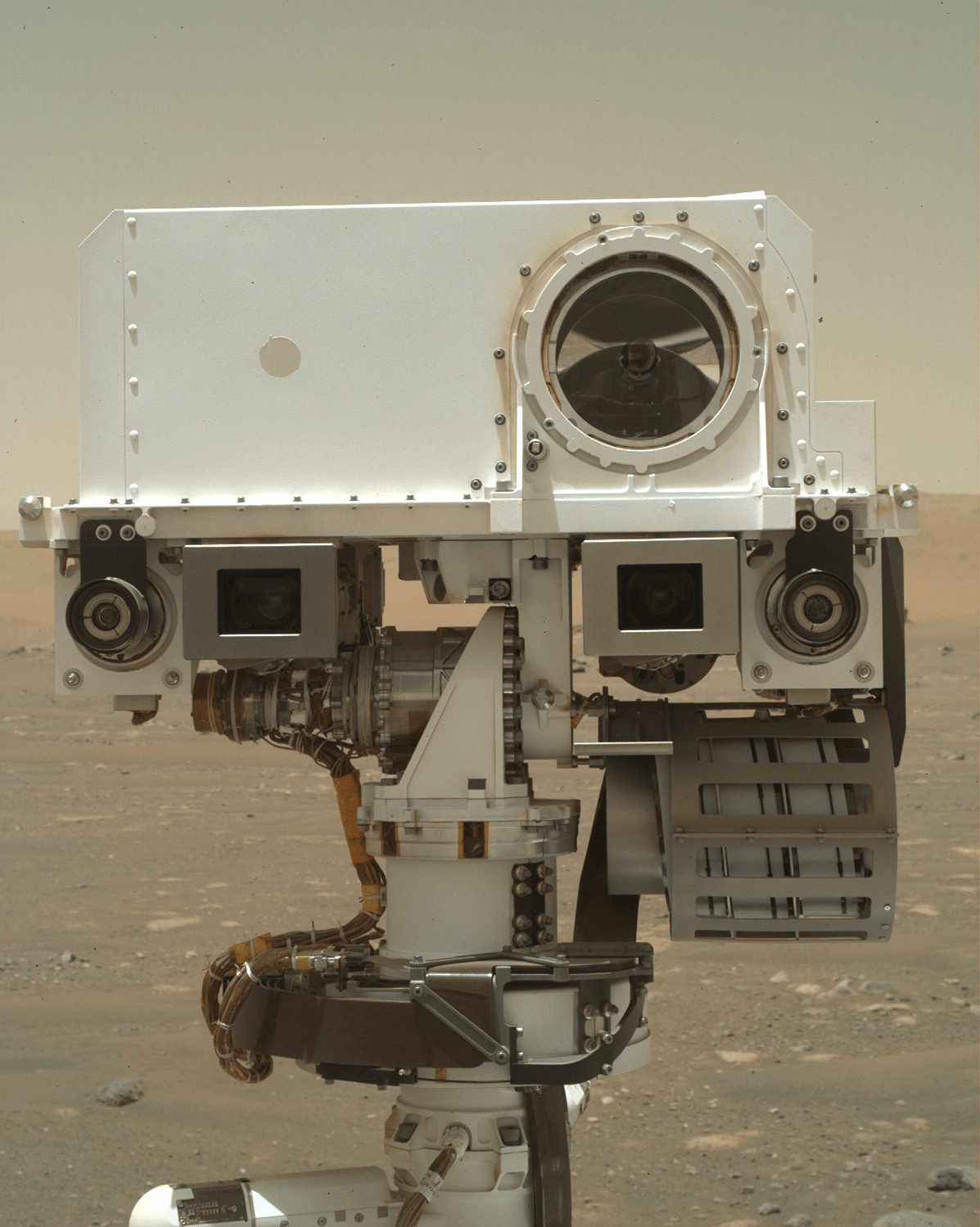
A grayscale close-up image of an instrument on the Mars rover Curiosity, showing at the center of the image a U-shaped flat piece of metal face the camera, with its rounded bottom pointing toward the lower right corner of the image. It’s surrounded by metal plates at different angles, some parallel to the plane of the image, others perpendicular, and most of them secured with hex nuts. Braided bunches of cable are twisted behind these other sections, leading into the instrument.
NASA’s Mars rover Curiosity acquired this image, used to inspect the magnet on its MAHLI (Mars Hand Lens Imager), a camera on the turret of tools at the end of the rover’s robotic arm. The main purpose of Curiosity’s MAHLI camera is to acquire close-up, high-resolution views of rocks and regolith in the field; it can focus on any target from about 0.8 inches (2.1 centimeters) to infinity. Curiosity used its Mast Camera (Mastcam) on Sept. 1, 2024 — Sol 4291, or Martian day 4,291 of the Mars Science Laboratory mission — at 05:48:14 UTC.
NASA/JPL-Caltech/MSSS

Written by Remington Free, Operations Systems Engineer at NASA’s Jet Propulsion Laboratory

Earth planning date: Friday, May 9, 2025

I was on downlink today for SA-SPaH, our robotic arm team. We successfully completed a number of fun arm activities, including a DRT brushing and APXS observations of a bedrock target, and also completed a traverse of about 25 meters (about 82 feet). Exciting!

Today, our uplink team planned three sols of activities. On Sol 4536, we are using the arm to do some inspection imaging of the MAHLI magnet using Mastcam. This magnet allows us to determine whether or not the MAHLI cover has successfully opened or closed. These magnets accumulate a lot of Martian dust particles, so we periodically take imaging to inspect the quantity of dust and get a better understanding of the state of the hardware. I’ve included above an image of the MAHLI instrument, from our last inspection on Sol 4291. After the magnet inspection, we’ll do some more typical arm activities, which include some APXS placements, DRT brushing, and MAHLI imaging on targets of interest. 

In this workspace, we are interested in targets characterizing the pale layered sulfate unit we’ve been driving on, as well as a target in the new ridge-forming unit. Beyond our arm activities, we’ll do additional science observations of the surface using Mastcam and ChemCam.  

On Sol 4537, we’ll focus on driving! Prior to our drive, we’ll take some more scientific observations, including a Navcam cloud movie, Mastcam documentation of some geological units, and ChemCam LIBS on a ridge-forming unit. We have then planned a 21-meter drive (about 69 feet) to take us to a bedrock area of scientific interest. We’re excited because the terrain looks pretty benign, so we’re hoping it all goes smoothly!

Post-drive, we’ll take some Mastcam survey imaging of clasts and soils along the traverse. Finally on Sol 4538, we’ll aim our focus upwards and take a number of observations of the sky. We’ll start with a Navcam large dust-devil survey, a Mastcam tau measurement of the atmospheric optical depth, and a ChemCam passive sky observation to study atmospheric composition. Early the following morning, we’ll take some additional Navcam observations of clouds, and complete another Mastcam tau measurement of optical depth.

Share

Details

Last Updated
May 13, 2025

Related Terms

Powered by WPeMatico

Get The Details…

Hi-Rate Composite Aircraft Manufacturing Project 2025 Spring Review

Hi-Rate Composite Aircraft Manufacturing Project 2025 Spring Review

1 min read

Preparations for Next Moonwalk Simulations Underway (and Underwater)

A large group of people who work on composite aircraft pose outside in a parking lot.
Advanced Composites Consortium team members gathered during May 2025 at NASA’s Langley Research Center in Virginia for a technical review of activities in the Hi-Rate Composite Aircraft Manufacturing project.
NASA

NASA and its partners in the Advanced Composites Consortium gathered at the agency’s Langley Research Center in Hampton, Virginia, on April 29-May 1, 2025.

Team members from 22 organizations in the public-private partnership are collaborating to increase the production rate of composite aircraft, reduce costs, and improve performance.

The team discussed results from the Technology Development Phase of NASA’s Hi-Rate Composite Aircraft Manufacturing (HiCAM) project.

The project is evaluating concepts and competing approaches at the subcomponent scale to determine technologies with the greatest impact on manufacturing rate and cost. The most promising concepts will be demonstrated on full-scale wing and fuselage components during the next four years. 

Through collaboration and shared investment, the team is increasing the likelihood of technologies being adopted for next-generation transports, ultimately lowering costs for operators and improving the U.S. competitive advantage in the commercial aircraft industry.

Want to Learn More About Composite Aircraft Research?

Share

Details

Last Updated

May 13, 2025

Editor
Jim Banke
Contact
Shannon Eichorn

Powered by WPeMatico

Get The Details…
Jim Banke

Hi-Rate Composite Aircraft Manufacturing Project 2025 Spring Review

Hi-Rate Composite Aircraft Manufacturing Project 2025 Spring Review

1 min read

Preparations for Next Moonwalk Simulations Underway (and Underwater)

A large group of people who work on composite aircraft pose outside in a parking lot.
Advanced Composites Consortium team members gathered during May 2025 at NASA’s Langley Research Center in Virginia for a technical review of activities in the Hi-Rate Composite Aircraft Manufacturing project.
NASA

NASA and its partners in the Advanced Composites Consortium gathered at the agency’s Langley Research Center in Hampton, Virginia, on April 29-May 1, 2025.

Team members from 22 organizations in the public-private partnership are collaborating to increase the production rate of composite aircraft, reduce costs, and improve performance.

The team discussed results from the Technology Development Phase of NASA’s Hi-Rate Composite Aircraft Manufacturing (HiCAM) project.

The project is evaluating concepts and competing approaches at the subcomponent scale to determine technologies with the greatest impact on manufacturing rate and cost. The most promising concepts will be demonstrated on full-scale wing and fuselage components during the next four years. 

Through collaboration and shared investment, the team is increasing the likelihood of technologies being adopted for next-generation transports, ultimately lowering costs for operators and improving the U.S. competitive advantage in the commercial aircraft industry.

Want to Learn More About Composite Aircraft Research?

Share

Details

Last Updated

May 13, 2025

Editor
Jim Banke
Contact
Shannon Eichorn

Powered by WPeMatico

Get The Details…
Jim Banke

La NASA calibra una segunda sonda de detección de impactos para las pruebas del X-59

La NASA calibra una segunda sonda de detección de impactos para las pruebas del X-59

3 min read

Preparations for Next Moonwalk Simulations Underway (and Underwater)

Read this story in English here.

Cuando se prueba un avión de última generación de la NASA, se necesitan herramientas especializadas para realizar pruebas y capturar datos, pero si esas herramientas necesitan mantenimiento, hay que esperar hasta que se reparen. A menos que tengas un respaldo. Por eso, recientemente la NASA ha calibró una nueva sonda de deteccíon de impactos para capturar datos de ondas de choque cuando el silencioso avión de investigación supersónico X-59 de la agencia inicie sus vuelos de prueba. 

Cuando un avión vuela más rápido que la velocidad del sonido, produce ondas de choque que viajan a través del aire, creando fuertes estampidos sónicos. El X-59 desviará esas ondas de choque, produciendo sólo un silencioso golpe supersónico. En las últimas semanas, la NASA ha completado los vuelos de calibración de una nueva sonda de detección de impactos de campo cercano, un aparato en forma de cono que captará datos sobre las ondas de choque que generará el X-59. 

Esta sonda está montada en un avión de investigación F-15D que volará muy cerca del X-59 para recopilar los datos que necesita la NASA. La nueva unidad servirá como la sonda de campo cercano principal de la NASA, con un modelo idéntico desarrollado por la NASA el año pasado actuará como reserva montada en otro F-15B. 

Las dos unidades significan que el equipo del X-59 tiene una alternativa lista en caso de que la sonda principal necesite mantenimiento o reparaciones. Para pruebas de vuelo como las del X-59, donde la recopilación de datos es crucial y las operaciones giran en torno a plazos ajustados, condiciones meteorológicas y otras variables, las copias de respaldo de los equipos críticos ayudan a garantizar la continuidad, mantener los plazos y preservar la eficiencia de las operaciones. 

“Si le ocurre algo a la sonda, como una falla en unsensor, no hay una solución fácil,” explica Mike Frederick, investigador principal de la sonda en el Centro de Investigación de Vuelos Armstrong de la NASA en Edwards, California. “El otro factor es el propio avión. Si uno necesita mantenimiento, no queremos retrasar los vuelos del X-59.” 

Para calibrar la nueva sonda, el equipo midió las ondas de choque de un avión de investigación F/A-18 de la NASA. Los resultados preliminares indicaron que la sonda captó con éxito los cambios de presión asociados a las ondas de choque, de acuerdo con las expectativas del equipo. Frederick y su equipo ahora están revisando los datos para confirmar que se alinean con los modelos matemáticos en tierra y cumplen las normas de precisión requeridas para los vuelos X-59. 

Los investigadores de la NASA en Armstrong se están preparando para vuelos adicionales con las sondas principal y de respaldo en sus aviones F-15. Cada avión volará a velocidad supersónico y recopilará datos de las ondas de choque del otro. El equipo está trabajando para validar tanto la sonda principal como la de respaldo para confirmar la redundancia total;en otras palabras, asegurarse de que tengan un respaldo fiable y listo para usar. 

Artículo Traducido por: Priscila Valdez

Share

Details

Last Updated

May 13, 2025

Editor
Dede Dinius
Contact
Nicolas Cholula

Powered by WPeMatico

Get The Details…
Dede Dinius

NASA’s Artemis III Core Stage Receives Thermal Protection Coating

NASA’s Artemis III Core Stage Receives Thermal Protection Coating

Teams at NASA’s Michoud Assembly Facility in New Orleans move a liquid hydrogen tank for the agency’s SLS (Space Launch System) rocket into the factory’s final assembly area on April 22, 2025. The propellant tank is one of five major elements that make up the 212-foot-tall rocket stage.
NASA/Steven Seipel

NASA completed another step to ready its SLS (Space Launch System) rocket for the Artemis III mission as crews at the agency’s Michoud Assembly Facility in New Orleans recently applied a thermal protection system to the core stage’s liquid hydrogen tank.

Building on the crewed Artemis II flight test, Artemis III will add new capabilities with the human landing system and advanced spacesuits to send the first astronauts to explore the lunar South Pole region and prepare humanity to go to Mars. Thermal protection systems are a cornerstone of successful spaceflight endeavors, safeguarding human life, and enabling the launch and controlled return of spacecraft.

The tank is the largest piece of SLS flight hardware insulated at Michoud. The hardware requires thermal protection due to the extreme temperatures during launch and ascent to space – and to keep the liquid hydrogen at minus 423 degrees Fahrenheit on the pad prior to launch.

“The thermal protection system protects the SLS rocket from the heat of launch while also keeping the thousands of gallons of liquid propellant within the core stage’s tanks cold enough. Without the protection, the propellant would boil off too rapidly to replenish before launch,” said Jay Bourgeois, thermal protection system, test, and integration lead at NASA Michoud. “Thermal protection systems are crucial in protecting all the structural components of SLS during launch and flight.”

In February, Michoud crews with NASA and Boeing, the SLS core stage prime contractor, completed the thermal protection system on the external structure of the rocket’s liquid hydrogen propellant fuel tank, using a robotic tool in what is now the largest single application in spaceflight history. The robotically controlled operation coated the tank with spray-on foam insulation, distributing 107 feet of the foam to the tank in 102 minutes. When the foam is applied to the core stage, it gives the rocket a canary yellow color. The Sun’s ultraviolet rays naturally “tan” the thermal protection, giving the SLS core stage its signature orange color, like the space shuttle external tank.

Having recently completed application of the thermal protection system, teams will now continue outfitting the 130-foot-tall liquid hydrogen tank with critical systems to ready it for its designated Artemis III mission. The core stage of SLS is the largest ever built by length and volume, and was manufactured at Michoud using state-of-the-art manufacturing equipment. (NASA/Steven Seipel)

While it might sound like a task similar to applying paint to a house or spraying insulation in an attic, it is a much more complex process. The flexible polyurethane foam had to withstand harsh conditions for application and testing. Additionally, there was a new challenge: spraying the stage horizontally, something never done previously during large foam applications on space shuttle external tanks at Michoud. All large components of space shuttle tanks were in a vertical position when sprayed with automated processes.

Overall, the rocket’s core stage is 212 feet with a diameter of 27.6 feet, the same diameter as the space shuttle’s external tank. The liquid hydrogen and liquid oxygen tanks feed four RS-25 engines for approximately 500 seconds before SLS reaches low Earth orbit and the core stage separates from the upper stage and NASA’s Orion spacecraft.

“Even though it only takes 102 minutes to apply the spray, a lot of careful preparation and planning is put into this process before the actual application of the foam,” said Boeing’s Brian Jeansonne, the integrated product team senior leader for the thermal protection system at NASA Michoud. “There are better process controls in place than we’ve ever had before, and there are specialized production technicians who must have certifications to operate the system. It’s quite an accomplishment and a lot of pride in knowing that we’ve completed this step of the build process.”

The core stage of SLS is the largest NASA has ever built by length and volume, and it was manufactured at Michoud using state-of-the-art manufacturing equipment. Michoud is a unique, advanced manufacturing facility where the agency has built spacecraft components for decades, including the space shuttle’s external tanks and Saturn V rockets for the Apollo program.

Through Artemis, NASA will send astronauts to explore the Moon for scientific discovery, economic benefits, and build the foundation for the first crewed missions to Mars.

For more information on the Artemis Campaign, visit:

https://www.nasa.gov/feature/artemis/

News Media Contact

Jonathan Deal
Marshall Space Flight Center, Huntsville, Ala. 
256-544-0034 
jonathan.e.deal@nasa.gov

Powered by WPeMatico

Get The Details…
Lee Mohon