NASA to Provide Media with International Space Station Update Today

NASA to Provide Media with International Space Station Update Today

NASA insignia.
Credit: NASA

NASA will host a live news conference at 5 p.m. EST on Thursday from the agency’s headquarters in Washington to discuss the International Space Station and its crew.

On Jan. 7, the agency announced it was postponing a planned spacewalk originally scheduled for Jan. 8 while teams monitored a medical concern with a crew member currently living and working aboard the orbital laboratory.

The matter involved a single crew member, who is stable. Due to medical privacy, it is not appropriate for NASA to share more details about the crew member.

Participants in the news conference include:

  • NASA Administrator Jared Isaacman
  • Amit Kshatriya, associate administrator
  • Dr. James Polk, chief health and medical officer, NASA Headquarters

NASA will provide live coverage of the news conference on NASA+, Amazon Prime, and the agency’s YouTube channel. Learn how to stream NASA content through a variety of online platforms, including social media.

To participate in the news conference virtually or in-person, media must RSVP for details no later than one hour before the start of the event to the NASA Newsroom at: hq-media@mail.nasa.gov. NASA’s media credentialing policy is online.

To learn more about the International Space Station, visit:

https://www.nasa.gov

-end-

Bethany Stevens / Cheryl Warner
Headquarters, Washington
202-358-1600
bethany.c.stevens@nasa.gov / cheryl.m.warner@nasa.gov

Share

Details

Last Updated

Jan 08, 2026

Editor
Jessica Taveau

Powered by WPeMatico

Get The Details…
Jessica Taveau

Best of 2025: Artemis II Countdown Demonstration Test

Best of 2025: Artemis II Countdown Demonstration Test

Four astronauts in spacesuits walk through a small corridor, following another person. The photo is in black and white.
NASA/Joel Kowsky

Artemis II crewmembers (left to right) NASA astronauts Christina Koch, mission specialist; and Victor Glover, pilot; CSA (Canadian Space Agency) astronaut Jeremy Hansen, mission specialist; and NASA astronaut Reid Wiseman, commander are led by Bill Owens of the Closeout Crew from the elevator at the 275-foot level of the mobile launcher to the crew access arm as they prepare to board their Orion spacecraft atop NASA’s Space Launch System rocket during the Artemis II countdown demonstration test, Saturday, Dec. 20, 2025, inside the Vehicle Assembly Building at NASA’s Kennedy Space Center in Florida. For this operation, the Artemis II crew and launch teams are simulating the launch day timeline including suit-up, walkout, and spacecraft ingress and egress.

Through the Artemis campaign, NASA will send astronauts to explore the Moon for scientific discovery, economic benefits, and to build the foundation for the first crewed missions to Mars, for the benefit of all.

This image was chosen by NASA’s Headquarters photo team as one of the best of 2025.

Image credit: NASA/Joel Kowsky

Powered by WPeMatico

Get The Details…
Monika Luabeya

NASA Starts Up Gateway’s Power System for First Time

NASA Starts Up Gateway’s Power System for First Time

1 min read

Preparations for Next Moonwalk Simulations Underway (and Underwater)

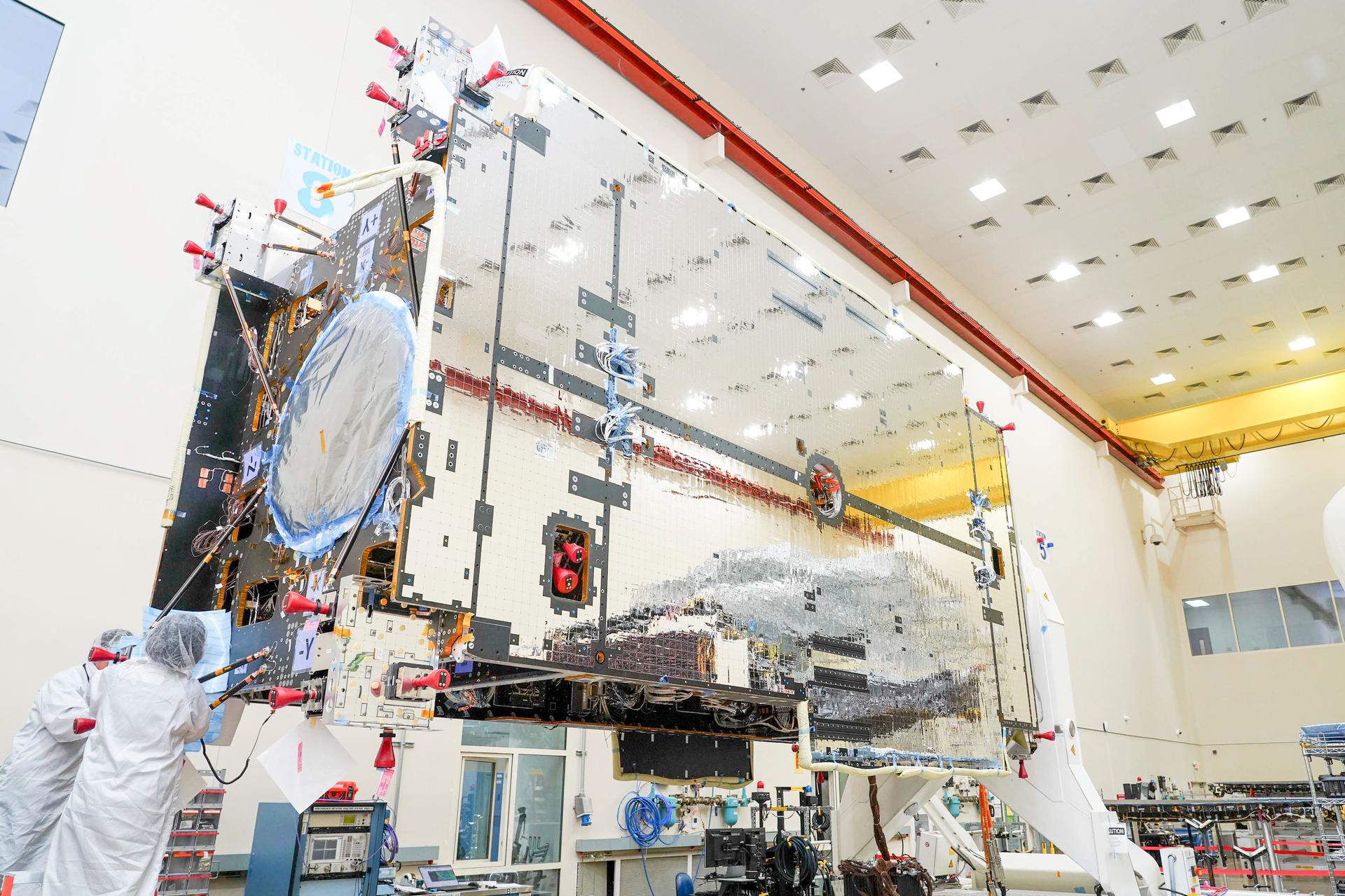
The primary structure of Gateway’s Power and Propulsion Element stands inside a high-bay cleanroom at Lanteris Space Systems in Palo Alto, California. The large rectangular structure is covered in reflective silver-colored panels. Two technicians in white cleanroom suits work near the base of the structure.
The primary structure of Gateway’s Power and Propulsion Element (PPE) undergoing assembly, integration, and testing at Lanteris Space Systems in Palo Alto, California, on September 29, 2025.
Lanteris Space Systems

Development continues on NASA’s Power and Propulsion Element, a solar electric propulsion spacecraft designed to provide power for Gateway in lunar orbit.

Able to generate 60 kilowatts of power, the element was successfully powered on earlier last year. The milestone demonstrates the element can provide the spacecraft with power, high-rate communications, attitude control, as well as the ability to maintain and maneuver between orbits.

The Power and Propulsion Element is managed by NASA’s Glenn Research Center in Cleveland and built by industry partner Lanteris Space Systems in Palo Alto, California, where teams have secured the element’s main electrical system inside protective exterior panels. On deck for installation at Lanteris Space Systems are three 12-kilowatt advanced electric propulsion system thrusters, manufactured by L3Harris, and four 6-kilowatt Busek-built BHT-6000 thrusters. The roll-out solar arrays for Gateway are complete and moving through testing at Redwire’s facility in Goleta, California.

For more information about NASA’s lunar exploration missions, visit:

https://www.nasa.gov/artemis

Share

Details

Last Updated

Jan 08, 2026

Contact
Jacqueline Minerd
Location
Glenn Research Center

Powered by WPeMatico

Get The Details…
Briana R. Zamora

Meltwater Turns Iceberg A-23A Blue

Meltwater Turns Iceberg A-23A Blue

A satellite image captured on December 26, 2025, centers on iceberg A-23A adrift in dark Southern Ocean waters. The iceberg appears as a bright white, roughly rectangular slab with jagged edges and parallel blue stripes across its surface. The blue areas are meltwater ponds. A thick patch of ice fragments known as brash ice is visible along one edge of the main iceberg in an area where meltwater is leaking from it, while patches of small icebergs and clouds are also visible around it.
December 26, 2025

The year that iceberg A-23A first broke away from Antarctica’s Filchner Ice Shelf, Ronald Reagan was president of the United States, and the movie Top Gun was setting box office records. Forty years later, the massive tabular berg—one of the largest and longest-lived bergs ever tracked by scientists—is sopping with blue meltwater and on the verge of complete disintegration as it drifts in the South Atlantic between the eastern tip of South America and South Georgia island.

When it first detached from Antarctica in 1986, the berg was nearly twice the size of Rhode Island—about 4,000 square kilometers. Estimates from the U.S. National Ice Center put the berg’s area at 1,182 square kilometers (456 square miles) in early January 2026, following the breakup of several sizable pieces in July, August, and September of 2025 as it moved into relatively warm summer conditions by December.

When the MODIS (Moderate Resolution Imaging Spectroradiometer) on NASA’s Terra satellite captured this image of what remained of the waterlogged berg on December 26, 2025, extensive pools of blue meltwater were visible on its surface. Though much smaller than it once was, what remains is still among the largest icebergs in the ocean, covering an area larger than New York City. An astronaut aboard the International Space Station captured a photograph showing a closer view (below) of the iceberg a day later, with an even more extensive melt pool.

The “blue-mush” areas are likely the result of ongoing disintegration events, explained Ted Scambos, a senior research scientist at the University of Colorado Boulder. “You have the weight of the water sitting inside cracks in the ice and forcing them open,” he said. Note also the thin white line around the outer edge of the iceberg seemingly holding in blue meltwater—a “rampart-moat” pattern caused by an upward bending of the iceberg plate as its edges melt at the waterline.

A photograph taken by an astronaut aboard the International Space Station on December 27, 2025, shows a closer view of the iceberg. Striking blue melt ponds cover nearly the surface top of A-23A except for a thin boundary of white along the edge—an area where the ice has warped upward. Wispy clouds run diagonally across the image, partially obscuring the view.
December 27, 2025

The striking linear patterns of blue and white across the berg are likely related to striations that were scoured hundreds of years ago when the ice was part of a glacier dragging across Antarctic bedrock.


“The striations formed parallel to the direction of flow, which ultimately created subtle ridges and valleys on the top of the iceberg that now direct the flow of meltwater,” explained Walt Meier, a senior research scientist at the National Snow & Ice Data Center. “It’s impressive that these striations still show up after so much time has passed, massive amounts of snow have fallen, and a great deal of melting has occurred from below,” added retired University of Maryland Baltimore County scientist Chris Shuman.

The MODIS image suggests that the ailing iceberg has also sprung a leak. The white area to its left may be the result of what Shuman described as a “blowout.” The weight of the water pooling at the top of the towering iceberg would have created enough pressure at the edges to punch through. The blowout may have allowed meltwater to spill tens of meters down to the ocean surface in what researchers call a “freshwater discharge plume,” where it mixed with the mélange of ice bits floating next to the iceberg.

Scientists say these signs indicate the iceberg could be just days or weeks from disintegrating completely. “I certainly don’t expect A-23A to last through the austral summer,” said Shuman, noting that the season typically brings clearer skies and warmer air and water temperatures—factors that accelerate the disintegration process in an area known among ice experts as a “graveyard” for icebergs. It’s already in water that’s about 3 degrees Celsius and riding currents that are pushing it toward even warmer waters that will eat away at it quickly, added Meier.

Even by Antarctic standards, A-23A has had a long, winding journey full of unexpected chapters that have improved scientists’ understanding of the “megabergs” occasionally released into the Southern Ocean. After grounding in the shallow waters of the Weddell Sea for more than 30 years, A-23A broke free in 2020, then spent several months in a twirling ocean vortex called a Taylor column. It eventually spun away and headed north, nearly colliding with South Georgia island and lodging in shallow waters for several months before escaping into the open ocean, where it has been rapidly breaking apart throughout 2025.

Scientists who have been tracking the berg for their entire careers see its imminent demise as a bittersweet moment. “I’m incredibly grateful that we’ve had the satellite resources in place that have allowed us to track it and document its evolution so closely,” said Shuman. “A-23A faces the same fate as other Antarctic bergs, but its path has been remarkably long and eventful. It’s hard to believe it won’t be with us much longer.”

Even as A-23A fades, other massive bergs are parked or drifting along the Antarctic shoreline. Several, including A-81, B22A, and D15A, are each larger than 1,500 square kilometers and sit waiting for their moment to break free and begin their journey north.

NASA Earth Observatory image by Michala Garrison, using MODIS data from NASA EOSDIS LANCE and GIBS/Worldview. ISS Astronaut photograph ISS074-E-8943 was acquired on December 27, 2025, with a Nikon Z 9 digital camera using a focal length of 500 millimeters. It is provided by the ISS Crew Earth Observations Facility and the Earth Science and Remote Sensing Unit at NASA Johnson Space Center. The image was taken by a member of the Expedition 74 crew. The image has been cropped and enhanced to improve contrast, and lens artifacts have been removed. The International Space Station Program supports the laboratory as part of the ISS National Lab to help astronauts take pictures of Earth that will be of the greatest value to scientists and the public, and to make those images freely available on the Internet. Additional images taken by astronauts and cosmonauts can be viewed at the NASA/JSC Gateway to Astronaut Photography of Earth. Story by Adam Voiland.

References and Resources

You may also be interested in:

Stay up-to-date with the latest content from NASA as we explore the universe and discover more about our home planet.

A Giant Iceberg’s Final Drift

3 min read

After a long, turbulent journey, Antarctic Iceberg A-23A is signaling its demise as it floats in the South Atlantic.

Article

Antarctic Iceberg Downsizes

3 min read

Iceberg A-23A continued to lose sizable pieces of ice during the 2025 austral winter, but it remained the planet’s largest…

Article

Antarctic Sea Ice Saw Its Third-Lowest Maximum

2 min read

Sea ice around the southernmost continent hit one of its lowest seasonal highs since the start of the satellite record.

Article

Powered by WPeMatico

Get The Details…

NASA Celebrates Artemis II During Houston Texans Space City Day 

NASA Celebrates Artemis II During Houston Texans Space City Day 

Four people pose in front of a stadium. The two people in the middle are wearing an orange spacesuit.
From left, NASA astronaut Jessica Watkins, Johnson Space Center employees Tessa Rundle and Daniel Kolodziejcyk wearing Orion Crew Survival System suits, and Johnson Director Vanessa Wyche stand on the field during the Houston Texans’ Space City Day game Jan. 4, 2026.
NASA/James Blair

NASA’s Johnson Space Center was front and center Jan. 4, 2026, as the Houston Texans faced the Indianapolis Colts during Space City Day at NRG Stadium. Fans watched the Texans win while getting a close look at NASA’s Artemis II mission, the first crewed flight of the Artemis campaign. 

The Artemis II mission will send four astronauts—NASA astronauts Reid Wiseman, Victor Glover, and Christina Koch, along with CSA (Canadian Space Agency) astronaut Jeremy Hansen—around the Moon and back to Earth to test Orion spacecraft systems in deep space and help lay the groundwork for future lunar missions. 

NASA connected fans with the agency’s next giant leap, reinforcing Space City’s role in shaping the future of human exploration.   

A group of volunteers wearing dark clothes hold a large U.S. flag on the stadium's 50-yard line.
NASA’s Johnson Space Center employees hold the American flag on the field during the national anthem at NRG Stadium in Houston.
Image courtesy of the Houston Texans

Before kickoff, 27 Johnson employees helped unfurl the U.S. flag for the national anthem, marking the start of an evening that blended football, exploration, and Houston pride.  

Johnson employees gather on the BULLevard to share the excitement of space exploration with football fans.

On the BULLevard, Johnson employees engaged with fans at a NASA activation area, where visitors explored the agency’s Mobile Exhibit Trailer and learned more about Artemis II. Team members answered questions and shared how NASA is preparing to send humans back to the Moon.  

From left, Johnson Community Engagement Lead Jessica Cordero, NASA astronaut Jessica Watkins, Johnson Space Center Director Vanessa Wyche, NASA Flight Controller Jonathan Guthmiller wearing the Extravehicular Mobility Unit (EMU), Multimedia Developer Jessica Krenzel, and NASA Flight Controller Sarah Hill stand together during the outdoor engagement on the BULLevard outside NRG Stadium.

Johnson Director Vanessa Wyche and NASA astronaut Jessica Watkins visited the exhibit and the Extravehicular Activity and Human Surface Mobility Program booth, where they greeted team members and thanked volunteers supporting the event. 

The International Space Station Program joined the celebration with a prerecorded message from the Expedition 74 crew, marking over 25 years of continuous human presence in low Earth orbit. 

An image of a full stadium at a football game with a video playing on the jumbotron.
The Expedition 74 crew aboard the International Space Station deliver a prerecorded message to fans on the stadium jumbotron during the Houston Texans’ Space City Day game.

“Even from 250 miles above the Earth, we’re proud to represent Houston and celebrate the mission of this incredible city on and off the field,” said NASA astronaut Mike Fincke.  

“Today’s game reminds us how connected Houston, NASA, and the Texans truly are,” said NASA astronaut Zena Cardman.  

Cardman highlighted how research aboard the International Space Station has led to innovations that benefit life on Earth, including applications now used in sports and athletic safety. Advances in materials developed for spacesuits and astronaut protection have influenced the design of modern helmets and padding, while cooling technologies originally created for extreme environments are used in training gear and protective equipment. 

“Space innovation doesn’t remain in orbit, sometimes it ends up on the 50-yard line.” 

Three people pose with their hands in the air on the football field. Two people are wearing an orange spacesuit and the person in the middle is wearing a blue flight jacket.
NASA astronaut Jessica Watkins, center, and Johnson employees Tessa Rundle and Daniel Kolodziejcyk, wearing Orion Crew Survival System spacesuits, take the field during the Texans’ “Reppin’ H-Town” appearance.
Image courtesy of the Houston Texans
An image from the January 4th, 2026 regular season week 18 home game against the Indianapolis Colts at NRG Stadium in Houston, TX. The Texans won 38-30.
Johnson Director Vanessa Wyche waves to fans after participating in the ceremonial coin toss.
Image courtesy of the Houston Texans

Jessica Watkins took the field for the Texans’ “Reppin’ H-Town” appearance, joined by Johnson employees Tessa Rundle and Daniel Kolodziejcyk wearing NASA’s Orion Crew Survival System spacesuits. The bright orange pressure suits are designed to protect astronauts during launch, flight, and reentry aboard NASA’s Orion spacecraft.  

The pregame continued with Center Director Vanessa Wyche joining the festivities on the field and participating in the ceremonial coin toss, where she called heads. 

About 30 seconds into halftime, the Artemis Fueling the Fire video played on the stadium jumbotron, sharing NASA’s plans to return humans to the Moon and marking a major step in the agency’s Moon to Mars campaign.  

Center Director Vanessa Wyche and NASA astronaut Jessica Watkins are interviewed on the field during halftime.

The video led into a live interview with Vanessa Wyche and Jessica Watkins, where Wyche discussed the Artemis II mission and Watkins highlighted similarities between astronaut training and football training. At the conclusion of the interview, the host invited fans to take part in NASA’s “Send Your Name with Artemis II” initiative, which allows the public to have their names stored on a small chip aboard the Orion spacecraft during the mission. Participants receive a digital boarding pass and virtual guest access to select NASA launches. While the names remain stored electronically inside the spacecraft, the effort symbolically gives participants a place on Orion’s journey around the Moon. 

Powered by WPeMatico

Get The Details…
Sumer Loggins