I Am Artemis: Ethan Jacobs

I Am Artemis: Ethan Jacobs

3 Min Read

I Am Artemis: Ethan Jacobs

Colorado National Guard Chief Warrant Officer and military helicopter pilot Ethan Jacobs stands in the hangar bay at the High-Altitude Army National Guard Training Site near Gypsum, Colorado. NASA and the Colorado Army National Guard are partnering on a simulated lander flight training course for Artemis in the mountains of northern Colorado. Jacobs is the lead instructor and helped to develop the course.

Listen to this audio excerpt from Ethan Jacobs, a helicopter pilot and member of the Colorado Army National Guard developing a foundational flight training course for Artemis astronauts:

0:00 / 0:00

High above the Rocky Mountains, Ethan Jacobs is helping NASA preparing to land people on the Moon for the first time in more than 50 years. NASA will send astronauts to the lunar South Pole during the Artemis III mission and beyond. As part of their journeys, crew will travel in a human landing system that will safely transport them from lunar orbit to the lunar surface and back.

Jacobs, a chief warrant officer with the Colorado National Guard and helicopter pilot for 20 years, both privately, and with the U.S. Army active duty and National Guard, has been working with NASA to develop a foundational training course at the High-Altitude Army National Guard Aviation Training Site, near Gypsum, Colorado. The culmination of that work is a NASA-certified foundational training course for astronauts that exposes them to the challenges of vertical flight profiles and landing in extreme conditions.

The challenging conditions we fly in replicates – as much as possible here on Earth – some of the challenges astronauts will face when landing on the Moon.

Ethan Jacobs

Ethan Jacobs

Chief Warrant Officer, Colorado Army National Guard

Colorado’s challenging terrain, dusty and white-out conditions in certain places, and high desert landscape make it an ideal setting for replicating a lunar environment for flight. In addition, there can be flat light where there is little to no shadow, all of which can create visual illusions and challenge a crew’s sense of depth perception.

And a lot of the visual illusions the NASA astronauts training at the High-Altitude Army National Guard Aviation Training Site experience are eye-opening.

“I teach the astronauts how to distinguish slopes in degraded visual conditions because we normally judge slope by shadows and changes in vegetation color,” Jacobs said. “But these conditions in the Colorado mountains can be monochromatic, like on the Moon.”

On a typical flight in a UH-72 Lakota helicopter, Jacobs sits in the front with one astronaut crew member and another astronaut sits in the back. Jacobs trains the astronaut team on how best to identify and overcome visual and cognitive illusions while evaluating techniques and team dynamics. Working with NASA, Jacobs and his team have studied maps of the lunar terrain, then located similar landing zones in the Colorado mountains.

“The two-person astronaut crew has to work together, communicate, and navigate with real-world consequences,” Jacobs said. “Fuel is burning and they can’t press the pause button like in a simulator. I try to expose them to as many different conditions and various landing zones as possible.”

At the end of the day, adaptability is key to successfully landing in extreme conditions.

Ethan Jacobs

Ethan Jacobs

Chief Warrant Officer, Colorado Army National Guard

NASA recently certified the course, marking a milestone in preparing for the future Artemis III crew. Since 2021, astronauts with NASA and ESA (European Space Agency) have taken part in the high-altitude aviation course have proven to be receptive to the training and adaptable to expanding their piloting skills, Jacobs said.

Artemis astronauts will receive specialized training on the specific lander for their mission from NASA’s commercial providers, SpaceX and Blue Origin. The training course, along with simulators and specialized crew training, provides fundamental coursework that will allow Artemis astronauts to be best prepared to land on the lunar surface.

Through the Artemis campaign, NASA will send astronauts to explore the Moon for scientific discovery, economic benefits, and to build the foundation for the first crewed missions to Mars for the benefit of all.

For more information about Artemis visit:

https://www.nasa.gov/artemis

Share

Details

Last Updated

Nov 20, 2025

Editor
Lee Mohon
Contact
Corinne M. Beckinger

Powered by WPeMatico

Get The Details…
Lee Mohon

NASA Stennis Engineer Follows Family Footsteps into NASA’s Artemis Era

NASA Stennis Engineer Follows Family Footsteps into NASA’s Artemis Era

Huy Nguyen
Huy Nguyen is an electrical controls engineer at NASA’s Stennis Space Center, where his work has contributed to NASA’s Artemis program that will send astronauts to the Moon to prepare for future human exploration of Mars.
NASA/Danny Nowlin

Huy Nguyen grew up hearing about rocket engines and space flight around the family table. His parents worked for NASA’s Michoud Assembly Facility in New Orleans, and those early conversations eventually started his path to NASA’s Stennis Space Center near Bay St. Louis, Mississippi.

“They both created a household that allowed me to be curious and to be a problem solver,” Nguyen said.

The dinner conversations have come full circle as the New Orleans native finds himself applying that same curiosity and problem-solving mindset at NASA Stennis.

Nguyen is currently the electrical controls engineer for propulsion testing support areas, which include the NASA Stennis High Pressure Gas Facility and the High Pressure Industrial Water Facility.

“Both areas are considered the heart and powerhouse of testing,” Nguyen said.

His work involves two key challenges: maintaining legacy systems with hard-to-find replacement parts and modernizing them with robust control systems that offer better monitoring and maintenance capabilities. What energizes Nguyen most is bridging old and new technology by creating improved user interfaces and integrating modern controls with existing infrastructure.

“This is what excites me about my work,” he said.

One of the most exciting moments in Nguyen’s NASA career came with the successful Green Run test series at NASA Stennis for NASA’s Artemis campaign to return humans to the Moon.

The test series helped validate the first SLS (Space Launch System) core stage for the Artemis I test flight around the Moon, setting the stage for the Artemis II test flight when four astronauts will fly around the Moon in early 2026.

As the engineer overseeing controls operations for the NASA Stennis High Pressure Gas Facility and High Pressure Industrial Water Facility, Nguyen had a critical responsibility leading to the Green Run test series.

He ensured the complex systems ran flawlessly to supply helium, nitrogen, air, and water for SLS core stage testing.

It turned into a career highlight.

“It was a lot of work to set it up and then run it around the clock for 24 hours,” Nguyen recalled.

For an entire day, multiple systems had to operate in perfect harmony, supplying everything the massive SLS core stage needed for a sitewide stress test.

“Seeing everyone focused on a single goal like that was truly amazing,” he said.

Engineers, technicians, and support staff worked in shifts around the clock. Each person knew their role was essential to the mission’s success. It was the kind of teamwork his NASA parents likely witnessed countless times, and now Nguyen experienced it himself.

The 24-hour exercise helped make way for a historic milestone at NASA Stennis. The Green Run testing series reached its conclusion on March 18, 2021, when the SLS core stage fired its four RS-25 engines for a full mission duration of 8 minutes and 19 seconds. The final Green Run hot fire represented the most powerful propulsion test at the center in more than 40 years.

As NASA prepares for Artemis II, Nguyen’s work upgrading these critical facilities ensures NASA Stennis will remain ready to support humanity’s next giant leaps into deep space.

When Artemis II launches in 2026, Nguyen looks forward to watching the test flight around the Moon with his parents, who inspired him as a young boy, and his young nephews.

“My nephews are currently obsessed with cars and trucks, so I hope Artemis II will expose them to space travel,” Nguyen said.

Through the Artemis campaign, NASA will send astronauts to the Moon to prepare for future human exploration of Mars and inspire the next generation of explorers.

Powered by WPeMatico

Get The Details…
LaToya Dean

Celebrating 25 Years of Humanity in Space 

Celebrating 25 Years of Humanity in Space 

NASA astronaut and Expedition 73 Flight Engineer Jonnny Kim poses for a portrait with the American flag on the Fourth of July, or Independence Day, inside the International Space Station's
NASA astronaut Jonny Kim poses for a portrait with the American flag inside the International Space Station’s “window to the world,” the cupola.
NASA

In 2025, NASA and its international partners celebrate 25 years of continuous human presence aboard the International Space Station. Since November 2, 2000, more than 290 people from 26 countries have lived and worked aboard the orbiting laboratory, conducting thousands of experiments that have advanced science and technology on Earth and paved the way for Artemis missions to the Moon and future journeys to Mars. 

Beyond its role as a science platform, the station has been a bridge—connecting cultures, sparking creativity, and inspiring generations. The memories of Johnson Space Center employees reflect how the orbiting laboratory is not only an engineering marvel but also a deeply human endeavor.  

Christopher Brown – Advancing Life Support Systems for Future Exploration 

Christopher Brown (center) receives the Rotary National Award for Space Achievement alongside NASA astronaut Sunita Williams.
NASA/James Blair

As a space station Environmental Control and Life Support System (ECLSS) integrator, Christopher Brown’s role has been ensuring astronauts have clean air and water. ECLSS removes carbon dioxide from the air, supplies oxygen for breathing, and recycles wastewater—turning yesterday’s coffee into tomorrow’s coffee. Today, these systems can recover nearly 98% of the water brought to the station.  

His proudest memory was commissioning regenerative life support systems and raising a symbolic toast with the crew while on console in mission control. He also helped activate the Water Storage System, saving crew time and improving operations on station. For Brown, these milestones were vital steps toward future long-duration missions beyond Earth. 

Stephanie Sipila – The Heart of Microgravity Research  

image of an astronaut working with an experiment at a glovebox
NASA astronaut Kate Rubins works on the Cardinal Heart study, which seeks to help scientists understand the aging and weakening of heart muscles in the search for new treatments for astronauts and people on Earth.
NASA/Mike Hopkins

Stephanie Sipila, now integration manager for NASA’s Extravehicular Activity and Human Surface Mobility Program, began her career as a mechanical and robotic systems instructor for the orbital outpost. Her favorite experiment, Engineered Heart Tissues, studies microgravity’s effect on the human heart to help develop new treatments for cardiovascular disease. She recalls NASA astronaut Sunita Williams running the Boston Marathon on a treadmill aboard station, becoming the first person to complete the race in space and showing how astronauts stay connected to Earth while living on orbit.  

Sipila also highlights the Spacesuit Art Project, an initiative that turned artwork from children with cancer into spacesuits flown to and worn aboard the orbital outpost during live downlinks, connecting science, art, and hope — and raising awareness of cancer research conducted aboard the orbital outpost.  

Liz Warren – Where Exploration Meets Humanity 

An image of an astronaut aboard the space station wearing a colorful spacesuit.
NASA astronaut Jack Fischer wearing the Unity spacesuit painted by patients at MD Anderson Cancer Center in Houston.
NASA/Randy Bresnik

Space station Associate Chief Scientist Liz Warren has seen firsthand how the Spacesuit Art Project uplifted children on Earth. During Expedition 52, she watched astronaut Jack Fischer wear a suit covered in artwork created by young cancer patients, including his own daughter, a survivor. “It was incredibly touching to note the power of art and inspiration. Human spaceflight requires fortitude, resilience, and teamwork—so does fighting childhood cancer,” Warren said. 

Her memories also extend to her time as an operations lead for NASA’s Human Research Program, which uses research to develop methods to protect the health and performance of astronauts in space to prepare for long-duration missions. While out for a weekend run, Warren received a call from the Payload Operations and Integration Center in Huntsville, Alabama. An astronaut on station, following a prescribed diet for a research study, wanted to swap out a food item. Warren coordinated with her support team and relayed the decision back to orbit—all while continuing her run. The moment, she recalls, underscored the constant, real-time connection between astronauts in space and teams on the ground. 

Adam Baker – Checkmate: Space Debris Cleanup 

A man sitting at a desk on console with several monitors in front of him.
Flight Director Chris Edelen, left, and capsule communicator Jay Marschke discuss their next chess move during a match with NASA astronaut Greg Chamitoff, Expedition 17 flight engineer aboard the space station.
NASA/Robert Markowitz

As an aerospace engineer, Adam Baker helped track experiments and spacecraft operations from mission control. Baker remembers when mission control played a live chess match with astronaut Greg Chamitoff during Expedition 17, a moment that showed the unique ways the station connects crews in orbit with people on Earth. His favorite technical project, though, was the RemoveDebris small satellite, deployed from the station in 2018 to test technologies for cleaning up space junk. “Knowing these experiments could one day help keep the orbital environment safe made it even more meaningful,” he said.   

Michael McFarlane – Training for Success 

An image of people walking through an Earth dome simulation with a spacec.
Engineers run simulations inside Johnson’s Systems Engineering Simulator during a shuttle-to-station docking simulation.
Smiley Pool/Houston Chronicle

As chief of the Simulation and Graphics Branch, Michael McFarlane prepared astronauts for space station assembly missions using high-fidelity simulators. “My greatest memory is seeing the station grow as we successfully executed assembly missions that looked very much like what we analyzed and trained for in our ground-based simulations,” he said. 

A Legacy of Ingenuity and Community 

A group of people dressed in Halloween costumes pose inside of a room.
Date: 10-31-2023 Location: Bldg 30 MCC, ISS MER Subject: Mission Evaluation Room (MER) Halloween Celebration “MERloween” Photographer: James Blair
NASA/James Blair

In the Mission Evaluation Room, engineers not only troubleshoot in real time but also celebrate milestones with traditions like “MERloween,” where controllers dress in space-themed costumes to honor the year’s lessons learned. 

A spacecraft in the ocean surrounded by dolphins. A boat is approaching from the right.
NASA’s SpaceX Dragon Freedom spacecraft splashed down in the Gulf of America, off the coast of Tallahassee, Florida, returning Crew-9 to Earth on March 18, 2025.
NASA/Keegan Barber

For social media consultant Mark Garcia, sharing the station story with the public has been the highlight of his career. His favorite moment was watching NASA’s SpaceX Crew-9 splash down in 2025, greeted by dolphins in the Gulf of America. “I love writing about the science aboard the station that benefits people on Earth,” he said. 

For 25 years, the International Space Station has shown what humanity can accomplish together. The lessons learned aboard will guide Artemis missions to the Moon and future journeys to Mars—ensuring the next 25 years are built on innovation, resilience, and the human spirit. 

Powered by WPeMatico

Get The Details…
Sumer Loggins

NASA’s X-59 Completes First Flight, Prepares for More Flight Testing

NASA’s X-59 Completes First Flight, Prepares for More Flight Testing

5 min read

Preparations for Next Moonwalk Simulations Underway (and Underwater)

After years of design, development, and testing, NASA’s X-59 quiet supersonic research aircraft took to the skies for the first time Oct. 28, marking a historic moment for the field of aeronautics research and the agency’s Quesst mission.

The X-59, designed to fly at supersonic speeds and reduce the sound of loud sonic booms to quieter sonic thumps, took off at 11:14 a.m. EDT and flew for 67 minutes. The flight represents a major step toward quiet supersonic flight over land.

“Once again, NASA and America are leading the way for the future of flight,” said acting NASA Administrator Sean Duffy. “The X-59 is the first of its kind, and a major breakthrough in America’s push toward commercial air travel that’s both quiet and faster than ever before. Thanks to the X-59 team’s innovation and hard work, we’re revolutionizing air travel. This machine is a prime example of the kind of ingenuity and dedication America produces.”

Following a short taxi from contractor Lockheed Martin’s Skunk Works facility, NASA X-59 test pilot Nils Larson approached U.S. Air Force Plant 42’s runway in Palmdale, California, where he completed final system checks and called the tower for clearance.

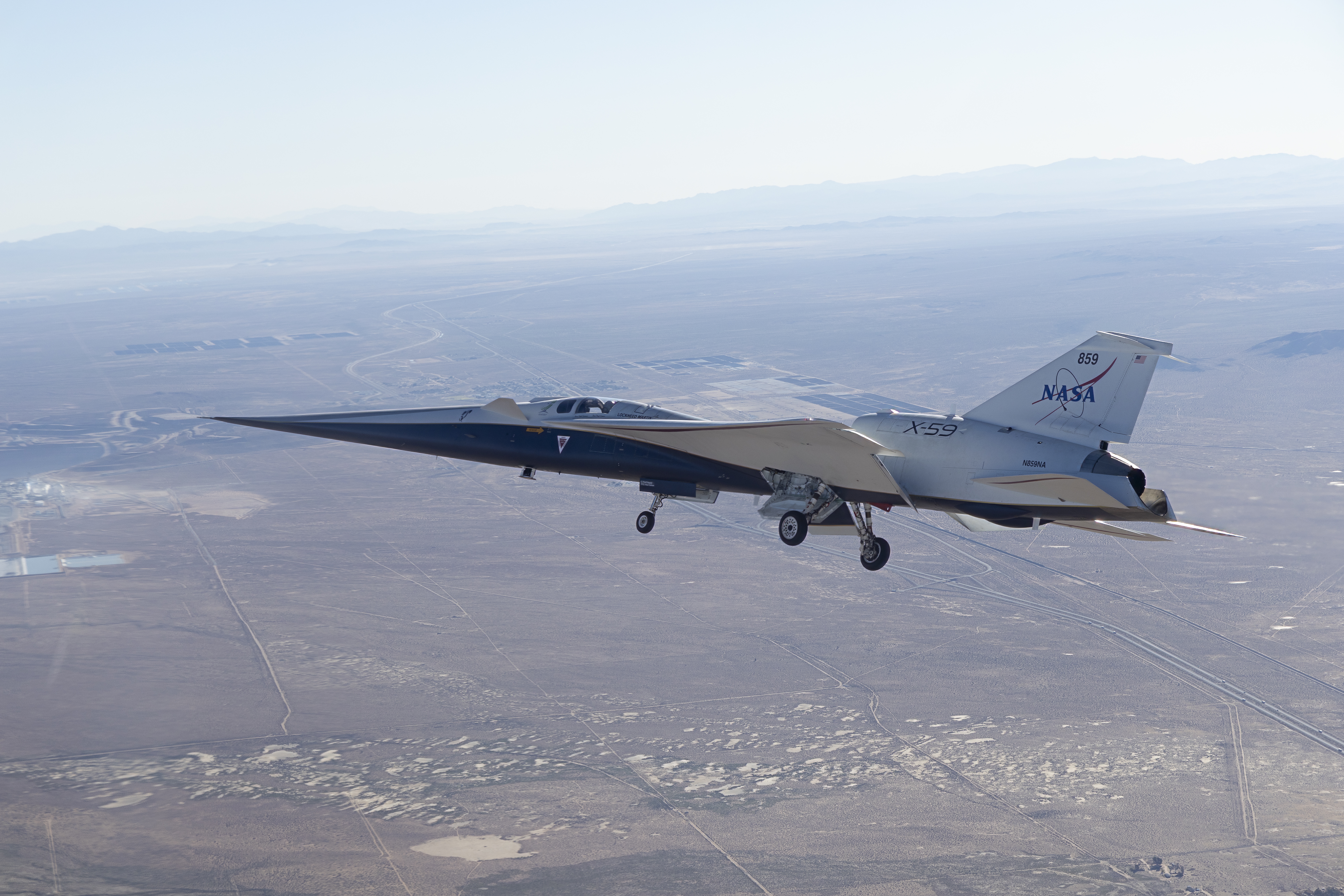
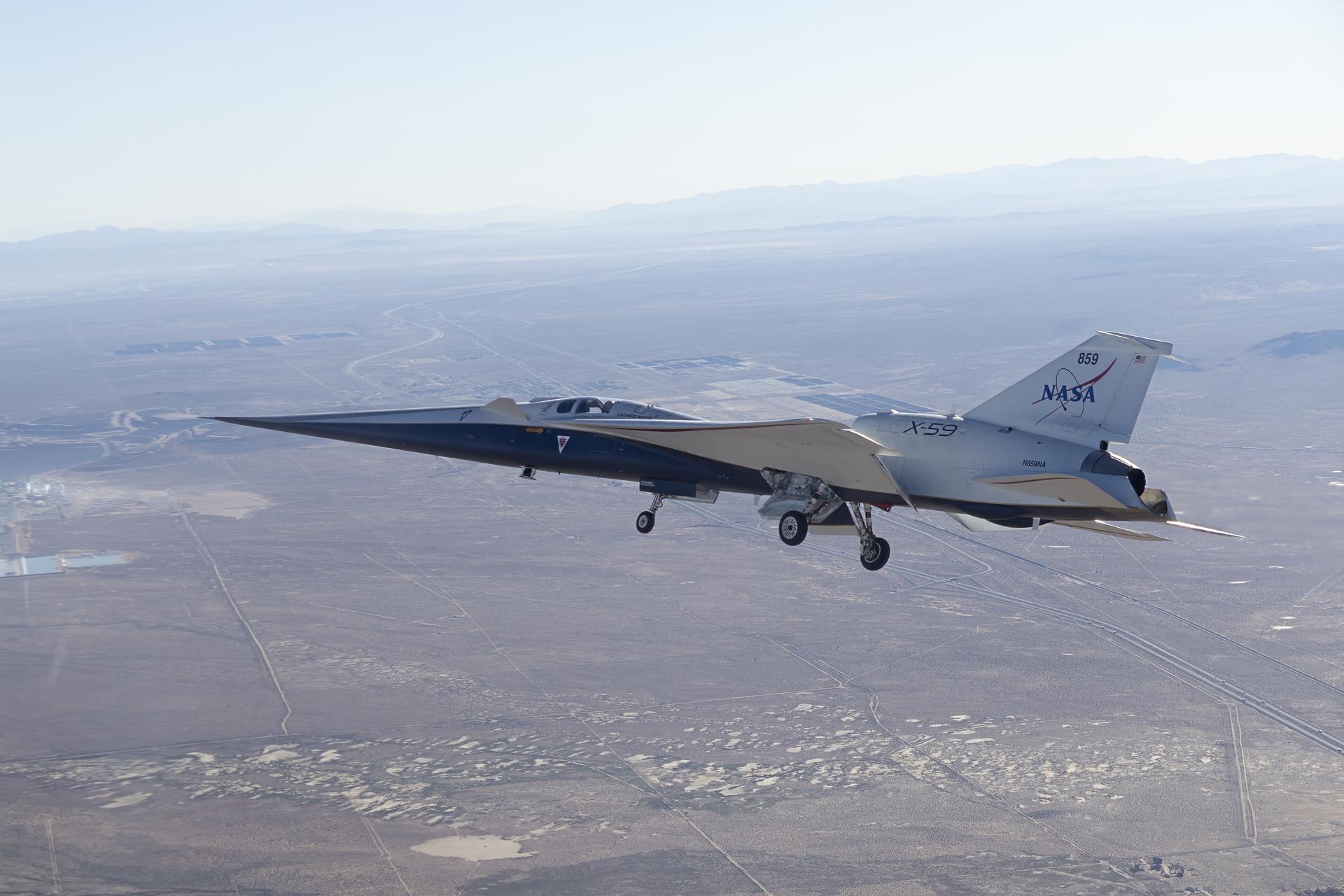
NASA’s X-59 is seen in flight, with a blue sky and mountains behind it and land below it. The aircraft’s long nose and distinct silhouette are visible as it ferries to NASA’s Armstrong Flight Research Center in Edwards, California 
NASA’s X-59 quiet supersonic research aircraft cruises above Palmdale and Edwards, California, during its first flight, Tuesday, Oct. 28, 2025. The aircraft traveled to NASA’s Armstrong Flight Research Center in Edwards, California.
NASA/Lori Losey

Then, with a deep breath, steady hands, and confidence in the labor of the X-59’s team, Larson advanced his throttle, picking up speed and beginning his climb – joining the few who have taken off in an experimental aircraft for the first time.

“All the training, all the planning that you’ve done prepares you,” Larson said. “And there is a time when you realize the weight of the moment. But then the mission takes over. The checklist starts. And it’s almost like you don’t even realize until it’s all over – it’s done.”

The X-59’s first flight went as planned, with the aircraft operating slower than the speed of sound at 230 mph and a maximum altitude of about 12,000 feet, conditions that allowed the team to conduct in-flight system and performance checks. As is typical for an experimental aircraft’s first flight, landing gear was kept down the entire time while the team focused on ensuring the aircraft’s airworthiness and safety.

The aircraft traveled north to Edwards Air Force Base, circled before landing, and taxied to its new home at NASA’s Armstrong Flight Research Center in Edwards, California, officially marking the transition from ground testing to flight operations.

“In this industry, there’s nothing like a first flight,” said Brad Flick, center director of NASA Armstrong. “But there’s no recipe for how to fly an X-plane. You’ve got to figure it out, and adapt, and do the right thing, and make the right decisions.”

NASA’s X-59 flies above the Mojave Desert against a blue sky. The aircraft’s long nose is angled slightly upward to the left, with its landing gear down. Layers of mountains are visible in the background. The aircraft is backlit, appearing to float as it ferries to NASA’s Armstrong Flight Research Center in Edwards, California.
NASA’s X-59 quiet supersonic research aircraft flies above Palmdale and Edwards, California, on its first flight Tuesday, Oct. 28, 2025. The aircraft traveled to NASA’s Armstrong Flight Research Center in Edwards, California, where it will begin flight testing for NASA’s Quesst mission, which aims to demonstrate quiet supersonic flight over land.
NASA/Jim Ross

Historic flight

The X-59 is the centerpiece of NASA’s Quesst mission and its first flight connects with the agency’s roots of flying bold, experimental aircraft.

 “The X-59 is the first major, piloted X-plane NASA has built and flown in over 20 years – a unique, purpose-built aircraft,” said Bob Pearce, NASA associate administrator for the Aeronautics Research Mission Directorate. “This aircraft represents a validation of what NASA Aeronautics exists to do, which is to envision the future of flight and deliver it in ways that serve U.S. aviation and the public.”

NASA Armstrong has a long history of flying X-planes that pushed the edges of flight. In 1947, the X-1 broke the sound barrier. More than a decade later, the X-15 pushed speed and altitude to new extremes. Starting in the 1960s, the X-24 shaped how we understand re-entry from space, and in the 1980s the X-29 tested forward-swept wings that challenged aerodynamic limits.

Each of those aircraft helped answer a question about aeronautics. The X-59 continues that tradition with a mission focused on sound – reducing loud sonic booms to sonic thumps barely audible on the ground. The X-59 was built for one purpose: to prove that supersonic flight over land can be quiet enough for public acceptance.

Nils Larson steps down a ladder beside the X-59’s cockpit. He is wearing a tan flight suit with the aircraft parked on the ramp and its canopy open behind him.
NASA test pilot Nils Larson steps out of the X-59 after successfully completing the aircraft’s first flight Tuesday, Oct. 28, 2025. The mission marked a key milestone in advancing NASA’s Quesst mission to enable quiet supersonic flight over land.
NASA/Genaro Vavuris

Next steps

Getting off the ground was only the beginning for the X-59. The team is now preparing the aircraft for full flight testing, evaluating how it will handle and, eventually, how its design will shape shock waves, which typically result in a sonic boom, in supersonic flight. The X-59 will eventually reach its target cruising speed of about 925 mph (Mach 1.4) at 55,000 feet.

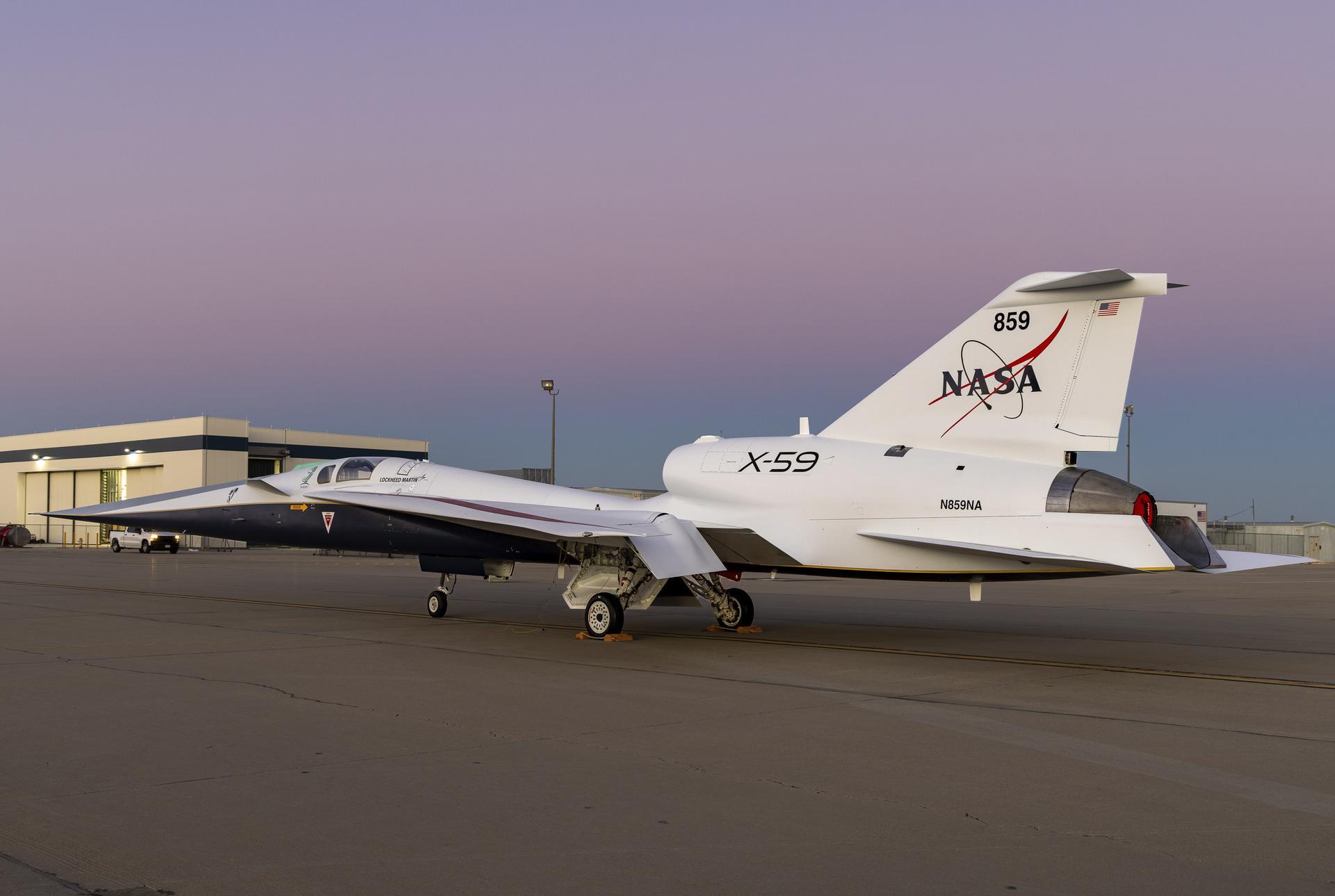
The aircraft’s design sits at the center of that testing, shaping and distributing shock-wave formation. Its engine is mounted on top of the fuselage – the main body of the aircraft – to redirect air flow upward and away from the ground.

The cockpit sits mid-fuselage, with no forward-facing window. Instead, NASA developed an eXternal Vision System – cameras and advanced high-definition displays that allow the pilot to see ahead and below the aircraft, which is particularly critical during landing.

These design choices reflect years of research and modeling – all focused on changing how the quieter sonic thump from a supersonic aircraft will be perceived by people on the ground.

NASA’s goal is to gather community response data to support the development of new standards for acceptable levels of sound from commercial supersonic flight over land. To do this, NASA will fly the X-59 over different U.S. communities, collecting ground measurement data and survey input from residents to better understand people’s perception of the X-59’s sonic thump.

“Most X-planes only live in the restricted airspace here on center,” Flick said. “This one is going to go out and fly around the country.”

When the X-59 lifted off the ground for the first time, it carried a piece of NASA’s history back into the air. And with it, a reminder that advancing aeronautics remains central to NASA’s mission.

Powered by WPeMatico

Get The Details…
Dede Dinius

SARP 2025 Closeout

SARP 2025 Closeout

2 min read

Preparations for Next Moonwalk Simulations Underway (and Underwater)

Two students with headphones stand in the back of a cockpit, watching three pilots in flight suits fly the plane.
SARP students peer into the cockpit onboard NASA’s P-3 aircraft, during research flights for the 2025 Student Airborne Research Program (SARP) internship.
NASA/Milan Loiacono

In August 2025, 47 students from NASA’s Student Airborne Research Program (SARP) culminated a summer of science by presenting their research to an audience of mentors, professors, family, friends, and NASA personnel.

SARP is a summer internship for undergraduate students, hosted in two cohorts: this year SARP West operated out of Guardian Jet Center and University of California, Irvine in Southern California, while SARP East operated out of Wallops Flight Facility and Virginia Commonwealth University in Virginia.

SARP randomly assigns students into one of four research disciplines, to encourage interdisciplinary collaboration and give them the opportunity to work outside of their usual field. Each discipline is led by a faculty researcher who is an expert in their field, and supported by a graduate mentor. This year, SARP research topics spanned three spheres: atmosphere,  biosphere, and hydrosphere, covered between the two cohorts.

The beauty of Earth science lies in its interconnectedness. As a student who primarily researches atmospheric science, stepping out of my comfort zone to explore something new was truly eye-opening, and I am incredibly grateful for the experience.

Nimay mahajan

Nimay mahajan

2025 SARP West student

Over the course of two months, students learned more about NASA’s Airborne Science Program and Earth Science through lectures led by SARP faculty and guest speakers from NASA and the Earth science community, engaged in Earth science data collection while flying onboard Dynamic Aviation’s B-200 and NASA’s P-3 aircraft, and participated in field trips to perform ground sampling fieldwork. Students also visited NASA’s Jet Propulsion Laboratory, Goddard Space Flight Center, and NASA Headquarters. The program also includes other enriching opportunities such as visiting the University of California San Diego’s WAVElab and Virginia Commonwealth University’s Rice Rivers Center.

Students were also provided the opportunity to attend introductory programming sessions and receive hands-on support from a coding mentor to develop and strengthen their experience with code, and incorporate code in their research project. 

SARP really made me realize that science is bigger than all of us, but it needs every one of us – even those just stepping into the scientific world – to contribute. Every effort, no matter how big or small, is a step forward in a mission greater than any one individual.

TJ Ochoa Peterson

TJ Ochoa Peterson

2025 SARP East student

To watch videos of these student’s presentations, read their research abstracts, or see more photos from the summer, please follow the links below.

2025 SARP East Research Presentations

A group of students and faculty in gray shirts stand on dark gray tarmac in front of a large white plane with a blue stripe down the middle.
The 2025 SARP East Aerosols Group poses in front of the Dynamic Aviation B-200 aircraft, parked in a hangar at NASA’s Wallops Flight Facility in Virgina. During the internship, students spend a week engaged in Earth science data collection and learning from instruments specialists while flying onboard both the B-200 and NASA’s P-3 aircraft.
NASA/Milan Loiacono

2025 SARP West Research Presentations

A group of students in gray shirts and several men in tan flight suits stand on tan tarmac in front of a large white plane with a blue stripe down the middle.
The students and faculty of the 2025 Student Airborne Research Program (SARP) pose in front of NASA’s P-3 aircraft.
NASA/Milan Loiacono

About the Author

Milan Loiacono

Milan Loiacono

Science Communication Specialist

Milan Loiacono is a science communication specialist for the Earth Science Division at NASA Ames Research Center.

Share

Details

Last Updated

Nov 19, 2025

Powered by WPeMatico

Get The Details…
Milan Loiacono