Experience the Launch of NASA’s Roman Space Telescope 

Experience the Launch of NASA’s Roman Space Telescope 
8 Min Read

Experience the Launch of NASA’s Roman Space Telescope 

Are you ready for a new view of the universe? The Nancy Grace Roman Space Telescope will reveal distant worlds, dark energy, and the structure of the cosmos, and we want you to be a part of it!  

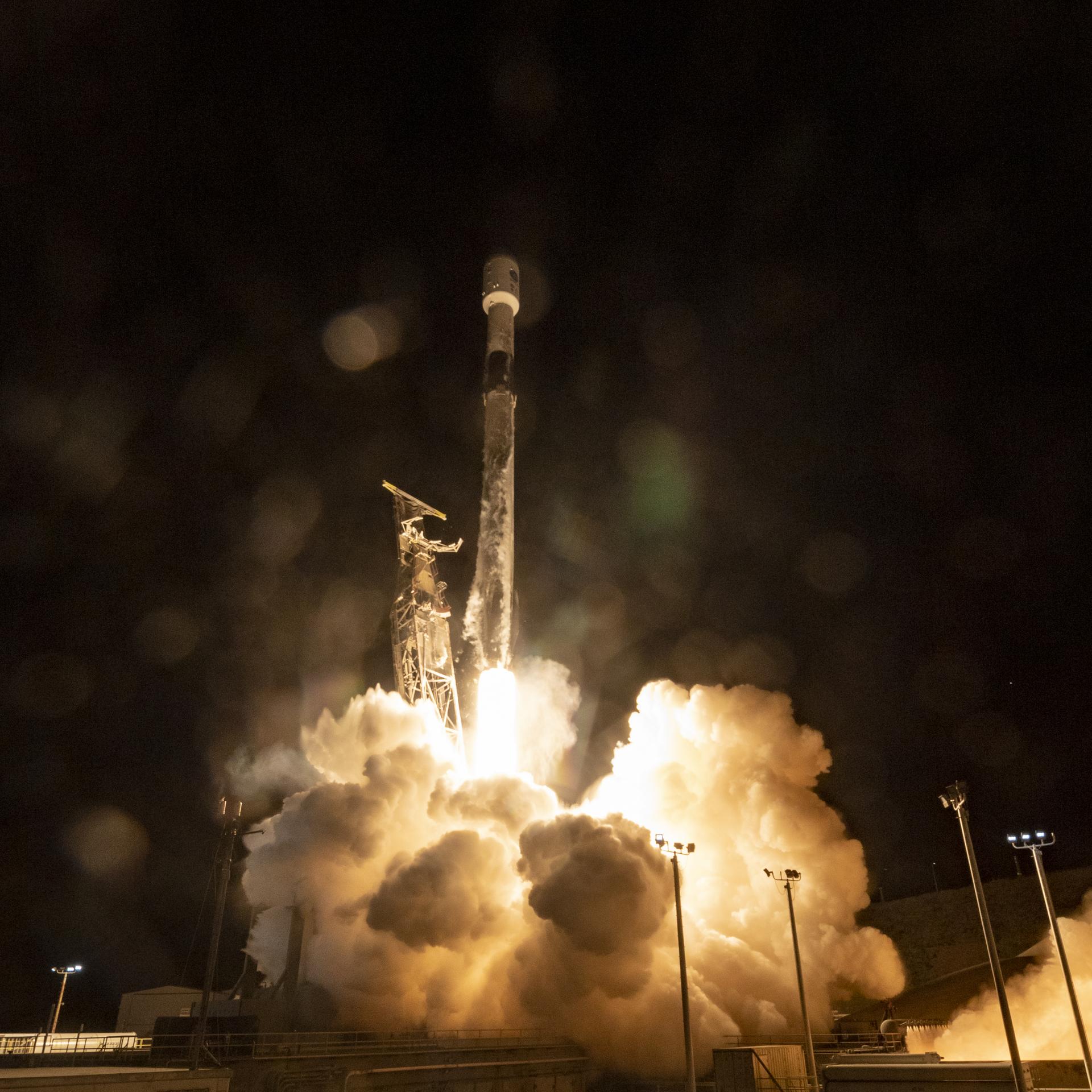
Digital creators and social media users are invited to register to our NASA Social for the Nancy Grace Roman Space Telescope launch. Roman is NASA’s next flagship astrophysics mission, designed to explore everything from our outer solar system to the edge of the observable universe. This mission is scheduled to launch on Aug. 30, 2026, aboard a SpaceX Falcon Heavy rocket from Launch Complex 39A at NASA’s Kennedy Space Center in Florida.  

Are you passionate about social media and communications? Do you love to create content for an audience? Are you a fan of new, unique experiences? If you said yes, this NASA Social event is for you! This is your opportunity to be on the front lines of this historic mission. 

The NASA Social event will take place over two days, including the day of launch. A maximum of 50 digital creators will be selected to attend this two-day event and will be given access similar to news media. 

NASA Social participants will have the opportunity to: 

  • Tour NASA’s Kennedy Space Center 
  • Learn directly from astrophysics subject matter experts 
  • Meet fellow digital creators and social media users 
  • Spend time with members of NASA’s social media team 
  • View the launch of the Nancy Grace Roman Space Telescope  

NASA Social events are intended for members of the public. Current or former NASA civil servants, NASA contractors, NASA interns, and individuals or organizations currently under contract to provide products or services to NASA are not eligible to apply or participate in NASA Social events.

NASA Social registration for the Roman launch opens on this page on Monday, June 15 and the deadline to apply is at 11:59 p.m. EDT on Sunday, June 28. All applications will be considered on a case-by-case basis.

APPLY NOW 

Do I need to have a social media account to register? 

Yes. This event is designed for people who: 

  • Actively use multiple social networking platforms and tools to disseminate information to a unique audience. 
  • Regularly produce new content that features multimedia elements. 
  • Have the potential to reach a large number of people using digital platforms. 
  • Reach a unique audience, separate and distinctive from traditional news media and/or NASA audiences. 
  • Must have an established history of posting content on social media platforms. 
  • Have previous postings that are highly visible, respected, and widely recognized. 

Users are encouraged to follow @NASARoman for Roman updates on X, Facebook, and @NASAGoddard and @NASAUniverse on Instagram. Updates and information about the event will be shared on X via @NASA_Events

How do I register? 

Registration for this event opens Monday, June 15 and closes at 5 p.m. EDT on Sunday, June 28. Registration is for one person only (you) and is non-transferable. Each individual wishing to attend must register separately. Each application will be considered on a case-by-case basis. 

Can I register if I am not a U.S. citizen? 

Yes, this event is open for all to apply. 

When will I know if I am selected? 

After registrations have been received and processed, an email with confirmation information and additional instructions will be sent to those selected. We expect to send the first notifications on July 17 and waitlist notifications on July 22. 

What are NASA Social credentials? 

All NASA social applications will be considered on a case-by-case basis. Those chosen must prove through the registration process they meet specific engagement criteria. 

If you do not make the registration list for this NASA Social, you still can attend the launch off site and participate in the conversation online. Find out about ways to experience a launch at https://www.nasa.gov/kennedy/see-a-launch-up-close/.

What are the registration requirements? 

Registration indicates your intent to travel to NASA Kennedy and attend the two-day event in person. You are responsible for your own expenses for travel, accommodation, food, and other amenities. 

The schedule of events and special guest appearances are subject to change without notice. NASA is not responsible for loss or damage incurred as a result of attending. NASA, moreover, is not responsible for loss or damage incurred if the event is canceled with limited or no notice. Please plan accordingly. 

Kennedy is a government facility. Those who are selected may need to complete additional steps to receive clearance to enter the secure areas. 

IMPORTANT: Those without proper identification cannot be admitted. 

For United States Citizens: 

You will be required to present a REAL ID compliant identification or valid U.S. passport PLUS one of the following:

Acceptable documents to accompany federal or state identification: 

  • U.S. Passport 
  • Unexpired Employment Authorization Card (Form I-688A) 
  • Unexpired Employment Authorization Document issued by DHS that contains a photograph (Form I-688B) 
  • Driver’s license or ID card issued by a state or outlying possession of the United States provided it contains a photograph or information such as name, date of birth, gender, height, eye color, and address 
  • ID card issued by federal, state, or local government agencies or entities, provided it contains a photograph or information such as name, date of birth, gender, height, eye color, and address 
  • School ID card with a photograph 
  • Voter’s Registration Card 
  • Military Dependent’s ID Card 
  • U.S. Military card or draft record 
  • U.S. Coast Guard Merchant Mariner Card 
  • Native American Tribal Document 
  • U.S. Social Security Card issued by the Social Security Administration (other than a card stating it is not valid for employment) 
  • Original or Certified copy of birth certificate issued by a state, county, municipal authority, or outlying possessions of the United States bearing an official seal 
  • U.S. Citizen ID Card (Form I-197) 
  • ID Card for use of Resident Citizens of the United States (Form I-179) 
  • Unexpired employment authorization document issued by DHS (other than those listed previously) 

For Foreign Nationals: 

  • Same items required of U.S. Citizens (SSN only when applicable) 
  • Unexpired foreign passport, with I-551 stamp or attached Form I-94 indicating unexpired employment authorization 
  • Passport number and registration date 
  • Citizenship 
  • Driver’s license issued by a Canadian Government authority 

For Legal Resident Aliens: 

  • Same items required of U.S. Citizens, and: 
  • Permanent Resident Card or Alien Registration Receipt Card with photograph (Form I-551) 
  • Unexpired Temporary Resident Card (Form I-688) 
  • Certification of Birth Abroad issued by the Department of State (Form FS-545 or Form DS-1350) 

The REAL ID Act was passed by Congress in 2005 to establish minimum security standards for state-issued driver’s licenses and identification cards. 

All registrants must be at least 18 years old. 

What if the launch date changes? 

Hundreds of different factors can cause a scheduled launch date to change multiple times. The launch date will not be official until after the Flight Readiness Review. If the launch date changes prior to the review, NASA may adjust the date of the NASA Social accordingly to coincide with the new target launch date, and will notify registrants of any changes via email. 

If the launch is postponed, attendees will be invited to attend a later launch date. If the launch is postponed beyond 72 hours, the NASA Social event may be canceled. 

NASA Social attendees are responsible for any additional costs they incur related to any launch delay. We strongly encourage participants to make travel arrangements that are refundable and/or flexible. 

What if I cannot come to the Kennedy Space Center? 

If you cannot come to NASA Kennedy and attend in person, you should not register for the NASA Social. Join the conversation by following @NASARoman on X and Facebook, and @NASAGoddard and @NASAUniverse on Instagram. You can watch the launch at nasa.gov/live. NASA will provide regular launch and mission updates on @NASA. 

If you cannot make this NASA Social, don’t worry; NASA is planning many other NASA Social events in the near future at various locations! Check for updates on NASA Socials. 

Powered by WPeMatico

Get The Details…
Gary Daines
NASA to Cover 34th SpaceX Resupply Mission Space Station Departure

NASA to Cover 34th SpaceX Resupply Mission Space Station Departure

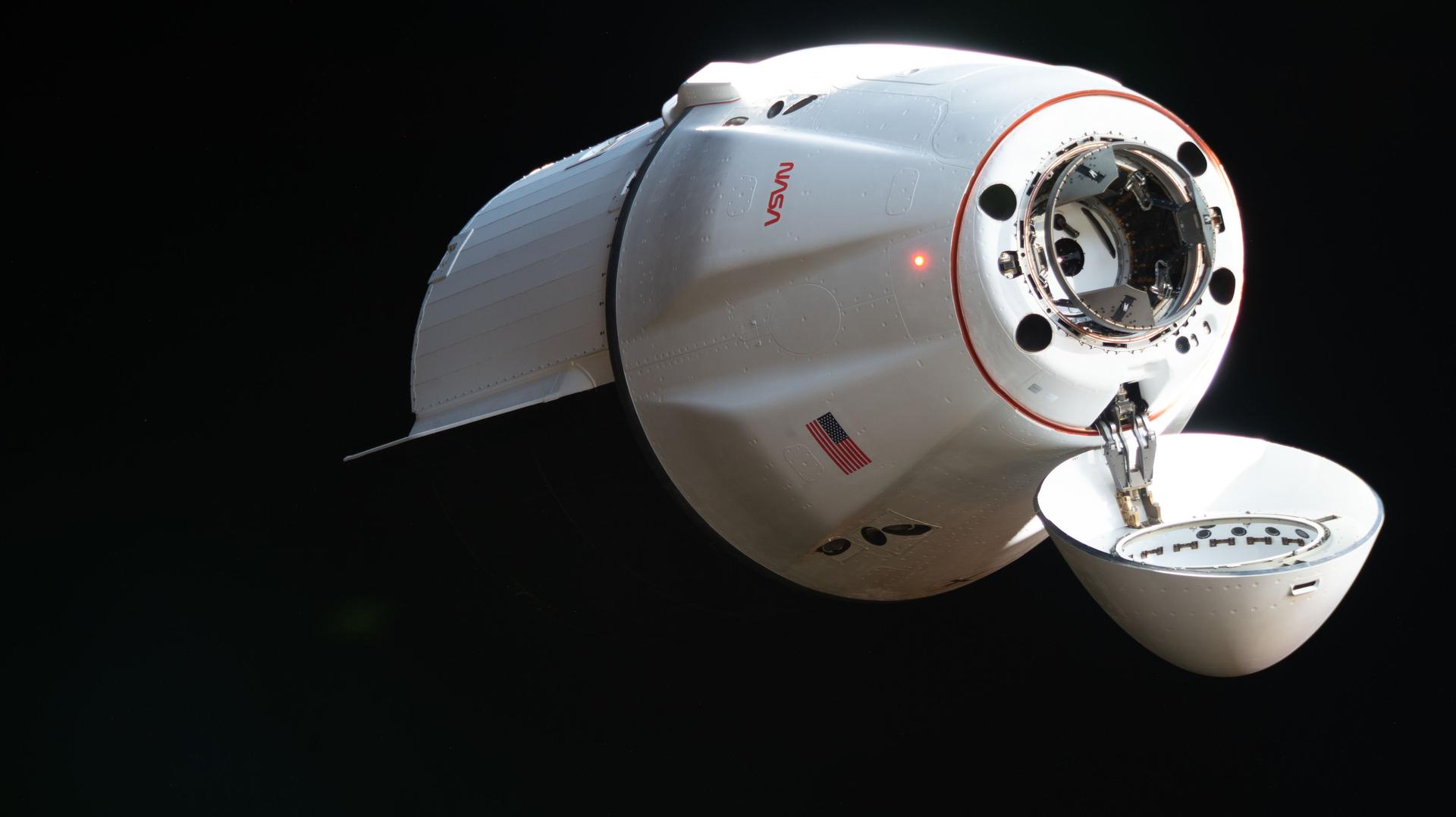
The SpaceX Dragon cargo spacecraft supporting the company’s 34th commercial resupply services mission for NASA approaches the International Space Station on May 17, 2026, carrying nearly 6,500 pounds of food, supplies, and equipment for the Expedition 74 crew.
Credit: NASA

NASA and its international partners are set to receive scientific research samples and hardware as a SpaceX Dragon spacecraft is scheduled to depart the International Space Station on Tuesday, June 16, for its return to Earth.

Watch NASA’s live undocking coverage beginning at 11:45 a.m. EDT on NASA+, Amazon Prime, and the agency’s YouTube channel. Learn how to watch NASA content through a variety of online platforms, including social media.

The Dragon spacecraft will undock from the forward port of the station’s Harmony module at about 12:05 p.m., after receiving a command from SpaceX ground controllers. The spacecraft then will fire its thrusters to move safely away from the orbiting complex.

Following a June 16 departure, the spacecraft will reenter Earth’s atmosphere on Wednesday, June 17, before splashing down off the coast of California at approximately 5:08 a.m. PDT. NASA will not stream the splashdown but will post updates on its space station blog.

Dragon will return to Earth with thousands of pounds of cargo, carrying samples that could shape future space exploration and life on Earth. Research returning includes bioprinted organ and cartilage tissue, data on improving cryogenic fuel storage for future space missions, and DNA‑inspired materials to develop new cancer treatments. The returning hardware includes an ocular imaging device used to monitor crew members’ eye health, an absorbent bed that filters trace contaminants from cabin air, and a separator pump from the waste and hygiene compartment.

Loaded with nearly 6,500 pounds of crew cargo and science experiments, Dragon arrived at the station on May 17 after launching two days earlier on a Falcon 9 rocket from Space Launch Complex 40 at Cape Canaveral Space Force Station in Florida.

For more than 25 years, people have lived and worked continuously aboard the International Space Station, advancing scientific knowledge and making research breakthroughs not possible on Earth. The space station helps NASA understand and overcome the challenges of human spaceflight, expand commercial opportunities in low Earth orbit, and build on the foundation for long-duration missions to the Moon, as part of the Artemis program, and to Mars.

Get breaking news, images, and features from the space station on Instagram, Facebook, and X.

Learn more about International Space Station research and operations at:

https://www.nasa.gov/international-space-station

-end-

Jimi Russell
Headquarters, Washington
202-358-1100
james.j.russell@nasa.gov

Leah Cheshier
Johnson Space Center, Houston
281-483-5111
leah.d.cheshier@nasa.gov

Share

Details

Last Updated

Jun 12, 2026

Powered by WPeMatico

Get The Details…
Gerelle Q. Dodson

Black Eye Galaxy

Black Eye Galaxy

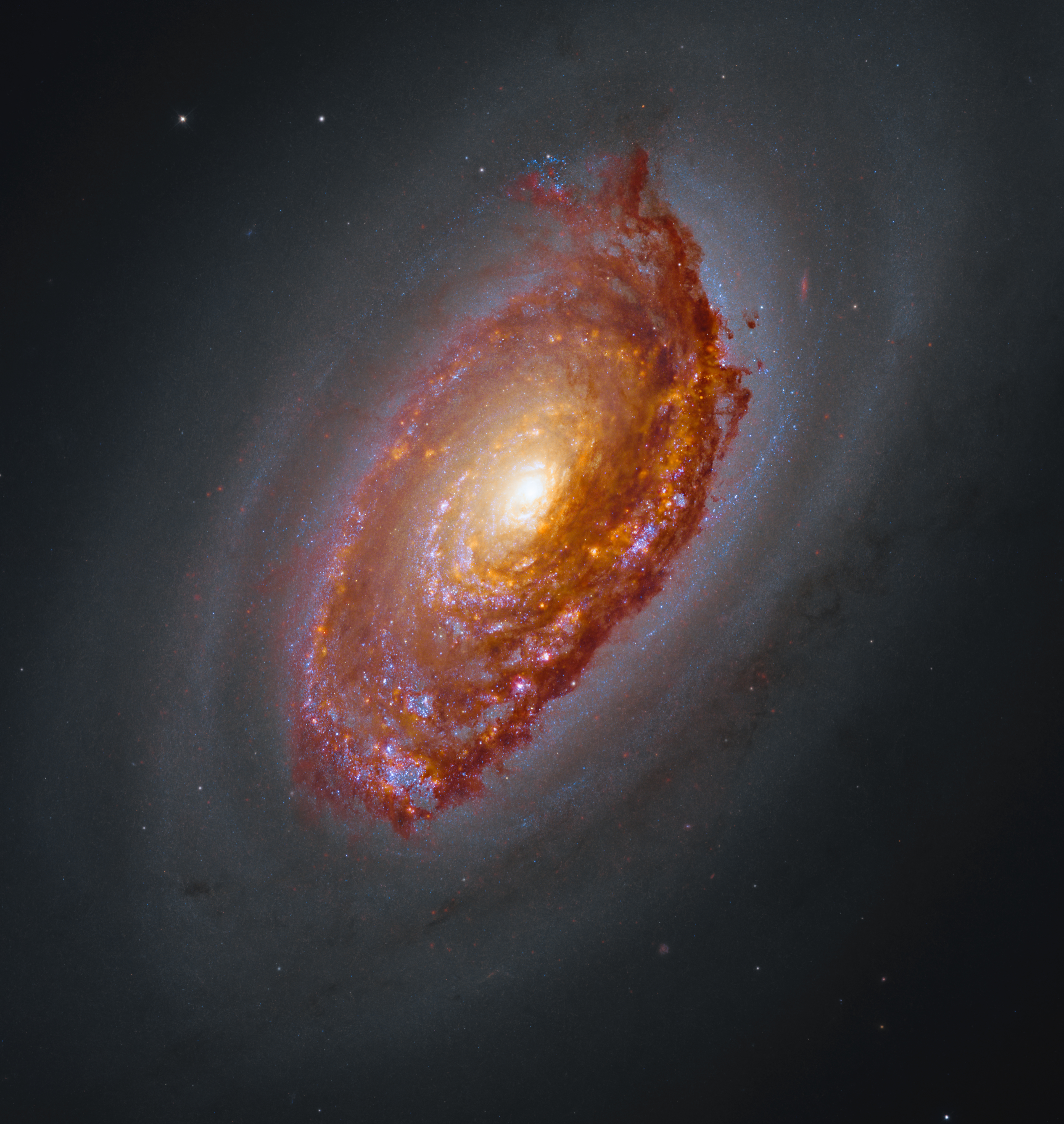
Hubble and Webb image of M64. A massive spiral galaxy glows with a yellow core, surrounded by arms full of orange-brown dust and pink and blue patches of star formation. Framed by a haze of dark dust, the galaxy shines against black space dotted with a few stars.
Easily identified by the spectacular band of dark dust that partially obscures its bright core, Messier 64, or the Black Eye Galaxy, is characterized by its bizarre internal motion.
NASA, CSA, ESA, F. Belfiore (European Southern Observatory – Germany), J. Lee (Space Telescope Science Institute), A. Leroy (The Ohio State University), and D. Thilker (The Johns Hopkins University); Processing: Gladys Kober (NASA/Catholic University of America)

This March 20, 2026, image of Messier 64, or the Black Eye Galaxy, is a composite view from NASA’s Hubble Space Telescope and James Webb Space Telescope. It shows Messier 64 captured at near- and mid-infrared wavelengths by Webb, while Hubble’s image shows the galaxy in ultraviolet, visible, and near-infrared light.

Messier 64 is characterized by its bizarre internal motion. The gas in the outer regions of this spiral galaxy is rotating in the opposite direction from the gas and stars in its inner regions. This strange behavior may be the result of a merger between M64 and a satellite galaxy over a billion years ago.

Image credit: NASA, CSA, ESA, F. Belfiore (European Southern Observatory – Germany), J. Lee (Space Telescope Science Institute), A. Leroy (The Ohio State University), and D. Thilker (The Johns Hopkins University); Processing: Gladys Kober (NASA/Catholic University of America)

Powered by WPeMatico

Get The Details…
HQ Web Team

Hubble Sees Swarm of Galaxies

Hubble Sees Swarm of Galaxies

2 min read

Hubble Sees Swarm of Galaxies

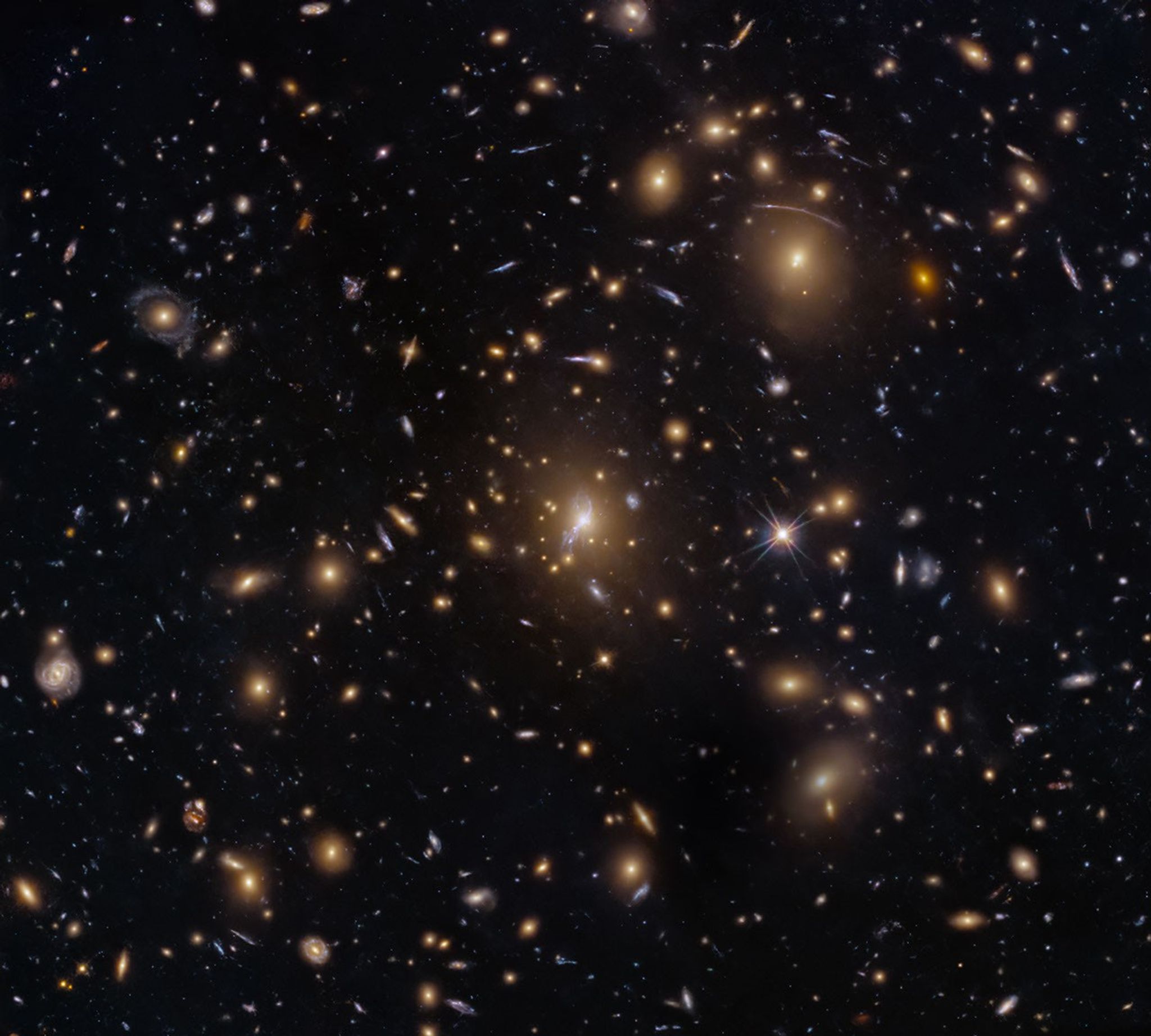
Numerous galaxies dot the scene and appear to cluster around the image center. The view includes large elliptical galaxies along with spiral and lenticular galaxies. Faint arcs of distant galaxies gravitationally lensed by the cluster appear in the upper-right quadrant of the image. A couple of foreground stars are also visible and easily distinguished by their diffraction spikes.
This NASA Hubble Space Telescope image features the galaxy cluster MACS0329-0211.
NASA, ESA, M. Postman (STScI); Image Processing: G. Kober (NASA/Catholic University of America)

Looking somewhat like a swarm of bees returning to their hive, this NASA Hubble Space Telescope image features the galaxy cluster MACS0329-0211. Galaxy clusters like MACS0329-0211 are important signposts in the story of how the structure of the universe evolved, and are the ultimate telescopic lenses, placing gravitationally lensed galaxies from the earliest stages of the universe into our view.

Zoom into this galaxy swarm and you will find large, oval-shaped elliptical galaxies, and thin spiral and lenticular galaxies viewed from the edge. We can also see the full, face-on view of spiral galaxies and their curving spiral arms. The image’s upper-right quadrant holds faint arcs of distant galaxies gravitationally lensed by the cluster’s massive gravity. The largest of these arcs appears above the bright oval shape of a giant elliptical galaxy. Closer inspection of the image’s center reveals several bright-white intersecting curves that appear as a distorted figure eight. This may be another distant galaxy whose light was magnified and distorted by this massive cluster’s gravity.

Hubble looked at MACS0329-0211 as part of an observing program of X-ray bright galaxy clusters. Researchers used Hubble’s two main cameras, the Advanced Camera for Surveys and its Wide Field Camera 3, to gather data visible and infrared light from the cluster. Hubble’s ability to see such a broad spectrum of light makes it a valuable tool in understanding the very nature of these galaxy clusters.

Media Contact:

Claire Andreoli
NASA’s Goddard Space Flight Center, Greenbelt, MD
claire.andreoli@nasa.gov

Powered by WPeMatico

Get The Details…

World Cup Fever in Guadalajara

World Cup Fever in Guadalajara


April 13, 1986
April 27, 2026

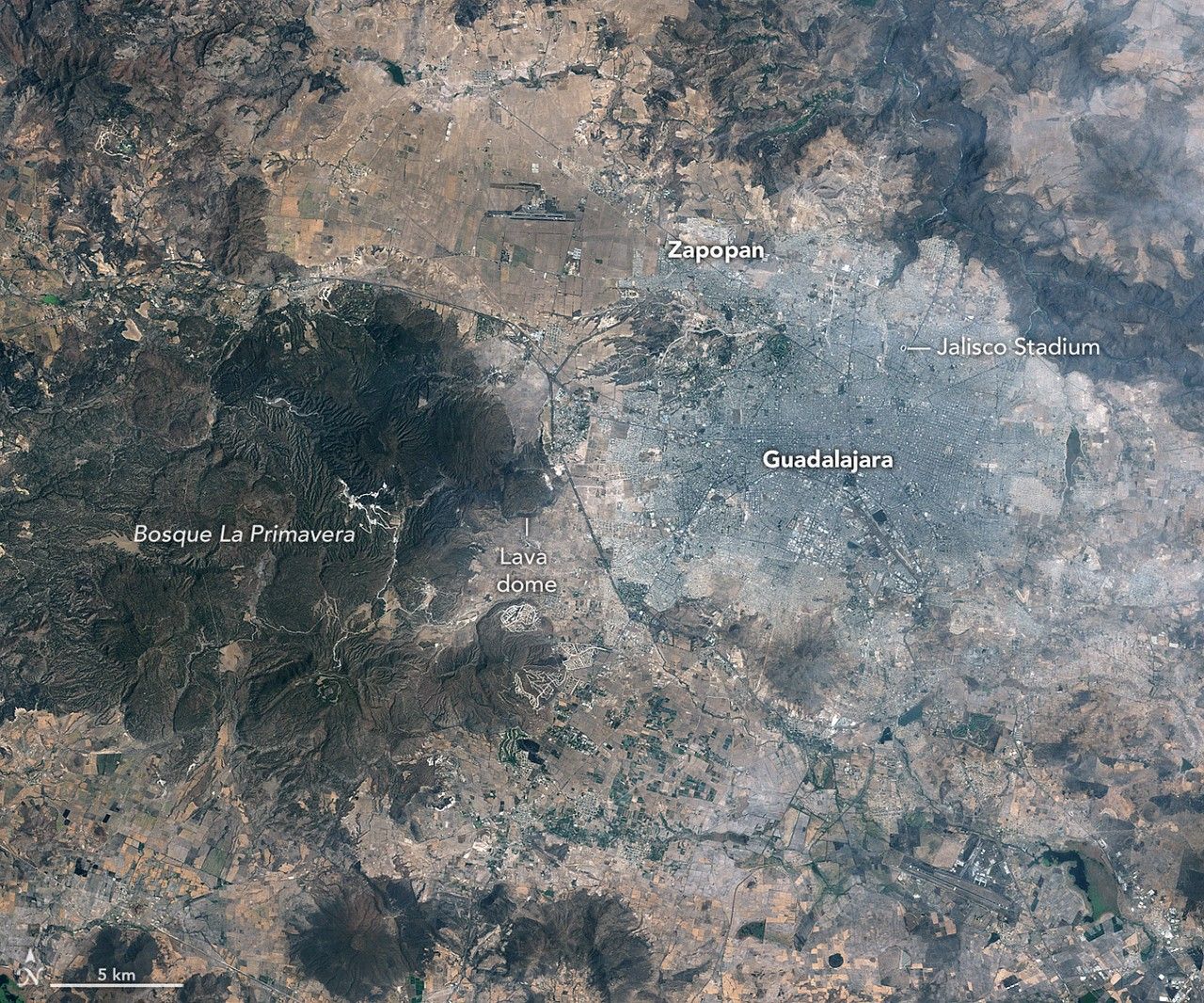
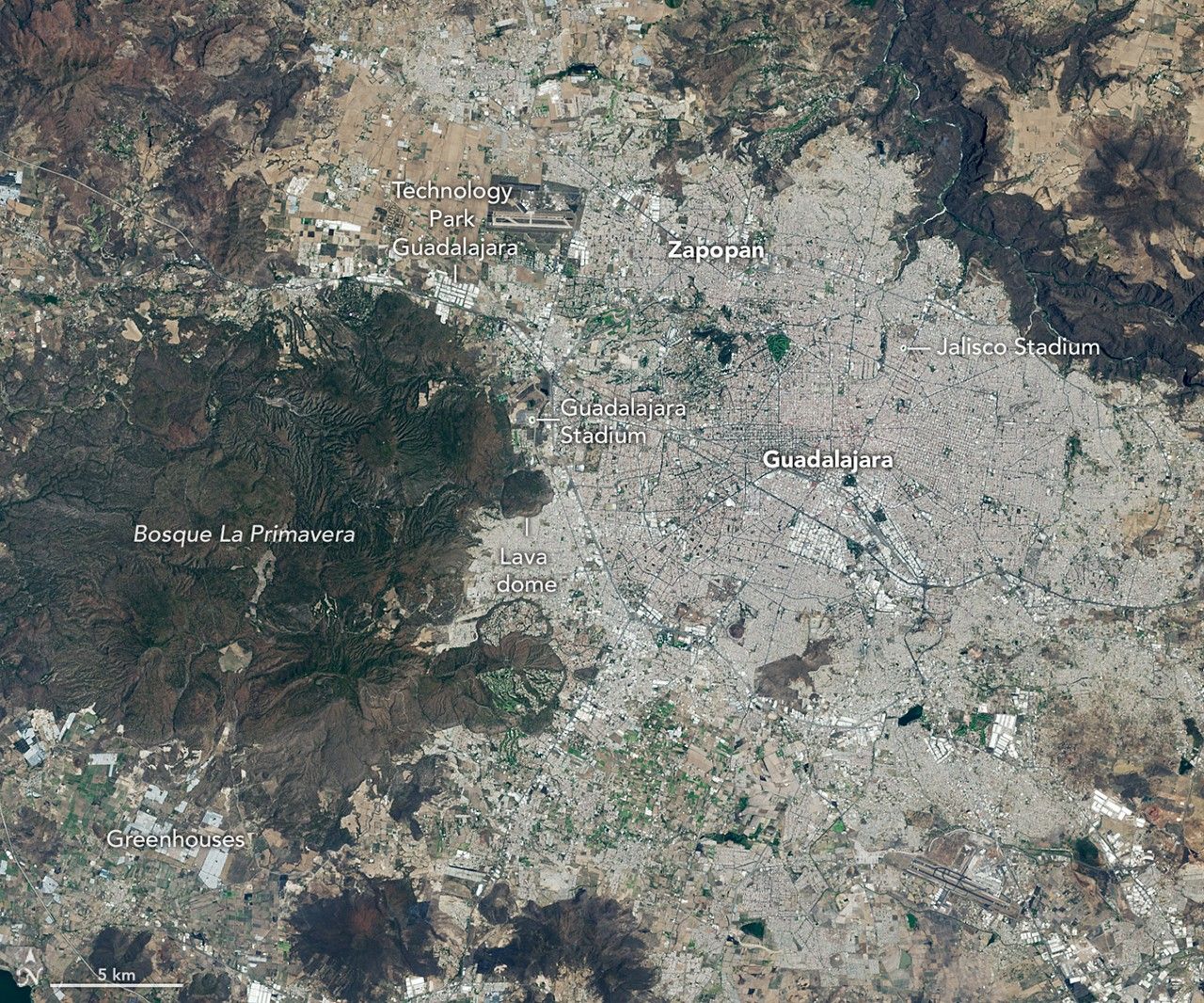
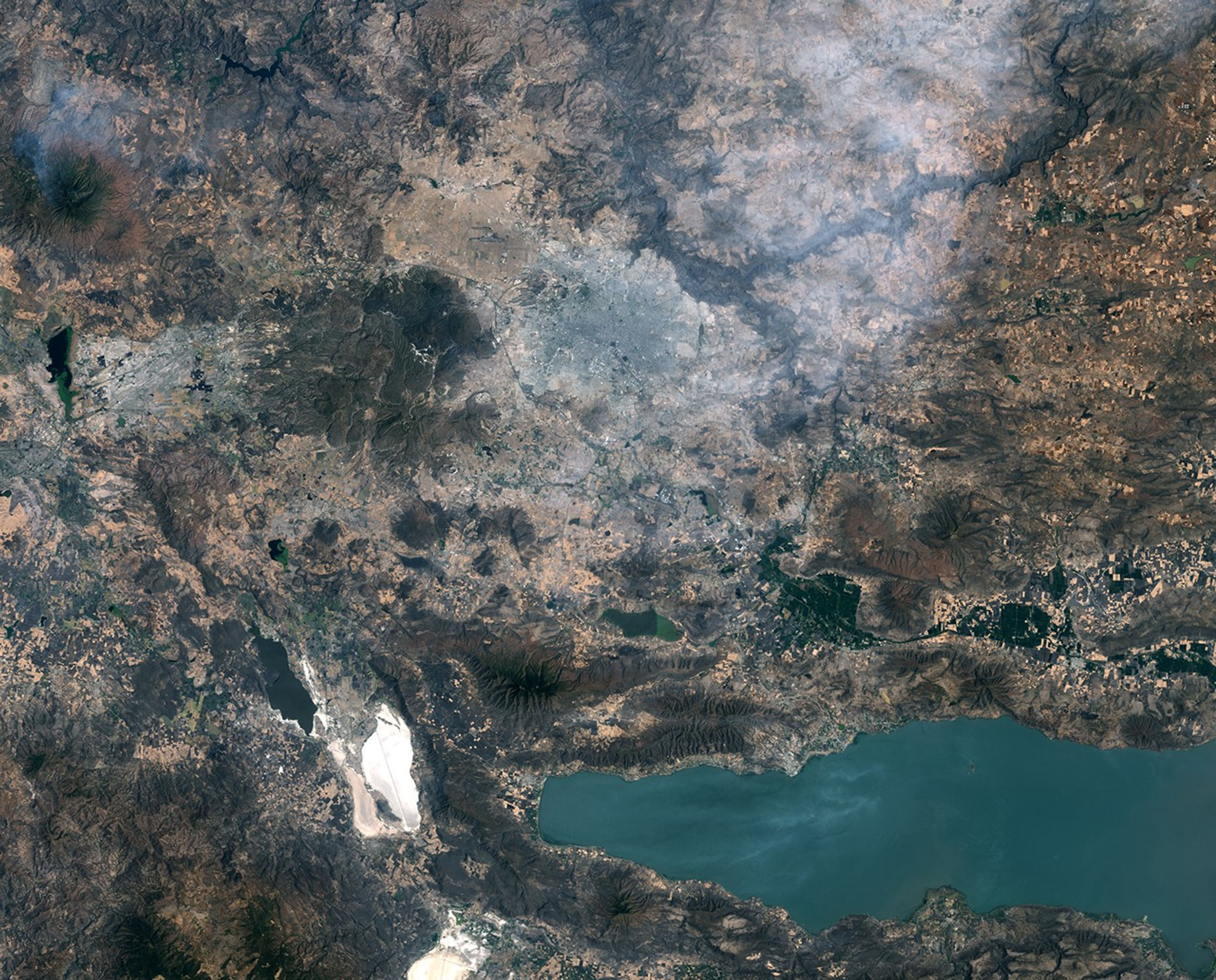
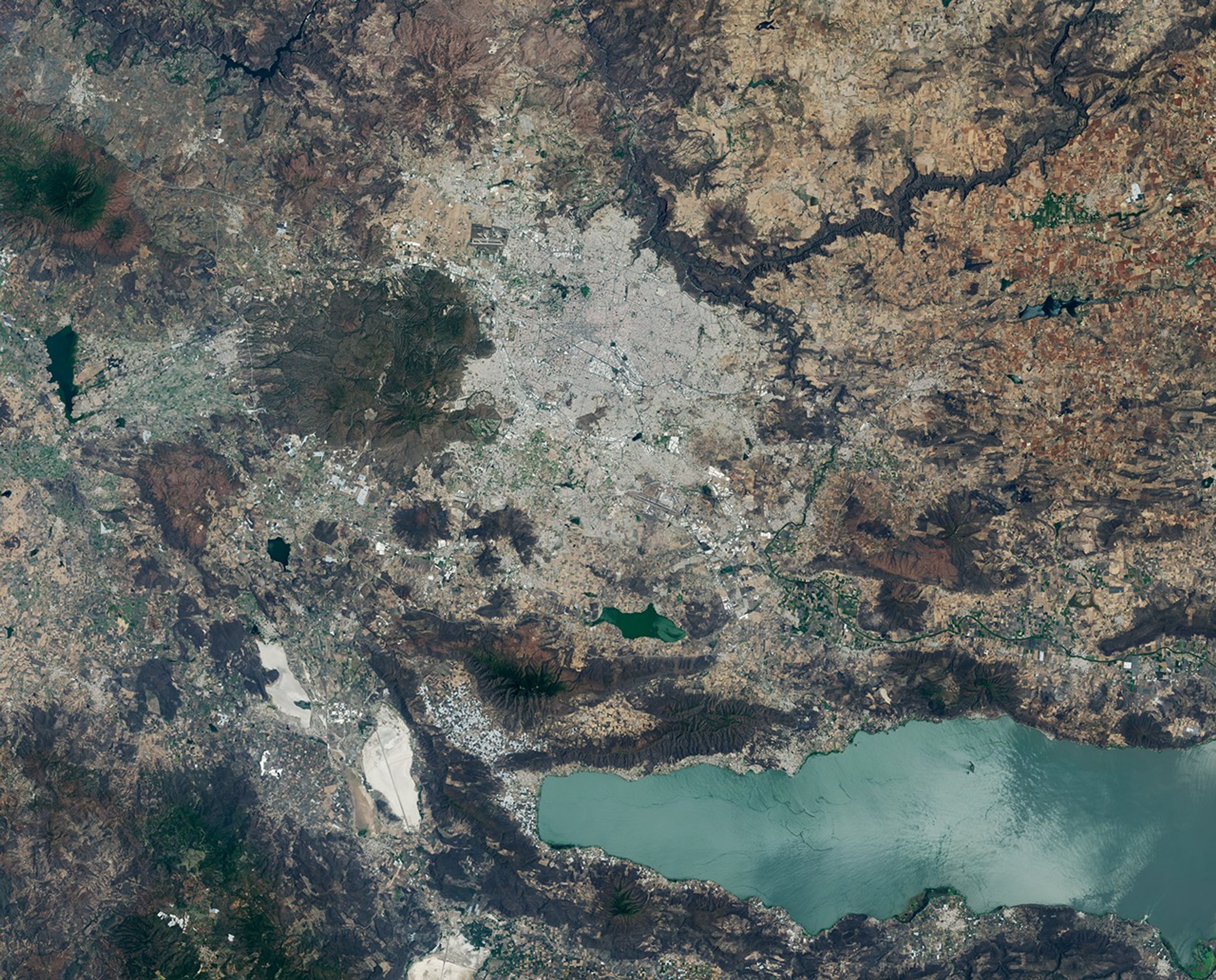
: Images of Guadalajara in 1986 (left) and 2026 (right) shows the city expanding westward into an area that had been mostly farmland. Guadalajara Stadium appears as a small circular feature on the left side of the 2026 image.
A pair of Landsat images shows 40 years of westward urban expansion from Guadalajara, Mexico. The Thematic Mapper on Landsat 5 captured the left image in 1986; the Operational Land Imager on Landsat 8 captured the right image in 2026.

Images of Guadalajara in 1986 (left) and 2026 (right) shows the city expanding westward into an area that had been mostly farmland. Guadalajara Stadium appears as a small circular feature on the left side of the 2026 image.
A pair of Landsat images shows 40 years of westward urban expansion from Guadalajara, Mexico. The Thematic Mapper on Landsat 5 captured the left image in 1986; the Operational Land Imager on Landsat 8 captured the right image in 2026.
NASA Earth Observatory / Lauren Dauphin

: Images of Guadalajara in 1986 (left) and 2026 (right) shows the city expanding westward into an area that had been mostly farmland. Guadalajara Stadium appears as a small circular feature on the left side of the 2026 image.
A pair of Landsat images shows 40 years of westward urban expansion from Guadalajara, Mexico. The Thematic Mapper on Landsat 5 captured the left image in 1986; the Operational Land Imager on Landsat 8 captured the right image in 2026.
Images of Guadalajara in 1986 (left) and 2026 (right) shows the city expanding westward into an area that had been mostly farmland. Guadalajara Stadium appears as a small circular feature on the left side of the 2026 image.
A pair of Landsat images shows 40 years of westward urban expansion from Guadalajara, Mexico. The Thematic Mapper on Landsat 5 captured the left image in 1986; the Operational Land Imager on Landsat 8 captured the right image in 2026.
NASA Earth Observatory / Lauren Dauphin

April 13, 1986

April 27, 2026

April 13, 1986 – April 27, 2026


A pair of Landsat images shows 40 years of westward urban expansion from Guadalajara, Mexico. The TM (Thematic Mapper) on Landsat 5 captured the left image in 1986; the OLI (Operational Land Imager) on Landsat 8 captured the right image in 2026.

Guadalajara, Mexico, was quite a different place when it last hosted World Cup games 40 years ago. The city welcomed matches in June 1986 and did so again in 2026, when South Korea faced Czechia at Guadalajara Stadium in the opening round of the 2026 FIFA World Cup.

In 1986, Guadalajara Stadium had not yet been built in Zapopan, the fast-growing municipality just northwest of Guadalajara. Many of that year’s World Cup matches were held instead at Jalisco Stadium in northeastern Guadalajara. It was in that stadium that France defeated Brazil in a penalty shootout in the 1986 quarterfinals, in what is widely regarded as one of the most memorable World Cup games of all time.

As seen in the Landsat images above, the land where Guadalajara Stadium (also called Estadio Akron) now sits was farmland in 1986. The new stadium, built in 2010 to host Mexico’s Club Deportivo Guadalajara, or Chivas, lies near the Sierra la Primavera volcanic complex, a rugged landscape full of lava flows, volcanic domes, steam vents, and hot springs. The architects who designed the stadium took inspiration from the nearby volcanic terrain, creating a structure that rises from a grassy earthen berm meant to resemble the flanks of a volcano, topped with a white roof reminiscent of a volcanic cloud.   

About 95,000 years ago, the volcanic system underneath Sierra la Primavera produced a massive eruption that caused a caldera 11 kilometers (7 miles) in diameter to slump downward. Water filled the depression for tens of thousands of years, but tectonic uplift and the accumulation of sediment eventually led to the demise of the lake. Erosion wore away the softer surrounding rock over time, leaving harder, erosion-resistant volcanic rocks within the circular feature that now stand high above the surrounding terrain.

Starting about 60,000 years ago, several lava domes erupted along the southern edge of the caldera. The youngest of them, Cerro del Colli, formed about 30,000 years ago, leaving the dome-shaped feature just south of the stadium and contributing to a broader landscape dotted with other volcanic domes and cinder cones.

Today, much of the original caldera has been preserved as a forested area known as La Primavera Biosphere Reserve, even as development has partially encircled it during the past 40 years. The population of the Guadalajara metro area has grown from about 2.7 million in 1986 to more than 5.5 million now, with particularly rapid growth in Zapopan, a burgeoning tech hub sometimes billed as “Mexico’s Silicon Valley.” A prominent development visible in Landsat images is Guadalajara Technology Park, one of several new industrial parks in Zapopan. New greenhouses have also come to the area en masse, including south of the reserve, where they are mostly used to grow fruits and vegetables.

World Cup fever runs particularly high in Guadalajara, which is hosting World Cup matches for the third time. During Brazil’s legendary title run in 1970, when Pelé led the team, Jalisco Stadium was the venue for Brazil’s first-round, quarterfinal, and semifinal matches. To commemorate him, the city in May 2026 erected a 9.5-meter (31-foot) bronze statue of the iconic football (soccer) player.

Even the animals at Guadalajara Zoo are taking part in the festivities, with elephants, gorillas, giraffes, capybaras, pumas, and macaws “predicting” match winners by choosing between food, shirts, boxes, soccer balls, and other items. A puma named Muluk predicted South Korea would beat Czechia by sniffing and moving a ball, one newspaper reported.

Guadalajara will host four first-round matches: South Korea vs. Czechia on June 12, Mexico vs. South Korea on June 18, Colombia vs. Democratic Republic of the Congo on June 23, and Uruguay vs. Spain on June 26.

NASA Earth Observatory images by Lauren Dauphin, using Landsat data from the U.S. Geological Survey. Story by Adam Voiland.

References & Resources

You may also be interested in:

Stay up-to-date with the latest content from NASA as we explore the universe and discover more about our home planet.

A Volcanic Medley Near Mammoth Lakes 

4 min read

A massive, old caldera and more recently formed craters shape the landscape in the eastern Sierra Nevada.

Article

Scoria Cones on Earth and Mars

7 min read

The hill-shaped features are a sign of explosive volcanic activity—a rarity on the Red Planet.

Article

Restless Kīlauea Launches Lava and Ash

3 min read

Episode 43 of the Hawaiian volcano’s current eruption was marked by high lava fountains and widespread ash dispersal.

Article

Powered by WPeMatico

Get The Details…