Tracing the Origin and Energization of Plasma inthe Heliosphere

Tracing the Origin and Energization of Plasma inthe Heliosphere

5 Min Read

Tracing the Origin and Energization of Plasma inthe Heliosphere

An artist’s depiction of dark starry background with the Sun in the upper right corner, the Earth in the center, and a circular spacecraft in the bottom left corner. Gold lines stream away from the Sun on all directions, colliding with Earth.
–
Credits:
Stephen Alvey, University of Michigan

PROJECT:

Solar Wind Pickup Ion Composition Energy Spectrometer (SPICES)

SNAPSHOT:

SPICES is a new sensor that will help scientists discover where matter originates and how it is energized throughout the solar system
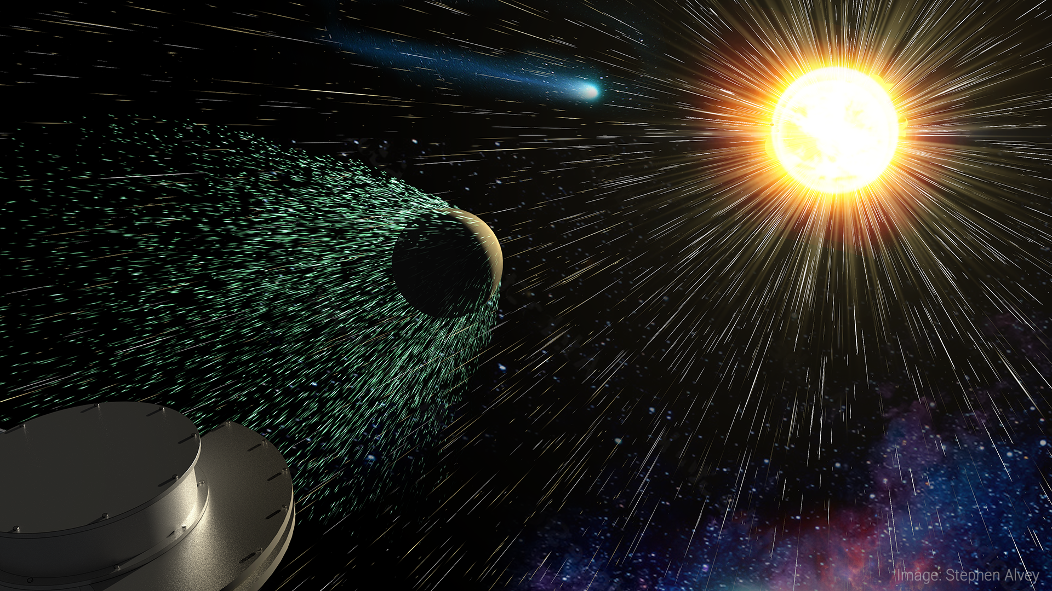
An artist’s depiction of dark starry background with the Sun in the upper right corner, the Earth in the center, and a circular spacecraft in the bottom left corner. Gold lines stream away from the Sun on all directions, colliding with Earth.
SPICES will measure plasma in space and trace its origin back to the Sun, planetary atmospheres, comet tails, and interstellar space.
Credits: Stephen Alvey, University of Michigan

Imagine that you have a secret decoder ring that you can use to decipher a secret message with important clues about things around you: where they came from, why they are there, and what will become of them in the future. Now imagine that the secret decoder ring is actually a sensor that can be flown in space to unravel secrets about the matter in the solar system. Where did this matter originate, how did it become energized, and how could it impact humans living on Earth and traveling in space? SPICES is like a decoder ring for the plasma (gas consisting of electrically charged particles) in the solar system. It has the potential to reveal important information about how the Sun behaves and interacts with planets and their atmospheres, and how the solar system is impacted by its own motion through interstellar space. 

The universe is mostly made of hydrogen, but the elements that make up life as well as the planets, comets, and many other celestial bodies are heavier than hydrogen. In fact, these heavier elements, although not as abundant, can hold the key to understanding how numerous processes in the universe work. In our solar system, these “heavy elements”—which are called “heavy ions” when they are electrically charged—can help us trace plasma to its origin at planets, comets, the Sun and solar atmosphere, and even to interstellar space. 

Heavy ions are an important piece of the puzzle that describes how the solar system supports and sustains life. They also play a role in large eruptions on the Sun that cause solar storms. For example, solar flares that emit vast amounts of X-rays are mostly due to excitation of heavy ions on the Sun. Being able to predict and prepare for solar storms is important to keep humans and robotics safe on space missions. SPICES will enable us to better understand how these solar storms form by giving scientists information about how eruptions on the Sun occur and how they accelerate plasma. With this information, scientists can better predict when and how severe solar storms will be. 

SPICES is designed to measure the chemical makeup of electrically charged streams of particles (also called wind) that blow in space. SPICES will measure the solar wind—the wind that blows away from the Sun, including the wind that results from the most severe solar storms. It will also measure neutral wind that blows into the solar system from interstellar space and becomes charged as it encounters the Sun, and wind that blows off planetary surfaces and out of planetary atmospheres. Measuring the chemical composition of these streams of particles can help us understand how the solar system was created, its behavior today, and how it will behave in the future. 

SPICES is optimized to detect less common heavy ions—like low-charge ions and isotopes—that are not well measured by current spaceborne sensors. The SPICES design incorporates a novel and state-of-the-art method of boosting the energy of incoming ions so that their fingerprints can be more clearly identified, allowing the abundance and variability of these rare species to be accurately measured. Some of these rarer species are only found inside solar storms and can change how these storms interact with Earth’s space environment. 

But boosting the energy of these incoming ions is challenging; it must be done safely, without putting the SPICES electronics or other instruments at risk, and without heating the sensor up too much.  The methods used on SPICES to boost the ion energy are based on traditional methods, but the new design can boost the ion energy 60% higher than prior space sensors by stepping up the energy one stage at a time to reach the maximum level desired. The design also incorporates a protective bubble to shield electronics and other onboard systems from the high energy ions generated by SPICES.  SPICES will soon be ready to fly on upcoming missions that study the global behavior of the Sun, planetary atmospheres, monitor space weather, or fly out to the edges of the solar system into interstellar space. 

This engineering challenge is being tackled by engineers at the University of Michigan Space Physics Research Laboratory, with contributions from Southwest Research Institute in Texas.  The sensor’s original design was a result of collaboration of scientists at the University of Michigan including Dr. George Gloeckler, one of the pioneers of space-based ion mass spectrometers; Professor Susan Lepri; Dr. Jason Gilbert; and Associate Professor Jim Raines. 

PROJECT LEAD:

Professor Susan Lepri, The University of Michigan

SPONSORING ORGANIZATION

Heliophysics Strategic Technology Office (HESTO)

Powered by WPeMatico
Get The Details…

Five Tips for Photographing the Annular Solar Eclipse on Oct. 14

Five Tips for Photographing the Annular Solar Eclipse on Oct. 14

3 min read

Five Tips for Photographing the Annular Solar Eclipse on Oct. 14

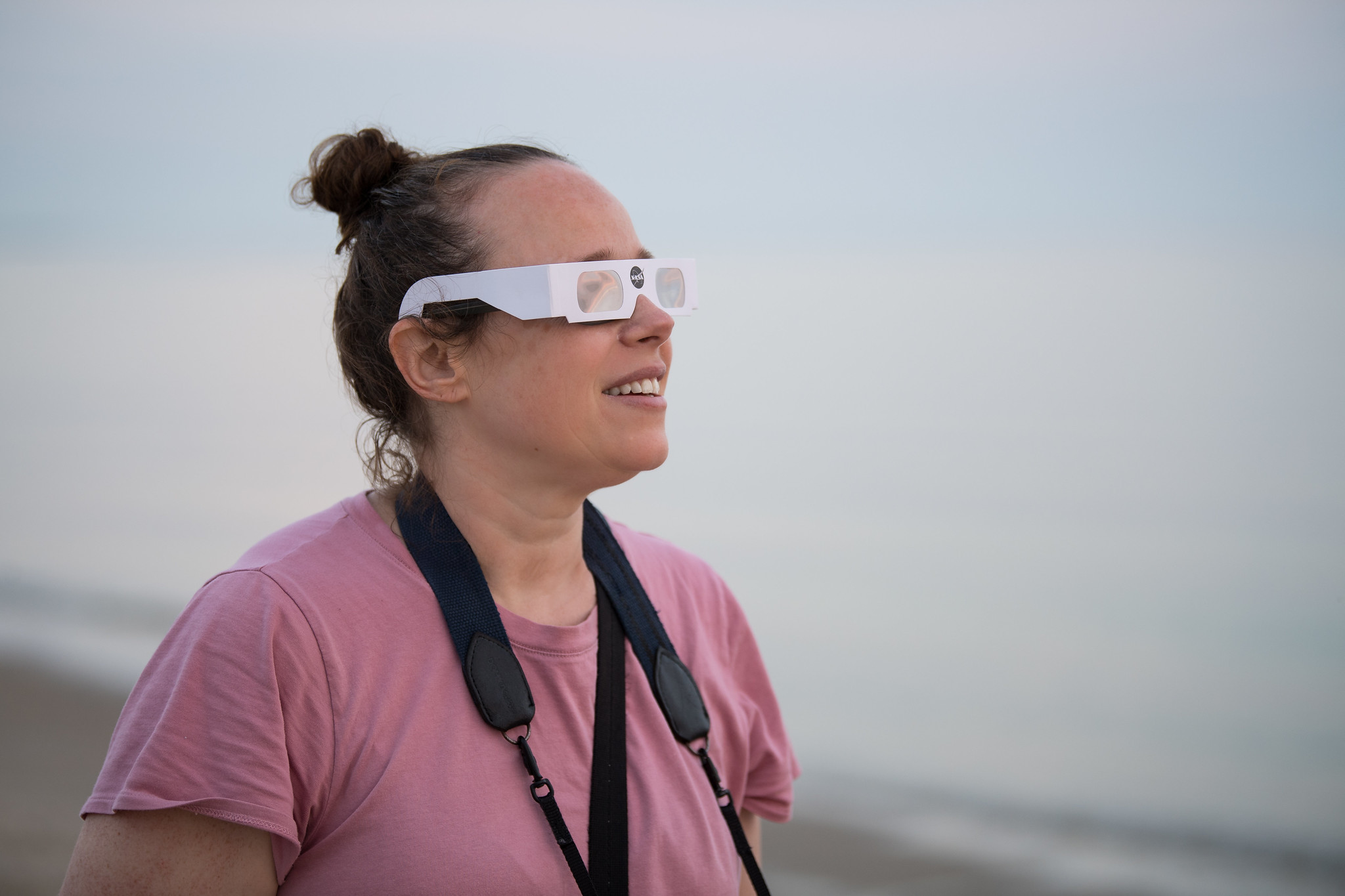
A woman, seen from the torso up, stands on a beach. She is wearing white solar viewing glasses and has a camera strap around her neck.
Sarah Baker views the partial solar eclipse as the sun rises, Thursday, June 10, 2021, at Lewes Beach in Delaware.
NASA/Aubrey Gemignani

An annular solar eclipse is crossing the Americas on Oct. 14, 2023. This astronomical event is a perfect opportunity to capture unforgettable images of the Moon “taking a bite” out of the Sun or creating a “ring of fire” effect in the sky. Whether you’re an amateur photographer or a selfie master, try out these tips for photographing the eclipse. 

#1 – Safety First

To take images as the Sun is being eclipsed, you’ll need to use a special solar filter to protect your camera, just as you’ll need a pair of eclipse glasses to protect your own eyes. 

Having a few other pieces of equipment can also come in handy during the eclipse. Using a tripod can help you stabilize the camera and avoid taking blurry images during the low lighting. Additionally, using a delayed shutter release timer will allow you to snap shots without jiggling the camera.

#2 – Any Camera Is a Good Camera

Taking a stunning photo has more to do with the photographer than the camera. Whether you have a high-end DSLR, or a camera phone, you can take great photos during the eclipse; after all, the best piece of equipment you can have is a good eye and a vision for the image you want to create. If you don’t have a telephoto zoom lens, focus on taking landscape shots, which capture the changing environment.

Trees line the landscape. On the right, a camera sits on a tripod. Two hands hold either side of the camera.
A safe solar filter must be used in front of a camera lens whenever photographing an annular solar eclipse or a partial solar eclipse. Putting the camera on a tripod will help stabilize the view and produce clearer photos.
Danny B. Thomas

#3 – Look Up, Down, All Around

While the Sun is the most commanding element of an eclipse, remember to look around you. As the Moon slips in front of the Sun, the landscape will be bathed in long shadows, creating eerie lighting across the landscape. Light filtering through the overlapping leaves of trees create natural pinholes, which will also create mini eclipse replicas on the ground. Everywhere you can point your camera can yield exceptional imagery, so be sure to compose some wide-angle photos that can capture your eclipse experience.

NASA photographer Bill Ingalls recommends focusing on the human experience of watching the eclipse. “The real pictures are going to be of the people around you pointing, gawking, and watching it,” Ingalls noted. “Those are going to be some great moments to capture to show the emotion of the whole thing.”

#4 – Practice

Be sure you know the capabilities of your camera before eclipse day. Most cameras, and even many camera phones, have adjustable exposures, which can help you darken or lighten your image during the tricky eclipse lighting. Make sure you know how to manually focus the camera for crisp shots.

For DSLR cameras, the best way to determine the correct exposure is to test settings on the uneclipsed Sun beforehand. Using a fixed aperture of f/8 to f/16, try shutter speeds between 1/1000 to 1/4 second to find the optimal setting, which you can then use to take images during the partial or annular stages of the eclipse.

#5 – Share!

Share your eclipse experience with friends and family afterwards. Tag @NASA to connect your photos on social media to those taken around the country and share them with NASA. 

While you’re out perfecting your perfect eclipse shot, don’t forget to stop and look at the eclipse with your own eyes. Just remember to wear your solar viewing glasses (or “eclipse glasses”) throughout the entire eclipse!

Share

Details

Last Updated
Oct 10, 2023

Powered by WPeMatico

Get The Details…

Hubble Examines Entrancing Galaxy in Eridanus

Hubble Examines Entrancing Galaxy in Eridanus

2 min read

Hubble Examines Entrancing Galaxy in Eridanus

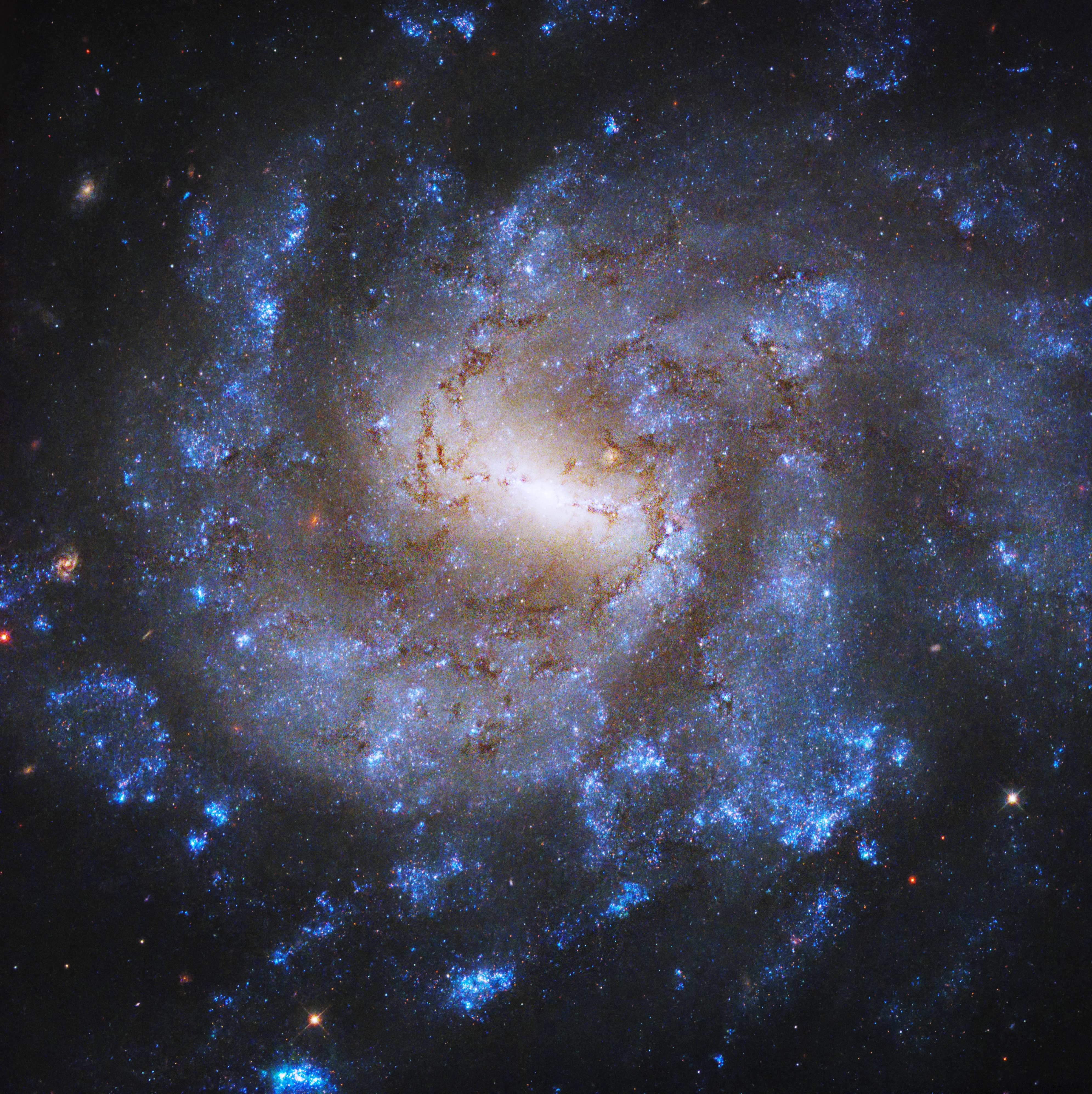
A face-on spiral galaxy with bright, blue-white spiral arms and dark, reddish-brown dust lanes. A bright-white bar of stars extends through the center of the galaxy. Small, more distant, reddish galaxies are visible in the background.
NASA’s Hubble Space Telescope’s view of NGC 685 in the constellation Eridanus, the River.
NASA, ESA, and J. Lee (Space Telescope Science Institute); Processing: Gladys Kober (NASA/Catholic University of America)

Hubble is sharing a brand new galaxy image every day through October 7, 2023!
Visit our website daily, or follow along on X, Facebook, and Instagram.

NGC 685 takes center stage amid faintly twinkling stars on an inky black background. This galaxy is clearly a barred spiral galaxy with its bright center bar and patchy, curving arms. It is about 58 million light-years away in the constellation Eridanus. NGC 685 lies south of the celestial equator and is visible from the southern hemisphere at certain times of the year.

British astronomer John Herschel discovered NGC 685 in 1834, and early observers noted its apparent roundness. The whole galaxy is about 60,000 light-years across – a little more than half the size of our Milky Way. The patches of bright blue along the galaxy’s arms are star clusters, groups of stars held together by their mutual gravitational attraction. Wisps of dark red near the central bar depict interstellar gas and dust, the matter from which stars form. About two-thirds of all spiral galaxies have a central bar like NGC 685. Its intense glow comes from many stars concentrated in a relatively small area.

NASA’s Hubble Space Telescope took this image as part of a scientific effort to study star cluster formation and evolution. Hubble’s ultraviolet capabilities are well-suited to this task, since young stars shine brightly at ultraviolet wavelengths. An average-sized galaxy like NGC 685 can have around 100 million stars, which is on the low end.

Media Contact:

Claire Andreoli
NASA’s Goddard Space Flight Center, Greenbelt, MD
claire.andreoli@nasa.gov

Keep Exploring

Discover More Topics From NASA

Powered by WPeMatico

Get The Details…