NASA’s Artemis II Crew Eclipses Record for Farthest Human Spaceflight

NASA’s Artemis II Crew Eclipses Record for Farthest Human Spaceflight

The Artemis II crew floats in Orion; NASA astronaut Christina Koch smiles at the camera as NASA a
On Monday, April 6, 2026, six days into the Artemis II mission, NASA astronauts Reid Wiseman, Victor Glover, and Christina Koch, and CSA (Canadian Space Agency) astronaut Jeremy Hansen surpassed the record for human spaceflight’s farthest distance from Earth, which was previously set by the Apollo 13 mission in 1970.
Credit: NASA

Four astronauts aboard NASA’s Artemis II test flight around the Moon made history at 12:56 p.m. CDT on Monday, traveling 248,655 miles from Earth, surpassing the record for human spaceflight’s farthest distance previously set by the Apollo 13 mission in 1970. At its farthest point, crew inside the Orion spacecraft will have traveled about 252,760 miles, before looping back toward our home planet, setting the new record for human spaceflight.

Six days into the first crewed mission of NASA’s Artemis program, NASA astronauts Reid Wiseman, Victor Glover, and Christina Koch, and CSA (Canadian Space Agency) astronaut Jeremy Hansen continued collecting pictures of the Moon on their voyage away from Earth.

“At NASA, we dare to reach higher, explore farther, and achieve the impossible. That’s embodied perfectly by our Artemis II astronauts – Reid, Victor, Christina, and Jeremy. They are charting new frontiers for all humanity,” said Dr. Lori Glaze, acting associate administrator for Exploration Systems Development Mission Directorate at NASA Headquarters in Washington. “Their dedication is about more than breaking records – it’s fueling our hope for a bold future. Their mission is carrying our promise to return to the Moon’s surface, this time to stay as we establish a Moon Base.”

NASA’s Orion spacecraft began its journey to the Moon following a successful April 1 launch on an SLS (Space Launch System) rocket from the agency’s Kennedy Space Center in Florida. After conducting a series of burns to break free of Earth orbit the following day, the spacecraft set its path toward the Moon.

Following their record achievement, crew provided brief, emotional remarks. The world heard from CSA (Canadian Space Agency) astronaut Jeremy Hansen aboard Orion:

“From the cabin of Integrity here, as we surpass the furthest distance humans have ever traveled from planet Earth, we do so in honoring the extraordinary efforts and feats of our predecessors in human space exploration. We will continue our journey even further into space before Mother Earth succeeds in pulling us back to everything that we hold dear. But we most importantly choose this moment to challenge this generation and the next to make sure this record is not long-lived.”

In addition to their spaceflight record, crew suggested naming two craters on the Moon during their flight. The first is named in honor of their spacecraft, Integrity. The second honors Wiseman’s late wife, Carroll. After this mission is complete, the crater name proposals will be formally submitted to the International Astronomical Union, the organization that governs the naming of celestial bodies and their surface features.

When they fly past the Moon later, crew will come within about 4,070 miles from its surface at the closest approach. The astronauts will be the first to see the far side of the Moon with human eyes and are the first to travel behind the Moon. Finally, they will witness a solar eclipse as the Moon passes in front of the Sun.

NASA is expecting to lose communication with the astronauts for about 40 minutes during a planned blackout period. The break will occur as the Moon blocks signals between the spacecraft and the Earth through the Deep Space Network. When Orion reemerges from behind the Moon, it is expected to quickly reacquire contact with flight controllers in the Mission Control Center at NASA’s Johnson Space Center in Houston. 

During their lunar flyby, a fleet of cameras will capture imagery of the Moon, including features humans have never directly seen. The astronauts will use a variety of digital handheld cameras to conduct high-resolution photography of the lunar surface. Artemis II is providing astronauts an opportunity to gather data as one of the most powerful scientific tools for observation are the four pairs of eyes observing lunar features with varying illumination and texture.

Photos, videos, mission telemetry, and communication information are all sources of data from the test flight, which will be used to inform future Artemis missions as the agency embarks on development of its Moon Base.

The Artemis II astronauts are more than halfway through their mission. The crew is scheduled to splash down off the coast of San Diego at approximately 8:07 p.m. EDT (5:07 p.m. PDT) on Friday, April 10. Following splashdown, recovery teams will retrieve the crew members using helicopters and deliver them to the USS John P. Murtha. Once aboard, the astronauts will undergo post-flight medical evaluations in the ship’s medical bay before traveling back to shore to meet with an aircraft bound for NASA Johnson.

Under the Artemis program, NASA will send Artemis astronauts on increasingly challenging missions to explore more of the Moon for scientific discovery, economic benefits, and to build on our foundation for the first crewed missions to Mars.

For the latest mission progress, visit:

https://www.nasa.gov/artemis-ii

-end-

Cheryl Warner / Rachel Kraft
Headquarters, Washington
202-358-1600
cheryl.m.warner@nasa.gov / rachel.h.kraft@nasa.gov

Share

Details

Last Updated

Apr 06, 2026

Editor
Jennifer M. Dooren

Powered by WPeMatico

Get The Details…
Jessica Taveau

NASA’s Northrop Grumman CRS-24 Mission Overview 

NASA’s Northrop Grumman CRS-24 Mission Overview 

NASA’s Northrop Grumman Commercial Resupply Services 24 mission, or Northrop Grumman CRS-24, will deliver approximately 11,000 pounds of science and supplies to the International Space Station. This mission will be the second flight of the Cygnus XL, the larger, more cargo-capable version of the company’s solar-powered spacecraft. 

The Cygnus XL will launch on a SpaceX Falcon 9 rocket from the Cape Canaveral Space Force Station in Florida. Following arrival, astronauts aboard the space station will use the Canadarm2 to grapple Cygnus XL before robotically installing the spacecraft to the Unity module’s Earth-facing port for cargo unloading. 

NASA’s Northrop Grumman Commercial Resupply Services 24 mission will launch on a SpaceX Falcon 9 rocket to deliver research and supplies to the International Space Station.
NASA
NASA’s Northrop Grumman Commercial Resupply Services 24 mission will deliver more than 11,000 pounds of research and supplies to the International Space Station.
NASA
NASA’s Northrop Grumman Commercial Resupply Mission 24 will launch from Space Launch Complex 40 at Cape Canaveral Space Force Station in Florida.
NASA
NASA’s Northrop Grumman Commercial Resupply Services 24 spacecraft is named in honor of NASA astronaut Steven Nagel. Selected by NASA in 1979, Nagel is a veteran of four space flights (STS-51G and STS-61AA in 1985, STS37 in 1991, and STS-55 in 1993) and has logged more than 723 hours in space. Nagel died in 2014.
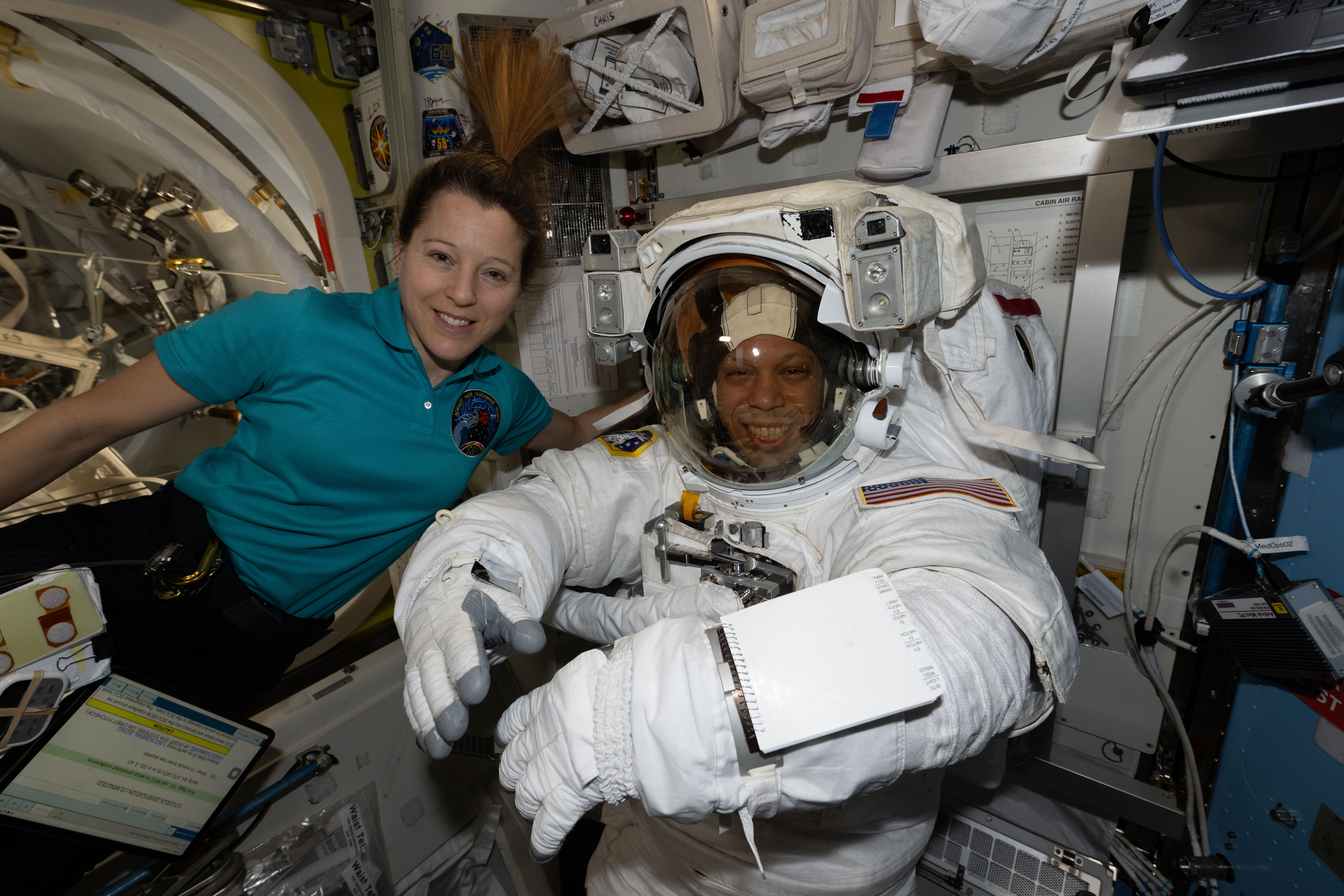
NASA astronauts Jack Hathaway and Chris Williams will be on duty during the Cygnus spacecraft’s approach and rendezvous. Hathaway will be at the controls of the Canadarm2 robotic arm ready to capture Cygnus as Williams monitors the spacecraft’s arrival.
NASA

Science Highlights 

Along with supplies and equipment for the crew, Cygnus XL will deliver a range of scientific investigations to the International Space Station that helps to advance knowledge and technology in support of the Artemis program. This research includes:  

A new module for the Cold Atom Lab to expand its research capabilities and improve our understanding of general relativity, planetary composition, and dark matter. The Cold Atom Lab advances quantum research to improve technologies, such as solar cells, MRI scanners, and components that power phones and computers.

A new module for the Cold Atom Lab to expand its research capabilities and improve our understanding of general relativity, planetary composition, and dark matter. The Cold Atom Lab advances quantum research to improve technologies, such as solar cells, MRI scanners, and components that power phones and computers. 

An investigation (InSPA-StemCellEX-H2) studying blood stem cell production in microgravity to create a larger number of therapeutic cells. Successful stem cell production could advance healthcare on Earth for patients with certain blood diseases and cancers.
NASA

An investigation (InSPA-StemCellEX-H2) studying blood stem cell production in microgravity to create a larger number of therapeutic cells. Successful stem cell production could advance healthcare on Earth for patients with certain blood diseases and cancers.  

An investigation (Nanoracks-ITSI) that measures how radio signals sent from Earth change as they pass through the upper atmosphere. These measurements could improve models that predict the impacts of solar activity and space weather, which can disrupt technologies like GPS navigation and radar tracking systems.
NASA

An investigation (Nanoracks-ITSI) that measures how radio signals sent from Earth change as they pass through the upper atmosphere. These measurements could improve models that predict the impacts of solar activity and space weather, which can disrupt technologies like GPS navigation and radar tracking systems.  

A study (CBIOMES) of how spaceflight impacts the relationship between organisms and their gut microbiome. Researchers will observe changes in roundworms down to the cellular level to identify ways to maintain microbiome stability and help protect astronaut health on future Moon and Mars missions.

A study (CBIOMES) of how spaceflight impacts the relationship between organisms and their gut microbiome. Researchers will observe changes in roundworms down to the cellular level to identify ways to maintain microbiome stability and help protect astronaut health on future Moon and Mars missions. 

Mission Hardware 

A study (CBIOMES) of how spaceflight impacts the relationship between organisms and their gut microbiome. Researchers will observe changes in roundworms down to the cellular level to identify ways to maintain microbiome stability and help protect astronaut health on future Moon and Mars missions. 

  • The European Enhanced Exploration Exercise Device is a compact exercise system that help preserve muscle mass and bone health in microgravity. By enabling a broader and more adaptable range of resistance exercises, this device combines cycling, rowing, and resistance training in addition to the ability to perform rope-pulling and climbing movements, even when unpowered. The device was jointly developed by NASA and ESA (European Space Agency). 
  • The Supplemental Heat Rejection Evaporative Cooler provides heat rejection for the orbiting laboratory in the event of dual thermal control system loop failures. The cooler connects to the vacuum system and multiple onboard water sources to evaporate water through hollow fiber membranes.  
  • The Ocular Coherence Tomography is a noncontact medical imaging device that uses reflected light to produce detailed cross-sectional and 3D images to actively track the eye during imagery. Tracking eye movement with simultaneous dual-beam imaging minimizes motion artifact, enables noise reduction, and allows the instrument to precisely track changes in crew eye health over time. This unit will replace a degraded unit in orbit

Additional Hardware

  • 8 hatch seal covers, to be installed over current hatch seals 
  • 2 batteries to support the operations of the Zarya module 
  • 3 resupply water tanks for the water storage system 
  • 1 nitrogen tank and 1 oxygen tank, used for recharging spacesuits and maintaining a pressurized environment on space station 
  • 1 pretreat and water dispenser, a spare unit for the Waste and Hygiene Compartment 

Powered by WPeMatico

Get The Details…
Mark A. Garcia

Night Sky Network Celebrates Artemis II

Night Sky Network Celebrates Artemis II

1 min read

Night Sky Network Celebrates Artemis II

Today, the crew of Artemis II reaches a milestone, traveling farther than any humans in recorded history, as they orbit the far side of the Moon, roughly 4,000 miles above the lunar surface. 

You can watch this historic broadcast on NASA’s YouTube channel today, April 6, 2026, at 10 AM Pacific (1 PM Eastern), or on NASA+.

Be sure to celebrate with your communities with the following NSN resources:

From us here at Night Sky Network, Godspeed Integrity, and the crew of Artemis II!

–Vivian White and Kat Troche
The NASA Night Sky Network Team

Powered by WPeMatico

Get The Details…

Thinking of You, Earth

Thinking of You, Earth

NASA astronaut Reid Wiseman looks out of the Orion spacecraft's rectangular window at Earth. He is barely visible in the dimly lit cabin, but Earth is bright. The entirety of Earth cannot be seen; in this view, Earth's round shape is cut off. Earth itself looks like a bright blue ball with swirling white clouds all over it; at center is a brown and green landmass.
NASA

On April 4, 2026, NASA astronaut and Artemis II Commander Reid Wiseman peers out of one of the Orion spacecraft’s main cabin windows, looking back at Earth, as the crew travels towards the Moon.

The Artemis II astronauts – Wiseman and fellow NASA astronauts Christina Koch and Victor Glover, and CSA (Canadian Space Agency) astronaut Jeremy Hansen – are now more than two-thirds of the way to the Moon. Follow along on their journey with our photo gallery and 24/7 livestream.

Image credit: NASA

Powered by WPeMatico

Get The Details…
Monika Luabeya

NASA Answers Your Most Pressing Artemis II Questions

NASA Answers Your Most Pressing Artemis II Questions

IMG_0173.DNG
NASA astronaut Christina Koch, Artemis II mission specialist, peers out of one of the Orion spacecraft’s main cabin windows on Saturday, April 4, 2026, looking back at Earth, as the crew travel toward the Moon.
NASA

The first crewed test flight under NASA’s Artemis program is underway. Four Artemis II astronauts are flying aboard NASA’s Orion spacecraft around the Moon and back, as they test how the spacecraft’s systems operate in a deep space environment.

NASA astronauts Reid Wiseman, Victor Glover, and Christina Koch, and CSA (Canadian Space Agency) astronaut Jeremy Hansen lifted off at 6:35 p.m. EDT on April 1 from launch pad 39B at the agency’s Kennedy Space Center in Florida.

Real-time coverage continues throughout the mission on NASA’s YouTube channel. The agency also provides a separate live stream of views from the Orion spacecraft as bandwidth allows, as well as inside the capsule. In addition NASA is providing the latest mission imagery online.

Daily mission status briefings are held live from the agency’s Johnson Space Center in Houston through splashdown, except for Monday, April 6, due to lunar flyby activities. A list of activities is regularly updated online.

The crew are participating in live conversations throughout the mission, which were scheduled prior to their departure from Earth. NASA will provide the exact times of each of these downlink events, as well as the latest mission coverage, on the Artemis blog.

To track Orion in space, visit: nasa.gov/trackartemis

Frequently Asked Questions (all times Eastern):

How long is the Artemis II mission? NASA’s Artemis II mission is an approximately 10-day journey around the Moon including launch, a lunar flyby, and a safe splashdown off the coast of San Diego.

How far will Artemis II travel? Crew is expected to travel a total of 695,081 miles from launch to splashdown. The spacecraft will pass within 4,066 miles of the lunar surface during its closest approach and will reach a maximum distance of 252,757 miles from Earth, about 4,102 miles farther than Apollo 13.

When and where will the Artemis II crew and Orion spacecraft splashdown?

The location and time of our Artemis II splashdown will continue to shift as mission milestones are reached. In the days leading up to splashdown, updates will be available on NASA’s website and in our daily news conferences. Mission media events are available on the agency’s website.

NASA’s Artemis II mission is scheduled to splash down off the coast of San Diego at approximately 8:07 p.m. EDT (5:07 p.m. PDT) on Friday, April 10. Following splashdown, recovery teams will retrieve the crew using helicopters and deliver them to the USS John P. Murtha. Once aboard, the astronauts will undergo post-mission medical evaluations in the ship’s medical bay before traveling back to shore to meet with an aircraft bound for NASA’s Johnson Space Center in Houston.

What is the crew doing on this mission? Artemis II astronauts are putting the Orion spacecraft through a series of planned tests to evaluate systems, procedures, and performance in deep space. They will conduct manual spacecraft operations and monitor automated activities; evaluate Orion’s life-support, propulsion, power, thermal, and navigation systems; perform proximity operations activities; assess habitability and crew interfaces; and participate in science activities, including lunar surface observations and human health studies, that will inform science operations on future Moon missions. They also will practice mission-critical activities, including trajectory adjustments, communications at lunar distances, and piloting Orion during key phases of flight, culminating in a re-entry and splashdown to further validate the spacecraft’s performance with crew aboard.

What can we expect to see during lunar flyby? All times are subject to change. Here’s a rough schedule of activities:

  • Live coverage begins at 1 p.m., and continues through 9:45 p.m.
  • 1:30 p.m.: NASA hosts a conversation between the crew and the science officer in NASA’s Mission Control Center at the agency’s Johnson Space Center in Houston, to go over the objectives and timeline for the flyby.
    • Because the Sun’s angle on the Moon shifts by about one degree every two hours, the crew could not know the exact lighting conditions to expect on the lunar surface until after launch. This briefing provides one final opportunity to review details before the flyby begins.
  • 7:05 p.m.: The Artemis II crew is expected surpass the record previously set by the Apollo 13 crew in 1970 for the farthest humans have ever traveled from Earth.
    • The Apollo 13 crew traveled 248,655 miles from Earth; Artemis II will reach a maximum distance of 252,757 miles from Earth, surpassing the record by about 4,102 miles. The crew is expected to make remarks on the milestone around 2:10 p.m.
  • 2:45 p.m.: The seven-hour lunar observation period begins. Crew will see both the near and far sides of the Moon as the observation period begins.
    • Because room at Orion’s windows is limited, the crew will divide into pairs, with two crew members observing for 55 to 85 minutes, while the pair exercises or completes on other tasks.
  • 6:47 p.m.: Mission control expects to temporarily lose communication with the crew as Orion passes behind the Moon.
  • 7:02 p.m.: Astronauts will make their closest approach to the Moon, the reach its farthest point from Earth at 7:05 p.m.
    • At this distance, the Moon will appear to the astronauts about the size of a basketball held at arm’s length. They also may be the first humans to see some parts of the Moon’s far side with the unaided eye.
  • 7:27 p.m.: NASA’s Mission Control Center should re-acquire communication with the astronauts.
  • 9:20 p.m.: The flyby observation period wraps, and crew will begin transferring some of the imagery to the ground. NASA’s science team will review the images and observations overnight, and then discuss with crew the following day, while the experience is still fresh.

Why do we need astronauts to view the Moon when we have robotic observers? Human eyes and brains are highly sensitive to subtle changes in color, texture, and other surface characteristics. Having astronaut eyes observe the lunar surface directly, in combination with the context of all the advances that scientists have made about the Moon over the last several decades, may uncover new discoveries and a more nuanced appreciation for the features on the surface of the Moon.

Though the crew will not be able to downlink all their imagery before they return    to Earth, as much as possible will be made available on the Artemis II Multimedia website. Additional imagery will also be added as it is processed following splashdown.

What do the astronauts eat during the mission? The Artemis II crew has access to 189 unique menu items during their mission, including 10 different beverages like coffee and smoothies. Common food items include tortillas, nuts, barbeque beef brisket, cauliflower, macaroni and cheese, butternut squash, cookies, and chocolate. Food flying aboard Artemis II is designed to support crew health and performance during the mission around the Moon. Menu selections are developed with space food experts and the crew to balance calorie needs, hydration, and nutrient intake while accommodating individual preferences. For more information about their menu, visit here.

What are the goals of the Artemis II Mission? The Artemis II test flight will confirm the systems necessary to support astronauts in deep space exploration and prepare to establish a sustained presence on the Moon. The primary goal of Artemis II is a crewed test flight in lunar space. There are five main additional priorities for Artemis II:

  • Crew: Demonstrate the ability of systems and teams to sustain the flight crew in the flight environment, and through their return to Earth.
  • Systems: Demonstrate systems and operations essential to a crewed lunar campaign. This ranges from ground systems to hardware in space, and operations spanning from development to launch, flight, and recovery.
  • Hardware and Data: Retrieve flight hardware and data, assessing performance for future missions.
  • Emergency Operations: Demonstrate emergency system capabilities and validate associated operations to the extent practical, such as abort operations and rescue procedures, as needed.
  • Data and Subsystems: Complete additional objectives to verify subsystems and validate data.

Can I talk to the crew aboard Orion during their mission? During their mission, crew will participate in several live and taped downlinks with news outlets, administration officials, and more. These opportunities were allocated prior to their launch. A schedule of these events is available on the agency’s website.

What is the Artemis II zero-gravity indicator and how was it selected? NASA’s Artemis II crew selected Rise as their zero-gravity indicator for the mission. A zero-gravity indicator is a small plush item that flies along with a crew to visually indicate when they are in space. Rise was designed by Lucas Ye from Mountain View, California, as a tribute to the iconic Earthrise moment from the Apollo 8 mission, which deeply resonated with the crew. Rise was fabricated by NASA’s Thermal Blanket Lab at the Goddard Space Flight Center in Greenbelt, Maryland. NASA worked with the company Freelancer to hold a Moon Mascot Design Challenge to design the zero-gravity indicator for Artemis II, which drew more than 2,600 submissions from more than 50 countries, including from K-12 students.

How many cameras are installed on the Orion spacecraft? Orion is carrying 32 cameras and devices, including any instrument with a lens capable of capturing photos or video, inside or on the exterior of the vehicle. The systems support engineering, navigation, crew monitoring, and a range of lunar science and outreach activities. Fifteen cameras are mounted directly to the spacecraft, and 17 are handheld cameras operated by the crew.

Artemis Program FAQs

Artemis II will travel around the Moon but will not land on its surface. Why is this mission so important? The Artemis II test flight is NASA’s first crewed Artemis mission. Astronauts on their first flight aboard NASA’s Orion spacecraft will confirm the spacecraft’s systems operate as designed with crew aboard in the actual environment of deep space. The unique Artemis II mission profile builds on the uncrewed Artemis I flight test by demonstrating a broad range of SLS (Space Launch System) and Orion capabilities needed on deep space missions. This mission will verify Orion’s life support systems can sustain astronauts on longer-duration missions ahead and allow the crew to practice operations essential to Artemis III and beyond.

What is the next mission for NASA’s Artemis program and the agency? NASA is aligning agencywide initiatives to achieve President Donald J. Trump’s National Space Policy and advance American leadership in space. During an Ignition event on March 24 at the agency’s headquarters in Washington. Among the updates, NASA is prioritizing the Artemis program launch cadence, a robust U.S. presence in low Earth orbit, the creation of a Moon Base, breakthrough science, space nuclear power and propulsion, and investment in the NASA workforce to deliver on the agency’s mission with urgency. Learn more on the agency’s website: https://www.nasa.gov/ignition.

For more information about the Artemis mission, visit:

https://www.nasa.gov/artemis-ii

Powered by WPeMatico

Get The Details…
Cheryl Warner