NASA Study: Asteroid’s Orbit, Shape Changed After DART Impact

NASA Study: Asteroid’s Orbit, Shape Changed After DART Impact
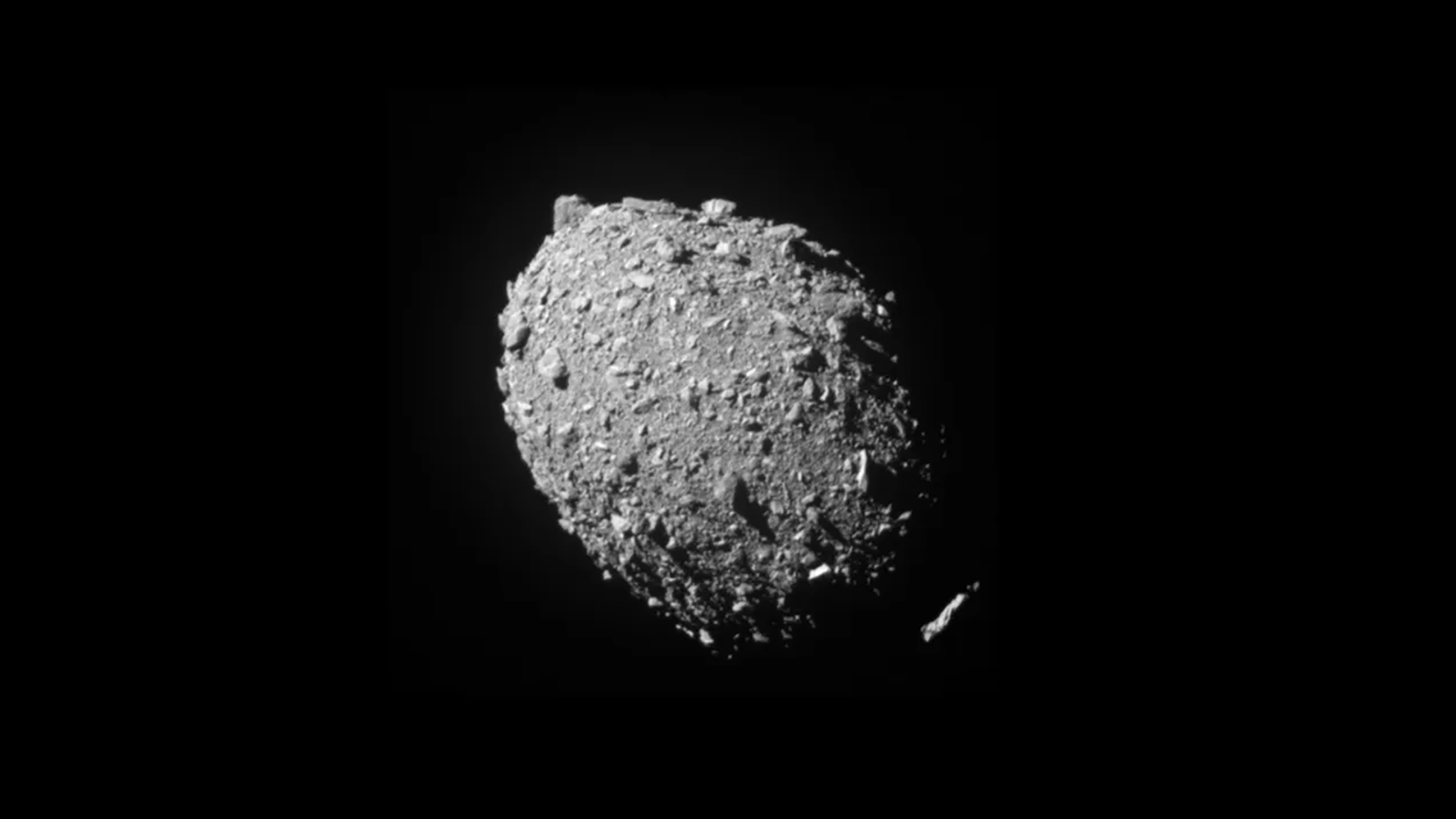
The asteroid Dimorphos was captured by NASA’s DART mission just two seconds before the spacecraft struck its surface on Sept. 26, 2022. Observations of the asteroid before and after impact suggest it is a loosely packed “rubble pile” object.
NASA/Johns Hopkins APL

After NASA’s historic Double Asteroid Redirection Test, a JPL-led study has shown that the shape of asteroid Dimorphos has changed and its orbit has shrunk.

When NASA’s DART (Double Asteroid Redirection Test) deliberately smashed into a 560-foot-wide (170-meter-wide) asteroid on Sept. 26, 2022, it made its mark in more ways than one. The demonstration showed that a kinetic impactor could deflect a hazardous asteroid should one ever be on a collision course with Earth. Now a new study published in the Planetary Science Journal shows the impact changed not only the motion of the asteroid, but also its shape.

DART’s target, the asteroid Dimorphos, orbits a larger near-Earth asteroid called Didymos. Before the impact, Dimorphos had a roughly symmetrical “oblate spheroid” shape – like a squashed ball that is wider than it is tall. With a well-defined, circular orbit at a distance of about 3,900 feet (1,189 meters) from Didymos, Dimorphos took 11 hours and 55 minutes to complete one loop around Didymos.

“When DART made impact, things got very interesting,” said Shantanu Naidu, a navigation engineer at NASA’s Jet Propulsion Laboratory in Southern California, who led the study. “Dimorphos’ orbit is no longer circular: Its orbital period” – the time it takes to complete a single orbit – “is now 33 minutes and 15 seconds shorter. And the entire shape of the asteroid has changed, from a relatively symmetrical object to a ‘triaxial ellipsoid’ – something more like an oblong watermelon.”
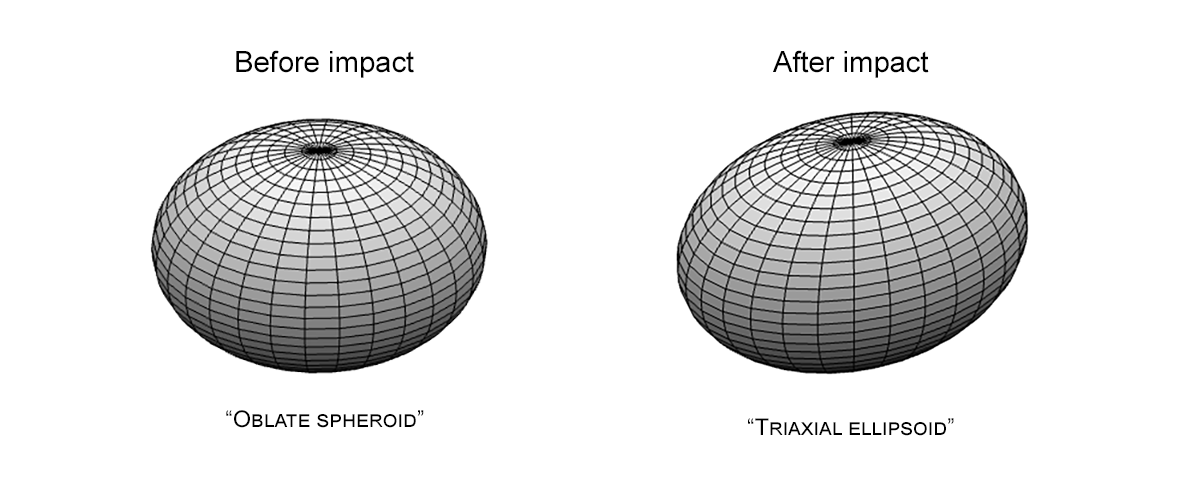
This illustration shows the approximate shape change that the asteroid Dimorphos experienced after DART hit it. Before impact, left, the asteroid was shaped like a squashed ball; after impact it took on a more elongated shape, like a watermelon.
NASA/JPL-Caltech

Dimorphos Damage Report

Naidu’s team used three data sources in their computer models to deduce what had happened to the asteroid after impact. The first source was aboard DART: The spacecraft captured images as it approached the asteroid and sent them back to Earth via NASA’s Deep Space Network (DSN). These images provided close-up measurements of the gap between Didymos and Dimorphos while also gauging the dimensions of both asteroids just prior to impact.

The second data source was the DSN’s Goldstone Solar System Radar, located near Barstow, California, which bounced radio waves off both asteroids to precisely measure the position and velocity of Dimorphos relative to Didymos after impact. Radar observations quickly helped NASA conclude that DART’s effect on the asteroid greatly exceeded the minimum expectations.

The third and most significant source of data: ground telescopes around the world that measured both asteroids’ “light curve,” or how the sunlight reflecting off the asteroids’ surfaces changed over time. By comparing the light curves before and after impact, the researchers could learn how DART altered Dimorphos’ motion.

As Dimorphos orbits, it periodically passes in front of and then behind Didymos. In these so-called “mutual events,” one asteroid can cast a shadow on the other, or block our view from Earth. In either case, a temporary dimming – a dip in the light curve – will be recorded by telescopes.

“We used the timing of this precise series of light-curve dips to deduce the shape of the orbit, and because our models were so sensitive, we could also figure out the shape of the asteroid,” said Steve Chesley, a senior research scientist at JPL and study co-author. The team found Dimorphos’ orbit is now slightly elongated, or eccentric. “Before impact,” Chesley continued, “the times of the events occurred regularly, showing a circular orbit. After impact, there were very slight timing differences, showing something was askew. We never expected to get this kind of accuracy.”

The models are so precise, they even show that Dimorphos rocks back and forth as it orbits Didymos, Naidu said.

Orbital Evolution

The team’s models also calculated how Dimorphos’ orbital period evolved. Immediately after impact, DART reduced the average distance between the two asteroids, shortening Dimorphos’ orbital period by 32 minutes and 42 seconds, to 11 hours, 22 minutes, and 37 seconds.

Over the following weeks, the asteroid’s orbital period continued to shorten as Dimorphos lost more rocky material to space, finally settling at 11 hours, 22 minutes, and 3 seconds per orbit – 33 minutes and 15 seconds less time than before impact. This calculation is accurate to within 1 ½ seconds, Naidu said. Dimorphos now has a mean orbital distance from Didymos of about 3,780 feet (1,152 meters) – about 120 feet (37 meters) closer than before impact.

“The results of this study agree with others that are being published,” said Tom Statler, lead scientist for solar system small bodies at NASA Headquarters in Washington. “Seeing separate groups analyze the data and independently come to the same conclusions is a hallmark of a solid scientific result. DART is not only showing us the pathway to an asteroid-deflection technology, it’s revealing new fundamental understanding of what asteroids are and how they behave.”

These results and observations of the debris left after impact indicate that Dimorphos is a loosely packed “rubble pile” object, similar to asteroid Bennu. ESA’s (European Space Agency) Hera mission, planned to launch in October 2024, will travel to the asteroid pair to carry out a detailed survey and confirm how DART reshaped Dimorphos.

More About the Mission

DART was designed, built, and operated by the Johns Hopkins Applied Physics Laboratory (APL) in Laurel, Maryland, for NASA’s Planetary Defense Coordination Office, which oversees the agency’s ongoing efforts in planetary defense. DART was humanity’s first mission to intentionally move a celestial object.

JPL, a division of Caltech in Pasadena, California, manages the DSN for NASA’s Space Communications and Navigation (SCaN) program within the Space Operations Mission Directorate at the agency’s headquarters in Washington.

News Media Contacts

Ian J. O’Neill
Jet Propulsion Laboratory, Pasadena, Calif.
818-354-2649
ian.j.oneill@jpl.nasa.gov

Karen Fox / Charles Blue
NASA Headquarters
karen.c.fox@nasa.gov / charles.e.blue@nasa.gov

2024-029

Powered by WPeMatico

Get The Details…
Naomi Hartono
NASA Administrator, Health Secretary to Host Cancer Moonshot Event

NASA Administrator, Health Secretary to Host Cancer Moonshot Event

NASA circular logo
NASA logo

Media are invited to join NASA and Department of Health and Human Services leadership at 9:30 a.m. EDT on Thursday, March 21, at NASA Headquarters in Washington, to highlight how the agencies are making progress toward President Joe Biden and First Lady Jill Biden’s Cancer Moonshot initiative.

During the event, NASA Administrator Bill Nelson and Health and Human Services Secretary Xavier Becerra will give remarks and are available for interviews afterward.

Additional participants include:

  • NASA Astronaut Frank Rubio
  • NASA Astronaut Stephen Bowen
  • Dr. Kimryn Rathmell, director, National Cancer Institute

Media interested in covering the event must RSVP to Luis Botello Faz no later than 5 p.m. Wednesday, March 20, via email at: luis.m.botellofaz@nasa.gov. A copy of NASA’s media accreditation policy is online.

The event will take place in the agency’s Earth Information Center in the East Lobby at NASA Headquarters, located at 300 E St. SW.

The International Space Station is a hub for scientific research and technology, including demonstrations to help end cancer as we know it.

NASA is working with agencies and researchers across the federal government to help cut the nation’s cancer death rate by at least 50% in the next 25 years, a goal of the Cancer Moonshot Initiative.

Learn more about Cancer Moonshot at:

https://www.whitehouse.gov/cancermoonshot/

-end-

Faith McKie
Headquarters, Washington
202-358-1600
faith.d.mckie@nasa.gov

Renata Miller
Health and Human Services
202-570-8194
Renata.Miller@hhs.gov

Share

Details

Last Updated

Mar 19, 2024

Editor
Jennifer M. Dooren

Powered by WPeMatico

Get The Details…
Jennifer M. Dooren

Student-Built Robots Clash at Competition Supported by NASA-JPL

Student-Built Robots Clash at Competition Supported by NASA-JPL

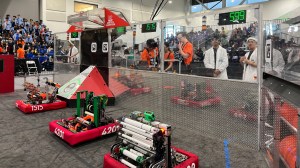
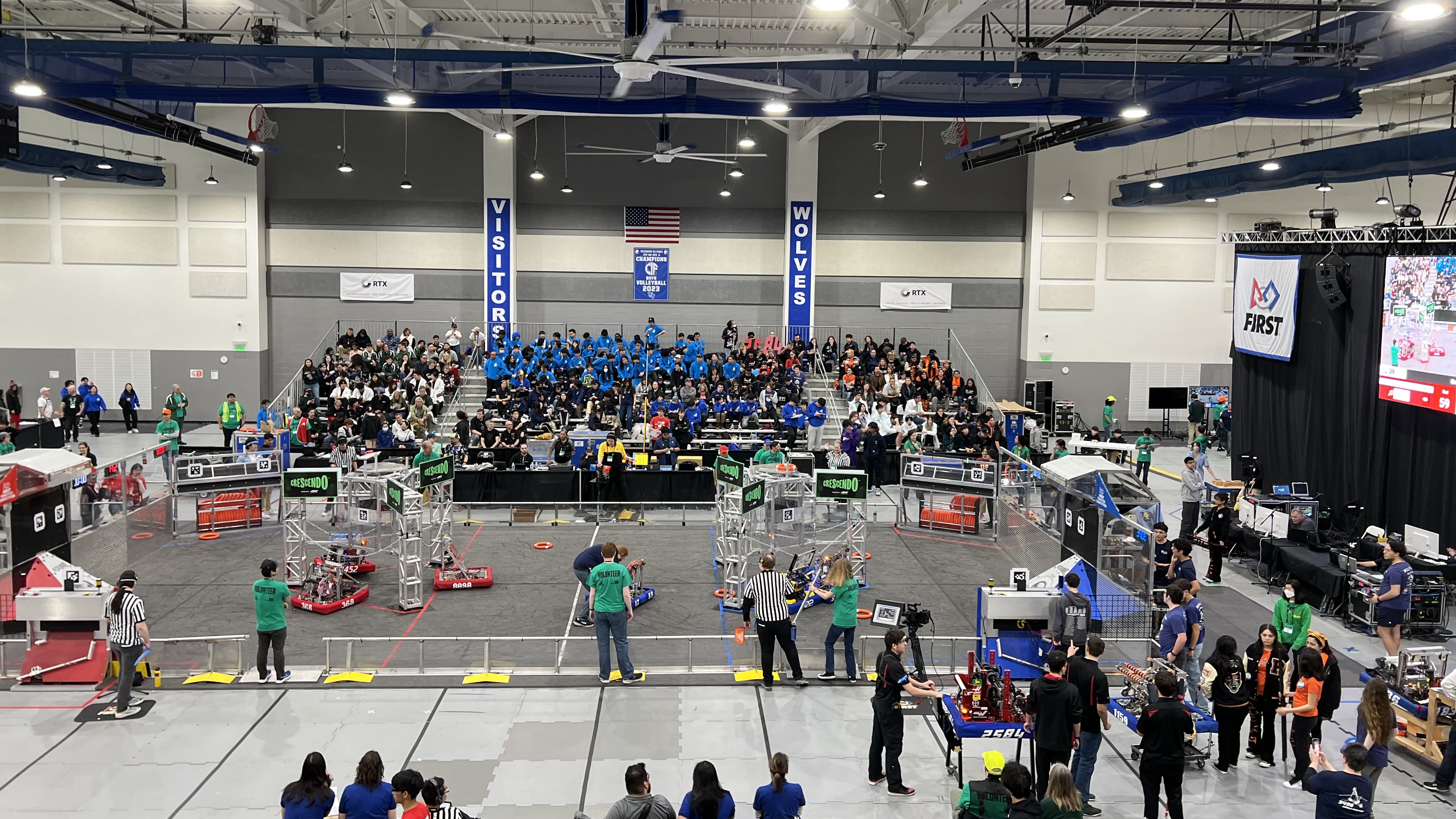
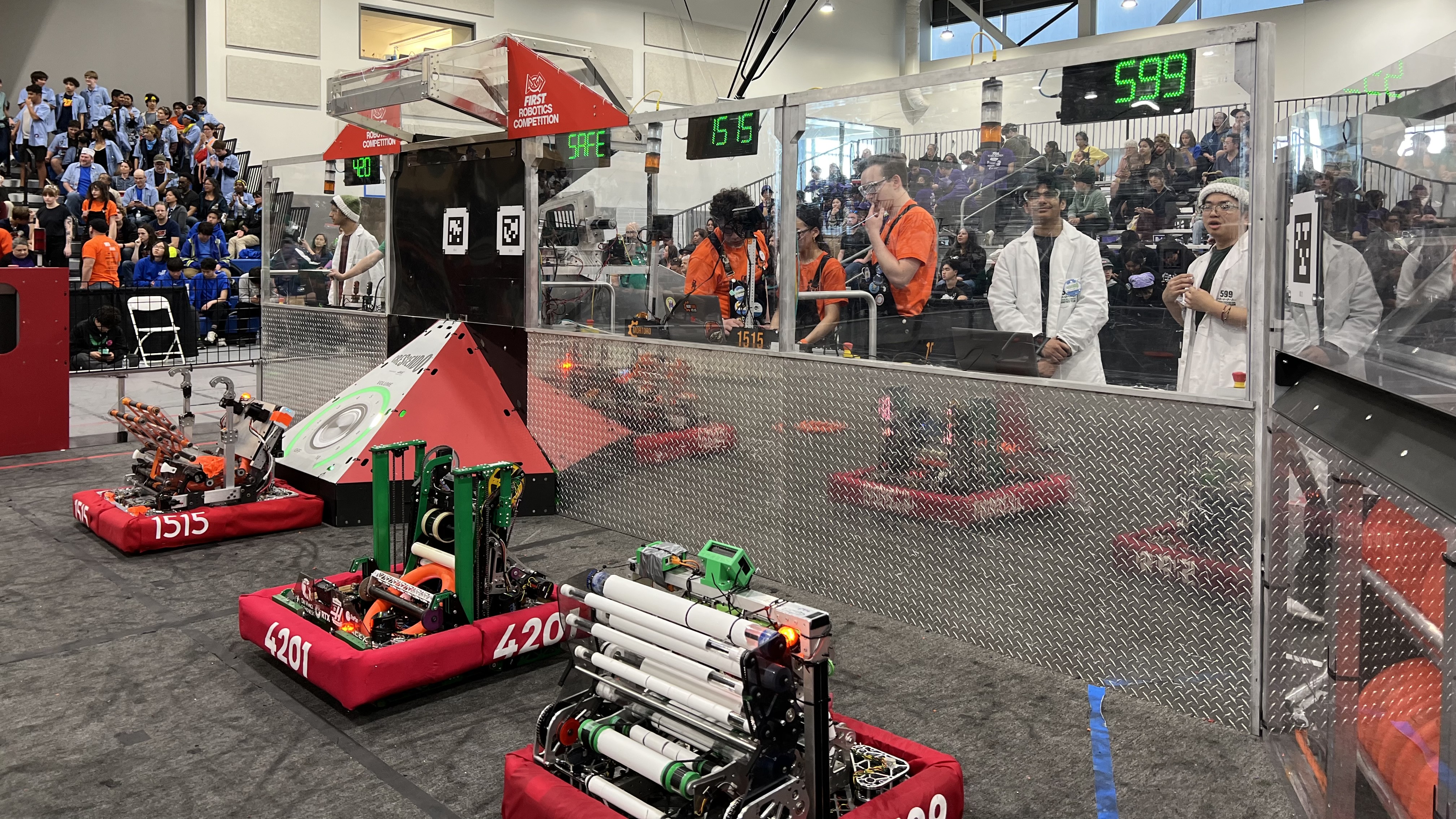
Hand-crafted robots, constructed over the past two months by 44 high school teams, duked it out at the FIRST Robotics Los Angeles regional competition.

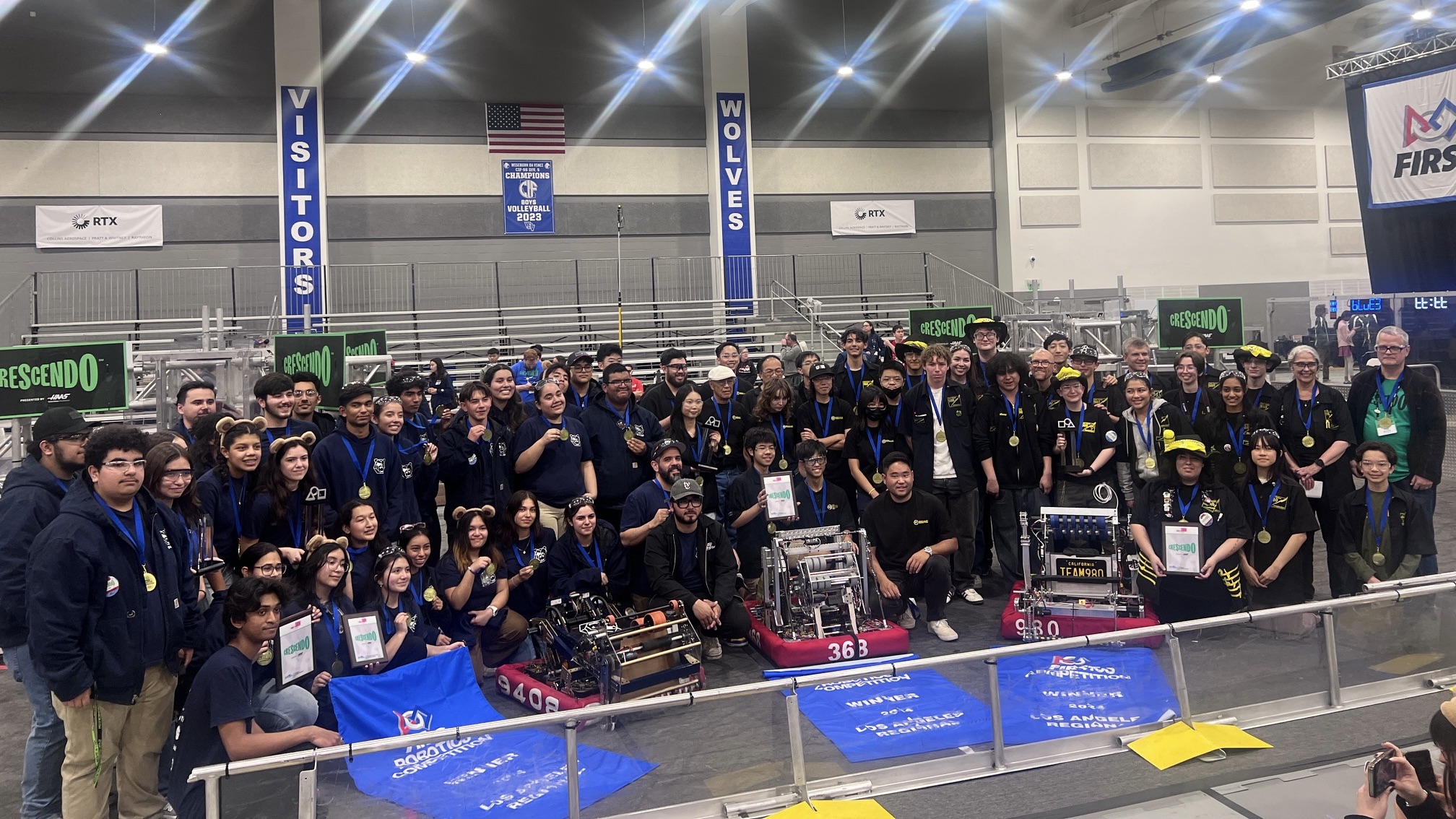
Student-made contraptions of a metal and a little magic battled each other in front of cheering and dancing high schoolers at the annual Los Angeles regional FIRST Robotics Competition over the weekend, an event supported by NASA’s Jet Propulsion Laboratory. Of the 44 participating teams, five triumphed, earning the chance to compete this April at the FIRST international championship tournament in Houston.

The raucous event at the Da Vinci Schools campus in El Segundo saw six 125-pound robots racing around the playing field during each 2 ½-minute match as pounding music filled the room and a live announcer narrated the action. Working in alliances of three teams on each side, the robots jockeyed for position and banged into each other, using a variety of mechanical devices to retrieve large, foam rings from the floor and launch them into two target chutes. In the final seconds of each round, the bots could earn extra points by hoisting themselves off the ground to dangle from a metal chain.

“The energy in the room was amazing this year,” said Kim Lievense, the manager of JPL’s Public Services Office, who coordinates some 100 volunteers for the event every year. “These teams and their bots really left it all on the field, and it was so great to be there to see it yet again.”

The 24th year for this L.A.-area competition, the event is one of many under the umbrella of the nonprofit FIRST (For Inspiration and Recognition of Science and Technology), which pairs students with STEM professionals. The competitions give students hands-on experience with engineering and problem-solving, team-building, fundraising, and other business skills.

Teams receive the rules of the game – titled “Crescendo” this year and themed around arts and entertainment – in January. Using FIRST’s technical specifications, students have just weeks to design, build, and test their robots, devoting hours after school and on weekends to the project.

“There were a lot of really impressive robots, and students, this year. The engineering, the manufacturing, the programming in the software these kids are writing – it’s quite complex,” said Julie Townsend, one of three event judges from JPL. She has been volunteering with FIRST for nearly 20 years as a judge and coach and is JPL’s point of contact for the NASA Robotics Alliance Project, which supports NASA “house” youth robotics teams across the country.

“Without these programs like FIRST, high school students don’t have the opportunity to do this kind of engineering,” Townsend added. “It’s hard, but they eventually get to experience the joy of a functioning system that you designed. You failed 16 times and then you get to see it work flawlessly.”

In the end, the winning alliance joined together a team from Hawaii with two Southern California teams: Team 368 (“Team Kika Mana”) of McKinley High School in Honolulu, Team 9408 (“Warbots”) of Warren High in Downey, and Team 980 (“ThunderBots”) of Burbank and Burroughs high schools in Burbank, which is a NASA house team supported by JPL.

Two other L.A.-area teams won awards that mean they’ll get to compete in Houston as well: Team 687 (“The Nerd Herd”) of California Academy of Math and Science in Carson, and Team 3473 (“Team Sprocket”) of Diamond Bar High.

For more information about the FIRST Los Angeles regional, visit:

https://cafirst.org/frc/losangeles/

News Media Contact

Melissa Pamer
Jet Propulsion Laboratory, Pasadena, Calif.
626-314-4928
melissa.pamer@jpl.nasa.gov

2024-028

Share

Details

Last Updated

Mar 18, 2024

Powered by WPeMatico

Get The Details…
Naomi Hartono
NASA’s Swift Temporarily Suspends Science Operations

NASA’s Swift Temporarily Suspends Science Operations

1 min read

NASA’s Swift Temporarily Suspends Science Operations

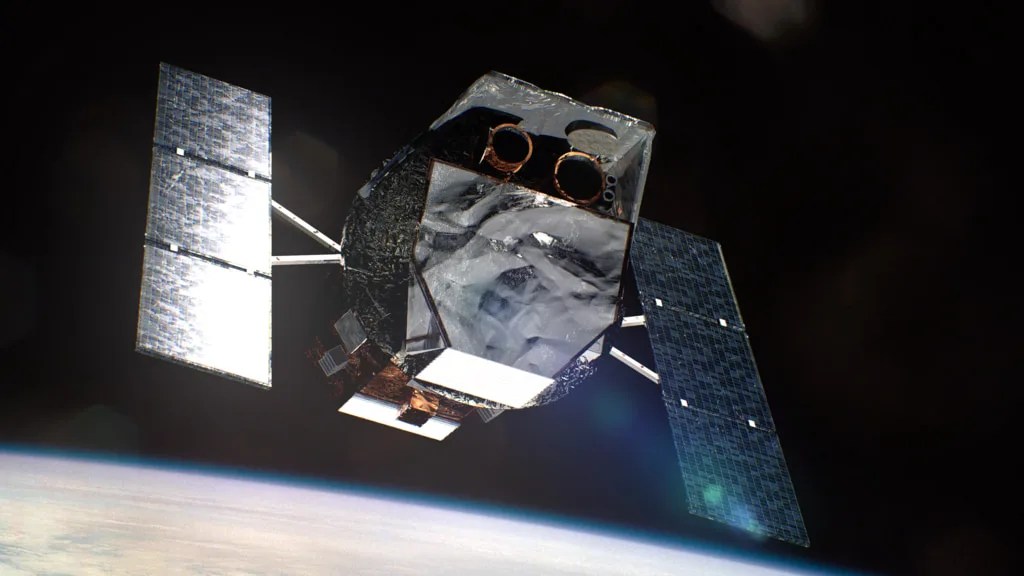
illustration of the swift
Swift, illustrated here, is a collaboration between NASA’s Goddard Space Flight Center in Greenbelt, Maryland, Penn State in University Park, the Los Alamos National Laboratory in New Mexico, and Northrop Grumman Innovation Systems in Dulles, Virginia. Other partners include the University of Leicester and Mullard Space Science Laboratory in the United Kingdom, Brera Observatory in Italy, and the Italian Space Agency.
NASA’s Goddard Space Flight Center

On March 15, NASA’s Neil Gehrels Swift Observatory entered into safe mode, temporarily suspending science operations due to degrading performance from one of its three gyroscopes (gyros), which are used to point the observatory for making observations. The rest of the spacecraft remains in good health.

Swift is designed to successfully operate without one of its gyros if necessary; however, a software update is required. The team is working on the flight software update that would permit the spacecraft to continue science operations using its two remaining gyros. The team is working to return Swift to science observations as soon as possible.

Launched in 2004, Swift has been observing the high-energy universe for nearly 20 years. Stay tuned to nasa.gov/swift for more updates.

Share

Details

Last Updated

Mar 18, 2024

Editor
Jamie Adkins

Powered by WPeMatico

Get The Details…

NASA Administrator Pays Tribute to Space Pioneer Thomas Stafford 

NASA Administrator Pays Tribute to Space Pioneer Thomas Stafford 

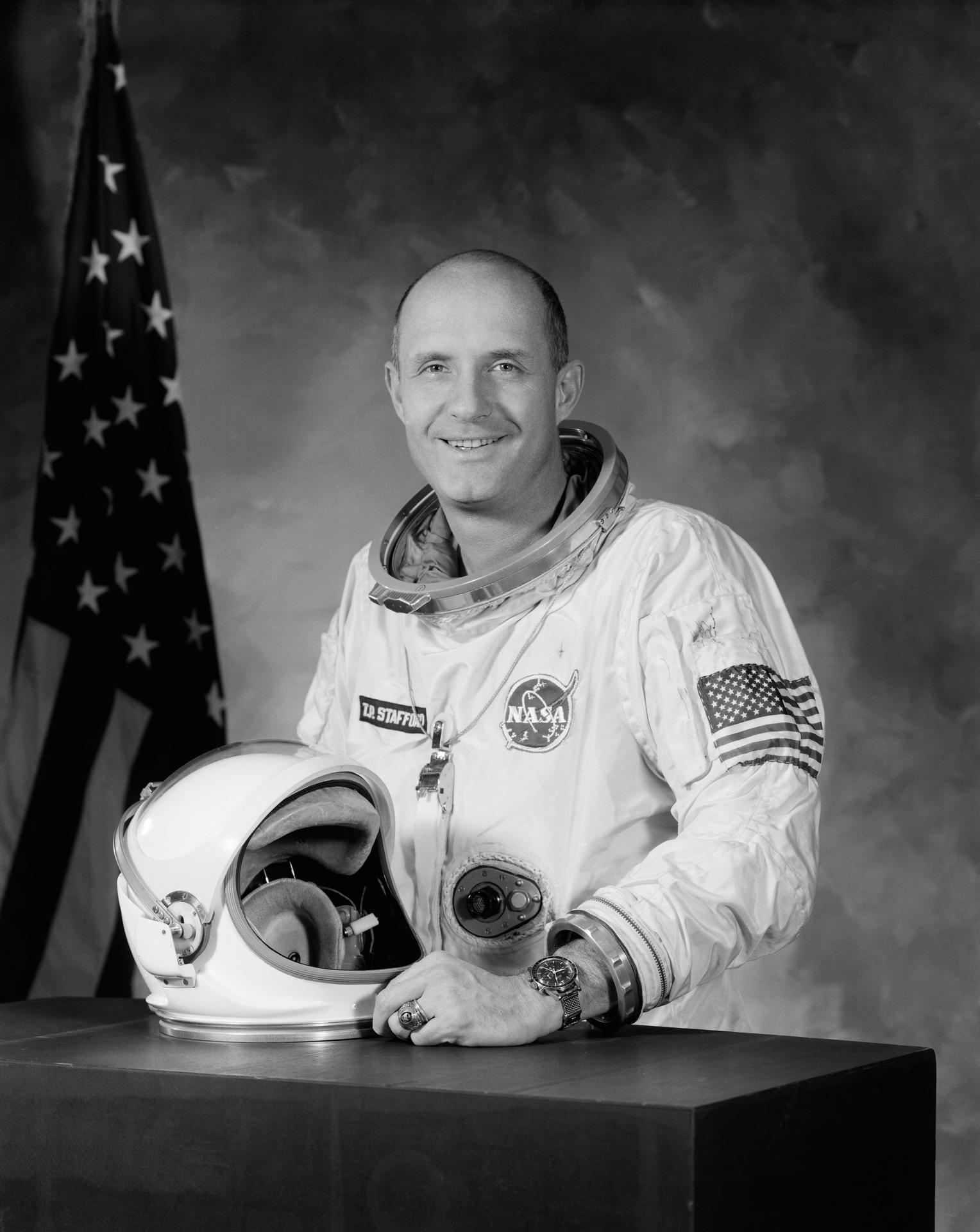
(1966) — Portrait of astronaut Thomas P. Stafford, wearing his spacesuit.
Credits: NASA

The following is a statement from NASA Administrator Bill Nelson on Monday’s passing of Thomas Stafford, a lifelong space exploration advocate, former NASA astronaut, and U.S. Air Force general: 

“Today, General Tom Stafford went to the eternal heavens, which he so courageously explored as a Gemini and Apollo astronaut as well as a peacemaker in the Apollo-Soyuz mission. Those of us privileged to know him are very sad but grateful we knew a giant.

“Tom was critical to the earliest successes of our nation’s space program and was instrumental in developing space as a model for international cooperation. He also helped us learn from our tragedies and grow and reach for the next generation of achievement. He was intimately involved with the space program, sharing his thoughts and suggestions on NASA missions until the end of his life. 

“Tom was a gentleman and a daredevil. He flew our first rendezvous in space on Gemini 6, and piloted Gemini 9’s path to Earth with pencil and paper when the spacecraft’s guidance computer failed in orbit. He commanded Apollo 10, the first flight of the lunar module to the Moon, a critical test flight that resulted in the successful landing on the Moon during the Apollo 11 mission. Tom also flew more than 100 different types of aircraft throughout his career as he pushed the edge of the envelope of our achievement in air and space. He was an extraordinary peacemaker who commanded NASA’s first rendezvous of an international spacecraft on the Apollo-Soyuz mission. His counterpart, General Alexei Leonov, became a best friend over the years. Tom gave Alexei’s eulogy in 2019 at the Russian state funeral.

“Tom’s dedication to NASA never wavered. In later years, he chaired a team to independently advise NASA on how to carry out President H.W. Bush’s space policy and completed the study ‘America at the Threshold’ about the nation’s potential future with humans in space. He also was co-chairman of the Stafford-Covey Space Shuttle Return to Flight Task Group that assessed NASA’s implementation of the Columbia Accident Investigation Board Space Shuttle Return to Flight recommendations.

“Our nation will be forever grateful to an explorer who never lost his sense of wonder. About his time in space, he said, ‘It changes you, oh sure. Changes your outlook…As you look back, you see a little blue and white baseball, actually, it’s smaller than a baseball. But it’s hard to envision that is where all the people you’ve known all your life are, where you went to school, your friends, your family. It’s also hard to envision that there are three billion people on that blue and white baseball.’ 

“Godspeed, Tom Stafford.”  

For more information about Stafford’s NASA career, and his agency biography, visit: 

https://www.nasa.gov/former-astronaut-thomas-stafford/

-end-

Faith McKie / Cheryl Warner  
Headquarters, Washington  
202-358-1600  
faith.d.mckie@nasa.gov / cheryl.m.warner@nasa.gov   

Share

Details

Last Updated

Mar 18, 2024

Powered by WPeMatico

Get The Details…
Tiernan P. Doyle