QO-100 satellite, GNU Radio and SDR talks released

QO-100 satellite, GNU Radio and SDR talks released

BT Adastral Park, Martlesham - credit BTBT Adastral Park, Martlesham – credit BT

Mark M5BOP reports the complete set of amateur radio technical talks from this year’s Martlesham Microwave Round Table is now available to watch on YouTube.

Videos of these MMRT 2019 talks are available:
• Practical GNUradio – Heather Lomond M0HMO
• From Death Rays to Dinner – William Eustace M0WJE
• Equipment for Es’hail-2 / QO-100 Narrowband – David Bowman G0MRF
• DATV on Es’hail-2 / QO100 – Noel Matthews G8GTZ
• Low-pass Harmonic Filter for 23cm – John Quarmby G3XDY
• UKuG SDR Voice Transceiver Project Discussion

Watch the videos on the Martlesham Microwave YouTube channel at
https://www.youtube.com/channel/UCHV7cC7ZMehKjAM81QxUS9w/videos

Source UK Microwaves on Groups IO
https://groups.io/g/UKMicrowaves/message/51753

UK Microwave Group
https://www.microwavers.org/
https://twitter.com/UKGHZ

AMSAT-UK: https://amsat-uk.org/
Twitter: https://twitter.com/AmsatUK
Facebook: https://facebook.com/AmsatUK
YouTube: https://youtube.com/AmsatUK

Get The Details…

m5aka

AMSAT-UK

Powered by WPeMatico

University CubeSat Club members get ham radio licenses

University CubeSat Club members get ham radio licenses

Dawson Duckworth KC3NNB, Lauren Hurley KD2RHC, Kaixuan Ji AC3EN and Dr. Alan Johnston KU2Y staffed the AMSAT / Villanova CubeSat Club table at the Robotstock/STEM event in AugustDawson Duckworth KC3NNB, Lauren Hurley KD2RHC, Kaixuan Ji AC3EN and Dr. Alan Johnston KU2Y staffed the AMSAT / Villanova CubeSat Club table at the Robotstock/STEM event in August

Students at the Villanova University College of Engineering started a CubeSat Club in the fall of 2018 and have since got their amateur radio licenses.

The university website reports:

A CubeSat is a nanosatellite—a small, lightweight satellite that is cheaper to build than a conventional satellite. They can be launched from rockets, or occasionally from the International Space Station by astronauts. CubeSats send telemetry information—measurements communicated at remote points by automated processes—over radio signals received on earth by a ground station.

The CubeSat club’s 2018-2019 year was packed with a variety of workshops and projects, including:

• Setting up temporary ground stations called SatNOGS (Satellite Network Operators Group)
• Building Yagi-Uda antennas from tape measurers and scrap wood and using them to track low earth orbit satellites as they flew over Villanova
• Building an AMSAT CubeSat Simulator, a functional satellite model
• Assisting with the freshman CubeSat mini-design projects
• Earning amateur radio licenses and ham radio callsigns
• Assembling and selling electronic transceiver boards used in CubeSats as a fundraiser
• Attending the 2019 Hamvention conference and running the AMSAT education table
• Received and decoded a special message sent from the AO-73 FUNcube Satellite especially for Villanova

Read the full story at
https://www1.villanova.edu/villanova/engineering/newsevents/newsarchives/2019/community/CubeSat-Club.html

The students emailed a request to the FUNcube Operations Team to get their special message transmitted from space by the AO-73 satellite. Further information on these ‘Fitter’ messages is available at https://funcube.org.uk/ground-segment/fitter-messages/

Get The Details…

m5aka

AMSAT-UK

Powered by WPeMatico

Taurus-1 with Codec-2 transponder launched

Taurus-1 with Codec-2 transponder launched

Taurus-1 with solar sail deployedTaurus-1 with solar sail deployed

Taurus-1 (Jinniuzuo-1) carrying an amateur radio FM to Codec-2 transponder was launched on a CZ-4B rocket from the Taiyuan Satellite Launch Center on Thursday, September 12 at 0326 GMT.

Taurus-1 is a CubeSat project developed by Aerospace System Engineering Research Institute of Shanghai for youth education and amateur radio.

The transponder is similar to that used on LilacSat-1 receiving FM with 67 Hz CTCSS on 145.820 and retransmitting it as Codec-2 9600 bps BPSK digital voice on 436.760 MHz. The telemetry downlink is on 435.840 MHz +/-10 kHz Doppler shift.

On Friday, September 13, Mark Jessop VK5QI tweeted:
“Good signals from #Taurus-1 on 435.840 MHz! Doesn’t look like the FM/Codec2 Transponder is enabled yet though (no response on 436.760 MHz when transmitting on 145.820 MHz)”
https://twitter.com/vk5qi/status/1172505034551988225

Taurus-1 beacon received by Mark Jessop VK5QITaurus-1 beacon received by Mark Jessop VK5QI

Codec2 9600 bps BPSK Downlink information by Daniel Estévez EA4GPZ
https://destevez.net/2016/10/lilacsat-1-codec-2-downlink/

Adam Whitney K0FFY documented how to receive the similar Codec2 Digital Voice transponder originally flown on LilacSat-1 using the FUNcube Dongle Pro+ SDR
http://adamwhitney.net/working-lilacsat-1/

Keplerian Two Line Elements (TLEs) ‘Keps’ for new satellites launched in past 30 days
http://celestrak.com/NORAD/elements/tle-new.txt

Get The Details…

m5aka

AMSAT-UK

Powered by WPeMatico

NASA Funds CubeSat Pathfinder Mission to Unique Lunar Orbit

NASA Funds CubeSat Pathfinder Mission to Unique Lunar Orbit

NASA has awarded a $13.7 million contract to Advanced Space of Boulder, Colorado, to develop and operate a CubeSat mission to the same lunar orbit targeted for Gateway – an orbiting outpost astronauts will visit before descending to the surface of the Moon in a landing system as part of NASA’s Artemis program.

Get The Details…

NASA Breaking News

Powered by WPeMatico

New Station Crew Continues Preparations for Launch as Expedition 60 Enjoys Off Day

New Station Crew Continues Preparations for Launch as Expedition 60 Enjoys Off Day

In the Integration Building at the Baikonur Cosmodrome in Kazakhstan, Expedition 61 crew member Jessica Meir of NASA runs through procedures Sept. 11 aboard the Soyuz MS-15 spacecraft during an initial Soyuz vehicle fit check. Credit: NASA/Victor Zelentsov

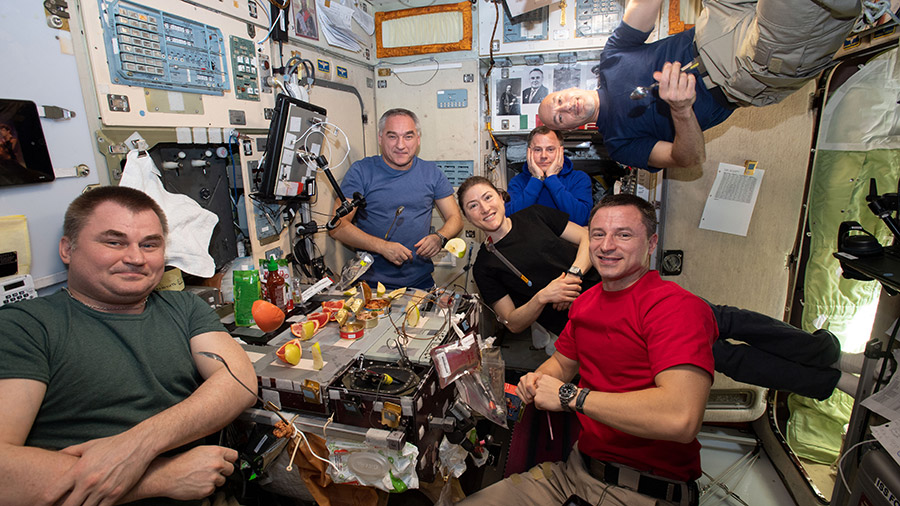
The crew of Expedition 60, consisting of Commander Alexey Ovchinin of Roscosmos; NASA astronauts Christina Koch, Andrew Morgan and Nick Hague; ESA (European Space Agency) astronaut Luca Parmitano; and cosmonaut Alexander Skvortsov, took much-needed respite during an off-duty day aboard the International Space Station. Tomorrow, investigations furthering scientific research in support of crew health and extended travels to destinations deeper in the solar system will resume.

On Earth, the Expedition 61 prime crew of cosmonaut Oleg Skripochka and NASA astronaut Jessica Meir, along with spaceflight participant Hazzaa Ali Almansoori, are at the Gagarin Cosmonaut Training Center in Star City, Russia, finalizing pre-launch training and preparations for their launch on Sept. 25 aboard a Soyuz MS-15 spacecraft. Yesterday, they ran through procedures and completed the necessary fit check, spacesuits donned, within the Soyuz vehicle. Today, they took part in ceremonial activities, such as raising the flags of Russia, the United States, and the United Arab Emirates, along with backup crew members Tom Marshburn of NASA, Sergey Ryzhikov of Roscosmos and spaceflight participant Sultan Al-Neyadi of the United Arab Emirates.

Get The Details…

Catherine Williams

Powered by WPeMatico