Earth’s Limb, Pacific Ocean and the Space Station’s Kibo Laboratory
The Earth’s limb and the Pacific Ocean contrast segments of the International Space Station’s Kibo laboratory module built by the Japan Aerospace Exploration Agency in this June 23, 2018 image. At right is a portion of the Experiment Logistics Module, Pressurized Section (ELM-PS) which is the Kibo lab’s storage facility.
Crew Sets Up Station for New Research Delivery Aboard Dragon
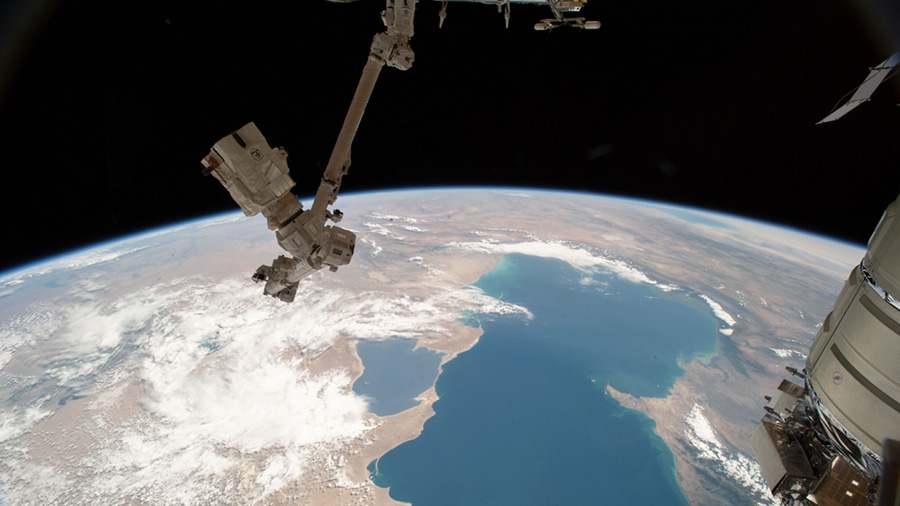
Canada’s 57.7-foot-long robotic arm, also known as the Canadarm2, with a latching end effector at its tip (used to grapple approaching spacecraft and portable data grapple fixtures) is pictured in the foreground as the International Space Station was orbiting over the Caspian Sea.
NASA astronauts Drew Feustel and Ricky Arnold worked on science hardware today to support new research being delivered aboard Dragon when it arrives Monday at 7 a.m. EDT. The duo also continued studying the robotics procedures necessary to capture Dragon after its approach and rendezvous next week.
Feustel cleaned a mouse habitat for the Rodent Research-7 experiment observing microbes in the gastrointestinal system in mice. Arnold checked out the functionality of the Veggie facility that will process plants for the Veg-03 study researching how to grow food in space.
Flight Engineer Serena Auñón-Chancellor looked at how cement solidifies in space exploring its microstructure and material properties. Results could impact the design of lightweight space habitats and improve cement and concrete processing on Earth.
Finally, Alexander Gerst of the European Space Agency looked at spacesuit gear and set up the Quest airlock for future spacewalk operations. Gerst purged nitrogen from the suit’s oxygen lines and helped ground controllers prepare for overnight oxygen leak checks.
If you have ever seen a series of concentric rings of color near a mist or fog, you have likely seen a glory. This colorful optical phenomenon, bright red on the outside and blue toward the center, forms when water droplets scatter sunlight back toward a source of light.
Crew Gets Ready for Dragon, Studies Space Impacts on Health and Physics
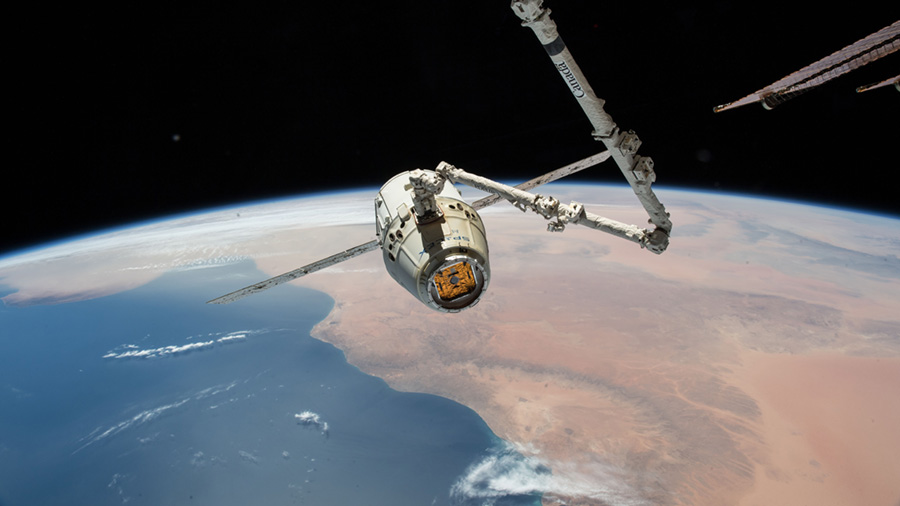
The SpaceX Dragon cargo craft is pictured in the grips of the Canadarm2 robotic arm as the International Space Station was orbiting above northern Africa on May 5, 2018.
The Expedition 56 crew members are getting ready for the arrival next week of the 15th SpaceX Dragon mission to the International Space Station. The space residents also explored how microgravity impacts health and physics today while setting up a variety of cubesats for deployment.
The Falcon 9 rocket from SpaceX that will launch the Dragon space freighter into Earth orbit is due to lift off Friday at 5:41 a.m. EDT and take a three-day trip to the orbital laboratory. The commercial space freighter will be loaded with almost six thousand pounds of new science experiments, crew supplies and space station hardware.
NASA astronaut Ricky Arnold will be backed up by Commander Drew Feustel in the Cupola when he commands the Canadarm2 to grapple Dragon Monday at 7 a.m. The duo is reviewing procedures and training on a computer this week for the rendezvous and capture activities. Robotics controllers on the ground will then take over after the capture and remotely install Dragon a couple of hours later to the Harmony module where it will remain for 32 days. NASA TV will broadcast live the Dragon science briefings, launch, capture and installation activities.
Feustel started the workweek collecting and stowing biological samples for the Multi-Omics study that is observing how gut microbes may affect an astronaut’s immune system. He then worked on the Atomization experiment that is researching liquid spray processes to potentially improve the design of jet and rocket engines.
NASA astronaut Serena Auñón-Chancellor installed a cubesat deployer on a multi-purpose experiment platform that will soon be placed outside the Japanese Kibo laboratory module. It will deploy nine different cubesats to continue space research and demonstrate space applications.
NASA Technologies Significantly Reduce Aircraft Noise
A series of NASA flight tests has successfully demonstrated technologies that achieve a significant reduction in the noise generated by aircraft and heard by communities near airports.