
Today’s Research Explores How Space Impacts Life and Physics

Today’s Research Explores How Space Impacts Life and Physics
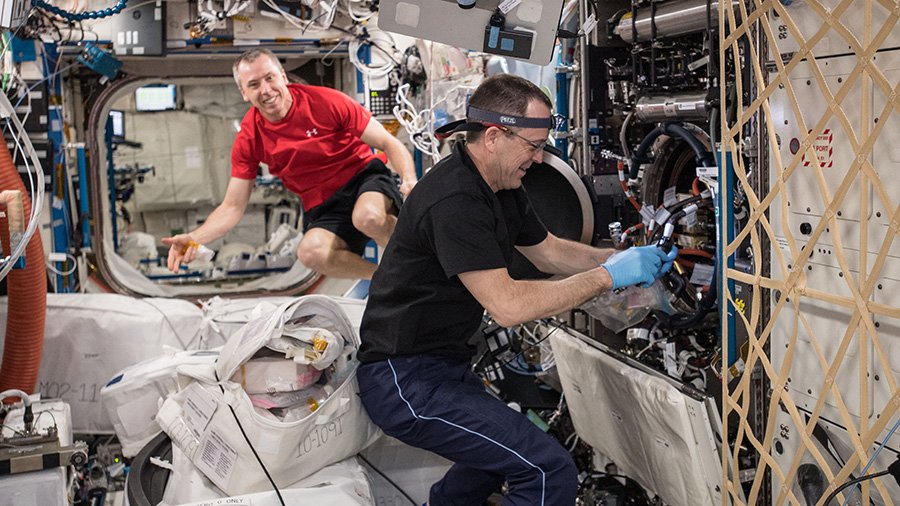
NASA astronauts Ricky Arnold and Drew Feustel
NASA astronauts Ricky Arnold and Drew Feustel are at work inside the U.S. Destiny laboratory module.

The six orbital residents living aboard the International Space Station worked on a broad array of advanced space experiments and research gear today. Today’s life science research included exploring fertility, extracting DNA from microbes and studying how the heart adapts to living in space. The crew also researched space physics observing magnetic fields, exploring the micro-properties of cement and detecting neutron radiation.

The Micro-11 experiment seeks to determine if human reproduction is possible in outer space. The study utilizes a microscope and the Microgravity Science Glovebox and observes sperm samples to determine the viability of fertility beyond Earth. DNA is being extracted from microbe samples swabbed off surfaces inside the space station. The DNA will be sequenced on Earth to help scientists understand how life adapts to microgravity. An ongoing Russian study is researching how a crew member’s heart and circulatory system adjusts to a long-term space mission.

A European astrophysics investigation is looking at how Earth’s magnetic field interacts with conductors. The study may provide insights for electrical engineers them design better space systems. Cement research is important in space and the crew has been exploring its microstructure possibly impacting the construction of future space habitats. Finally, radiation detectors have been deployed inside the orbital lab for a Canadian experiment to understand how neutrons affect astronauts.

Get The Details…
Mark Garcia

ISS

Powered by WPeMatico
NASA Invites Media to Preview Briefing on Spacecraft that will “Touch” Sun

NASA Invites Media to Preview Briefing on Spacecraft that will “Touch” Sun

Media are invited to NASA’s Kennedy Space Center in Florida for a preview briefing on the agency’s Parker Solar Probe at 1 p.m. EDT Friday, July 20. The event will air live on NASA Television, the agency’s website and Facebook Live.

Get The Details…

NASA Breaking News

Powered by WPeMatico

Mid-week Cancer Study and Emergency Drill Fill Station Schedule

Mid-week Cancer Study and Emergency Drill Fill Station Schedule

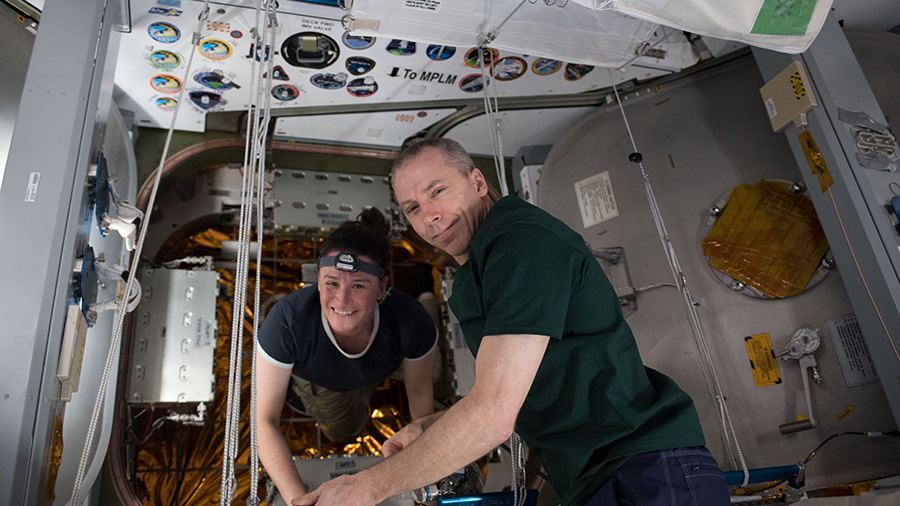
NASA astronauts Serena Auñón-Chancellor and Drew Feustel
NASA astronauts Serena Auñón-Chancellor and Drew Feustel begin cargo operations shortly after the SpaceX Dragon cargo craft arrived at the International Space Station packed with more than 5,900 pounds of research, crew supplies and hardware.

Cancer and rodent studies were on the crew’s timeline today to help doctors and scientists improve the health of humans in space and on Earth. The crew also conducted an emergency drill aboard the International Space Station.

Flight Engineer Serena Auñón-Chancellor examined endothelial cells through a microscope for the AngieX Cancer Therapy study. The new cancer research seeks to test a safer, more effective treatment that targets tumor cells and blood vessels. Commander Drew Feustel partnered with astronaut Alexander Gerst and checked on mice being observed for the Rodent Research-7 (RR-7) experiment. RR-7 is exploring how microgravity impacts microbes living inside organisms.

Astronaut Ricky Arnold and Gerst collected and stowed their blood samples for a pair of ongoing human research studies. Arnold went on to work a series of student investigations dubbed NanoRacks Module-9 exploring a variety of topics including botany, biology and physics.

During the afternoon, all six Expedition 56 crew members joined forces to practice a simulated emergency. The orbital lab residents went over escape routes and safety procedures while coordinating communication and decision-making with mission controllers in Houston and Moscow.

Get The Details…
Mark Garcia

ISS

Powered by WPeMatico