NASA Awards Base Operations, Spaceport Services Contract at Kennedy Space Center
NASA has selected PAE-SGT Partners LLC (PSP) of Arlington, Virginia, to provide institutional support services at the agency’s Kennedy Space Center in Florida and NASA facilities at its neighboring Cape Canaveral Air Force Station.
The Earth, in all its majesty and its tragedy, is the subject of images taken aboard the International Space Station. This image of the Carr and Ferguson fires was captured from the station on August 3, 2018, by European Space Agency astronaut Alexander Gerst.
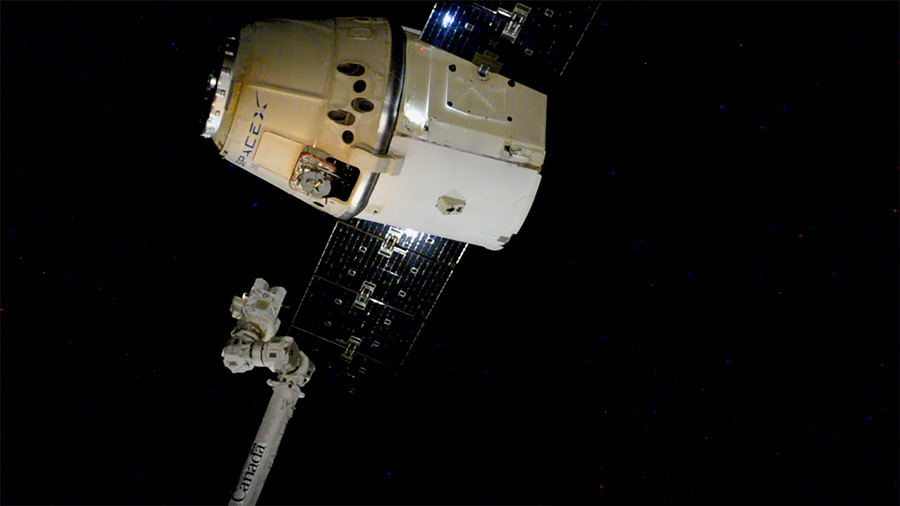
The SpaceX Dragon cargo craft begins its separation from the space station after being released from the Canadarm2.
Robotic flight controllers released the SpaceX Dragon cargo spacecraft from the International Space Station’s robotic arm at 12:38 p.m. EDT, and Expedition 56 Serena Auñon-Chancellor of NASA is monitoring its departure.
Dragon’s thrusters will be fired to move the spacecraft a safe distance from the station before SpaceX flight controllers in Hawthorne, California, command its deorbit burn about 5:23 p.m. The capsule will splashdown about 6:17 p.m. in the Pacific Ocean, where the SpaceX recovery team will retrieve the capsule and its more than 3,800 pounds of cargo, including a variety of technological and biological studies.
NASA and the Center for the Advancement of Science in Space (CASIS), the non-profit organization that manages research aboard the U.S. National Laboratory portion of the space station, will receive time-sensitive samples and begin working with researchers to process and distribute them within 48 hours of splashdown.
Dragon is the only space station resupply spacecraft currently capable of returning cargo to Earth, and this was the second trip to the orbiting laboratory for this spacecraft. SpaceX launched its 15th NASA-contracted commercial resupply mission to the station June 29 from Space Launch Complex 40 from Cape Canaveral Air Force Station in Florida on a Falcon 9 rocket that also previously launched NASA’s TESS mission to study exoplanets.
Launch announced for Es’hail-2 carrying ham radio transponders
Es’hail-2 coverage area
Es’hailSat has tweeted their geostationary satellite Es’hail-2 is expected to be launched by SpaceX in the 4th quarter of 2018.
Qatar’s Es’hail-2 satellite will provide the first amateur radio geostationary communications and is capable of linking amateurs from Brazil to Thailand.
Es’hail-2 will carry two “Phase 4” amateur radio transponders operating in the 2400 MHz and 10450 MHz bands. A 250 kHz bandwidth linear transponder intended for conventional analogue operations and an 8 MHz bandwidth transponder for experimental digital modulation schemes and DVB amateur television.
BHUTAN-1, MAYA-1 and UiTMSat-1 will transmit 30 minutes after deployment. Initial mode looks CW on 70cm.
They use same frequency 437.375 MHz and transmit in the order of BHUTAN-1, MAYA-1 and UiTMSat-1. Each CubeSat also has an APRS digipeater on 145.825 MHz.
Satellite Country ID Call Sign
BHUTAN-1 Bhutan BIRD-BT JG6YKL
MAYA-1 Philippines BIRD-PH JG6YKM
UiTMSat-1 Malaysia BIRD-MY JG6YKN



 Masa JN1GKZ reports JAXA has announced three BIRDS-2 CubeSats with APRS digipeaters will deploy from the International Space Station on August 10, 2018.
