«Captured Cygnus today with @Astro_Alex…Proud to have The SS John Young on-board!» said astronaut Serena Auñón-Chancellor today, as the International Space Station crew brought aboard the latest Northrop Grumman Cygnus cargo craft, loaded with almost three tons of food, fuel and supplies.
NASA’s Quiet Supersonic Technology Project Passes Major Milestone
X-plane
NASA has officially committed to a development timeline that will lead to the first flight of its X-59 Quiet Supersonic Technology (QueSST) aircraft in just three years.
NASA has chosen Jezero Crater as the landing site for its upcoming Mars 2020 rover mission after a five year search, during which every available detail of more than 60 candidate locations on the Red Planet was scrutinized and debated by the mission team and the planetary science community.
Comentarios desactivados en Canadian Robotic Arm Installs U.S. Cygnus Cargo Ship to Station
Canadian Robotic Arm Installs U.S. Cygnus Cargo Ship to Station
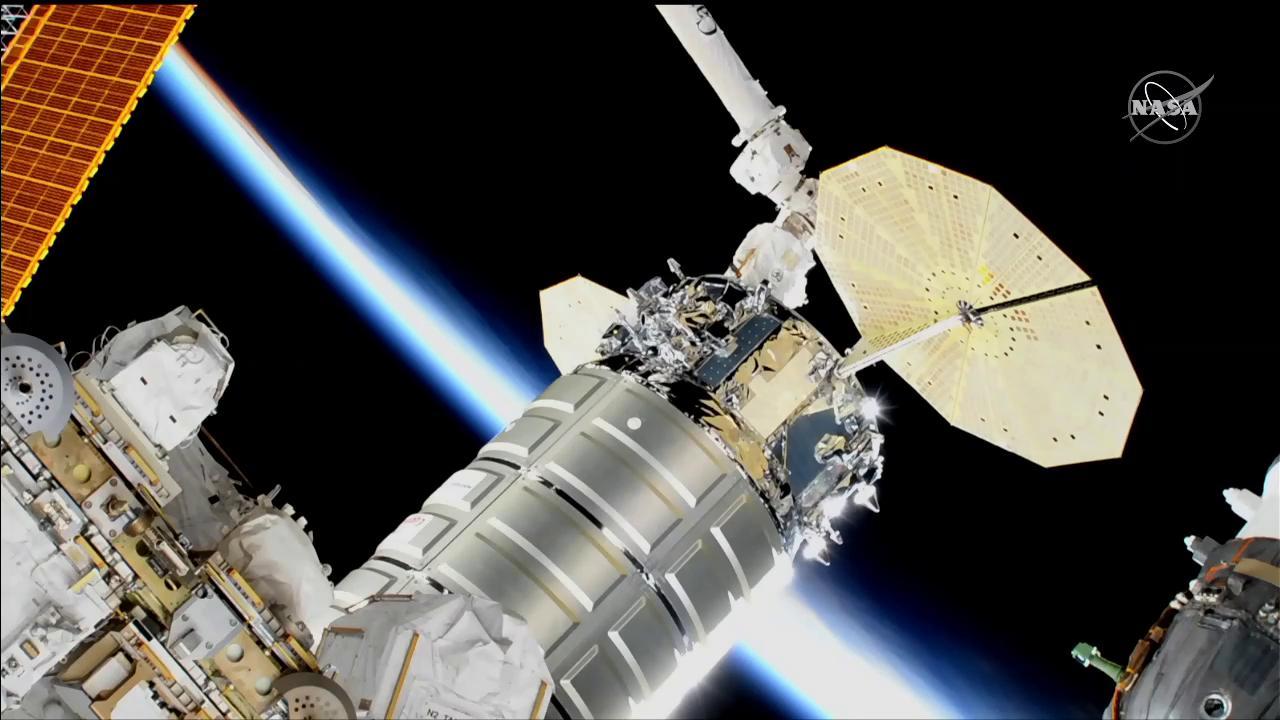
The International Space Station heads into an orbital sunset as the Canadarm2 robotic arm guides the Cygnus space freighter to its installation point on the Unity module. Credit: NASA TV
The Northrop Grumman Cygnus cargo ship was bolted into place on the International Space Station’s Earth-facing port of the Unity module at 7:31 a.m. EST. The spacecraft will spend about three months attached to the space station before departing in February 2019. After it leaves the station, the uncrewed spacecraft will deploy several CubeSats before its fiery re-entry into Earth’s atmosphere as it disposes of several tons of trash.
The spacecraft’s arrival brings close to 7,400 pounds of research and supplies to space station. Highlights of NASA-sponsored research to advance exploration goals and enable future missions to the Moon and Mars include:
Sensory input in microgravity
Changes in sensory input in microgravity may be misinterpreted and cause a person to make errors in estimation of velocity, distance or orientation. VECTION examines this effect as well as whether people adapt to altered sensory input on long-duration missions and how that adaptation changes upon return to Earth. Using a virtual reality display, astronauts estimate the distance to an object, length of an object and orientation of their bodies in space. Tests are conducted before, during and after flight. The investigation is named for a visual illusion of self-movement, called vection, which occurs when an individual is still but sees the world moving past, according to principal investigator Laurence Harris. The Canadian Space Agency (CSA) sponsors the investigation.
Solidifying cement in space
The MVP-Cell 05 investigation uses a centrifuge to provide a variable gravity environment to study the complex process of cement solidification, a step toward eventually making and using concrete on extraterrestrial bodies. These tests are a follow-on to the previous studies known as Microgravity Investigation of Cement Solidification (MICS), which studied cement solidification in microgravity. Together, these tests will help engineers better understand the microstructure and material properties of cement, leading to design of safer, lightweight space habitats and improving cement processing techniques on Earth. This investigation is sponsored by NASA.
Investigations sponsored by the U.S. National Laboratory on the space station, which Congress designated in 2005 to maximize its use for improving quality of life on Earth, include:
From stardust to solar systems
Much of the universe was created when dust from star-based processes clumped into intermediate-sized particles and eventually became planets, moons and other objects. Many questions remain as to just how this worked, though. The EXCISS investigation seeks answers by simulating the high-energy, low gravity conditions that were present during formation of the early solar system. Scientists plan to zap a specially formulated dust with an electrical current, then study the shape and texture of pellets formed.
Principal investigator Tamara Koch explains that the dust is made up of particles of forsterite (Mg2SiO4), the main mineral in many meteorites and related to olivine, also known as the gemstone peridot. The particles are about the diameter of a human hair.
Growing crystals to fight Parkinson’s disease
The CASIS PCG-16 investigation grows large crystals of an important protein, Leucine-rich repeat kinase 2, or LRRK2, in microgravity for analysis back on Earth. This protein is implicated in development of Parkinson’s disease, and improving our knowledge of its structure may help scientists better understand the pathology of the disease and develop therapies to treat it. Crystals of LRRK2 grown in gravity are too small and too compact to study, making microgravity an essential part of this research.
Better gas separation membranes
Membranes represent one of the most energy-efficient and cost-effective technologies for separating and removing carbon dioxide from waste gases, thereby reducing greenhouse gas emissions. CEMSICA tests membranes made from particles of calcium-silicate (C-S) with pores 100 nanometers or smaller. Producing these membranes in microgravity may resolve some of the challenges of their manufacture on Earth and lead to development of lower-cost, more durable membranes that use less energy. The technology ultimately may help reduce the harmful effects of CO2 emissions on the planet.
For more information about the International Space Station, visit www.nasa.gov/station.
Comentarios desactivados en U.S. Space Freighter Captured by NASA Astronaut
U.S. Space Freighter Captured by NASA Astronaut
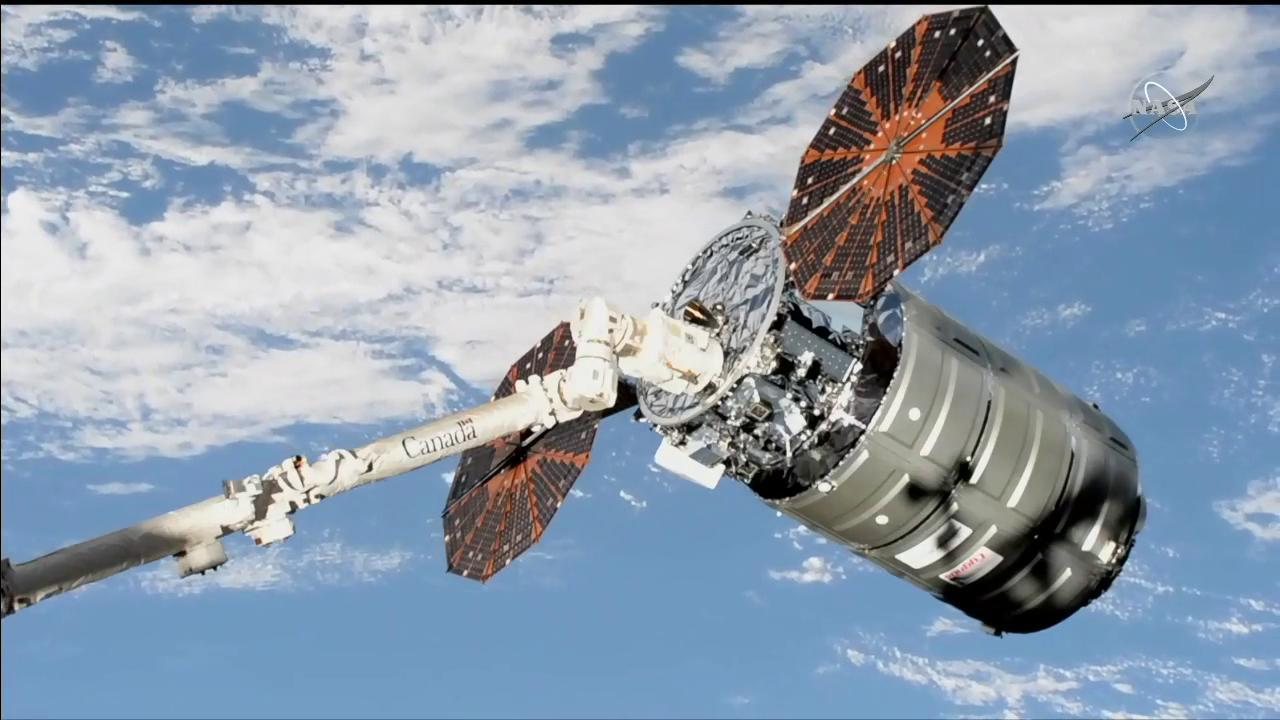
The Cygnus space freighter is pictured moments after it was captured by the Canadarm2 robotic arm operated by NASA astronaut Serena Auñón-Chancellor. Credit: NASA TV
At 5:28 a.m. EST, Expedition 57 Flight Engineer Serena Auñón-Chancellor of NASA used the International Space Station’s robotic Canadarm2 to grapple the Northrop Grumman Cygnus spacecraft as Alexander Gerst of ESA (European Space Agency), monitored Cygnus’ systems during its approach. Next, ground controllers will command the station’s arm to rotate and install Cygnus, dubbed the SS John Young, on the bottom of the station’s Unity module.
NASA Television coverage of installation will begin at 6:45 a.m., and installation of the Cygnus spacecraft to the space station is expected to be completed later this morning.
For more information about the International Space Station, visit www.nasa.gov/station.