Amateur radio satellites to launch from India November 29

Amateur radio satellites to launch from India November 29

Indian Space Research Organisation (ISRO) LogoSatellites with Amateur Radio payloads are set to launch from India on an ISRO PSLV rocket at approximately 0400 GMT on Thursday, November 29, 2018.

Talking to the Times of India, ISRO chair Kailasavadivoo Sivan said, “We are going to to launch HySIS at 9.59 am [IST] on November 29 from Sriharikota. Over 30 foreign satellites, including nano and mini satellites, will also be launched along with the main payload. Out of the 30 commercial satellites, 23 are from the US.”
https://timesofindia.indiatimes.com/india/isro-to-launch-hyperspectral-imaging-sat-with-30-foreign-satellites-on-nov-29/articleshow/66801810.cms

The satellites with amateur radio payloads, all CubeSats, are:

3CAT1 http://www.amsatuk.me.uk/iaru/finished_detail.php?serialnum=370

FacSat-1 http://www.amsatuk.me.uk/iaru/finished_detail.php?serialnum=635

InnoSat-2 http://www.amsatuk.me.uk/iaru/finished_detail.php?serialnum=548

Reaktor HelloWorld http://www.amsatuk.me.uk/iaru/finished_detail.php?serialnum=503

IARU Satellite Frequency Coordination http://amsat.org.uk/iaru

Get The Details…

m5aka

AMSAT-UK

Human Research in Space; Next Crew Preps for Launch on Earth

Human Research in Space; Next Crew Preps for Launch on Earth

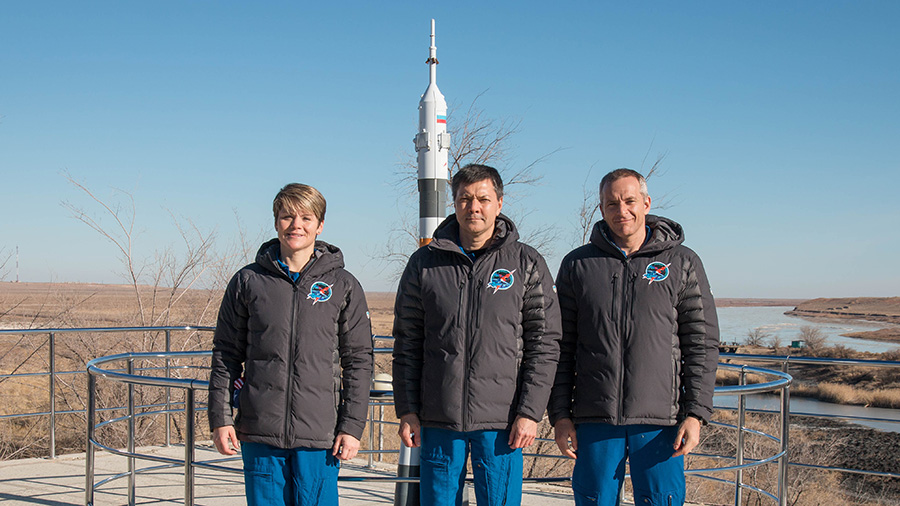
Expedition 58 crew members in front of their Soyuz MS-11 spacecraft
Expedition 58 crew members (from left) Anne McClain, Oleg Kononenko and David Saint-Jacques pose Nov. 20 in front of their Soyuz MS-11 spacecraft during a vehicle fit check.

The Expedition 57 crew aboard the International Space Station conducted human research and space physics today while maintaining life support systems. The space trio also continued U.S. and Russian cargo operations as another crew on Earth prepared for its launch early next week.

Commander Alexander Gerst started his day with astronaut Serena Auñón-Chancellor and scanned her eyes with an ultrasound device helping doctors understand how microgravity impacts vision. Gerst then observed protein crystals associated with Parkinson’s disease to help improve treatments on Earth. Auñón-Chancellor jotted down her space experiences for a psychological study then set up hardware for a semiconductor crystal experiment.

Gerst also gathered items to be packed inside the next SpaceX Dragon cargo vessel due to launch Dec. 4 and arrive at the station for capture Dec. 6. Flight Engineer Sergey Prokopyev transferred fluids for disposal aboard the Russian Progress 70 cargo craft which will depart from the Pirs docking compartment Jan. 25.

Back on Earth in Kazakhstan, three Expedition 58 crew members are in their final week of mission preparations before beginning a six-and-a-half-month mission aboard the orbital lab. Astronauts Anne McClain and David Saint-Jacques will join Cosmonaut Oleg Kononenko for a six-hour ride aboard the Soyuz MS-11 spacecraft to the station. The new trio will launch Dec. 3 at 6:31 a.m. EST and dock to the Poisk module at 11:36 a.m. NASA TV will broadcast live the launch, docking and crew greeting.

Get The Details…

Mark Garcia

FCC rejects AMSAT Orbital Debris Petition

FCC rejects AMSAT Orbital Debris Petition

FCC SealARRL reports the FCC has rejected a Petition for Reconsideration that AMSAT filed 14 years ago, seeking to exempt Amateur Radio satellites from the FCC’s satellite orbital debris mitigation requirements.

The ARRL story says:

The Commission took the opportunity in a Notice of Proposed Rulemaking and Order on Reconsideration, released on November 19, that revisits its orbital debris rules for the first time since their adoption in 2004. Among other things, AMSAT had argued at the time of its Petition that applying the orbital debris requirements to Amateur Radio satellites would be cost prohibitive, and that the FCC had not indicated what constitutes an acceptable orbital debris mitigation plan.

Acknowledging that time has made some of AMSAT’s arguments moot, the FCC said the costs involved with modifications to comply with post-mission disposal requirements “are justified when balanced against the public interest in mitigating orbital debris.” The FCC said it determined that closer adherence to the disposal methods described in the rules was “warranted in order to limit the growth of orbital debris” in low-Earth orbit (LEO).

“In any event, in the years since the debris mitigation rules were adopted, and notwithstanding any costs imposed by FCC regulations, well over 150 small satellites have been authorized, with at least 20 of those considered amateur satellites,” the FCC said in its November 15 Order on Reconsideration. “It appears that, to the extent that any costs have been incurred, the main contributor to costs for amateur and similar LEO missions has to do with the availability of launches to appropriate orbits.”

The FCC also said that in the years since the FCC issued its Orbital Debris Order, “numerous licensees, including amateur satellites operating in LEO, have successfully satisfied our orbital debris mitigation requirements.

FCC Notice of Proposed Rulemaking and Order on Reconsideration
https://docs.fcc.gov/public/attachments/FCC-18-159A1.pdf

2004 AMSAT Petition for Reconsideration
https://ecfsapi.fcc.gov/file/6516493220.pdf

2004 FCC Second Report and Order IB Docket No. 02-54
https://docs.fcc.gov/public/attachments/FCC-04-130A1.pdf

Source ARRL http://www.arrl.org/news/fcc-rejects-2004-amsat-petition-to-reconsider-applying-orbital-debris-rules-to-ham-satellites

Get The Details…

m5aka

AMSAT-UK