New Crew Blasts Off Heading to Space Station Today

New Crew Blasts Off Heading to Space Station Today

Expedition 58 Crew Blasts Off
The Expedition 58 crew blasts off inside the Soyuz MS-11 rocket today from the Baikonur Cosmodrome IN Kazakhstan to the International Space Station . Credit: NASA TV

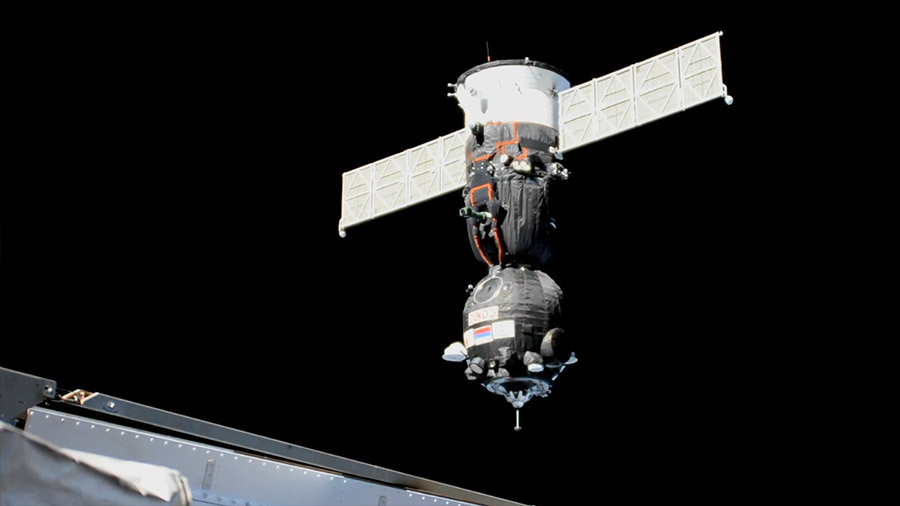
The Soyuz MS-11 launched from the Baikonur Cosmodrome in Kazakhstan to the International Space Station at 6:31 a.m. EST Monday, Dec. 3 (5:31 p.m. in Baikonur) and have safely reached orbit.  At the time of launch, the station was flying about 250 miles over central Kazakhstan southwest of the capital of Astana, 405 miles ahead of the Soyuz as it leaves the launch pad.

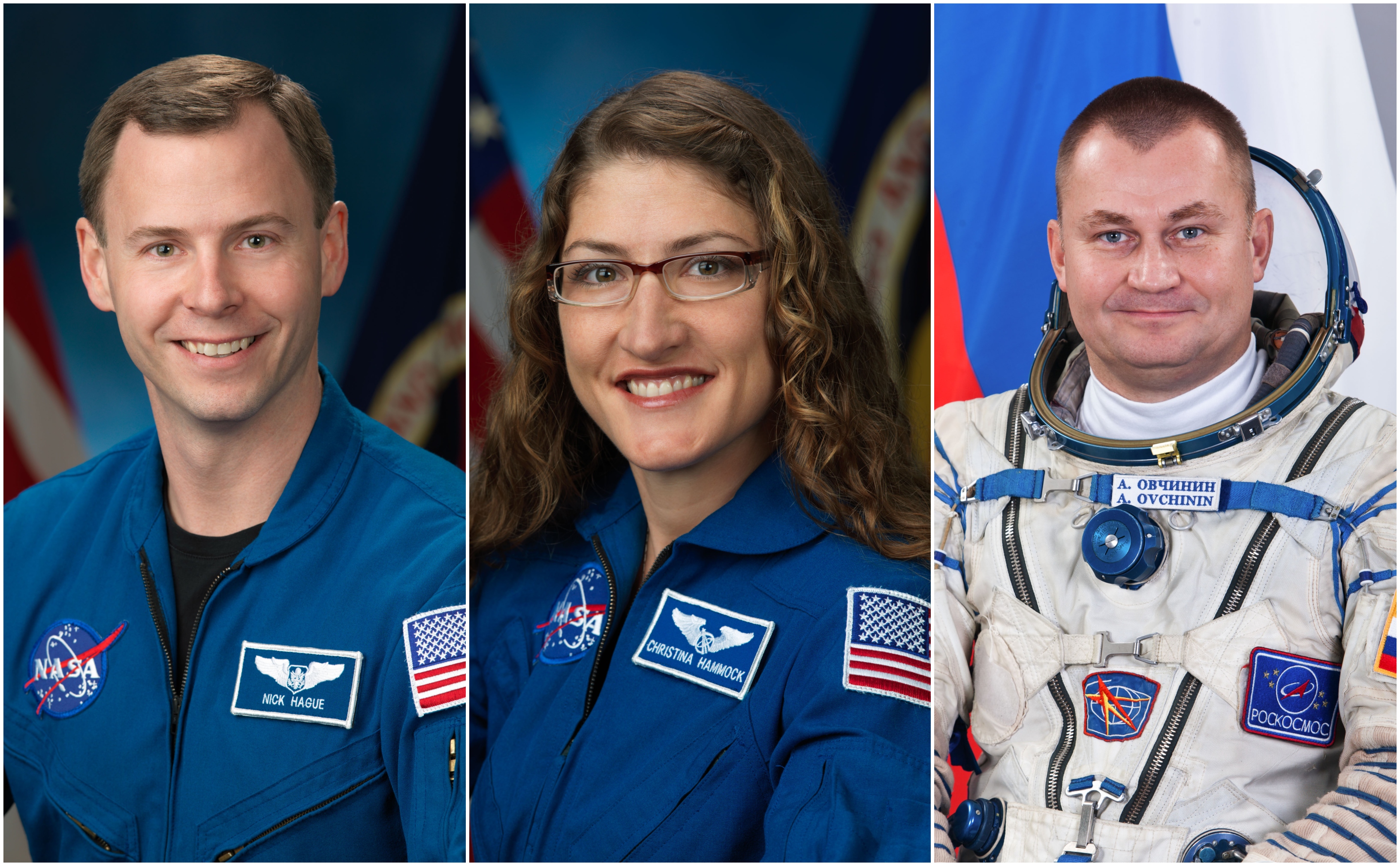
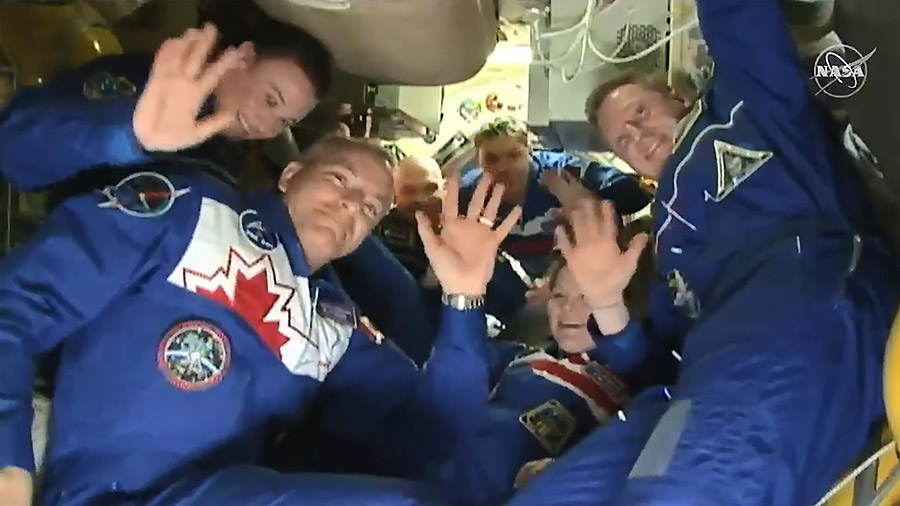
NASA astronaut Anne McClain, David Saint-Jacques of the Canadian Space Agency, and Oleg Konenenko of the Russian space agency Roscosmos have begun their six-hour trip to the orbital laboratory where they will live and work for the next six-and-a-half months.

The arrival will briefly restore the station’s crew complement to six as they join Serena Auñón-Chancellor of NASA, Expedition 57 Commander Alexander Gerst of ESA (European Space Agency) and Sergey Prokopyev of the Russian space agency Roscosmos, who are scheduled to remain aboard the station until Dec. 20.

Just days after their arrival, the crew members will capture the SpaceX Dragon cargo resupply spacecraft set to launch Tuesday from Cape Canaveral Air Force Station and deliver more than 5,800 pounds of critical research and supplies.

At 9:30 a.m., NASA TV will broadcast from NASA’s Kennedy Space Center in Florida a briefing to highlight the science and research on board the Dragon.

Following the science briefing, NASA TV will then broadcast beginning at 11:15 a.m. the arrival of the agency’s first asteroid sample return mission as the OSIRIS-REx spacecraft is set to rendezvous with asteroid Bennu.

Coverage of the Soyuz docking to the International Space Station will begin on NASA TV’s media channel and the agency’s website beginning at 11:45 a.m. and be broadcast on all channels following the conclusion of OSIRIS-REx coverage expected at 12:15 p.m., with the spacecraft docking expected at 12:36 p.m.

Coverage of the hatch opening between the Soyuz and the space station will begin at 1:45 p.m.

For continued coverage and more information about the mission, visit: https://blogs.nasa.gov/spacestation/. Get space station news, images and features via social media on Instagram at: @iss, ISS on Facebook, and on Twitter @Space_Station and @ISS_Research.

Get The Details…

Mark Garcia

Watch NASA TV Now to See New Crew Launch to Station

Watch NASA TV Now to See New Crew Launch to Station

The Soyuz booster MS-11 spacecraft is seen on the launch pad
The Soyuz booster MS-11 spacecraft is seen on the launch pad Sunday, Dec. 2, 2018 at the Baikonur Cosmodrome in Kazakhstan.

Live launch coverage is underway on NASA Television and the agency’s website for the targeted lift off at 6:31 a.m. EST (5:31 p.m. in Baikonur) of a Soyuz spacecraft from the Baikonur Cosmodrome in Kazakhstan. NASA astronaut Anne McClain, David Saint-Jacques of the Canadian Space Agency, and Oleg Konenenko of the Russian space agency Roscosmos will begin a six-hour journey to the International Space Station.

The three will join Expedition 57 Commander Alexander Gerst of ESA (European Space Agency), Serena Auñón-Chancellor of NASA, and Sergey Prokopyev of Roscosmos. The crew members will continue important research experiments in fields such as biology, Earth science, human research, physical sciences and technology development.

This is the first spaceflight for both McClain and Saint-Jacques and the fourth trip to the space station for Kononenko.

For launch coverage and more information about the mission, visit: https://blogs.nasa.gov/spacestation/. Get space station news, images and features via social media on Instagram at: @iss, ISS on Facebook, and on Twitter @Space_Station and @ISS_Research.

Get The Details…

Mark Garcia

Live on NASA TV Now, Watch New Crew Blast Off to Station

Live on NASA TV Now, Watch New Crew Blast Off to Station

The Soyuz MS-11 spacecraft is seen on the launch pad
The Soyuz MS-11 spacecraft is seen on the launch pad Sunday, Dec. 2, 2018 at the Baikonur Cosmodrome in Kazakhstan.

At the Baikonur Cosmodrome in Kazakhstan, teams are making final preparations for the launch of Anne McClain of NASA, David Saint-Jacques of the Canadian Space Agency, and Oleg Konenenko of the Russian space agency Roscosmos to the International Space Station. Their journey to the station will begin with a lift off at 6:31 a.m. EST Monday (5:31 p.m. in Baikonur). Live launch coverage will begin at 5:30 a.m. on NASA Television and the agency’s website.

The three will join Expedition 57 Commander Alexander Gerst of ESA (European Space Agency), Serena Auñón-Chancellor of NASA, and Sergey Prokopyev of Roscosmos. Auñón-Chancellor, Gerst and Prokopyev are scheduled to remain aboard the station until Dec. 20; Expedition 58 officially begins when they undock from the space station.

McClain, Saint-Jacques and Konenenko will spend more than six months conducting hundreds of science investigations in fields such as biology, Earth science, human research, physical sciences and technology development, providing the foundation for continuing human spaceflight beyond low-Earth orbit to the Moon and Mars. Some of the investigations they will conduct are sponsored by the U.S. National Laboratory on the space station, which Congress designated in 2005 to maximize its use for improving quality of life on Earth. Highlights of upcoming investigations include experiments in forest observation, robotic refueling, and satellite deployment.

Below is the crew’s launch timeline in EST:

Monday, Dec. 3

12:31:53am     6:00              Crew departs Cosmonaut Hotel
12:46:53am     5:45              Batteries installed in booster
1:16:53am     5:15              Crew arrives at Site 254
1:31:53am     5:00              Tanking begins
2:01:53am     4:30              Crew suit up
2:26:53am     4:05              Booster loaded with liquid oxygen
3:01:53am     3:30              Crew meets family members on other side of the glass
3:26:53am     3:05              First and second stage oxygen fueling complete
3:31:53am     3:00              Crew walkout from 254 and boards bus for the launch pad
3:36:53am     2:55              Crew departs for launch pad (Site 1)
3:56:53am     2:35              Crew arrives at launch pad (Site 1)
4:06:53am     2:25              Crew boards Soyuz; strapped in to the Descent module
4:56:53am     1:35              Descent module hardware tested
5:11:53am     1:20              Hatch closed; leak checks begin
5:30:00am    1:01:53        NASA TV LAUNCH COVERAGE BEGINS
5:31:53am     1:00              Launch vehicle control system prep; gyro activation
5:45:00am      :46:53        NASA TV: Crew pre-launch activities B-roll played)
5:46:53am       :45:00        Pad service structure components lowered
5:47:53am       :44:00        Clamshell gantry service towers retracted
5:54:53am       :37:00        Suit leak checks begin; descent module testing complete
5:57:53am       :34:00        Emergency escape system armed
6:16:53am       :15:00        Suit leak checks complete; escape system to auto
6:21:53am       :10:00         Gyros in flight readiness and recorders activated
6:24:53am       :07:00         Pre-launch operations complete
6:25:53am       :06:00         Launch countdown operations to auto; vehicle ready
6:26:53am       :05:00         Commander’s controls activated
6:27:53am       :04:00         Combustion chamber nitrogen purge
6:28:53am       :03:00         Propellant drainback
6:29:10am       :02:43         Booster propellant tank pressurization
6:30:23am       :01:30         Ground propellant feed terminated
6:30:43am      :01:10       ISS flies directly over the Baikonur Cosmodrome
6:30:53am       :01:00         Vehicle to internal power
6:31:18am       :00:35         First umbilical tower separates
Auto sequence start
6:31:23am       :00:30         Ground umbilical to third stage disconnected
6:31:38am       :00:15         Second umbilical tower separates
6:31:41am       :00:12         Launch command issued
Engine Start Sequence Begins
6:31:43am       :00:10         Engine turbo pumps at flight speed
6:31:48am       :00:05        Engines at maximum thrust
6:31:53am      :00:00       LAUNCH OF SOYUZ MS-11 TO THE ISS
6:40:38am       +8:45        Third stage shutdown; Soyuz orbital insertion

For launch coverage and more information about the mission, visit: https://blogs.nasa.gov/spacestation/. Get space station news, images and features via social media on Instagram at: @iss, ISS on Facebook, and on Twitter @Space_Station and @ISS_Research.

Get The Details…

Mark Garcia

FUNcube Payload Telemetry Dashboards

FUNcube Payload Telemetry Dashboards

JY1SAT CubeSatJY1SAT CubeSat

Sunday, December 2, 2018 should see two more satellites carrying FUNcube payloads launched into orbit.

With that launch, JY1Sat and ESEO will join FUNcube-1 (AO-73) and Nayif-1 (EO-88).

The FUNcube team have been busy, not only designing and implementing the payloads, but also working on the Telemetry Dashboards and the Data Warehouse.

Each satellite has a dedicated dashboard and we have created a one page summary (FUNcube Dashboard Summary v1) of those dashboards, their current version number and a dedicated download link.

Telemetry Dashboard

We have included the recommended warehouse settings for each satellite as well as the “FCD Centre Frequency”. Note that the frequency we quote is 20 kHz offset from the published telemetry downlink to allow for the zero Hertz spike and close in phase noise that is inherent on SDRs.

Currently, to view the telemetry for a particular satellite, it is necessary to run the dashboard for that satellite. Any telemetry for one of the other FUNcube satellites can be captured and forwarded to the central data warehouse. For this reason, some users tend to run all dashboards simultaneously using the same FUNcube Dongle. Users should remember the that dashboard that was started last, is the one that will control the frequency settings applied to the FUNcube Dongle.

These dashboards are under continual development and the next planned development is to create a single dashboard that will service all FUNcube Telemetry payloads simultaneously. Keep a look out for further news on this unified dashboard in 2019.

ESEO satellite in the anechoic chamber at the ESTEC test facilities, in the NetherlandsESEO satellite in the anechoic chamber at the ESTEC test facilities, in the Netherlands

Telemetry Data Warehouse

All telemetry received via the dashboards is forwarded to the central data warehouse, providing you have registered for an account. This has been a very successful part of the FUNcube project as it has allowed for worldwide data collection by amateurs and for all the data to be available to download and used for educational purposes.

With the pending launch of two additional satellites, some changes where required to allow this data capture to continue in an efficient manner. The data warehouse has a new user interface and all satellite data can be assessed with one URL – http://data.amsat-uk.org/

Once at the new user interface, simply select the satellite you are interested in, and all the usual telemetry will be available along with the list of current data providers to the database for that satellite.

Both the dashboards and the data warehouse are under continual development, so be sure to check back for updates.

The FUNcube team is very grateful to all radio amateurs worldwide for their continued support and we encourage you all to join in with the reception of JY1Sat and ESEO telemetry upon a successful launch this Sunday.

73s Ciaran Morgan M0XTD

FUNcube Dashboard Summary v1
https://funcubetest2.files.wordpress.com/2018/12/funcube-dashboard-summary-v1.pdf

Information on other spacecraft on the SSO-A mission with amateur radio payloads
https://amsat-uk.org/2018/11/14/ssoa-amateur-radio-satellites/

Get The Details…

m5aka

AMSAT-UK