Time Perception Studies, Free-Flying Robotics on Station Schedule

Time Perception Studies, Free-Flying Robotics on Station Schedule

The forward end of the International Space Station
The forward end of the International Space Station is pictured showing portions of five modules.

The Expedition 58 crew is helping scientists today understand how astronauts perceive time and orient themselves when living in space. The orbital residents are also working on CubeSat and free-flying robotics hardware aboard the International Space Station.

Astronauts Anne McClain and David Saint-Jacques wore virtual reality gear for the Time Perception experiment sponsored by the European Space Agency. The study takes place in the Columbus lab module and is researching the hypothesis that time and depth perception are altered in microgravity.

McClain of NASA started the day inside the Kibo lab module, opened the airlock and removed the CubeSat deployer. She disassembled and stowed the hardware in Kibo’s logistics module after it ejected a series of CubeSats into Earth orbit in January.

Astrobee is a new experimental program that uses three small free-flying assistants and is due to begin operations soon. Saint-Jacques installed the Astrobee docking station in the Unity module where the cube-shaped robotic helpers will be able to attach themselves in the future. The autonomous free-flyers may be able to help astronauts with simple duties and enhance monitoring abilities on the orbital lab.

Commander Oleg Kononenko spent Friday morning exploring how crew activities and the Earth’s magnetic field impact the structure of the space station. The experienced cosmonaut moved into the afternoon replacing dust filters before researching space navigation techniques.

Get The Details…

Mark Garcia

Research into How Space Impacts Humans and Physics Continues

Research into How Space Impacts Humans and Physics Continues

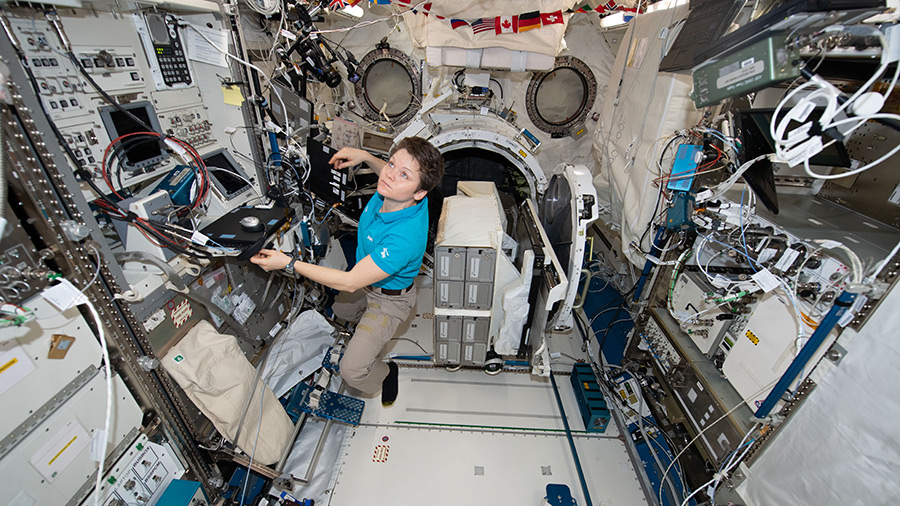
NASA astronaut Anne McClain
NASA astronaut Anne McClain works inside the Kibo laboratory module designed and built by the Japan Aerospace Exploration Agency.

The three residents onboard the International Space Station today worked with a diverse array of science hardware. The trio continues to explore what living in space is doing to their bodies and helped scientists promote healthier humans in space and on Earth.

Astronauts have reported increased head and eye pressure during long-duration space missions. The Expedition 58 crew is researching that phenomenon today to help doctors reverse the upward fluid shifts that affect space residents.

One solution being studied is a special suit that draws fluids such as blood and water toward the lower body to prevent swelling in the face and elevated head and eye pressure. Astronaut Anne McClain tried that suit on today and Flight Engineer David Saint-Jacques used an ultrasound device to scan the activity. Commander Oleg Kononenko assisted the duo inside Russia’s Zvezda service module.

Afterward, McClain glided to the opposite end of the station in Japan’s Kibo lab module to work on the Two-Phase Flow fluid physics experiment. She set up and installed the research hardware inside Kibo’s Multi-purpose Small Research Rack. The experiment may enable engineers to design advanced thermal management systems for use on Earth and in space.

Saint-Jacques returned to biomedical studies today collecting and stowing more breath, blood and urine samples for later analysis. The ongoing research is helping scientists understand the long-term space impacts to bone marrow, red blood cells and the overall human physiology.

Saint-Jacques finally reviewed instructions to install a docking station on Friday for new cube-shaped, free-flying robots that will arrive at the station later this year. The Astrobee autonomous assistants may free up more science time for astronauts and allow mission controllers better monitoring capabilities.

Get The Details…

Mark Garcia

SSO-A Solar Sails deployed – may be quite bright to naked eye

SSO-A Solar Sails deployed – may be quite bright to naked eye

SSO-A mission's free flyers separating from upper stage of SpaceX's Falcon-9 rocket - credit SpaceflightSSO-A mission’s free flyers separating from upper stage of SpaceX’s Falcon-9 rocket – credit Spaceflight

The solar sails on the SSO-A mission “Free Flyer” deployers, launched December 3, 2018 with many amateur radio satellites, are believed to have deployed and may now be quite bright to the naked eye.

Ben Taylor writes:

I represent a team from the University of Surrey in the UK; we have been developing and flying drag de-orbit sails with our first successful demonstration on our InflateSail mission in 2017.

Two dragsail systems were installed on the “Free Flyer” deployers used on the SSO-A launch from December 3, 2018 https://directory.eoportal.org/web/eoportal/satellite-missions/content/-/article/sso-a

The free flyers separated from the launch vehicle and in turn deployed multiple satellites each including Microsats and CubeSats over the course of several hours. The Upper Free Flyer (NORAD ID: 43763) is a large structure at approximately 1,000kg and the Lower Free Flyer is approximately 260kg (NORAD ID: 43760). Each Free Flyer hosts one of our 16m2 aluminised kapton sail which was set to deploy 24 hours after launch.

The systems were standalone isolated systems with no communications so we don’t have any telemetry confirmation. Drag parameters from the TLEs are indicative of a successful deployment, but far from definitive. We’re therefore waiting for them to become optically visible in northern latitudes in the next couple of weeks. Based on the experience with our InflateSail mission, we’d expect these objects to be quite bright to the naked eye if the sails have deployed successfully. InflateSail was 10m2 and (initially) transparent with a +4.2 mag, whereas these sails are 16m2 and metalised so could well flare brightly.

Any observations that could be made by the community of either of these objects would be greatly appreciated and they should make for interesting targets.

We are also the team leading the RemoveDebris mission (NORAD ID: 43510) launched from the ISS last year
https://www.surrey.ac.uk/surrey-space-centre/missions/removedebris

We have a 9m^2 dragsail installed on this mission too which is planned for deployment next month. Similarly, this should make quite a big change to the brightness of the satellite which could make for some interesting observations.

Best Regards,
Ben Taylor,
Guildford, Surrey, UK

Seesat-l mailing list http://mailman.satobs.org/mailman/listinfo/seesat-l

Track of Upper Free Flyer https://n2yo.com/?s=43763&df=1&live=1

Track of Lower Free Flyer https://n2yo.com/?s=43760&df=1&live=1

Get The Details…

m5aka

AMSAT-UK