Hubble Views Cosmic Dust Lanes

Hubble Views Cosmic Dust Lanes

2 min read

Hubble Views Cosmic Dust Lanes

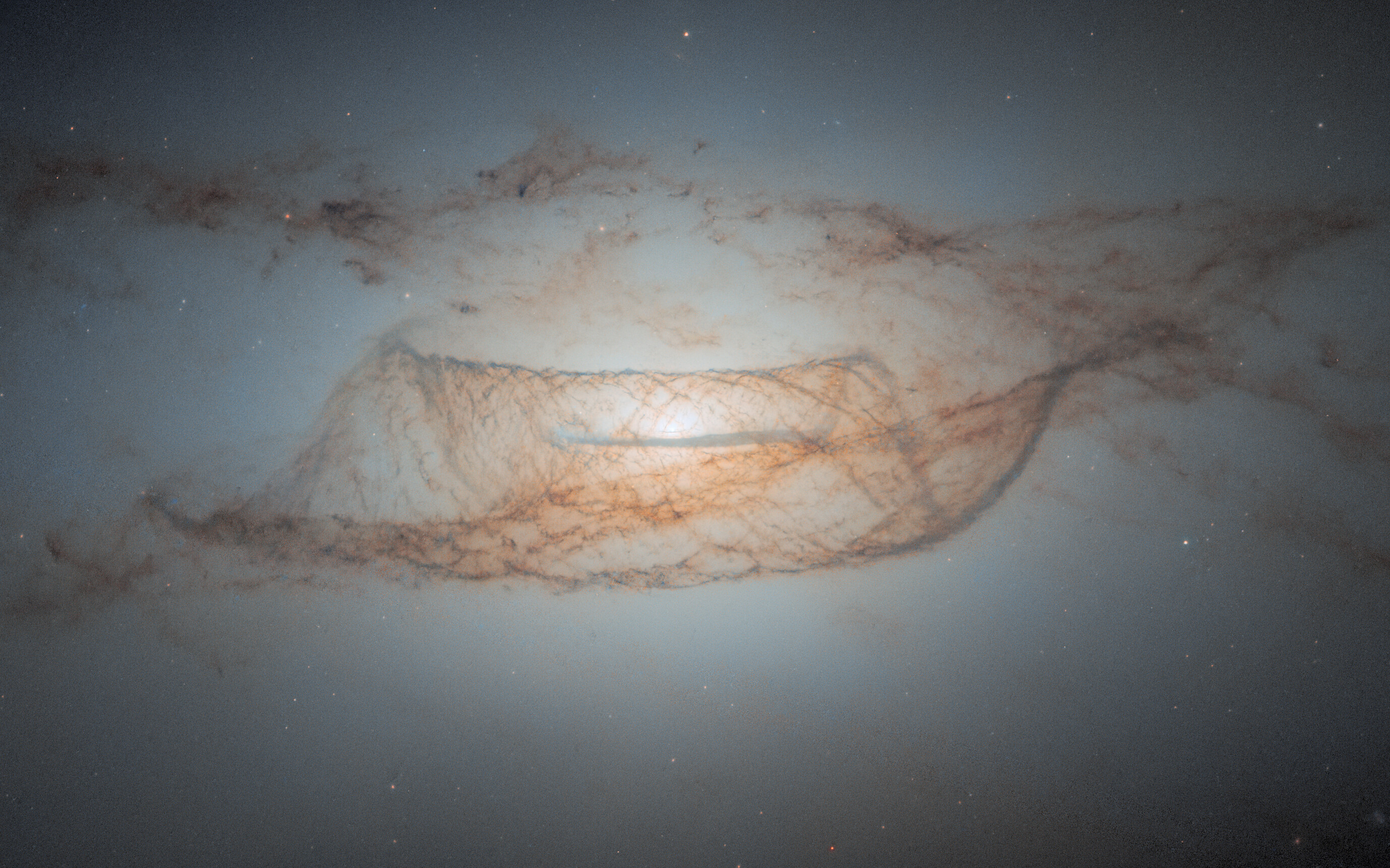
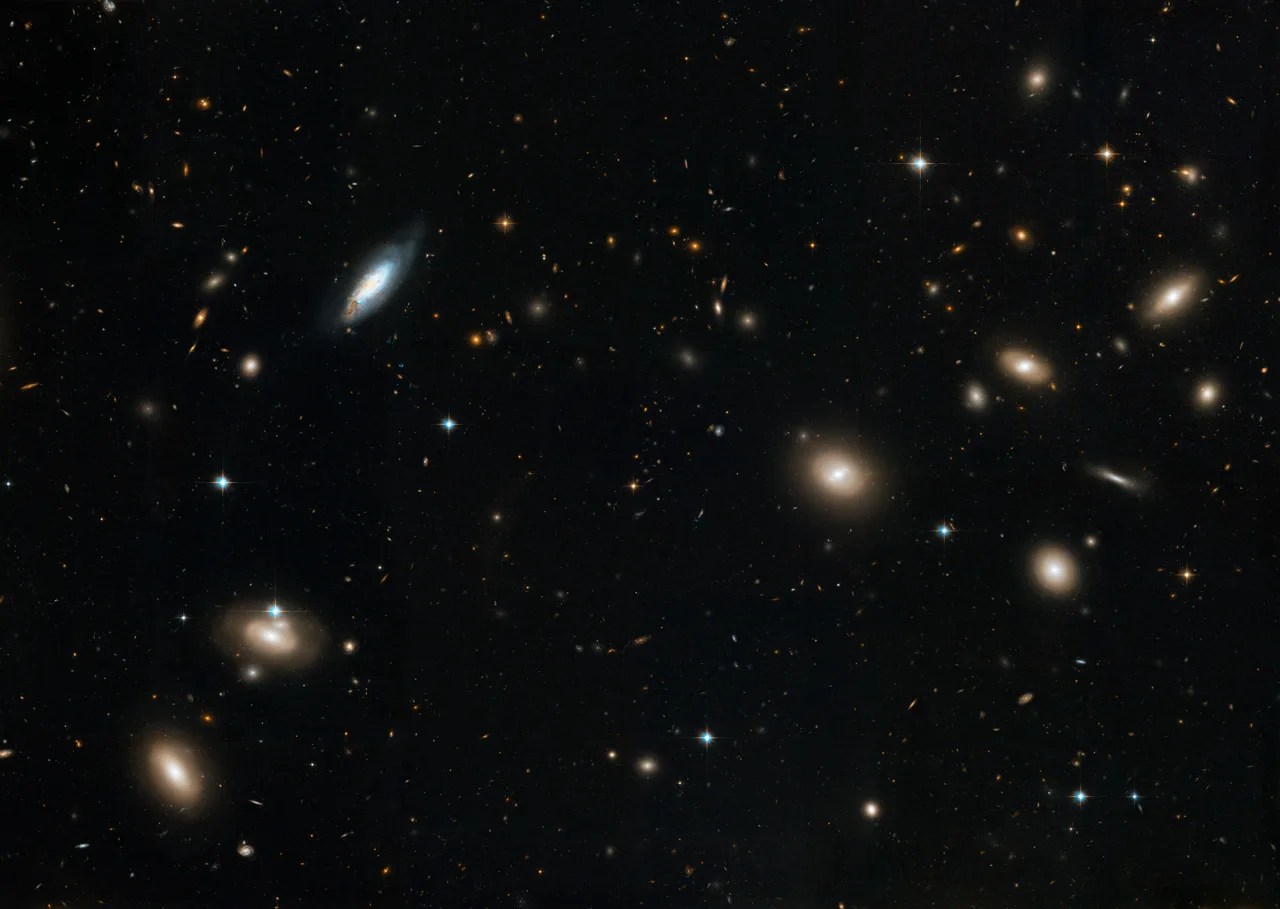
Lenticular galaxy NGC 4753 holds a bright-white core and surrounding, defined dust lanes around its nucleus that predominantly appear dark brown in color. A variety of faint stars fill the background of the image.
This Hubble Space Telescope image showcases a nearly edge-on view of the lenticular galaxy NGC 4753.
ESA/Hubble & NASA, L. Kelsey

Featured in this new image from the NASA/ESA Hubble Space Telescope is a nearly edge-on view of the lenticular galaxy NGC 4753. Lenticular galaxies have an elliptical shape and ill-defined spiral arms.

This image is the object’s sharpest view to date, showcasing Hubble’s incredible resolving power and ability to reveal complex dust structures. NGC 4753 resides around 60 million light-years from Earth in the constellation Virgo and was first discovered by the astronomer William Herschel in 1784. It is a member of the NGC 4753 Group of galaxies within the Virgo II Cloud, which comprises roughly 100 galaxies and galaxy clusters.

This galaxy is likely the result of a galactic merger with a nearby dwarf galaxy roughly 1.3 billion years ago. NGC 4753’s distinct dust lanes around its nucleus probably accreted from this merger event.

Astronomers think that most of the mass in the galaxy lies in a slightly flattened, spherical halo of dark matter. Dark matter is called ‘dark’ because we cannot directly observe it, but astronomers think it comprises about 85% of all matter in the universe. Dark matter doesn’t appear to interact with the electromagnetic field, and therefore does not seem to emit, reflect, or refract light. We can only detect it by its gravitational influence on the matter we can see, called normal matter.

NGC 4753’s low-density environment and complex structure make it scientifically interesting to astronomers who can use the galaxy in models that test different theories of formation of lenticular galaxies. The galaxy has also hosted two known Type Ia supernovae. These types of supernovae are extremely important in the study of the expansion rate of the universe. Because they are the result of exploding white dwarfs which have companion stars, they always peak at the same brightness — 5 billion times brighter than the Sun. Knowing the intrinsic brightness of these events and comparing that with their apparent brightness allows astronomers to use them to measure cosmic distances, which in turn help us determine how the universe has expanded over time.

Text Credit: European Space Agency (ESA)

Explore More

Media Contact:

Claire Andreoli
NASA’s Goddard Space Flight CenterGreenbelt, MD
claire.andreoli@nasa.gov

Share

Details

Last Updated
May 17, 2024
Editor
Andrea Gianopoulos
Location
Goddard Space Flight Center

Powered by WPeMatico

Get The Details…

Aviary: A New NASA Software Platform for Aircraft Modelling

Aviary: A New NASA Software Platform for Aircraft Modelling

4 min read

Preparations for Next Moonwalk Simulations Underway (and Underwater)

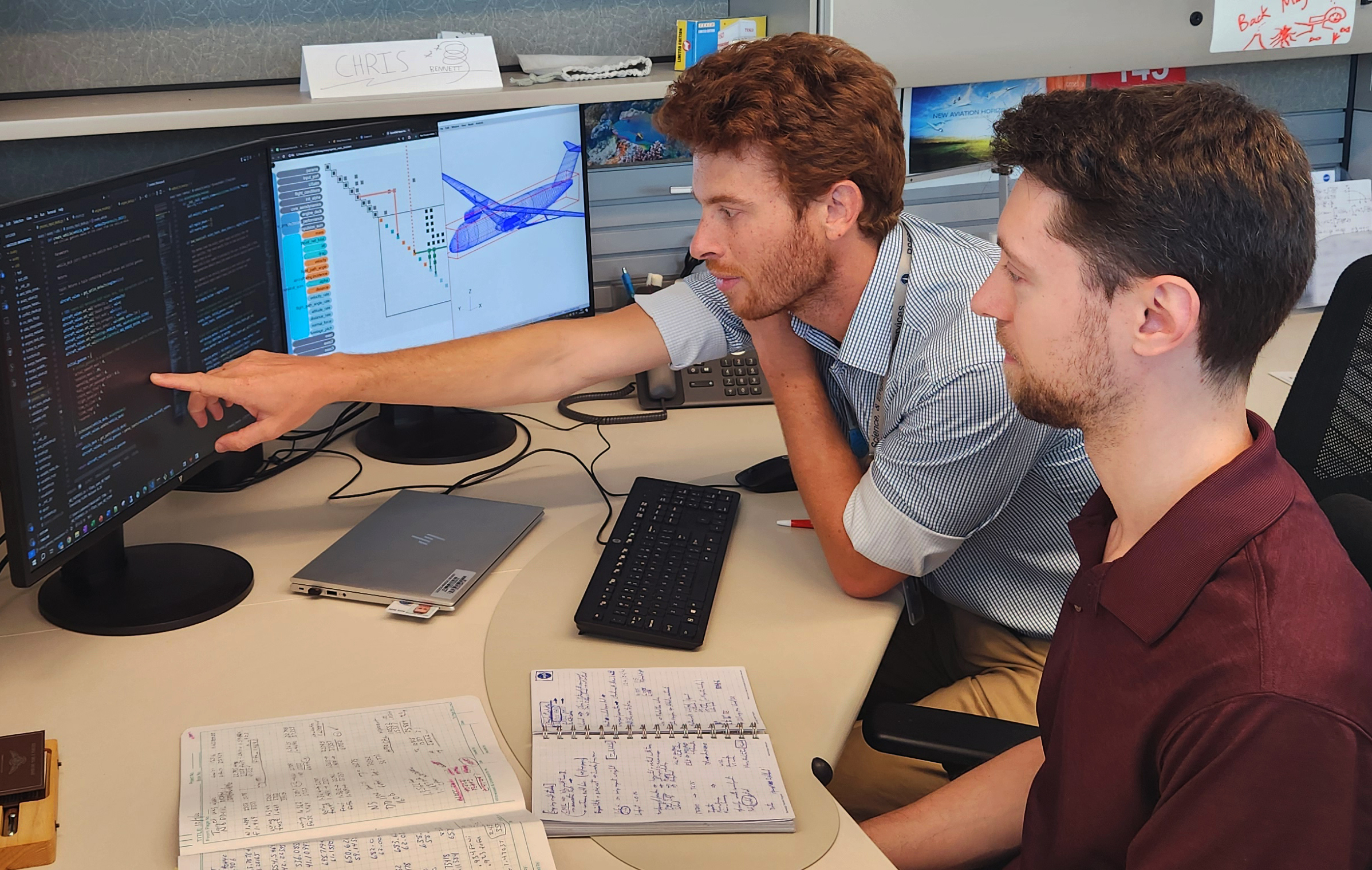
Two men work at a desk in a NASA office as one points to some Aviary computer code displayed on a monitor. A picture of a future aircraft design appears on a neighboring monitor.
Christopher Bennett, left, and Jason Kirk are seen in an Aeronautics Systems Analysis Branch laboratory at NASA’s Langley Research Center in Virginia, discussing computer code that is part of Aviary, a new digital modeling tool that helps engineers innovate new aircraft designs.

NASA has created a new digital modelling tool for aeronautical engineers to innovate new aircraft designs, building on decades of experience using highly advanced computer code for aviation.

Using this tool, researchers can create simulations of conceptual aircraft featuring never-flown technology and receive detailed data about how it would work.

Named “Aviary” for enclosures where birds are kept and studied, the tool creates virtual models of airplanes based on information provided by the user. In this analogy, Aviary is the enclosure, and the birds are the virtual airplane models.

Researchers can input information about an aircraft’s shape, range, and other characteristics. Then, Aviary creates a corresponding digital model of that airplane.

“Aviary is flexible enough that you can decide what you want to learn more about, then configure it to teach you.”

Jennifer Gratz

Jennifer Gratz

Aviary Task Lead

Aviary is a significant leap in progress. Unlike past aviation modelling tools, Aviary can link with other codes and programs to expand and customize its capabilities.

“We wanted to make it easy to extend the code and tie it in with other tools,” said Jennifer Gratz, who leads Aviary’s integration and development. “Aviary is intentionally designed to be able to integrate disciplines together more tightly.”

Aviary is free and accessible to all. The code continues to grow as contributions are made by the public. The code is hosted on GitHub, along with its key documentation.

Top down view of a computer generated image showing an airplane with a silver body, T-shaped tail, and twin jet engines on a purple wing that is longer and skinnier than today's typical airliners.
This image of a Transonic Truss Braced Wing airplane represents a digital model created by Aviary, a new computer modelling tool aeronautical engineers can use to innovate new aircraft designs, The Aviary code builds on NASA’s decades of experience using highly advanced computer code for aviation. Aviary is a resource created by NASA’s Transformational Tools and Technologies project.

Building Aviary from a Legacy

Aviary is a descendant of two prior modelling tools created by NASA decades ago: the Flight Optimization System, and the General Aviation Synthesis Program.

These older legacy codes, however, were comparatively limited in terms of flexibility and detail.

“The older legacy codes were not designed to handle these more modern-day concepts such as hybrid-electric aircraft,” Gratz said. “They viewed certain systems as more separated than they really are in the vehicles we envision now.”

Aviary bridges that gap, enabling researchers to seamlessly incorporate detailed information reflecting the more integrated, enmeshed systems needed to model newer aircraft.

The team began creating Aviary by taking the best parts of the legacy codes and merging them, then adding in new code to make Aviary extendable and compatible with other tools.

“That’s one of its most important characteristics,” Gratz said. “Aviary is flexible enough that you can decide what you want to learn more about, then configure it to teach you.”

Nearly a dozen NASA researchers associated with developing the Aviary computer modeling tool pose for a photo outside their office building.
Members of the NASA team responsible for developing Aviary, a new computer-based digital modeling tool for designing aircraft, pose for a group picture outside an office building at the Langley Research Center in Virginia. Front row from left: Eric Hendricks, Rob Falck, Jennifer Gratz, Ben Phillips, Eliot Aretskin-Hariton, and Ken Moore. Back row from left: Darrell (DJ) Caldwell, Greg Wrenn, Carl Recine, John Jasa, and Jason Kirk.
NASA / Rich Wahls

Expanded Capabilities

Learning specific, tailored information ahead of time can inform researchers what direction the aircraft design should take before doing costly flight tests.

Instead of having to use built-in estimates for certain parameters such as a battery’s power level, as would be done with past tools, Aviary users can easily use information generated by other tools with specific information catered to batteries.

Another capability Aviary touts is gradients. A gradient, essentially, is how much a certain value affects another value when changed.

Say a researcher is considering how powerful a battery should be to successfully power an aircraft. Using older systems, the researcher would have to run a separate simulation for each battery power level.

But Aviary can accomplish this task in one simulation by considering gradients.

“You could tell Aviary to figure out how powerful a battery should be to make using it worthwhile. It will run a simulated flight mission and come back with the result,” Gratz said. “Older tools can’t do that without modification.”

Aviary can simulate all these concepts simultaneously – no other modelling tool can easily consider prior legacy tools, separate tools introduced by users, and gradients.

“Other tools have some of these things, but none of them have all of these things,” Gratz said.

What’s more, Aviary comes with extensive documentation.

“Documentation is another important part of Aviary,” Gratz said. “If nobody can understand the tool, nobody can use it. By having a good record of Aviary’s development and changes, more people can benefit. You don’t have to be an expert to use it.”

NASA’s Glenn Research Center in Cleveland, Ames Research Center in California, and Langley Research Center in Virginia contributed to Aviary.

About the Author

John Gould

John Gould

Aeronautics Research Mission Directorate

John Gould is a member of NASA Aeronautics’ Strategic Communications team at NASA Headquarters in Washington, DC. He is dedicated to public service and NASA’s leading role in scientific exploration. Prior to working for NASA Aeronautics, he was a spaceflight historian and writer, having a lifelong passion for space and aviation.

Powered by WPeMatico

Get The Details…
John Gould

NASA Earns Best Place to Work in Government for 12 Straight Years

NASA Earns Best Place to Work in Government for 12 Straight Years

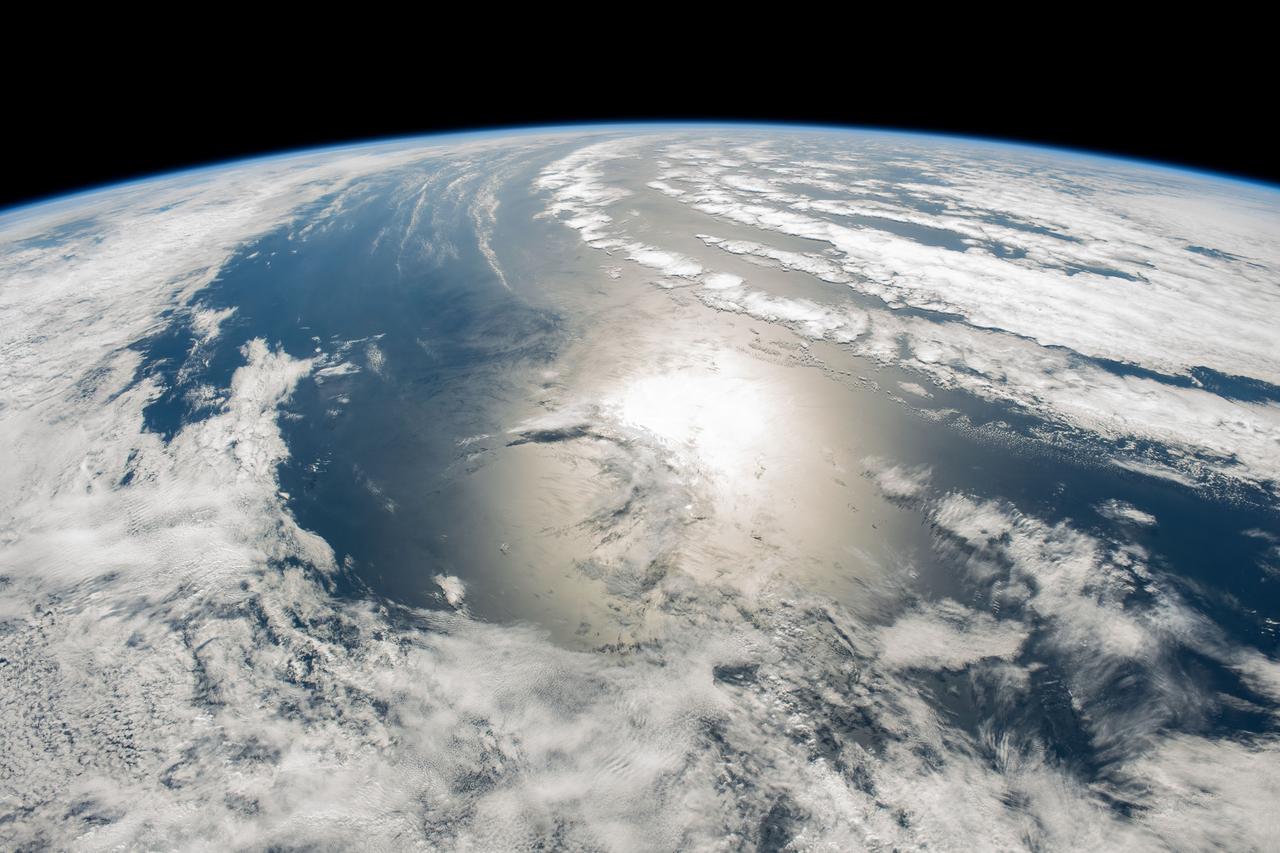
2023 image capturing the Sun’s glint in between a cloudy stretch of the south Atlantic Ocean off the coast of Argentina.
Credits: NASA

NASA was named Thursday as the 2023 Best Place to Work in the Federal Government – large agency – for the 12th year in a row by the Partnership for Public Service. The title serves as a reflection of employee satisfaction with the workplace and functioning of the overall agency as NASA explores the unknown and discovers new knowledge for the benefit of humanity.

“Once again, NASA has shown that with the world’s finest workforce, we can reach the stars,” said NASA Administrator Bill Nelson. “Through space exploration, advances in aviation, groundbreaking science, new technologies, and more, the team of wizards at NASA do what is hard to achieve what is great. That’s the pioneer spirit that makes NASA the best place to work in the federal government. With this ingenuity and passion, we will continue to innovate for the benefit of all and inspire the world.”

The agency’s workforce explored new frontiers in 2023, including shattering an American record for longest astronaut spaceflight, announcing the Artemis II crew, launching the Deep Space Optical Communications experiment, partnering on a sustainable flight demonstration later designated as X-66, and celebrating a year of science gathered from the agency’s James Webb Space Telescope. Feats beyond our atmosphere persisted with NASA’s OSIRIS-Rex (Origins, Spectral Interpretation, Resource Identification, and Security – Regolith Explorer) mission – the first U.S. mission to collect an asteroid sample. Insights from the asteroid data will further NASA’s studies on celestial objects, while the agency also continues its pursuit to return astronauts to the Moon as part of the Artemis campaign.

Along with being the 65th anniversary of the agency, 2023 brought new climate data with the launching of the U.S. Greenhouse Gas Center and Earth Information Center, new perspectives on Earth’s surface water through NASA’s SWOT (Surface Water and Ocean Topography) mission, and accrued air quality data from NASA’s TEMPO (Tropospheric Emissions: Monitoring of Pollution) mission.

The Partnership for Public Service began to compile the Best Places to Work rankings in 2003 to analyze federal employee’s viewpoints of leadership, work-life balance, and other factors of their job. A formula is used to evaluate employee responses to a federal survey, dividing submissions into four groups: large, midsize, and small agencies, in addition to their subcomponents.

Read about the Best Places to Work for 2023 online.

To learn more about NASA’s missions, visit:

https://www.nasa.gov/

-end-

Faith McKie / Cheryl Warner
Headquarters, Washington
202-358-1600
faith.d.mckie@nasa.gov / cheryl.m.warner@nasa.gov

Share

Details

Last Updated

May 16, 2024

Powered by WPeMatico

Get The Details…
Lauren E. Low

NASA, European Space Agency Unite to Land Europe’s Rover on Mars

NASA, European Space Agency Unite to Land Europe’s Rover on Mars

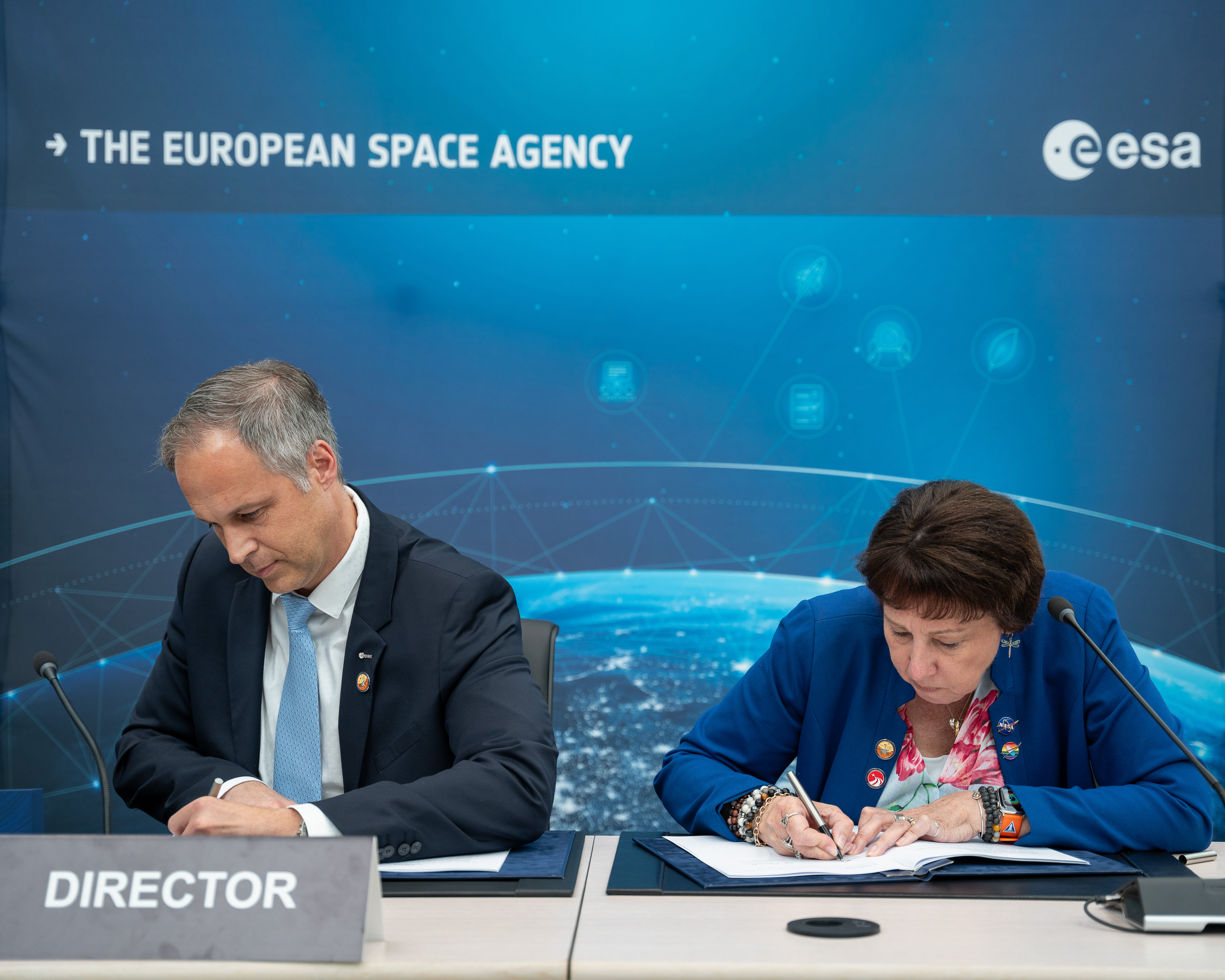
NASA’s Associate Administrator for the Science Mission Directorate Nicky Fox and ESA’s Director of Human and Robotic Exploration Daniel Neuenschwander sign an agreement on the Rosalind Franklin mission at ESA’s headquarters in Paris, France on May 16, 2024.
Credits: ESA/Damien Dos Santos

NASA and ESA (European Space Agency) announced Thursday they signed an agreement to expand NASA’s work on the ExoMars Rosalind Franklin rover, an ESA-led mission launching in 2028 that will search for signs of ancient life on the Red Planet.

With this memorandum of understanding, the NASA Launch Services Program will procure a U.S. commercial launch provider for the Rosalind Franklin rover. The agency will also provide heater units and elements of the propulsion system needed to land on Mars. A new instrument on the rover will be the first drill to a depth of up to 6.5 feet (2 meters) deep below the surface to collect ice samples that have been protected from surface radiation and extreme temperatures.

“The Rosalind Franklin rover’s unique drilling capabilities and onboard samples laboratory have outstanding scientific value for humanity’s search for evidence of past life on Mars,” said Nicola Fox, associate administrator, Science Mission Directorate at NASA Headquarters in Washington. “NASA supports the Rosalind Franklin mission to continue the strong partnership between the United States and Europe to explore the unknown in our solar system and beyond.”

Through an existing, separate partnership with the German Aerospace Center (DLR) and the French space agency CNES (Centre National d’Etudes Spatiales), NASA is contributing key components to the Rosalind Franklin rover’s primary science instrument, the Mars Organic Molecule Analyzer, that will search for the building blocks of life in the soil samples.

NASA has a longstanding partnership with the Department of Energy to use radioisotope power sources on the agency’s space missions and will be partnering again with the Energy Department for the use of lightweight radioisotope heater units for the rover.  

The Rosalind Franklin rover mission complements the Mars Sample Return multi-mission campaign led by both agencies.

For more information on NASA’s research on Mars, visit:

https://science.nasa.gov/mars

-end-

Katherine Rohloff
Headquarters, Washington
202-358-1600
katherine.a.rohloff@nasa.gov

Share

Details

Last Updated

May 16, 2024

Powered by WPeMatico

Get The Details…
Tiernan P. Doyle

How NASA Tracked the Most Intense Solar Storm in Decades

How NASA Tracked the Most Intense Solar Storm in Decades

5 Min Read

How NASA Tracked the Most Intense Solar Storm in Decades

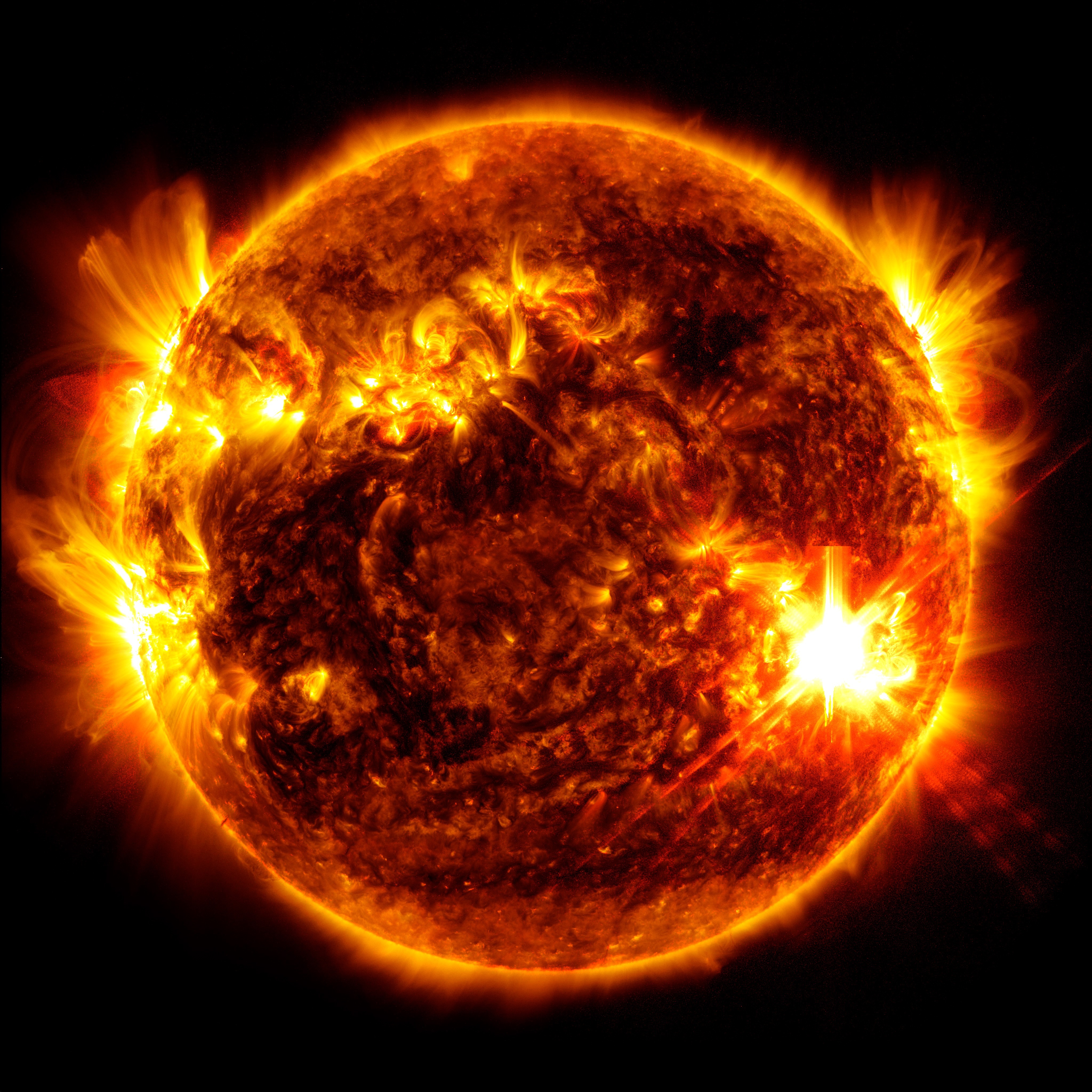
NASA’s Solar Dynamics Observatory captured these images of the solar flare on May 14, 2024 — as seen in the bright flash on the right side. These images show a subset of extreme ultraviolet light that highlights the extremely hot material in flares and which is colorized in royal blue and gold. This flare shows ongoing activity from the same region active during the storm.
Credits:
NASA/SDO

May 2024 has already proven to be a particularly stormy month for our Sun. During the first full week of May, a barrage of large solar flares and coronal mass ejections (CMEs) launched clouds of charged particles and magnetic fields toward Earth, creating the strongest solar storm to reach Earth in two decades — and possibly one of the strongest displays of auroras on record in the past 500 years.

We’ll be studying this event for years. It will help us test the limits of our models and understanding of solar storms.

Teresa Nieves-Chinchilla

Teresa Nieves-Chinchilla

Acting Director of NASA’s Moon to Mars (M2M) Space Weather Analysis Office

“We’ll be studying this event for years,” said Teresa Nieves-Chinchilla, acting director of NASA’s Moon to Mars (M2M) Space Weather Analysis Office. “It will help us test the limits of our models and understanding of solar storms.”

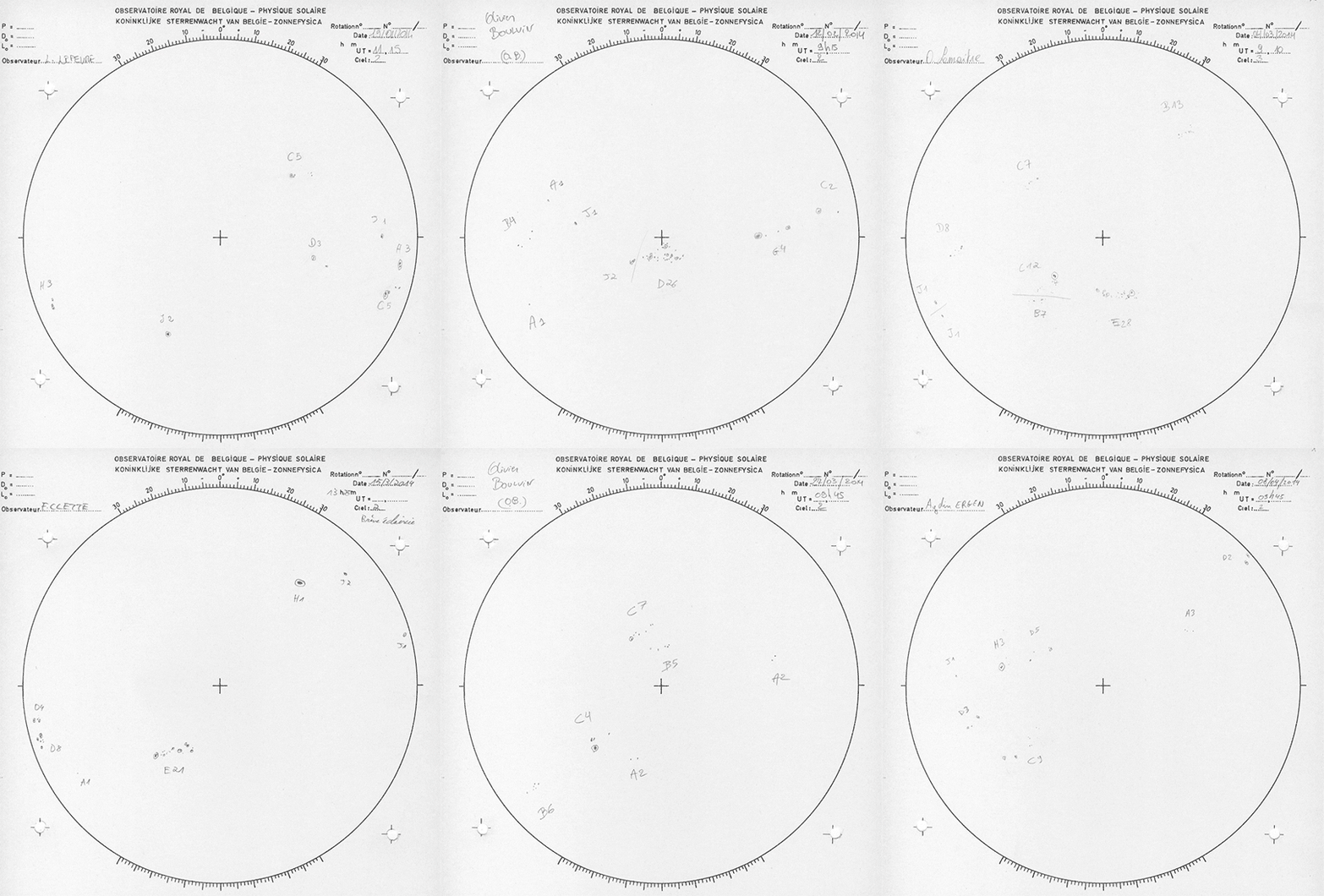
From May 3 through May 9, 2024, NASA’s Solar Dynamics Observatory observed 82 notable solar flares. The flares came mainly from two active regions on the Sun called AR 13663 and AR 13664. This video highlights all flares classified at M5 or higher with nine categorized as X-class solar flares.
NASA’s Goddard Space Flight Center

The first signs of the solar storm started late on May 7 with two strong solar flares. From May 7 – 11, multiple strong solar flares and at least seven CMEs stormed toward Earth. Eight of the flares in this period were the most powerful type, known as X-class, with the strongest peaking with a rating of X5.8. (Since then, the same solar region has released many more large flares, including an X8.7 flare — the most powerful flare seen this solar cycle — on May 14.)

On May 14, 2024, the Sun emitted a strong solar flare. This solar flare is the largest of Solar Cycle 25 and is classified as an X8.7 flare.
NASA’s Goddard Space Flight Center

Traveling at speeds up to 3 million mph, the CMEs bunched up in waves that reached Earth starting May 10, creating a long-lasting geomagnetic storm that reached a rating of G5 — the highest level on the geomagnetic storm scale, and one that hasn’t been seen since 2003.

“The CMEs all arrived largely at once, and the conditions were just right to create a really historic storm,” said Elizabeth MacDonald, NASA heliophysics citizen science lead and a space scientist at NASA’s Goddard Space Flight Center in Greenbelt, Maryland.

When the storm reached Earth, it created brilliant auroras seen around the globe. Auroras were even visible at unusually low latitudes, including the southern U.S. and northern India. The strongest auroras were seen the night of May 10, and they continued to illuminate night skies throughout the weekend. Thousands of reports submitted to the NASA-funded Aurorasaurus citizen science site are helping scientists study the event to learn more about auroras.

“Cameras — even standard cell phone cameras — are much more sensitive to the colors of the aurora than they were in the past,” MacDonald said. “By collecting photos from around the world, we have a huge opportunity to learn more about auroras through citizen science.”

Red and green streaks of an aurora radiate out from the center of the photo. Black silhouettes of trees line the edge.
A coronal aurora appeared over southwestern British Columbia on May 10, 2024.
NASA/Mara Johnson-Groh

By one measure of geomagnetic storm strength, called the disturbance storm time index which dates back to 1957, this storm was similar to historic storms in 1958 and 2003. And with reports of auroras visible to as low as 26 degrees magnetic latitude, this recent storm may compete with some of the lowest-latitude aurora sightings on record over the past five centuries, though scientists are still assessing this ranking.

“It’s a little hard to gauge storms over time because our technology is always changing,” said Delores Knipp, a research professor in the Smead Aerospace Engineering Science Department and a senior research associate at the NCAR High Altitude Observatory, in Boulder, Colorado. “Aurora visibility is not the perfect measure, but it allows us to compare over centuries.”

MacDonald encourages people to continue submitting aurora reports to Aurorasaurus.org, noting that even non-sightings are valuable for helping scientists understand the extent of the event.

Leading up to the storm, the National Oceanic and Atmospheric Administration’s Space Weather Prediction Center, which is responsible for forecasting solar storm impacts, sent notifications to operators of power grids and commercial satellites to help them mitigate potential impacts.

Warnings helped many NASA missions brace for the storm, with some spacecraft preemptively powering down certain instruments or systems to avoid issues. NASA’s ICESat-2 — which studies polar ice sheets — entered safe mode, likely because of increased drag due to the storm.  

Looking Forward

Better data on how solar events influence Earth’s upper atmosphere is crucial to understanding space weather’s impact on satellites, crewed missions, and Earth- and space-based infrastructure. To date, only a few limited direct measurements exist in this region. But more are coming. Future missions, such as NASA’s Geospace Dynamics Constellation (GDC) and Dynamical Neutral Atmosphere-Ionosphere Coupling (DYNAMIC), will be able to see and measure exactly how Earth’s atmosphere responds to the energy influxes that occur during solar storms like this one. Such measurements will also be valuable as NASA sends astronauts to the Moon with the Artemis missions and, later, to Mars.

An image of the Sun shows a bright flash in the bottom right side where a solar flare erupts.
NASA’s Solar Dynamics Observatory (SDO) captured this image of an X5.8 solar flare peaking at 9:23 p.m. EDT on May 10, 2024. The image shows a subset of extreme ultraviolet light that highlights the extremely hot material in flares.
NASA SDO

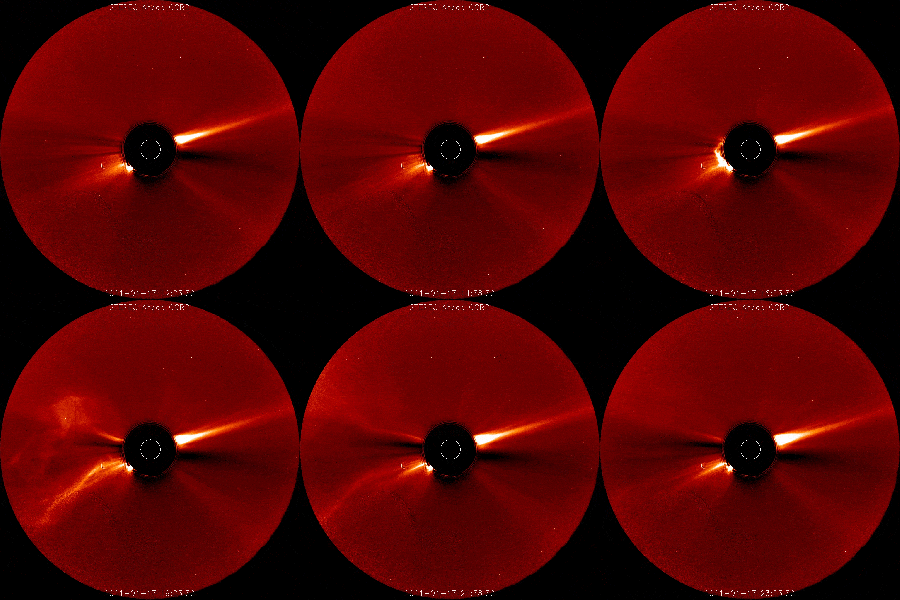
The solar region responsible for the recent stormy weather is now turning around the backside of the Sun, where its impacts can’t reach Earth. However, that doesn’t mean the storm is over. NASA’s Solar TErrestrial RElations Observatory (STEREO), currently located at about 12 degrees ahead of Earth in its orbit, will continue watching the active region an additional day after it is no longer visible from Earth.

“The active region is just starting to come into view of Mars,” said Jamie Favors, director for the NASA Space Weather Program at NASA Headquarters in Washington. “We’re already starting to capture some data at Mars, so this story only continues.”

By Mara Johnson-Groh
NASA’s Goddard Space Flight Center, Greenbelt, Md.

Media Contact:
Sarah Frazier
NASA’s Goddard Space Flight Center, Greenbelt, Md.

Keep Exploring

Discover More Topics From NASA

Powered by WPeMatico

Get The Details…