NASA Astronaut Don Pettit’s Science of Opportunity on Space Station

NASA Astronaut Don Pettit’s Science of Opportunity on Space Station

3 min read

Preparations for Next Moonwalk Simulations Underway (and Underwater)

Don Pettit is floating in space station, arms folded, looking up at the camera.
A fisheye lens attached to an electronic still camera was used to capture this image of NASA astronaut Don Pettit.
NASA

Science ideas are everywhere. Some of the greatest discoveries have come from tinkering and toying with new concepts and ideas. NASA astronaut Don Pettit is no stranger to inventing and discovering. During his previous missions, Pettit has contributed to advancements for human space exploration aboard the International Space Station resulting in several published scientific papers and breakthroughs.

Pettit, accompanied by cosmonauts Alexey Ovchinin and Ivan Vagner, will launch to the orbiting laboratory in September 2024. In preparation for his fourth spaceflight, read about previous “science of opportunity” experiments Pettit performed during his free time with materials readily available to the crew or included in his personal kit.

Freezing Ice in Space

A circular piece of ice in front of a black background shows a jewel-like structure with a variety of yellows, blues, pinks, and greens. The ice has small gas bubbles spread throughout the structure with sharp breaks and jagged edges between the colors.
Thin ice under polarized light frozen aboard the International Space Station.
NASA

Have you ever noticed a white bubble inside the ice in your ice tray at home? This is trapped air that accumulates in one area due to gravity. Pettit took this knowledge, access to a -90° Celsius freezer aboard the space station, and an open weekend to figure out how water freezes in microgravity compared to on Earth. This photo uses polarized light to show thin frozen water and the visible differences from the ice we typically freeze here on Earth, providing more insight into physics concepts in microgravity.

Space Cup

NASA astronaut Don Pettit demonstrates how surface tension, wetting, and container shape hold coffee in the space cup.
NASA

Microgravity affects even the most mundane tasks, like sipping your morning tea. Typically, crews drink beverages from a specially sealed bag with a straw. Using an overhead transparency film, Pettit invented the prototype of the Capillary Beverage, or Space Cup. The cup uses surface tension, wetting, and container shape to mimic the role of gravity in drinking on Earth, making drinking beverages in space easier to consume and showing how discoveries aboard station can be used to design new systems.

Planetary Formation

Astronaut Don Pettit demonstrates a mixture of coffee grounds and sugar sticking together in microgravity to understand planetary formation.
NASA

Using materials that break into very small particles, such as table salt, sugar, and coffee, Pettit experimented to understand planetary formation. A crucial early step in planet formation is the aggregation or clumping of tiny particles, but scientists do not fully understand this process. Pettit placed different particulate mixtures in plastic bags, filled them with air, thoroughly shook the bags, and observed that the particles clumped within seconds due to what appears to be an electrostatic process. Studying the behavior of tiny particles in microgravity may provide valuable insight into how material composition, density, and turbulence play a role in planetary formation.

Orbital Motion

Individual knitting needles on the screen with multiple water droplets orbiting the needle in a figure eight motion until they attach to the knitting needle.
Charged water particles orbit a knitting needle, showing electrostatic processes in space.
NASA

Knitting needles made of different materials arrived aboard station as personal crew items. Pettit electrically charged the needles by rubbing each one with paper. Then, he released charged water from a Teflon syringe and observed the water droplets orbit the knitting needle, demonstrating electrostatic orbits in microgravity. The study was later repeated in a simulation that included atmospheric drag, and the 3D motion accurately matched the orbits seen in the space station demonstration. These observations could be analogous to the behavior of charged particles in Earth’s magnetic field and prove useful in designing future spacecraft systems.

Astrophotography

Top: NASA astronaut Don Pettit photographed in the International Space Station cupola surrounded by cameras.
Bottom: Star trails photographed by NASA astronaut Don Pettit in March of 2012.
NASA

An innovative photographer, Pettit has used time exposure, multiple cameras, infrared, and other techniques to contribute breathtaking images of Earth and star trails from the space station’s unique viewpoint. These photos contribute to a database researchers use to understand Earth’s changing landscapes, and this imagery can inspire the public’s interest in human spaceflight.

Christine Giraldo

International Space Station Research Communications Team

NASA’s Johnson Space Center

Powered by WPeMatico

Get The Details…
Andrea Lloyd
Gateway’s Propulsion System Testing Throttles Up

Gateway’s Propulsion System Testing Throttles Up

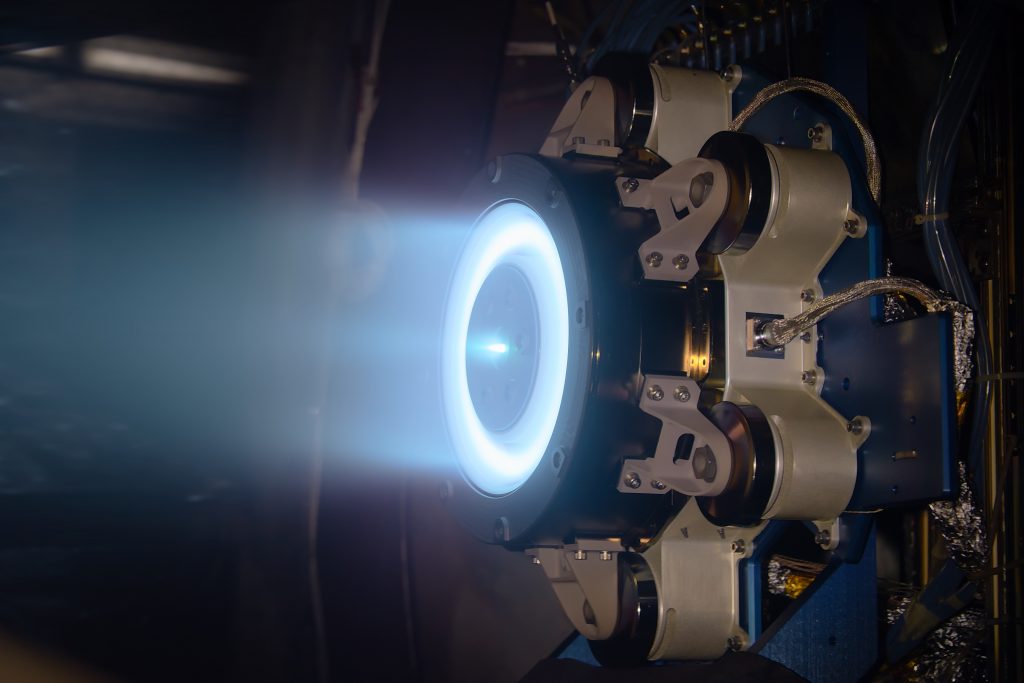
In this image from April, PPE engineers successfully tested the integration of Aerojet Rocketdyne’s thruster with Maxar’s power procession unit and Xenon Flow Controller.

The powerhouse of Gateway, NASA’s orbiting outpost around the Moon and a critical piece of infrastructure for Artemis, is in the midst of several electric propulsion system tests.

The Power and Propulsion Element (PPE), being manufactured by Maxar Technologies, provides Gateway with power, high-rate communications, and propulsion for maneuvers around the Moon and to transit between different orbits. The PPE will be combined with the Habitation and Logistic Outpost (HALO) before the integrated spacecraft’s launch, targeted for late 2024 aboard a SpaceX Falcon Heavy. Together, these elements will serve as the hub for early Gateway crewed operations and various science and technology demonstrations as the full Gateway station is assembled around it in the coming years.

In this image, PPE engineers successfully tested the integration of Aerojet Rocketdyne’s thruster with Maxar’s power procession unit and Xenon Flow Controller.

Image Credit: NASA

Powered by WPeMatico

Get The Details…
Gary Daines

NASA TechRise Student Challenge

NASA TechRise Student Challenge

The TechRise Student Challenge

Are you ready for this year’s NASA TechRise Student challenge? From researching Earth’s environment to designing experiments for space exploration, schools are invited to join NASA in its mission to inspire the world through discovery. If you are in sixth to 12th grade at a U.S. public, private, or charter school – including those in U.S. territories – your challenge is to team up with your schoolmates and develop a science or technology experiment idea for this year’s NASA TechRise flight vehicle – the high-altitude balloon! The High-Altitude Balloon will offer approximately four to eight hours of flight time at approximately 70,000 to 95,000 feet and exposure to Earth’s atmosphere, high-altitude radiation, and perspective views of our planet.

Award: $60,000 in total prizes

Open Date: August 1, 2024

Close Date: November 1, 2024

For more information, visit: https://www.futureengineers.org/nasatechrise

Powered by WPeMatico

Get The Details…
Sarah Douglas

6 Ways Students Can Engage With NASA Glenn

6 Ways Students Can Engage With NASA Glenn

4 min read

Preparations for Next Moonwalk Simulations Underway (and Underwater)

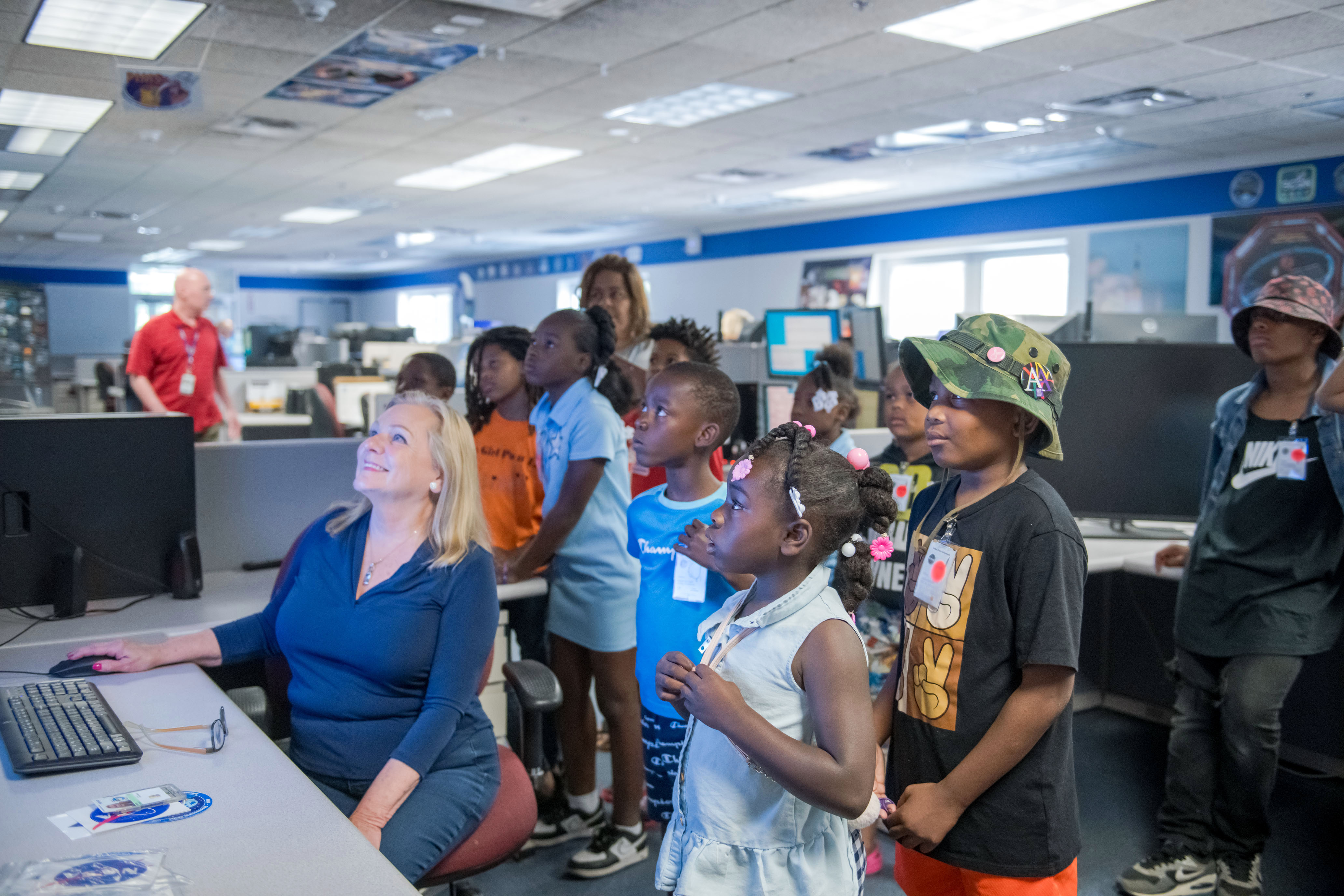
Caption: A dozen grade school students look up at the screen of NASA Glenn’s Telescience Support Center, a facility where researchers operate International Space Station experiments. A NASA expert wearing a blue shirt and jeans sits in a chair and smiles as she tells students how she supports NASA. Students are engaged in what is on the screen.
Students take a tour of NASA Glenn’s Telescience Support Center, where researchers operate International Space Station experiments.
Credit: NASA/Jef Janis

School is back in session, and the joy of learning is back on students’ minds. Teachers and parents seeking ways to extend students’ academic excitement outside of the classroom should know NASA’s Glenn Research Center in Cleveland offers various opportunities to engage with NASA.

NASA educators encourage Ohio students and teachers to take part in the incredible space and aeronautics research happening right in their backyards.

“We have lofty goals to send the first woman and first person of color to the Moon, on to Mars, and beyond. To get there, we’ll need all the creativity and talent available to us,” said Darlene Walker, Glenn’s Office of STEM Engagement director. “We offer programs, events, and experiences at Glenn to inspire and attract students to NASA careers.”

Throughout the year, NASA Glenn offers in-person and virtual events for students and schools.

6 Ways Students Can Engage With NASA Glenn

One-day events are open to students and teachers who are U.S. citizens as well as Ohio schools or other youth-serving organizations. Registration generally opens one to two months prior to the event. Event dates may be subject to change. Check the Glenn STEM Engagement webpage for the most up-to-date information.

Events are designed to inspire students and spark their interest in STEM fields. These events feature NASA experts, engaging STEM activities, and tours of Glenn facilities.

1. High School Shadowing Days | High school students

Offered in fall and spring, this one-day event allows high school students to explore career opportunities in STEM, as well as business.

Fall Event Date – Nov. 14, 2024

Registration Opens – Sept. 16, 2024

Spring Event Date – May 15, 2025

Registration Opens – March 14, 2025

2. Girls in STEM | 5-8th grade students

To inspire an interest in STEM fields among middle school students, Girls in STEM features female Glenn employees, STEM activities, and tours of center facilities.

Event Date – April 10, 2025

Registration Opens – Feb. 10, 2025

3. Aviation Day | Middle and high school students

This one-day event celebrates advancements in aviation and encourages middle and high school students’ interest in aeronautics.

Event Date – Aug. 28, 2025

Registration Opens – June 27, 2025

4. TECH Day | Middle school students

TECH is short for Tours of NASA, Engineering challenge, Career exploration, and Hands-on activity. This event includes tours of center facilities, a student engineering design challenge, and career exploration opportunities.

Event Date – May 1, 2025

Registration Opens – Feb. 28, 2025

5. Manufacturing Day | High school students

Manufacturing Day aims to educate high school students about careers in the manufacturing field while encouraging an interest in STEM. Students will see how teams of engineers, researchers, and technicians work together to design and prototype aeronautics and space hardware.

Event Date – Sept. 18, 2025

Registration Opens – July 18, 2025

6. NASA STEM Kids Virtual Events | K-4th grade students

These virtual events are designed to engage kindergarten through fourth grade students by sharing the excitement of NASA’s missions of exploration and discovery through virtual tours, conversations with NASA experts, and hands-on activities.

Event Dates – Dec. 5, 2024; March 8, 2025; June 7, 2025; and Sept. 13, 2025

Registration Opens – 60 days prior to each event

“Through these opportunities, we want students to see astronauts, scientists, engineers, and role models who look like them and grew up like them work toward NASA’s missions and goals,” Walker said. “We hope they see themselves achieving these things too. We have all kinds of careers at NASA. Any career you can find outside of NASA, you can find here as well.”

Additional programs and projects

Glenn offers additional programs and projects for schools, teachers, and students looking for other ways to engage with NASA:

For more information about these opportunities, reach out the NASA contact listed on the correlating web page.

Learn more about NASA’s Office of STEM Engagement.

Jacqueline Minerd 
NASA’s Glenn Research Center 

Powered by WPeMatico

Get The Details…
Kelly M. Matter

Leveraging Teacher Leaders to Share the Joy of NASA Heliophysics

Leveraging Teacher Leaders to Share the Joy of NASA Heliophysics

2 min read

Leveraging Teacher Leaders to Share the Joy of NASA Heliophysics

Many teachers are exceptionally skilled at bridging students’ interests with real-world science. Now for the third year, the American Association of Physics Teachers (AAPT) has brought together such a group of highly-motivated secondary and higher education teachers as part of their NASA Heliophysics Education Activation Team (HEAT) Space Physics Ambassador program. In June of 2024, eight educators from across the country gathered in Chicago to reflect on how they could make use of the AAPT NASA HEAT team’s instructional materials for teaching basic physics concepts in a space science context. Following the three-day summit, each ambassador would plan to carry out professional development workshops for approximately 20 other educators.

Heliophysics can provide ample opportunity for teaching many concepts that are foundational to the Next Generation Science Standards and can support teachers who want to teach physics in context, but don’t always feel they have the resources to do so. One of the team’s most popular instructional materials includes a lesson about using data from NASA’s Solar and Heliospheric Observatory (SOHO) to create motion graphs of coronal mass ejections. Another activity relates data from NASA’s Solar Dynamics Observatory (SDO) from solar flare observations to explore how energy is stored and released in magnetic fields. These authentic learning resources offer the opportunity for teachers to bring space data into the classroom.

Educators who are interested in learning more about these and other lessons are welcome to join the team’s free 1.5-hour mini-workshops, one Saturday per month from September to December 2024.

Register: https://forms.gle/jD3fZskjqzFcuXGXA

NASA HEAT is part of NASA’s Science Activation Portfolio. Learn more about how Science Activation connects NASA science experts, real content, and experiences with community leaders to do science in ways that activate minds and promote deeper understanding of our world and beyond: https://science.nasa.gov/learn

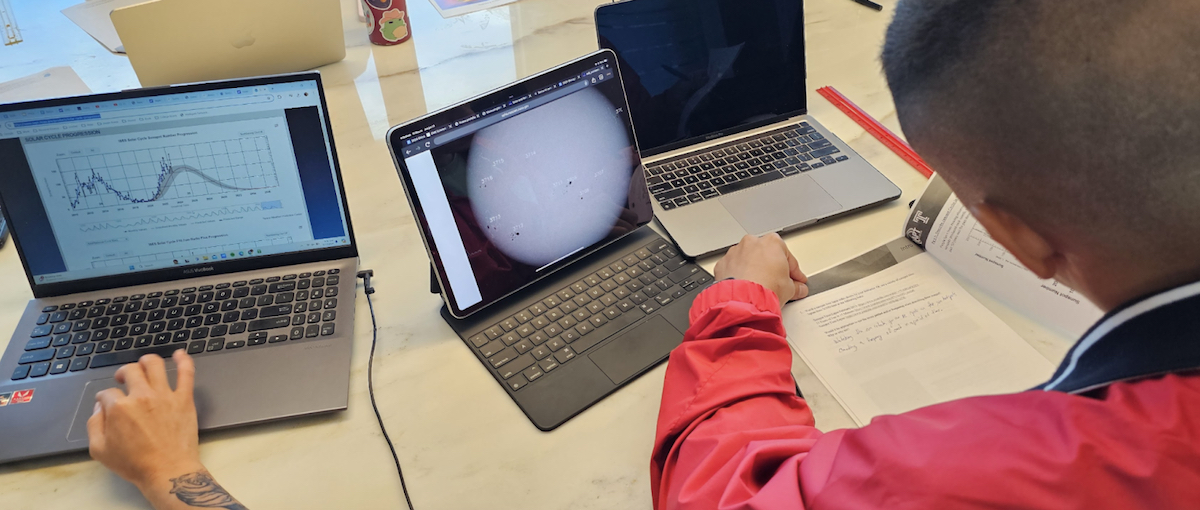
Two ambassadors work with NASA sunspot data on computers, graphing sunspot number versus time, and an image of the Sun's surface with spots, while completing an activity sheet.
Two ambassadors explore sunspot data during the summit.
Rebecca Vieyra

Share

Details

Last Updated
Sep 04, 2024
Editor
NASA Science Editorial Team

Powered by WPeMatico

Get The Details…