NASA to Embrace Commercial Sector, Fly Out Legacy Relay Fleet 

NASA to Embrace Commercial Sector, Fly Out Legacy Relay Fleet 

4 Min Read

NASA to Embrace Commercial Sector, Fly Out Legacy Relay Fleet 

Alt Text: An artistic rendering. We see a line art representation of a satellite relay communicating with Earth over a deep dark green starry background. Three light green commercial satellites are seen surrounding the top half of the Earth, alongside one light green TDRS satellite. A thin bright green beam of light is shown connecting each satellite to Earth, as a way to represent the flow of data. The surface of the Earth is covered in many small dots connected by lines to represent communication nodes across near-Earth orbit and on Earth.

An artist’s concept of commercial and NASA space relays.

Credits:
NASA/Morgan Johnson

NASA is one step closer on its transition to using commercially owned and operated satellite communications services to provide future near-Earth space missions with increased service coverage, availability, and accelerated science and data delivery.     

As of Friday, Nov. 8, the agency’s legacy TDRS (Tracking and Data Relay Satellite) system, as part of the Near Space Network, will support only existing missions while new missions will be supported by future commercial services.    

“There have been tremendous advancements in commercial innovation since NASA launched its first TDRS satellite more than 40 years ago,” said Kevin Coggins, deputy associate administrator of NASA’s SCaN (Space Communications and Navigation) program. “TDRS will continue to provide critical support for at least the next decade, but now is the time to embrace commercial services that could enhance science objectives, expand experimentation, and ultimately provide greater opportunities for discovery.”    

TDRS will continue to provide critical support for at least the next decade, but now is the time to embrace commercial services.»

Kevin Coggins

Kevin Coggins

Deputy Associate Administrator for NASA’s SCaN

Just as NASA has adopted commercial crew, commercial landers, and commercial transport services, the Near Space Network, managed by NASA’s SCaN, will leverage private industry’s vast investment in the Earth-based satellite communications market, which includes communications on airplanes, ships, satellite dish television, and more. Now, industry is developing a new space-based market for these services, where NASA plans to become one of many customers, bolstering the domestic space industry.    

NASA’s Communications Services Project is working with industry through funded Space Act Agreements to develop and demonstrate commercial satellite communications services that meet the agency’s mission needs, and the needs of other potential users.   

In 2022, NASA provided $278.5 million in funding to six domestic partners so they could develop and demonstrate space relay communication capabilities.  

An artist’s concept of commercial relay satellites.
NASA/Morgan Johnson

A successful space-based commercial service demonstration would encompass end-to-end testing with a user spacecraft for one or more of the following use cases: launch support, launch and early operations phase, low and high data rate routine missions, terrestrial support, and contingency services. Once a demonstration has been completed, it is expected that the commercial company would be able to offer their services to government and commercial users.    

NASA also is formulating non-reimbursable Space Act Agreements with members of industry to exchange capability information as a means of growing the domestic satellite communications market. The Communications Services Project currently is partnered with Kepler Communications US Inc. through a non-reimbursable Space Act Agreement.    

As the agency and the aerospace community expand their exploration efforts and increase mission complexity, the ability to communicate science, tracking, and telemetry data to and from space quickly and securely will become more critical than ever before. The goal is to validate and deliver space-based commercial communications services to the Near Space Network by 2031, to support future NASA missions.   

NASA’s Tracking and Data Relay System  

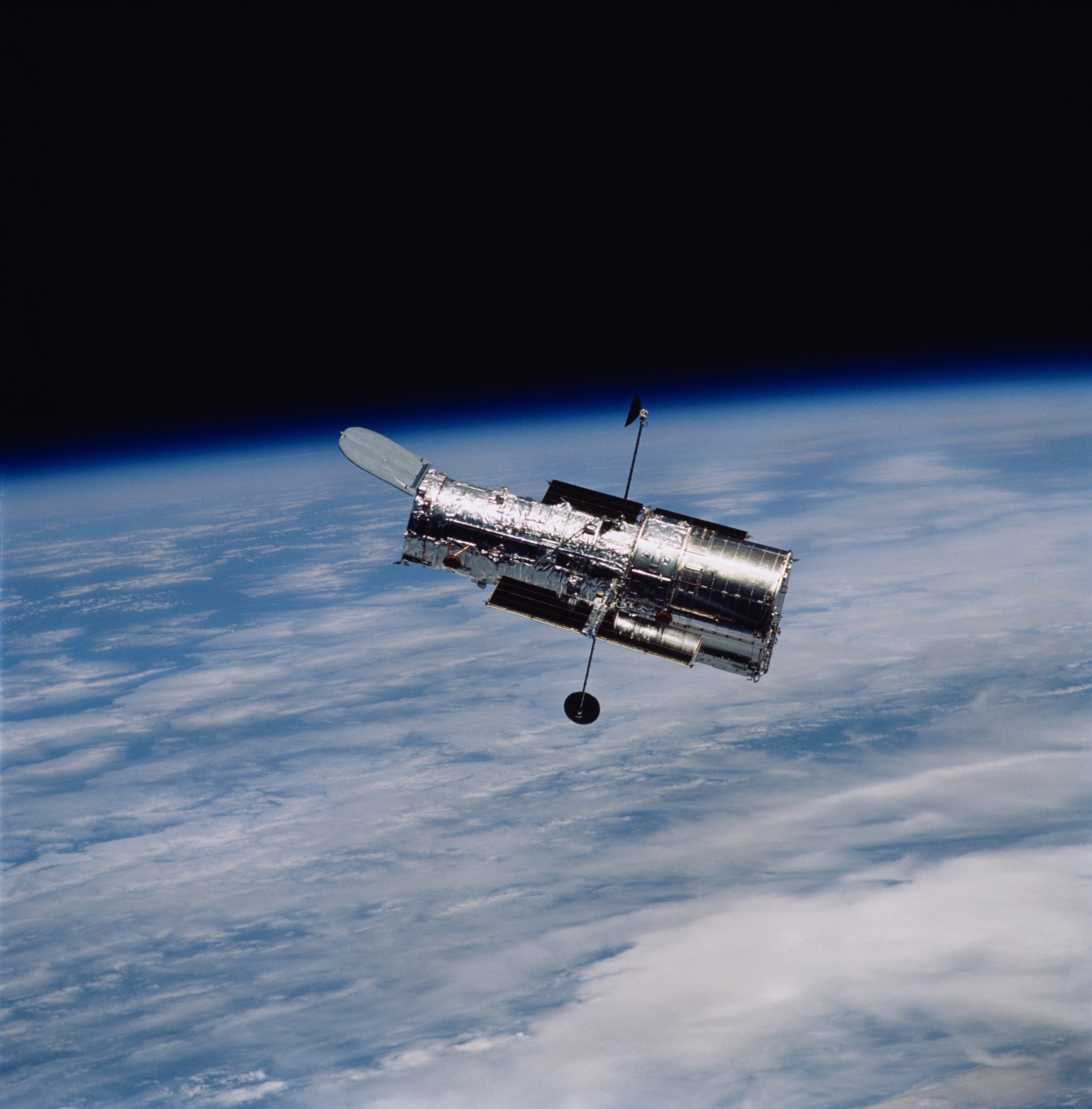
While TDRS will not be accepting new missions, it won’t be retiring immediately. Current TDRS users, like the International Space Station, Hubble Space Telescope, and many other Earth- and universe-observing missions, will still rely on TDRS until the mid-2030s. Each TDRS spacecraft’s retirement will be driven by individual health factors, as the seven active TDRS satellites are expected to decline at variable rates.     

An artist’s concept of the International Space Station using NASA’s Tracking and Data Relay Satellite (TDRS) fleet to transmit data to Earth.
NASA

The TDRS fleet began in 1983 and consists of three generations of satellites, launching over the course of 40 years. Each successive generation of TDRS improved upon the previous model, with additional radio frequency band support and increased automation.    

The first TDRS was designed for a mission life of 10 years, but lasted 26 years before it was decommissioned in 2009. The last in the third generation – TDRS-13 –was launched Aug. 18, 2017.   

The TDRS constellation has been a workhorse for the agency, enabling significant data transfer and discoveries.”   
DAve Israel

DAve Israel

Near Space Network Chief Architect

“Each astronaut conversation from the International Space Station, every picture you’ve seen from Hubble Space Telescope, Nobel Prize-winning science data from the COBE satellite, and much more has flowed through TDRS,” said Dave Israel, Near Space Network chief architect. “The TDRS constellation has been a workhorse for the agency, enabling significant data transfer and discoveries.”   

Countdown Underway for TDRS-M
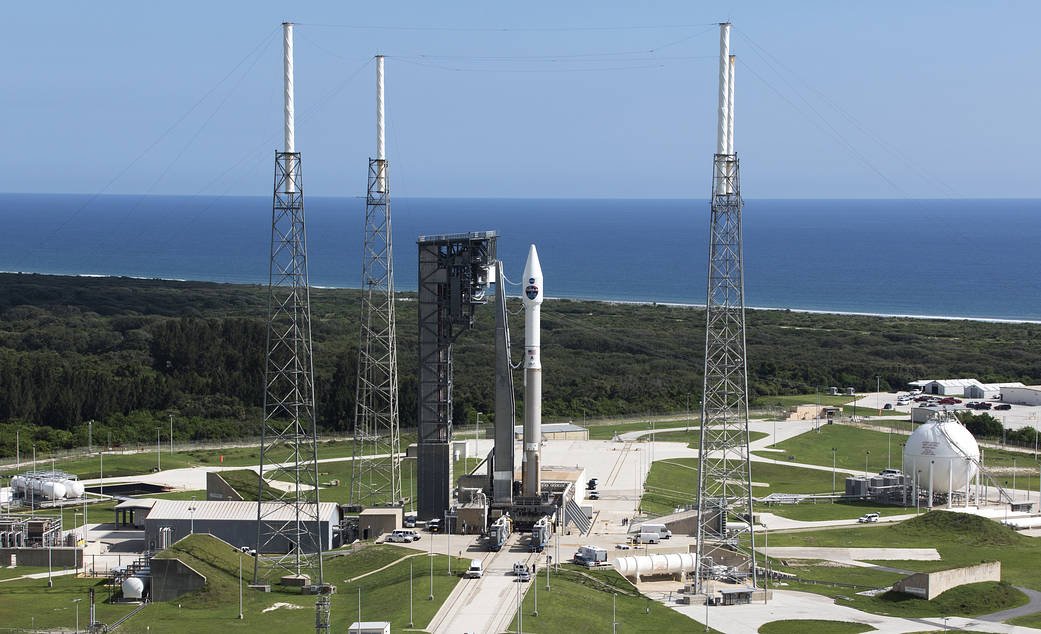
NASA’s Tracking and Data Relay Satellite 13 (TDRS-13) atop an Atlas V rocket at NASA’s Kennedy Space Center in Florida before launch.
NASA/Tony Gray and Sandra Joseph

The Near Space Network and the Communications Services Project are funded by NASA’s SCaN (Space Communications and Navigation) program office at NASA Headquarters in Washington. The network is operated out of NASA’s Goddard Space Flight Center in Greenbelt, Maryland, and the Communications Services Project is managed out of NASA’s Glenn Research Center in Cleveland. 

Share

Details

Last Updated

Oct 16, 2024

Editor
Goddard Digital Team
Contact
Katherine Schauer
Molly Kearns
Location
Goddard Space Flight Center

Powered by WPeMatico

Get The Details…
Katherine Schauer

Sols 4334-4335: Planning with Popsicles — A Clipper Celebration!

Sols 4334-4335: Planning with Popsicles — A Clipper Celebration!

3 min read

Sols 4334-4335: Planning with Popsicles — A Clipper Celebration!

A grayscale photograph of the Martian surface shows a wide expanse of very rocky terrain, with sharp, angular stones arrayed as far as the eye can see, as if set together in a mosaic, stretching to the horizon where distant hills rise up, all in medium gray, A portion of the Curiosity rover is visible in the lower right corner of the frame.
This image was taken by Left Navigation Camera aboard NASA’s Mars rover Curiosity on Sol 4329 — Martian day 4,329 of the Mars Science Laboratory mission — on Oct. 10, 2024, at 05:35:08 UTC.
NASA/JPL-Caltech

Earth planning date: Monday, Oct. 14, 2024

Today was an unusually exciting day during tactical planning on the Curiosity mission because it intersected with a momentous event in space exploration: the launch of Europa Clipper from Kennedy Space Center. Even though the launch window occurred right in the middle of our morning planning meetings, at 9:06 a.m. PDT to be specific, today’s Tactical Uplink Lead and Science Operations Working Group Chair agreed it would be OK for the entire tactical team to take a 15-minute pause to turn on NASA TV and watch the launch together. Down the hall the Perseverance rover tactical team had decided the same, and for a few moments, the two teams paused their planning and watched together in anticipation as the countdown ticked down to T-0. Many of my close friends and co-workers had worked for years — some for decades — to make this mission a reality, and it was amazing to watch the enormous rocket carrying the Clipper spacecraft leap off the pad knowing how hard it was to get to this point. I cannot wait for the mission’s discoveries once it reaches Jupiter’s watery moon Europa!

In true JPL tradition, we of course had to commemorate the event with some sweet frozen treats on-lab. Back when Curiosity landed, we had a full fridge of ice cream that was kept stocked for the first 90 sols of the mission. (Eating ice cream cones at 2 in the morning is a core memory of mine from those early days in our mission.) Today, in a clever nod to Europa’s icy surface, we celebrated with some even icier sweets: fruit and coffee popsicles to anyone on-lab. I chose coffee of course; the caffeine was great to help me get through a busy day of planning for Curiosity!

On Mars, things with our rover are going well. We completed our mega ~50-meter drive (about 164 feet) over the weekend, which took Curiosity further north along the western side of Gediz Vallis channel. Our plan today is a “touch and go,” which means we’ll do contact science with APXS and MAHLI on a block in front of us named “Dollar Lake,” some remote sensing, including ChemCam LIBS of a target named “Cape Horn” and a couple Mastcam mosaics, followed by a drive to the north. We’ll continue to follow the western side of Gediz Vallis channel as we descend slightly down Mount Sharp, until we reach a location where we are able to head west towards a more easily traversable valley, and then restart our ascent.

What a fun day of planning today. Congratulations to everyone involved helping Europa Clipper reach this incredible milestone, and go Clipper go!

Written by Abigail Fraeman, Planetary Geologist at NASA’s Jet Propulsion Laboratory

Share

Details

Last Updated
Oct 16, 2024

Related Terms

Powered by WPeMatico

Get The Details…

NASA’s Hubble Sees a Stellar Volcano

NASA’s Hubble Sees a Stellar Volcano

3 Min Read

NASA’s Hubble Sees a Stellar Volcano

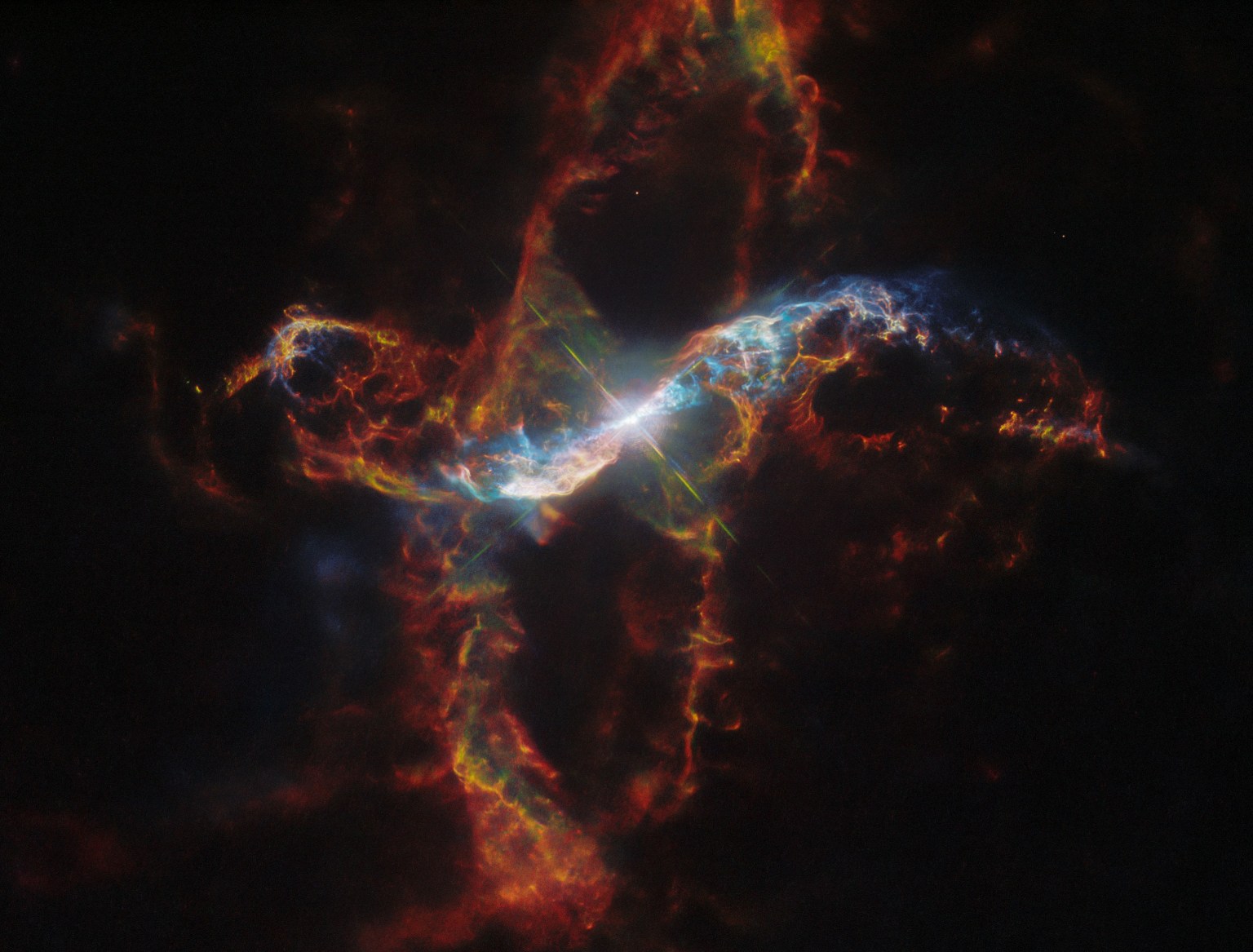
A bright binary star surrounded by a colorful loops of nebula on the black background of space. One loop is vertical the other is horizontal across the center of the image.
NASA’s Hubble Space Telescope captures a spectacular view the star R Aquarii.
Credits:
NASA, ESA, Matthias Stute , Margarita Karovska , Davide De Martin (ESA/Hubble), Mahdi Zamani (ESA/Hubble)

NASA’s Hubble Space Telescope has provided a dramatic and colorful close-up look at one of the most rambunctious stars in our galaxy, weaving a huge spiral pattern among the stars.

Located approximately 700 light-years away, a binary star system called R Aquarii undergoes violent eruptions that blast out huge filaments of glowing gas. The twisted stellar outflows make the region look like a lawn sprinkler gone berserk. This dramatically demonstrates how the universe redistributes the products of nuclear energy that form deep inside stars and jet back into space.

R Aquarii belongs to a class of double stars called symbiotic stars. The primary star is an aging red giant and its companion is a compact burned-out star known as a white dwarf. The red giant primary star is classified as a Mira variable that is over 400 times larger than our Sun. The bloated monster star pulsates, changes temperature, and varies in brightness by a factor of 750 times over a roughly 390-day period. At its peak the star is blinding at nearly 5,000 times our Sun’s brightness.

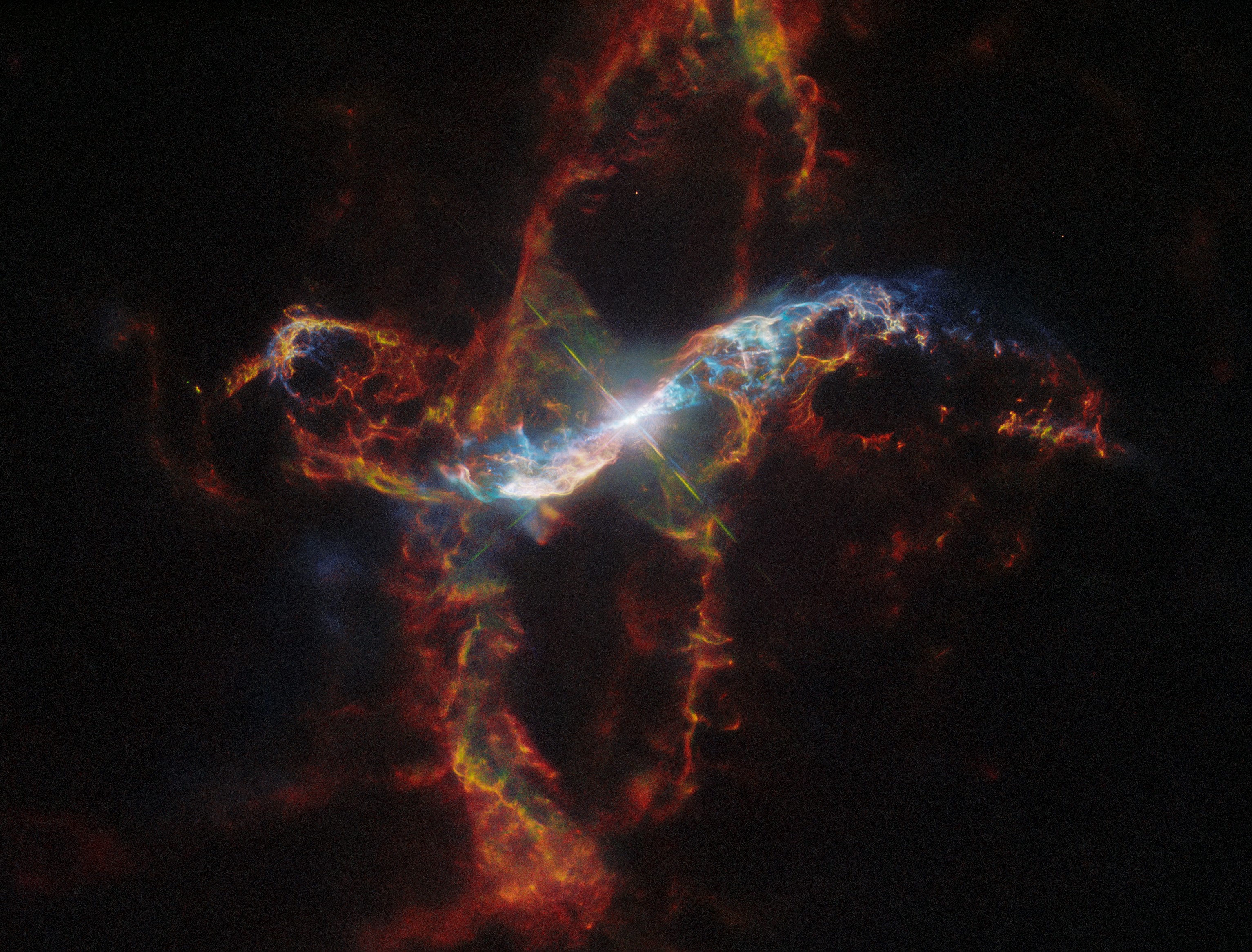
A bright binary star surrounded by a colorful loops of nebula on the black background of space. One loop is vertical the other is horizontal across the center of the image.
This NASA Hubble Space Telescope image features the binary star system R Aquarii.
NASA, ESA, Matthias Stute , Margarita Karovska , Davide De Martin (ESA/Hubble), Mahdi Zamani (ESA/Hubble)

When the white dwarf star swings closest to the red giant along its 44-year orbital period, it gravitationally siphons off hydrogen gas. This material accumulates on the dwarf star’s surface until it undergoes spontaneous nuclear fusion, making that surface explode like a gigantic hydrogen bomb. After the outburst, the fueling cycle begins again.

This outburst ejects geyser-like filaments shooting out from the core, forming weird loops and trails as the plasma emerges in streamers. The plasma is twisted by the force of the explosion and channeled upwards and outwards by strong magnetic fields. The outflow appears to bend back on itself into a spiral pattern. The plasma is shooting into space over 1 million miles per hour – fast enough to travel from Earth to the Moon in 15 minutes! The filaments are glowing in visible light because they are energized by blistering radiation from the stellar duo.

Hubble first observed the star in 1990. R Aquarii was resolved into two very bright stars separated by about 1.6 billion miles. The ESA/Hubble team now has made a unique timelapse of R Aquarii’s dynamic behavior, from observations spanning from 2014 to 2023. Across the five images, the rapid and dramatic evolution of the binary star and its surrounding nebula can be seen. The binary star dims and brightens due to strong pulsations in the red giant star.

This video features five frames spanning from 2014 to 2023 of R Aquarii. These frames show the brightness of the central binary changing over time due to strong pulsations in the red giant star. The central structures spiral outward due to their interaction with material previously ejected by the binary. This timelapse highlights the value of Hubble’s high resolution optical observations in the changing universe, known as time-domain astronomy.
NASA, ESA, Matthias Stute , Margarita Karovska , Davide De Martin , Mahdi Zamani , N. Bartmann (ESA/Hubble)

The scale of the event is extraordinary even in astronomical terms. Space-blasted material can be traced out to at least 248 billion miles from the stars, or 24 times our solar system’s diameter. Images like these and more from Hubble are expected to revolutionize our ideas about such unique stellar “volcanoes” as R Aquarii.

The Hubble Space Telescope has been operating for over three decades and continues to make ground-breaking discoveries that shape our fundamental understanding of the universe. Hubble is a project of international cooperation between NASA and ESA (European Space Agency). NASA’s Goddard Space Flight Center in Greenbelt, Maryland, manages the telescope and mission operations. Lockheed Martin Space, based in Denver, Colorado, also supports mission operations at Goddard. The Space Telescope Science Institute in Baltimore, Maryland, which is operated by the Association of Universities for Research in Astronomy, conducts Hubble science operations for NASA.

Media Contact:

Claire Andreoli
NASA’s Goddard Space Flight CenterGreenbelt, MD
claire.andreoli@nasa.gov

Ray Villard
Space Telescope Science Institute, Baltimore, MD

Bethany Downer
ESA/Hubble

Powered by WPeMatico

Get The Details…

Christine Knudson Uses Earthly Experience to Study Martian Geology

Christine Knudson Uses Earthly Experience to Study Martian Geology

Name: Christine Knudson
Title: Geologist
Formal Job Classification: Research Assistant
Organization: Planetary Environments Laboratory, Science Directorate (Code 699)

person stands in front of stanchions and red ribbon, behind which is a model of the six-wheeled, SUV-sized Curiosity rover
Christine Knudson is a geologist at NASA’s Goddard Space Flight Center in Greenbelt, Md. She began graduate school in August 2012, the same month that NASA’s Curiosity rover landed on Mars. “It is very exciting to be part of the rover team and to be involved in an active Mars mission,” she says. “On days when we’re downlinking science data and I’m on shift, I am one of the first people to see data from an experiment done on Mars!”
Courtesy of Christine Knudsen

What do you do and what is most interesting about your role here at Goddard?

I am a geologist doing both laboratory and field work, primarily focusing on Mars analog research. I work on the Curiosity rover as part of the Sample Analysis at Mars (SAM) instrument team.

Why did you become a geologist?

As a child, I always loved being outside and I was really interested in all things related to the Earth. In college, I figured out that I wanted to be a geologist after taking an introduction to geology course. I wanted to learn more about the Earth and its interior, specifically volcanism.

What is your educational background?

In 2012, I received a B.S. in geology and environmental geoscience from Northern Illinois University. In August 2012, the same month that Curiosity landed on Mars, I started graduate school and in December 2014, I received a M.S. in geology from the same university. I focused on igneous geochemistry, investigating the pre-eruptive water contents of a Guatemalan volcano.

Why did you come to Goddard?

I came to Goddard in February 2015 to perform laboratory analyses of Mars analog materials, rock and mineral samples, from Earth, that the Curiosity rover and spectral orbiters have also identified on Mars. It is very exciting to be part of the rover team and to be involved in an active Mars mission.

What is a highlight of your work as a laboratory geologist doing Mars analog research?

Using laboratory analyses to interpret data we are getting back from Curiosity is incredibly exciting! I perform evolved gas analysis to replicate the analyses that the SAM instrument does on the rover. Curiosity scoops sand or drills into the rocks at stops along its drive through Gale Crater on Mars, then dumps the material into a small cup within the SAM instrument inside the rover. The rock is heated in a small oven to about 900 C [about 1650 F], and the instrument captures the gases that are released from the sample as it is heated. SAM uses a mass spectrometer to identify the different gases, and that tells us about the minerals that make up the rock.

We do the same analyses on rocks and minerals in our lab to compare to the SAM analyses. The other instruments on Curiosity also aid in the identification of the rocks, minerals, and elements present in this location on the Martian surface.

I also serve as a payload downlink lead for the SAM instrument. I check on the science and engineering data after we perform an experiment on Mars. On the days I’m on shift, I check to make sure that our science experiments finish without any problems, and that the instrument is “healthy,” so that the rover can continue driving and begin the science that is planned for the next sol.

On days when we’re downlinking science data and I’m on shift, I am one of the first people to see data from an experiment done on Mars!

What is some of the coolest field work you have done?

I have done Mars analog field work in New Mexico, Hawaii, and Iceland. The field work in Hawaii is exciting because one of our field sites was inside a lava tube on Mauna Loa. We expect that there are lava tubes on Mars, and we know that the interior of the tubes would likely be better shielded from solar radiation, which might allow for the preservation of organic markers. Scientifically, we’re interested in characterizing the rocks and minerals inside lava tubes to understand how the interior differs from the surface over time and to investigate differences in elemental availability as an accessible resource for potential life. Learning about these processes on Earth helps us understand what might be possible on Mars too.

a person wearing an orange reflective safety vest stands in a dark gray, rocky lava tube tunnel
“The field work in Hawaii is exciting because one of our field sites was inside a lava tube on Mauna Loa,” Knudson says. “We expect that there are lava tubes on Mars, and we know that the interior of the tubes would likely be better shielded from solar radiation, which might allow for the preservation of organic markers.”
Courtesy of Christine Knudson

I use handheld versions of laboratory instruments, some of which were miniaturized and made to fit on the Curiosity rover, to take in situ geochemical measurements — to learn what elements are present in the rocks and in what quantities. We also collect samples to analyze in the laboratory.

I also love Hawaii because the island is volcanically active. Hawaii Volcano National Park is incredible! A couple years ago, I was able to see the lava lake from an ongoing eruption within the crater of Kīlauea volcano. The best time to see the lava lake is at night because the glowing lava is visible from multiple park overlooks.

As a Mars geologist, what most fascinates you about the Curiosity rover?

When Curiosity landed, it was the largest rover NASA had ever sent to Mars: It’s about the size of a small SUV, so landing it safely was quite the feat! Curiosity also has some of the first science instruments ever made to operate on another planet, and we’ve learned SO much from those analyses.

Curiosity and the other rovers are sort of like robotic geologists exploring Mars.  Working with the Curiosity rover allows scientists to do geology on Mars — from about 250 million miles away! Earth analogs help us to understand what we are seeing on Mars, since that “field site” is so incredibly far away and inaccessible to humans at this time.  

What do you do for fun?

I spend most of my free time with my husband and two small children. We enjoy family hikes, gardening, and both my boys love being outside as much as I do.

I also enjoy yoga, and I crochet: I make hats, blankets, and I’m starting a sweater soon.

What is your “six-word memoir”? A six-word memoir describes something in just six words.

Nature-lover. Mom. Geologist. Cat-enthusiast. Curious. Snack-fiend.

By Elizabeth M. Jarrell
NASA’s Goddard Space Flight Center, Greenbelt, Md.

A banner graphic with a group of people smiling and the text "Conversations with Goddard" on the right. The people represent many genders, ethnicities, and ages, and all pose in front of a soft blue background image of space and stars.

Conversations With Goddard is a collection of Q&A profiles highlighting the breadth and depth of NASA’s Goddard Space Flight Center’s talented and diverse workforce. The Conversations have been published twice a month on average since May 2011. Read past editions on Goddard’s “Our People” webpage.

Share

Details

Last Updated

Oct 16, 2024

Editor
Rob Garner
Contact
Rob Garner
Location
Goddard Space Flight Center

Powered by WPeMatico

Get The Details…
Rob Garner

Europa Clipper Begins Journey to Jupiter’s Icy Moon

Europa Clipper Begins Journey to Jupiter’s Icy Moon

A SpaceX Falcon Heavy rocket carrying NASA’s Europa Clipper spacecraft lifts off from Launch Complex 39A at NASA’s Kennedy Space Center in Florida at 12:06 p.m. EDT on Monday, Oct. 14, 2024. After launch, the spacecraft plans to fly by Mars in February 2025, then back by Earth in December 2026, using the gravity of each planet to increase its momentum. With help of these “gravity assists,” Europa Clipper will achieve the velocity needed to reach Jupiter in April 2030.

Powered by WPeMatico

Get The Details…