Old Data Yields New Secrets as NASA’s DAVINCI Preps for Venus Trip

Old Data Yields New Secrets as NASA’s DAVINCI Preps for Venus Trip

Due to launch in the early 2030s, NASA’s DAVINCI mission will investigate whether Venus — a sweltering world wrapped in an atmosphere of noxious gases — once had oceans and continents like Earth.

Consisting of a flyby spacecraft and descent probe, DAVINCI will focus on a mountainous region called Alpha Regio, a possible ancient continent. Though a handful of international spacecraft plunged through Venus’ atmosphere between 1970 and 1985, DAVINCI’s probe will be the first to capture images of this intriguing terrain ever taken from below Venus’ thick and opaque clouds.

But how does a team prepare for a mission to a planet that hasn’t seen an atmospheric probe in nearly 50 years, and that tends to crush or melt its spacecraft visitors?

Scientists leading the DAVINCI mission started by using modern data-analysis techniques to pore over decades-old data from previous Venus missions. Their goal is to arrive at our neighboring planet with as much detail as possible. This will allow scientists to most effectively use the probe’s descent time to collect new information that can help answer longstanding questions about Venus’ evolutionary path and why it diverged drastically from Earth’s.
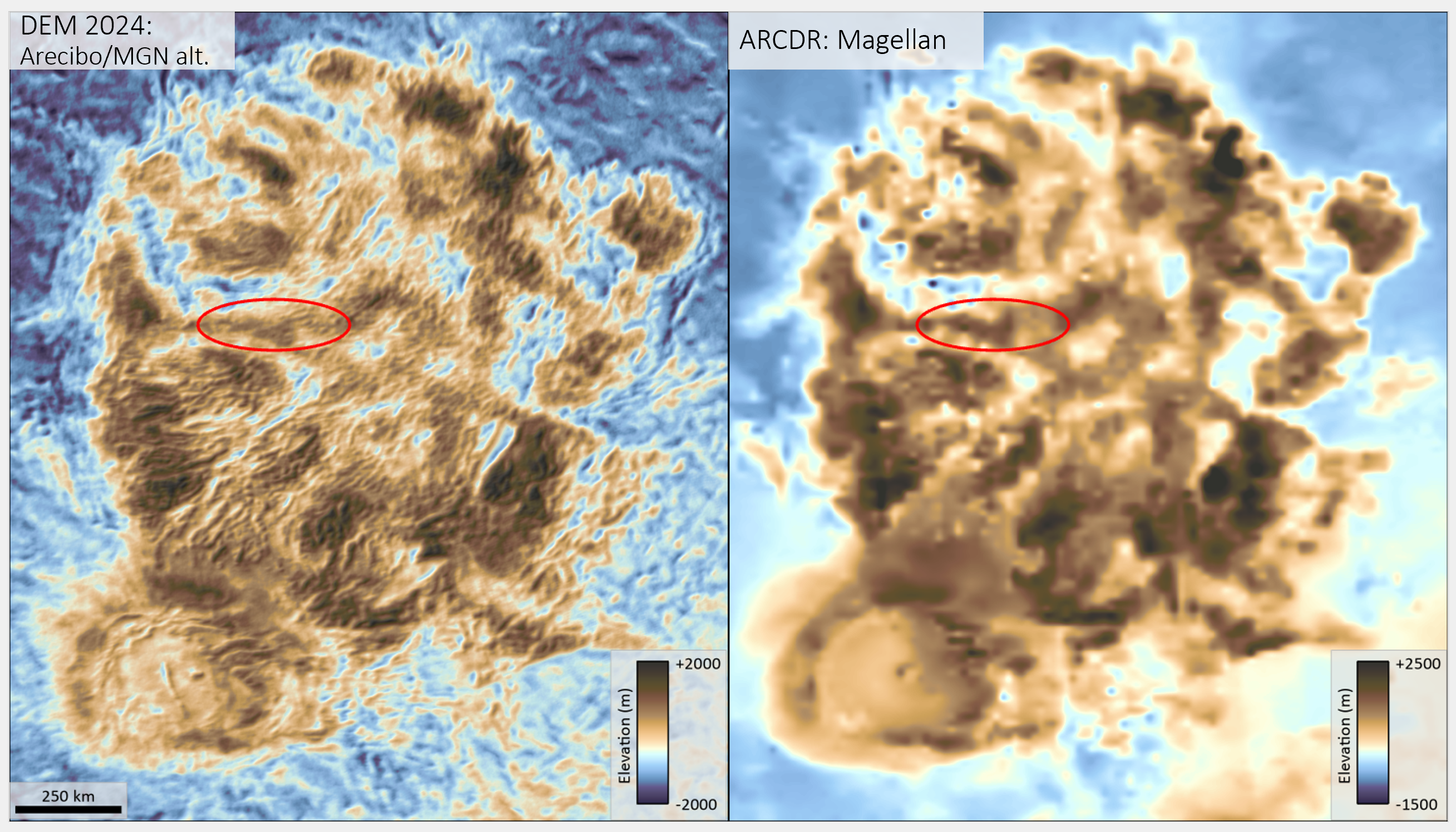
Two nearly identical scenes are side by side. Each has a blue background with a splotchy brown and tan pattern on top of it. The image on the left is much sharper than the one on the right, with texture and shades of colors visible. A small, red ellipse marks a spot a little left of the center of the splotchy pattern.
On the left, a new and more detailed view of Venus’ Alpha Regio region developed by scientists on NASA’s DAVINCI mission to Venus, due to launch in the early 2030s. On the right is a less detailed map created using radar altimeter data collected by NASA’s Magellan spacecraft in the early 1990s. The colors on the maps depict topography, with dark blues identifying low elevations and browns identifying high elevations. To make the map on the left, the DAVINCI science team re-analyzed Magellan data and supplemented it with radar data collected on three occasions from the Arecibo Observatory in Puerto Rico, and used machine vision computer models to scrutinize the data and fill in gaps in information. The red ellipses on each image mark the area DAVINCI’s probe will descend over as it collects data on its way toward the surface.
Jim Garvin/NASA’s Goddard Space Flight Center

Between 1990 and 1994, NASA’s Magellan spacecraft used radar imaging and altimetry to map the topography of Alpha Regio from Venus’ orbit. Recently, NASA’s DAVINICI’s team sought more detail from these maps, so scientists applied new techniques to analyze Magellan’s radar altimeter data. They then supplemented this data with radar images taken on three occasions from the former Arecibo Observatory in Puerto Rico and used machine vision computer models to scrutinize the data and fill in gaps in information at new scales (less than 0.6 miles, or 1 kilometer).  

As a result, scientists improved the resolution of Alpha Regio maps tenfold, predicting new geologic patterns on the surface and prompting questions about how these patterns could have formed in Alpha Regio’s mountains.  

Benefits of Looking Backward

Old data offers many benefits to new missions, including information about what frequencies, parts of spectrum, or particle sizes earlier instruments covered so that new instruments can fill in the gaps.

At NASA Space Science Data Coordinated Archive, which is managed out of NASA’s Goddard Space Flight Center in Greenbelt, Maryland, staff restore and digitize data from old spacecraft. That vintage data, when compared with modern observations, can show how a planet changes over time, and can even lead to new discoveries long after missions end. Thanks to new looks at Magellan observations, for instance, scientists recently found evidence of modern-day volcanic activity on Venus.
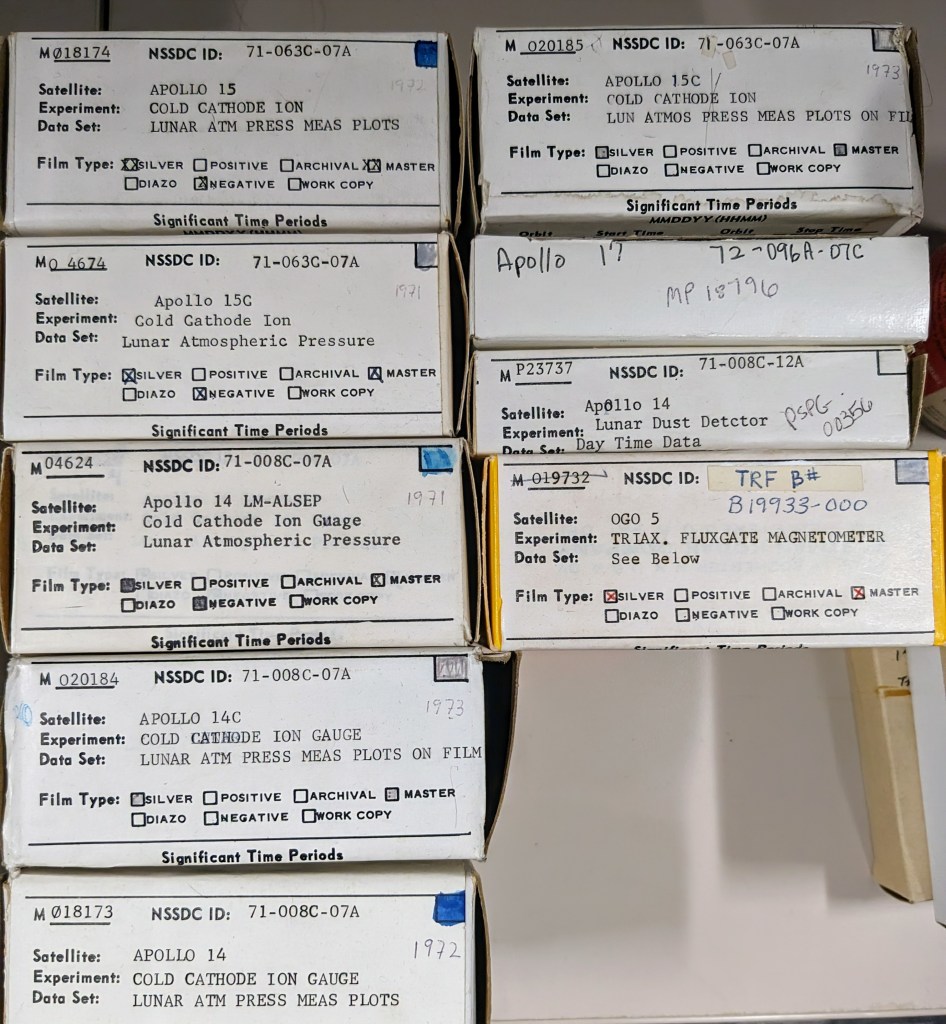
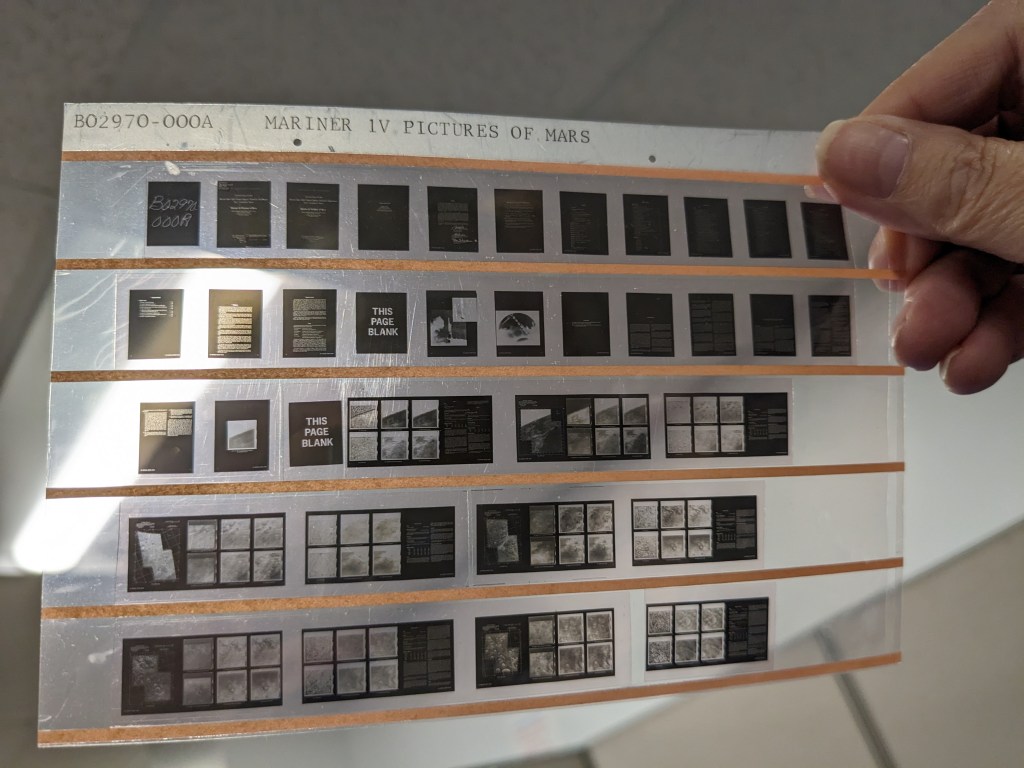
Magellan was among the first missions to be digitally archived in NASA’s publicly accessible online repository of planetary mission data. But the agency has reams of data — much of it not yet digitized — dating back to 1958, when the U.S. launched its first satellite, Explorer 1.

Data restoration is a complex and resource-intensive job, and NASA prioritizes digitizing data that scientists need. With three forthcoming missions to Venus — NASA’s DAVINCI and VERITAS, plus ESA’s (European Space Agency) Envision — space data archive staff are helping scientists access data from Pioneer Venus, NASA’s last mission to drop probes into Venus’ atmosphere in 1978.

Mosaic of Venus

Alpha Regio is one of the most mysterious spots on Venus. Its terrain, known as “tessera,” is similar in appearance to rugged Earth mountains, but more irregular and disorderly.

So called because they resemble a geometric parquet floor pattern, tesserae have been found only on Venus, and DAVINCI will be the first mission to explore such terrain in detail and to map its topography.

DAVINCI’s probe will begin photographing Alpha Regio — collecting the highest-resolution images yet — once it descends below the planet’s clouds, starting at about 25 miles, or 40 kilometers, altitude. But even there, gases in the atmosphere scatter light, as does the surface, such that these images will appear blurred.

Could Venus once have been a habitable world with liquid water oceans — like Earth? This is one of the many mysteries associated with our shrouded sister world. Credit: NASA’s Goddard Space Flight Center

DAVINCI scientists are working on a solution. Recently, scientists re-analyzed old Venus imaging data using a new artificial-intelligence technique that can sharpen the images and use them to compute three-dimensional topographic maps. This technique ultimately will help the team optimize DAVINCI’s images and maps of Alpha Regio’s mountains. The upgraded images will give scientists the most detailed view ever — down to a resolution of 3 feet, or nearly 1 meter, per pixel — possibly allowing them to detect small features such as rocks, rivers, and gullies for the first time in history.

“All this old mission data is part of a mosaic that tells the story of Venus,” said Jim Garvin, DAVINCI principal investigator and chief scientist at NASA Goddard. “A story that is a masterpiece in the making but incomplete.”

By analyzing the surface texture and rock types at Alpha Regio, scientists hope to determine if Venusian tesserae formed through the same processes that create mountains and certain volcanoes on Earth.

By Lonnie Shekhtman

NASA’s Goddard Space Flight Center, Greenbelt, Md.

Powered by WPeMatico

Get The Details…

Imagining the Future

Imagining the Future

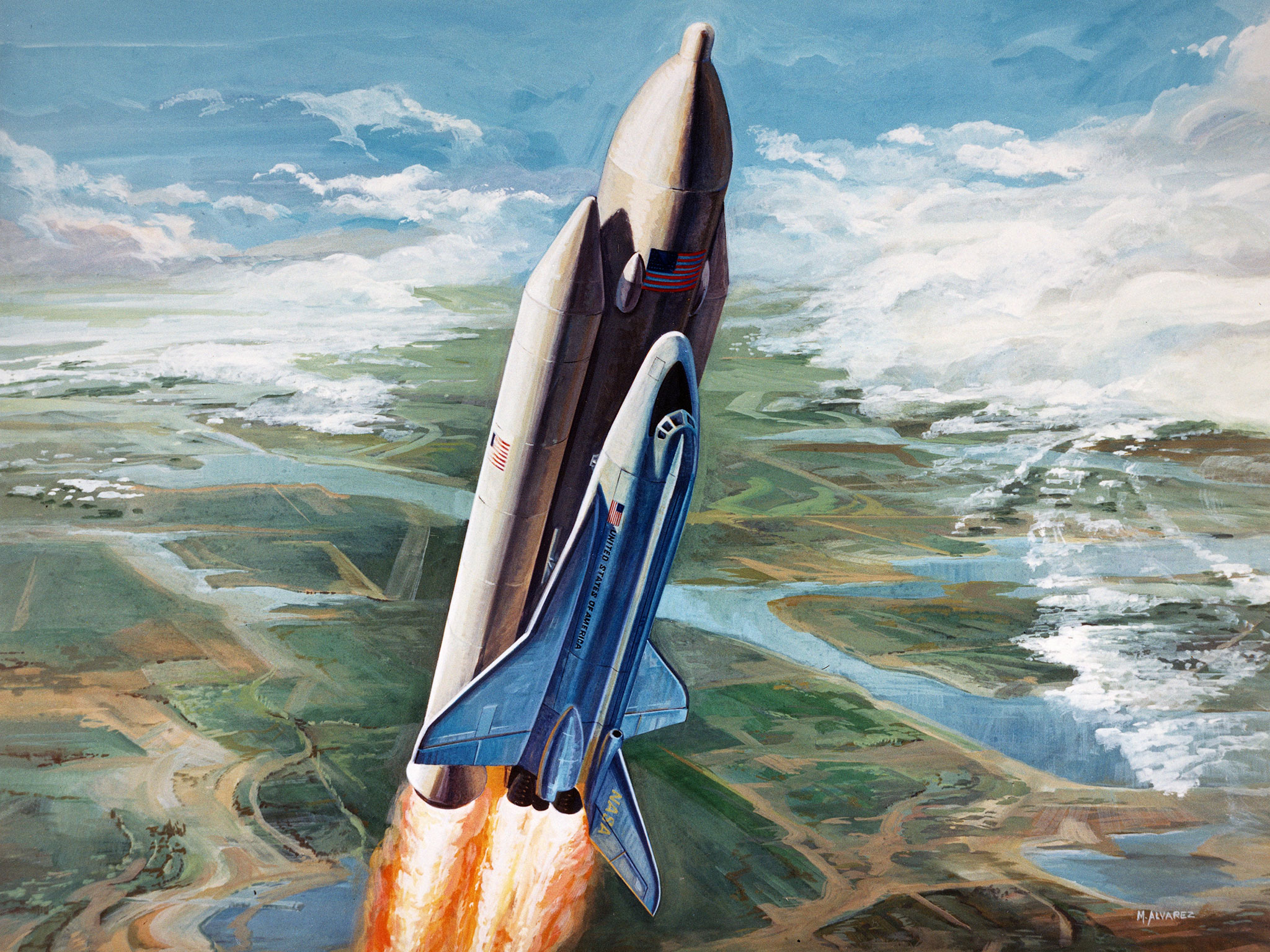
An illustration of a space shuttle liftoff. The shuttle flies upward at a slight angle as a column of fire shooting downward from the rocket boosters. In the background is the surrounding green land and blue water, along with white clouds on the top left and right sides of the image.
NASA

A space shuttle lifts off high above the surrounding land in this Aug. 1, 1973, illustration. With 135 missions flown over 30 years, NASA’s shuttle fleet achieved numerous firsts and opened space up to more people than ever before.

Each space shuttle consisted of three major components: the orbiter, which housed the crew, a large external tank that held fuel for the main engines, and two solid rocket boosters that provided most of the shuttle’s lift during the first two minutes of flight. All the components were reused except for the external fuel tank, which burned up in the atmosphere after each launch. The space shuttle was the world’s first reusable spacecraft.

Check out the NASA+ playlist, “The Shuttle Era.”

Image credit: NASA

Powered by WPeMatico

Get The Details…
Monika Luabeya

Could Life Exist Below Mars Ice? NASA Study Proposes Possibilities

Could Life Exist Below Mars Ice? NASA Study Proposes Possibilities

4 min read

Preparations for Next Moonwalk Simulations Underway (and Underwater)

Researchers think meltwater beneath Martian ice could support microbial life.

While actual evidence for life on Mars has never been found, a new NASA study proposes microbes could find a potential home beneath frozen water on the planet’s surface.

Through computer modeling, the study’s authors have shown that the amount of sunlight that can shine through water ice would be enough for photosynthesis to occur in shallow pools of meltwater below the surface of that ice. Similar pools of water that form within ice on Earth have been found to teem with life, including algae, fungi, and microscopic cyanobacteria, all of which derive energy from photosynthesis.

“If we’re trying to find life anywhere in the universe today, Martian ice exposures are probably one of the most accessible places we should be looking,” said the paper’s lead author, Aditya Khuller of NASA’s Jet Propulsion Laboratory in Southern California.

Mars has two kinds of ice: frozen water and frozen carbon dioxide. For their paper, published in Nature Communications Earth & Environment, Khuller and colleagues looked at water ice, large amounts of which formed from snow mixed with dust that fell on the surface during a series of Martian ice ages in the past million years. That ancient snow has since solidified into ice, still peppered with specks of dust.  

Although dust particles may obscure light in deeper layers of the ice, they are key to explaining how subsurface pools of water could form within ice when exposed to the Sun: Dark dust absorbs more sunlight than the surrounding ice, potentially causing the ice to warm up and melt up to a few feet below the surface.

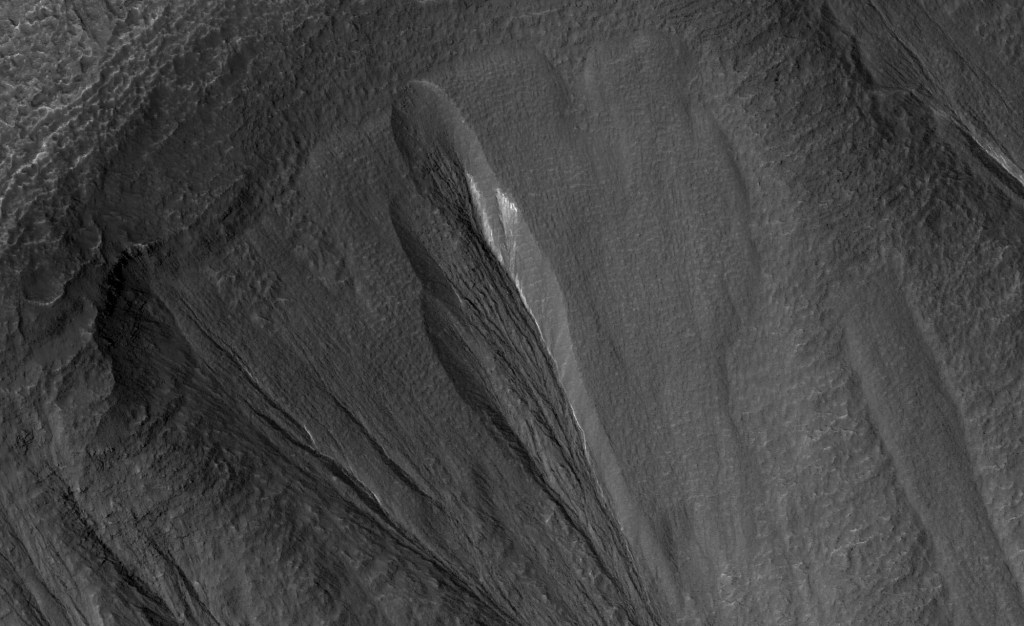
The white edges along these gullies in Mars’ Terra Sirenum are believed to be dusty water ice
The white edges along these gullies in Mars’ Terra Sirenum are believed to be dusty water ice. Scientists think meltwater could form beneath the surface of this kind of ice, providing a place for possible photosynthesis. This is an enhanced-color image; the blue color would not actually be perceptible to the human eye.
NASA/JPL-Caltech/University of Arizona

Mars scientists are divided about whether ice can actually melt when exposed to the Martian surface. That’s due to the planet’s thin, dry atmosphere, where water ice is believed to sublimate — turn directly into gas — the way dry ice does on Earth. But the atmospheric effects that make melting difficult on the Martian surface wouldn’t apply below the surface of a dusty snowpack or glacier.

Thriving Microcosms

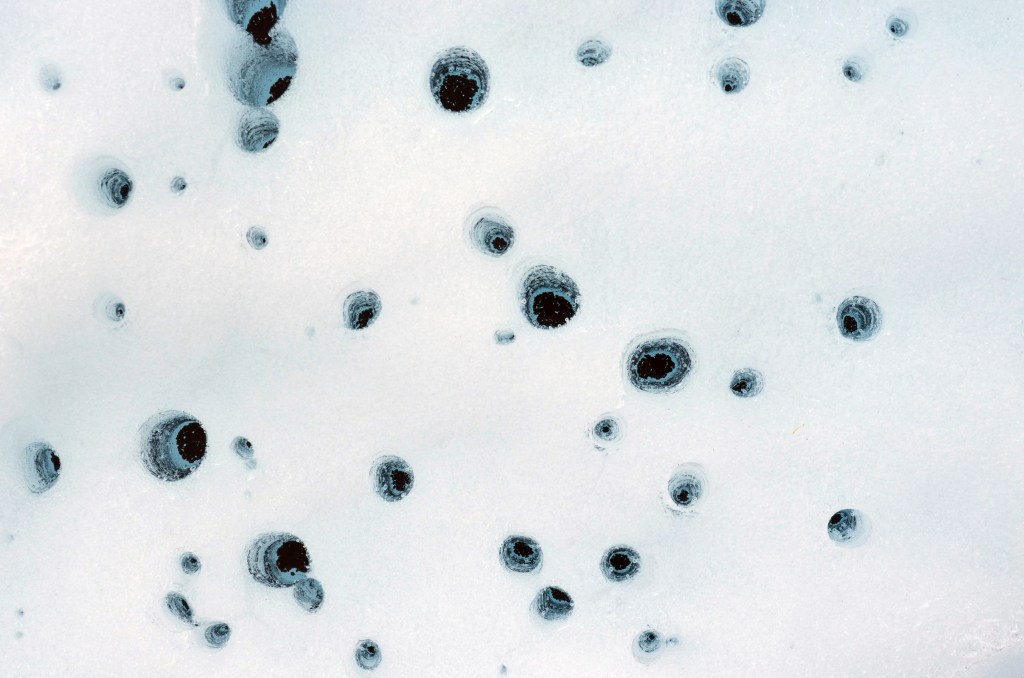
On Earth, dust within ice can create what are called cryoconite holes — small cavities that form in ice when particles of windblown dust (called cryoconite) land there, absorb sunlight, and melt farther into the ice each summer. Eventually, as these dust particles travel farther from the Sun’s rays, they stop sinking, but they still generate enough warmth to create a pocket of meltwater around them. The pockets can nourish a thriving ecosystem for simple lifeforms..

“This is a common phenomenon on Earth,” said co-author Phil Christensen of Arizona State University in Tempe, referring to ice melting from within. “Dense snow and ice can melt from the inside out, letting in sunlight that warms it like a greenhouse, rather than melting from the top down.”

Christensen has studied ice on Mars for decades. He leads operations for a heat-sensitive camera called THEMIS (Thermal Emission Imaging System) aboard NASA’s 2001 Mars Odyssey orbiter. In past research, Christensen and Gary Clow of the University of Colorado Boulder used modeling to demonstrate how liquid water could form within dusty snowpack on the Red Planet. That work, in turn, provided a foundation for the new paper focused on whether photosynthesis could be possible on Mars.

In 2021, Christensen and Khuller co-authored a paper on the discovery of dusty water ice exposed within gullies on Mars, proposing that many Martian gullies form by erosion caused by the ice melting to form liquid water.

This new paper suggests that dusty ice lets in enough light for photosynthesis to occur as deep as 9 feet (3 meters) below the surface. In this scenario, the upper layers of ice prevent the shallow subsurface pools of water from evaporating while also providing protection from harmful radiation. That’s important, because unlike Earth, Mars lacks a protective magnetic field to shield it from both the Sun and radioactive cosmic ray particles zipping around space.

The study authors say the water ice that would be most likely to form subsurface pools would exist in Mars’ tropics, between 30 degrees and 60 degrees latitude, in both the northern and southern hemispheres.

Khuller next hopes to re-create some of Mars’ dusty ice in a lab to study it up close. Meanwhile, he and other scientists are beginning to map out the most likely spots on Mars to look for shallow meltwater — locations that could be scientific targets for possible human and robotic missions in the future.

News Media Contacts

Andrew Good
Jet Propulsion Laboratory, Pasadena, Calif.
818-393-2433
andrew.c.good@jpl.nasa.gov

Karen Fox / Molly Wasser
NASA Headquarters, Washington
202-358-1600
karen.c.fox@nasa.gov / molly.l.wasser@nasa.gov

2024-142

Share

Details

Last Updated

Oct 17, 2024

Powered by WPeMatico

Get The Details…
Anthony Greicius

Scientist Profile: Jacquelyn Shuman Blazes New Trails in Fire Science

Scientist Profile: Jacquelyn Shuman Blazes New Trails in Fire Science

4 min read

Preparations for Next Moonwalk Simulations Underway (and Underwater)

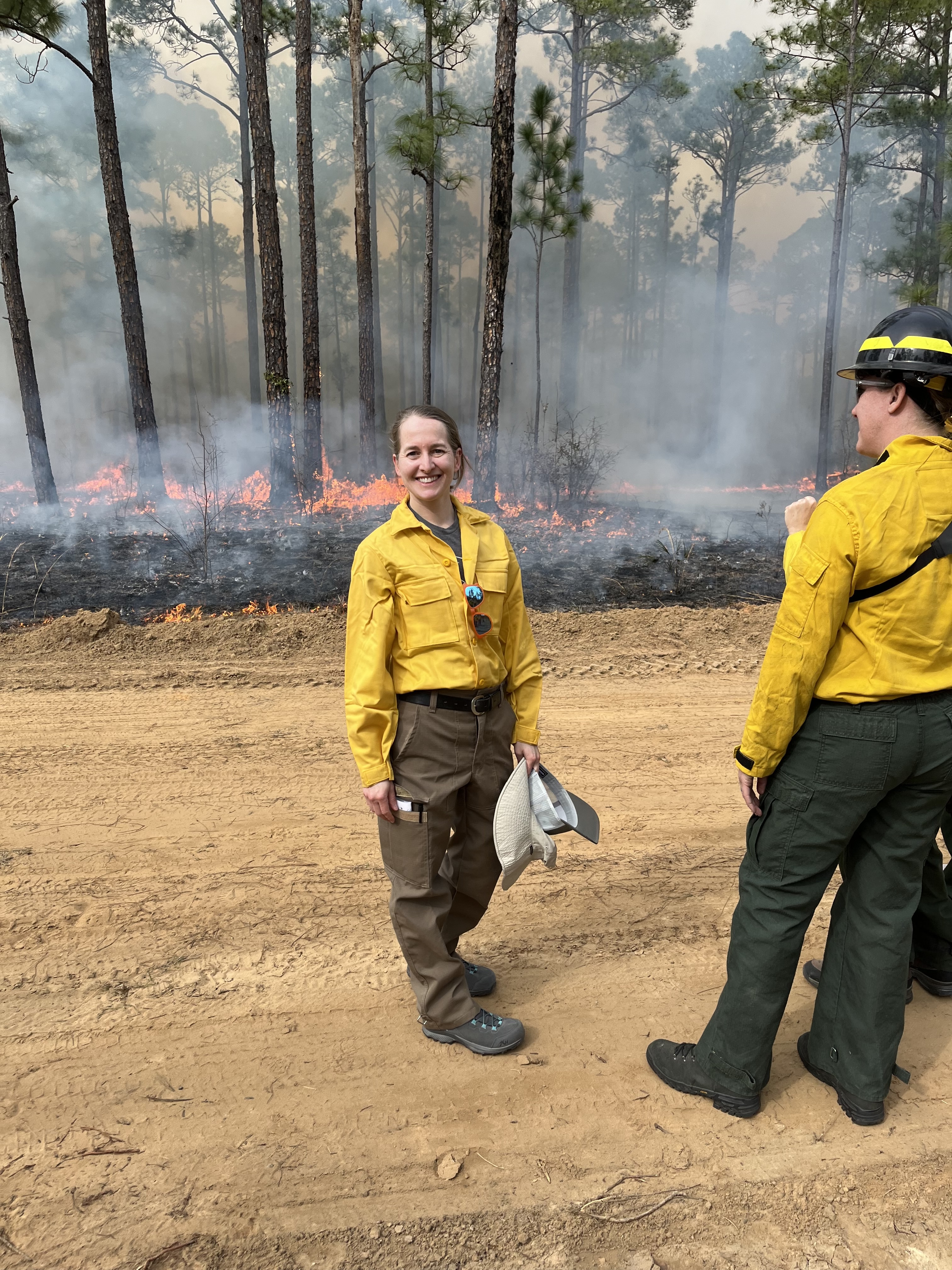
Jacquelyn Shuman visually assesses a prescribed fire at Ft. Stewart in Georgia, working with partner organizations as part of the Department of Defense Ft. Stewart 2024 Fire Research Campaign.
USFS/Linda Chappell

Jacquelyn Shuman, FireSense Project Scientist at NASA Ames Research Center, originally wanted to be a veterinarian. By the time she got to college, Shuman had switched interests to biology, which became a job teaching middle and high school science. Teaching pivoted to finance for a year, before Shuman returned to the science world to pursue a PhD.

It was in a forest ecology class taught by her future PhD advisor, Herman “Hank” Shugart, that she first discovered a passion for ecosystems and dynamic vegetation that led her into the world of fire science, and eventually to NASA Ames.

While Shuman’s path into the world of fire science was not a direct one, she views her diverse experiences as the key to finding a fulfilling career. “Do a lot of different things and try a lot of different things, and if one thing isn’t connecting with you, then do something different,” Shuman said.

Diving into the World of Fire

Shuman’s PhD program focused on boreal forest dynamics across Russia, examining how the forest changes in response to climate change and wildfire. During her research, she worked mainly with scientists from Russia, Canada, and the US through the Northern Eurasia Earth Science Partnership Initiative (NEESPI), where Shugart served as the NEESPI Chief Scientist. “The experience of having a highly supportive mentor, being a part of the NEESPI community, and working alongside other inspiring female scientists from across the globe helped me to stay motivated within my own research,” Shuman said.

After completing her PhD, Shuman wanted to become involved in collaborative science with a global impact, which led her to the National Center for Atmospheric Research (NCAR). There, she spent seven years working as a project scientist on the Next Generation Ecosystem Experiment NGEE-Tropics) on a dynamic vegetation model project called FATES (Functionally Assembled Terrestrial Ecosystem Simulator). As part of the FATES team, Shuman used computer modeling to test vegetation structure and function in tropical and boreal forests after wildfires, and was the lead developer for updating the fire portion of the model.

The frame is split into four horizontal banners, each of which show a cross-section of the tropical latitudes of the world: South America, Africa, SouthEast Asia, and Australia. Color spectrums on each are strongest in a line across Northern Africa, in various shades of black, red, orange, and yellow. The bottom banner is shades of lilac and periwinkle.
This figure shows fire characteristics from an Earth system model that uses vegetation structure and interactive fire. The FATES model captures the fire intensity associated with burned land and grass growth in the Southern Hemisphere.
Shuman et al. 2024 GMD

Fire has also played a powerful role in Shuman’s personal life. In 2021, the Marshall Fire destroyed neighborhoods near her hometown of Boulder, Colorado, causing over $513 million of damage and securing its place as the state’s most destructive wildfire. Despite this, Shuman is determined to not live in fear. “Fire is part of our lives, it’s a part of the Earth system, and it’s something we can plan for. We can live more sustainably with fires.” The way to live safely in a fire-inclusive ecosystem, according to Shuman, is to develop ways to accurately track and forecast wildfires and smoke, and to respond to them efficiently: efforts the fire community is continuously working on improving.

The Fire Science Community

Collaboration is a critical element of wildland fire management. Fire science is a field that involves practitioners such as firefighters and land managers, but also researchers such as modelers and forecasters; the most effective efforts, according to Shuman, come when this community works together. “People in fire science might be out in the field and carrying a drip torch and marching along in the hilltops and the grasslands or be behind a computer and analyzing remote sensing data,” Shuman said. “We need both pieces.”

Protecting communities from wildfire impacts is one of the most fulfilling aspects of Shuman’s career, and a goal that unites this community. “Fire research poses tough questions, but the people who are thinking about this are the people who are acting on it,” Shuman said. “They are saying, ‘What can we do? How can we think about this? What information do we need? What are the questions?’ It’s a special community to be a part of.”

Looking to the Future of Fire

Currently at NASA Ames Research Center, Shuman is the Project Scientist for FireSense: a project focused on delivering NASA science and technology to practitioners and operational agencies. Shuman acts as the lead for the project office, identifying and implementing tools and strategies. Shuman still does ecosystem modeling work, including implementing vegetation models that forecast the impact of fire, but also spends time traveling to active fires across the country so she can help partners implement NASA tools and strategies in real time.

A white woman in a blue jacket and jeans stands next to a white man in a black sweatshirt and green pants, looking out over a valley. They stand on brown dirt, and the sky in front of them is clear and blue, the mountains a darker shade of blue and purple.
FireSense Project Scientist Jacquelyn Shuman stands with Roger Ottmar (United States Forest Service), surveying potential future locations for prescribed burns in Fishlake National Forest.
NASA Ames/Milan Loiacono

“Right now, many different communities are all recognizing that we can partner to identify the best path forward,” Shuman said. “We have an opportunity to use everyone’s strengths and unique perspectives. It can be a devastating thing for a community and an ecosystem when a fire happens. Everyone is interested in using all this collective knowledge to do more, together.”

Written by Molly Medin, NASA Ames Research Center

Share

Details

Last Updated

Oct 17, 2024

Powered by WPeMatico

Get The Details…
Milan Loiacono

Iowa Students to Connect with NASA Astronaut Aboard Space Station

Iowa Students to Connect with NASA Astronaut Aboard Space Station

NASA astronaut and Expedition 72 Flight Engineer Nick Hague in the space station cupola. (Credit: NASA)

Students from Iowa will have the opportunity to hear NASA astronaut Nick Hague answer their prerecorded questions while he’s serving an expedition aboard the International Space Station on Monday, Oct. 21.

Watch the 20-minute space-to-Earth call at 11:40 a.m. EDT on NASA+. Students from Iowa State University in Ames, First Robotics Clubs, World Food Prize Global Youth Institute, and Plant the Moon teams will focus on food production in space. Learn how to watch NASA content on various platforms, including social media.

Media interested in covering the event must contact Angie Hunt by 5 p.m., Friday, Oct.18 at amhunt@iastate.edu or 515-294-8986.

For more than 23 years, astronauts have continuously lived and worked aboard the space station, testing technologies, performing science, and developing skills needed to explore farther from Earth. Astronauts aboard the orbiting laboratory communicate with NASA’s Mission Control Center in Houston 24 hours a day through SCaN’s (Space Communications and Navigation) Near Space Network.

Important research and technology investigations taking place aboard the space station benefit people on Earth and lays the groundwork for other agency missions. As part of NASA’s Artemis campaign, the agency will send astronauts to the Moon to prepare for future human exploration of Mars; inspiring Artemis Generation explorers and ensuring the United States continues to lead in space exploration and discovery.

See videos and lesson plans highlighting space station research at:

https://www.nasa.gov/stemonstation

-end-

Abbey Donaldson
Headquarters, Washington
202-358-1600
Abbey.a.donaldson@nasa.gov

Sandra Jones 
Johnson Space Center, Houston
281-483-5111
sandra.p.jones@nasa.gov

Powered by WPeMatico

Get The Details…
Abbey A. Donaldson