30 Years On, NASA’s Wind Is a Windfall for Studying our Neighborhood in Space

30 Years On, NASA’s Wind Is a Windfall for Studying our Neighborhood in Space

5 min read

30 Years On, NASA’s Wind Is a Windfall for Studying our Neighborhood in Space
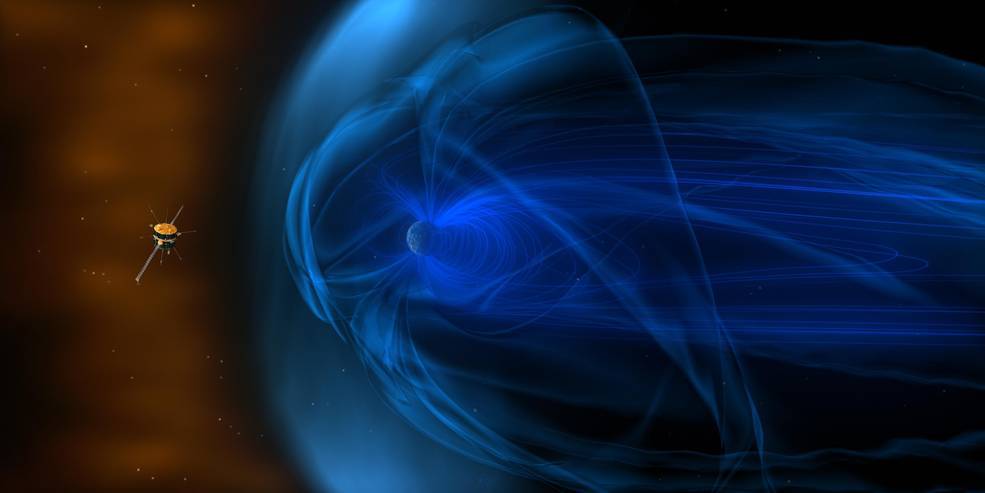
An artist's concept of the Wind spacecraft shows the spacecraft on the left outside Earth's magnetosphere, shown as a blue bubble extending around Earth.
An artist’s concept of NASA’s Wind spacecraft outside of Earth’s magnetosphere.
NASA

Picture it: 1994. The first World Wide Web conference took place in Geneva, the first Chunnel train traveled under the English Channel, and just three years after the end of the Cold War, the first Russian instrument on a U.S. spacecraft launched into deep space from Cape Canaveral. The mission to study the solar wind, aptly named Wind, held promise for heliophysicists and astrophysicists around the world to investigate basic plasma processes in the solar wind barreling toward Earth — key information for helping us understand and potentially mitigate the space weather environment surrounding our home planet.

Thirty years later, Wind continues to deliver on that promise from about a million miles away at the first Earth-Sun Lagrange Point (L1). This location is gravitationally balanced between Earth and the Sun, providing excellent fuel economy that requires mere puffs of thrust to stay in place.

According to Lynn Wilson, who is the Wind project scientist at NASA’s Goddard Space Flight Center in Greenbelt, Maryland, fuel is only one indicator of Wind’s life expectancy, however. “Based on fuel alone, Wind can continue flying until 2074,” he said. “On the other hand, its ability to return data hinges on the last surviving digital tape recorder onboard.” 
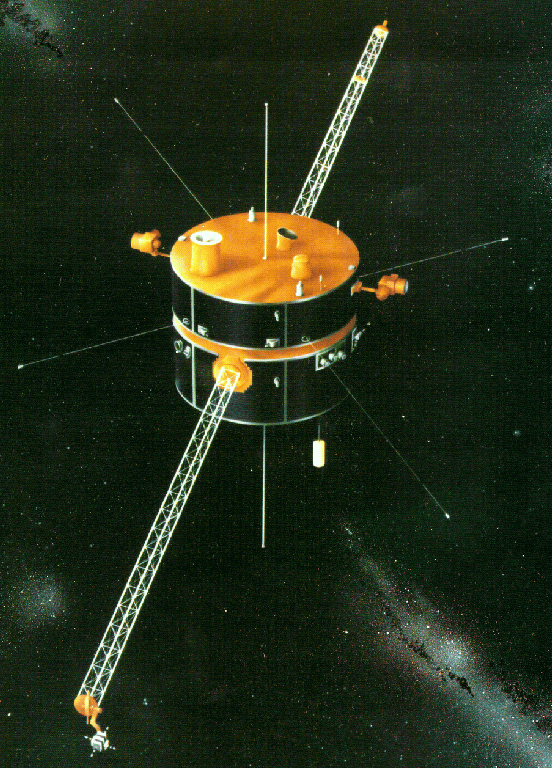
Illustration shows Wind as a cylindrical spacecraft with antennae and other instruments extending from it.
An artist’s concept shows a closeup of the Wind spacecraft.
NASA

Wind launched with two digital tape recorders to record data from all the instruments on the spacecraft and provide reports on the spacecraft’s thermal conditions, orientation, and overall health. Each recorder has two tape decks, A and B, which Wilson affectionately refers to as “fancy eight-tracks.”

After six years of service, the first digital tape recorder failed in 2000 along with its two tape decks, forcing mission operators to switch to the second one. Tape Deck A on that one started showing signs of wear in 2016, so the mission operators now use Tape Deck B as the primary deck, with A as a backup.  

“They built redundancy into the digital tape recorder system by building two of them, but you can never predict how technology will perform when it’s a million miles away, bathing in ionizing radiation,” said Wilson. “We’re fortunate that after 30 years, we still have two functioning tape decks.”
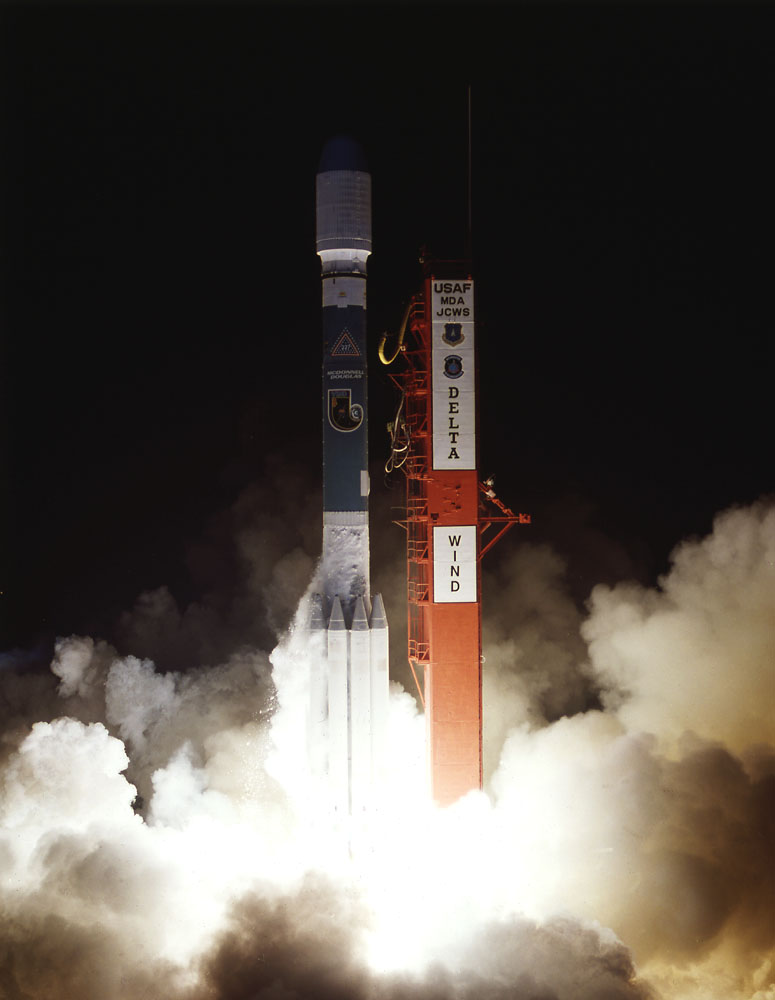
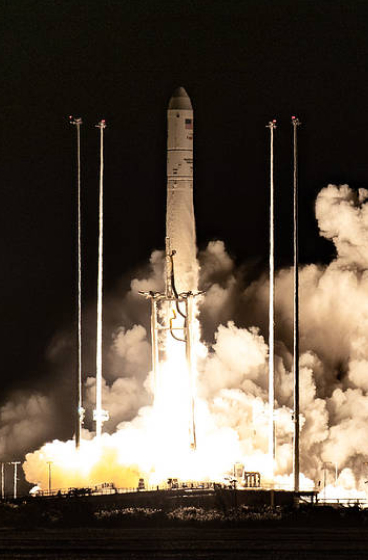
A rocket is seen launching with a large plume of smoke beneath it. Next to the rocket, the orange launch tower has placards of text reading “USAF MDA JCWS,” “DELTA,” and “WIND.”
Wind launched on Nov. 1, 1994, on a Delta IV rocket from Cape Canaveral Air Force Station in Florida.
NASA

Bonus Science

When Wind launched on Nov. 1, 1994, nobody could have possibly predicted that exactly 30 years later, NASA would be kicking off “Bonus Science” month in the Heliophysics Big Year. Beyond the mission’s incredible track record of mesmerizing discoveries about the solar wind — some detailed on its 25th anniversary — Wind continues to deliver with bonus science abound.

Opportunity and Collaborative Discovery

Along its circuitous journey to L1, Wind dipped in and out of Earth’s magnetosphere more than 65 times, capturing the largest whistler wave — a low-frequency radio wave racing across Earth’s magnetic field — ever recorded in Earth’s Van Allen radiation belts. Wind also traveled ahead of and behind Earth — about 150 times our planet’s diameter in both directions, informing potential future missions that would operate in those areas with extreme exposure to the solar wind. It even took a side quest to the Moon, cruising through the lunar wake, a shadow devoid of solar wind on the far side of the Moon.

Later, from its permanent home at L1, Wind was among several corroborating spacecraft that helped confirm what scientists believe is the brightest gamma-ray burst to occur since the dawn of human civilization. The burst, GRB 221009A, was first detected by NASA’s Fermi Gamma-ray Space Telescope in October 2022. Although not in its primary science objectives, Wind carries two bonus instruments designed to observe gamma-ray bursts that helped scientists confirm the burst’s origin in the Sagitta constellation.

Academic Inspiration

More than 7,200 research papers have been published using Wind data, and the mission has supported more than 100 graduate and post-graduate degrees.

Wilson was one of those degree candidates. When Wind launched, Wilson was in sixth grade, on the football, baseball, and wrestling teams, with spare time spent playing video games and reading science fiction. He had a knack for science and considered becoming a medical doctor or an engineer before committing to his love of physics, which ultimately led to his current position as Wind’s project scientist. While pursuing his doctorate, he worked with Adam Szabo who was the Wind project scientist at NASA Goddard at the time and used Wind data to study interplanetary collisionless shock waves. Szabo eventually hired Wilson to work on the Wind mission team at Goddard.

Also in sixth grade at the time, Joe Westlake, NASA Heliophysics division director, was into soccer and music, and was a voracious reader consumed with Tolkein’s stories about Middle Earth. Now he leads the NASA office that manages Wind.

“It’s amazing to think that Lynn Wilson and I were in middle school, and the original mission designers and scientists have long since retired,” said Westlake. “When a mission makes it to 30 years, you can’t help but be inspired by the role it has played not only in scientific discovery, but in the careers of multiple generations of scientists.”

By Erin Mahoney
NASA Headquarters, Washington

Keep Exploring

Discover More Topics From NASA

Powered by WPeMatico
Get The Details…

Station Nation: Meet Carlos Fontanot, the Imagery Manager Leaving a Legacy of Visual Storytelling 

Station Nation: Meet Carlos Fontanot, the Imagery Manager Leaving a Legacy of Visual Storytelling 

Born and raised in Mexico City, Carlos Fontanot has dedicated 34 years to NASA. He supports the International Space Station Mission Integration and Operations Office, ensuring that high-quality imagery enhances mission objectives and operations.  

Fontanot is known for conceiving and leading the High Definition Earth Viewing (HDEV) project, which has brought stunning live visuals of Earth to millions around the globe. As he approaches his well-deserved retirement, we are excited to spotlight Fontanot’s remarkable career, celebrating his contributions to NASA and the lasting impact he has made on the agency’s mission to share the wonders of space. 

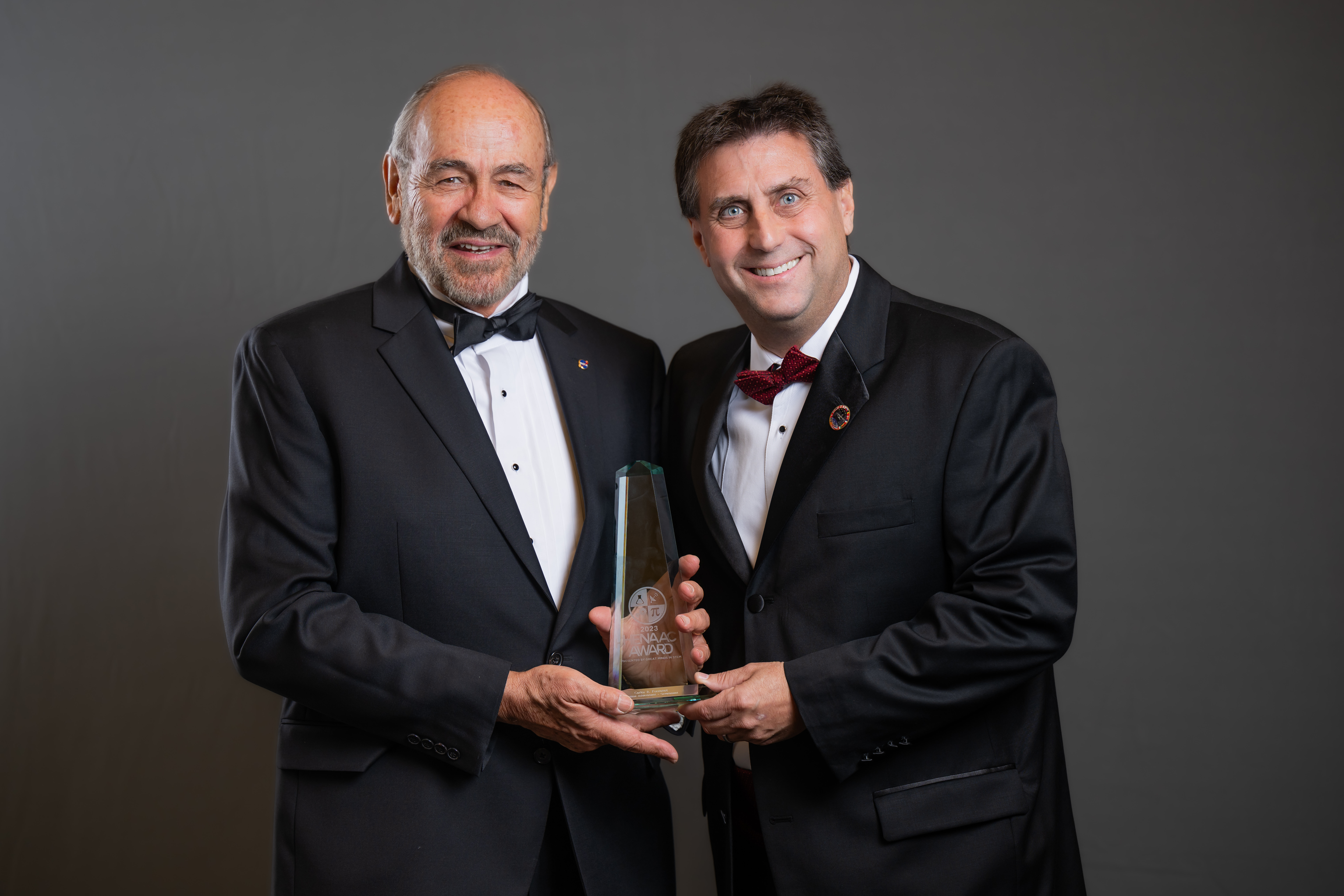
Carlos Fontanot receives a glass award from Joel Montelbano.
Carlos Fontanot (left) receives the Great Minds in STEM Lifetime Achievement Award from Joel Montelbano, NASA at the Hispanic Engineer National Achievement Award Conference.

What does your position entail? 

Integrate all aspects of station imagery, from initial requirements to acquisition, processing, cataloging, archiving, and distribution of station imagery to multiple stakeholders, our clients.  

How would you describe your job to family or friends who may not be as familiar with NASA? 

I manage an array of television and digital still imagery cameras on the International Space Station. Each day we receive eight channels of high definition (HD) video and thousands of digital images that allow the ground team to see what the crew is doing in their daily lives and as part of scientific activities. In today’s age of social media and high-quality imagery, having these images is crucial for effectively conveying the station narrative. 

I also chair the International Space Station’s Multilateral Imagery Working Group. Our team captures and processes the video and still images on a large server, where they are cataloged, archived, and distributed to our clients. Additionally, we are responsible for the photo and TV hardware aboard the space station and provide training to astronauts on how to use this equipment. 

Carlos Fontanot with Liam Kennedy at the International Space Station Research and Development Conference.

How do you feel the imagery and public affairs teams contribute to the overall mission of NASA? 

Imagery is critical for communication in today’s visual environment. If people can’t see it, they won’t believe it! Effective communication through multimedia and pointed messaging is essential for securing continued support for NASA missions from both Congress and the public. 

What was your path to NASA? 

I was always interested in photography and film, so I studied radio, TV, and film in college. My first job after graduation was with a local TV station, and I also managed a media center for a multinational company. Then, I joined Johnson Space Center’s television and film division, where I managed space shuttle and institutional imagery. 

Once at Johnson, I worked in the Office of Public Affairs as the audiovisual manager and served for two years as the public affairs officer in Moscow at the start of the International Space Station Program, including the launch of the first station crew. 

What advice would you give to young individuals aspiring to work in the space industry or at NASA? 

NASA is not just about astronauts, flight controllers, and engineers—there are countless disciplines and job opportunities here. Take imagery, for example: in today’s digital age, having the highest resolution imagery of our incredible orbiting laboratory environment and our home planet is essential. 

For those aspiring to join the NASA team, I encourage you be open-minded and a team player. We need well-educated and talented individuals from diverse backgrounds across all disciplines to help us achieve our goals and explore the wonders of space. 

Is there a space figure you’ve looked up to? 

The space figure I will always remember and look up to is John Glenn. I had the fortune and privilege to meet him during his training. He was an extraordinary human being with incredibly high goals throughout his career. 

I was assigned to escort John Glenn and the STS-95 crew on a two-week official visit to several European countries. John was by far the most inspiring and dedicated crew member that I’d ever met. He was always ready and willing to engage with dignitaries, politicians, leaders, journalists, and the public to share the NASA story and promote future programs to gain support from various governments and the public. 

What do you love sharing about the International Space Station to general audiences? 

I love sharing the wonders of life in space, especially the unique and breathtaking views of our planet Earth that can only be appreciated from space. I like to tell audiences about the observations and inspiration our astronauts share upon returning from their missions. I emphasize our thin and fragile atmosphere that sustains life as we know it, the beauty of Earth’s deserts, mountains, jungles, and oceans, and most importantly, the absence of borders. There’s always a profound realization that we are all human and that Earth belongs to all of us. 

How has the technology for capturing images and video in space evolved over the years? 

There was no digital imagery when I started my professional career. Photographs were taken on film that had to be processed in a dark room using chemicals to produce images. Video was recorded on two-inch magnetic tape at low resolution. We even flew film on our spacecraft that had to be brought back and processed on the ground. 

Today, in the digital world, images can be streamed directly from our spacecraft and almost instantaneously shared with the entire globe. The evolution of technology has truly transformed how we capture and share the wonders of space! 

Carlos Fontanot works to install an imagery display in Houston early in his career.
Carlos Fontanot (left) sets up a NASA imagery exhibit in the Houston Downtown Tunnel System.

What are some of the key projects you’ve worked on during your time at NASA? What have been your favorites? 

During my time at NASA, I co-led the High Definition Earth Viewing (HDEV) project, which deployed four Earth-viewing cameras on the International Space Station, reaching over 318 million viewers globally. I also contributed to designing Johnson’s new PAO studio, collaborated on upgrading the space station’s downlink system from four standard-definition to eight high-definition channels, and advanced television technology, including the first HD and later UHD live downlinks from the station. These projects have allowed me to enhance NASA’s capacity for sharing space imagery with the world. 

What are your plans for retirement, and how do you hope to stay connected to the space community? 

I plan to travel across the U.S. in a travel trailer with my wife and dog and enjoying my hobbies I will now have time for, such as photography and spending quality time with my family.

Carlos Fontanot explores the Grand Canyon with his wife, Pat.
Carlos and Pat Fontanot at the Grand Canyon South Rim in Arizona.

 How do you believe NASA’s imagery can continue to inspire future generations? 

Astronaut John Young would come to the photo lab after every shuttle mission to review the film shot onboard. He would say, “A picture is worth a thousand words.” What can inspire more than a breathtaking image of a sunset captured from space or the aurora borealis over the polar regions? 

What legacy do you hope to leave behind after your time at NASA? 

I hope to leave behind a legacy of passion and dedication to acquiring and making pristine, high-resolution imagery from space available for the public to enjoy. 

If you could have dinner with any astronaut, past or present, who would it be? 

I would choose John Young. He flew during both the Apollo and shuttle eras, was an imagery expert, and had a deep understanding of the space station. 

Favorite space movie? 

Interstellar   

NASA Worm or Meatball logo? 

Worm   

*** 

Every day we are conducting exciting research aboard our orbiting laboratory that will help us explore farther into space and bring benefits back to people on Earth. You can keep up with the latest news, videos, and pictures about space station science on the Station Research & Technology news page. It is a curated hub of space station research and digital media from Johnson and other centers and space agencies. 

Sign up for our weekly email newsletter to get the updates delivered directly to you. 

Follow updates on social media at @ISS_Research on X, and on the space station accounts on Facebook and Instagram

Powered by WPeMatico

Get The Details…
Linda E. Grimm

NASA Ames Recognizes Representative Eshoo for Her 32 Years of Service

NASA Ames Recognizes Representative Eshoo for Her 32 Years of Service

Dr. Eugene Tu, center director at NASA’s Ames Research Center in California’s Silicon Valley, presents Representative Anna Eshoo with a replica of the Pioneer plaque during a recognition event for her 32 years of public service.
NASA/Brandon Torres Navarrete

On Oct. 29, NASA’s Ames Research Center in California’s Silicon Valley hosted a gathering to recognize Representative Anna G. Eshoo for her 32 years of distinguished public service and her enduring support for the agency. During the event, Dr. Eugene Tu, center director at Ames, presented the Congresswoman with the Pioneer plaque, a replica of the messages sent on the Pioneer 10 and 11 probes, which launched in 1972 and 1973 respectively.

Powered by WPeMatico

Get The Details…
Abby Tabor

I am Artemis: Lane Polak

I am Artemis: Lane Polak

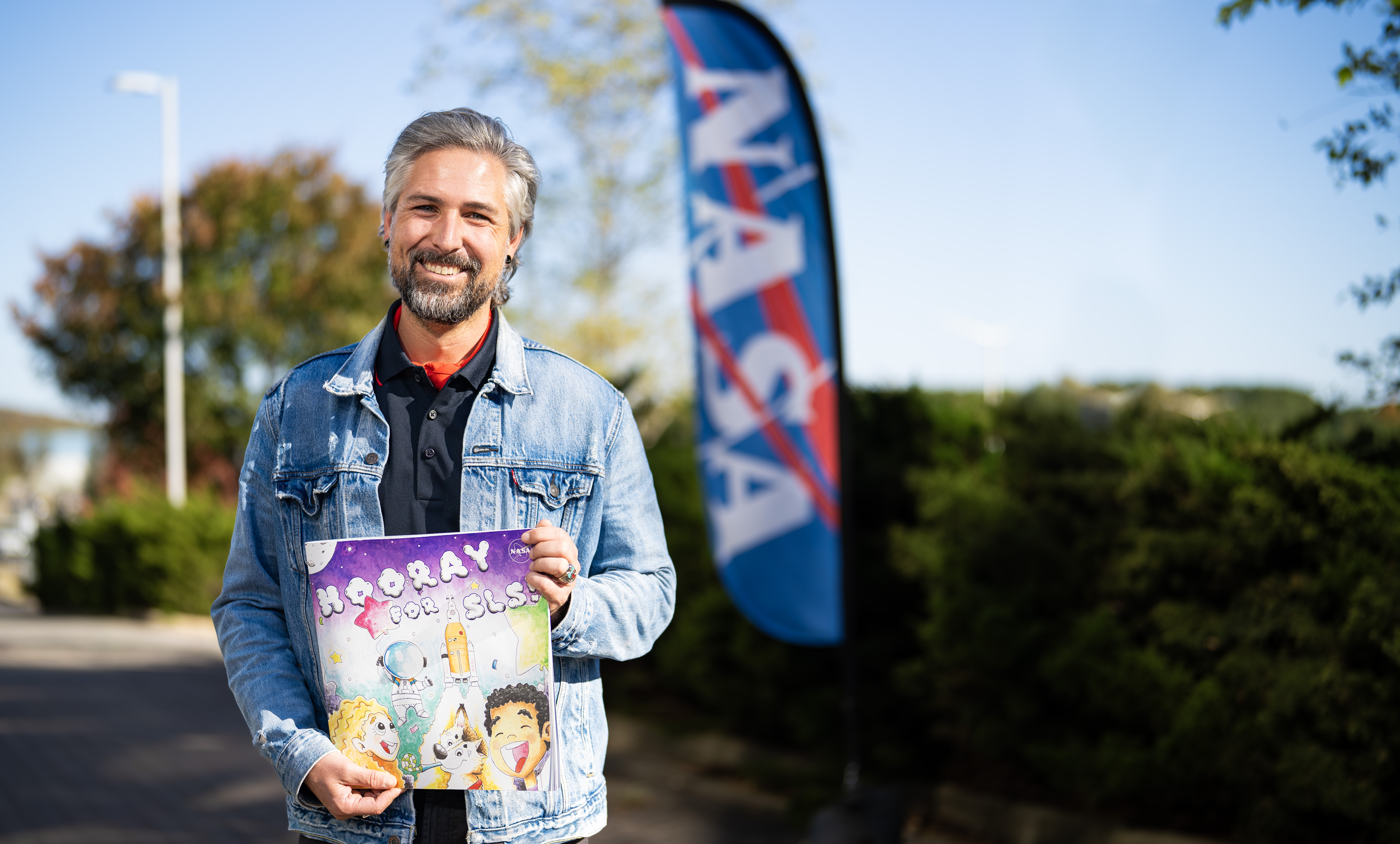
I Am Artemis: Lane Polak is a technical writer for NASA’s SLS (Space Launch System), where he is responsible for creating content that raises public awareness of NASA and specifically SLS.
Lane Polak is a technical writer for NASA’s SLS (Space Launch System), where he is responsible for creating content that raises public awareness of NASA and specifically SLS.
NASA/Samuel Lott

Growing up, Lane Polak didn’t have much interest in space. Instead, he was busy writing stories, doodling, or riding his skateboard. He later dreamed of becoming an author but also considered stepping into the arena as an American Gladiator.

After earning a degree in communications with a minor in English from the University of Alabama in Huntsville, Polak chose to embrace his passion for storytelling and continued his path toward technical writing.

Fast forward 14 years and Polak is now a technical writer for NASA’s SLS (Space Launch System); a dream he never knew he had. In his current role at the agency’s Marshall Space Flight Center in Huntsville, Alabama, he is responsible for creating content that raises public awareness of NASA and specifically SLS. He also assists with outreach programs and supports exhibits, but it’s the opportunity to engage with the community, especially children, that he finds most rewarding.

“I believe a child’s development is one of the most amazing wonders in this world,” Polak said. “As a father, I love watching my two boys progress and learn new things, but I’ve always had a passion for helping children take their own giant leaps. That’s another great thing about creating – there is always a new idea to build on and explore.”

One way Polak has made his mark with the agency is through a series of children’s books designed to inspire the youngest members of the Artemis Generation. His first book, “Hooray for SLS!”, invites young readers on a journey to learn all about the SLS Moon rocket. With catchy writing and colorful illustrations, he captures the wonder of space exploration, making learning about the Artemis campaign both fun and engaging. It’s a celebration of curiosity and adventure, showing children just how exciting the journey to the Moon and Mars can be.

Working with NASA has transformed Polak’s perspective on collaboration and the power of storytelling in science. “After just a few months at NASA, I found myself completely captivated by space and the incredible projects and opportunities unfolding daily,” he said. “Being part of the Artemis Generation isn’t just a job for me; it’s a privilege. I have the opportunity to inspire future generations while contributing to humanity’s quest for deep space exploration. One of the many things my position allows me to do is help others see the scale of this amazing agency, all the work people are doing, and that there truly is a place for anyone here.”

Outside of work, Polak stays busy coaching youth sports, mountain biking, and spending quality time with his family. He and his wife Emily also enjoy buying and selling vintage clothing. Whether it’s creating new stories for kids or finding the next great idea to explore, he embraces the endless possibilities of creation.

Read other I am Artemis features.

Powered by WPeMatico

Get The Details…
Lee Mohon

What’s Up: November 2024 Skywatching Tips from NASA

What’s Up: November 2024 Skywatching Tips from NASA

See the Moon Hide a Bright Star

In the early morning hours of November 27, catch a rare lunar occultation of Spica visible from parts of the U.S. and Canada.

Skywatching Highlights

  • All month – Planet visibility report: Saturn shines in the south most of the night, Jupiter rises in the early evening alongside Taurus and Orion, while Mars trails a couple of hours behind, visible high in the early morning sky.
  • November 4 – Slim crescent Moon pairs with Venus. Enjoy a beautiful sight just after sunset as the Moon and Venus meet up in the southwestern sky.
  • November 10 – Saturn & the Moon. The ringed planet has a close pairing with the Moon tonight (perfect for binoculars)
  • November 27 – Lunar occultation of Spica. Early risers in the eastern U.S. and Canada can catch the Moon passing in front of Spica this morning, briefly hiding the bright star from view.

Transcript

What’s Up for November?

When to look for Saturn, Jupiter, and Mars this month, a NASA spacecraft swings by Venus on its way to the Sun, and the tricky business of seeing the Moon hide a bright star. And stick around until the end for photos of highlights from last month’s skies.

Saturn is visible toward the south for most of the night. For observers in the Americas, it has a close meetup with the Moon on the 10th, when the pair will appear less than a degree apart just after dark, making for a great sight through binoculars. Check the sky again around midnight, and you’ll see the Moon has visibly shifted a couple of degrees west of Saturn, showing evidence of the Moon’s orbital motion in just a few hours.

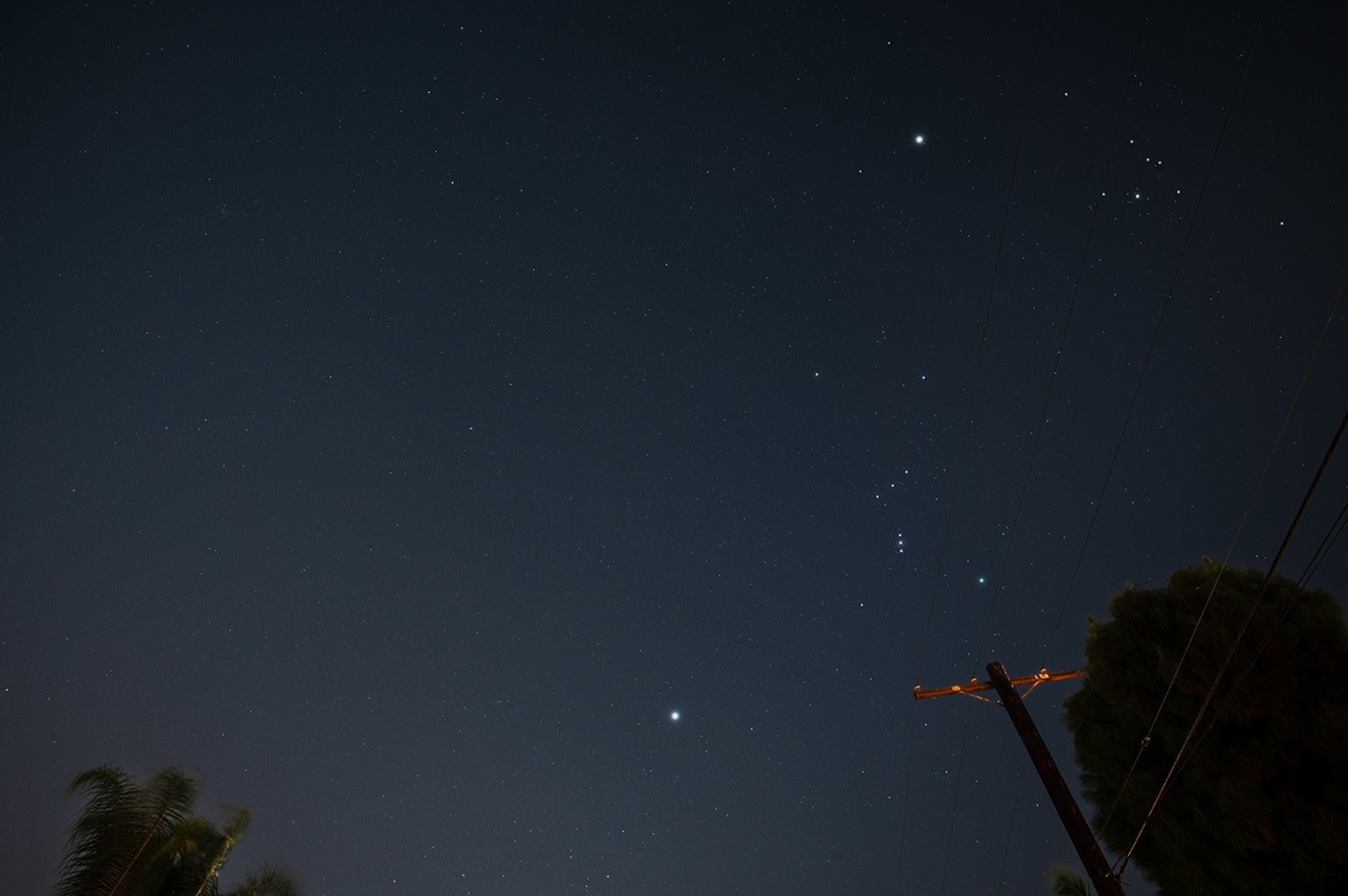
Planet Jupiter shines bright in the night sky above Orion.
In late 2024, Jupiter could be found high overhead as dawn approached with the bright stars of Taurus and Orion. (Jupiter is the bright object at top, right of center.)
NASA/Preston Dyches

Jupiter is rising in the east early in the night, together with the bright stars of the constellations Taurus and Orion, and working its way across the sky by dawn. By the end of November, it’s rising just as the sky is getting dark. Mars follows behind Jupiter, rising about three hours after the giant planet.

As in October, early risers will find the Red Planet high overhead in the morning sky before dawn. In the evening sky, Venus is low in the southwest following sunset throughout the month of November. It’s blazing bright and unmistakable if you find a relatively unobstructed view. It appears much higher in the sky for those in the Southern Hemisphere, who’ll also be able to easily observe Mercury after sunset this month. And on the 4th, a slim crescent Moon will appear just below Venus for a beautiful pairing as the glow of sunset fades.

Now, staying with Venus, one of NASA’s intrepid solar system explorers is headed for a close encounter with this Earth-sized hothouse of a planet on November 6th. Parker Solar Probe studies our planet’s nearest star, the Sun. Its mission is to trace the flow of energy that heats the Sun’s outer atmosphere and accelerates the million-mile-per-hour stream of particles it emits. It makes its measurements from super close to the Sun, within the region where all the action happens. To do this, the spacecraft was designed to fly within just 4 million miles of the Sun’s surface, which is 10 times closer than the orbit of the closest planet, Mercury. No other spacecraft has ever gotten this close to the Sun before. In the six years since its launch, the spacecraft has made a bunch of approaches to the Sun, using flybys of the planet Venus to shape its orbit. The November 6th flyby is the final such maneuver, intended to send the spacecraft toward its three closest-ever solar approaches, starting on December 24th. During this last Venus flyby, the mission will capture images of the planet. Previous views returned by Parker showed that the spacecraft could actually see features of the Venusian surface through its dense cloud cover. So look out for Venus in the evening sky, as the brilliant planet helps a craft from Earth to touch the face of the Sun.

In the couple of hours before sunrise on November 27th, skywatchers in the eastern half of the U.S. and Canada will have the chance to witness an occultation – an event where the Moon passes in front of, and temporarily hides, a bright star – in this case Spica. Observers in other parts of the world will see the Moon pass extremely close to Spica, but won’t see it cover up the star. This occultation is one of a series that began in June and will continue monthly through late next year. These happen as the Moon’s orbit slowly shifts northward and southward across the sky, and every so often, its path crosses in front of Spica monthly for a time. But each occultation is only visible from a small portion of Earth. For example, while this November event favors North American viewers, South American observers will get their chance next April. For U.S. skywatchers, this November occultation is the last good opportunity in this series to see the Moon occult Spica until 2032, when a new series of monthly occultations will begin for locations across the globe. Now, if you miss this event, don’t worry!

The Moon also passes in front of three other bright stars from time to time. This means that no matter where you’re located, you’ll have the opportunity before too long to witness the impressive sight of a bright star briefly disappearing behind the Moon.

Watch our video for views of what some of the highlights we told you about in last month’s video actually looked like.

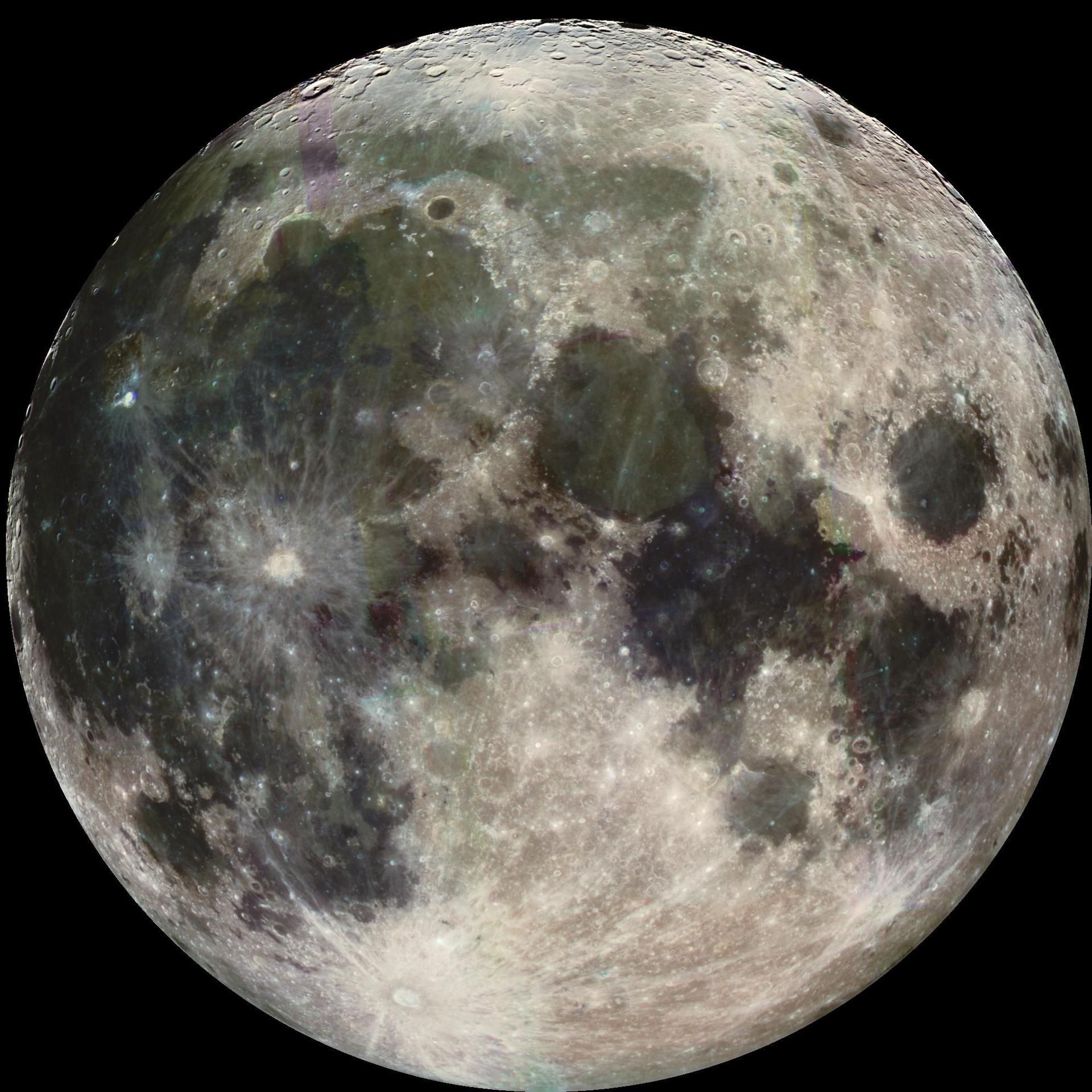
Four images of Earth's Moon against a black background showing the parts visible during the month of November on the 1st, 9th, 15th, and 22.
The phases of the Moon for November 2024.
NASA/JPL-Caltech

Above are the phases of the Moon for November.

Stay up to date on all of NASA’s missions exploring the solar system and beyond at science.nasa.gov.

I’m Preston Dyches from NASA’s Jet Propulsion Laboratory, and that’s What’s Up for this month.

Powered by WPeMatico

Get The Details…