NASA Ames Stars of the Month: November 2024

NASA Ames Stars of the Month: November 2024

The NASA Ames Science Directorate recognizes the outstanding contributions of (pictured left to right) Forrest Melton, Ariel Deutsch, Dan Sirbu, and Chanel Idos. Their commitment to the NASA mission represents the entrepreneurial spirit, technical expertise, and collaborative disposition needed to explore this world and beyond.

Forrest Melton fixes an instrument in the field as part of OpenET.

Earth Science Star: Forrest Melton

Forrest Melton serves as Senior Research Scientist with the Atmospheric Science Branch, and leads the OpenET consortium, which develops a unique satellite-driven support system for water resources management using six satellite-driven models and publicly available data from NASA, USGS and NOAA. OpenET currently provides data for 23 states in the western U.S., delivers data at daily, monthly, seasonal and annual timescales, and has become a necessary tool for domestic and international water managers and agricultural producers (feature story).

Space Science & Astrobiology Star: Ariel Deutsch

Ariel Deutsch is an early career planetary scientist in the Planetary Systems Branch for the Bay Area Environmental Research Institute. She is recognized for being invited to join the Artemis II Science Team to support the Artemis II Lunar Science Objectives.  Her Lunar Data Analysis Program grant was selected to improve our understanding of the distribution and abundance of volatiles cold-trapped on the Moon, which include Artemis III candidate landing sites.

Dan Sirbu

Space Science & Astrobiology Star: Dan Sirbu

Dan Sirbu is a key member of the Exoplanet Technologies group within the Astrophysics Branch. He currently serves as the principal investigator on the Photonic Integrated Circuit High-Contrast Imaging for Space Astronomy (AstroPIC) early career initiative, serves multiple roles on the Multi-Star Wavefront Control (MSWC) project, and is involved in outreach efforts. In recent months, Dan has been the primary operator performing MSWC testing, setting several new performance records demonstrating high contrast imaging of planets around binary stars. Dan’s work also advances NASA’s and humanity’s capability of imaging exoplanets in multi-star systems, including Alpha Centauri, the nearest star system to the Sun.

Space Biosciences Star: Chanel Idos

Chanel Idos serves as the ARC Resource Analyst for the Human Research Program (HRP) in the Space Biosciences Division. HRP is a multifaceted initiative encompassing six Elements and Offices at JSC and three Divisions across two Directorates at ARC. Her exceptional expertise, coupled with outstanding organizational skills and clear, effective communication, have been instrumental in ensuring the seamless operation of HRP activities at ARC. Chanel’s contributions have been pivotal in achieving excellent cost performance for FY24, positioning ARC to enter FY25 in an optimal state.

Powered by WPeMatico

Get The Details…
Aaron McKinnon

Station Science Top News: Nov. 22, 2024

Station Science Top News: Nov. 22, 2024

Space-grown crystals could lead to targeted cancer drugs

Researchers used space-grown protein crystals to determine the structure of a helix-loop-helix (HLH) peptide (one with a double helix and connecting loop) in a complex with vascular endothelial growth factor-A (VEGF). VEGF prompts the formation of new blood vessels and inhibiting it can stop tumor growth. This finding suggests that HLH peptides could be used to create drugs to target disease-related proteins like VEGF.

JAXA PCG, an investigation from JAXA (Japan Aerospace Exploration Agency), grew protein crystals in microgravity and returned them to Earth for detailed analysis of their structures. Microgravity enables production of high-quality crystals, and examining their structures supports the design of new drugs and other types of research.

Japan Aerospace Exploration Agency astronaut Soichi Noguchi works on the PCG experiment aboard the International Space Station.
NASA

Wood could make satellites more sustainable

Wood exposed to space for approximately 10 months showed no change in weight and no erosion due to atomic oxygen. This finding could inform selection of the appropriate species and thickness of wood for use in building satellites.

Metal satellites reentering Earth’s atmosphere can generate particles and aerosols that may harm the ozone layer. Wood becomes water and carbon dioxide on reentry, does not contribute to atmospheric pollution, and could provide a more sustainable option for future space exploration. JAXA’s Exposure of Wood to Outer Space evaluated how atomic oxygen, galactic cosmic rays, and solar energetic particles in space affect the mechanical properties of wood.

Six samples of different wood types are pictured on a white tabletop.
Different types of wood to be tested in space as a building material for satellites.
Kyoto University

Analyzing glass-forming ability of magnesium silicates

Researchers report detailed structural and atomic information for glassy and liquid magnesium silicates, which are important in glass science and geoscience. The results suggest that electronic structure does not play an important role in determining glass-forming ability, but atomic structure does.

JAXA’s Fragility measured thermophysical properties such as density and viscosity of oxidized molten metals using the International Space Station’s Electrostatic Levitation Furnace (ELF) to gain insight into glass formation and the design of novel materials. The ELF makes it possible to observe the behavior of materials without the use of a container, providing information crucial for examining glass formation.

A NASA astronaut floats aboard the International Space Station while conducting an experiment.
NASA astronaut Scott Kelly works on the Electrostatic Levitation Furnace aboard the International Space Station.
NASA

Powered by WPeMatico

Get The Details…
Linda E. Grimm

NASA’s Europa Clipper: Millions of Miles Down, Instruments Deploying

NASA’s Europa Clipper: Millions of Miles Down, Instruments Deploying

5 min read

Preparations for Next Moonwalk Simulations Underway (and Underwater)

Europa Clipper illustration
An artist’s concept of NASA’s Europa Clipper shows the spacecraft in silhouette against Europa’s surface, with the magnetometer boom fully deployed at top and the antennas for the radar instrument extending out from the solar arrays.
NASA/JPL-Caltech

Headed to Jupiter’s moon Europa, the spacecraft is operating without a hitch and will reach Mars in just three months for a gravity assist.

NASA’s Europa Clipper, which launched Oct. 14 on a journey to Jupiter’s moon Europa, is already 13 million miles (20 million kilometers) from Earth. Two science instruments have deployed hardware that will remain at attention, extending out from the spacecraft, for the next decade — through the cruise to Jupiter and the entire prime mission.

A SpaceX Falcon Heavy rocket launched it away from Earth’s gravity, and now the spacecraft is zooming along at 22 miles per second (35 kilometers per second) relative to the Sun.

Europa Clipper is the largest spacecraft NASA has ever developed for a planetary mission. It will travel 1.8 billion miles (2.9 billion kilometers) to arrive at Jupiter in 2030 and in 2031 will begin a series of 49 flybys, using a suite of instruments to gather data that will tell scientists if the icy moon and its internal ocean have the conditions needed to harbor life.

For now, the information mission teams are receiving from the spacecraft is strictly engineering data (the science will come later), telling them how the hardware is operating. Things are looking good. The team has a checklist of actions the spacecraft needs to take as it travels deeper into space. Here’s a peek:

Boom Times

Shortly after launch, the spacecraft deployed its massive solar arrays, which extend the length of a basketball court. Next on the list was the magnetometer’s boom, which uncoiled from a canister mounted on the spacecraft body, extending a full 28 feet (8.5 meters).

To confirm that all went well with the boom deployment, the team relied on data from the magnetometer’s three sensors. Once the spacecraft is at Jupiter, these sensors will measure the magnetic field around Europa, both confirming the presence of the ocean thought to be under the moon’s icy crust and telling scientists about its depth and salinity.

This animation shows how the boom of Europa Clipper’s magnetometer deployed — while the spacecraft was in flight — to its full length of 28 feet (8.5 meters).
NASA/JPL-Caltech

On the Radar

After the magnetometer, the spacecraft deployed several antennas for the radar instrument. Now extending crosswise from the solar arrays, the four high-frequency antennas form what look like two long poles, each measuring 57.7 feet (17.6 meters) long. Eight rectangular very-high-frequency antennas, each 9 feet (2.76 meters) long, were also deployed — two on the two solar arrays.

“It’s an exciting time on the spacecraft, getting these key deployments done,” said Europa Clipper project manager Jordan Evans of NASA’s Jet Propulsion Laboratory in Southern California. “Most of what the team is focusing on now is understanding the small, interesting things in the data that help them understand the behavior of the spacecraft on a deeper level. That’s really good to see.”

Instrument Checkout

The remaining seven instruments will be powered on and off through December and January so that engineers can check their health. Several instruments, including the visible imager and the gas and dust mass spectrometers, will keep their protective covers closed for the next three or so years to guard against potential damage from the Sun during Europa Clipper’s time in the inner solar system.

Mars-Bound

Once all the instruments and engineering subsystems have been checked out, mission teams will shift their focus to Mars. On March 1, 2025, Europa Clipper will reach Mars’ orbit and begin to loop around the Red Planet, using the planet’s gravity to gain speed. (This effect is similar to how a ball thrown at a moving train will bounce off the train in another direction at a higher speed.) Mission navigators already have completed one trajectory correction maneuver, as planned, to get the spacecraft on the precise course.

At Mars, scientists plan to turn on the spacecraft’s thermal imager to capture multicolored images of Mars as a test operation. They also plan to collect data with the radar instrument so engineers can be sure it’s operating as expected.

The spacecraft will perform another gravity assist in December 2026, swooping by Earth before making the remainder of the long journey to the Jupiter system. At that time, the magnetometer will measure Earth’s magnetic field, calibrating the instrument.

More About Europa Clipper

Europa Clipper’s three main science objectives are to determine the thickness of the moon’s icy shell and its interactions with the ocean below, to investigate its composition, and to characterize its geology. The mission’s detailed exploration of Europa will help scientists better understand the astrobiological potential for habitable worlds beyond our planet.

Managed by Caltech in Pasadena, California, JPL leads the development of the Europa Clipper mission in partnership with the Johns Hopkins Applied Physics Laboratory in Laurel, Maryland, for NASA’s Science Mission Directorate in Washington. APL designed the main spacecraft body in collaboration with JPL and NASA’s Goddard Space Flight Center in Greenbelt, Maryland, NASA’s Marshall Space Flight Center in Huntsville, Alabama, and Langley Research Center in Hampton, Virginia. The Planetary Missions Program Office at Marshall executes program management of the Europa Clipper mission. NASA’s Launch Services Program, based at Kennedy, managed the launch service for the Europa Clipper spacecraft.

Find more information about Europa Clipper here:

https://science.nasa.gov/mission/europa-clipper

News Media Contacts

Gretchen McCartney
Jet Propulsion Laboratory, Pasadena, Calif.
818-287-4115
gretchen.p.mccartney@jpl.nasa.gov 

Karen Fox / Molly Wasser
NASA Headquarters, Washington
202-358-1600
karen.c.fox@nasa.gov / molly.l.wasser@nasa.gov  

2024-163

Share

Details

Last Updated

Nov 25, 2024

Powered by WPeMatico

Get The Details…
Anthony Greicius

NASA, JAXA XRISM Mission Looks Deeply Into ‘Hidden’ Stellar System

NASA, JAXA XRISM Mission Looks Deeply Into ‘Hidden’ Stellar System

4 min read

NASA, JAXA XRISM Mission Looks Deeply Into ‘Hidden’ Stellar System

The Japan-led XRISM (X-ray Imaging and Spectroscopy Mission) observatory has captured the most detailed portrait yet of gases flowing within Cygnus X-3, one of the most studied sources in the X-ray sky.

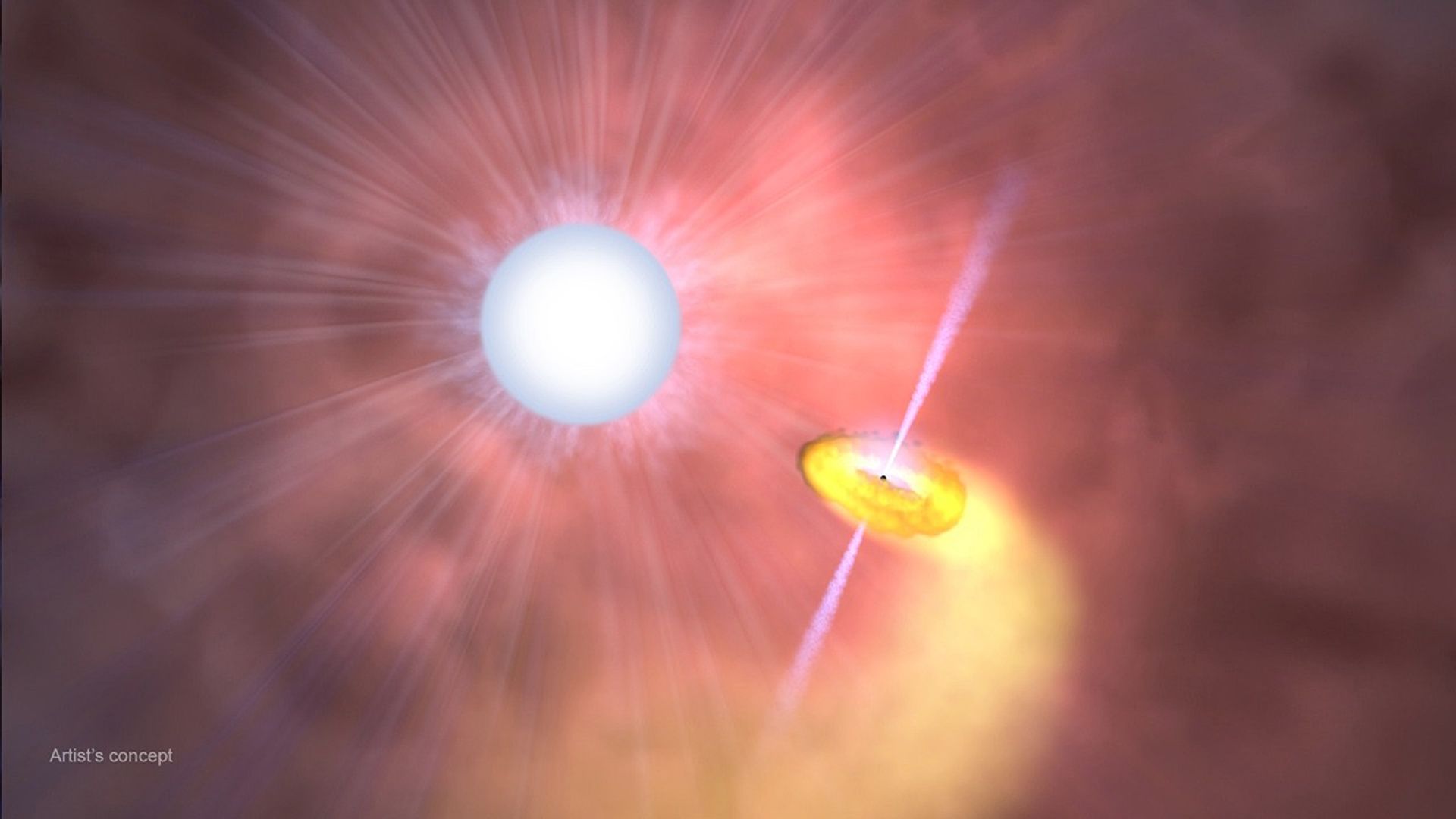
Cygnus X-3 is a binary that pairs a rare type of high-mass star with a compact companion — likely a black hole.

Illustration of the Cygnus X-3 system
Cygnus X-3 is a high-mass binary consisting of a compact object (likely a black hole) and a hot Wolf-Rayet star. This artist’s concept shows one interpretation of the system. High-resolution X-ray spectroscopy indicates two gas components: a heavy background outflow, or wind, emanating from the massive star and a turbulent structure — perhaps a wake carved into the wind — located close to the orbiting companion. As shown here, a black hole’s gravity captures some of the wind into an accretion disk around it, and the disk’s orbital motion sculpts a path (yellow arc) through the streaming gas. During strong outbursts, the companion emits jets of particles moving near the speed of light, seen here extending above and below the black hole.
NASA’s Goddard Space Flight Center

“The nature of the massive star is one factor that makes Cygnus X-3 so intriguing,” said Ralf Ballhausen, a postdoctoral associate at the University of Maryland, College Park, and NASA’s Goddard Space Flight Center in Greenbelt, Maryland. “It’s a Wolf-Rayet star, a type that has evolved to the point where strong outflows called stellar winds strip gas from the star’s surface and drive it outward. The compact object sweeps up and heats some of this gas, causing it to emit X-rays.”

A paper describing the findings, led by Ballhausen, will appear in a future edition of The Astrophysical Journal.

“For XRISM, Cygnus X-3 is a Goldilocks target — its brightness is ‘just right’ in the energy range where XRISM is especially sensitive,” said co-author Timothy Kallman, an astrophysicist at NASA Goddard. “This unusual source has been studied by every X-ray satellite ever flown, so observing it is a kind of rite of passage for new X-ray missions.”

XRISM (pronounced “crism”) is led by JAXA (Japan Aerospace Exploration Agency) in collaboration with NASA, along with contributions from ESA (European Space Agency). NASA and JAXA developed the mission’s microcalorimeter spectrometer instrument, named Resolve.

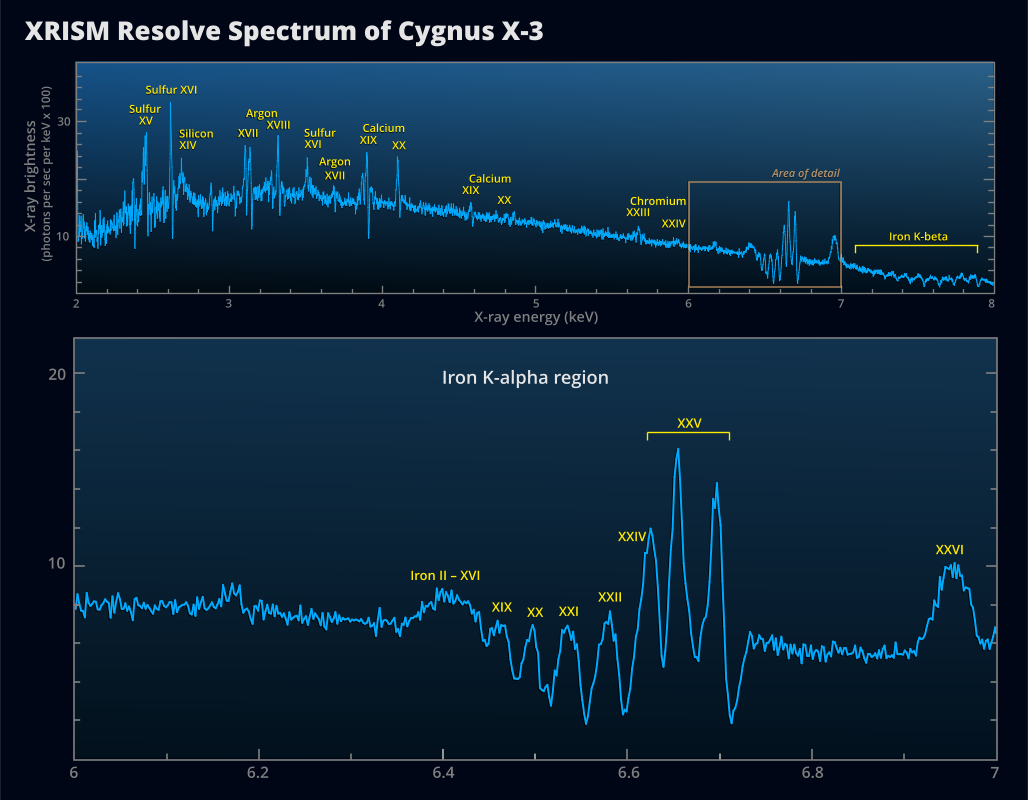
Observing Cygnus X-3 for 18 hours in late March, Resolve acquired a high-resolution spectrum that allows astronomers to better understand the complex gas dynamics operating there. These include outflowing gas produced by a hot, massive star, its interaction with the compact companion, and a turbulent region that may represent a wake produced by the companion as it orbits through the outrushing gas.

XRISM Resolve X-ray spectrum of Cygnus X-3
XRISM’s Resolve instrument has captured the most detailed X-ray spectrum yet acquired of Cygnus X-3. Peaks indicate X-rays emitted by ionized gases, and valleys form where the gases absorb X-rays; many lines are also shifted to both higher and lower energies by gas motions. Top: The full Resolve spectrum, from 2 to 8 keV (kiloelectron volts), tracks X-rays with thousands of times the energy of visible light. Some lines are labeled with the names of the elements that produced them, such as sulfur, argon, and calcium, along with Roman numerals that refer to the number of electrons these atoms have lost. Bottom: A zoom into a region of the spectrum often dominated by features produced by transitions in the innermost electron shell (K shell) of iron atoms. These features form when the atoms interact with high-energy X-rays or electrons and respond by emitting a photon at energies between 6.4 and 7 keV. These details, clearly visible for the first time with XRISM’s Resolve instrument, will help astronomers refine their understanding of this unusual system.
JAXA/NASA/XRISM Collaboration

In Cygnus X-3, the star and compact object are so close they complete an orbit in just 4.8 hours. The binary is thought to lie about 32,000 light-years away in the direction of the northern constellation Cygnus.

While thick dust clouds in our galaxy’s central plane obscure any visible light from Cygnus X-3, the binary has been studied in radio, infrared, and gamma-ray light, as well as in X-rays.

The system is immersed in the star’s streaming gas, which is illuminated and ionized by X-rays from the compact companion. The gas both emits and absorbs X-rays, and many of the spectrum’s prominent peaks and valleys incorporate both aspects. Yet a simple attempt at understanding the spectrum comes up short because some of the features appear to be in the wrong place.

That’s because the rapid motion of the gas displaces these features from their normal laboratory energies due to the Doppler effect. Absorption valleys typically shift up to higher energies, indicating gas moving toward us at speeds of up to 930,000 mph (1.5 million kph). Emission peaks shift down to lower energies, indicating gas moving away from us at slower speeds.

Some spectral features displayed much stronger absorption valleys than emission peaks. The reason for this imbalance, the team concludes, is that the dynamics of the stellar wind allow the moving gas to absorb a broader range of X-ray energies emitted by the companion. The detail of the XRISM spectrum, particularly at higher energies rich in features produced by ionized iron atoms, allowed the scientists to disentangle these effects.

“A key to acquiring this detail was XRISM’s ability to monitor the system over the course of several orbits,” said Brian Williams, NASA’s project scientist for the mission at Goddard. “There’s much more to explore in this spectrum, and ultimately we hope it will help us determine if Cygnus X-3’s compact object is indeed a black hole.”

XRISM is a collaborative mission between JAXA and NASA, with participation by ESA. NASA’s contribution includes science participation from CSA (Canadian Space Agency).  

By Francis Reddy
NASA’s Goddard Space Flight Center, Greenbelt, Md.

Media Contact:
Claire Andreoli
301-286-1940
claire.andreoli@nasa.gov
NASA’s Goddard Space Flight Center, Greenbelt, Md.

Powered by WPeMatico

Get The Details…

NASA Invites Media to Firefly Blue Ghost Mission 1 Launch to Moon

NASA Invites Media to Firefly Blue Ghost Mission 1 Launch to Moon

Caption: Firefly Aerospace’s Blue Ghost Mission One lander, seen here, will carry 10 NASA science and technology instruments to the Moon’s near side when it launches from NASA’s Kennedy Space Center in Florida on a SpaceX Falcon 9 rocket, as part of NASA’s CLPS (Commercial Lunar Payload Services) initiative and Artemis campaign. Credit: Firefly Aerospace
Caption: Firefly Aerospace’s Blue Ghost Mission One lander, seen here, will carry 10 NASA science and technology instruments to the Moon’s near side when it launches from NASA’s Kennedy Space Center in Florida on a SpaceX Falcon 9 rocket, as part of NASA’s CLPS (Commercial Lunar Payload Services) initiative and Artemis campaign.
Credit: Firefly Aerospace

Media accreditation is open for the next delivery to the Moon through NASA’s CLPS (Commercial Lunar Payload Services) initiative and Artemis campaign for the benefit of humanity. A six-day launch window opens no earlier than mid-January 2025 for the first Firefly Aerospace launch to the lunar surface.

The Blue Ghost flight, carrying 10 NASA science and technology instruments, will launch on a SpaceX Falcon 9 rocket from Launch Complex 39A at the agency’s Kennedy Space Center in Florida. Media prelaunch and launch activities will take place at NASA Kennedy.

Attendance for this launch is open to U.S. citizens and international media. International media must apply by Monday, Dec. 9, and U.S. media must apply by Thursday, Jan. 2. Media interested in participating in launch activities must apply for credentials at:

https://media.ksc.nasa.gov

Credentialed media will receive a confirmation email upon approval. NASA’s media accreditation policy is available online. For questions about accreditation or to request special logistical support such as space for satellite trucks, tents, or electrical connections, please send an email by Thursday, Jan. 2, to: ksc-media-accreditat@mail.nasa.gov. For other questions, please contact Kennedy’s newsroom at: 321-867-2468.

Para obtener información sobre cobertura en español en el Centro Espacial Kennedy o si desea solicitar entrevistas en español, comuníquese con Antonia Jaramillo o Messod Bendayan a: antonia.jaramillobotero@nasa.gov o messod.c.bendayan@nasa.gov.

The company named the mission Ghost Riders in the Sky. It will land near a volcanic feature called Mons Latreille within Mare Crisium, a more than 300-mile-wide basin located in the northeast quadrant of the lunar near side. The mission will carry NASA investigations and first-of-their-kind technology demonstrations to further our understanding of the Moon’s environment and help prepare for future human missions to the lunar surface, as part of the agency’s Moon to Mars exploration approach. This includes payloads testing lunar subsurface drilling, regolith sample collection, global navigation satellite system abilities, radiation tolerant computing, and lunar dust mitigation. The data captured also benefits humanity by providing insights into how space weather and other cosmic forces impact Earth.

Under the CLPS model, NASA is investing in commercial delivery services to the Moon to enable industry growth and support long-term lunar exploration. As a primary customer for CLPS deliveries, NASA aims to be one of many customers on future flights.

As part of its Artemis campaign, NASA is working with multiple U.S. companies to deliver science and technology to the lunar surface. These companies are eligible to bid on task orders to deliver NASA payloads to the Moon. The task order includes payload integration and operations and launching from Earth and landing on the surface of the Moon. Existing CLPS contracts are indefinite-delivery/indefinite-quantity contracts with a cumulative maximum contract value of $2.6 billion through 2028.

For more information about the agency’s Commercial Lunar Payload Services initiative, see:

https://www.nasa.gov/clps

-end-

Alise Fisher
Headquarters, Washington
202-358-2546
alise.m.fisher@nasa.gov   

Wynn Scott / Natalia Riusech
Johnson Space Center, Houston
281-483-5111
wynn.b.scott@nasa.gov / nataila.s.riusech@nasa.gov

Antonia Jaramillo
Kennedy Space Center, Florida
321-867-2468
antonia.jaramillobotero@nasa.gov

Share

Details

Last Updated

Nov 25, 2024

Powered by WPeMatico

Get The Details…
Roxana Bardan