SpaceX Dragon Counts Down to Launch and Resupply Station

SpaceX Dragon Counts Down to Launch and Resupply Station

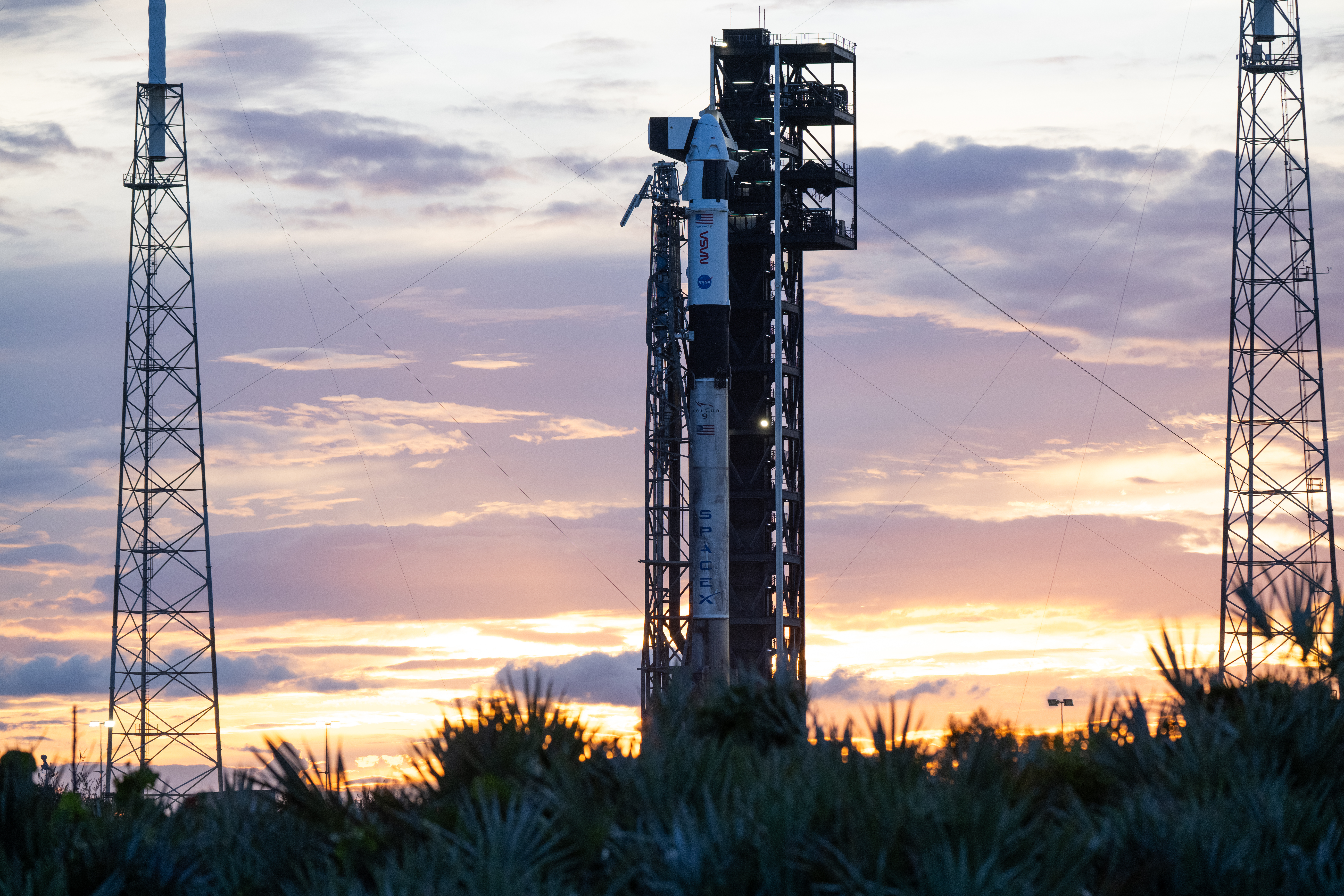
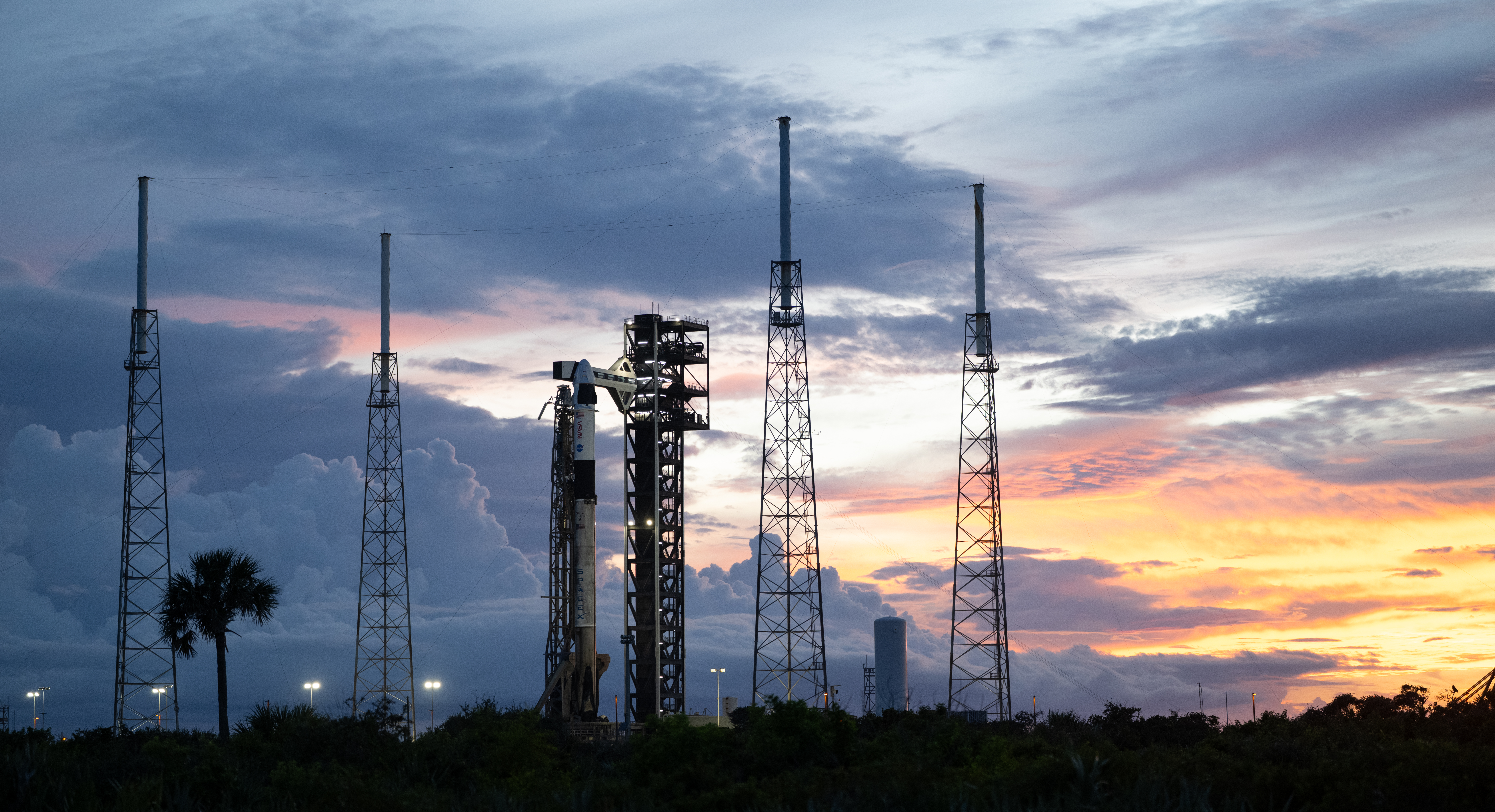
A SpaceX Falcon 9 rocket, with the company’s Dragon spacecraft atop, stands in a vertical position at Space Launch Complex 40 at Cape Canaveral Space Force Station in Florida on Monday, May 11, 2026, in preparation for the company’s 34th commercial resupply services launch to the International Space Station for NASA. Dragon will deliver about 6,500 pounds of science investigations, supplies, and equipment to the International Space Station. NASA and SpaceX are targeting liftoff at 6:50 p.m. EDT, Wednesday, May 13.
A SpaceX Falcon 9 rocket, with the company’s Dragon spacecraft atop, stands in a vertical position at Space Launch Complex 40 at Cape Canaveral Space Force Station in Florida on Monday, May 11, 2026, in preparation for launch to the International Space Station.
SpaceX

Live launch coverage is underway on NASA+, Amazon Prime, and the agency’s YouTube channel for the launch of SpaceX’s 34th commercial resupply services mission to the International Space Station. Learn how to watch NASA content through a variety of online platforms, including social media.

The SpaceX Dragon spacecraft is scheduled to lift off at 6:50 p.m. EDT aboard a Falcon 9 rocket from Space Launch Complex 40 at Cape Canaveral Space Force Station in Florida.

Filled with nearly 6,500 pounds of food, supplies, and equipment, Dragon will arrive at the orbiting outpost at approximately 7:35 a.m. Thursday, May 14, and dock autonomously to the forward port of the orbiting laboratory’s Harmony module.

In addition to cargo for the crew aboard the space station, Dragon will deliver several new experiments, including a project to determine how well Earth-based simulators mimic microgravity conditions, a bone scaffold made from wood that could produce new treatments for fragile bone conditions like osteoporosis, and equipment to help researchers evaluate how red blood cells and the spleen change in space. The Dragon spacecraft also will carry a new instrument to study charged particles around the Earth that can impact power grids and satellites, an investigation that could provide a fundamental understanding of how planets form, and a instrument designed to take highly accurate measurements of sunlight reflected by Earth and the Moon. 

Watch NASA’s live rendezvous and docking coverage beginning at 8:20 a.m. on NASA+, Amazon Prime, and the agency’s YouTube channel.

Learn more about space station operations by follow @NASASpaceOps and @space_station on X, as well as the International Space Station’s Facebook and Instagram accounts.

Powered by WPeMatico

Get The Details…

Mark A. Garcia

Crew Preps for Dragon Arrival and Keeps Up Research, Maintenance

Crew Preps for Dragon Arrival and Keeps Up Research, Maintenance

NASA astronaut and Expedition 74 flight engineer Jessica Meir works inside the International Space Station's Harmony module conducting a biotechnology investigation to observe how tiny, engineered materials that mimic DNA behave in microgravity. Meir pointed a light-measuring device, called a spectrophotometer, at the DNA-like sample materials housed in small transparent containers to analyze their ability to form stable structures. Doctors on Earth will use the research data to learn how to improve and develop future treatments, or nano-therapies, that target cancer cells more precisely.
NASA astronaut Jessica Meir conducts a biotechnology investigation to observe how tiny, engineered materials that mimic DNA behave in microgravity. Doctors on Earth will use the research data to learn how to improve and develop future treatments, or nano-therapies, that target cancer cells more precisely.
NASA/Jessica Meir

A SpaceX Falcon 9 rocket with a Dragon cargo spacecraft atop stands ready to launch to the International Space Station at 6:50 p.m. EDT today, weather permitting, from Launch Complex 40 at Cape Canaveral Space Force Station in Florida. The uncrewed Dragon, packed with about 6,500 pounds of science experiments, crew supplies, and lab hardware for the Expedition 74 crew, will orbit Earth for half-a-day before approaching the orbital outpost for an automated docking to the Harmony module’s forward port at 7:35 a.m. on Thursday. Watch NASA’s live launch coverage beginning at 6:30 p.m. on NASA+Amazon Prime, and the agency’s YouTube channel. 

NASA flight engineers Chris Williams, Jessica Meir, and Jack Hathaway joined flight engineer Sophie Adenot of ESA (European Space Agency) for part of the day on Wednesday reviewing Dragon cargo operations then calling down to flight controllers for a mission readiness review. The quartet will begin unpacking critical, time-sensitive research samples packed inside Dragon’s portable science freezers just a few after hours after the cargo spacecraft’s arrival. Hathaway and Adenot will also be on duty Thursday monitoring Dragon during its automated approach and rendezvous.

Williams assisted Hathway on Wednesday as he worked in the Tranquility module configuring hardware and making space for the installation of a new water recycling system reducing the need to resupply water from Earth. Williams then tested using voice commands on a free-flying robotic camera that could assist astronauts with video and photography activities.

Meir swapped out materials research hardware inside the Kibo laboratory module’s airlock for placement into the external environment of space for exposure and testing. Adenot wore the sensor-packed Bio-Monitor vest and headband that monitored her heart and breathing activity while she pedaled on an exercise cycle. The two astronauts wrapped up their shift together in the Columbus laboratory module with Meir scanning Adenot’s leg veins with the Ultrasound 3 biomedical device looking for potential signs of space-caused blood clots.

Roscosmos cosmonauts Sergey Kud-Sverchkov and Sergey Mikaev, station commander and flight engineer respectively, started their shift reviewing procedures they will use on an upcoming spacewalk for external lab maintenance. Kud-Sverchkov then collected and stowed his saliva samples for analysis while Mikaev serviced scientific control and data processing hardware. Roscosmos flight engineer Andrey Fedyaev pedaled on exercise cycle for a fitness test then performed maintenance on  Roscosmos computer systems.

Learn more about station activities by following the space station blog, @space_stationon X, as well as the ISS Facebookand ISS Instagram accounts.

Get the latest from NASA delivered every week. Subscribe here.

Powered by WPeMatico

Get The Details…

Mark A. Garcia

NASA-Supported Space Tech Advances Earthly Construction

NASA-Supported Space Tech Advances Earthly Construction

3 min read

Preparations for Next Moonwalk Simulations Underway (and Underwater)

Two boxy structures, one with an office-like interior and the other with an eating area, side-by-side in a hangar-like location
Branch’s work outfitting a prototype of a lunar surface habitat they developed, pictured here, under a cooperative agreement with Marshall Space Flight Center, helped the company evolve its printing processes.
Credit: Branch Technology Inc.

An innovative 3D printing process that advanced NASA’s approach to outfitting a lunar habitat is making buildings on Earth beautiful, efficient, and strong. 

Instead of building structures layer by layer, Branch Technology Inc. of Chattanooga, Tennessee, has developed a process the company calls Freeform 3D Printing, which creates shapes with lightweight lattice structures that can be filled or covered. The company uses the technique to manufacture visually interesting, modular building elements, such as wall panels and cladding. 

“Our process eliminates a ton of material from something that otherwise might be printed solid all the way through,” said David Goodloe, who leads Branch Technology’s Advanced Concepts team, which manages the company’s NASA collaborations. 

In 2017, the company won Phase II of NASA’s 3D-Printed Habitat Challenge, a public competition to build a habitat for deep space exploration. 

Tracie Prater, a technical manager in the Habitat Systems Development Branch at NASA’s Marshall Spaceflight Center in Huntsville, Alabama, served as a subject matter expert for the challenge and worked with Branch Technology on a cooperative agreement. 

“With the 3D-Printed Habitat Challenge, teams were focused on how to build a large habitat structure on a planetary surface,” said Prater. “But once that structure is pressurized and ready for crew occupancy, how do you populate it with systems and supplies? That’s what Branch was looking at through the cooperative agreement — what their on-demand fabrication process enables in terms of novel designs for interior items.” 

NASA’s parameters for the habitat challenge led Branch to develop its nozzles to extrude unique lattice structures as well as more traditional layers. The company uses this dual capability frequently in its wall panels where traditionally printed sections offer solid substrates for attaching fasteners. 

The polymers Branch extrudes were informed by its materials science research for the 3D-Printed Habitat Challenge, which asked that print material be made of something like the dust and rocks found on the Martian surface and mission recyclables. Branch came up with a basalt fiber-reinforced plastic and from that work went on to develop an optimal loading recipe for its terrestrial “inks.” 

These innovations exemplify the purpose of NASA’s Technology Transfer program within the Space Technology Mission Directorate, which uses space-based solutions to improve life on Earth. For 50 years, NASA has documented the everyday benefits of space technology through the agency’s Spinoff publication.  

Share

Details

Last Updated

May 13, 2026

Powered by WPeMatico

Get The Details…
Andrew Wagner

Rise Goes to Washington

Rise Goes to Washington

Rise, the Artemis II zero gravity indicator, sits on a wooden desk. A NASA astronaut is in the foreground.
NASA/Joel Kowsky

“Rise,” the Artemis II zero gravity indicator, is seen sitting on the dais as NASA astronauts Reid Wiseman, Victor Glover, and Christina Koch, and CSA (Canadian Space Agency) astronaut Jeremy Hansen speak with congressional staff, Tuesday, May 12, 2026, in Washington.

NASA’s Artemis II mission took Wiseman, Glover, Koch, and Hansen on a nearly 10-day journey around the Moon and back to Earth in April 2026.

See more photos from the crew’s visit to the U.S. Capitol.

Image credit: NASA/Joel Kowsky

Powered by WPeMatico

Get The Details…
HQ Web Team

NASA Outlines Preliminary Artemis III Mission Plans

NASA Outlines Preliminary Artemis III Mission Plans

The Sun rises behind NASA’s Artemis II SLS (Space Launch System) rocket and Orion spacecraft on top of a mobile launcher at Launch Complex 39B at NASA’s Kennedy Space Center in Florida on March 30, 2026.
Credit: NASA/Jim Ross

NASA is moving quickly to define next year’s Artemis III mission in Earth orbit, a crewed flight that will test rendezvous and docking capabilities between the agency’s Orion spacecraft and commercial landers from Blue Origin and SpaceX. Since a February announcement adding an Artemis mission ahead of crewed landing missions to the Moon’s South Pole region, engineers have been evaluating mission profile options and operational considerations for Artemis III to ensure the test flight helps the agency and its partners reduce risk ahead of the next Americans landing on the Moon during Artemis IV.

“While this is a mission to Earth orbit, it is an important stepping stone to successfully landing on the Moon with Artemis IV. Artemis III is one of the most highly complex missions NASA has undertaken,” said Jeremy Parsons, Moon to Mars acting assistant deputy administrator, NASA’s Exploration Systems Development Mission Directorate in Washington. “For the first time, NASA will coordinate a launch campaign involving multiple spacecraft integrating new capabilities into Artemis operations. We’re integrating more partners and interrelated operations into this mission by design, which will help us learn how Orion, the crew, and ground teams all interact together with hardware and teams from both providers before we send astronauts to the Moon’s surface and build a Moon Base there.”

The mission is planned to carry out a series of objectives designed to demonstrate critical systems needed for a future lunar landing. During the Artemis III mission, the SLS (Space Launch System) rocket will launch the Orion spacecraft from NASA’s Kennedy Space Center in Florida with four crew members. Instead of using the interim cryogenic propulsion stage as the upper stage of the rocket, NASA will use a “spacer,” a representation of the mass and overall dimensions of an upper stage but without propulsive capabilities. The spacer will maintain the same overall dimensions and interface connection points as the upper stage between the Orion stage adapter and launch vehicle stage adapter.

Design and fabrication activities for the spacer are progressing rapidly at NASA’s Marshall Space Flight Center in Huntsville, Alabama. Material for the barrel section and the upper and lower rings is currently being machined at Marshall in preparation for upcoming welding operations. 

The Artemis III core stage sits in High Bay 2 in the Vehicle Assembly Building at NASA Kennedy with the core stage tank attached to its engine section on May 12, 2026.
Credit: NASA/Kim Shiflett

After the rocket delivers Orion to orbit, the spacecraft’s European-built service module will provide propulsion to circularize Orion’s orbit around the planet in low Earth orbit. This orbit increases overall mission success by allowing more launch opportunities for each element as compared to a lunar mission — SLS carrying Orion and its crew, SpaceX’s Starship human landing system pathfinder, and Blue Origin’s Blue Moon Mark 2 human landing system pathfinder. 

Informed by Blue Origin and SpaceX capabilities, NASA also is defining the concept of operations for the mission. While some decisions are yet to be determined, astronauts could potentially enter at least one lander test article.

The crew will spend more time aboard Orion than during Artemis II, further advancing the evaluation of life support systems, and for the first time will demonstrate the docking system performance. The mission will inform lander rendezvous and habitation concepts and mission operations in preparation for future surface missions. The agency also plans to test an upgraded heat shield during Orion’s return to Earth to enable more flexible and robust reentry profiles for future missions.

The Artemis III Orion service module is pictured ahead of acoustic testing in NASA’s Kennedy Space Center Operations and Checkout Facility on May 7, 2026.
NASA/Jess Ruffa

Over the coming weeks, NASA will continue to refine specific plans for the flight, including a timeline for identifying astronauts to train for mission operations, options to evaluate Axiom’s AxEMU spacesuit lander interfaces ahead of lunar surface missions, mission duration, and potential science operations for the flight. NASA has asked for industry input on potential solutions to improve the communications with the ground during the mission since the Deep Space Network will not be used. The agency also is seeking both international and domestic interest in potentially flying CubeSats to deploy in Earth orbit, and may share other opportunities as the concept of operations for the mission is further defined.

As part of the Golden Age of innovation and exploration, NASA will send Artemis astronauts on increasingly difficult missions to explore more of the Moon for scientific discovery, economic benefits, establish an enduring human presence on the lunar surface, and to build on our foundation for the first crewed missions to Mars.

Learn more about NASA’s Artemis program:

https://www.nasa.gov/artemis

Share

Details

Last Updated

May 13, 2026

Location
Kennedy Space Center

Powered by WPeMatico

Get The Details…
Lauren E. Low