


NASA’s Hubble Uncovers Case of Missing Oxygen in Nearby Dwarf Galaxies
NASA’s Hubble Uncovers Case of Missing Oxygen in Nearby Dwarf Galaxies
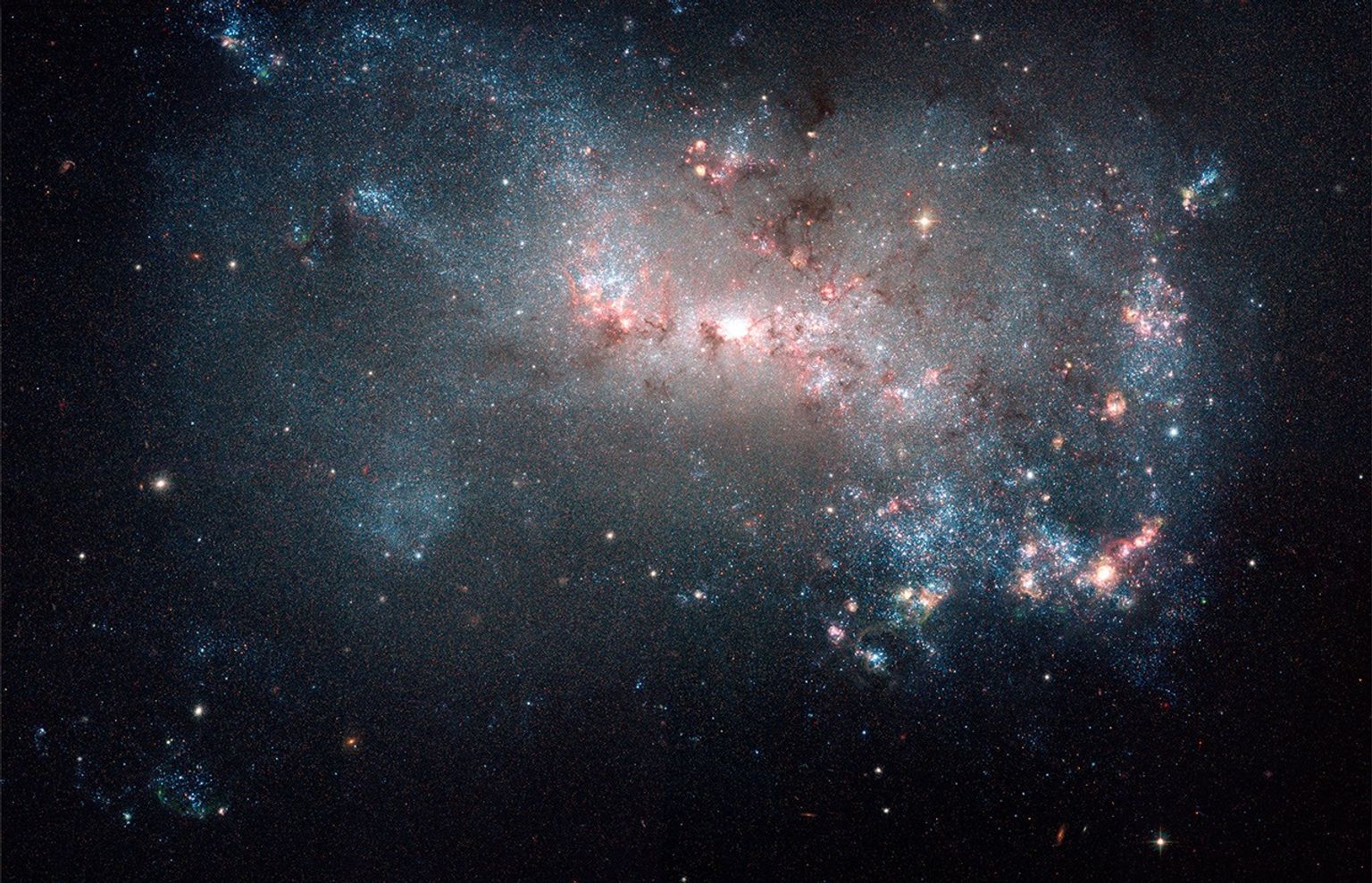
Image: NASA, ESA, Hubble Heritage–ESA/Hubble Collaboration, Alessandra Aloisi (STScI, ESA)
NASA’s Hubble Space Telescope just revealed a mystery in our cosmic neighborhood. In a paper published Monday in The Astrophysical Journal, researchers using Hubble studied 37 nearby dwarf galaxies — small galaxies containing a few thousand to hundreds of millions of stars — and found that much of the oxygen they expected to see is missing.
Simulations predict that significantly more oxygen, a tracer of a wider set of heavy elements, should reside in these galaxies. So where did it go?
“Oxygen is produced by stars, which are inside of galaxies. We know that the oxygen had to be inside of the galaxies at some point in the past, so the oxygen must have been ejected,” said co-investigator Grace Telford, assistant professor in the Department of Physics and Astronomy at the University of Utah. “And to do that, you need energy from massive stars and supernova explosions to drive material out of the host galaxies and into the space between galaxies.”
Galactic winds unleashed by supernovae are apparently more effective at removing oxygen from low-mass galaxies than current models predict, according to the new study. The findings show that dwarf galaxies can hold onto only a small fraction of the oxygen made by stars.
In the Galaxies Losing Oxygen via Winds (GLOW) project, funded by NASA and the National Science Foundation, scientists traced the oxygen to understand how it is distributed inside stars, in the gas between stars, and in the space between galaxies. But, of all the elements in the galaxies, why study oxygen?
Oxygen, the most abundant element after hydrogen and helium, is relatively easy to detect and measure, and its production is well understood — making it a reliable indicator of how chemical elements are distributed in a galaxy.
“So, it’s really for practical reasons that we’ve chosen oxygen,” said Kristen Wingfield McQuinn, GLOW principal investigator and mission head of the Science Operations Center for NASA’s newly launched, panoramic Nancy Grace Roman Space Telescope at the Space Telescope Science Institute in Baltimore, Maryland. She also is an associate professor at Rutgers University in New Brunswick, New Jersey.
“Oxygen is one of the primary elements formed by stars. Being able to trace how much oxygen gets made, and then how much is distributed inside and outside of galaxies, helps us understand galaxy evolution,” said McQuinn. “It also helps us learn where and how much galaxies are enriching the space between galaxies, called the intergalactic medium.”
The study used archival optical imaging data from Hubble to resolve stellar populations and determine star-formation histories and compositions. Along with data from NASA’s retired Spitzer Space Telescope as well as the ground-based Very Large Array and Australian Telescope Compact Array, the researchers analyzed 37 nearby dwarf galaxies to trace oxygen atoms produced by stars.
The team wanted to understand how oxygen is distributed across the stars, gas, and dust in the galaxies. These dwarf galaxies were selected because their masses fall in the range where simulations and theory predict that an increasing amount of their oxygen will be expelled from the galaxies via supernovae explosions. These 37 galaxies also are all close enough for Hubble to resolve their individual stars. That’s not true for the vast majority of known dwarf galaxies, which are too far away for this kind of study.
Although astronomers already suspected that galaxies expel a large fraction of oxygen and other heavy elements, an open question has been where these metals end up. A previous study from 2014 addressed this question for Milky Way-like, star-forming galaxies, finding that these galaxies lost a large fraction of their oxygen, some of which is found in the diffuse haloes of gas surrounding galaxies outside their disks, called the circumgalactic medium.
In the GLOW study, McQuinn and her team extended this research to low-mass galaxies across a wide range of masses and environments. While previous teams have measured oxygen in the circumgalactic medium of dwarf galaxies, it is still unclear if most of the missing oxygen is in this region, or if it has been completely ejected from the galaxy’s surroundings.
In the future, McQuinn hopes to study even lower-mass galaxies in the nearby universe. She has an approved program to use the Roman Space Telescope to find these faint and tiny systems across a wide swath of sky. Once she’s identified these galaxies, McQuinn hopes to use Hubble and NASA’s James Webb Space Telescope to get deeper observations of their stars. This would allow her to reconstruct the galaxies’ histories to understand how they formed stars across cosmic time.
Telford’s future work involves using Hubble to zoom in on the individual, massive stars that produce oxygen and eject it from their host galaxies. She’s using some of the nearby GLOW targets to get very detailed observations to characterize how the massive stars are different in these small galaxies.
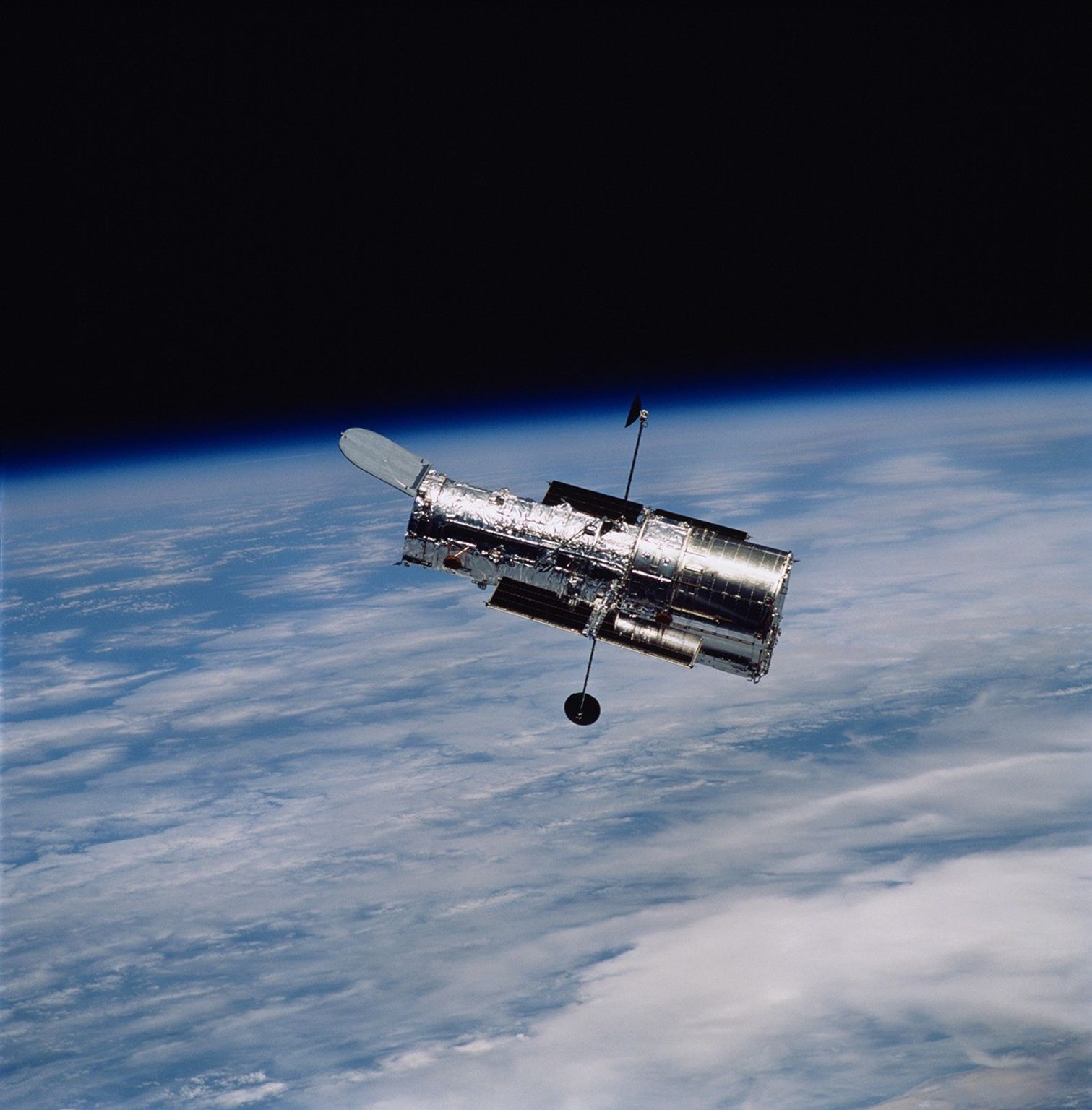
The Hubble Space Telescope has been operating for over three decades and continues to make ground-breaking discoveries that shape our fundamental understanding of the universe. Hubble is a project of international cooperation between NASA and ESA (European Space Agency). NASA’s Goddard Space Flight Center in Greenbelt, Maryland, manages the telescope and mission operations. Lockheed Martin Space, based in Denver, also supports mission operations at Goddard. The Space Telescope Science Institute in Baltimore, which is operated by the Association of Universities for Research in Astronomy, conducts Hubble science operations for NASA.
Share
Details
Claire Andreoli
NASA’s Goddard Space Flight Center
Greenbelt, Maryland
claire.andreoli@nasa.gov
Ann Jenkins, Christine Pulliam
Space Telescope Science Institute
Baltimore, Maryland
Related Terms
Powered by WPeMatico
